What's inside
- Where to buy flat fiberglass panels by the pack
- Quick Picks
- How these picks were chosen
- The six packs, reviewed one by one
- Reading the six packs against each other
- How do you pick the right fiberglass filter for your furnace?
- What MERV 1 actually means at the register
- The monthly ritual, done properly
- Fiberglass against pleated: an honest comparison
- Storing a season of panels without ruining them
- Reading a loaded panel: what the grey is telling you
- When fiberglass is the wrong answer
- Common mistakes
- Final recommendation
- Frequently asked questions
As an Amazon Associate I earn from qualifying purchases. This post may contain affiliate links at no extra cost to you.
As an Amazon Associate, cottageverdict.com earns from qualifying purchases.
A fiberglass furnace filter is the humblest purchase in home maintenance: a flat panel of spun glass fibre in a cardboard frame, slid into a slot, forgotten for a month or two, then thrown away. Yet shoppers hunting the best fiberglass furnace filters quickly discover that the flat panels are not interchangeable. Nominal sizes hide actual sizes a fraction smaller, pack counts change the maths of a heating season, one listing prints its MERV rating in large type while another leaves the rating out entirely, and two panels with the same dimensions can be built around different frames with different ideas about airflow. The six packs below cover the three most common residential slots — 16×20, 16×25 and 20×25, plus a 20×20 — and they divide neatly into panels that advertise their construction and panels that simply promise to fit and filter.
Why choose fiberglass at all, in a market full of pleated paper that captures finer particles? Because a furnace is first an air-moving machine, and a low-restriction panel lets it breathe. Older blowers, systems with long duct runs and households whose main enemy is visible dust rather than microscopic pollen often run happier on spun glass: the airflow stays strong, the filter costs little enough to change on schedule without resentment, and a fresh panel every month beats a clogged premium panel left in for a season. The trade is honest and known — fiberglass catches the coarse fraction and lets the finest through — and this guide treats that trade as a legitimate choice rather than a failure to buy something dearer.
Where to buy flat fiberglass panels by the pack
All six packs are sold through Amazon, and each earns its shelf space in the heating cupboard differently.
- Glasfloss 16x20x1 Fiberglass 6-Pack: American-made panels with a double-strut frame the listing credits with a tenth more open area, six to a pack, no metal anywhere in the construction.
- AIRX 16x25x1 Fiberglass Filter 12 Pack: the year’s supply in one box, a dozen non-pleated panels positioned against basic economy ratings and sold on low airflow restriction.
- Filtrete 16x25x1 MERV 1 Flat Filter 6-Pack: 3M’s flat panel with the rating printed plainly, actual dimensions spelled out to two decimal places, six replacements deep.
- Flanders EZ-Flow II 16x20x1 MERV 1: a high-airflow fiberglass pair from one of the oldest names in filtration, sold two at a time for households that buy little and often.
- Generic 20x25x1 MERV 1 Fiberglass 8 Pack: two bundles of four unbranded panels for the largest slot in this guide, rated MERV 1 and built to be swapped without ceremony.
- Glasfloss 20x20x1 Fiberglass 6-Pack: the Glasfloss construction again, scaled to the square 20×20 slot found in many return grilles and older air handlers.
Measure your slot before ordering anything on this page; the reviews below explain why the tape measure matters more than the brand.
Quick Picks
| Pick | Best for | Standout from the listing |
|---|---|---|
| Glasfloss 16x20x1 Fiberglass 6-Pack | A 16×20 slot and a quality frame | Double-strut design, 10% greater open area per the listing, craftboard frame, made in USA |
| AIRX 16x25x1 Fiberglass Filter 12 Pack | Buying a full year at once | 12 non-pleated panels, low airflow restriction headline |
| Filtrete 16x25x1 MERV 1 Flat Filter 6-Pack | Shoppers who read the fine print | 3M MERV 1, actual size printed as 15.98x25x0.98 in |
| Flanders EZ-Flow II 16x20x1 MERV 1 | Small, frequent purchases | High-airflow fiberglass media, pack of 2 |
| Generic 20x25x1 MERV 1 Fiberglass 8 Pack | The big 20×25 slot, kept simple | Eight panels as two 4-packs, lightweight swaps |
| Glasfloss 20x20x1 Fiberglass 6-Pack | Square 20×20 return slots | Same double-strut build as its 16×20 sibling |
How these picks were chosen
The pool for this keyword began with complete filters only. Electronic filter pads — the refill media that slides into a powered frame — were excluded, because a pad without its frame filters nothing in an ordinary slot. Paint-booth pads and cut-to-fit rolls went out for the mirror-image reason: they are raw material, not a finished filter with a frame and a stated size. What remained were framed, disposable, nominally sized fiberglass panels, and the six packs kept here were chosen to disagree with each other on the axes a buyer actually faces: slot size, pack depth, whether the MERV rating is printed, and how the frame is built.
Four slot sizes appear because furnace filters are a fitment purchase before they are a filtration purchase. A superb panel in the wrong size is a gap with cardboard around it, and unfiltered air takes the gap every time. Pack depth was the second axis: the dozen-pack AIRX and the two-pack Flanders sit at opposite ends of a real behavioural divide, between households that stock a cupboard once a year and households that buy when the calendar reminds them. The third axis is candour. Filtrete and Flanders print MERV 1 in the title; the generic pack prints it too; the AIRX title instead positions itself against an MPR figure, and the Glasfloss titles omit a rating altogether — each review states plainly which situation its pick is in, because a buyer comparing panels deserves to know what the listing does and does not claim.
One honesty note belongs here rather than in a footnote. The Filtrete title calls its panel a flat furnace filter without using the word fiberglass; the basic flat-panel construction is the fiberglass class of the 3M line, but this guide marks the material as not stated in that listing’s title wherever the spec box appears, and the review below treats the panel on its printed facts: size, rating, brand and pack count.
The six packs, reviewed one by one

Glasfloss 16x20x1 Fiberglass 6-Pack
Glasfloss is a specialist: filtration is the whole business, and this 16x20x1 six-pack shows a specialist’s attention to the frame, the part of a fiberglass panel most brands treat as packaging. The listing describes a double-strut design and credits it with ten percent greater open area than a conventional layout — open area being the portion of the panel where air actually passes, so the claim, if it holds, means more filtration surface inside the same 16-by-20 slot. The frame is heavy-duty craftboard, the panel is disposable, there are no metal parts anywhere in it, and the title closes with the origin: made in USA.
- Nominal size in the listing: 16x20x1
- Pack count: 6
- Frame: heavy-duty craftboard, double-strut design
- Open-area claim in the listing: 10% greater
- Metal parts: none, per the listing
- MERV rating: not stated in the listing title
Strengths
- The double-strut frame holds the media flat against the airstream instead of letting the centre bow, which keeps the full panel working.
- Six panels cover roughly half a year of monthly changes, a sensible middle depth for a first purchase of an untried brand.
- No metal parts means the spent panel folds straight into household waste without separating a wire grille.
Trade-offs
- The title prints no MERV figure, so a buyer comparing ratings across brands must treat this panel’s fine-particle performance as unquantified.
- Craftboard softens if a slot runs damp; systems with a humidifier leak upstream should inspect the frame at each change.
- The open-area advantage is a manufacturer’s claim in a listing title, not a measurement this guide can reproduce.
Sixteen-by-twenty is the slot of smaller air handlers, many condos and a generation of compact furnaces, and it is a size where frame quality shows fastest because the panel is small enough to flex. The Glasfloss struts address exactly that flex. Owners who have watched a cheap panel belly into the blower’s draw will recognise the problem the design is solving, and owners who have never seen it can take the shorter route: a panel that stays flat seals at its edges, and a panel that seals forces the air through the glass instead of around it.
Disposal deserves its sentence. A fiberglass panel that has done a winter carries the dust of the house in its fibres, and the craftboard frame lets the whole thing bend for the bin without shaking that dust back into the room — carry it out flat, media side folded inward, and wash hands after. Small courtesies of design like the absent metal become visible only at this unglamorous end of the filter’s life, which is where ownership actually happens.
One practical check belongs to the first Glasfloss you fit: run the blower for a full heating cycle, then return and press each edge of the panel gently. A well-seated craftboard frame stays put and silent; a panel that ticks or shifts is telling you the slot is a fraction oversize for it, and a strip of foam gasket tape on the slot’s edge — not on the filter — closes that tolerance permanently. Owners who perform this five-minute audit once tend to discover their slot’s personality for good, and every subsequent change becomes a blind, confident slide.
Best for: a 16x20x1 slot whose owner changes panels monthly and wants a frame that stays flat and seals.
Not suited for: a rating-led comparison shop, since the listing title gives no MERV number to compare.
Check price on Amazon — craftboard framing and six panels for the smaller slot.

AIRX 16x25x1 Fiberglass Filter 12 Pack
Twelve panels is not a pack size; it is a decision to stop thinking about furnace filters for a year. AIRX sells that decision for the 16x25x1 slot, describing its panels as non-pleated fiberglass comparable to MPR 100 basic economy furnace filters — a positioning against 3M’s proprietary rating scale rather than the MERV scale — and headlines the property fiberglass owners care about: low airflow restriction. The brand signs off in capital letters as AIRX FILTERS WICKED CLEAN AIR, a flourish that tells you this is a challenger label selling volume and candour about its economy tier rather than a filtration laboratory selling science.
- Nominal size in the listing: 16x25x1
- Pack count: 12
- Media: non-pleated fiberglass
- Rating language in the listing: comparable to MPR 100 basic economy
- Airflow claim in the listing: low airflow restriction
- MERV figure: the title prints no MERV number
Strengths
- A dozen panels at monthly changes is a full year with no reorder decision, the strongest convenience case in this guide.
- The economy positioning is declared in the title itself; nobody buys this pack under an illusion about fine-particle capture.
- Low restriction suits older blowers that audibly labour behind dense pleated media.
Trade-offs
- Storage is real: twelve framed panels need a dry shelf, and a damp garage corner will soften craftboard before its month arrives.
- MPR comparability is a different scale from MERV, so cross-shopping against the Filtrete below requires care rather than direct number-matching.
- A year of stock commits you; households still deciding their change interval should start smaller, perhaps with the Flanders pair.
The behavioural economics of the dozen-pack are its real specification. Filter changing fails in most homes not from ignorance but from friction: the cupboard is empty, the shop trip slips a week, the old panel stays for a second month and then a third. A box of twelve removes the empty-cupboard failure for a full year, and the panel that gets changed on time outperforms, in a real house, the superior panel that does not. AIRX is selling regularity disguised as bulk, and for the 16×25 slot — the commonest size in this guide — that is a genuinely useful product.
Store the box flat and high. Panels stored on edge in a basement take on the basement’s moisture and odour, and a filter that smells of cellar will perfume the supply air for its first days of service. Kept dry, fiberglass waits patiently; it has no expiry mechanism short of water and crushing, which is another quiet argument for buying the year in one go when the price of the slot in your cupboard is acceptable.
There is a budgeting rhythm worth naming for the dozen-pack buyer. Heating households burn through panels fastest exactly when the system runs hardest, so a box opened in October may be half gone by February while a box opened in April idles. Order the AIRX year against your heaviest season rather than the calendar year and the stock will align with the consumption, sparing the mid-winter discovery that the year’s supply was really only autumn’s. The panels themselves do not care when they serve; the household’s memory cares a great deal.
Best for: a 16x25x1 household that changes monthly and wants the reorder question settled until next year.
Not suited for: a trial purchase, since twelve panels of an untested fit is a commitment a two-pack makes better.
Check price on Amazon — AIRX’s year-in-a-box for the commonest slot on the page.
Filtrete 16x25x1 MERV 1 Flat Filter 6-Pack
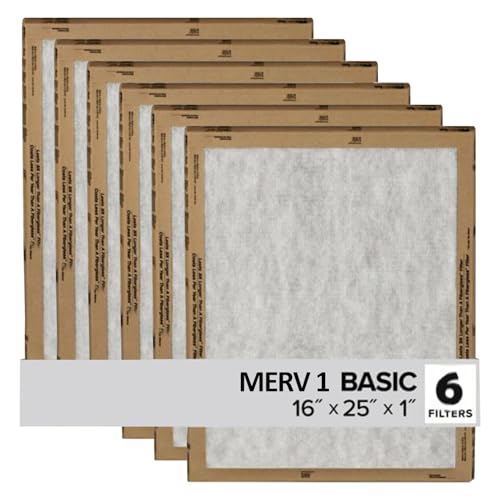
Filtrete is 3M’s filtration brand, and its flat 16x25x1 panel does the most 3M thing imaginable: it prints the actual size. The nominal 16x25x1 on the box resolves, in the title’s own parenthesis, to 15.98 by 25 by 0.98 inches — the small undersize that lets a panel slide into a slot built to the nominal figure without buckling. The rating is printed with equal plainness: MERV 1, the entry tier of the scale, declared rather than disguised. Six panels make the pack. As noted in the selection section, the title calls this a flat furnace filter and does not use the word fiberglass; its material is therefore recorded below as not stated in the listing title, and the panel is judged on the facts 3M chose to print.
- Nominal size in the listing: 16x25x1
- Actual size printed in the listing: 15.98x25x0.98 in
- Rating in the listing: 3M MERV 1
- Style in the listing: flat furnace filter, HVAC replacement
- Pack count: 6
- Media material: not stated in the listing title
Strengths
- Printed actual dimensions end the guesswork that makes first-time buyers order a panel a quarter-inch too proud for its slot.
- An honestly labelled MERV 1 lets a buyer place this panel on the airflow-versus-capture trade with open eyes.
- 3M’s distribution means the same pack is the easiest here to find again in a hurry, online or off.
Trade-offs
- MERV 1 is the floor of the rating scale; pollen-focused households will find this panel’s capture beside the point.
- The listing’s silence on media material leaves the fiberglass question to the product page rather than the title.
- Six panels at monthly changes is half the AIRX horizon, so the reorder reminder returns twice a year.
The actual-size parenthesis deserves more respect than it usually gets. Furnace slots vary by installer and by decade, and the nominal system only works because manufacturers shave the panel slightly; a brand that publishes its shaving lets a careful owner measure once, compare honestly and order once. Owners of older homes, where the slot may itself be a nominal size executed approximately, should measure the slot rather than the departing panel, then check the figure against that printed 15.98 — the closest thing this category offers to a fitting service.
There is also a quiet lesson in the MERV 1 label. A giant of filtration could have dressed this panel in the language of its premium lines; instead the number sits in the title where a shopper can see it before purchase. That candour makes the Filtrete the reference panel of this guide — the one whose declared performance the unrated packs can be sanity-checked against — and for many buyers, a known modest number beats an unknown one.
The Filtrete’s precision invites a matching habit: keep a card in the filter cupboard with the slot’s three measurements and the panel’s actual size written on it, dated. Houses change hands, panels get bought by different family members, and the card ends the telephone debate about which size the furnace takes. It is a trivial artefact, yet it converts the most error-prone purchase in home maintenance into a copying exercise — and it began, in most homes that keep one, with a listing honest enough to print 15.98 on its title.
Best for: a 16x25x1 owner who measures carefully and prefers a printed rating to a promising adjective.
Not suited for: a pollen-driven purchase, where a MERV 1 panel is the wrong tool however honestly labelled.
Check price on Amazon — Filtrete’s precisely measured flat panel, decimals and all.

Flanders EZ-Flow II 16x20x1 MERV 1
Flanders has made air filters since the middle of the last century, and the EZ-Flow II is its fiberglass staple: a 16x20x1 panel, MERV 1, described in the title as high-airflow fiberglass media for furnace, HVAC and AC replacement. It is sold here as a pack of two, the smallest commitment in this guide, and its listing carries the range’s model number, 10055.011620, for owners who reorder by number rather than by name. Everything about the presentation says utility: this is the panel a facilities cupboard buys by the case, offered to households in a household quantity.
- Nominal size in the listing: 16x20x1
- Rating in the listing: MERV 1
- Media named in the listing: high-airflow fiberglass
- Model number in the listing: 10055.011620
- Pack count: 2
- Frame material: not stated in the listing title
Strengths
- The two-pack is the cheapest way in this guide to test a 16×20 fit before committing to a half-year box.
- High-airflow media suits systems whose blowers strain audibly behind denser filters.
- A printed model number makes reordering exact, a mercy in a category where lookalike sizes abound.
Trade-offs
- Two panels is two months at the standard interval; the reorder cycle is the price of the small commitment.
- MERV 1 capture is, again, the coarse tier — dust and lint, not the fine fraction.
- The title leaves the frame undescribed, so buyers who care about craftboard versus alternatives learn nothing here.
Small packs have a strategic use beyond thrift: diagnosis. A homeowner unsure whether weak airflow at the registers is a filter problem can fit an EZ-Flow — deliberately the freest-breathing class of panel — and listen. If the blower quietens and the registers wake up, the previous filter was strangling the system, and the household can then choose its long-term panel with that knowledge. Two panels buy that experiment plus a spare, which is a respectable amount of information for the smallest box on this page.
The Flanders also suits the second-property rhythm: a cabin, a rental between tenants, a workshop heater that runs on weekends. Such systems do not need a year of stock gathering dust; they need a panel now and one on the shelf, replaced when someone remembers. Judged by that rhythm rather than by the suburban monthly calendar, the pair is not the small option at all — it is the correctly sized one.
Renters find a particular friend in the Flanders pair. A tenant cannot always justify stocking a landlord’s furnace with a year of panels, yet lives with the consequences of a clogged one in every bill and every cold corner. Two panels let a renter protect the tenancy cheaply — one fitted on moving in, one spare in the cupboard — and leave the system demonstrably better than it was found. The model number in the listing helps here too, since a departing tenant can leave it written inside the furnace-room door for the next occupant.
Best for: a 16x20x1 system being tested for airflow trouble, or a lightly used property that changes panels occasionally.
Not suited for: a set-and-forget year, since the pair runs out before a season of monthly changes does.
Check price on Amazon — two panels only, for diagnosis and small duties.

Generic 20x25x1 MERV 1 Fiberglass 8 Pack
The largest common residential slot, 20x25x1, gets the least decorated listing in this guide: eight MERV 1 fiberglass panels, described as nested, arriving as two packs of four, disposable, lightweight and easy to swap. No brand name competes for your loyalty and no construction claim asks for your admiration. The listing’s plainness is itself information — this is the commodity end of the category, where the panel is a consumable in the same mental drawer as bin liners, and the buying decision rests on size, count and the MERV number, all three of which the title does state.
- Nominal size in the listing: 20x25x1
- Rating in the listing: MERV 1
- Media named in the listing: fiberglass, nested
- Pack structure: 8 panels as two 4-packs
- Handling note in the listing: lightweight, easy to swap
- Brand: none named in the listing title
Strengths
- Eight panels cover most of a year of monthly changes for the big slot, split into two bundles that store in separate places.
- The MERV figure is printed despite the absence of a brand, so the performance tier is declared rather than implied.
- Lightweight panels matter at 20×25, a size large enough to be awkward overhead in a return grille.
Trade-offs
- An unbranded listing offers no model lineage to reorder by; save the link or expect a fresh search next year.
- Nested fiberglass is the basic construction, without the frame claims the Glasfloss packs make.
- Fit tolerance on unbranded panels varies more between production runs, so check the first panel’s seating carefully.
Twenty-by-twenty-five systems move a great deal of air, and their panels load visibly: hold a month-old one to the light and the grey gradient tells the story of the house’s dust. At this size the swap itself is the skill — sliding the fresh panel in without folding a corner, seating it flush so air cannot whistle around an edge. Lightweight construction genuinely helps there, especially for ceiling returns reached from a step stool, where a heavier framed panel is a two-handed negotiation conducted at arm’s length.
The two-bundle structure has an underappreciated virtue: it splits the stock between the furnace room and wherever the household keeps its seasonal supplies, so a flood, a spill or a borrowed-and-never-returned pack cannot zero the inventory. Commodity buying done thoughtfully looks exactly like this — no romance about the brand, some care about the logistics.
Owners of the big slot should know the whistle test. After fitting a fresh generic panel, stand at the return while the blower runs at full call: silence means a seal, while a faint whistle means air is sprinting past an edge faster than the media passes it, and the panel needs reseating or a quarter-turn of patience. Unbranded panels reward this ten-second check more than branded ones, because their tolerances wander slightly between runs — catch the wander at fitting time and the panel’s month is uneventful.
Best for: a 20x25x1 slot changed monthly by an owner who shops on size, count and rating alone.
Not suited for: brand-and-model reordering, since this listing offers neither handle to hold.
Check price on Amazon — eight unbranded panels for the largest slot, split into two handy bundles.

Glasfloss 20x20x1 Fiberglass 6-Pack
The second Glasfloss in this guide is not a repeat pick; in filtration, size is the product. This six-pack takes the same construction as its 16×20 sibling — double-strut design, the listing’s claim of ten percent greater open area, heavy-duty craftboard frame, no metal parts, made in USA — and builds it at 20x20x1, the square format of many return-air grilles, closet air handlers and older furnaces whose slots predate the rectangular standards. A square panel also rotates: it can be seated in either orientation, which removes one small way to install a filter wrong.
- Nominal size in the listing: 20x20x1
- Pack count: 6
- Frame: heavy-duty craftboard, double-strut design
- Open-area claim in the listing: 10% greater
- Metal parts: none, per the listing
- MERV rating: no figure appears in the title
Strengths
- The strut-braced frame matters even more at 20 inches square, where an unbraced panel has the span to sag into the airstream.
- Square symmetry ends orientation mistakes; either way up is the right way up.
- Six panels give the square-slot owner the same half-year horizon as the 16×20 Glasfloss.
Trade-offs
- As with its sibling, no MERV figure appears in the title, so the fine-particle story stays unquantified.
- Square slots are often in return grilles at floor or wall level, where craftboard meets kicked-up moisture more often.
- Owners whose slot is actually 20×25 gain nothing here; measure rather than assuming squareness.
Return-grille duty shapes this panel’s life. A filter in a wall or floor grille is the house’s public face of filtration — visible, reachable, sometimes behind a grille a child can open — and it loads with the coarse traffic of a hallway: pet hair, sock lint, the grit that shoes surrender. Fiberglass is well cast for that role, catching the bulky fraction while letting the blower draw freely through a grille that may also be undersized for the system. The Glasfloss frame, kept flat by its struts, prevents the slow bowing that turns a grille filter into a drum skin humming at certain blower speeds, a small domestic mystery this construction quietly prevents.
Because the panel is square, storage is tidy and the swap can be done one-handed while the other hand holds the grille. Owners of both Glasfloss sizes — a furnace at 16×20 and a return at 20×20 is a common pairing — can standardise on one maker and one frame style across the house, which simplifies the cupboard and the calendar alike.
Square-slot owners often discover their size by accident, having ordered a rectangular panel for a grille they never measured, and the lesson generalises: in this category the tape measure is the first filter. Once the 20×20 Glasfloss is in service, mark the grille itself with the size in pencil on its inner lip. Grilles outlive panels, memories and sometimes owners, and the next person to open that grille — perhaps a decade from now, perhaps a heating engineer on a callout — will be grateful for eleven millimetres of handwriting.
Best for: a square 20x20x1 slot, especially in a return grille where a flat, braced panel seals and stays silent.
Not suited for: a rectangular 20×25 slot, however close the numbers look across a showroom page.
Check price on Amazon — square, strutted and six deep, for the 20-inch return.
Reading the six packs against each other
| Pack | Slot size | Rating as printed | Panels per purchase |
|---|---|---|---|
| Glasfloss 16×20 | 16x20x1 | No rating printed | 6 |
| AIRX 16×25 | 16x25x1 | MPR 100 comparability claimed | 12 |
| Filtrete 16×25 | 16x25x1 (actual 15.98x25x0.98) | MERV 1 | 6 |
| Flanders EZ-Flow II | 16x20x1 | MERV 1 | 2 |
| Generic 20×25 | 20x25x1 | MERV 1 | 8, as two 4-packs |
| Glasfloss 20×20 | 20x20x1 | Rating left unprinted | 6 |
The table’s first lesson is that size eliminates most of the field instantly: your slot chooses your shortlist, and only then do rating and pack depth get a vote. Its second lesson is about information. Three packs print MERV 1, one claims comparability to an MPR figure, and two print no rating at all, preferring construction claims. Neither style of listing is dishonest, but they reward different shoppers — the number-led buyer should stay in the MERV rows, while the owner whose system wheezes behind dense media may reasonably choose the frame-and-airflow story instead.
How do you pick the right fiberglass filter for your furnace?
Measure the slot, then measure it again
Pull the old panel and measure the slot itself — width, height and the depth of the channel — rather than trusting the print on a panel that may itself have been a previous owner’s approximation. Nominal sizes round; actual panels run slightly small, as the Filtrete’s printed 15.98 inches confesses on the whole category’s behalf. If your slot falls between standards, the panel must still cover the opening fully: a quarter-inch gap along one edge bypasses more air than the entire fiberglass debate is worth, because air takes the open road every time.
Let the blower’s age argue for airflow
Systems installed before high-efficiency filtration became fashionable were often sized with fiberglass resistance in mind. Slide a dense modern panel into such a furnace and the symptoms arrive as comfort complaints — rooms that lag, a blower that runs long, a whistle at the return. Fiberglass, and especially the high-airflow Flanders and the low-restriction AIRX, is the corrective the older machine was designed around. Newer variable-speed systems tolerate more resistance, yet even they repay a free-breathing panel with quieter operation.
Match pack depth to your real habits
Be honest about the household’s administrative character. Meticulous schedulers can buy the Flanders pair and thrive; the rest of humanity should stock like AIRX or the generic eight-pack, because the best filter programme is the one still running in month nine. Count a season before ordering: monthly changes across a six-month heating season consume six panels, and a household that filters year-round for air conditioning consumes twelve. Buy for the calendar you keep, not the one you admire.
Decide what you need the panel to catch
Fiberglass earns its keep on dust, lint, hair and the coarse grit of hallways. If the household’s concern is that visible load — and for many homes it genuinely is — a MERV 1 panel changed on time is a rational, economical answer. If the concern is fine pollen or smoke, no panel in this guide is the right tool, and the honest move is to step up the filtration ladder rather than to expect spun glass to perform a pleated panel’s job. Knowing which problem you own is the whole of filter wisdom.
One sentence for the household that runs heating and cooling through the same air handler: the calendar does not pause in summer. Air conditioning moves the same air across the same panel, loads it with the same dust and suffers the same restriction when the panel is spent, so the monthly rhythm belongs to the machine’s whole year. Owners who filter only in winter are protecting their furnace for half its working life and their cooling coil for none of it.
What MERV 1 actually means at the register
MERV — Minimum Efficiency Reporting Value — grades a filter by the smallest particles it reliably captures, and grade 1 sits at the ladder’s foot: it stops the big, visible fraction, the lint and dust bunnies and carpet fibre, while finer material passes through. Read that as a design brief rather than an insult. The furnace’s own health depends on exactly this tier of protection, since the blower motor and heat exchanger suffer from the coarse load, not from pollen. A MERV 1 panel also imposes the gentlest resistance, which is why the rating pairs so often with the words high airflow in these listings. Households sometimes apologise for choosing it; no apology is required. The error is not owning a MERV 1 filter — the error is owning any filter, of any grade, and leaving it in place for a year. Grade decides what a fresh panel catches; the calendar decides whether it catches anything at all, and between those two variables the calendar wins by a distance.
The monthly ritual, done properly
A filter change takes four minutes and repays a small ceremony. Kill the power at the thermostat or the furnace switch, so the blower cannot startle awake mid-swap and inhale the dust you are about to disturb. Note the airflow arrow on the frame of the departing panel before it comes out — the new panel’s arrow points toward the blower, always — and slide the old one into a bag where it stands rather than carrying it through the house shedding its month of grey. Seat the fresh panel fully, check its edges with a fingertip for gaps, restore power, and write the date on the frame’s edge with a marker. That dated edge, seen at the next change, ends all arguments about whether the panel is a month old or three. Households that keep a spare pack beside the furnace — the AIRX dozen and the generic eight both lend themselves to the shelf — find the ritual survives busy seasons, which is the entire difference between a maintenance programme and a maintenance intention. When the heating season’s chores are done, the kitchen calls again, and Best Mini Espresso Machines covers the smallest machines on the counter for readers whose reward for furnace work is a proper coffee.
Fiberglass against pleated: an honest comparison
Every fiberglass buyer eventually faces the pleated panel on the next shelf, with its higher MERV number and its accordion of extra surface, and deserves the comparison stated fairly. Pleats win on capture: more media in the same frame strains finer particles, and a pleated panel at a mid-range rating will leave supply air measurably cleaner of pollen and fine dust. Fiberglass wins on three other fields. It resists airflow least, which older blowers experience as mercy. It costs least per month of service, which is what makes the monthly change — the single most effective filtration habit — financially painless. And it fails more gracefully: a loaded fiberglass panel restricts gradually, while a loaded pleated panel, its folds packed, can strain a system hard before anyone thinks to look.
The mature position is that the two media answer different questions. A household asking how to protect a furnace and tame visible dust owns the fiberglass question. A household asking how to scrub the air for a sensitive sleeper owns the pleated one, and should also expect to pay for the privilege monthly rather than quarterly, since pleats loaded with fine dust are no gift to a blower either. What no household should do is buy pleated numbers and fiberglass habits — fitting a fine panel and then forgetting it for a season combines the worst of both shelves. The packs in this guide were chosen for people whose question is the first one, and within that question they are not the cheap compromise; they are the correct instrument.
Storing a season of panels without ruining them
Bulk packs fail in the cupboard more often than in the furnace. Craftboard drinks moisture from a damp room and warps just enough to spoil a seal; fiberglass media, left uncovered, collects the storage room’s own dust before it ever meets the furnace’s. The defences are dull and total: keep the box closed until a panel is needed, store it off a concrete floor on a shelf or a pair of battens, and choose the driest cupboard rather than the nearest one. A linen cupboard beats a garage in a wet climate every time, and the faint absurdity of filters among the towels is preferable to panels that smell of mildew when their month arrives.
Rotation matters in miniature, too. Take panels from the same end of the box each time so the stock ages evenly, and when a new box arrives mid-stock, marry the remnants honestly rather than burying the old panels beneath the new. A panel has no expiry date, yet a five-year-old panel from the back of a damp shelf is not the equal of a fresh one, and the small discipline of first-in, first-out keeps the cupboard’s promise. Households that master this unglamorous logistics find that the AIRX dozen and the generic eight deliver exactly what their listings promised: a year in which the filter question simply never arises.
Reading a loaded panel: what the grey is telling you
A spent fiberglass panel is a diary of the house’s month, and learning to read it turns a chore into a diagnostic. Even grey across the whole face means the seal held and the load was ordinary airborne dust — the system is healthy and the interval is right. A dark ring at the edges with a pale centre reverses the story: air found the perimeter easier than the media, which points to a seating problem or a warped frame, and the next panel deserves the fingertip edge-check described in the Glasfloss review. A single dark stripe usually maps to a duct feature, a partial blockage or a return path that favours one side, and while it rarely demands action, it is worth noticing twice before dismissing.
Colour carries information as well as pattern. Ordinary household dust dries grey-tan; a panel that comes out dark and damp-smelling is reporting moisture where moisture should not be, perhaps a humidifier set generously or a condensate line misbehaving, and that report is worth more than the panel ever cost. Pet households read a different text again — hair mats the upstream face in a felt that can be peeled, and a heavy mat at three weeks is the panel requesting a shorter interval, whatever the calendar printed on a box says. None of this requires expertise, only the habit of looking at the old filter for ten seconds before bagging it. The furnace talks once a month, in grey; the ritual section’s advice to date the frame gives that conversation a timeline, and two or three readings are enough to teach an owner their own house’s dialect.
When fiberglass is the wrong answer
Honesty about a category includes naming its exits. Wildfire smoke is the clearest one: the particles that make a smoky week miserable are far below the size fiberglass addresses, and a household in a fire-prone region should treat these panels as furnace protection only, running a proper room purifier for the air people breathe. Renovation is the second exit. A month of plaster dust, floor sanding or tile cutting loads any panel brutally fast, and the correct move during works is the cheapest fiberglass you can fit, changed weekly or even daily, sacrificed to protect the blower — after which the household returns to its normal panel and interval with the system unharmed. Several owners learned that lesson backwards, fitting a premium panel for a building project and clogging it in a weekend.
The third exit is a household whose needs changed: a new baby, a new diagnosis, a new pet of the particularly downy kind. Filtration is not a loyalty programme, and a panel that served a house of adults may be honestly outgrown. What should not change is the discipline this category teaches — right size, real rating, monthly rhythm — because those habits transfer intact to whatever media the household graduates to. The six packs here will still be protecting the furnace in the meantime, which was always their first job, and doing it at a price that leaves room in the budget for the upgrades happening elsewhere in the house.
There is a smaller, commoner exit worth naming: the household that simply hates the ritual. Four minutes a month is little, yet some owners know they will not do it, and a filter forgotten is worse than a filter upgraded. For them the honest path is a service contract or a longer-life panel fitted by a technician on a schedule someone else keeps. This guide’s packs serve the willing; recognising unwillingness is also a form of maintenance wisdom, and the furnace does not care whose hands keep its calendar.
Common mistakes
Ordering by the size printed on the old panel. The departing filter may itself have been the wrong size, wedged or gapped by a previous owner. Measure the slot; the slot is the truth, the old panel is merely a witness.
Installing the panel backwards. The frame’s airflow arrow exists because the media is supported against the draw of the blower. Reversed, a panel can belly, shed fibres downstream and seat poorly — a four-minute job done in the wrong direction.
Stretching a fiberglass panel to a quarterly habit. Spun glass loads faster than pleated media because it has less surface. A monthly panel left for three months is not a saving; it is a restriction with a frame around it, taxing the blower daily.
Buying a dozen before checking the fit. Bulk is wisdom only after the first panel has seated perfectly. New to a size or a brand, start with the Flanders pair or a six-pack, prove the fit across two changes, then commit to the year.
Judging a fresh panel by shaking the old one indoors. A loaded panel releases its month of dust at the slightest knock. Bag it at the furnace, carry the bag out, and let the old filter’s contents leave by the door rather than through the rooms it spent a month cleaning.
Final recommendation
Start from the slot. For 16x25x1, the Filtrete six-pack is this guide’s default: its rating is printed, its actual dimensions are printed, and 3M’s flat panel asks no faith of its buyer — while the AIRX dozen is the same slot’s answer for households that would rather stock once and forget the question until next year. For 16x20x1, the Glasfloss six-pack’s braced craftboard frame makes it the considered choice, with the Flanders pair kept in reserve as the diagnostic and small-duty option. The 20×25 slot belongs to the generic eight-pack’s plain arithmetic, and the square 20×20 return to the second Glasfloss, whose struts earn their keep across that wider span. Across all five recommendations the deeper advice is identical: choose the panel your system breathes through easily, change it on the month, and let consistency do the work that specifications cannot. Readers planning the rest of the house’s systems will find the cooktop survey at Best Gas On Glass Cooktops and the sink guide at Best Low Divide Kitchen Sinks written to the same measure-first philosophy.
Keep the marker by the furnace rather than in a kitchen drawer, because a date written from memory in another room is a date half-invented, and the whole value of the dated frame lies in its being beyond argument.
Frequently asked questions
How often should a fiberglass furnace filter be changed?
Monthly is the working answer for the panels in this guide, stretching to six or eight weeks only in a small, pet-free home with a lightly used system. Fiberglass media has modest surface area, so it loads — and starts restricting airflow — sooner than a pleated panel of the same size. The dated-frame habit from the ritual section settles the question empirically: pull the panel at a month, hold it to the light, and let the grey tell you whether your house is a four-week house or a six-week one.
Is a MERV 1 filter too weak to be worth buying?
It is weak at fine particles and strong at its actual job: protecting the blower and heat exchanger from the coarse load while imposing almost no resistance. For dust-led households and older systems, that is a rational purchase made with open eyes. It becomes the wrong purchase only when the household’s real problem is pollen, smoke or fine allergens, which no fiberglass panel in this guide claims to solve.
Why does my new panel measure smaller than its stated size?
Because nominal sizing is a slot name, not a measurement. Manufacturers shave the panel fractionally so it slides into a slot built to the nominal figure; Filtrete simply prints the shaving, at 15.98 inches across a nominal 16. Measure your slot, expect the panel to run a hair under, and worry only if the gap grows large enough to pass a fingertip — that is bypass, not tolerance.
Can I wash and reuse a fiberglass filter?
No — every panel in this guide is disposable, and washing spun glass mats the fibres, collapses what structure the media has and reseats trapped dust deeper rather than removing it. The economics already assume disposal: these are the least costly framed panels in the filtration world, and their low price is precisely what makes the monthly change painless. Reusable filters exist as a separate category with washable electrostatic media and a very different purchase price.
Does the airflow arrow really matter on a flat panel?
Yes. The media is laid and supported to face the airstream in one direction; reversed, the panel can deflect under the blower’s draw, open gaps at its edges and pass fibres downstream. The arrow is printed on the frame of every pack here — take the two seconds to point it at the blower and the panel will sit flatter and seal better for its whole month of service.
My slot is between sizes — which panel should I choose?
Choose coverage over convenience: the panel must blanket the opening completely, because bypass air at an uncovered edge defeats the media entirely. A panel a fraction large can sometimes be seated with its frame flexed, while a panel a fraction small needs the gap closed with gasket material on the slot, never with tape on the media itself. If neither standard size covers your opening honestly, the slot — not the filter — is the anomaly, and a heating technician can fit a proper filter rack in one visit, after which every purchase in this guide becomes simple.
Heat the house with a panel that fits, breathe through it easily, and change it when the frame’s date says so — the furnace will never ask for more than that.


