What's inside
- Key Takeaways
- Quick Picks
- How Did We Choose These Sets for Flat Cooktops?
- How Do the Six Cookware Sets Compare at a Glance?
- What Makes a Pan Safe and Effective on a Glass Cooktop?
- Ceramic or Traditional Nonstick: How Do the Coatings Differ?
- Does Nonstick Work on Induction Hobs?
- How Many Pieces Does a Kitchen Actually Need?
- How Should You Care for Nonstick on a Flat Top?
- What Should You Cook in Nonstick, and What Should You Not?
- How Do You Stop Pans Warping on Glass Tops?
- What About Handles, Lids and Oven Limits?
- How Long Should a Nonstick Set Last?
- Which Set Suits a First Flat-Top Kitchen?
- How Do You Test a Pan’s Flatness Before Keeping It?
- What Pan Sizes Cover a Week of Real Cooking?
- How Should You Season or Prepare a New Nonstick Set?
- What Is the Story With Egg Pans and Griddles?
- How Do You Cook Sauces and Custards in Nonstick?
- What Should Renters and First-Time Glass-Top Owners Know?
- How Do You Dispose of or Replace a Single Worn Pan?
- How Does a Flat Top’s Heat Differ From a Gas Flame?
- Why Do Some Pans Spin on Glass Tops, and How Do You Stop It?
- A Brief Word on Cooking for Children in Nonstick Pans
- One More Habit: Matching Pan Size to the Ring
- What Mistakes Do Flat-Top Owners Make With Nonstick Sets?
- Final Recommendation
- Frequently Asked Questions
- Related Guides
As an Amazon Associate I earn from qualifying purchases. This post may contain affiliate links at no extra cost to you.
cottageverdict.com is reader-supported. When you buy through links on our site, we may earn an affiliate commission.
Where to buy: the six best nonstick cookware sets for flat cooktops below are sold through Amazon, and their names in the Quick Picks table, the detailed reviews and the comparison table link to the matching listing, where you can check price on Amazon and confirm the exact piece count, base type and oven limit before ordering. A flat cooktop, whether glass-ceramic radiant or induction, asks two things of a pan: a base that sits truly flat so heat transfers evenly and the pan does not rock or spin, and a bottom smooth enough to glide, or better, to be lifted, across a surface that scratches more easily than a cast-iron grate forgives.
This guide reads every set through that lens first and through its nonstick coating second. You will find three CAROTE sets that look alike in photographs and differ in piece count, finish and coating build, a hard-anodized T-Fal set from the traditional school, and the same GreenLife ceramic set in two colours, included deliberately so the ceramic-versus-traditional comparison sits inside one guide. Coating chemistry is discussed neutrally in its own section below, because both families cook well when used as their makers intend, and neither deserves scare stories or miracle claims.
Key Takeaways
- Flat, smooth, unworn bases are the whole game on glass: a warped pan rocks, heats unevenly and can scuff the surface.
- The three CAROTE sets differ honestly: 21 pieces with an egg pan, 26 pieces with a textured finish, and a 21-piece black titanium-reinforced build.
- Ceramic coatings, like GreenLife’s, are PFAS-free per their listings; traditional coatings, like T-Fal’s, are PTFE-based and long-proven.
- Induction only works with a magnetic base, so check each set’s stated compatibility rather than assuming nonstick means induction-ready.
- GreenLife’s two entries are one set in two colours, grey or turquoise, with the same 16 pieces and 350F oven limit.
- Lifting pans instead of sliding them is the cheapest glass-top protection ever devised.
Quick Picks
| Pick | Badge | Why it earns its place |
|---|---|---|
| CAROTE 21pcs Nonstick Set | Best All-Round CAROTE Set | A 21-piece induction-ready set with a dedicated egg pan covers the daily repertoire of a flat-top kitchen. |
| CAROTE 26pcs Nonstick Set | Best Maximum Piece Count | Twenty-six pieces with a special texture design give big households the deepest bench of pans and pots. |
| CAROTE 21pcs Black Titanium Set | Best Reinforced Coating | A titanium-reinforced, scratch-resistant coating in black makes it the durability-led CAROTE choice. |
| T-Fal Ultimate Hard Anodized 17pc | Best Hard-Anodized Traditional Set | Hard-anodized bodies, a griddle in the mix and dishwasher-safe billing bring the established school to glass tops. |
| GreenLife 16pc Ceramic Set Gray | Best Ceramic Set in Gray | A PFAS-free ceramic coating, stay-cool handles and a full 16-piece spread in a calm grey finish. |
| GreenLife 16pc Ceramic Set Turquoise | Best Ceramic Set in Turquoise | The same 16-piece ceramic set in the cheerful turquoise finish that has made the line a kitchen fixture. |
How Did We Choose These Sets for Flat Cooktops?
Our first test was the base, judged by listing claims and design: sets describing flat, induction-ready bases with even-heating construction went to the top of the pile, because on a glass top the base is the interface and everything else is commentary. We favoured sets whose bases are smooth-finished rather than ringed with sharp machining, since a rough bottom dragged across glass-ceramic is how fine scratches accumulate over a year of breakfasts.
Then we separated the coating families so the guide teaches something. Traditional PTFE-based nonstick, represented by CAROTE’s lines and the T-Fal set, brings the longest track record and the slickest egg release. Ceramic sol-gel coatings, represented by GreenLife in two colours, answer shoppers who prefer a PFAS-free listing. Piece counts were read sceptically, as they should be: lids and utensils inflate the number, so we describe what kind of cooking each set actually covers rather than worshipping the largest figure on the box.
CAROTE 21pcs Nonstick Set — Best All-Round CAROTE Set
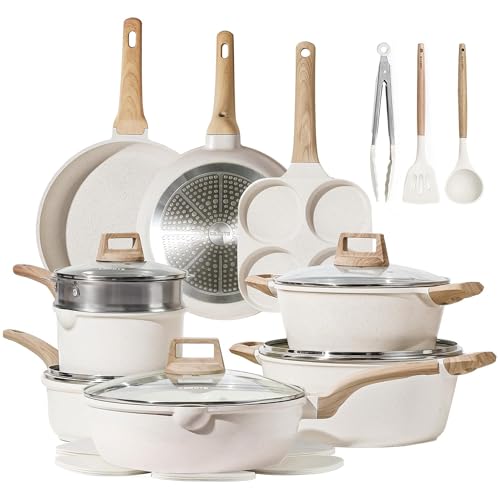
The CAROTE 21pcs Nonstick Set is the set most flat-top households are actually picturing when they go shopping. Twenty-one pieces cover the frying pans, saucepans and pots a week of cooking rotates through, the listing promises fast and even heating from bases built for induction kitchens, and there is a dedicated egg pan, a small delight that sounds like a gimmick until a single fried egg slides out of its own little pan without tearing on a Tuesday morning.
On glass, the set’s appeal is its base manners: flat, smooth bottoms that sit still on the rings and heat without the rocking that makes sauces catch at one edge. Easy food release is the coating’s party trick, and it is the traditional nonstick kind, slick in the way decades of development have made familiar. Treat it with wooden or silicone tools, keep the heat in the low-to-medium band where nonstick belongs, and the release stays honest for years rather than months.
Choose this CAROTE if you want one box that equips a flat-top kitchen completely, induction included, without paying for the largest piece count in the brand’s catalogue. It is the balanced buy of the three CAROTE siblings: the egg pan and the sensible spread beat raw numbers for most cooks.
- Pieces: 21, including a dedicated egg pan
- Base: induction kitchen set, built for fast, even heating
- Coating family: traditional nonstick with easy food release
- Listing emphasis: durability across the frying and pot range
Strengths
- Induction-ready bases sit flat and heat evenly
- Dedicated egg pan is a small daily pleasure
- 21 pieces cover a full week of varied cooking
Trade-offs
- Traditional coating wants gentle heat and soft tools
- Piece count includes lids and accessories, as always
- Serious searing still belongs in another pan material
Best for: flat-top households wanting one complete induction set. Not suited for: cooks who sear steaks at maximum heat nightly.

CAROTE 26pcs Nonstick Set — Best Maximum Piece Count
If the 21-piece set is the sensible sibling, the CAROTE 26pcs Nonstick Set is the maximalist. Twenty-six pieces is the deepest bench in this guide, and for a household that cooks several dishes at once, batch-cooks on Sundays or regularly finds every pan in the dishwasher simultaneously, that depth is a real feature rather than a marketing one. The listing adds a special texture design to the finish, the brand’s ultra durable billing, and the same induction-ready, even-heating base story as its smaller sibling.
More pieces ask a question of your kitchen, though: storage. Twenty-six pieces with their lids need a cupboard plan, ideally stacking protectors between pans so the nonstick surfaces do not grind against each other in a drawer avalanche. On the glass top itself, the set behaves like the other CAROTE lines, flat bases sitting steady on the rings, with easy release across the frying range and the gentle-heat discipline that traditional coatings reward.
Buy the 26-piece set when your cooking genuinely runs wide: multiple burners busy, guests frequent, leftovers strategic. A couple cooking two-pan dinners will use a third of it weekly and store the rest, and for them the smaller sets in this guide are the cleverer money. Scale is a virtue only when the household matches it.
- Pieces: 26, the largest count in this guide
- Finish: special texture design across the set
- Base: induction kitchen set with even heating
- Coating family: traditional nonstick, ultra durable billing
Strengths
- Deepest selection of pans and pots here
- Texture design finish with ultra durable billing
- Induction bases with even heating across the set
Trade-offs
- Needs a real cupboard and stacking plan
- Many pieces will rest unused in small households
- Lids and tools inflate the headline count
Best for: large households cooking several dishes at once. Not suited for: small kitchens or two-pan weeknight cooks.

CAROTE 21pcs Black Titanium Set — Best Reinforced Coating
The third CAROTE sibling, the CAROTE 21pcs Black Titanium Set, sells toughness. Its coating is titanium reinforced and billed as scratch-resistant, finished in a sober black that suits kitchens where cookware lives on display. The piece count matches the first CAROTE at 21, and the base story is the same flat-top-friendly one: induction compatible, even heating, easy cleaning. The difference is where the money went: not into more pieces, but into a harder-wearing surface on the same sensible spread.
Scratch-resistant deserves its honest footnote. It means the coating tolerates the small accidents of real kitchens, a metal utensil grabbed in haste, a stacking scuff, better than an unreinforced surface would; it does not invite metal tools as a lifestyle, and the cooks who keep any nonstick slick for years still reach for wood and silicone by default. What the reinforcement genuinely buys is forgiveness, and forgiveness is what separates a set that ages gracefully from one that looks tired by its second winter.
Choose the black titanium set if your household is lively, your utensils are mixed, and your pans stack in a busy drawer. It is the CAROTE for real life rather than for careful people, and its black finish hides the minor marks of service better than pale coatings ever will.
- Pieces: 21, finished in black
- Coating: titanium reinforced, billed scratch-resistant
- Base: induction compatible with even heating
- Listing emphasis: easy cleaning across the set
Strengths
- Titanium-reinforced coating forgives small accidents
- Black finish hides the marks of daily service
- Same flat, induction-compatible bases as siblings
Trade-offs
- Reinforced is not metal-proof; soft tools still wise
- Black interiors show pale scratches more than wear
- Same piece count as the plainer, cheaper-feeling sibling
Best for: busy households wanting the toughest CAROTE coating. Not suited for: gentle cooks who do not need reinforced durability.

T-Fal Ultimate Hard Anodized 17pc — Best Hard-Anodized Traditional Set
The T-Fal Ultimate Hard Anodized 17pc represents the established order: a hard-anodized set from one of the oldest names in nonstick, in a deep onyx finish. Hard anodizing gives the bodies a hardness and heft that thin pressed pans lack, which matters on a flat top because a substantial, flat base stays planted on the glass and spreads heat across its whole footprint rather than hot-spotting in the middle. The 17 pieces include a griddle alongside the fry pans, saucepans and sauté pan, and a griddle on a glass top is a pancake morning waiting to happen.
Dishwasher-safe billing is this set’s lifestyle headline, and it is genuinely convenient, though the same advice applies here as everywhere in this guide: nonstick coatings of every family live longer with hand washing, and the dishwasher is best treated as an occasional rescue rather than a nightly regime. One compatibility note deserves plain speech: check the listing’s current induction statement for your exact hob, because hard-anodized lines vary, and on radiant glass this set is entirely at home while induction demands a magnetic base by model.
Buy the T-Fal if you trust the traditional school, want the griddle, and prefer a set with a long public track record behind it. It lacks the CAROTE sets’ induction-forward pitch, and in exchange it offers the settled confidence of a design that has cooked a generation of weeknight dinners.
- Pieces: 17, including fry pans, saucepans, sauté pan and griddle
- Body: hard-anodized construction in onyx
- Care: dishwasher safe according to the listing
- Coating family: traditional nonstick, T-Fal Ultimate line
Strengths
- Hard-anodized bodies feel substantial and stay flat
- Griddle included for pancakes and flat-top breakfasts
- Dishwasher-safe billing suits busy households
Trade-offs
- Verify induction compatibility for your exact hob
- Dishwasher convenience still shortens coating life
- Seventeen pieces is the smallest spread here
Best for: traditionalists wanting hard-anodized build and a griddle. Not suited for: induction owners who have not checked base compatibility.

GreenLife 16pc Ceramic Set Gray — Best Ceramic Set in Gray
The GreenLife 16pc Ceramic Set Gray is this guide’s ceramic standard-bearer in its calmer colour. Sixteen pieces cover the stockpot, frying pans, saucepans and sauté pan a household rotates through, coated in GreenLife’s ceramic nonstick, which the listing states is PFAS-free. Ceramic coatings are a different technology from traditional nonstick, a silica-based sol-gel rather than a PTFE surface, and the section below compares the families without fear or favour. What you notice first in the kitchen is the release: eggs and sauces let go willingly, and the light interior shows browning as it develops.
Stay-cool handles suit the flat-top life, where pans are lifted and settled constantly rather than dragged, and the set’s stated oven ceiling of 350F covers finishing a frittata or keeping a sauce warm without drama. On glass, treat ceramic sets with the same base courtesy as any other: lift, do not slide, and keep the heat moderate, because ceramic coatings dislike thermal shock and scorching oil more than their traditional cousins do. Dishwasher-safe billing appears on the listing, with the usual longevity footnote that hand washing is kinder.
Choose the grey GreenLife if you prefer the ceramic route, want a full set rather than a token pan, and like a colour that disappears into any kitchen. Its twin in turquoise follows next, identical in substance, and the choice between them is honestly and entirely about which one makes you happier to open the cupboard.
- Pieces: 16, including stockpot, fry pans, saucepans, sauté pan
- Coating: ceramic nonstick, PFAS-free per the listing
- Handles: stay-cool design
- Oven limit: up to 350F; dishwasher safe per listing
Strengths
- Ceramic PFAS-free coating per the listing
- Stay-cool handles suit lift-and-settle cooking
- Full 16-piece spread including a stockpot
Trade-offs
- Oven ceiling of 350F limits finishing options
- Ceramic release fades faster if overheated often
- Light interior shows staining from tomato and spice
Best for: ceramic-preferring households wanting a full grey set. Not suited for: high-heat finishers who live above 350F in the oven.
GreenLife 16pc Ceramic Set Turquoise — Best Ceramic Set in Turquoise
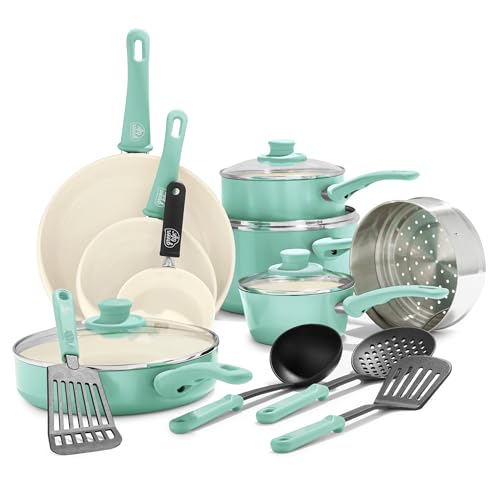
Everything true of the grey set is true of the GreenLife 16pc Ceramic Set Turquoise, because beneath the colour they are the same sixteen pieces with the same ceramic coating, the same stay-cool handles and the same 350F oven limit. What differs is the effect on the kitchen. Turquoise is the finish that made this line recognisable across a thousand kitchens: bright, retro and unapologetic, the kind of colour that turns a saucepan left on the hob from clutter into decoration. If cookware lives visible in your home, colour is a legitimate specification.
The ceramic coating behaves identically, releasing eggs and fish fillets cleanly, asking for moderate heat and soft utensils, and preferring to be lifted across the glass rather than skated over it. The light interior, common to both colours, is a genuine cooking aid for sauces and custards, where you judge by colour, and a mild housekeeping burden with turmeric and tomato, which leave their autographs until a baking-soda paste lifts them.
Buy the turquoise if the colour lifts your kitchen and your mood; there is no performance penalty and no performance gain, and honesty about that is the review. Households furnishing a cheerful rental, a cottage kitchen or a first flat will find this the set guests ask about, while the grey twin waits for minimalists one shelf up in this guide.
- Pieces: 16, stockpot, fry pans, saucepans and sauté pan
- Coating: PFAS-free ceramic nonstick per the listing
- Handles: stay-cool design
- Oven limit: up to 350F; dishwasher safe per listing
Strengths
- Same capable ceramic set in a joyful finish
- Colour suits kitchens where pans live on display
- Light interior helps judge sauces and browning
Trade-offs
- Identical performance to the grey set, colour only
- Turquoise shows chips and wear more visibly
- Same 350F oven ceiling as its grey twin
Best for: cheerful kitchens wanting the ceramic set in turquoise. Not suited for: anyone expecting a performance difference from colour.
How Do the Six Cookware Sets Compare at a Glance?
| Pick | Badge | Distinguishing detail |
|---|---|---|
| CAROTE 21pcs Nonstick Set | Best All-Round CAROTE Set | 21 pieces, egg pan included, induction base design |
| CAROTE 26pcs Nonstick Set | Best Maximum Piece Count | 26 pieces, textured finish, induction, largest set here |
| CAROTE 21pcs Black Titanium Set | Best Reinforced Coating | 21 pieces, black, titanium reinforced coating |
| T-Fal Ultimate Hard Anodized 17pc | Best Hard-Anodized Traditional Set | 17 pieces, hard anodized, griddle included, onyx |
| GreenLife 16pc Ceramic Set Gray | Best Ceramic Set in Gray | 16 pieces, ceramic PFAS-free, gray, oven to 350F |
| GreenLife 16pc Ceramic Set Turquoise | Best Ceramic Set in Turquoise | 16 pieces, ceramic PFAS-free, turquoise, oven to 350F |
What Makes a Pan Safe and Effective on a Glass Cooktop?
A flat cooktop is a sheet of glass-ceramic, tougher than it looks and easier to mark than it feels. Pans serve it well when their bases are flat, so contact is total and heat spreads evenly; smooth, so nothing gouges or grinds across the surface; and clean underneath, because a single baked-on grain of sugar or grit trapped under a hot pan becomes sandpaper. Weight helps stability up to the point where lifting becomes a strain, and a base that overhangs the ring by a sensible margin wastes less heat than one dwarfed by it.
The habits matter as much as the hardware. Lift pans to move them, settle them gently, and never slide a loaded pot across the glass to the cool side. Wipe the hob before cooking, not after, so yesterday’s spill is not carbonised under today’s pan. The sets in this guide all present smooth, flat bases suited to the surface; which one stays unmarked in five years will be decided more by these small courtesies than by the badge on the box.
Ceramic or Traditional Nonstick: How Do the Coatings Differ?
Traditional nonstick coatings are PTFE-based, the technology that made slippery pans ordinary, refined over decades into systems like T-Fal’s and the CAROTE lines here. Their virtues are the slickest release, especially for eggs and fish, and a long, well-understood service life when heat stays moderate and utensils stay soft. Ceramic coatings, like GreenLife’s, are sol-gel surfaces derived from silica; their listings state PFAS-free, they tolerate a bright, light-coloured finish, and their release is excellent when new, with a reputation for fading sooner if regularly overheated.
This guide takes no side in the coating argument, because the honest summary is that both families are sold for home cooking, both perform when used as directed, and both fail early when abused with high heat, metal tools and thermal shock. Choose ceramic if a PFAS-free listing is your preference and your cooking is gentle; choose traditional if maximum release and longevity top your list. What neither family deserves is the internet’s habit of absolute claims, in either direction, about safety or performance.
Does Nonstick Work on Induction Hobs?
Induction does not care about the coating at all; it cares about the base. A pan works on induction only if its base contains magnetic material, which is why the CAROTE sets here announce induction compatibility as a headline and why any set you consider for an induction hob must state it plainly. The magnet test is the household version: a fridge magnet that clings firmly to the pan’s base promises induction will see it, while a magnet that slides off means the ring will ignore the pan entirely.
Radiant glass tops are less picky and accept any flat-based pan, which is why this guide serves both audiences and flags compatibility per set rather than assuming. The T-Fal’s hard-anodized line is the one to verify model by model for induction, as noted in its review. Whichever hob you own, the flatness rule is identical: a pan that rocks on glass wastes heat and worries cooks on both technologies.
How Many Pieces Does a Kitchen Actually Need?
Set counts count lids and utensils, so translate before you buy. The working core of any kitchen is two frying pans in different sizes, two saucepans, a sauté pan and a stockpot; everything beyond that is depth for busy days. By that measure the 16-piece GreenLife sets and the 17-piece T-Fal cover the core with spares, the 21-piece CAROTE sets add breathing room and the egg pan or reinforced coating, and the 26-piece CAROTE equips a household that genuinely cooks in parallel.
Storage is the silent specification. Pans stored nested without protection shed their coatings against each other; pans stored with felt or cloth protectors between them age slowly. Before choosing the biggest set, open the cupboard it must live in and be honest about the geometry. A set that fits its home gets used daily, and a set exiled to a high shelf becomes the small set you actually own plus a storage problem wearing a lid.
How Should You Care for Nonstick on a Flat Top?
Heat discipline is the first rule for every coating family here: preheat briefly on low to medium, add food, and reserve high heat for other pan materials. Empty nonstick left roaring on a ring degrades its own surface and, on glass, bakes a ring of fumes and discolouration onto the hob. Use the fat the recipe wants, since a whisper of oil or butter protects both food and coating, and let pans cool before washing so cold water never shocks a hot base into warping, the flat-top owner’s true enemy.
Washing is the second rule: warm water, a soft sponge, and a soak instead of a scour when something catches. Dishwasher-safe listings exist in this guide, and the machine will not ruin a set in a night, but repeated cycles dull every coating faster than hand washing does. Dry pans fully, store them protected, and retire a pan whose coating is deeply scratched or peeling rather than nursing it along; a single replacement pan is cheaper than a ruined hob or a ruined dinner.
What Should You Cook in Nonstick, and What Should You Not?
Nonstick earns its keep on the delicate and the sticky: eggs in every form, fish fillets with fragile skins, pancakes, crêpes, reheated rice, cheese-topped anything, sauces that scorch where they touch, and vegetables in glazes that would cement themselves to steel. On a flat top, where temperature control is precise and gentle, these are exactly the jobs the surface was designed to host, and the sets here handle them with the easy release their listings promise.
Other jobs belong to other materials, and a wise kitchen owns both. A hard sear on a steak, a fond you intend to deglaze into a sauce, a dish that starts under a fierce grill: these want stainless steel or cast iron and heat that nonstick should never meet. The sets in this guide are the daily fleet, not the whole navy. Cook within their talents and they will feel miraculous; force them into the searing station’s role and you will shorten their lives while producing a worse crust.
How Do You Stop Pans Warping on Glass Tops?
Warping is a thermal event, not a moral failing. A thin base heated fiercely on one ring, then plunged into cold water or set on a cold wet surface, changes shape a fraction at a time until one day the pan spins on the glass like a top. Prevent it with boring consistency: heat gradually, match the pan size to the ring so heat spreads evenly, let pans cool on the hob or a trivet before washing, and favour the substantial bases that the hard-anodized and better aluminium sets here provide.
Test any pan, new or old, with a ruler across the base or a spin test on the switched-off hob. A slight rock in a new pan is a reason to return it, because glass tops forgive nothing and the rock only grows. A warped favourite can sometimes be flattened by a specialist, but prevention costs nothing but patience. Flat bases are the entire premise of this guide, and keeping them flat is a habit, not a purchase.
What About Handles, Lids and Oven Limits?
The supporting cast decides daily comfort. Stay-cool handles, as on the GreenLife sets, matter on a glass top because pans are lifted constantly and a handle that stays graspable without a cloth speeds everything. Handles should also be checked for oven tolerance before a pan finishes a dish under heat; the GreenLife sets state a 350F ceiling, which covers warming and gentle finishing, while cooks who routinely roast in their saucepans should read every listing’s limit before the first attempt rather than after the first smell.
Lids deserve a glance too: glass lids let you watch a sauce without lifting and losing heat, and they count toward those headline piece numbers, so a set with lids for every pot is genuinely better equipped than one where lids are shared. Knobs should stay cool or be honestly metal for oven use. None of this is glamorous, and all of it is what you will notice at month three, long after the coating’s first egg has been forgotten.
How Long Should a Nonstick Set Last?
With kind use, a traditional nonstick set serves a household for several years before release fades enough to notice, and a ceramic set typically gives a shorter but still useful span, especially in gentle kitchens. The variables are heat habits, utensils, washing and storage, in roughly that order, which is why two households can report opposite experiences of the identical set and both be telling the truth. The reinforced CAROTE exists precisely for households whose variables run rough.
Plan replacement as a rhythm rather than a tragedy. Frying pans work hardest and fade first; many cooks refresh the two fry pans midway through a set’s life and keep the pots for years. When a coating is scratched through, flaking or has lost its release despite gentle care, retire that piece without sentimentality. A nonstick set is a consumable tool with a long fuse, and treating it that way, buying well and replacing calmly, produces better cooking than either babying a cheap set or abusing a dear one.
Which Set Suits a First Flat-Top Kitchen?
A first glass-top kitchen needs forgiveness more than features, and two picks compete for the honour. The 21-piece CAROTE with the egg pan equips everything, works on induction and radiant alike, and asks only for gentle heat and soft tools. The grey GreenLife suits a first kitchen that prefers the ceramic listing and cooks gently by temperament. Either will teach the lift-don’t-slide habit on forgiving equipment, and either leaves budget for the one cast-iron or steel pan that searing will eventually demand.
What a first kitchen should avoid is the extremes: the 26-piece maximalist set that overwhelms a small cupboard, or a lone frying pan bought so cheaply that its base warps by spring and teaches the cook to hate the hob. Start with a complete, flat-based set in the middle of this guide, learn the surface’s manners, and add specialist pans one by one as your cooking asks for them.
How Do You Test a Pan’s Flatness Before Keeping It?
A new set deserves a five-minute inspection before the packaging leaves the house. Set each pan on the switched-off hob and press a corner: a pan that rocks or spins has a base that will heat unevenly and annoy you for years, and it should go back while returning is easy. Run a fingertip around the base edge feeling for burrs or sharp machining that could mark the glass, and check that lids sit without wobbling and handles are tight, since a set is easiest to exchange on day one and most annoying to fault on day ninety.
Cook one honest test meal before the verdict too: an egg in the small fry pan, a sauce in the saucepan, pancakes if a griddle is included. You are testing release, balance and how the pan feels to lift when full, because a saucepan that is graceful empty can be a wristful when it carries soup. Sets that pass these small trials rarely disappoint later; the ceremony simply moves the disappointment, when it exists, inside the returns window where it belongs.
What Pan Sizes Cover a Week of Real Cooking?
Recipes assume a quiet standard kit, and a set earns its place by matching it. A small frying pan around the size of two eggs handles breakfasts and reheating for one; a large one takes family frittatas, fish fillets and pancakes in rotation. Saucepans divide into a small one for sauces, eggs and reheating, and a larger one for pasta water in modest quantities, vegetables and soups for two, while the sauté pan, wide with straight sides, becomes the weeknight hero for anything that starts with onions and ends with a sauce.
The stockpot is the set’s reserve: pasta for a crowd, soup batches, corn on the cob and the occasional preserving day. If your household cooks grains in quantity, check that the large saucepan or stockpot takes a steamer insert you already own. None of the sets here can be everything, and the honest question is whether the sizes match your three most-cooked dinners. Lay those recipes mentally across the set’s composition before ordering and the answer will be obvious.
How Should You Season or Prepare a New Nonstick Set?
Modern nonstick needs no seasoning ritual of the cast-iron kind, whatever the internet suggests. Wash each piece in warm soapy water to remove factory residues, dry it, and, if the maker suggests it, rub the cooking surface with the thinnest film of oil before the first use and heat it gently for a moment. That single light preparation is the whole ceremony. From then on, a drop of cooking fat per dish is about flavour and protection, not about maintaining a seasoned layer that does not exist.
The first weeks set the set’s habits and yours. Keep the heat in the gentle band, let pans cool before washing, and store them padded from the start rather than after the first scratch teaches the lesson. A set treated well from its first egg develops the faint, even patina of use that cooks recognise as a pan in its prime. A set abused in its first month rarely recovers its reputation in the household, however long its coating technically survives.
What Is the Story With Egg Pans and Griddles?
Two specialist pieces appear across these sets and both earn their keep in the right kitchen. The dedicated egg pan in the first CAROTE set looks like a toy and behaves like a ritual: one or two eggs, cooked in their own small arena, slide out unbroken with a fraction of the fat a large pan demands, and the pan washes in seconds. Households that fry eggs daily will use it daily; households that poach or scramble should save the cupboard space and let the small fry pan do everything.
The griddle in the T-Fal set is the opposite kind of specialist, wide rather than small, turning a flat top’s two rings into a breakfast station for pancakes, French toast, grilled sandwiches and a family’s worth of bacon-adjacent projects. On glass it must be flat and lifted rather than slid, like everything else here. Judge both pieces by your actual breakfasts. A set whose specialists match your mornings feels custom-built; a set whose specialists gather dust was bought for a household in a magazine.
How Do You Cook Sauces and Custards in Nonstick?
Sauces are where a light interior and gentle release pay rent. In the GreenLife sets especially, a pale cooking surface lets you watch a roux take colour, a custard thicken to the ribbon stage or a caramel approach the shade you want, judgements that a black interior hides until they are overdone. Nonstick also frees the cook from the scorched ring that milk-based sauces weld onto steel, which is why a nonstick saucepan becomes the porridge and custard pan in most households that own one.
Technique stays classical: steady low heat on the flat top, constant gentle stirring with a soft spatula that can sweep the corners, and the pan off the heat a breath before the sauce looks finished, because it will coast the rest of the way. Never leave a wooden spoon standing in a hot empty pan, and never park a nonstick saucepan on a ring to keep warm for an hour; residual heat is still heat, and the sauce and the coating both prefer a trivet and a lid.
What Should Renters and First-Time Glass-Top Owners Know?
Renters inherit hobs they did not choose and deposits they would like back, which makes them the perfect audience for this guide’s habits. Photograph the hob’s condition when you move in, cook with flat-based pans from the sets here, lift rather than slide, and clean spills with the hob maker’s recommended scraper and cleaner rather than improvised abrasives. A glass top returned unmarked is a deposit argument you never have to have, and nonstick pans, being light and smooth-based, are the gentlest cookware a rented hob can meet.
First-time owners should know the surface’s one true fragility: impact and thermal shock, not cooking. A heavy pan dropped from height or a cold pan slammed onto a hot ring are the events that crack glass-ceramic, and both are habits rather than accidents. Everything in this guide is light enough to handle kindly. Learn the surface’s manners in the first month and it will serve a decade of dinners without a mark worth mentioning.
How Do You Dispose of or Replace a Single Worn Pan?
Sets rarely die all at once. The fry pans fade first, the stockpot may outlive two replacements, and the sensible household replaces pieces individually rather than landfilling a working set because its hardest worker retired. Match a replacement by size and base type so it sits on the same rings and stacks with its siblings, and consider whether the replacement should repeat the same coating family or answer a new need, since a single stainless fry pan beside a nonstick set is a combination many experienced kitchens arrive at deliberately.
Retired nonstick pans leave the food chain entirely: a scratched pan can serve a garage or garden shed life holding screws or paint, but it should not return to cooking once its coating is flaking. Check local guidance for cookware recycling, since some schemes accept metal pans. The calm rhythm of replace-the-worn-piece is cheaper, less wasteful and better cooking than the dramatic whole-set replacement, and it is how the sets in this guide are designed to be owned.
How Does a Flat Top’s Heat Differ From a Gas Flame?
A gas flame wraps a pan in moving heat and forgives a slightly domed base, because the fire finds the metal wherever it is. A flat top transfers heat only where pan and glass truly meet, and it holds that heat in the surface itself, so a pan keeps cooking for a while after the ring is turned down. That stored heat is a gift for sauces and a trap for the impatient: turn the ring off a moment earlier than instinct suggests, or slide, no, lift the pan to a cold part of the hob when a dish must stop dead.
Response speed also differs by hob type. Radiant glass glows and cools in its own time, induction answers almost instantly, and nonstick cooking, with its moderate temperatures, suits both once the cook recalibrates. The sets here, with their even-heating base designs, are built for exactly this contact-based world. A week of cooking teaches the new rhythm, after which gas feels oddly theatrical and imprecise by comparison.
Why Do Some Pans Spin on Glass Tops, and How Do You Stop It?
A pan spins when its base touches the glass at a single high point, usually the centre, turning the whole pan into a lazy top that rotates when you stir. Causes divide into birth and age: some inexpensive pans are pressed with a slight dome that was meant to flatten when hot and never quite does, while older pans dome gradually through years of thermal shock. Test for it cold on the hob, and test again warm, since a few pans flatten only when heated, which their makers consider a feature and most cooks consider a nuisance.
The cure for an aged spinner is replacement, and the prevention is the cooling discipline this guide repeats: no cold water on hot pans, no fierce empty preheats. A spinning pan is not merely annoying; it heats unevenly, scratches in circles and makes one-handed stirring impossible. Any set here will sit still when treated kindly, and that stillness, felt the first time you stir a sauce and the pan simply stays, is the flat-top pleasure the whole category exists to deliver.
A Brief Word on Cooking for Children in Nonstick Pans
Family cooking leans on nonstick for reasons beyond release. Pancakes that never tear, eggs that never weld to the pan, fish fingers that come out whole: these are the small mercies that keep a weeknight kitchen calm, and a light pan is safer for a young helper to lift under supervision than a cast-iron skillet of the same diameter. The sets here, with their stay-cool or easy-grip handles and modest weights, suit a household where cooking is a shared, slightly chaotic event rather than a solo performance.
The disciplines stay the same with children helping: moderate heat, soft utensils, pans lifted rather than dragged, and hot handles announced out loud every time. A child who learns those habits on a forgiving set carries them to every pan they will ever own, which may be the most durable thing a nonstick set ever produces.
One More Habit: Matching Pan Size to the Ring
Glass tops reward a match between pan base and ring diameter that gas never demanded. A small pan centred on a large glowing ring wastes heat into the kitchen and overheats its own handle, while a pan much wider than the ring cooks a pale ring of food around a scorched centre. Most hobs print their ring sizes in the manual and mark them subtly on the glass; spend one minute learning yours, then choose the pan whose base matches the ring you are about to use. The sets here span enough sizes that a match exists for every ring in a normal kitchen, and using it is free performance hiding in plain sight.
What Mistakes Do Flat-Top Owners Make With Nonstick Sets?
Sliding is the original sin: dragging a loaded pan across glass grinds any trapped grit into the surface and, over a season, writes a visible history of breakfasts onto the hob. The second mistake is heat bravado, preheating an empty nonstick pan on the highest ring to save a minute, which ages the coating and can mark the glass. Third comes the cold-water plunge, a hot pan under a cold tap, warping the base a fraction at a time until the pan rocks and the owner blames the hob.
Storage and utensils complete the list. Pans nested bare, metal against coating, shed their surfaces in the drawer before they ever fade on the hob, and a metal spatula used daily will defeat even a reinforced coating eventually. None of these mistakes requires money to fix. Lift the pan, moderate the heat, let it cool, pad the stack and reach for wood or silicone, and both the set and the glass will look younger at year three than most kitchens manage at month six.
- Dragging pans across the glass instead of lifting and settling them.
- Preheating empty nonstick on maximum heat to save a minute.
- Running cold water over a hot pan and warping its flat base.
- Stacking pans bare so coatings grind against each other.
- Using metal utensils daily and blaming the coating for scratches.
Final Recommendation
Start from your hob: induction owners should take a CAROTE, with the 21-piece egg-pan set as the all-rounder, the 26-piece as the maximal bench and the black titanium build as the durability pick; radiant-glass owners may add the hard-anodized T-Fal for its griddle and track record. Ceramic households have the GreenLife in grey or turquoise, identical twins separated only by mood. Every set here sits flat and smooth on glass, which is the qualification that matters before all others.
If your current pans rock, spin or scratch, replace them for the hob’s sake as much as your own, because a flat top rewards flat pans every single day it is used, and the first egg that slides out of a new pan onto a calm, unmarked glass surface will explain this entire guide better than its thousands of words can.
Frequently Asked Questions
Will nonstick pans scratch my glass cooktop?
The pans themselves, with smooth flat bases, are not the usual culprit; grit trapped under a base and the habit of sliding pans are. Wipe the hob before cooking, lift pans to move them, and check bases for baked-on debris when you wash up. Rough or damaged bases, especially on old pans with exposed, burred edges, should be retired from glass duty. Used with those courtesies, every set in this guide is a polite guest on a flat top.
Can I use metal utensils on the titanium-reinforced CAROTE?
The reinforcement tolerates accidents better than a standard coating, which is its purpose, but it is not an invitation to cook daily with metal. A metal spatula grabbed in haste will not ruin the pan, and that forgiveness is worth having in a busy household. For the coating’s longest life, wood, bamboo and silicone remain the right everyday tools in every set here, reinforced or not.
What is the difference between the grey and turquoise GreenLife sets?
Colour, and only colour. Both are the same 16 pieces with the same PFAS-free ceramic coating, stay-cool handles and 350F oven limit stated on their listings. Choose grey for a calm, blend-in kitchen and turquoise for one where the pans are part of the décor. Anyone selling you a performance difference between them is selling you a story, and this guide declines to.
Why do the piece counts differ from the number of pans?
Manufacturers count every lid and, in some sets, utensils and protectors as pieces, which is why a 21-piece set contains fewer than 21 pans. Read the composition, not the headline: two fry pans, two saucepans, a sauté pan and a stockpot with lids is a complete working core, and sets here range from that core with spares to the 26-piece CAROTE’s full bench. The count is a starting clue, never the verdict.
How do I know if a set works on my induction hob?
Look for the set to state induction compatibility plainly, as the CAROTE lines do, and confirm with the magnet test when the set arrives: a magnet that grips the base firmly means induction will heat it. If a listing is silent or ambiguous, as can happen with hard-anodized lines that vary by model, treat that as a no until the maker confirms otherwise. Radiant glass owners can ignore the question entirely and shop on flatness alone.
Related Guides
A flat-top kitchen usually refreshes its small electrics in the same season, so continue to Best Inexpensive Garbage Disposals for the sink that receives these pans, revisit the gentle-heat philosophy in Best Slow Cookers With Stovetop-Safe Inserts for the pots that share the surface, and finish with the laundry workhorses in Best Stackable Front Load Washer and Dryer Sets With Steam because a kitchen renovation never stops at the hob.



[…] frother rarely lives alone in a kitchen, so pair it with the sets reviewed in Best Nonstick Cookware Sets for Flat Cooktops for the pans that warm the milk, silence the morning with help from Best Quiet Dishwashers for the […]