What's inside
- Key Takeaways
- Quick Picks
- How Did We Choose These Air Jet Tubs?
- What Is the Real Difference Between Air Jets and Whirlpool Jets?
- How Loud Is an Air Blower, Really?
- Why Does an Inline Heater Change the Air Bath So Much?
- Where Do Air Jet Tubs Fit in a Real Bathroom Layout?
- What Should You Know About Running an Air Tub Outdoors or in a Guest Bath?
- What Does an Air Bath Actually Feel Like, Minute by Minute?
- How Should a First-Time Owner Set Up the First Soak?
- What Should You Ask an Installer About a Powered Tub?
- How Do You Care for Acrylic Around Jets, Lights, and Panels?
- How Do the Six Air Jet Tubs Compare Side by Side?
- How Does Water Depth Change the Air Experience?
- What Mistakes Do Air Tub Buyers Keep Making?
- What Does Ownership Cost Beyond the Tub Itself?
- Which Installation Style Suits Which Room?
- Final Recommendation
- Frequently Asked Questions
- Related Guides
As an Amazon Associate I earn from qualifying purchases. This post may contain affiliate links at no extra cost to you.
cottageverdict.com is reader-supported. When you buy through links on our site, we may earn an affiliate commission.
Where to buy: Each tub below is listed on Amazon under the maker’s own name. Open any linked pick to check price on Amazon, verify the jet configuration in the maker’s own words, and confirm the drain and electrical details against your bathroom before committing to a delivery date.
The best air jet tubs take a gentler road to the spa bath. Instead of forcing water through a few large nozzles, an air system warms air in a blower and releases it through dozens of small openings in the tub floor and walls, so the whole body is wrapped in rising streams of fine bubbles. The sensation is often compared to sitting in champagne: lively, even, and soft enough to run for an entire soak without the pushing and kneading a whirlpool delivers. For bathers who find water jets too insistent — or who simply prefer their massage distributed rather than aimed — air is the technology that fits.
Honesty about the current market matters here, because pure air-only tubs are rarer than the category name suggests. Most of the strongest listings pair the air system with whirlpool jets in one shell, letting the bather choose bubbles, water jets, or both together, and this guide describes each pick’s system exactly as its maker specifies it rather than pretending every tub below is air-only. One pick leads with air bubble massage as its headline act. The FerdY uses combined air-and-water spa jets. The three WOODBRIDGE models and the Garvee are true dual-system tubs. Read the per-pick sections closely if the distinction decides your purchase, because it should.
Air systems bring two practical gifts that rarely make the brochure. The first is hygiene: after a bath, the air channels can be purged with a short blast of the blower, and since those channels carry air rather than bath water between soaks, they dry out in a way whirlpool pipework never quite does. The second is placement freedom — air tubs appear in freestanding, back-to-wall, and compact alcove-friendly shells alike, so the technology no longer demands a huge bathroom. Readers whose space caps out at five feet will find a size-specific companion guide waiting in our Related Guides at the end of this page; the selection here ranges wider, from a 55-inch freestanding oval to full 71-inch soakers.
Sizing deserves a word before the picks, because air tubs punish optimistic measuring. The shell’s stated length is its outside dimension; the bathing well inside is shorter by the thickness of two ends, and in jetted models the equipment claims a little more. A bather who wants to sit with legs genuinely extended should think in terms of the longest shell the room accepts, while a bather who soaks upright with a book will be perfectly served two sizes down. Both bathers appear in the picks below, deliberately.
Key Takeaways
- Air jets wrap the whole body in fine bubbles; whirlpool jets knead specific spots with directed water.
- Most strong listings are dual-system, so read each pick’s actual jet configuration before assuming air-only.
- Air channels purge and dry after use, which makes the air side the lower-maintenance half of any combo tub.
- An inline heater holds soak temperature far better than topping up from the tap during a long bath.
- Blower placement and speed settings decide how quiet an air bath is; adjustable blowers earn their premium nightly.
Quick Picks
| Pick | Badge | Why it earns its place |
|---|---|---|
| Empava 71″ Jetted Tub with Air Bubble Massage | Best Back-to-Wall Statement | Air bubble massage with an inline heater, twin waterfalls, and colour-changing light in a long back-to-wall shell. |
| FerdY Tahiti 55″ Freestanding Whirlpool Tub | Best Compact Freestanding | A small oval carrying eight combined air-and-water spa jets, for bathrooms that cannot spare six feet. |
| WOODBRIDGE 59″ Compact Whirlpool and Air Tub | Best Compact Combo | Sixteen jets split between whirlpool and air, a heated soak, and an adjustable blower in under five feet. |
| WOODBRIDGE 66-1/2″ Whirlpool and Air Tub | Best Roomy Combo | The same dual-system formula stretched past 66 inches, giving taller bathers room to actually unfold. |
| Garvee 71″ Freestanding Whirlpool Air Bubble Tub | Best Long Soak with Heat | Whirlpool jets plus air bubbles plus built-in heating at full length, aimed at unhurried evening baths. |
| WOODBRIDGE 71″ Double Slipper Whirlpool and Air Tub | Best Classic Silhouette | A raised-at-both-ends slipper profile with dual systems and chromotherapy light for traditional rooms. |
How Did We Choose These Air Jet Tubs?
Jet honesty came first. We read every listing’s own description of its system and kept only tubs whose air component was real and specified — a named blower, air jets counted or described, and controls that let the bather run the air side on its own. Tubs that used the word air as decoration while describing a purely water-driven system did not survive the shortlist, and each pick below is labelled with the system it actually carries.
Heat came second, because bubbles churn water and churning water cools. Models with an inline heater or a heated-soak design hold a long bath at temperature without the bather repeatedly reaching for the hot tap, and that difference is felt in the last ten minutes of every soak. Third came blower manners: adjustable air speed matters more than raw power, since the difference between a lively fizz and a boiling cauldron is a dial, and every WOODBRIDGE below offers that dial. Finally we spread the list across sizes and install styles — freestanding, back-to-wall, compact — because air bathing should not belong only to people with the largest bathrooms.
We also discounted presentation. Listings that led with lifestyle photography while burying the blower specification, the heater’s presence, or the drain handing were read with suspicion, and two otherwise handsome tubs fell at this fence. A powered bath is an appliance as much as a furnishing, and it should be documented like one; the six survivors are.
What Is the Real Difference Between Air Jets and Whirlpool Jets?
Whirlpool jets recirculate the bath water itself. A pump draws water from the tub and pushes it back through a handful of adjustable nozzles, producing a firm, directed pressure that can be aimed at a sore lower back or tired shoulders. It is massage in the truest sense, and bathers either love its insistence or find it faintly aggressive after ten minutes. Air jets do something else entirely: a blower pushes warmed air through many small ports, and the water is moved only by the rising bubbles. Nothing is aimed. The whole surface of the skin is tickled at once, the water stays in gentle motion, and bath salts or oils that would trouble a whirlpool pump are far less of a concern on the air side.
The maintenance profiles differ just as clearly. Whirlpool pipework holds residual water between baths and asks for periodic line cleaning to stay fresh. Air channels hold air; a post-bath purge cycle blows them clear, and they dry while the tub stands empty. Dual-system tubs inherit both personalities and both routines, which is worth knowing before choosing one: you are buying two appliances in a single shell, and the water half will set the cleaning calendar for both.
How Loud Is an Air Blower, Really?
Blower noise is the question every air-tub shopper asks and few listings answer well. A blower is a fan, and a fan moving enough air to fill a tub with bubbles makes a hum — roughly comparable to a bathroom extractor running, varying with speed. Three things decide whether that hum bothers you. Placement matters most: a blower mounted away from the shell, or insulated within the tub’s structure, sounds distant, while a hard-mounted unit can pass vibration into the acrylic. Speed control matters next, because most bathers settle at a middle setting far quieter than the maximum used in showroom demonstrations. And the room itself plays a part; a tiled bathroom reflects sound that a room with towels, wood, and a bath mat absorbs.
Practical advice follows from that. If the bathroom shares a wall with a nursery or a light sleeper’s bedroom, favour a model with a genuinely adjustable blower and plan evening soaks at gentle settings. If the bath is a morning ritual in a house already awake, noise drops down the priority list and jet character should lead instead. Either way, treat any claim of a silent blower as marketing; the honest goal is a hum you stop noticing once the bubbles start.
There is a testing trick worth borrowing from owners: run the blower in the showroom or, failing that, at home during the return window, with the bathroom door closed and the house in its evening state. Noise judged at noon in a warehouse tells you nothing about noise at ten in a quiet street. The tubs that pass the evening test are the ones whose owners still describe them fondly years later, and it is no coincidence that the adjustable models dominate that group — a blower you can turn down is a blower you can live with at any hour.
Why Does an Inline Heater Change the Air Bath So Much?
Air bubbles feel wonderful and steal heat relentlessly. Every bubble that rises through the water carries warmth away with it, and a long air soak in an unheated tub can drift from inviting to tepid while the bather is still enjoying themselves. An inline heater answers by warming the water as it circulates or the air as it blows, holding the soak near its starting temperature for the full session. The difference is not subtle in practice: without a heater, the bather tops up from the hot tap, unbalancing the water level and the mood alike; with one, the bath simply stays where it was set.
Heating is also where running costs quietly live. Holding temperature electrically for forty minutes costs something, though far less than reheating a cooled tub from the tap, and households comparing formats sometimes look at how outdoor models handle the same problem — our guide to Best Alcove Soaking Tubs covers the unjetted end of the spectrum, where insulation and water depth do the work a heater does here. The principle is shared: a bath that stays warm is a bath that gets used, and features that protect warmth repay their cost in use rather than in specifications.
Where Do Air Jet Tubs Fit in a Real Bathroom Layout?
Almost anywhere a soaking tub fits, with two conditions. The blower needs air and a power supply, so the tub cannot be sealed into a cavity with no access; freestanding models keep their equipment in the shell’s base, while alcove and back-to-wall designs need a service route the installer will plan. The second condition is the floor: a filled 71-inch tub is a serious load, and upstairs installs deserve the same joist conversation any large bath does. Beyond those, air tubs are unusually flexible — the Empava below is shaped to sit against a wall where a room lacks the clearance for a true freestanding island, and the compact WOODBRIDGE drops into bathrooms that a whirlpool alcove model would overwhelm.
Renovators weighing a jetted tub against a combined bathing arrangement sometimes browse our coverage of Best Bath Tubs for Shower-Tub Combos before deciding, and the comparison is healthy: a combo serves a busy family bathroom, while an air tub serves the bather. Houses with one bathroom often land on the combo; houses where the main bath is an evening retreat land here. Neither is the upgrade of the other — they answer different questions asked by different households.
What Should You Know About Running an Air Tub Outdoors or in a Guest Bath?
Air technology also lives outdoors in plug-and-play form, and a few readers arrive here from that direction. The principles rhyme — bubbles from a blower, gentler than pumped jets — but the ownership experience differs: an outdoor spa holds heated water for weeks and serves several bathers at once, which is why shoppers comparing the two worlds often detour through our guide to Best 2-Person Plug-and-Play Hot Tubs to see the format honestly before choosing a plumbed indoor tub. Indoors, the guest-bath question is simpler: an air tub in a guest room’s bath will be used rarely and admired often, and its dry air channels tolerate that neglect far better than water-filled whirlpool lines would. If any tub in this guide suits a seldom-used bathroom, it is one run mostly on its air side.
The same tolerance makes air a forgiving choice for holiday homes and weekend places, where a tub may stand empty for a month between visits. Water systems dislike abandonment; air systems barely notice it. A purge on arrival, a fill, and the bath is ready, with none of the flushing ceremony a long-idle whirlpool properly demands before anyone climbs in.
What Does an Air Bath Actually Feel Like, Minute by Minute?
The first minute surprises most newcomers, because the bubbles arrive everywhere at once rather than starting at one end. The water seems to come alive under the skin, and the sound of the blower settles into the background as the fizz takes attention. By five minutes, the difference from a still soak is clear: the moving water keeps the temperature feeling even from shoulders to toes, where a still bath layers into warm on top and cool below. Bathers who read in the tub find the gentle settings compatible with a book held above the surface; bathers who meditate find the white noise of bubbles and blower a useful curtain against the house.
Later in the soak, the air system’s mildness becomes its argument. A whirlpool’s firm pressure can start to feel like work after twenty minutes; bubbles never do, and air baths commonly run longer simply because nothing is insisting. When the blower stops, the silence and the sudden stillness of the water mark the bath’s end more gracefully than any timer. It is a small theatre, repeated nightly, and it explains why owners of air tubs tend to become quietly evangelical about a technology that photographs badly and demonstrates worse — it has to be sat in to be understood.
How Should a First-Time Owner Set Up the First Soak?
Begin with water a degree or two cooler than a still bath, because the moving water will feel warmer against the skin and an unheated tub will drift downward anyway. Fill to the level the maker suggests — air ports need covering, and a too-shallow bath blows spray rather than bubbles. Run the blower at its lowest setting for the first minutes and step it up slowly; most bathers find their preferred level well below maximum and then return to it nightly like a radio preset. Keep the first session short, not from any caution but to learn the tub’s personality: how fast it cools, how the controls behave with wet hands, where the light switch sits in the dark.
After draining, run the purge. That single habit, learned on day one, is the whole maintenance secret of the air side — thirty seconds of blower while the tub empties, channels blown clear, nothing left standing. Owners who build it into the draining ritual never think about their air channels again, which is the highest compliment a piece of bathroom engineering can earn.

Empava 71″ Jetted Tub with Air Bubble Massage — Best Back-to-Wall Statement
The Empava is the pick that leads with air. Its headline system is air bubble massage — warmed air released through the tub to wrap the bather — supported by an inline heater that keeps that bubble-stirred water at temperature, and the listing counts twenty jets across the design. The shell is a 71-inch back-to-wall form, flat on one side so it can stand against a wall like a fitted tub while keeping the sculpted look of a freestanding piece from every angle the room actually sees. Twin waterfalls and colour-changing LED lighting complete a specification clearly aimed at the evening-soak ritual.
Back-to-wall is an underrated shape. It buys the visual calm of a freestanding tub without demanding the cleaning gap all the way around, and it lets the plumbing hide against the wall where it belongs. The chromotherapy lighting will divide households — some bathers will use it nightly, others exactly once — but the heater and the air system are the substance here, and both are specified plainly. ETL certification is noted in the listing, a detail worth having in any powered bath. To see how the current package is configured, check price on Amazon for the 71-inch Empava and look closely at the waterfall fittings, which define this tub’s character more than any other single feature.
One ownership note: waterfall fillers pour beautifully and fill more slowly than a plain spout, so the first fill of the evening should be started a few minutes before the bather is ready. Owners tend to fold that into the ritual — water on, towels warmed, door closed — and stop noticing it within a week.
The back-to-wall format also flatters rooms with one handsome wall and three ordinary ones, since the tub composes itself against the good one and asks nothing of the rest. In new-build bathrooms, designers increasingly plan exactly this arrangement — a tiled feature wall, a long tub beneath it, and no fussy island clearance to police with a mop. The Empava reads like a product designed by people who had seen that plan.
- Length: 71 inches, back-to-wall installation
- System: air bubble massage with inline heater
- Jets: 20 across the design
- Features: dual waterfalls, colour-changing LED lighting
- Certification: ETL listed, acrylic shell, chrome fixtures
Strengths
- Air massage is the headline system, not an afterthought
- Inline heater protects long soaks from bubble cooling
- Back-to-wall shape simplifies placement and cleaning
Trade-offs
- Waterfall fillers pour more slowly than a standard spout
- Lighting effects will not be to every bather’s taste
- Full 71-inch length still demands a generous room
Best for: bathers who want air massage first, in a statement tub that sits neatly against a wall. Not suited for: small bathrooms, or anyone wanting a purely traditional filler.

FerdY Tahiti 55″ Freestanding Whirlpool Tub — Best Compact Freestanding
The Tahiti proves a jetted freestanding tub does not need six feet of floor. At 55 inches, this oval FerdY carries eight spa jets that combine air and water — read the listing’s own phrasing carefully, because this is a combined-jet design rather than a pure air system — inside a deep-soaking acrylic shell with an LED light and a brushed nickel drain. For an en-suite or a converted spare room where a full-size tub would crowd the door swing, it is close to the only shape that works.
Compact jetted tubs live or die by their interior shaping, since exterior inches are fixed by the room. An oval that cradles one bather closely, with the jets placed around a single seated position, will always beat a stretched shell with jets spread thin. The Tahiti is a one-bather tub and makes no apology for it; couples wanting to share water should look at the longer picks below. The freestanding form also means a floor-standing or wall-mounted filler is part of the project budget. Shoppers short on space can check price on Amazon for the Tahiti and then measure their room’s door swing against the oval’s footprint before falling for it.
Because the shell is small, it also fills quickly and asks less of the water heater — a hidden economy that repeats every single bath. In a household where the big tub would stand empty for fear of the gas bill, the little tub that gets used three times a week is the better appliance by any honest accounting.
Small shells have one more friend: the standard doorway. A 55-inch oval threads through halls and bathroom doors that would defeat a 71-inch statement piece, and in older houses with narrow landings that fact alone can decide the shortlist. Measure the route as carefully as the room, and the Tahiti’s modest dimensions start to look less like a compromise and more like a design brief honestly answered.
- Length: 55 inches, freestanding oval
- System: 8 combined air-and-water spa jets
- Shell: acrylic deep-soaking design
- Features: LED light, brushed nickel drain
- Bather count: shaped for one
Strengths
- Jetted freestanding bathing in a genuinely small footprint
- Modest water volume fills fast and heats cheaply
- Oval shaping suits a single bather’s seated position
Trade-offs
- Combined jets, so not a pure air-only experience
- One-bather interior with no room to share
- Freestanding filler is an additional project cost
Best for: one bather with a small bathroom who refuses to give up jets. Not suited for: couples, or purists seeking air bubbles only.

WOODBRIDGE 59″ Compact Whirlpool and Air Tub — Best Compact Combo
This is the dual-system idea executed at alcove scale. The WOODBRIDGE pairs whirlpool jets with air bubble jets — sixteen jets across the two systems — in a heated soaking shell just under five feet long, with an adjustable air blower, an LED control panel, a matte black drain, and a chromotherapy light. Every control a bather could want is present, yet the footprint respects the standard bathroom rather than demanding a remodelled one.
The adjustable blower is the detail to underline. At low speed the air side murmurs; at full speed it boils merrily, and having the dial means the tub adapts to the evening rather than the other way round. The heated soak design answers the bubble-cooling problem discussed earlier without a separate heater specification to decode. Sixteen jets across two systems in a 59-inch shell is a dense installation, and owners should expect the whirlpool half to set a regular line-cleaning routine. For the full current specification, check price on Amazon for the compact WOODBRIDGE and confirm the panel layout pictured matches the version shipping.
Its size also makes it the natural replacement candidate when an ordinary 60-inch alcove tub comes out: the new shell lands close to the old one’s territory, keeping the plumbing conversation short. Few dual-system tubs can say that, and it is a large part of this pick’s practical charm.
Renters of a certain ambition occasionally ask about models like this, and the answer is that a plumbed, powered alcove tub is a landlord conversation, not a weekend project. Owners, though, should note how completely this one answers the standard brief: five feet, two systems, heat, and controls that do not require a manual after the first week. Briefs do not come more standard than that, and neither do answers.
- Length: 59 x 31-1/2 inches, compact footprint
- Systems: whirlpool and air bubble jets, 16 total
- Heat: heated soaking design
- Controls: LED panel, adjustable air blower speed
- Trim: matte black drain, chromotherapy light
Strengths
- Both systems and heat inside a sub-five-foot shell
- Adjustable blower lets the bather set the bubble intensity
- Near-standard footprint eases replacement projects
Trade-offs
- Whirlpool lines bring a standing cleaning routine
- Compact interior suits one bather at a time
- Feature density means more components to understand
Best for: bathers who want the complete dual-system menu in a standard-size bathroom. Not suited for: anyone hoping to stretch out at full length.
WOODBRIDGE 66-1/2″ Whirlpool and Air Tub — Best Roomy Combo
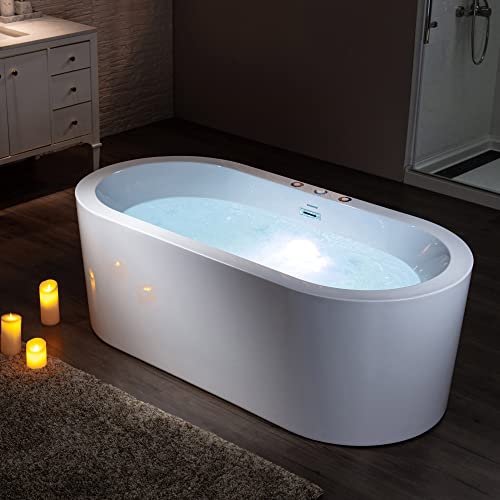
Take the compact WOODBRIDGE formula and give it the one thing it lacks: length. At 66-1/2 inches this version keeps the same sixteen-jet partnership of whirlpool and air, the same heated soaking design, the same adjustable blower and LED panel — with a chrome drain this time — and spends the extra inches entirely on the bather’s legs. Anyone over average height knows the difference between a tub that fits and a tub that accommodates; knees that stay submerged and a back that meets the sloped end properly change the soak from a compromise into a rest.
The maker’s word for this shell is spacious, and unusually for marketing language, the dimension backs it. The extra length also spreads the same jet count over a larger interior, which softens the whirlpool’s insistence slightly — a side effect taller bathers tend to welcome. Everything else about ownership mirrors the smaller model: the air side for gentle evenings, the water side for worked muscles, and a cleaning routine set by the whirlpool plumbing. Those ready to compare the two sizes directly can check price on Amazon for the 66-1/2-inch WOODBRIDGE, where the listing’s dimension drawing is worth a careful minute with a tape measure beside it.
Rooms that can take this length usually take it in a drop-in or alcove arrangement rather than freestanding, so plan the surround and access panel conversation with the installer early. A dual-system tub whose pump and blower can be reached without demolition is a tub that will still be serviceable in fifteen years.
There is a social dimension to the longer shell, too. Two people can share 66 inches without the negotiations a compact tub imposes — not sprawled, but genuinely together — and households that bathe together on weekends while solo-soaking on weekdays get both lives from this one purchase. The compact model cannot honestly promise that, and pretending otherwise would do nobody a service.
- Length: 66-1/2 x 31-7/8 inches
- Systems: whirlpool and air bubble jets, 16 total
- Heat: heated soaking design
- Controls: LED panel, adjustable air blower speed
- Trim: chrome drain, chromotherapy light
Strengths
- Real legroom for taller bathers in a dual-system shell
- Identical control set to the proven compact model
- Jets spread over a larger interior feel less insistent
Trade-offs
- Needs a bathroom that can genuinely spare the length
- Larger fill volume draws more heavily on the heater
- Whirlpool maintenance routine applies in full
Best for: taller bathers wanting both jet systems without folding themselves in. Not suited for: standard five-foot alcoves.
Garvee 71″ Freestanding Whirlpool Air Bubble Tub — Best Long Soak with Heat
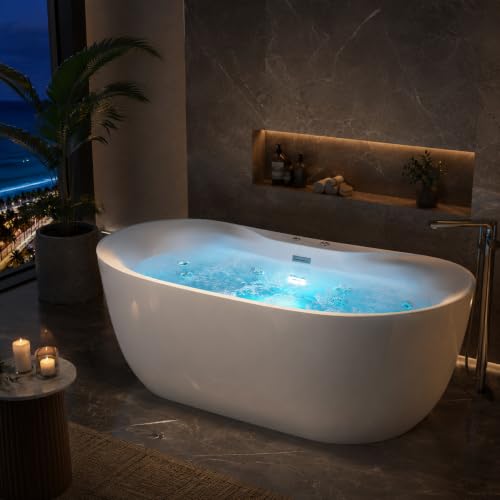
The Garvee states its priorities in its own listing language: powerful whirlpool jets, gentle air bubbles, built-in heating, and customisable LED lighting, wrapped in a 71-inch freestanding acrylic shell. That pairing of firm water jets with soft air is the dual-system bargain at its clearest, and the built-in heating is the feature that will be appreciated most often, on the cold evenings when a long soak is the whole point of the room.
Freestanding at this length makes a visual claim on the bathroom, and the Garvee’s oval form is drawn to carry it — this is a tub for a main bathroom with the floor space to walk around it and the intention to use it as the room’s centre. The heating also changes the filling ritual: because temperature is maintained in the tub, the bather can fill slightly cooler and let the system bring the soak to its level, rather than gambling on tap temperature. Households pricing the full project should remember the floor-standing filler a freestanding shell requires. The listing itself is the place to check price on Amazon for the Garvee and to look at how its jet layout is distributed along the shell.
A note on the lighting: customisable colour is best treated as a bonus rather than a reason. The reasons are length, heat, and the two water personalities sharing one shell. If those three suit the household, the light show is simply the tub dressing for the evening.
Buyers comparing this Garvee against the Empava at the same length should decide by wall or by island: the Empava composes against a wall and fills through waterfalls, while the Garvee stands free and fills through a separate filler. Both lead with heat and bubbles; the room, as ever, casts the deciding vote, and it should be allowed to.
- Length: 71 inches, freestanding oval
- Systems: whirlpool jets plus air bubble massage
- Heat: built-in heating for the soak
- Features: customisable LED lighting
- Shell: acrylic, deep soaking form
Strengths
- Full length with heat and both jet personalities
- Freestanding oval anchors a large bathroom visually
- Heating removes the top-up ritual from long soaks
Trade-offs
- Demands genuine floor space on all sides
- Freestanding filler adds to the project total
- Dual systems mean dual maintenance habits
Best for: dedicated bathers with a big bathroom and long evening soaks in mind. Not suited for: compact rooms or minimal-feature households.

WOODBRIDGE 71″ Double Slipper Whirlpool and Air Tub — Best Classic Silhouette
The double slipper is the oldest elegant shape in bathing — both ends raised and rolled, so a bather can recline against either — and this WOODBRIDGE fills that traditional outline with thoroughly modern equipment: whirlpool and air bubble jets totalling sixteen, a heated soaking design, an adjustable blower, an LED control panel, chrome drain, and chromotherapy light. In a period house or a bathroom styled toward the classic, it delivers the dual-system experience without asking the room to pretend it is a spa showroom.
The raised ends are not mere decoration. A slipper end supports the shoulders at a steeper, more seated angle than a modern oval’s shallow slope, which readers and tea-drinkers in the bath genuinely prefer, and having that support at both ends lets the bather face the window or the door as the mood dictates. The trade is a slightly shorter flat floor in the middle, irrelevant to a seated soaker. Buyers drawn to the silhouette can check price on Amazon for the double slipper WOODBRIDGE and study the end profile in the listing photographs, since that curve is the entire reason to choose it.
Chromotherapy in a classic shell will amuse some visitors, but the light sits discreetly and can simply be left off. What cannot be left off is the shape itself, which will still look right in the room decades after lighting fashions have moved on — a fair definition of buying well in a traditional bathroom.
One caution belongs to the shape rather than the systems: a slipper tub’s raised ends make stepping in a slightly more deliberate act than in a low modern oval, since the rim at the middle is where entry happens and the ends rise on either side. A bath mat with grip and a moment’s care answer it fully, but bathers choosing for unsteady mornings should weigh the low-sided picks above first.
- Length: 71 x 31-1/2 inches, double slipper profile
- Systems: whirlpool and air bubble jets, 16 total
- Heat: heated soaking design
- Controls: LED panel, adjustable air blower speed
- Trim: chrome drain, chromotherapy light
Strengths
- Classic raised-end shape with full modern systems
- Steep end support suits bathers who sit up to read
- Recline either way; no wrong end of the tub
Trade-offs
- Slipper ends shorten the flat floor between them
- Traditional styling will clash with stark modern rooms
- Whirlpool lines require their regular cleaning
Best for: classic bathrooms wanting dual jets inside a period-appropriate silhouette. Not suited for: minimal modern schemes or bathers who lie fully flat.
What Should You Ask an Installer About a Powered Tub?
Ask where the blower will breathe. Every air system inhales room air and exhales it through the water, and an installer who plans the intake path — rather than sealing the unit into the first cavity available — delivers a quieter, longer-lived installation. Ask how the pump and blower will be reached in five years: an access panel positioned now costs almost nothing, while reaching a buried blower later costs a surround. Ask, too, about the circuit, and have the electrician confirm the panel can carry the heater’s draw before the tub is ordered, since that single answer can reorder a shortlist.
Finally, ask about the first fill. A good installer fills the tub, runs both systems, and checks every jet and the drain under working conditions before the surround is closed or the freestanding shell is finally positioned. That half hour is the cheapest quality control in the entire project, and it is far easier to insist on while the tools are still in the room than to request a return visit for a weeping fitting.
How Do You Care for Acrylic Around Jets, Lights, and Panels?
Acrylic asks for gentleness and rewards it with a long gloss. A soft cloth, warm water, and a mild non-abrasive cleaner handle the weekly wipe; scouring powders and stiff brushes cloud the surface in ways no polish fully reverses. Around jet faces and air ports, a soft brush lifts the soap film that collects in the detail, and around the control panel a dry cloth beats a wet one, since electronics and enthusiasm for spraying rarely mix. Chrome and matte trim each prefer a simple wipe and dry, which prevents the water spotting that makes new tubs look older than they are.
Once a season, give a dual-system tub its line flush on the whirlpool side, following the maker’s method, and run the air purge after every bath as a matter of rhythm. That is the whole liturgy. Owners sometimes expect powered tubs to demand spa-technician devotion; in practice they demand less attention than a coffee machine, provided the little routines are done little and often rather than heroically and late.
How Do the Six Air Jet Tubs Compare Side by Side?
| Pick | Length | Air system | Other system | Defining trait |
|---|---|---|---|---|
| Empava 71″ Jetted Tub with Air Bubble Massage | 71 in | Air bubble massage | Inline heater | Back-to-wall, twin waterfalls |
| FerdY Tahiti 55″ Freestanding Whirlpool Tub | 55 in | Combined air-water jets | Whirlpool action | Smallest freestanding here |
| WOODBRIDGE 59″ Compact Whirlpool and Air Tub | 59 in | Air bubble jets | Whirlpool jets | Full menu, compact shell |
| WOODBRIDGE 66-1/2″ Whirlpool and Air Tub | 66-1/2 in | Air bubble jets | Whirlpool jets | Legroom version of the combo |
| Garvee 71″ Freestanding Whirlpool Air Bubble Tub | 71 in | Air bubbles | Whirlpool jets | Built-in heating, freestanding |
| WOODBRIDGE 71″ Double Slipper Whirlpool and Air Tub | 71 in | Air bubble jets | Whirlpool jets | Classic double-ended shape |
How Does Water Depth Change the Air Experience?
Air ports sit low in the shell, and they need the bather’s body covered to do their work; a shallow fill turns the system into a surface disturbance rather than a full-body wrap. This is why the depth of the bathing well — the distance from the floor of the tub to the overflow — quietly matters more in an air tub than in a plain soaker of the same length. A deep, shorter tub like the Tahiti can deliver a more complete bubble bath than a long, shallow one, because the bubbles rise through more water around the body. When comparing listings, look for the soaking depth figure and treat it as a headline specification rather than fine print.
Depth also disciplines the fill bill. A deep narrow well reaches a satisfying level with less water than a broad shallow one, which is kind to both the heater and the household’s patience. The experienced air-tub buyer therefore reads three numbers in order — well depth, interior length, exterior length — and only then looks at the photographs, however handsome the room staging happens to be.
What Mistakes Do Air Tub Buyers Keep Making?
Assuming the category name describes every tub in it is the first and commonest error. As this very list shows, most strong models are partnerships between air and water, and a buyer who wanted bubbles alone and ordered without reading would feel misled by their own shortcut. Read the system description in the maker’s words, decide whether air-only, air-led, or dual suits your bathing, and only then compare shapes and sizes.
The second mistake is ignoring the blower’s working conditions. A blower starved of air by a sealed installation runs hot and loud; a blower given its specified clearance hums along for years. Talk access and ventilation through with the installer before the tub is committed to its position, not after the surround is built. Third, buyers forget the electrical plan until the tub is in the room: powered tubs need a proper protected circuit, and arranging it during the remodel is a fraction of the cost of arranging it afterwards. Finally, do not let lighting demonstrations in a showroom choose the tub. Lights are the least-used feature on most jetted baths within a year; jet character, heat, and fit are used every single soak.
What Does Ownership Cost Beyond the Tub Itself?
The honest ledger has four lines beyond the shell. Installation leads: a freestanding tub needs its filler and a floor connection, an alcove model needs its surround made good, and every powered model needs the electrician’s visit for its protected circuit. Water and energy follow — a 71-inch heated soak is not free to run, though it compares kindly with heating a small room or filling a whirlpool bath twice from the tap. Maintenance costs are mostly time rather than money: line cleaner for whirlpool halves, a cloth and mild cleaner for acrylic, and the occasional professional visit if a pump or blower ever tires.
Set against that ledger is the usage line, which is where these tubs justify themselves. A bath drawn three evenings a week spreads its costs across hundreds of soaks a year; a bath drawn twice a month never will, whatever its price. Buyers hesitating between a modest tub they will use constantly and a grand one they will use ceremonially should let that arithmetic speak — it argues for the compact WOODBRIDGE more often than the showroom does.
Which Installation Style Suits Which Room?
Freestanding shells suit rooms with space to walk around them and a desire for the tub to be the room’s subject; they also forgive imperfect walls, since nothing must meet them. Back-to-wall designs like the Empava suit the same taste in tighter rooms, trading the all-round gap for one clean wall line and simpler plumbing. Alcove and drop-in arrangements suit working bathrooms where storage, screens, and shower-over-bath practicality still matter, and where the tub must earn its place among other furniture. The technology inside is identical across all three; the choice is architectural, not mechanical, and should be made by the room rather than by the catalogue.
Final Recommendation
Decide your jet personality first and your silhouette second. Bathers who know bubbles are the point should start with the Empava, the one pick here that leads with air and backs it with a heater. Bathers who want both personalities in a normal bathroom should take the compact WOODBRIDGE seriously, and taller readers its 66-1/2-inch sibling. The Garvee serves the grand bathroom and the long soak; the double slipper serves the beautiful one. The Tahiti, smallest of all, may be the cleverest buy on the page for the small rooms most of us actually own. Whichever shell comes home, the first evening the blower starts and the water fills with rising bubbles, the bathroom goes quiet in a way no specification sheet can quite promise — and that quiet is what you were buying all along.
A last word on ordering: powered tubs are heavy, fragile in transit, and miserable to return, so the hour spent confirming dimensions, drain handing, and circuit capacity before checkout is the best-value hour in the project. Take the photographs of your bathroom to the listing, not the other way round, and let the room veto anything it cannot honestly hold.
Frequently Asked Questions
Can I use bath oils or salts in an air jet tub?
On the air side, generally yes — since no pump is recirculating the water, oils and salts are far less troublesome than in a whirlpool. In a dual-system tub, the whirlpool half sets the rules: if you plan to run the water jets, follow the maker’s guidance on additives, and rinse the shell after indulgent baths either way.
How often do air channels need cleaning?
Barely at all, which is their charm. Running the blower for a short purge after the tub drains clears the channels, and they dry naturally between baths. The whirlpool lines in combo models are the ones on a schedule — a periodic flush per the maker’s instructions keeps them fresh.
Does an air tub need its own electrical circuit?
Expect yes. A blower plus a heater is a meaningful load, and powered tubs are normally installed on a dedicated protected circuit arranged by an electrician during the fit. Confirm the requirement in the listing for the model you choose, because heaters in particular change the calculation.
Why does the water feel cooler with the bubbles running?
Because the bubbles are doing it — each one rises through the water and carries warmth off the surface, and the blower is constantly introducing air. It is the physics of the pleasure, and it is exactly why the heated models in this guide hold such an advantage for long soaks.
Do air jets work while someone showers over the tub?
They are designed for a filled bath, not a shower, and running a blower in an empty or ankle-deep tub mostly makes noise and spray. In a combined installation the shower serves the quick morning wash and the air system serves the evening; each does its own job properly rather than covering for the other.
Are air jet tubs suitable for two bathers?
The 71-inch models can seat two at a companionable squeeze, though their jet layouts are drawn around a primary bather. Households where shared bathing is the main event usually step up to dedicated two-person designs; occasional shared soaks, however, are well within what the longer shells here offer.
How long does a blower typically last?
Blowers are among the simpler components in a powered tub — a motor and a fan — and with their air intake kept clear they commonly serve for many years. The practical protection is the access arrangement discussed earlier: a blower that can be reached can be replaced in an hour, whenever that day eventually comes. Asking the installer to label the access route and leave the blower’s paperwork with the tub’s documents turns that future hour into a simple job rather than an archaeological dig through a sealed surround.
Can an air tub be fitted where a whirlpool tub already sits?
Usually, yes, and the swap is one of the smoother remodels in bathing. The footprint and drain position often carry over, the existing circuit may serve the new blower subject to an electrician’s check, and the household trades water-filled lines for dry air channels in the process. The old tub’s removal remains the disruptive day; everything after it is fitting rather than building.
Related Guides
When five feet is the hard limit rather than a starting point, our dedicated roundup of Best 60-Inch Air Jet Bathtubs narrows this same technology to the standard alcove, model by model. Readers still deciding between bubbles and water pressure as their primary system will find the head-to-head discussion earlier in this guide the quickest route to a settled mind, since the two technologies suit genuinely different evenings.


