What's inside
- Key Takeaways
- Quick Picks
- How Did We Choose These Baby Tubs for Kitchen Sinks?
- How Do You Prepare a Kitchen Sink for a Baby’s Bath?
- Why Do Flower Pads Work So Well in a Sink?
- Soft Tub, Pad, or Structured Bather: Which Suits Your Household?
- When Does the Sink Stage End?
- How Do You Keep Sink Bathing Hygienic Week After Week?
- How Does a Sink Bath Run, Step by Step, on an Ordinary Evening?
- What About Siblings, Pets, and the General Audience?
- What Does the First Sink Bath Teach a New Household?
- How Do the Six Sink Picks Compare Side by Side?
- How Do You Size a Pad or Bather for an Unusual Sink?
- What Happens to Sink Pads After the Baby Graduates?
- What Mistakes Do Sink-Bathing Buyers Keep Making?
- Why Do Midwives and Grandmothers Keep Recommending the Sink?
- What Should You Have Within Reach Before the Water Runs?
- Final Recommendation
- Frequently Asked Questions
- Related Guides
As an Amazon Associate I earn from qualifying purchases. This post may contain affiliate links at no extra cost to you.
cottageverdict.com is reader-supported. When you buy through links on our site, we may earn an affiliate commission.
Where to buy: Each product in this guide to the best baby tubs for kitchen sinks is sold on Amazon under its maker’s name. Follow a linked pick to check price on Amazon and to confirm the sink dimensions and age guidance it was designed around.
Before the products, the ground rule of this whole category, stated without softening: a baby bathing in a sink is held in your attention and within your reach from the first second to the last, with no exceptions for the kettle, the phone, or the toddler asking a question from the doorway. Sink bathing is chosen because it brings the baby up to a comfortable height — it never licenses a step away, and every pad and bather below is a cushion for the baby, not a minder. The best baby tubs for kitchen sinks earn their place inside that rule, by making the sink’s hard, slippery basin soft, warm, and shaped for a newborn who cannot yet hold up their own head.
Why the sink at all? Because the first weeks of parenthood are hard on adult bodies. A parent recovering from birth, or any parent with a complaining back, faces a long bend over a low bath with a wet, wriggling newborn at the end of it — and the kitchen sink abolishes the bend. The baby bathes at counter height, the taps are right there, the water is a kettle’s worth rather than a tub’s, and the whole event takes minutes in the warmest room of the house. For a small newborn, the sink is also reassuringly proportioned: a basin that fits the baby feels safer to everyone than a vast bath in which a tiny body can slide.
The products divide into three families. Soft sink tubs, led by the Skip Hop below, are shaped vessels that sit in the basin and hold their own water. Flower pads — the blooming mats that fill a thousand nursery photographs — cushion the sink’s own surface so the baby lies in the basin itself. Structured bather inserts recline the baby at a supported angle and travel between sink and bath. All six picks serve the newborn months; when the baby outgrows the sink, the household graduates to the bathroom equipment our companion pages describe, beginning with the overview waiting in Related Guides.
Key Takeaways
- Supervision at arm’s reach is absolute in a sink, exactly as it is in a bath.
- Sink bathing exists to save the adult’s back and to keep a tiny baby in a proportioned space.
- Flower pads cushion the basin itself; soft tubs hold their own water inside the basin.
- Clean the sink thoroughly before every bath — it is a food-preparation surface the rest of the day.
- The sink stage is measured in weeks and early months; buy light, dry everything, and graduate on time.
Quick Picks
| Pick | Badge | Why it earns its place |
|---|---|---|
| Skip Hop Moby Soft Sink Bath Tub | Best Soft Sink Tub | A cushioned whale-shaped tub that sits in the sink and holds its own bath water for newborns. |
| PandaEar Baby Bath Pad, Flower Petals | Best Flower Pad, Pink | A soft petal pad that turns a bare basin into a cushioned cradle, in a giftable pink. |
| TOFOAN Baby Bath Flower Mat | Best Large Lotus Mat | A generous 31-inch lotus mat with petal support for bigger sinks and bigger newborns, in blue. |
| lalalark Foldable Baby Sink Bath | Best Structured Sink Bather | A folding sink bather with non-slip support and four-hole water level control for the first six months. |
| Ingenuity Foldaway 2-Position Bather | Best Two-Position Bather | Two recline positions for sink or bath, from a trusted baby brand, up to six months or twenty pounds. |
| Flower Baby Bath Pad for Sink, Gray | Best Neutral Flower Pad | The classic flower-pad idea in a calm grey that suits any kitchen and any baby. |
How Did We Choose These Baby Tubs for Kitchen Sinks?
Fit came first, because a sink product that does not fit the sink is a photograph, not a product. We favoured pads wide enough to cushion a standard basin generously and tubs shaped to sit stable inside one, and we read every listing for its stated age envelope — the honest ones here speak of newborns and the first six months, which is the sink’s true jurisdiction. Products claiming to serve toddlers from a kitchen sink were treated as confused about their own category.
We also handled the category’s photography with care. Flower pads are among the most staged objects in the nursery market, photographed in gleaming sinks under studio light with improbably serene babies. The staging does not invalidate the design — the petals genuinely work — but we weighted the listings that showed dimensions, care instructions, and the pad in an ordinary basin over those that offered only the portrait, and the survivors are products a household can evaluate with a tape measure rather than a mood.
Cushioning and drainage were judged together. A pad must soften porcelain, enamel, or steel without becoming a cold, waterlogged sponge; the flower designs earn their shape here, since petals hold air and water in a way a flat mat does not, and they dry petal by petal on a line. Structured bathers were judged on recline support and grip, and on how completely they fold away, because a sink bather stored in a kitchen must compete with everything else a kitchen stores. Finally, we kept the set honest across budgets and tastes: one soft tub, three flower pads in two colours and two sizes, and two structured bathers from different design schools.
How Do You Prepare a Kitchen Sink for a Baby’s Bath?
Scrub it like you mean it. The kitchen sink spends its day meeting raw food, dishwater, and the sponge, and a newborn’s skin deserves a basin cleaned properly before the bath: wash the basin and the tap area with hot soapy water, rinse away every trace of cleaner, and lay a clean towel or the pad itself between the baby and any surface you could not prepare to your satisfaction. Clear the counters around it, move the washing-up out of splash range, and set out the towel, clothes, and nappy before the water runs — the arm’s-reach rule means the bath cannot pause for a forgotten vest.
Then mind the tap. A kitchen faucet is the one hard, hot object in the arrangement; position the baby with the head away from it, consider a soft tap cover if the baby will face it, and test the mixed water in the basin before the baby goes near it, wrist or elbow, as with any bath. Fill shallow — a few inches over the pad — because a sink bath is a warm wash, not a deep soak, and the baby’s body should rest supported with the head clearly above the waterline on the pad’s raised centre or the bather’s recline.
Why Do Flower Pads Work So Well in a Sink?
Because the petal shape solves three problems at once. The raised centre cradles the baby’s back and lifts the head, the petals spread to cushion the basin’s corners and edges wherever they fall, and the whole flower conforms to round, square, single, and double basins without needing to know which one it is in. A rigid tub must match a sink; a flower simply blooms in it. That adaptability is why the design has survived a decade of nursery fashion while trendier objects have come and gone.
The petals also manage temperature kindly. The foam inside them holds the bath’s warmth against the baby’s back instead of conducting the cold of the basin through, which is the difference between a baby who relaxes into the water and one who startles at every contact with the sink itself. After the bath, the flower hangs by a loop or over a rail and dries through its petals — provided the household actually hangs it, a discipline this guide will repeat until it sticks, because a damp flower stored in a cupboard is a mildew garden with good public relations.
There is a sizing subtlety inside the flower family worth one more paragraph. Petals that are too small for the basin leave the rim’s hard line exposed exactly where a kicking baby’s heel lands, while petals too large fold over each other and create a lumpy bed. The sweet spot is a flower whose span meets the basin’s edges with the petals lying nearly flat — which is why this guide keeps returning to the tape measure, the least glamorous and most decisive instrument in the nursery.
Soft Tub, Pad, or Structured Bather: Which Suits Your Household?
Choose the soft tub if your sink is large, your baby is at the very beginning, and you like the idea of the water travelling with the baby — a filled sink tub can be set on a counter or table where a pad in a basin cannot. Choose a flower pad if your sink is the bath, your storage is a hook, and your taste runs to the simple and washable; pads are also the cheapest route into sink bathing and the easiest to hand on. Choose a structured bather if the recline matters most — a baby who needs a defined angle, or parents who bathe the baby in both sink and bath and want the same support in each.
Households renovating around a growing family sometimes read this guide alongside our value-focused roundup of Best Bang-for-Your-Buck Bathroom Tubs, and the pairing is sensible: the sink serves the first months beautifully, but the family bath is where the next several years of bathing live, and choosing it well is the larger half of the same decision.
When Does the Sink Stage End?
When the baby’s length defeats the basin, when the kicks start travelling the pad across the sink, or when sitting arrives and the baby objects to lying back for a bath — whichever comes first, usually somewhere in the middle of the first year. The structured bathers here state their own ceilings, six months or twenty pounds, and the pads retire by the same evidence of size and wriggle rather than by date. Graduation is not a loss; the family bath, a support or seat, and a baby who now splashes back is one of the first year’s genuine upgrades.
It is worth saying that the sink habit leaves a legacy. Parents who began at counter height often keep a stool at the family bath afterwards, or choose bathing arrangements that respect the adult’s back as the baby grows heavier — a kindness to themselves that began with a flower in the kitchen sink. Readers planning the long arc of family bathing sometimes glance at how the grown-up end of the house handles shared water, where our guide to Best 10-Person Hot Tubs describes the largest bathing format we cover; the journey from a sink pad to a ten-person spa is the whole biography of a family’s water, told in two product categories.
How Do You Keep Sink Bathing Hygienic Week After Week?
The basin gets its scrub before every bath, without exception, and the equipment gets its drying after every bath, with the same lack of negotiation. Pads hang until they are dry to the centre, not merely to the touch; bathers are rinsed and stood open; the soft tub is emptied, wiped, and stored where air reaches it. Once a week, wash the pads as their labels direct and inspect the petals’ seams, because a flower works hard in its short career and deserves a retirement the moment its cushioning thins or its stitching tires.
Keep the baby’s kit separate from the kitchen’s working tools in storage, even if the bath itself happens in the working sink. A hook or basket reserved for the pad, the towel, and the washcloths makes the gather-first routine automatic and keeps the baby’s things from migrating into the dish rack’s orbit. Small separations, maintained daily, are what hygiene actually consists of — a truth the outdoor-bathing world rediscovers at larger scale in our pages on Best 6-Person Plug-and-Play Hot Tubs, where the water is shared by six and the cleaning calendar matters even more.
How Does a Sink Bath Run, Step by Step, on an Ordinary Evening?
It begins with the kitchen put briefly on hold: dishes cleared, counters wiped, the baby’s basket set down within reach of the sink. The basin is scrubbed and rinsed, the pad or bather placed and settled, and the water run shallow and mixed, then tested at the wrist. Only when all of that stands ready does the baby enter the room, undressed at the last moment in the warm kitchen, and lowered onto the support with one adult hand maintaining contact from the first touch of water to the last.
The wash itself is unhurried and brief — face with plain water, body with a gentle wash, hair last of all — and the lift out lands the baby straight onto the waiting towel on the counter or the adult’s chest. Dressing happens on the spot, in the warm room, and the equipment is rinsed and hung before the kitchen resumes its evening. Timed honestly, the whole production runs inside fifteen minutes, most of it preparation, which is why experienced parents describe sink bathing as the easiest bath of the entire first year.
The evening timing is itself a choice worth making deliberately. Many households run the sink bath just before the last feed, when the kitchen is warm from cooking and the baby is hungry enough to be motivated and not yet tired enough to object. A bath that ends in a feed and a sleep is a bath that earns its place in the routine, and routines that end in sleep are guarded by parents like state secrets.
Cold-season households should warm the kitchen a little before the bath rather than after the protest begins, and summer households should mind the opposite — a sun-hot kitchen and a baby who needs the water on the cooler side of comfortable. The sink sits in the house’s climate more honestly than the bathroom does, which is one more reason the water is tested at the wrist every single time, in every season, without exception.
What About Siblings, Pets, and the General Audience?
A kitchen bath attracts spectators, and the household should choreograph them as carefully as the water. An older sibling can be stationed as the official towel-holder at a safe distance — a real job, proudly held — but never as a holder of the baby. Partners not bathing can run the perimeter: kettle, clothes, door. Pets, however beloved, leave the room for the duration, because a cat on the counter beside a sink bath is a variable nobody needs.
Photographs will be taken, and should be — the flower-pad bath is one of the first year’s iconic images — but the camera belongs to the adult who is not bathing the baby. The bathing adult’s hands and attention are the safety system, and a system does not take pictures. Households that assign the roles before the water runs get both the photograph and the uneventful bath it celebrates.
Visitors deserve a briefing as firm as the pets’ exile. A well-meaning grandparent who lifts a wet baby for a cuddle mid-bath means love and creates risk in the same gesture, so the household’s roles should be announced cheerfully and early: watchers watch, holders hold the towel, and the bather bathes. Said with a smile before the water runs, it is hospitality; said in a panic during it, it is a scene.
The dog, exiled, will forgive everyone by bedtime. The cat will not, but the cat was never going to, and a household that can keep its bathing rules against feline lobbying can keep them against anything the first year produces.
One spectator is genuinely useful, though: the partner with the camera who also watches the clock of the routine — supplies complete, water tested, towel ready — and calls the sequence like a quiet stage manager. Sink baths run best as a two-adult production in the first fortnight, and households that staff them properly learn the steps twice as fast as those that improvise solo.
By the second month, most households run the production with one adult and a sleeping household, the basket stocked, the pad hanging ready, the sequence in the hands rather than the head. That quiet competence is the sink stage’s real graduation — the baby’s move to the big bath merely makes it official.
Keep one photograph of that competent version, too, taped inside a cupboard door: the stocked basket, the hanging pad, the order of the clothes. On the tired evenings that still come, the picture restores the system faster than memory can, and the bath runs on rails laid down by your rested selves.
That, in the end, is what every product in this guide is really selling: not petals, not foam, not a fold, but a routine a tired household can run perfectly at the end of a long day, with a baby who comes out of the water warm, clean, and entirely unbothered by the logistics. The products differ; that destination does not, and choosing the one whose shape suits your sink is simply choosing the shortest road to it, and the road is short enough that the whole household will be running it from memory before the first month is out, which is exactly the kind of head start a new family should expect from its simplest equipment.

Skip Hop Moby Soft Sink Bath Tub — Best Soft Sink Tub
Skip Hop’s Moby line is a nursery fixture, and this soft sink tub brings the whale to the kitchen: a cushioned, shaped vessel that sits inside the basin and holds the bath water itself, cradling a newborn in a soft recline rather than asking the sink to be the bath. For parents whose sink is small, oddly shaped, or simply not a surface they want the baby resting against directly, a tub-within-the-sink is the tidy answer — the water, the warmth, and the baby all contained in one soft object that lifts out afterwards.
The softness is the argument and the design is the charm, in that order, though the charm should not be undersold: equipment that makes tired parents smile gets used more carefully, and the Moby shape has been making parents smile for years. The cushioned walls suit the youngest babies best, the ones for whom every surface should yield. Parents who like the contained-water approach can check price on Amazon for the Moby sink tub and measure their basin against the listing’s footprint before ordering, since a soft tub still has a size even if it forgives the sink’s shape.
After the bath, the whole vessel lifts out and the sink returns to kitchen duty in seconds — the fastest venue change in this guide, and a real consideration in a small home where the kitchen cannot be annexed by the nursery for longer than the bath itself lasts.
The whale shape earns a practical footnote as well: its raised tail end gives the adult a natural handle and a visual head-end marker, so the tub is oriented correctly in the basin by instinct, in dim evening light, by a parent running on very little sleep. Design that communicates without instructions is doing quiet safety work.
- Type: soft tub that sits in the sink
- Water: holds its own bath water
- Support: cushioned recline for newborns
- Design: Moby whale styling
- Maker: established baby brand
Strengths
- Contains the water; the sink’s surface never touches the baby
- Cushioned walls suit the very youngest babies
- Lifts out whole, returning the kitchen instantly
Trade-offs
- Needs a basin large enough to receive it
- Soft structure offers less defined recline than a bather
- Newborn stage only, like everything here
Best for: newborns whose parents want a contained, cushioned sink bath. Not suited for: very small sinks or babies past the recline stage.

PandaEar Baby Bath Pad, Flower Petals — Best Flower Pad, Pink
The PandaEar is the flower pad in its most giftable form: a soft petal cushion in pink that opens in the basin and turns cold porcelain into a cradle. PandaEar sells it squarely as a shower gift, and the positioning is honest — this is the object that photographs like a present and works like equipment, cushioning the baby’s back and head while the petals spread to cover the sink’s hard geometry in any direction.
In use, the flower’s virtues are the category’s virtues, well executed: the baby lies in the sink’s own shallow water, warmed by the pad beneath rather than chilled by the basin, while the adult washes at counter height with both hands available in turn. The pad rinses, squeezes, and hangs to dry, and its career, like all sink careers, is a short and intensive one. Gift-givers and pink-committed households can check price on Amazon for the PandaEar pad, keeping in mind that the basin it must cushion should be measured across, since even a flower has a span.
One practical grace of the petal design appears at laundry time: the flower flattens into a wash and hangs in a small space, so the household with no utility room can still keep it in the dry-and-fresh rotation this guide keeps insisting on.
Pink also performs one small service in a busy kitchen: it is unmistakably the baby’s territory. Nobody stacks dishes on a pink flower, nobody mistakes it for a dish mat, and the basin’s bath-time identity is declared at a glance to every member of the household, including the ones who were not listening earlier.
- Type: flower petal bath pad
- Use: cushions the sink basin directly
- Finish: pink
- Positioning: newborn sink bathing and gifts
- Care: rinse, squeeze, hang to dry
Strengths
- Conforms to almost any basin shape
- Presents beautifully as a shower gift
- Simple to wash, dry, and store on a hook
Trade-offs
- Pink only, for households avoiding it
- Baby rests in the basin, so the sink scrub matters
- Outgrown with the sink stage itself
Best for: gift-givers and pink nurseries bathing a newborn in the sink. Not suited for: anyone wanting the water contained in a separate vessel.

TOFOAN Baby Bath Flower Mat — Best Large Lotus Mat
TOFOAN’s lotus is the flower pad grown larger: a 31-inch mat whose petals support the baby across a generous span, in blue, described by its maker as a petal-soft lounger for the sink or the infant tub. Size is its whole argument, and it is a good one. Farmhouse sinks, wide single basins, and long newborns all defeat standard pads at the edges; a mat with inches to spare covers the basin’s rim line and gives a bigger baby room to lie at full length while the sink stage lasts.
The lotus shaping — layered petals rather than a single ring — distributes support under the back and head with a slightly more sculpted feel than the simpler flowers, and the mat works in a baby tub as well as a sink, which extends its usefulness into the transition weeks when the household is bathing in both venues. Parents with a big sink or a big baby can check price on Amazon for the TOFOAN mat and compare its 31 inches against their basin’s diagonal, which is the measurement that decides.
Blue will suit the households that pink excludes, and between this mat and the PandaEar above, the flower category covers both traditional colour camps at two sizes — a small completeness that gift-buyers shopping for twins of different nurseries may quietly appreciate.
The lotus also forgives an unlevel basin better than its smaller cousins, since its layered centre builds a flatter lying surface over a sloped floor. Older sinks with a pronounced fall toward the drain — exactly the sinks a small pad slides on — are steadied by that architecture, which is a genuinely useful trait disguised as a size upgrade.
- Type: lotus flower bath mat
- Size: 31 inches across
- Use: sink or infant tub
- Finish: blue
- Support: layered petal lounger
Strengths
- Largest span here, for wide basins and long babies
- Works in a baby tub as well as the sink
- Layered petals give a sculpted support
Trade-offs
- May overwhelm a small bar sink entirely
- Larger pad takes longer to dry through
- Blue only in this listing
Best for: farmhouse sinks, wide basins, and larger newborns. Not suited for: compact sinks where a standard pad already covers.

lalalark Foldable Baby Sink Bath — Best Structured Sink Bather
The lalalark is the engineer’s entry in a category of cushions: a foldable sink bather with a non-slip support surface and a four-hole water level control, designed for newborns and infants from birth to six months, folding slim for storage. The water level feature deserves explanation, because it is genuinely useful — the holes let the bath settle at a chosen depth in a basin whose own depth varies, giving the parent a repeatable fill rather than a nightly estimate.
Structure is the difference from the pads. Where a flower conforms, this bather defines: a recline angle that stays where it was set, a support that does not drift across the basin, and a frame that folds to a slim profile a kitchen drawer or a narrow cupboard can accept. Parents who found pads too free-form, or whose sink is deep and steep-sided, will feel the appeal immediately. They can check price on Amazon for the lalalark bather and note the six-month envelope against their baby’s expected growth.
The slim fold also makes it the sink bather most likely to be lent, borrowed, and travelled with, since it packs like a book rather than a bouquet. Households that value order in a small kitchen will understand that as a headline feature rather than a footnote.
The level-control holes teach a good habit to first-timers, too: they make depth a decision taken once, at setup, rather than a judgement remade nightly over a running tap. Repeatability is the soul of a safe routine, and this little frame builds it into the hardware.
- Type: structured foldable sink bather
- Age span: newborn to 6 months
- Support: non-slip reclined support
- Water: four-hole level control
- Storage: slim fold design
Strengths
- Defined recline that stays set in the basin
- Water level holes make the fill repeatable
- Folds slimmest of the structured options
Trade-offs
- Six-month ceiling, firmly stated
- Less enveloping softness than a petal pad
- Unbranded maker; inspect on arrival
Best for: parents who want a set recline and a controlled water level. Not suited for: anyone seeking the softest possible cradle.
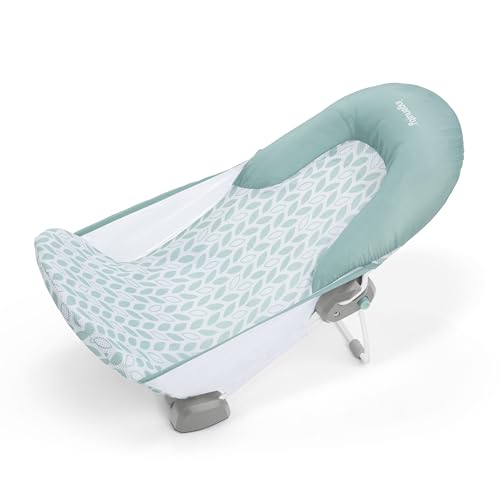
Ingenuity Foldaway 2-Position Bather — Best Two-Position Bather
Ingenuity’s bather brings a trusted name and a two-position recline to the sink: a support that adjusts as the baby grows through the first six months, works in the sink or the bathtub, and folds away when the bath is done, rated to twenty pounds. The two positions track the newborn’s first transformation — from the full recline of the earliest weeks to the lifted lean of the baby who wants to watch the room — without asking the household to buy the second support the transformation usually requires.
Brand matters in this category more than the products’ simplicity suggests, because the bather is bought before the baby arrives and judged under the least rested conditions of adult life. A maker with a catalogue, instructions that make sense at midnight, and a support channel is worth having behind an object a newborn will lie on. Parents who share that view can check price on Amazon for the Ingenuity bather and compare its fold with the lalalark’s; the two structured picks divide the honours between brand assurance and water-level cleverness.
The sink-or-tub versatility quietly extends its career, too: when the sink stage ends, the same bather at its lifted position serves the first baths in the family tub, smoothing a transition that strands many single-venue products in the cupboard.
There is a confidence dividend to bathing a baby on equipment from a maker whose other products fill the nursery. When the bather behaves exactly as its instructions promised at the first use, new parents borrow that trust for the rest of the evening’s unfamiliar tasks, and borrowed confidence is a real resource in the first six months.
- Type: two-position reclining bather
- Age span: 0 to 6 months, up to 20 lb
- Positions: two recline settings
- Use: sink or bathtub
- Storage: foldaway design
Strengths
- Two reclines follow the first half-year
- Trusted baby brand behind the design
- Bridges from sink into the family bath
Trade-offs
- Twenty-pound ceiling arrives quickly for big babies
- Firmer structure than the petal pads
- Foldaway frame has more parts to rinse
Best for: parents wanting brand backing and a recline that grows. Not suited for: babies already past twenty pounds.

Flower Baby Bath Pad for Sink, Gray — Best Neutral Flower Pad
The classic flower pad, in the colour that goes with every kitchen ever built: grey. This pad does what the design has always done — opens into the basin, cradles the newborn on a cushioned centre, spreads its petals over the hard edges — while declining to declare a nursery theme in the middle of the cook’s workplace. For households whose kitchen is grey, steel, and serious, it is the only flower that will not look like it wandered in from a christening.
Neutrality has a second career advantage: hand-me-downs and second babies of every description inherit a grey pad without a colour conversation, and grandparents buying for an unknown nursery cannot choose wrong. The working virtues are the category’s own — conforming fit, warm cushioning, hang-it-up drying — delivered without ornament. Anyone who wants the flower idea at its plainest can check price on Amazon for the grey pad and spend the saved deliberation on measuring the sink instead.
It is also, quietly, the pad most likely to be bought twice: one for the kitchen sink at home, one for the sink at the other end of the family’s life — a holiday house, a grandparent’s bungalow — since its price and neutrality make duplication painless.
Grey also hides the honest wear of a working pad better than the pastel colours do, staying presentable through its whole short career. In a category where the products are used hard and briefly, looking respectable at the end of the season is a legitimate, if modest, virtue.
- Type: flower bath pad
- Use: sink or infant tub basin
- Finish: grey
- Support: cushioned petal cradle
- Care: rinse and hang to dry
Strengths
- Neutral colour suits every kitchen and baby
- Classic conforming flower design
- Easy to duplicate for a second household
Trade-offs
- No structural recline; the pad conforms instead
- Basin must be scrubbed before every bath
- Unbranded listing; check the unit on arrival
Best for: neutral kitchens and second-household duplicates. Not suited for: parents wanting a defined recline angle.
What Does the First Sink Bath Teach a New Household?
That the kitchen was always a nursery in waiting. The first bath gathers the whole household’s new reality into one warm room — the basket of supplies, the assigned roles, the photograph taken by the right pair of hands — and proves to everyone present that the production is manageable. Parents consistently report that the sink bath, more than any other early routine, is the one that first made them feel competent, because its scale is human and its feedback is immediate: a warm, clean, contented baby, achieved at counter height in a quarter of an hour.
It also teaches the household its own choreography for every later stage. The gather-first discipline, the tested water, the unbroken attention — learned over a flower pad in the sink, those habits transfer intact to the family bath, the seat stage, and the toddler years, which is why this small category punches so far above its size in a family’s memory.
How Do the Six Sink Picks Compare Side by Side?
| Pick | Type | Stage | Water arrangement | Defining trait |
|---|---|---|---|---|
| Skip Hop Moby Soft Sink Bath Tub | Soft sink tub | Newborn | Holds its own water | Contained cushioned vessel |
| PandaEar Baby Bath Pad, Flower Petals | Flower pad | Newborn | Baby lies in the basin | Giftable pink flower |
| TOFOAN Baby Bath Flower Mat | Lotus mat | Newborn | Baby lies in the basin | 31-inch span |
| lalalark Foldable Baby Sink Bath | Structured bather | 0-6 months | Four-hole level control | Set recline, slim fold |
| Ingenuity Foldaway 2-Position Bather | Structured bather | 0-6 months | Sink or bath use | Two reclines, brand name |
| Flower Baby Bath Pad for Sink, Gray | Flower pad | Newborn | Baby lies in the basin | Neutral grey flower |
How Do You Size a Pad or Bather for an Unusual Sink?
Measure the basin’s length, width, and depth, and then measure its diagonal, because a flower pad lives or dies by the diagonal it must cover. A pad should span the basin with its petals reaching the edges without bunching into ridges under the baby; a bather should sit on the basin’s floor without rocking on the drain hump or the disposal housing. Butler sinks and farmhouse basins run large and suit the TOFOAN’s span; bar sinks and narrow double basins suit the standard flowers and the compact bathers; a Belfast sink’s depth may ask for the structured recline to bring the baby up to a comfortable working level.
When a sink defeats every candidate — too small, too divided, too oddly plumbed — accept the verdict gracefully. The structured picks here work in the family bath as well, and the soft tub can sit on a counter inside a washing-up bowl’s worth of containment. The sink is a means to counter-height, back-friendly bathing, and any arrangement that achieves that height safely is honouring the idea even when the literal sink is not involved.
What Happens to Sink Pads After the Baby Graduates?
They retire gracefully, which is more than most nursery equipment manages. A flower pad becomes a cushion under a toddler’s bath toys in the big tub, a soft mat for a dolls’ hospital, a kneeling pad for the gardening parent, or a hand-me-down with a short and honourable history. The bathers fold into the box of equipment that waits for a sibling or a friend’s announcement. Nothing in this category is built to be heirloom furniture, and nothing needs to be; it is built to be perfect for one season, and the season repays it.
Before storing anything for the next baby, wash it, dry it beyond argument, and inspect the seams and foam. Stored dry and sound, a pad wakes up ready; stored damp, it wakes up as a science project, and the difference is decided entirely on the day it is put away.
What Mistakes Do Sink-Bathing Buyers Keep Making?
Skipping the sink scrub is the first and the worst, because it is invisible. The basin that held this morning’s dishes is not a bath until it has been washed and rinsed like one, every time, and households that treat the scrub as optional are bathing a newborn in the kitchen’s day. Build it into the routine — scrub, rinse, pad, fill, test, baby — until the order is as automatic as the arm’s-reach rule that governs the whole event.
The second mistake is buying the pad for the photograph rather than the basin: a flower too small for a farmhouse sink leaves the baby’s head near an uncovered edge, and one too large for a bar sink bunches into hills. Measure across the basin and compare with the pad’s span; the TOFOAN exists because that measurement varies more than the nursery industry admits. Third, parents forget the tap’s position and park the baby’s head beneath it, one startled kick away from a knock — arrange the baby facing away, always. Finally, do not let the sink stage overstay: a baby who is long, strong, and sitting is telling you the venue has been outgrown, and the family bath is ready when they are.
A fifth, gentler mistake is sentimental rather than practical: keeping the sink stage going for the photographs after the baby has plainly outgrown it, squeezing a long baby into a small flower for one more picture. The photographs worth keeping are the comfortable ones, and a baby folded into a basin they have defeated is not comfortable, however photogenic the petals remain.
Why Do Midwives and Grandmothers Keep Recommending the Sink?
Because they have watched the alternative. The experienced hands of the family have all seen a exhausted parent unfold from a low bath with a wet newborn and a seized back, and they know the sink removes that scene from the repertoire entirely. There is also an older memory at work: before plastic baby baths existed in every home, the kitchen sink was simply where babies were bathed, at the warm centre of the house, and the modern pads and bathers are that tradition with better cushioning and a hygiene routine written down.
The recommendation carries one condition, which the experienced voices state as plainly as this guide does: the sink is cleaned, the baby is attended, and the bath stays short. Tradition plus discipline is the whole formula, and it has raised a great many clean, contented babies in a great many ordinary kitchens.
What Should You Have Within Reach Before the Water Runs?
The list is short enough to memorise and important enough to deserve it: the towel, opened; the washcloth; the baby’s wash; a clean nappy and the full change of clothes, in order; a cup for rinsing; and somewhere for the wet pad to land afterwards that is not the floor. Everything on that list lives in the basket this guide keeps recommending, and the basket lives beside the sink for the whole season, because a routine that must be assembled nightly will eventually be assembled incompletely, on the one evening it matters.
Add one adult comfort to the list: a mat or a pair of slippers with grip for the standing adult, and the kettle filled for afterwards. The parent is part of the equipment of a sink bath, and equipment that is comfortable and steady does its job better — a sentence that is true of the flower pad and of the person holding the baby alike.
Final Recommendation
Match the product to your sink and your temperament. The Skip Hop Moby is the answer for parents who want the water contained and the baby cradled in a vessel of its own. The flower pads divide by size and colour — PandaEar for the giftable pink standard, TOFOAN for the wide basin and the long baby, grey for the kitchen that refuses a theme. The structured bathers serve the parents who think in angles and levels: lalalark for its water control and slim fold, Ingenuity for its two positions and its name. Every one of them turns the warmest room in the house into a bath that respects a recovering parent’s back. The first time you wash a contented newborn at counter height, in water you checked, with the towel already waiting — the sink stops looking like a compromise and starts looking like the smartest room in the house to be small in.
Buy before the baby arrives if the season allows, and rehearse once with a doll or a rolled towel: pad placed, water run and tested, lift practised, towel landed. A five-minute rehearsal in a quiet kitchen converts the first real bath from an expedition into a repetition, and repetitions are what new parents are quietly desperate for.
Frequently Asked Questions
Is it hygienic to bathe a baby in a kitchen sink?
Yes, provided the basin is scrubbed and rinsed thoroughly before every bath, as this guide describes. The sink is a washable surface like any other; the discipline is in the preparation, and households that build the scrub into the routine bathe their babies in sinks with complete confidence.
How deep should the water be in a sink bath?
Shallow — enough to warm the baby’s body over the pad while the head rests clearly above the waterline on the raised centre or recline. A sink bath is a supported wash, not a float, and the adult’s hands and eyes stay on the baby throughout regardless of depth.
What if my sink has a garbage disposal or a divided basin?
A divided basin works if one side fits the pad or bather with room to spare; measure that side honestly. Keep the disposal switched off and its opening away from the baby’s position, and when a basin is simply too small or awkward, the structured bathers here also work in the family bath — the sink is a convenience, not an obligation.
How do I stop the flower pad going musty?
Dry it completely after every bath — hung where air moves, until the centre is as dry as the petals — and wash it as its label directs on a weekly rhythm. Mustiness is a storage failure, not a product failure, and it is entirely preventable by the hanging habit.
When should we stop sink bathing?
When the baby outgrows the basin’s length, kicks the pad travelling, reaches the makers’ stated limits, or begins sitting and objecting to the recline. At that point the family bath with a support or seat is the next venue, and the sink returns to the dishes with honour.
Can I bathe twins in the sink setup?
One at a time, in relay, with the second twin safe and dry nearby and a second adult present wherever possible. The sink’s quick fill and emptying make the relay practical, and the pad can be rinsed and the water refreshed between babies in a couple of minutes — the routine scales by repetition, never by doubling the occupancy.
Does a flower pad work in the bathtub as well?
Yes — the larger mats here are explicitly suited to a baby tub or the family bath’s shallow end, and many households move the flower into the bath for the transition weeks. The cushioning logic is identical; only the venue changes, and the baby meets a familiar surface in the new place.
Related Guides
For the broader view of bathing a baby in proper tubs — the stage the sink hands over to — our overview of Best Baby Bathtubs for Infants is the companion read to this page. Together the two guides cover the arc from the first sink bath at a week old to the confident family-bath routines of the second half of the year, with the same rules — gathered supplies, checked water, unbroken attention — honoured at every step of it.


