What's inside
- Key Takeaways
- Quick Picks
- How Did We Choose These 72-Inch Vanities?
- Comparison Table
- How Should Mirrors and Lighting Work Across Six Feet?
- What Does a 72-Inch Vanity Cost to Own Over a Decade?
- One Last Measurement: The People Themselves
- How Wide Should the Walkway in Front of a Double Be?
- What Is the Double Vanity’s Effect on a Home’s Daily Rhythm?
- How Do Guests Experience a 72-Inch Double Bathroom?
- What Happens When One Partner Travels or Keeps Different Hours?
- How Do You Photograph and Live With a Big Vanity at Once?
- How Do You Stage the Install Day for a Six-Foot Vanity?
- Which Faucets and Hardware Suit a Wide Double Best?
- How Does a Large Double Change Cleaning and Laundry Routines?
- What Should You Check in the First Month of Ownership?
- How Do You Keep a White or Pale Double Looking New?
- What Does 72 Inches Actually Change at the Sink?
- How Should Two People Divide the Storage Fairly?
- Which Top Material Suits a Shared Bathroom Best?
- How Do You Plan Plumbing and Delivery for a Six-Foot Cabinet?
- What Mistakes Do Buyers of Large Double Vanities Make?
- Final Recommendation
- Frequently Asked Questions
- Related Guides
As an Amazon Associate I earn from qualifying purchases. This post may contain affiliate links at no extra cost to you.
cottageverdict.com is reader-supported. When you buy through links on our site, we may earn an affiliate commission.
Where to buy: the six double vanities below are all listed on Amazon, and every linked name below opens its own listing, where you can check price on Amazon and study the cabinet drawings before committing a wall to it.
Seventy-two inches is where a bathroom stops negotiating. The best 72-inch bathroom vanities give two adults separate basins, separate mirrors and, on a good morning, separate tempers, because nobody is leaning across anybody else to reach a tap. It is the width of shared bathrooms that actually work as shared, and of primary ensuites in homes where the morning rush involves two careers, two routines and one shared tolerance for steam.
Six vanities fill that width here, and they split along honest lines. Two come from James Martin, one in whitewashed walnut under marble and one in mid-century walnut under quartz. ARIEL answers with a white solid-wood cabinet carrying Carrara-toned quartz and six drawers. OVE Decors brings a birch-finished cabinet with the deepest drawer mix of the group. XWNE goes dark walnut with a thinner stone top and six drawers of its own, while DKB finishes the set in grey with a thick-edged white quartz slab.
The differences that matter at this size are rarely the ones in the photographs. What decides daily happiness is how the storage divides between two people, whether the plumbing can reach both basins without crossing a drawer box, and whether the top arrives as one calm surface or as a kit of parts. This guide works through those questions pick by pick, then steps back to the measuring, plumbing and delivery realities that a six-foot cabinet imposes.
Key Takeaways
- Seventy-two inches earns its keep when two people genuinely get ready at the same time.
- Drawer counts here run from four to seven storage zones, and the split between partners matters more than the total.
- Marble, quartz and stone tops all appear; only marble asks for sealing and gentler cleaners.
- Every pick below is a double-basin freestanding cabinet, so floor condition and wall plumbing decide the install day.
- Delivery at this size is a two-person, doorway-measuring event, not a doorstep afterthought.
Quick Picks
| Pick | Badge | Why it earns its place |
|---|---|---|
| ARIEL Hepburn 72 Inch Vanity | Best Balanced Double | White solid wood, Carrara-toned quartz and six drawers split fairly between two basins. |
| James Martin Bristol 72 Inch Vanity | Best Marble-Topped Classic | Whitewashed walnut under a Carrara marble top, the furniture-grade traditionalist. |
| James Martin Amberly 72 Inch Vanity | Best Mid-Century Walnut | Mid-century walnut warmth with quartz practicality and twin rectangular sinks. |
| XWNE 72 Inch Bathroom Vanity | Best Dark Walnut Value of Space | Dark walnut solid wood, six drawers and four doors under a slim stone top. |
| DKB Alenza 72 Inch Bathroom Vanity | Best Grey Contemporary | Grey cabinetry under a thick-edged pure white quartz top, calm and current. |
| OVE Decors Tahoe 72 Inch Vanity | Best Drawer Variety | Sahara birch with tilt-down trays, a double-deep drawer and matte black hardware. |
How Did We Choose These 72-Inch Vanities?
Candidates first had to use the full width honestly: two basins with real elbow room between them, not two small sinks squeezed onto a wide slab. Vanities that stretched a single-basin layout across six feet were set aside, because width spent on empty counter between one person’s things helps nobody at seven in the morning.
Construction came next. Solid wood frames, dovetail drawer boxes, soft-close hardware and tops with matching backsplashes are the signals that a cabinet this large will stay square and quiet. We also weighed how each maker divides storage, since a shared vanity succeeds or fails on whether each partner gets a private zone plus a fair share of the common ground.
Finally, range mattered. A six-foot vanity anchors very different rooms, from a whitewashed farmhouse ensuite to a grey-toned city renovation, so the six below span walnut dark and light, white, birch and grey rather than repeating one safe finish six times.

ARIEL Hepburn 72 Inch Vanity — Best Balanced Double
The Hepburn at seventy-two inches is the diplomat of this group: a white solid-wood cabinet that refuses to take sides in a colour argument, topped with a thick Carrara-look quartz slab and a matching backsplash. Two rectangular porcelain basins sit in that top, and below them the cabinet divides into four soft-closing doors and six dovetail drawers, which is the fairest storage split in this guide. Each partner can claim a door cabinet and a run of drawers without a treaty negotiation.
Quartz is the pragmatic top at this size. It shrugs off toothpaste, foundation and the occasional hot styling tool without the sealing calendar marble demands, and the Carrara veining gives a white bathroom the movement it needs to avoid feeling clinical. The backsplash being included matters more than it sounds: at six feet wide, sourcing a matching separate splash is a project of its own.
In daily service the Hepburn suits couples who want the double-vanity idea executed without drama. Its white finish returns light in north-facing rooms, its drawers swallow the clutter that usually colonises a shared counter, and its styling stays quiet enough to let tile and mirrors do the decorating. Households chasing a strong wood presence should look at the walnut picks instead; households chasing calm should stop here.
Living with the Hepburn reveals its thinking in small courtesies. The drawers beside each basin are sized for the objects a person actually reaches for half-awake, and the door cabinets behind them hold the week’s reserves, so the daily surface of the vanity stays almost monastically clear. Partners report, in the way of all good storage, that they stop thinking about it entirely, which is the highest praise a cabinet can earn. The quartz helps that forgetting along: it asks for a wipe, never a project, and its pale veining forgives the small marks of two routines better than a flat white slab would.
- Width: 72 inches, double basin
- Cabinet: solid wood, white finish
- Top: 1.5-inch Carrara white quartz with backsplash
- Basins: two rectangular porcelain sinks
- Storage: 4 soft-close doors, 6 dovetail drawers
Strengths
- Fairest two-person storage split in this guide
- Quartz top needs no sealing routine
- White finish brightens window-poor ensuites
Trade-offs
- White shows splash marks sooner than wood tones
- Six drawers means shallower plumbing channels to plan around
- Understated styling may feel plain in a dramatic room
Best for: couples who want a bright, even-handed double vanity with quartz practicality.
Not suited for: buyers who want dark wood drama or a marble top with natural variation.

James Martin Bristol 72 Inch Vanity — Best Marble-Topped Classic
The Bristol is what happens when a furniture maker builds a vanity: whitewashed walnut cabinetry with the grain still speaking through the finish, crowned by a genuine Carrara marble top. James Martin’s proportions borrow from the washstand era, panelled and deliberate, and at seventy-two inches that heritage reads as confidence rather than bulk. This is the pick for a primary bathroom in a period house, where a flat-pack aesthetic would look like an apology.
Marble is the honest trade at the centre of the Bristol. Nothing man-made quite matches its cool touch and wandering grey veins, and nothing man-made forgives like quartz either. Marble asks for sealing, for coasters under cosmetics bottles, and for a household that wipes up standing water as a habit rather than a chore. In return it gives the room a surface that ages into character instead of merely ageing.
Choose the Bristol when the bathroom is a long-term room in a long-term home and the budget includes caring for real stone. Renovators flipping a property or furnishing a busy family bathroom with young children may find its maintenance temperament demanding, but owners who enjoy materials with a past will understand exactly what their money bought every single morning.
The Bristol’s second act is about light. Whitewashed walnut changes character across the day, silvery in the morning, honeyed under evening bulbs, and the marble above it does the same, so the vanity never looks quite the same twice and never looks tired. That variability is what manufactured consistency cannot sell you. Owners should lean into it with warm lighting and natural textiles, linen towels, a wooden stool, and let the room feel collected rather than installed. The Bristol rewards that treatment by ageing the way good furniture does, into familiarity instead of wear.
- Width: 72 inches, double basin format
- Cabinet: whitewashed walnut finish
- Top: Carrara marble
- Maker: James Martin Vanities
- Style: traditional furniture grade
Strengths
- Genuine marble top with natural veining
- Whitewashed walnut warms without darkening
- Furniture-grade build suits period homes
Trade-offs
- Marble needs sealing and prompt wipe-ups
- Pale finish shows cosmetics stains if neglected
- Traditional profile overwhelms tiny ensuites
Best for: owners of period homes who want real marble and furniture presence.
Not suited for: busy family bathrooms where standing water sits unnoticed for hours.

James Martin Amberly 72 Inch Vanity — Best Mid-Century Walnut
Where the Bristol looks backward with affection, the Amberly looks sideways, to the mid-century decades when walnut was the wood of optimism. Its cabinet wears a rich mid-century walnut finish over clean, squared lines, and the listing pairs it with a quartz backsplash and rectangular sinks, so the warmth arrives with a low-maintenance wet zone on top. In a white-tiled bathroom the effect is instantly composed: wood below, stone above, nothing shouting.
Walnut at seventy-two inches is a commitment of tone. It will anchor the room’s palette, asking mirrors, lighting and towels to harmonise with a warm brown rather than a neutral one. Households planning brass or matte black hardware will find both flatter it, while chrome can look slightly stranded against the grain. The quartz elements keep the daily-care story simple, which suits the design-conscious buyers this cabinet attracts.
The Amberly fits couples renovating a mid-century house properly, or anyone whose taste runs to warm minimalism rather than farmhouse white. It is less forgiving of clashing wood elsewhere in the room, so flooring and mirror frames deserve a thought before ordering, but when the palette agrees, few doubles look this settled.
The Amberly’s quiet strength is how it handles hardware and mirrors chosen by the owner. Its squared walnut front is a disciplined background: a pair of round mirrors softens it, long linear mirrors sharpen it, and black or brass pulls both look deliberate against the grain. That flexibility makes it the safest of the three statement finishes for households whose tastes evolve, because the cabinet supports restyling instead of resisting it. Keep other woods in the room few and intentional, and the Amberly will hold the palette together for years.
- Width: 72 inches, double basin format
- Cabinet: mid-century walnut finish
- Package: quartz backsplash, rectangular sinks
- Maker: James Martin Vanities
- Style: mid-century modern
Strengths
- Warm walnut anchors a calm, designed palette
- Quartz wet zone keeps care simple
- Squared lines suit modern and mid-century rooms
Trade-offs
- Walnut tone can clash with other woods nearby
- Warm palette limits future colour changes
- Less bright than white cabinets in dark rooms
Best for: mid-century renovations and warm-minimalist primary bathrooms.
Not suited for: rooms already mixing several different wood tones.
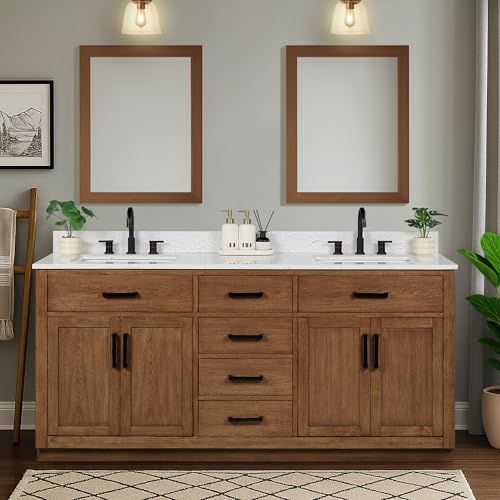
XWNE 72 Inch Bathroom Vanity — Best Dark Walnut Value of Space
The XWNE makes its case with inventory: solid wood in a dark walnut finish, six drawers, four soft-closing doors and two sinks, all under a stone countertop slimmer than the slabs elsewhere in this guide. That thinner top profile gives the cabinet a lighter silhouette, and the dark finish gives a large bathroom the grounded, hotel-like gravity that pale cabinets cannot. It is the most storage-forward of the walnut options here.
Six drawers across seventy-two inches means each partner can run a genuine filing system: daily items shallow and near, spares deeper and further. The four doors handle the tall bottles and cleaning supplies that drawers refuse. Dark walnut hides the minor scuffs of shared life gracefully, though it will show dust in hard sunlight, a fair exchange most owners accept within a week.
Pick the XWNE when storage volume outranks top thickness in your priorities and the room has the light to carry a dark cabinet. Smaller or north-facing bathrooms may find it heavy, and buyers devoted to a thick stone edge should look at the DKB or the Hepburn, but as a dark, drawer-rich double it argues its case completely.
The XWNE rewards households that assign drawers the way offices assign filing cabinets, one category per drawer, labelled in the mind if not on the front. Six drawers across two people means the shared categories, medicines, first aid, guest supplies, can hold a drawer of their own instead of squatting in somebody’s territory, and that single shared drawer quietly prevents the commonest double-vanity dispute. The dark walnut also pairs handsomely with pale stone floors and white tile, giving renovators a grounding element that does not need the rest of the room to be brave.
- Width: 72 inches, two sinks
- Cabinet: solid wood, dark walnut finish
- Top: 0.79-inch stone countertop with backsplash
- Storage: 6 drawers, 4 soft-closing doors
- Profile: slim top, storage-forward layout
Strengths
- Six drawers give each partner a real system
- Dark walnut hides scuffs of shared use
- Slim stone top keeps the silhouette light
Trade-offs
- Thinner top edge than quartz-slab rivals
- Dark finish shows dust in strong sunlight
- Can feel heavy in small, dim bathrooms
Best for: storage-hungry couples in larger, well-lit primary bathrooms.
Not suited for: compact ensuites or buyers who want a chunky stone top edge.

DKB Alenza 72 Inch Bathroom Vanity — Best Grey Contemporary
Grey is the colour bathrooms choose when they want to feel current without committing to a trend, and the Alenza executes it cleanly: a grey double-sink cabinet under a pure white quartz top with a pronounced thick edge and matching backsplash. Four soft-close doors and four dovetail drawers divide the storage, a slightly simpler layout than the drawer-maximalists here, which some households will honestly prefer.
The thick quartz edge is the Alenza’s signature. It gives the top a crafted, almost architectural line that photographs well and, more importantly, reads as quality every time a hand lands on it. Quartz care is the usual easy story: no sealing, tolerant of daily cosmetics, unhappy only with sustained heat and harsh abrasives. Against grey cabinetry the white top keeps the whole six feet feeling fresh rather than moody.
Choose the Alenza for a contemporary renovation where grey tile or grey-veined flooring is already in play, or where both partners prefer fewer, larger storage compartments over many small ones. Buyers wanting maximum drawer subdivision should compare the Hepburn and XWNE first; buyers wanting a calm grey anchor with a serious quartz slab have their pick.
The Alenza’s thick quartz edge changes how the vanity is used at its perimeter: forearms rest on it, children haul themselves up by it, objects get set down on a surface that feels engineered rather than applied. Grey cabinetry below stays out of the light argument entirely, working with daylight and warm bulbs alike, which makes the Alenza the pick for bathrooms whose lighting the owners do not plan to change. It is the least temperamental of the six to live with, and for many couples that temperament is the luxury.
- Width: 72 inches, double sink
- Cabinet: grey finish
- Top: 1.5-inch edge pure white quartz with backsplash
- Storage: 4 soft-close doors, 4 dovetail drawers
- Style: contemporary, clean-lined
Strengths
- Thick-edged quartz top feels genuinely premium
- Grey pairs with most modern tile palettes
- Simpler storage layout suits minimalists
Trade-offs
- Fewer drawers than the six-drawer rivals
- Grey can read cool under blue-toned lighting
- Contemporary lines jar in strongly period rooms
Best for: contemporary renovations built around grey and white palettes.
Not suited for: households wanting many small drawers or traditional styling.

OVE Decors Tahoe 72 Inch Vanity — Best Drawer Variety
The Tahoe thinks about storage the way a good kitchen designer does: not as a count of drawers but as a variety of shapes for a variety of things. Its Sahara birch cabinet holds two double-door cabinets with adjustable shelves, two tilt-down trays for the small daily items that otherwise colonise the counter, two regular drawers and one double-deep drawer that can swallow a hair dryer, spare towels or the family first-aid kit without folding anything twice.
Tilt-down trays deserve their sentence of praise. The space in front of a basin is normally dead, sacrificed to a false drawer front; OVE Decors turns it into the home of toothbrushes, razors and the lip balm that otherwise migrates. Matte black hardware against the pale birch keeps the look tailored, and adjustable shelves mean the door cabinets adapt as the household’s bottle collection changes shape over the years.
Pick the Tahoe when your shared-bathroom friction is about odd-shaped things with no home rather than about total volume. It is the most organisationally inventive cabinet in this guide. Pure minimalists may find its many compartments more system than they want to maintain, but families will recognise the design as one written by someone who has actually shared a bathroom.
The Tahoe’s adjustable shelves sound like a specification and behave like a philosophy: the cabinet expects the household to change. Bottles get taller, a water flosser arrives, a child’s step stool needs a home, and the Tahoe rearranges instead of overflowing. Its tilt-down trays also age well as a feature, because the small objects of a routine change least over the years, and giving them a permanent shallow home ends their migration permanently. Of the six, this is the vanity most likely to be described by its owners as ‘thoughtful’, a word rarely earned by furniture.
- Width: 72 inches
- Cabinet: Sahara birch, matte black hardware
- Storage: 2 double-door cabinets, adjustable shelves
- Drawers: 2 tilt-down, 2 regular, 1 double-deep
- Style: tailored transitional
Strengths
- Tilt-down trays rescue the dead space at each basin
- Double-deep drawer fits dryers and spare towels
- Adjustable shelves adapt as storage needs change
Trade-offs
- Many compartments demand a household that uses systems
- Pale birch shows dark cosmetics marks sooner
- Hardware finish limits mixing metals nearby
Best for: families whose clutter is varied, bulky and previously homeless.
Not suited for: minimalists who prefer two big empty cabinets and nothing else.
Comparison Table
| Pick | Badge | Format | Top or surface | Storage character |
|---|---|---|---|---|
| ARIEL Hepburn 72 Inch Vanity | Best Balanced Double | Double basin | Carrara white quartz | Doors plus six drawers |
| James Martin Bristol 72 Inch Vanity | Best Marble-Topped Classic | Double basin | Carrara marble | Traditional cabinet storage |
| James Martin Amberly 72 Inch Vanity | Best Mid-Century Walnut | Double basin | Quartz package | Cabinet storage, walnut finish |
| XWNE 72 Inch Bathroom Vanity | Best Dark Walnut Value of Space | Double sink | Slim stone top | Six drawers, four doors |
| DKB Alenza 72 Inch Bathroom Vanity | Best Grey Contemporary | Double sink | Pure white quartz, thick edge | Four doors, four drawers |
| OVE Decors Tahoe 72 Inch Vanity | Best Drawer Variety | Double basin format | Cabinet-led package | Mixed drawers incl. double-deep |
How Should Mirrors and Lighting Work Across Six Feet?
Plan the mirror wall as two portraits sharing a frame line. Two mirrors, each centred on its basin and wide enough for a face and shoulders, serve better than one sheet of glass, because each person gets an undistorted station and the wall gains rhythm. A single wide mirror remains acceptable where budget or tile layout demands it, but it should still be lit as two stations, not as one landscape.
Light belongs at face height on both outer edges, with a third source between the stations if the ceiling light is weak. Overhead-only lighting across a double vanity carves shadows into both faces simultaneously, which is why so many renovated bathrooms feel subtly unflattering despite their cost. Sconces or vertical fixtures at each station fix the problem at the planning stage for the price of two extra electrical boxes.
Keep the two stations’ accessories matched but not identical: same metal family, individual heights and angles. A shared bathroom reads as composed when its pairs rhyme, and as institutional when they clone. That small distinction is the difference between a hotel’s polish and a hotel’s anonymity, and it costs nothing but attention.
What Does a 72-Inch Vanity Cost to Own Over a Decade?
Ownership cost hides in the top. Quartz picks in this guide ask for almost nothing across ten years: no sealing products, no specialist cleaners, no refinishing. Marble asks for sealant on a schedule, gentler chemistry and the occasional professional polish if the household wants the showroom back, which across a decade becomes a real, if modest, line item that Bristol buyers should accept with open eyes.
Hardware is the second ledger. Soft-close hinges and drawer runners on a six-foot cabinet cycle twice as often as a single’s, and quality mechanisms are the difference between a vanity that feels new in year eight and one that announces every drawer. All six picks here use soft-close hardware, which is precisely why they were shortlisted; the cheapest large vanity is usually the one that needs its runners replaced first.
Water discipline is the third cost, and it is behavioural. Trays under pump bottles, a habit of drying the top’s edge after showers, and prompt attention to a dripping faucet protect any cabinet’s finish. A seventy-two-inch vanity is a decade-long piece of furniture; the households that treat it as furniture, not as a fixture, are the ones still pleased with it when the mortgage statements thin out.
One Last Measurement: The People Themselves
Measure the users as faithfully as the wall. Elbow width at the basin, the height at which each partner actually stands to work, the reach to the back of the counter where daily objects land: a double vanity fitted to two real bodies feels bespoke even off a catalogue page. Basin centres that suit the household’s actual shoulders end the subtle jostle that standard spacing can leave in a broad-shouldered home.
Heights deserve the same honesty. Standard vanity height serves most adults, but a household of the very tall or the notably petite should note how the chosen cabinet’s height meets their wrists at the basin, because a vanity is a workbench used twice daily and ergonomics compound like interest. The picks in this guide sit at conventional heights that suit the broad middle; households outside that middle should test the stance in a showroom before the tape measure is put away for good.
How Wide Should the Walkway in Front of a Double Be?
Comfort in front of a six-foot vanity is measured in passes: two adults crossing without either stepping into the tub’s territory or the doorway’s swing. Where the room allows roughly a metre of clear floor before the opposite fixture, a double feels like a ballroom; where it allows half that, the same vanity feels like a corridor with sinks. Measure the walkway with the same seriousness as the wall, because the body experiences the room at floor level, not at the backsplash.
Rugs change the walkway’s feel more than its size. A runner along the vanity’s length warms the standing zone, catches the splash arc before it reaches the floor’s grout, and gives the room’s longest wall a textile base that softens all that cabinetry. Choose one that washes, because a double’s runner serves two people’s worth of drips, and anchor it so a hurried exit at dawn does not surf it.
If the walkway is tight, steal space honestly: a wall-hung toilet, a shower instead of a tub, a door that swings out or slides. Renovations are systems, and the vanity’s comfort is often purchased in another object’s compromise. The households happiest with their seventy-two inches are the ones that budgeted the whole room’s geometry, not merely the cabinet’s.
What Is the Double Vanity’s Effect on a Home’s Daily Rhythm?
It removes a negotiation so completely that households forget it existed, until they stay in a hotel with one basin and remember. That forgetting is the purchase’s true yield: not admiration, not resale, but a hundred mornings a year that begin without a queue, a lean or a sigh. Few renovations pay out in a currency that regular, and none of the others in a typical bathroom project, not the tile, not the shower, touches the day’s first hour the way the vanity does.
The rhythm extends past mornings. Evening routines unspool in parallel, guests borrow a station without displacing anyone, children graduate to a basin of their own without a renovation. A double vanity is infrastructure disguised as furniture, and like all infrastructure it is most appreciated in its absence, which the owners of these six will hopefully never have to experience at home again.
Buy it once, buy its construction properly, divide it fairly, and let it disappear. The best seventy-two inches in the house are the ones nobody talks about by the second month, because the mornings simply work, and working mornings compound into something close to domestic peace.
How Do Guests Experience a 72-Inch Double Bathroom?
Guests read a big double instantly: this house takes mornings seriously. Two basins tell visiting couples they will not be queueing in a hallway, and the counter’s breadth tells them their washbags are welcome rather than tolerated. Hosts furnishing a guest ensuite at this width should keep one station genuinely surrendered, its drawers empty or stocked with guest supplies, because a double where both stations are colonised by the household is a single with scenery.
The guest test also audits the vanity honestly. Visitors notice the drawer that sticks, the faucet that drips at night, the mirror lit for nobody’s face, with a clarity owners lose through familiarity. A household that hosts twice a year owns a free inspection service; the wise renovator writes down what guests reveal and fixes the list while it is still short.
Stock the shared zones for the guest era: spare towels in the deep storage, a first-aid kit that is actually findable, the universal phone charger in a drawer. A seventy-two-inch vanity can hold a small hotel’s worth of hospitality inside its own footprint, and guests remember that competence longer than they remember the tile.
What Happens When One Partner Travels or Keeps Different Hours?
A double vanity’s second station does not sit idle when a partner travels; it becomes the staging ground the household otherwise lacks. Laundry sorting, packing, the evening’s clothes laid out, gift wrapping in December: the empty station absorbs the projects that migrate through a home, and its basin stays ready beneath them because the staging lives on the counter, not in the sink. Households underestimate this overflow value until the first business trip proves it.
Different hours are the double’s quieter triumph. The early riser takes the far station, its own light, its own drawers, and the later sleeper’s station stays dark and untouched, so a 5 a.m. start does not rummage through a shared drawer at pillow distance. Light discipline matters here: station lighting that can run independently is what converts two basins into two schedules, and it should be specified when the mirrors are planned.
Over years, households also assign the stations by task rather than by person during odd seasons: one for the morning routine, one for the evening’s, when a renovation elsewhere or a new baby scrambles the house’s geography. A double’s flexibility is a form of insurance, bought once, claimed in circumstances nobody predicted at the showroom.
How Do You Photograph and Live With a Big Vanity at Once?
Renovators often choose for the photograph and inherit the life. A seventy-two-inch vanity photographs best empty, symmetrical and lit like a gallery, and lives best full, asymmetrical and lit for faces. The picks in this guide were chosen for the second condition, which is why their storage is deep, their tops are wipeable and their finishes forgive. When a shortlist ties, choose the one whose tenth year you can picture, not whose first morning photographs best.
Living with the vanity also means letting it hold unfashionable objects: the water flosser’s charger, the magnifier on its arm, the child’s step stool parked beneath. A cabinet with genuine volume, the Tahoe’s deep drawer, the Hepburn’s nine, absorbs those objects out of sight, which is the only sustainable reconciliation between a beautiful room and a real household. Beauty that cannot hide a charger is a set, not a bathroom.
Give the room one deliberate imperfection to keep it human, a plant that sprawls, a stool with a past, towels that mismatch charmingly. Six feet of composed cabinetry can carry a great deal of personality without tipping into showroom coldness, and the households happiest with their doubles are the ones that let life visibly happen on top of them.
How Do You Stage the Install Day for a Six-Foot Vanity?
Clear the route the day before, not the morning of: hallway furniture moved, stair rails checked for the turn, the bathroom emptied of everything that can leave. A seventy-two-inch cabinet in motion needs a corridor, and the team carrying it needs both hands for the cabinet rather than for opening doors. Put one person on doors and one on guidance, and let the carriers simply carry.
Set the cabinet, level it, and walk away before the top lands. Levelling a six-foot base is patient work with shims and a long level, and rushing it to reach the satisfying part is how backsplash gaps are born. Once the base sits true and fixed to the wall studs, the top’s arrival becomes a placement instead of a negotiation, and the silicone line can be run once, cleanly.
Connect plumbing after the top, test every joint with the cabinet empty, and only then load the drawers. A leak discovered under a full drawer of toiletries is a small flood with an audience; the same leak discovered under an empty cabinet is a towel and a quarter-turn. Install day rewards sequence more than speed, and a double vanity, with twice the joints, rewards it twice.
Photograph everything before the backsplash seals the wall line: pipe positions, valve locations, the cabinet’s fixing points. Those photographs become the room’s maintenance map for a decade, consulted every time a trap needs clearing or a valve needs finding in a hurry. Renovations generate information exactly once, on install day, and the households that capture it stop paying to rediscover it.
Which Faucets and Hardware Suit a Wide Double Best?
Faucets at two stations should match exactly, in model and finish, because a double vanity’s symmetry is its calm. Widespread or single-hole choices follow the top’s drilling, which is why the top and faucets are chosen together, never sequentially. Lever handles serve wet hands better than cross handles at dawn, whatever the photographs prefer, and ceramic cartridges are the quiet technology that decides whether year five includes a drip.
Hardware on the cabinet, pulls and knobs, should rhyme with the faucets without cloning them: same metal family, compatible temperature of tone. Against the Hepburn’s white, black pulls sharpen and brass warms. Against the XWNE’s dark walnut, brass reads as jewellery. Against the Tahoe’s birch, the matte black it arrives with is already the answer, and changing it should require a reason.
Water pressure and aerators deserve a final word. Two stations drawing together expose weak pressure that a single basin concealed, and a plumber’s gauge reading during the renovation settles whether the house’s supply flatters the new double or needs help. It is a five-minute measurement that protects a four-figure purchase’s daily feel.
How Does a Large Double Change Cleaning and Laundry Routines?
A six-foot vanity concentrates a household’s bathroom laundry: towels multiply because two stations generate them, and the cabinet’s deep zones, the Tahoe’s double-deep drawer above all, become the clean-towel reservoir that keeps the room self-sufficient between washes. Plan that reservoir deliberately, or the deep drawer will fill with miscellaneous history instead of linen.
Cleaning consolidates too. One long top, wiped in a single pass, replaces the scattered surfaces of a smaller bathroom’s worth of furniture, and the under-cabinet shadow line is the only genuinely awkward reach. A cabinet on a plinth or with a recessed toe-kick keeps that reach honest; whichever your pick uses, a slim brush lives in the shared drawer from the first week.
The laundry consequence nobody predicts is the hamper’s promotion. Two people undressing in a room with a beautiful six-foot vanity will not carry clothes to a hallway basket, so give the room a hamper worthy of the furniture, lidded, sized to the corner, and the vanity’s dignity survives the household’s reality. Rooms fail at their unplanned objects, not their planned ones.
What Should You Check in the First Month of Ownership?
Week one is for water: check under both basins daily, run a fingertip along every joint, and look at the cabinet’s interior floor for the first sign of a weep. Most install leaks announce themselves in the first days and cost a quarter-turn to cure; the same leak in month three costs a swollen drawer bottom. The first month is the cheapest inspection regime the vanity will ever offer.
Week two is for alignment. Doors and drawers settle as a house breathes and a cabinet takes weight; soft-close mechanisms sometimes need a quarter-turn of adjustment once the drawers are loaded with real life. Every pick in this guide uses adjustable hardware, and ten minutes with a screwdriver returns the fronts to their showroom lines.
By week four, audit the storage map you drew on day one. Reality will have edited it: one drawer over-subscribed, one zone mysteriously empty, the shared compartment colonised by whoever loads fastest. Re-draw the map once, together, without blame, and the revised version will hold for years, because it was drawn from evidence instead of optimism.
How Do You Keep a White or Pale Double Looking New?
Pale cabinets at seventy-two inches, the Hepburn above all, stay new through rhythm rather than effort: a sixty-second wipe of the top and fronts after the morning peak, done by whoever finishes second, prevents the slow film that makes white look tired by spring. The task is too small to schedule and too effective to skip, which is exactly the profile of habits that survive.
Products are the pale cabinet’s real enemy, not water. Hair dye, self-tanner and dark nail products should meet the top only on a tray or towel, a rule worth stating aloud to teenagers and guests before the first incident rather than after it. Quartz forgives most of what reaches it, but cabinet fronts at knee height collect splashes nobody notices until the light changes.
Once a season, empty one cabinet zone at a time and wipe its interior, checking for the moisture that bathrooms generate invisibly. Pale interiors show trouble early, which is their hidden virtue: a white cabinet confesses its problems while they are still towels-and-fresh-air problems, long before they become carpentry.
What Does 72 Inches Actually Change at the Sink?
The honest answer is behaviour, not luxury. At sixty inches a double vanity works only if both people are tidy and synchronised; at seventy-two, each basin gains a genuine territory, with counter at the outer edges for the things in active use and a neutral strip in the middle that stays, by unspoken treaty, empty. That treaty zone is what ends the morning negotiations, because nobody’s elbow crosses it by accident.
It also changes the room’s acoustics and light. A six-foot cabinet fills the wall it stands against, so mirrors can run wide, sconces can flank two stations properly, and the whole wall reads as one composed elevation instead of furniture arranged along it. Renovators should plan lighting for two faces, not one: a single central fixture over a double this wide leaves both users half-lit.
Finally, seventy-two inches changes the storage maths. The cabinet volume under two basins can hold a household’s entire bathroom inventory, which means linen closets get their space back and counters stay clear enough to clean in one wipe. That clarity, maintained daily without effort, is the real product being bought.
How Should Two People Divide the Storage Fairly?
Start with symmetry where the cabinet allows it: a door cabinet and a drawer run each, claimed on day one and respected afterwards. Shared items, first aid, cleaning supplies, spare towels, belong in whichever central or deep compartment the design offers, such as the Tahoe’s double-deep drawer or the Hepburn’s middle drawers. Arguments about bathroom storage are almost never about volume; they are about one person’s overflow colonising the other person’s zone.
Height is the second fairness axis. The partner who uses tall bottles daily should get the cabinet with shelf spacing that fits them, while the partner with many small items takes the drawers. Trying to force identical contents into identical spaces wastes both. A ten-minute conversation with the cabinet empty saves a year of low-grade friction.
Leave one compartment deliberately unassigned. Households accumulate strange bathroom objects, guest supplies, a new appliance, a child’s bath toys, and an empty zone absorbs them without triggering a territorial dispute. It feels wasteful for exactly one week, and wise forever after.
Which Top Material Suits a Shared Bathroom Best?
Quartz, as on the Hepburn and the Alenza, is the shared-bathroom pragmatist: non-porous, consistent in colour, indifferent to toothpaste and most cosmetics, and free of any sealing schedule. Its weakness is sustained heat, so a trivet habit for straighteners is worth forming. For two people generating twice the splash and product traffic, quartz’s indifference is worth real money over a decade.
Marble, as on the Bristol, is the romantic: cooler, more varied, unmistakably natural, and honestly more demanding. It etches under acidic products and stains under standing coloured liquids, which in a two-person bathroom means two people’s habits must both be careful. Households that already wipe as they go will keep marble beautiful; households that tidy in weekly campaigns will watch it record their history.
Stone tops like the XWNE’s slimmer slab sit between the two in character. Whichever material wins, confirm whether the top arrives attached or separate, because a separate six-foot slab is a two-person lift with a real risk moment on the stairs.
How Do You Plan Plumbing and Delivery for a Six-Foot Cabinet?
Measure the doorway route before ordering, not the bathroom: hall turns, stair angles and the bathroom door itself, since a seventy-two-inch cabinet travels on its side or not at all. Many arrive with the top separate, which helps, but the cabinet alone is still the largest object most bathrooms ever admit. Photograph the route and compare it against the packaged dimensions on the listing.
Plumbing deserves the same foresight. Two basins mean two supply pairs and two drains, and drawer-rich cabinets route their boxes around those pipes with cut-outs that only work within a range of stub-out positions. Compare your wall’s plumbing centres against the cabinet drawings on the listing before purchase; moving a drain a few inches is a plumber’s hour, while discovering the clash on install day is a renovation’s bad week.
Set the cabinet before the top, level it patiently, and shim until a marble slab or quartz top would sit without rocking. At six feet, a small twist in the cabinet becomes a visible gap at the far end of the backsplash, and silicone hides only so much.
What Mistakes Do Buyers of Large Double Vanities Make?
The classic error is ordering the width the room deserves and forgetting the route the cabinet must travel, so the vanity spends its first night in the garage while a doorway is rethought. Measure the path, including the turn at the top of the stairs, with the same care as the wall.
The second error is assuming both basins will be plumbed identically to the old single. A double needs its supplies and drains planned as a pair, and drawer cabinets punish guesswork. Share the cabinet’s interior drawing with your plumber before the wall is closed, not after.
The third is choosing a top for its photograph and discovering its temperament later. Marble in a house of teenagers, high-gloss white in a house of hair dye: the mismatch is predictable at purchase time. Match the material to the household’s actual habits, which everyone in the house can describe honestly if asked.
Finally, buyers under-light wide vanities, hanging one fixture where two faces will stand. Plan two stations of light from the start, because retrofitting sconces after the tile is set turns a small oversight into a large bill.
Final Recommendation
For most couples, the Hepburn is the balanced answer: fair storage, quartz calm and a white finish that forgives changing tastes. The Bristol serves those who want marble and heritage, the Amberly the walnut modernists, the XWNE the drawer maximalists in dark wood, the Alenza the grey contemporary room, and the Tahoe the family whose clutter needed shapes, not just space. Measure the route, plan the plumbing as a pair, and any of the six will earn its wall.
Two basins will not fix a morning, but the right six feet of cabinetry can quietly remove every argument the morning used to contain.
Frequently Asked Questions
Do both basins on a 72-inch vanity get used equally?
In most households one basin becomes the weekday station and the other serves weekends, guests and overflow, until a schedule change promotes it. That is fine: the second basin’s value is capacity at peak moments, not identical daily mileage, and the counter space it anchors is used every single day.
Can a 72-inch vanity fit through a standard doorway?
Usually, when travelled on its side with doors and drawers removed and the top carried separately, but the turn from hallway into bathroom is the real test. Measure the route’s tightest corner against the cabinet’s depth and height, and confirm packaged dimensions on the listing before ordering.
Is marble worth it on a double vanity?
For households that wipe up promptly, yes: marble’s coolness and variation reward daily contact and suit long-term homes. For households with heavy cosmetics use by several people, quartz delivers ninety percent of the look with none of the sealing or etching anxiety, which is why two of this guide’s picks use it.
How much clearance should remain in front of the vanity?
Enough for two people to pass without turning sideways, which in practice means treating the vanity wall and the opposite wall as one system. If the room is tight, a seventy-two-inch vanity can still work, but drawer and door swings must be checked against tubs, toilets and shower screens on paper first.
Should the top come attached or separate?
Separate tops ease delivery and let you level the cabinet precisely before the heavy slab lands, at the cost of a careful setting and sealing session. Attached tops simplify install day but make the unit one very heavy lift. At seventy-two inches, most households are better served by the separate arrangement.
Related Guides
A six-foot double rarely stands alone in a renovation, so these companion guides cover the overall vanity field, the tub decisions that usually share the same project, and the topped-vanity options for the home’s other bathrooms: Best Bathroom Vanities Overall Best 60-Inch Air Jet Bathtubs Best Bathtubs Overall Best Bathroom Vanities with Tops.


