What's inside
- Key Takeaways
- Quick Picks
- How did we choose the best bathtubs overall?
- Comparison Table
- Which bathtub material suits your household?
- How do you measure a bathroom for a tub that will actually fit?
- What does installation involve, type by type?
- How do you keep each tub type looking new?
- What mistakes do bathtub buyers repeat most?
- Should the tub also serve as the household shower?
- How does a bathtub choice age alongside its owners?
- What should you pair with the tub — fillers, screens and storage?
- What does each type cost to own over the years?
- How do you read a bathtub specification sheet like a plumber?
- Which bathroom styles does each format serve best?
- How do you plan the delivery day itself?
- What separates a good soak from a great one?
- How should renters and short-horizon owners read this list?
- How do you test a showroom tub before believing any review?
- Final Recommendation
- Frequently Asked Questions
- Related Guides
As an Amazon Associate I earn from qualifying purchases. This post may contain affiliate links at no extra cost to you.
cottageverdict.com is reader-supported. When you buy through links on our site, we may earn an affiliate commission.
Where to buy: every tub below links to its Amazon listing, where you can check price on Amazon and confirm drain position, capacity and delivery terms. Bathtubs are buy-once furniture for the wettest room in the house, so the ten minutes spent checking a specification sheet is the cheapest insurance in the whole renovation.
Ask a showroom for the best bathtubs overall and you will be walked towards whatever gleams under the spotlights, which is precisely the wrong way to shop for the largest object in your bathroom. This guide takes the opposite route: it organises the shortlist by the kind of bathroom you actually have. An alcove remodel, a freestanding statement in a room with space to admire it, a corner that needs a job, and a jetted soak for a household that bathes like it means it — those are four different purchases wearing the same name, and a tub that triumphs in one category can be a genuine mistake in another.
That structure also disciplines the judging. An alcove tub is assessed on how gracefully it replaces what came before, on flange and apron details nobody photographs, and on whether the bathing well makes sixty inches feel generous. A freestanding tub is judged as furniture: silhouette from the doorway, the feel of its material at the shoulder blades, how its rim takes a book. Corner and jetted models answer to their own briefs again. Six tubs survived that four-way examination, one or two per bathroom type, and the sections after the reviews explain the materials, measurements and installation logic that let you place your own room in the right chapter.
A word about what this list refuses to do: it does not crown a single winner for every house, because bathtub shopping punishes that kind of certainty. The household replacing a cracked alcove tub during a two-week renovation window needs a different hero from the couple building a spa bathroom around a stone resin sculpture. Read the review that matches your room first, then borrow the others for contrast — the contrasts are where the useful truths live, particularly about weight, water capacity and how much of a tub’s quoted length a bather can actually use.
Key Takeaways
- Shop by bathroom type first — alcove, freestanding, corner or jetted — and by brand second.
- The Kohler Entity is the alcove remodel pick: a standard opening, a respected name, a calm design.
- Stone resin models from WOODBRIDGE and MEDUNJESS deliver the matte, weighty freestanding feel.
- The little FerdY Bali proves a freestanding statement tub can fit genuinely small rooms.
- Carver’s corner soaker converts awkward floor plans into two-person bathing space.
- The Empava 67 covers the jetted brief with a heater, waterfalls and a handshower.
Quick Picks
| Pick | Badge | Why it made the list |
|---|---|---|
| FerdY Bali 47 Inch Freestanding Bathtub | Best small-space freestanding | A gracefully shaped 47-inch soaker that brings the freestanding look to compact bathrooms. |
| MEDUNJESS 65 Inch Stone Resin Freestanding Tub | Best double-slipper stone resin | Raised ends at both sides, 20mm walls and a matte solid-surface finish for long soaks. |
| Kohler Entity 60 x 32 Alcove Bath | Best alcove remodel | A clean-lined 60 by 32 alcove bath from a name plumbers trust, left drain. |
| Carver Tubs CT6060 Corner Soaking Bathtub | Best corner soaker | A deep triangular two-person soaker with armrests, made for corner floor plans. |
| WOODBRIDGE 55 Inch Stone Resin Freestanding Tub | Best compact stone resin | Solid-surface matte luxury in a 55-inch oval that respects smaller footprints. |
| Empava 67 Inch Whirlpool Heated Tub | Best jetted all-rounder | Seventeen jets, an inline heater and back-to-wall tidiness for serious bathers. |
How did we choose the best bathtubs overall?
Overall lists fail when they average away the differences between installation types, so the selection here worked in four separate heats. Alcove candidates had to fit a true standard opening with an integral apron and flange, because a remodel pick that requires reframing has misunderstood its assignment. Freestanding candidates were weighed as objects in a room — profile, rim comfort, material honesty — while corner and jetted entries had to justify their specialisation against a plain soaker of the same footprint, which is the comparison a real buyer makes standing in the actual bathroom with a tape measure.
Materials received unusual scrutiny, because the word bathtub now covers acrylic, stone resin solid surface, enamelled steel and cast iron, and they age very differently. Acrylic entries needed reinforcement and a finish that resists scratching into dullness; stone resin entries needed genuine wall thickness rather than a mineral-dusted skin over a light core; and every pick had to include, or clearly specify, its drain and overflow hardware so the installed price holds no ambushes. Warranty length mattered less than warranty believability — established makers with reachable support scored above anonymous shells with extravagant promises.
The final screen was bathing itself, reconstructed from dimensions rather than marketing. Interior floor length, backrest angle, well depth to the overflow, rim width and step-over height were compared pick by pick, and any tub whose numbers promised a sprawl its shell could not deliver was demoted regardless of looks. What survived is a shortlist where each entry is the strongest answer to a distinct question, which is the only kind of overall list worth trusting.

FerdY Bali 47 Inch Freestanding Bathtub — Best small-space freestanding
Freestanding tubs are supposed to demand a ballroom, which is why the FerdY Bali matters: at 47 inches it carries the freestanding idea into bathrooms that would laugh at a 67-inch sculpture. The shape does the heavy lifting — a gracefully curved oval with a minimalist linear overflow, finished in glossy white acrylic with a toe-tap brushed nickel drain that keeps the silhouette clean from every angle. Placed even slightly angled in a modest room, it reads as a deliberate design decision rather than a compromise, and that visual confidence is the entire reason to choose freestanding in the first place.
Bathing in a 47-inch tub is a different discipline from bathing in a long one, and the Bali is honest about it. This is a deep, seated soak — knees bent, water high, shoulders submerged when you slide down — closer in spirit to a Japanese soaking ritual than to a stretched-out float. For bathers who read, think and unwind sitting in hot water, that posture is not a limitation at all; it concentrates the heat, reduces the fill volume dramatically and warms up fast. Taller bathers determined to extend their legs should look further down this list, and FerdY would be the first to agree.
Practicalities are well handled for the price tier. The acrylic keeps the tub light enough for upstairs rooms and two-person positioning, cUPC certification keeps inspectors calm, and the integrated overflow assembly arrives included rather than as a scavenger hunt. The floor-standing filler question applies, as with any freestanding tub: budget for a freestanding faucet or a wall-mounted spout, and confirm the floor’s finish runs beneath the tub, since a freestanding silhouette shows its surroundings from every side.
- Format: freestanding oval soaker, 47 inches long
- Material: glossy white acrylic, lightweight construction
- Drain: toe-tap brushed nickel, integrated linear overflow included
- Certification: cUPC certified for North American installs
- Bathing style: deep seated soak rather than full recline
Strengths
- Freestanding presence inside a genuinely compact footprint
- Deep seated soaking uses far less hot water
- Light acrylic suits upstairs bathrooms and easy positioning
Trade-offs
- Legroom ends quickly for bathers over average height
- Freestanding filler is an additional purchase to plan
- Gloss finish shows water spots sooner than matte rivals
Best for: small bathrooms that want one beautiful object and a deep, hot, seated soak. Check price on Amazon.
Not suited for: tall bathers, stretch-out floaters, or rooms needing a shower-over-tub arrangement.

MEDUNJESS 65 Inch Stone Resin Freestanding Tub — Best double-slipper stone resin
Some tubs you sit in; the MEDUNJESS you settle into, with ceremony. Its double-slipper profile raises both ends of the shell, so the back is supported whichever way the bather faces — towards the window or towards the door — and two people can share it without negotiating who gets the sloped end. That symmetry makes it the natural centrepiece for a bathroom designed around the bath itself, and the 65-inch length gives the shape room to be graceful rather than tubby.
The material is the second half of the appeal. Stone resin with a stated 20mm wall thickness feels cool, dense and faintly matte under the hand, a world away from the flex and drum-note of thin acrylic, and it holds heat in the water longer because the shell itself absorbs less of the bath’s warmth at the start. The matte white finish shrugs off the water-spot evidence that glossy tubs display, and minor scuffs on solid surface can typically be polished rather than mourned. A pop-up drain and overflow are included, which keeps the all-in cost honest.
Weight is the tax on all this substance. A filled stone resin tub of this size is a serious load, and ground-floor or properly assessed installations are the sensible settings; carrying it upstairs is a team event with planning, not a Saturday improvisation. The double-slipper ends, while democratic, also mean neither end offers the low, flat entry profile of a single-ended tub, so households thinking about bathing mobility in later years should sit in a similar shape before committing. For the right room, though, this is the list’s most hotel-like object.
- Format: freestanding double-slipper soaker, 65 inches
- Material: stone resin solid surface, 20mm wall thickness
- Finish: matte white, spot-forgiving and polishable
- Drain: pop-up drain and overflow included in the box
- Bathing style: reclined soak, either orientation, seats two
Strengths
- Raised ends support the back from either direction
- Dense matte shell holds heat and hides water marks
- Genuine two-person comfort without a corner footprint
Trade-offs
- Heavy shell demands floor confidence and careful delivery
- Raised ends raise the step-over height at both sides
- Needs floor space around it to look its best
Best for: primary bathrooms being designed around a shared, sculptural centrepiece soak. Check price on Amazon.
Not suited for: doubtful upper floors, tight footprints, or low step-over requirements.

Kohler Entity 60 x 32 Alcove Bath — Best alcove remodel
The alcove remodel is the commonest bathtub purchase in the country and the least glamorous: the old tub is cracked or harvest-gold, the walls are open for a fortnight, and the replacement must fit the same sixty inches, serve showers daily and baths occasionally, and not embarrass the house in fifteen years. The Kohler Entity is built for exactly that brief — a 60 by 32 inch alcove bath with a left-hand drain, clean modern lines that stop well short of fussiness, and the backing of a manufacturer whose parts and support will still exist when today’s trend brands are memories.
Thirty-two inches of width rather than thirty is the detail that changes daily life, buying elbow room in the shower and a less coffined feel in the bath without touching the alcove’s framing. The bathing well is shaped for sitting soaks and efficient showering alike, the apron front presents a flat, tidy face to the room, and the whole design speaks the visual language of mainstream bathroom fixtures, so it coordinates with the toilets, faucets and tile a remodel is likely to choose. Kohler’s acrylic construction keeps the weight manageable for a tub being threaded through a finished house.
Two honest caveats belong in this review. The drain is not included, which is normal at this level but must be added to the budget and matched to the rough-in before the walls close. And an alcove tub, however good, will never deliver the deep, shoulders-under soak of the freestanding models here — the format trades depth for universality. Within the remodel brief, though, the Entity’s combination of fit, finish, brand support and daily versatility is exactly what an overall list should reward.
- Format: three-wall alcove bath, 60 by 32 inches
- Drain: left-hand location, drain assembly purchased separately
- Material: Kohler acrylic with integral apron front
- Use profile: shower-first daily duty, comfortable seated baths
- Support: established manufacturer parts and service network
Strengths
- Extra two inches of width transform the standard opening
- Brand backing protects a fifteen-year installation decision
- Clean styling coordinates with mainstream remodel fixtures
Trade-offs
- Drain hardware adds a separate line to the budget
- Soaking depth cannot rival the freestanding picks
- Left-drain only, so right-drain rooms need replumbing
Best for: the classic alcove renovation that must simply be right, once, for years. Check price on Amazon.
Not suited for: deep-soak devotees or bathrooms being redesigned around a centrepiece.

Carver Tubs CT6060 Corner Soaking Bathtub — Best corner soaker
Every housing stock has them: bathrooms with the square footage for luxury and the geometry for nothing, where a long tub wastes the room’s best corner and a standard rectangle leaves the floor plan sulking. The Carver CT6060 is the classic answer — a 60 by 60 inch triangular corner soaker, 19.5 inches deep, with moulded armrests and a bathing well honestly shaped for two people to sit in warm water and face the room. It is a soaking tub without jets, and its restraint is its charm: no pump to maintain, no circuit to run, just depth, width and hot water.
The acrylic-and-fibreglass construction keeps a very large shell manageable, and the classic white finish disappears into traditional and transitional bathrooms alike. Depth is the specification to savour: at nearly twenty inches, the CT6060 submerges bathers in a way shallow alcove tubs cannot approach, and the corner geometry means two adults get genuine legroom rather than an interlaced compromise. For households whose bathing is about conversation, a shared glass of something and forty unhurried minutes, this format outperforms jetted rivals that cost far more to buy and run.
The costs are spatial and logistical. Sixty inches along two walls is a major land claim, the filled weight of a two-person corner tub is the largest in this guide relative to its price, and the far corner’s plumbing should be roughed in with future access in mind because reaching it later involves gymnastics. The design is also unapologetically traditional, which will either settle a classic bathroom or clash with a minimalist one. Chosen for the right corner, it turns the room’s problem into its personality.
- Format: corner soaking tub, 60 by 60 by 19.5 inches
- Material: acrylic with fibreglass reinforcement, classic white
- Comfort: moulded armrests, two-person triangular well
- Systems: none — pure soaking, no pump or electrics
- Depth: deep fill to the overflow for full submersion
Strengths
- Real two-person soaking with no machinery to maintain
- Depth delivers the full-submersion soak alcoves cannot
- Rescues awkward corner floor plans elegantly
Trade-offs
- Claims major floor area along two walls at once
- Filled weight needs a confident floor assessment
- Traditional styling will not suit stark modern rooms
Best for: couples with a large, awkward bathroom and a taste for unhurried shared soaks. Check price on Amazon.
Not suited for: jet seekers, small bathrooms, or anyone counting resale minimalism.
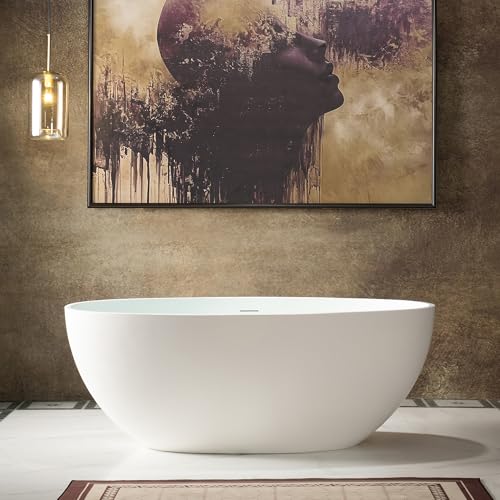
WOODBRIDGE 55 Inch Stone Resin Freestanding Tub — Best compact stone resin
Stone resin has become the material of desire in modern bathrooms, and the usual entry ticket is a 67-inch shell plus a floor inspection. WOODBRIDGE’s 55-inch version lowers both barriers: the same modern oval solid-surface design, the same integrated slotted overflow and included drain, the same matte white finish — compressed into a footprint that fits bathrooms the full-size sculptures must envy from the doorway. It is the pick for buyers who fell for the material before they measured the room.
In the water, the compact shell behaves like its bigger relatives in the ways that matter. The matte solid surface feels substantial and faintly warm once the bath is run, the oval well cradles a seated-to-reclined soak for one, and the modest capacity fills quickly and asks little of the water heater — a combination that makes the tub a realistic weeknight pleasure rather than a ceremonial one. The integrated overflow keeps the rim line uninterrupted, which is precisely the minimalist effect stone resin buyers are paying for.
Compromises track the tape measure. Fifty-five inches will not stretch a tall bather flat, two-person bathing is off the table, and stone resin at any size still outweighs acrylic, so the floor conversation remains obligatory even though the delivery is easier. The matte finish also prefers non-abrasive cleaning, a small discipline in exchange for its looks. As the bridge between compact practicality and the solid-surface aesthetic, nothing else on this list occupies the same square of ground.
- Format: freestanding oval soaker, 55 inches long
- Material: stone resin solid surface, matte white finish
- Drain: integrated slotted overflow with drain included
- Capacity: modest fill, kind to standard water heaters
- Bathing style: solo seated-to-reclined soaking
Strengths
- Solid-surface luxury inside a mid-size footprint
- Quick fills make it practical for weeknight bathing
- Uninterrupted rim line nails the minimalist brief
Trade-offs
- Tall bathers trade full extension for the material
- Solo bathing only, despite the premium positioning
- Heavier than acrylic rivals of the same length
Best for: design-led renovators whose rooms measure smaller than their taste. Check price on Amazon.
Not suited for: couples, very tall owners, or buyers wanting a shower over the tub.

Empava 67 Inch Whirlpool Heated Tub — Best jetted all-rounder
An overall list owes its readers one jetted representative, because for a substantial minority of bathers the jets are not a garnish but the entire point of the purchase. The Empava 67 earns the seat by balancing its machinery against its manners: seventeen hydro and air jets provide both the directional pressure of a whirlpool and the lighter effervescence of an air bath, an inline heater defends the water temperature through long sessions, and the back-to-wall silhouette keeps all of that technology visually calm and plumbing-friendly.
The supporting cast is unusually complete. Dual waterfall fillers give the bath a focal point and move its roughly 59 gallons at a civilised pace, chromatherapy lighting sets an evening mood without additional fixtures, and the bundled handshower handles rinsing, hair washing and the post-clean rinse-down that jetted ownership involves. ETL certification and acrylic construction from an established jetted-tub maker round out a package that asks the buyer to add a circuit and an access plan, and very little else.
Jetted ownership’s honest costs apply in full: a circulating cleaning routine, machinery that will one day want a service visit, and more noise than any soaker on this list. Bathers who suspect they would use the jets monthly rather than weekly should take the hint and buy one of the soakers instead, saving the difference for tile. For the household that will genuinely bathe with intent several times a week, the Empava is the most complete bathing machine in this guide.
- Format: back-to-wall jetted tub, 67 inches long
- Systems: 17 hydro and air jets, independently enjoyable
- Heat: inline heater maintains soak temperature
- Extras: waterfalls, handshower, chromatherapy lighting
- Capacity: approximately 59 gallons to the overflow
Strengths
- Both jet sensations plus heat in one tidy shell
- Handshower and waterfalls complete the package
- Back-to-wall layout simplifies plumbing and cleaning
Trade-offs
- Cleaning routine is the price of the pipework
- Requires dedicated electrical work at installation
- Pump and blower make it the loudest pick here
Best for: committed bathers who will use hydrotherapy weekly, not yearly. Check price on Amazon.
Not suited for: low-maintenance households or rooms where a quiet soaker is the dream.
Comparison Table
| Pick | Bathroom type | Standout trait |
|---|---|---|
| FerdY Bali 47 Inch Freestanding Bathtub | Freestanding, small | Deep seated soak, 47 in |
| MEDUNJESS 65 Inch Stone Resin Freestanding Tub | Freestanding statement | Double-slipper stone resin |
| Kohler Entity 60 x 32 Alcove Bath | Alcove remodel | Extra width, brand support |
| Carver Tubs CT6060 Corner Soaking Bathtub | Corner | Two-person depth, no jets |
| WOODBRIDGE 55 Inch Stone Resin Freestanding Tub | Freestanding, compact | Matte solid surface, 55 in |
| Empava 67 Inch Whirlpool Heated Tub | Jetted | Jets, heater, handshower |
Which bathtub material suits your household?
Acrylic dominates modern bathtub sales for sound reasons: it is light, warm to the touch, affordable at every size and forgiving to install, and the FerdY, Kohler and Carver picks all exploit those virtues. Its weaknesses are a flex that cheap shells exaggerate and a surface that rewards gentle cleaning. Stone resin — the MEDUNJESS and the compact WOODBRIDGE — trades weight and money for density, heat retention and a matte finish that hides the evidence of daily life, and for a forever bathroom that trade is often correct. Enamelled steel and cast iron, absent from this shortlist’s winners, remain the durability traditionalists’ answer, with iron’s heat-keeping mass balanced against delivery weights that frighten installers.
The deciding questions are practical rather than poetic. How long will this bathroom serve before its next renovation? A fifteen-year horizon justifies solid surface or a premium brand’s acrylic; a five-year refresh argues for value acrylic installed cleanly. Who cleans, and how cheerfully? Gloss shows spots, matte hides them, and jets add a routine all of their own. And what does the floor allow? Material choice is sometimes made by the joists, and discovering that late is the most expensive way to learn it.
How do you measure a bathroom for a tub that will actually fit?
Measure three different things, because tubs fail on each of them separately. First, the installation space: alcove length wall to wall, the width the room can surrender to a freestanding silhouette with cleaning access around it, and the corner dimensions for a triangular shell. Second, the bathing space, which is the interior floor length and depth to overflow of the candidate tub — the numbers that decide whether a soak is a sprawl or a crouch. Third, the journey: door widths, hallway turns, stair landings and the bathroom doorway itself, walked with a tape and pessimism, because a tub that reaches the room has only passed the easiest examination.
Then measure the invisible systems. Note the drain’s existing position and side, since moving it ranges from trivial in an open floor to expensive under a slab. Check the water heater’s capacity against the tub’s fill volume, and walk the floor for bounce or slope that hints at joist questions. Photograph everything, write the numbers on the photograph, and bring that sheet to every subsequent decision — it will settle more arguments than any review, including this one.
What does installation involve, type by type?
Alcove installations are the most procedural: old tub out, walls opened, rough plumbing adjusted to the new drain, the tub levelled and secured by its flange, then surround and tile. It is the format where a good installer is fastest and a careless one is most tempted to skip the levelling that prevents flex and leaks. Freestanding installations look simpler — a floor drain connection, a filler, a beautiful object — yet they hide their work in floor preparation and in the flexible drain connections that must be right the first time, because access afterwards means moving the sculpture.
Corner tubs add geometry: two walls must be true, the frame or mortar bed must support a wide shell evenly, and the far plumbing should be roughed in with a reachable plan. Jetted installations add the electrician to the cast and the access panel to the drawings. Across all four types, the universal rules are to dry-fit before committing, to fill and test before tiling closes the evidence away, and to keep the paperwork — because the household that can find its tub’s manual in year nine is the household whose renovation was run properly in week one.
How do you keep each tub type looking new?
Acrylic care is a short sermon: non-abrasive cleaners, soft cloths, prompt attention to the waterline, and no scouring powders ever, because the gloss you scratch today becomes the dull patch that holds grime tomorrow. Stone resin asks for the same gentleness with one addition — its matte surface appreciates a periodic deeper clean to lift soap film from the texture, and its solid-surface nature means a professional can usually polish out the kind of mishap that would retire an acrylic shell. Both materials reward a squeegee-or-wipe habit after showers in hard-water districts, where mineral spots are a water problem wearing a tub costume.
Alcove surrounds and corner installations add grout and silicone to the watch list: inspect the seals yearly, replace tired silicone before water finds the wall, and treat any flex or movement in the shell as a symptom to investigate rather than a personality trait. Jetted tubs add their circulating clean, covered in this site’s combination-tub coverage, and all tubs share one neglected duty — the overflow and drain should be cleared of hair before drainage slows, because a slow drain in a sealed installation is a small problem auditioning for a larger role.
What mistakes do bathtub buyers repeat most?
- Choosing by exterior length alone. Two 60-inch tubs can differ by half a foot of usable interior. Judge the bathing well’s floor length and depth, or sit in the dry shell before the order becomes a delivery.
- Forgetting the filler for a freestanding tub. The sculpture arrives without a tap, and floor-mounted fillers need plumbing planned in the floor. Discovering this after the tile is laid turns a design triumph into an improvisation.
- Skipping the floor and heater audit. Stone resin weight and jetted capacity both punish optimism. A joist opinion and a heater calculation cost little before delivery and a fortune after.
- Matching the drain side by guesswork. Left and right are determined by the room, not by preference. Photograph the existing rough-in and order against the photograph.
- Designing for guests instead of Tuesdays. The tub that suits the household’s ordinary evening — quick fill, right depth, easy clean — will delight visitors anyway. The reverse has never once been true.
Should the tub also serve as the household shower?
For many homes the bathtub is not a luxury appliance but the hardest-working fixture in the building, hosting the morning shower queue as well as the evening soak, and that double duty reshapes the shortlist completely. An alcove tub with a flat floor, a sensible rim and a surround designed for spray — the Kohler Entity’s home ground — is the honest champion of the double shift, because showering in a deep freestanding oval means a high step-over, water escaping to the floor and a curtain arrangement nobody enjoys. Households designing a dedicated bathing room can ignore this section; households with one bathroom cannot, and should let the shower decide before the soak seduces them.
The middle path exists and deserves naming: a wider alcove tub with a deeper well than the builder standard gives shower users their flat floor while giving bathers a noticeably better evening than the shallow default. Glass screens have also improved the compromise, keeping spray contained with more dignity than a curtain while still swinging clear for bath night. What does not work is pretending a sculptural freestanding tub will shower happily because a handheld sprayer exists in the catalogue photograph — it will, twice, and then the household will quietly start showering at the gym.
How does a bathtub choice age alongside its owners?
Bathrooms are renovated on fifteen-year cycles while bodies change on their own schedule, so the wise tub purchase asks a slightly uncomfortable question: who will climb into this in a decade? A lower rim, a floor that grips when wet, a rim wide enough to sit on while swinging legs over, and plumbing that allows grab bars to be fitted into proper blocking later are all cheap at renovation time and precious afterwards. Deep stone resin slipper tubs are glorious at forty and a negotiation at seventy-five, which does not disqualify them — it argues for choosing them knowingly, or for pairing the statement tub in the primary suite with a sensible alcove elsewhere in the house.
Children run the same film backwards. The deep soaker that serves a toddler beautifully, with an adult kneeling outside, becomes the teenager’s marathon bath and then the empty-nest luxury, and a well-chosen shell accommodates every act without modification. This is another quiet argument for the mainstream formats in family homes and for treating the dramatic shapes as primary-suite choices. A bathtub is one of the few household objects bought for the person you are and inherited by the person you become, and the overall winners in this guide were partly chosen for how gracefully they handle that inheritance.
What should you pair with the tub — fillers, screens and storage?
A tub is a system, and the supporting purchases decide whether the beautiful shell is also a pleasant one. Freestanding models need their filler chosen with the tub, not after it: floor-mounted fillers demand plumbing in the floor and suit rooms designed around the bath, wall-mounted spouts need the tub placed within their reach, and rim-mounted options exist only where the rim is wide and flat enough to drill. Flow rate matters more than finish — a large soaker fed by a domestic trickle turns filling into a scheduling event, and a high-flow filler with a hand shower attachment is the pairing experienced renovators specify without being asked.
Storage and surfaces follow. A rim that holds a book and a glass is a feature; a bath caddy is the aftermarket confession that the rim does not. Alcove tubs gain a niche or a ledge at the wall end, corner tubs gain the triangular shelf their geometry gifts, and every format gains from a mat with genuine suction grip and towels within arm’s reach of the water. Lighting deserves a thought too, since the same room must serve a bright morning shave and a dim evening soak, and a dimmer fitted during renovation is the cheapest luxury in this entire guide.
What does each type cost to own over the years?
Purchase prices get the attention, but ownership writes its own ledger in water, heat and attention. Deep and wide tubs — the corner Carver, the double-slipper MEDUNJESS — spend hot water generously at every fill, which households on metered water or modest heaters feel monthly rather than once. Compact soakers invert the equation, and their owners often report bathing more often precisely because a fill is quick and inexpensive, which is the real return on the purchase. Jetted ownership adds the cleaning products, the electricity and the eventual service visit to the ledger, all modest, all predictable, and all worth entering with open eyes.
Maintenance time is the other currency. A plain soaker asks for a wipe; an alcove installation asks for a yearly look at its seals; a jetted tub asks for its monthly routine. None of these is unreasonable, and households differ honestly in which they will sustain. The overall list’s structure — one winner per bathroom type — exists so that this arithmetic can be done per household rather than per advertisement, because the cheapest tub to own is always the one whose demands match the owner’s temperament.
How do you read a bathtub specification sheet like a plumber?
Specification sheets reward translation. The headline length is the rim at its longest; the number that governs comfort is the bathing well’s floor length, often six to ten inches shorter, and any listing that will not disclose it is telling you something. Depth should be read to the overflow, not to the rim, because water above the overflow is a flood audition. Capacity in gallons predicts both the fill time and the water heater conversation, while the drain location — left, right, centre or end — must be matched to the rough-in photograph before anything else on the sheet is allowed to charm you.
Weight appears twice and matters both times: the empty weight predicts the delivery difficulty, and the filled weight with a bather predicts the floor’s opinion. Material descriptions deserve the same scepticism as dimensions — stone resin should state its composition or wall thickness, acrylic should state its reinforcement, and a warranty should be read for what it excludes about finishes and fittings. None of this requires expertise, only the discipline to read the sheet before the photographs, a habit that would rescue a meaningful share of all bathtub returns.
Which bathroom styles does each format serve best?
Design coherence is not vanity; a tub that fights its room will be resented at some low level every day. The matte stone resin ovals belong to calm, contemporary rooms with large-format tile and restrained fixtures, while the FerdY’s glossy curves soften modern spaces that risk feeling clinical. The Carver’s classic corner profile settles traditional bathrooms with wainscoting and framed mirrors, and the Kohler Entity’s quiet lines are deliberately style-agnostic, which is why remodels that must please a future buyer gravitate towards it. The Empava’s waterfalls and lighting suit the unapologetic spa bathroom, where the tub is the evening’s destination rather than an appliance.
Mixed styles work when one element leads. A traditional room can carry a modern freestanding oval if the fixtures echo its restraint; a minimalist room can carry the corner soaker if the glass and lighting stay quiet. What fails is accumulation — every feature shouting at once — and the discipline of choosing a single hero per room is the thread running through every pick in this guide.
How do you plan the delivery day itself?
Bathtubs arrive on freight schedules with kerbside manners, so the delivery deserves the same planning as the installation. Confirm the route from the street to the bathroom, count the hands the weight requires, protect the floors and stair edges the tub will pass, and inspect the shell before signing anything — acrylic and stone resin both forgive many things, but a transit crack discovered after the driver leaves becomes an argument instead of an exchange. Keep the packaging until the tub is set and filled, because returns travel in their original armour or not at all.
Schedule the plumber for after the tub is in the room, not before, and keep one contingency day in the renovation plan for the discovery every old bathroom keeps in its walls. The households that glide through bathtub projects are not luckier than others; they simply sequenced the measuring, the ordering, the delivery and the trades in the order this guide has described, and left slack where reality likes to insert itself.
What separates a good soak from a great one?
Strip away the formats and the materials, and a great soak is a short list of physical kindnesses delivered simultaneously. The water stays hot without the bather performing kettle relays. The back meets a slope it can trust, the shoulders submerge without hunching, the feet find purchase without bracing, and the rim receives a book, a glass and an elbow without negotiation. Noise from the house fades because the room itself was planned — a door that closes properly, a fan that hums low, light that can fall to a glow. Every tub in this guide delivers most of that list in its own dialect, and the differences between good and great usually trace back to depth and temperature rather than to any feature with a trademark.
There is also a ritual dimension that specification sheets cannot capture and households should not be embarrassed to weigh. The corner tub that hosts a couple’s Friday conversation, the little Bali that turns a rented-feeling bathroom into a retreat, the alcove Kohler that simply never once annoys anyone — these are emotional returns on a plumbing purchase, and they compound nightly. Buy the tub whose ritual you can picture in your actual house on an actual Wednesday, and the physics will mostly take care of itself.
How should renters and short-horizon owners read this list?
Not every reader owns the floor their tub stands on, and the honest advice for renters is that the bathtub is the landlord’s fixture — the wins available are a deep-clean, a fresh bead of silicone with permission, a quality bath pillow and mat, and a caddy that makes the existing shell feel chosen. Owners expecting to move within a few years should weight the mainstream picks more heavily: the alcove remodel and the restrained freestanding shapes photograph well, offend nobody and return their cost in sale-room impressions, while highly personal installations — corner spas, dramatic jetted builds — return their value mainly to the people who commissioned them. Knowing which game you are playing is most of buying well.
How do you test a showroom tub before believing any review?
Reviews, including this one, can narrow a field; only your own body can close the sale. In the showroom, sit in the dry tub in your clothes, in the posture you actually bathe in, for a full minute — long enough for the backrest angle and the floor length to stop being first impressions and start being information. Lean back, extend your legs, mime reaching the controls and the rim, and notice where the shell presses and where it supports. Then climb out the way you would with wet hands and tired legs, because the exit is half the product. A retailer who rushes this examination is telling you how the after-sale relationship will feel, and a tub that wins the minute-long sit has earned more trust than any star-shaped badge on its listing.
Final Recommendation
Decide your bathroom’s type and this list resolves itself. The alcove remodel belongs to the Kohler Entity, whose extra width and brand backing make it the safest fifteen-year decision in the guide. Freestanding statements split by scale: the MEDUNJESS for the room that can carry a shared stone resin centrepiece, the compact WOODBRIDGE for the same material in a smaller footprint, and the FerdY Bali for the little bathroom that refuses to be left out of the freestanding era. The Carver owns the corner brief, and the Empava 67 serves the household whose bathing is a practice rather than an event.
If a single name must be carried to the showroom, carry the one that matches your walls, your floor and your water heater — because a bathtub is the rare purchase that the house itself gets a vote on. Photograph your room from the doorway before you shop, and judge every candidate against that photograph rather than against a showroom’s staging, since the tub must live in your light, beside your tile, under your ceiling. Choose the tub your room has been describing all along, install it boringly well, and it will repay the attention every single evening.
Frequently Asked Questions
What is the most comfortable standard bathtub size?
For most adults, a 60-inch alcove tub with a genuinely deep well or a 65 to 67-inch freestanding soaker hits the comfort sweet spot, but interior dimensions matter more than the label. A deep 55-inch stone resin oval can out-soak a shallow 67-inch shell for a seated bather, while a tall floater needs every inch of floor length. Match the well to the body and the posture, not the brochure to the ego.
Are freestanding tubs practical with children?
They are workable and widely used, with two adjustments: the adult bathes the child from outside a taller rim, which some knees dislike, and there is no wall ledge for the flotilla of toys and bottles that childhood deploys. Families who bathe small children nightly often prefer an alcove’s practicality and move to freestanding once the toy era passes. Neither choice is wrong; they are answers to different years of family life.
How long should a bathtub last?
A quality acrylic or stone resin tub, installed level and cleaned gently, should serve for decades; the surrounding silicone, drains and finishes will want attention long before the shell does. Cast iron is the longevity legend of the category, measured in generations, but modern materials installed properly have closed most of the practical gap. Installation quality predicts lifespan more reliably than material snobbery does.
Can I put a freestanding tub where an alcove tub was?
Usually yes, with carpentry honesty: the alcove’s walls and floor were finished to be hidden by the old tub, so expect to make good the floor and at least the lower walls, reposition the drain, and choose a filler strategy. The result can be the single most transformative change in a bathroom, which is why the conversion is popular — but it is a small renovation, not a swap, and should be budgeted as one.
Do I need a plumber, or is a bathtub a DIY project?
A confident DIYer can set a like-for-like alcove tub, yet the category’s expensive failures — slow leaks behind new tile, unlevelled shells that flex and crack seals — are concentrated in amateur installations. Jetted and stone resin models, with their weight and electrical or access requirements, repay professional installation plainly. The sensible middle path for many households is professional rough-in and setting, with the homeowner handling demolition and finishing.
Is a deeper tub always better than a longer one?
Depth and length serve different bathers. Depth submerges the torso, unloads the spine and keeps shoulders warm, which seated soakers and anyone bathing for aches will choose every time; length serves the floater, whose pleasure is extension. The mistake is assuming one number can substitute for the other, or that a tub generous in both is automatically best — the deepest, longest shells also carry the largest fills, weights and step-overs. Know your posture first, then let the dimensions follow it.
What water heater size does a big soaking tub need?
Work from the tub’s fill volume and the household’s other demands, remembering that bathers rarely fill to the overflow line and that a realistic soak uses perhaps three-quarters of the stated capacity. Even so, a household that bathes nightly in a deep tub will feel an undersized heater within the first week, in the form of baths that start brave and end tepid, so the calculation belongs at the front of the project rather than in its regrets. A deep 65-inch soaker can draw most of a modest tank on its own, leaving the rest of the house politely cold, so larger tanks or tankless capacity enter the conversation for the big freestanding and corner models. Compact picks like the FerdY Bali and the 55-inch WOODBRIDGE exist partly to spare households that upgrade — one more reason the room-by-room structure of this guide matters.
What is the easiest bathtub to keep clean?
A plain acrylic or stone resin soaker with an uninterrupted interior, no jets and a matte or satin finish that hides water marks between cleans. Every added system — jets, waterfalls, textured floors — adds surface area and routine, which is not an argument against them, only a reminder that cleanliness is a design decision made at purchase time. Households that know cleaning will be sporadic should buy the tub that forgives sporadic cleaning.
Related Guides
The bathing story continues around the room: families will want Best Baby Bathtubs for Infants for the smallest bathers, and anyone whose cleaning ambitions extend outdoors should see Best Above-Ground Pool Vacuums. Back inside, Best American-Made Bathroom Vanities covers the cabinetry end of the renovation, and no new tub is complete without Best Bath Sheets and Large Towels waiting on the rail.



[…] the whole bathing corner rather than one fixture? Our guide to Best Bathtubs Overall compares every format side by side, and our coverage of Best Robotic Vacuums for Above-Ground Pools […]
[…] the wider picture of bathing choices beyond the walk-in format, our overview of Best Bathtubs Overall compares freestanding, alcove, and soaking designs side by side, and it is the natural next read […]