What's inside
- Key Takeaways
- Quick Picks
- How did we choose the best Bali-style bathtubs?
- Comparison Table
- What actually makes a bathroom feel Balinese?
- How do you style around the tub without a full renovation?
- How do you keep matte stone resin looking like stone?
- What mistakes ruin the Bali effect?
- Can a Bali bathroom open onto a garden at home?
- What belongs in the water of a Bali-style soak?
- Which taps and hardware finishes suit the style?
- Which plants actually thrive beside a steamy bath?
- Where should the money go in a Bali bathroom?
- How do you photograph-proof the room for everyday life?
- What does the style ask of the bather?
- How do you adapt the style for a rental or a resale timeline?
- How do you choose the right size of Bali tub for your ritual?
- What should you ask the installer before the tub arrives?
- How does the style handle the shower question?
- What is the evening the style is designed for?
- How do you keep the ritual alive after the renovation dust settles?
- Final Recommendation
- Frequently Asked Questions
- Related Guides
As an Amazon Associate I earn from qualifying purchases. This post may contain affiliate links at no extra cost to you.
cottageverdict.com is reader-supported. When you buy through links on our site, we may earn an affiliate commission.
Where to buy: each linked tub below leads to its Amazon listing, where you can check price on Amazon and confirm the finish, drain hardware and delivery arrangements. The resort-built category discussed at the end is prose-only, since site-built stone and terrazzo work is commissioned locally rather than shipped in a box.
Type the words best bali bathtubs into a search bar and the results blur into a single photograph: a deep oval tub, matte as river stone, sitting on a wooden deck or a pale tiled floor with green leaves pressing at the window. Bali style, as the resorts of that island taught the world to want it, is less a product category than a recipe — natural-feeling materials, a deep and simple soaking shape, finishes that absorb light instead of reflecting it, and a room arranged so the bath feels like weather rather than plumbing. This guide takes that recipe seriously and asks which tubs you can actually buy, ship and install deliver it in an ordinary house.
The honest starting point is that no boxed tub is a Balinese resort bathroom. What the five linked models here offer is the recipe’s core, ranked by fidelity: stone resin shells with the matte, dense hand-feel of carved stone; deep oval wells shaped for a seated, shoulders-down soak; quiet silhouettes without chrome shouting. One of them — the FerdY Bali — carries the island’s name in its model line and brings the shape to small rooms in acrylic. A final prose-only section covers the genuine article, teak-and-terrazzo resort construction, and explains what it teaches the rest of us about chasing the look at home.
Read the style chapters as carefully as the reviews, because Bali style succeeds or fails at the level of the room. A matte stone tub under a fluorescent tube, surrounded by clutter, is just a grey afternoon; the same tub with warm light, wood underfoot or nearby, one plant and empty surfaces becomes the photograph. The tubs below were therefore judged on two axes at once — how they bathe, and how faithfully they carry the material and shape language that makes the style work.
Key Takeaways
- Bali style means matte natural-feeling materials, deep oval soaks and quiet silhouettes.
- The WOODBRIDGE 67 Inch stone resin tub is the closest boxed match to a resort soak.
- FerdY’s Bali model is the literal namesake, sized for compact bathrooms in glossy acrylic.
- MEDUNJESS adds raised slipper ends for bathers who face the garden view.
- Teak-and-terrazzo builds, covered prose-only, are the original — and a local commission.
- Warm light, wood tones and empty surfaces complete what the tub starts.
Quick Picks
| Pick | Badge | Why it made the list |
|---|---|---|
| FerdY Bali 47 Inch Freestanding Bathtub | The namesake, for small rooms | A model actually called Bali, with a deep oval soak in a 47-inch footprint. |
| WOODBRIDGE 67 Inch Stone Resin Freestanding Tub | Closest to the resort original | Matte solid-surface oval with integrated overflow, sized for a full sprawl. |
| WOODBRIDGE 55 Inch Stone Resin Freestanding Tub | Stone resin, smaller scale | The same matte material language compressed into a 55-inch oval. |
| MEDUNJESS 65 Inch Stone Resin Freestanding Tub | Best for view-facing soaks | Double-slipper ends and thick stone resin walls for either-way reclining. |
| FerdY Tahiti 55 Inch Freestanding Bathtub | Best glossy island alternative | An elegant oval in gloss acrylic for rooms that want sheen, not matte. |
| Teak-and-terrazzo resort-style tubs (category discussion) | The original inspiration | Site-built stone, terrazzo and timber bathing as resorts actually construct it. |
How did we choose the best Bali-style bathtubs?
Fidelity to the recipe came first. Candidates were scored on the three elements that define the style: material honesty, meaning a surface that reads as stone or another natural substance rather than glossy plastic; soaking geometry, meaning depth and an oval well that favours the seated, meditative posture of the resort bath over the stretched Western recline; and visual quiet, meaning integrated overflows, restrained hardware and silhouettes that let a room breathe. Tubs with waterfall gimmicks, coloured lighting or yacht-deck chrome were thanked and excluded, however well they bathe, because they speak a different language.
Bathing quality then separated the convincing from the costumed. Stone resin picks needed real substance in the shell and heat behaviour to match, acrylic picks needed a shape interesting enough to justify the material compromise, and every pick needed its drain and overflow resolved in the box rather than left as homework. Dimensions were read the sceptical way — interior depth and floor length over headline size — since the Bali soak lives or dies on whether the water covers the shoulders of a seated bather.
The final screen was installability in a real house far from any resort. Weight, delivery, filler options and floor requirements were weighed for each model, because a style that only works in a ground-floor villa is a screensaver, not a recommendation. The five linked tubs are the ones a household in an ordinary street can actually own; the prose-only finale describes the site-built originals for readers planning a bigger architectural gesture.

FerdY Bali 47 Inch Freestanding Bathtub — The namesake, for small rooms
Begin with the tub that wears the name. FerdY’s Bali is a 47-inch freestanding soaker whose designers clearly studied the same resort photographs as everyone else: a smooth oval bowl, a minimalist linear overflow that keeps the rim unbroken, and proportions that push depth over length. In a small bathroom it performs the style’s central trick — one calm, sculptural object, generously deep, around which everything else can stay simple. That it achieves this in a footprint many alcoves would envy makes it the gateway Bali tub, the one that lets a flat or a cottage play the resort game at all.
The soak itself is the seated, knees-risen, water-to-the-shoulders immersion the style prefers, closer to a hot spring pool than to a Western stretch. Hot water stays hot in a compact volume, the fill is quick, and the bather sits in the middle of the water’s warmth rather than distributed thinly along it. FerdY finishes the shell in glossy white acrylic with a toe-tap brushed nickel drain, and the gloss is the one place the model departs from the recipe — Balinese stone does not shine — yet in a small bright room the sheen reads as cleanliness and light rather than as plastic, especially against wood or woven textures nearby.
Ownership is easy in the ways small homes need. Acrylic keeps the weight friendly to upper floors and to the two people carrying it through the door, cUPC certification covers the paperwork, and the included overflow assembly means the box contains the whole product. A freestanding filler must still be planned, and tall bathers must accept the seated posture as the point rather than the price. As the style’s ambassador to small rooms, the little Bali earns its name more honestly than many larger imitations.
- Format: compact freestanding oval, 47 inches
- Material: glossy white acrylic, toe-tap brushed nickel drain
- Overflow: minimalist linear design, integrated and included
- Soak style: deep seated immersion, shoulders covered
- Certification: cUPC certified construction
Strengths
- Authentic deep-oval shape at a small-room scale
- Quick, economical fills suit daily soaking rituals
- Light shell is kind to floors and delivery routes
Trade-offs
- Gloss finish departs from the matte stone ideal
- Seated posture only; no stretching out
- Filler is a separate decision and purchase
Best for: small bathrooms and cottages chasing the resort mood on a realistic footprint. Check price on Amazon.
Not suited for: tall floaters, or purists who require a matte stone surface.

WOODBRIDGE 67 Inch Stone Resin Freestanding Tub — Closest to the resort original
If the brief is to stand in a showroom, close your eyes, run a hand along the rim and be transported, this is the tub that does it. WOODBRIDGE’s 67-inch stone resin oval has the cool density and soft matte skin of carved stone, a modern egg-like silhouette with an integrated slotted overflow that leaves the profile completely clean, and enough length for an adult to sink into the full resort sprawl — seated deep, legs extended, waterline at the collarbone. Of everything in this guide, it is the object a Balinese hotel would recognise as a relative.
The bathing physics follow the material. A dense solid-surface shell drinks less of the fill’s opening heat than thin acrylic, so the soak settles at temperature and stays there, and the matte finish keeps the experience tactile rather than slippery-glossy. The included drain matches the integrated overflow, so the installed object looks exactly like the photographed one, with no chrome afterthought at the foot end. Sixty-seven inches also buys the two-posture flexibility the smaller tubs cannot: sit up for reading, slide down for the full immersion, or share the space companionably.
The resort fidelity is paid for in logistics, as authenticity usually is. Stone resin is heavy before the water arrives and very heavy after, so the floor deserves a professional verdict and the delivery deserves a planned route with enough hands. The matte surface wants non-abrasive care, and the tub needs breathing room around it to achieve the island effect — crammed into a corner, it is merely a large grey oval. Given space, light and a confident floor, it is the most convincing piece of Bali that arrives in a crate.
- Format: freestanding oval soaker, 67 inches
- Material: stone resin solid surface, matte white
- Overflow: integrated slotted design, drain included
- Soak style: full-length immersion or deep seated soak
- Placement: needs surrounding space to read as sculpture
Strengths
- Matte density is the closest match to carved stone
- Length supports both soaking postures generously
- Heat behaviour suits long, unhurried evening baths
Trade-offs
- Weight demands structural confidence and planning
- Needs floor area around it to achieve the effect
- Matte care rules out abrasive cleaning habits
Best for: a primary bathroom being built around one serene, stone-feeling centrepiece. Check price on Amazon.
Not suited for: cramped rooms, doubtful floors, or gloss-and-chrome schemes.
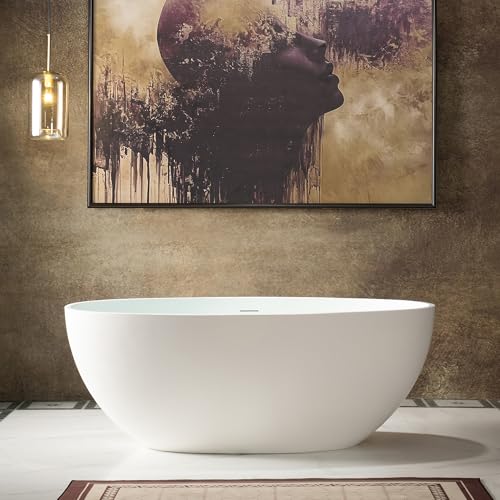
WOODBRIDGE 55 Inch Stone Resin Freestanding Tub — Stone resin, smaller scale
Not every Bali bathroom is a villa suite, and WOODBRIDGE’s 55-inch stone resin oval is the recipe translated for the guest bath, the ensuite and the thoughtfully small primary. It carries the same material language as its 67-inch sibling — solid surface, matte white, integrated slotted overflow with the drain in the box — at a scale that leaves room for a stool, a plant and the person. Where the big tub performs for a room, this one composes a corner, and in small spaces composition is the whole art.
The soak leans into the style’s seated philosophy. Fifty-five inches will not host a full-length sprawl for most adults, but the oval well is shaped for the deep sit that the resort bath actually celebrates, and the smaller volume fills in minutes from an ordinary water heater, arriving hot and staying proportionate. Couples renovating a modest bathroom often discover this is the Bali they will use daily, while the grand version would have been a monthly ceremony; frequency is a feature, and this tub is engineered for it.
It remains stone resin, with the family’s obligations: heavier than any acrylic of its size, happier on a verified floor, and deserving of gentle cleaning to protect the matte skin. It also remains a solo instrument. For the household whose bathing ritual is one person, warm water, a window and twenty minutes of quiet, the 55-inch WOODBRIDGE delivers the island’s material honesty without demanding the island’s architecture.
- Format: freestanding oval soaker, 55 inches
- Material: stone resin solid surface, matte white
- Overflow: integrated slotted design, drain included
- Soak style: deep seated soak for one bather
- Fill: modest volume, quick from standard heaters
Strengths
- Genuine matte stone feel at an ensuite scale
- Fast fills encourage a daily soaking habit
- Composes beautifully in corners and small rooms
Trade-offs
- Solo bathing is the design’s firm boundary
- Still heavy for its size, floor check required
- Tall bathers sit rather than recline fully
Best for: smaller bathrooms that want the true matte material, not an imitation. Check price on Amazon.
Not suited for: shared bathing, or buyers needing a shower over the tub.

MEDUNJESS 65 Inch Stone Resin Freestanding Tub — Best for view-facing soaks
Resort baths are oriented: towards the garden, the private courtyard, the green wall of plants. The MEDUNJESS understands orientation better than any tub here, because its double-slipper shape raises both ends of the shell, letting the bather recline facing whichever direction the room’s beauty lives in — and change their mind tomorrow. At 65 inches in stone resin with a stated 20mm wall thickness, it has the substance to anchor a room designed around a view, whether that view is a landscaped garden or a well-composed wall of timber and tile.
The raised ends do more than face views. They cradle the back and shoulders at a lazier angle than a uniform oval, they let two bathers share without a negotiation over the good end, and they give the silhouette a gentle wave that reads as crafted rather than moulded-minimal. The matte solid surface keeps the light soft, the pop-up drain and overflow arrive included, and the shell’s thermal manners suit the long, drifting soaks that a view invites.
As with the other stone resin picks, the invoice arrives as weight and step-over height: both raised ends must be climbed, and the filled tub is a load for a verified floor. The shape is also the most assertive in this guide — a double slipper makes a statement even in matte white — so rooms chasing absolute minimalism should choose the WOODBRIDGE ovals instead. For a bathroom with something worth looking at, no other pick frames the experience as generously.
- Format: freestanding double-slipper, 65 inches
- Material: stone resin, 20mm wall thickness stated
- Finish: matte white solid surface
- Drain: pop-up drain and overflow included
- Soak style: recline facing either direction, seats two
Strengths
- Both ends recline, so the view chooses the posture
- Thick walls give real carved-stone substance
- Shared bathing without a compromised end
Trade-offs
- Raised ends mean a higher climb in and out
- Silhouette is assertive for strict minimalist rooms
- Filled weight is among the heaviest here
Best for: bathrooms with a garden, courtyard or composed view worth facing. Check price on Amazon.
Not suited for: low step-over needs or very tight, quiet schemes.

FerdY Tahiti 55 Inch Freestanding Bathtub — Best glossy island alternative
Every style guide needs its loyal opposition, and the FerdY Tahiti is this one’s: an island-named, elegant oval freestanding tub that keeps the Bali recipe’s shape and depth but trades the matte stone finish for glossy white acrylic and brushed nickel hardware. Some bathrooms — bright, coastal, full of white tile and daylight — honestly suit the sheen better than the stone look, and the Tahiti serves them without apologising. Its oval is gracefully drawn, its integrated slotted overflow keeps the rim clean, and its 55-inch scale sits in the useful middle between the tiny Bali and the full-size sculptures.
The bathing is a comfortable middle register too: deeper and more enveloping than a standard alcove tub, sized for a proper seated-to-reclining solo soak, and light enough — acrylic again — to keep installation and floor demands modest. The included brushed nickel drain and cUPC certification complete a package that asks little of a renovation beyond the freestanding filler decision every tub in this guide shares. Gloss does show water marks more readily than matte, so the Tahiti’s owners trade a weekly wipe for their shine, a bargain most of them strike happily.
Within a Bali brief, the Tahiti is best understood as the shape’s ambassador to rooms that will never go matte: pair it with timber, rattan and green planting and the island mood survives the gloss perfectly well, because the style’s soul is the deep oval and the uncluttered room, not the finish alone. Buyers who dream specifically of stone should stay with the resin picks; buyers who dream of the shape in a bright room have found their tub.
- Format: freestanding oval soaker, 55 inches
- Material: glossy white acrylic, brushed nickel drain
- Overflow: integrated slotted design included
- Certification: cUPC certified
- Soak style: solo seated-to-reclined immersion
Strengths
- Island oval shape in a bright, light-friendly finish
- Featherweight installation compared with stone resin
- Mid-size footprint fits where sculptures cannot
Trade-offs
- Gloss shows water spots sooner than matte rivals
- Less heat-retentive than the dense resin shells
- Solo scale, despite the generous depth
Best for: bright, coastal-leaning bathrooms that want the shape without the stone. Check price on Amazon.
Not suited for: matte purists or couples planning shared soaks.
Teak-and-terrazzo resort-style tubs (category discussion) — The original inspiration
Everything above imitates something, and this closing pick names it: the site-built bathing of Balinese resorts themselves, discussed here as a category at a premium, commission-level tier because there is no box to link. In the originals, the tub might be carved from a single river stone, cast in terrazzo and polished for a week, or built as a deep masonry plunge lined in stone tile, with teak decking underfoot, a rain shower standing open to the sky and planting where a Western bathroom would put a cabinet. The materials are local, the labour is the luxury, and the bath is architecture rather than appliance.
Understanding the original clarifies what the boxed picks are doing. The stone resin ovals borrow the carved tub’s matte density; the deep compact FerdY borrows the plunge pool’s seated immersion; the double slipper borrows the resort’s orientation towards the garden. None of them borrows the open sky, and the honest homeowner response is to complete the illusion with the elements that do ship in boxes: a teak bath mat or stool, timber-toned flooring or wall panel, stone-look tile, a plant that tolerates steam, and lighting warm enough to suggest late afternoon in the tropics.
For readers planning a genuine architectural project — a garden bathroom extension, a courtyard conversion — a locally built terrazzo or stone tub is a legitimate commission to discuss with a builder, with waterproofing, drainage and structural engineering as the serious chapters. For everyone else, the category’s role in this guide is as the compass: it defines the direction, and the five linked tubs are how far a delivery van can take you towards it.
- Format: site-built stone, terrazzo or masonry bathing
- Materials: carved stone, polished terrazzo, teak accents
- Positioning: premium commission tier, locally built
- Setting: often semi-outdoor in the resort originals
- Lesson: room, light and planting carry half the style
Strengths
- The authentic material and setting every pick imitates
- Built to the exact dimensions of the room
- Ages as architecture rather than as an appliance
Trade-offs
- Requires builders, engineering and a real budget
- Impossible to return, exchange or relocate
- Outdoor formats suit few climates year-round
Best for: ground-up bathroom architecture with a garden to open onto.
Not suited for: standard renovations, upper floors, or the impatient.
Comparison Table
| Pick | Material | Standout trait |
|---|---|---|
| FerdY Bali 47 Inch Freestanding Bathtub | Gloss acrylic | The namesake, small rooms |
| WOODBRIDGE 67 Inch Stone Resin Oval | Matte stone resin | Closest to carved stone |
| WOODBRIDGE 55 Inch Stone Resin Oval | Matte stone resin | Stone feel, smaller scale |
| MEDUNJESS 65 Inch Stone Resin Slipper | Matte stone resin | Double-slipper, view-facing |
| FerdY Tahiti 55 Inch Freestanding Bathtub | Gloss acrylic | Island shape with sheen |
| Teak-and-terrazzo resort-style tubs (category discussion) | Site-built stone | The original inspiration |
What actually makes a bathroom feel Balinese?
Walk through the recipe slowly, because each ingredient is cheap compared with the tub and the ensemble fails without several of them. Material comes first: surfaces should feel mineral or vegetal — matte stone or its resin echo, timber in warm mid-tones, woven rattan or bamboo, limewashed or softly textured walls. Gloss is rationed to mirrors and glass. Shape comes second: curves over angles, the oval tub echoed in a round mirror or a pebble-form stool, nothing in the room shouting in chrome. Third comes depth of soak and slowness of ritual — the style assumes the bath is an event with a beginning, a middle and no phone.
Sound deserves a sentence of its own in a style devoted to calm: a bathroom with a rattling fan and a humming extractor is wearing the wrong soundtrack, so quiet ventilation and a door that closes without a slam belong on the renovation list beside the beautiful objects. Light and green complete the transformation. Balinese bathrooms borrow the tropics’ own lighting design — bright shade, warm evenings — which at home translates to layered light on dimmers, never a single ceiling glare, plus planting that tolerates humidity: a fern on the stool, a tall leafy silhouette in the corner, even a single stem in a stone vase on the rim. Scent and sound are the final, nearly free ingredients; a room that smells faintly of frangipani soap and sounds like water rather than extraction fans has arrived, whatever the tub cost.
How do you style around the tub without a full renovation?
The encouraging truth is that the Bali effect is mostly subtraction and textiles, which is why it survives contact with real budgets better than any other luxury bathroom language currently in fashion. Begin by removing: every bottle that is not beautiful goes into a closed cabinet, every colour that fights the palette leaves, and the surfaces around the tub are cleared to near-emptiness. Then add back in the style’s vocabulary — a teak or bamboo bath mat, rolled towels in natural whites and sands, a wooden caddy or stool, one plant, one stone or ceramic vessel. A freestanding tub from this guide placed in that edited room will read as Bali to any guest, because the eye reads the room first and the fixture second.
Paint and light finish the job for the price of a weekend, and neither asks permission from the floor joists or the water heater, which is more than can be said for the tub itself. A warm off-white or soft clay tone on one wall, bulbs swapped to warm colour temperatures, and a dimmer on the main light move a bathroom further towards the island than any accessory haul. Renters can run the entire playbook reversibly, which is why this style, alone among luxury bathroom looks, is genuinely available to a rented flat with the little FerdY Bali standing in the corner.
How do you keep matte stone resin looking like stone?
Matte solid surface has one personality trait to respect: it hides water marks gracefully but records abrasion permanently, so the cleaning kit is soft cloths and non-abrasive products, full stop. Soap film lifts with a gentle bathroom cleaner and patience; the scouring pad that would fix it in a minute would also fix the matte finish into a shiny scar. Hard water districts should wipe the shell down after soaks, since mineral scale on a matte ground reads as chalk and is easier to prevent than to dissolve.
The compensations are considerable. Minor scuffs and stains on genuine solid surface can usually be sanded or polished out by a professional because the material is consistent through its thickness — the tub can be refinished rather than replaced, which is a very Balinese attitude towards objects. Acrylic picks ask for the same non-abrasive discipline with less forgiveness, and both materials reward the simplest habit of all: rinse the shell after the bath, while the evidence is still soluble.
What mistakes ruin the Bali effect?
- Buying the tub and skipping the room. A matte oval under cold light amid plastic clutter reads as a grey pod, not a resort. The editing, textiles and warm light are not garnish; they are half the purchase.
- Choosing gloss when the dream was stone. Finish is the style’s loudest signal. If the reference photographs in your head are matte, an acrylic sheen will disappoint daily, however good the shape is.
- Undersizing the soak. The style is built on deep, seated immersion. A shallow tub in a beautiful room is a photograph of a bath, not a bath.
- Ignoring the floor under stone resin. The material’s weight is the price of its authenticity. A professional floor verdict belongs in the budget from the first day.
- Over-accessorising with themed kitsch. Bali style is restraint in natural materials, not a souvenir shop. One plant and honest timber beat a dozen decorative gestures.
Can a Bali bathroom open onto a garden at home?
The resort original often has no fourth wall at all, and temperate-climate homes can borrow the idea in degrees. A ground-floor bathroom with French doors to a private courtyard reproduces the essential move — bathing with the garden present — for the months the climate allows, with the tub oriented towards the opening exactly as the MEDUNJESS’s double slipper invites. Even a large window, a frosted lower pane and a planted view outside move a room measurably in the island’s direction, because the style’s deepest ingredient is not stone but greenery within sight of the water.
Privacy and practicality set the terms. Sightlines from neighbours, the security of ground-floor glazing and the behaviour of insects in summer all deserve a thought before the wall comes down, and a semi-outdoor shower or tub needs drainage and materials chosen for weather rather than for a brochure. Most households will land at the tasteful middle: an indoor tub, a big planted view, doors that open on warm evenings. That middle, executed calmly, delivers nine-tenths of the feeling at a tenth of the architecture.
What belongs in the water of a Bali-style soak?
The resort ritual treats the bath as an infusion — frangipani or lemongrass in the water, petals on the surface in the photographs — and the home version can borrow the spirit while respecting the materials. A handful of bath salts or a few drops of a bath oil suit acrylic and stone resin alike when the shell is rinsed afterwards, since residue dulls matte finishes and makes any surface treacherous underfoot. Petals are prettier than they are practical, decorating the drain as faithfully as the surface, and most home bathers retire them after one experiment in favour of scent at the room’s edge — a candle, a reed diffuser, soap in a tropical register.
Temperature and time are the real ingredients. The style’s soak runs warm rather than scalding and lasts rather than hurries, which is why the dense shells’ heat retention threads through this entire guide’s judging. A caddy with tea or cool water, a chapter of a book, and a household that understands the bathroom is occupied in the ceremonial sense complete a ritual that costs almost nothing beyond the decision to take it slowly.
Which taps and hardware finishes suit the style?
Hardware is where Bali bathrooms most often betray themselves, because a chrome waterfall spout with blue LED accents belongs to a different holiday entirely. The recipe asks for restraint: brushed or matte finishes, simple lever or crosshead forms, and a filler whose silhouette could be drawn in one line. Floor-mounted fillers in brushed nickel or matte black suit the freestanding ovals here; wall-mounted spouts in the same quiet finishes serve tubs placed near a wall. Brushed brass and aged bronze tones can warm a stone scheme beautifully, provided the whole room commits to one metal family rather than collecting them.
Flow deserves as much attention as finish. A deep stone resin tub fed slowly is a scheduling problem wearing a design costume, so the filler and the household’s water pressure should be discussed together, and a hand shower on the filler earns its place for rinsing both bather and shell. Towel rails, robe hooks and the humble toilet-roll holder should be chosen in the same sitting, in the same finish, before the room’s calm is negotiated item by item.
Which plants actually thrive beside a steamy bath?
The planting is not decoration in this style; it is a building material, and it should be chosen for the conditions a bathroom actually provides — humidity in waves, light that ranges from generous to grudging, and owners whose watering discipline varies. Ferns forgive almost everything a bathroom does and repay it with exactly the soft green architecture the style wants. Pothos trails obligingly from shelves and tolerates low light, orchids adore the steam and flower at rim height, and a tall palm or banana relative makes the single bold gesture for rooms with a window worth framing.
Placement follows the water. Plants belong near the tub but not in the splash zone’s daily line of fire, in pots with drainage that will not mark stone or timber, and at heights that layer — one tall silhouette, one mid-level mass, one small accent on the stool or caddy. Artificial plants have improved enormously and solve the windowless bathroom honestly, though the style’s soul prefers one real, thriving fern to a jungle of plastic. Start with a single plant that suits the light, and let the collection grow at the speed of success.
Where should the money go in a Bali bathroom?
The spending order that produces the strongest effect per note is unfashionable and reliable. First, the tub itself, in the most honest material the floor and budget allow — this is the object hands touch daily. Second, light: dimmers, warm lamps and the eradication of the single ceiling glare, because light is what the photographs are actually selling. Third, the floor and wall surfaces immediately around the tub, the zone the eye reads as the tub’s landscape. Fourth, textiles and timber — mats, stools, towels, a caddy — the portable layer that can travel to the next home. Decorative objects come last and fewest, because the style’s luxury is emptiness that has been chosen.
Households on a strict budget can run the order backwards with surprising success: edit the room, warm the light, lay the teak mat and roll the towels, and even an ordinary existing tub begins to lean towards the island. Then the boxed Bali tub, when it arrives, lands in a room already speaking its language — which is, in the end, the difference between buying a product and building a place.
How do you photograph-proof the room for everyday life?
Resort bathrooms look serene partly because nobody lives in them, and the home version survives by designing the mess a place to go. Closed storage for the bottles, a lidded basket for the laundry, a hook discipline for towels and robes, and a rule that the tub’s rim hosts one vessel rather than a skyline of products — these unglamorous systems are what let the room return to its photograph within two minutes of the morning rush. Families share bathrooms with the style successfully by giving every object a home that is not a surface, because the style is, at bottom, a surfaces policy.
Children and pets test the policy without breaking it. A step stool in timber, bath toys that live in a woven basket rather than the rim, and towels chosen in the palette rather than despite it all keep the room’s calm compatible with its inhabitants. The households that sustain the look for years are not the tidiest people alive; they are the ones who made tidiness the path of least resistance when the room was arranged.
What does the style ask of the bather?
Every bathing culture smuggles in a philosophy, and Bali’s is slowness with the senses switched on. The soak is not a wash with scenery; washing is brisk and preliminary, and the bath itself is for warmth, buoyancy and the deliberate absence of agenda. That philosophy explains the recipe’s every material choice — matte surfaces that do not glare, water deep enough to float the shoulders, light low enough to rest the eyes — and it is available in any of this guide’s tubs the moment the household decides the bath is an appointment rather than an errand.
Practically, the appointment is kept the way all appointments are: scheduled, defended and prepared. A caddy stocked before the water runs, a door the household respects, a phone in another room. Twenty minutes is enough; the resorts would approve of twenty honest minutes over an hour of distracted soaking. The tub is the venue, but the ritual is the resident, and it moves in the day the bather does.
How do you adapt the style for a rental or a resale timeline?
Renters hold a surprisingly strong hand with this particular look, because its portable layer — the compact FerdY Bali standing on an existing floor with a freestanding filler where plumbing allows, the teak mat, the plants, the textiles, the lamp — can be installed without touching a wall and removed without a trace. Where the tub itself cannot change, the room-editing chapters of this guide still apply in full, and an ordinary landlord-white bathroom can lean convincingly tropical by Friday. Sellers face the mirror-image calculation: the style photographs as luxury and calm, so a restrained Bali staging of the main bathroom — matte accessories, greenery, emptiness — sells the feeling without committing the buyer to a stone resin inheritance.
Owners mid-renovation with a sale in five years should choose the middle path this guide keeps recommending: a quality tub in a mainstream-friendly finish, styled personally around the edges. The island, it turns out, is portable in every sense that matters.
How do you choose the right size of Bali tub for your ritual?
Let the ritual, not the room’s maximum, set the size. A daily seated soaker who reads for twenty minutes is served best by the deep compact shells — the FerdY Bali or the 55-inch WOODBRIDGE — whose quick fills and concentrated warmth match the habit like a glove. A weekend immersion artist, or a couple whose bath is a shared debrief, needs the length and width of the 67-inch WOODBRIDGE or the double-ended MEDUNJESS, and should budget the water and the floor accordingly. The error to avoid is buying the largest tub the room can physically hold, because a sculpture that crowds its setting breaks the style’s first rule — the object must have air around it to read as calm.
Test the posture before the purchase wherever possible, and test it as the style intends: seated, back supported, water imagined at the collarbone. Many bathers discover in the showroom that the deep 55-inch sit suits them better than the long 67-inch sprawl, which is information worth more than any dimension on a listing. The island’s own bathing is compact and deep; trust the original’s proportions when your instincts waver.
What should you ask the installer before the tub arrives?
Four questions, asked early, prevent nearly every Bali-project regret. Where exactly will the drain land, and does the chosen tub’s waste position match the floor’s reality? Is the floor content with the filled weight of a stone resin shell plus its bather, in writing rather than in vibes? Which filler, mounted where, filled at what rate — and has its plumbing been roughed to the tub’s actual position rather than the plan’s approximation? And finally, what is the route from the delivery van to the bathroom, measured at its narrowest turn? A fitter who answers all four fluently is the fitter the project wants, and a tub ordered after those answers is a tub that will be bathing its owners on schedule.
How does the style handle the shower question?
Resort bathrooms usually give the shower its own open-air moment and keep the tub purely for soaking, and homes with the space to separate the two should copy that division without hesitation — a Bali tub asked to double as a shower base loses its meditative geometry to curtains, spray and compromise. Where one fixture must serve both duties, honesty beats aspiration: choose the alcove route for the working bathroom, style it with the full Bali vocabulary of matte, timber and green, and keep the freestanding dream for the ensuite or the next house. The style survives the compromise gracefully when the room is edited well; what it cannot survive is a freestanding oval behind a plastic curtain, pretending.
What is the evening the style is designed for?
Picture it plainly, because the picture is the specification. The light is low and warm, the room smells faintly of something green, the water is deep and still, and the bather — in the FerdY’s compact depth, the WOODBRIDGE’s stone sprawl or the MEDUNJESS’s view-facing recline — is doing absolutely nothing, at length, on purpose. Every decision in this guide, from matte finishes to dimmer switches, exists to protect that evening from the thousand small frictions that dissolve it: the tepid fill, the glaring tube, the cluttered rim, the phone buzzing on the caddy. A household that defends the evening gets the island; the tub is simply the most beautiful brick in the wall.
How do you keep the ritual alive after the renovation dust settles?
New bathrooms enjoy a honeymoon of use, and then life applies its usual taxes — the bath becomes storage for a drying rack, the plant misses a month of water, the caddy migrates. The households still soaking a year later protected the ritual structurally: a standing weekly slot that other plans bend around, supplies stocked like groceries rather than remembered like birthdays, and a five-minute reset after each use that returns the room to its photograph while the water drains. Build those habits into the first fortnight, when enthusiasm is free, and the island becomes a resident rather than a memory of the renovation.
Final Recommendation
For the fullest fidelity a delivery can bring, choose the WOODBRIDGE 67 Inch stone resin oval — it is the recipe’s material, shape and scale in one object, and a room styled with restraint around it will pass for the tropics on a February night. The MEDUNJESS is the pick where a view or a partner enters the brief, the 55-inch WOODBRIDGE carries true stone into smaller rooms, and the FerdY pair divide the acrylic honours: the Bali for tiny spaces that want depth and the name, the Tahiti for bright rooms that prefer their island with a sheen.
Whichever shell you bring home, spend the modest remainder of the budget on the room — the mat, the timber, the plant, the dimmer — because Bali was never a bathtub. It is the feeling of warm water, natural material and unhurried time conspiring together, and a household that builds that conspiracy carefully will find the island waiting at the end of the hallway. Start with one soak done properly — warm room, deep water, low light, nowhere to be — and let that single evening, rather than any catalogue, confirm what the room still needs.
Frequently Asked Questions
What is the difference between stone resin and acrylic for this style?
Stone resin is a mineral-loaded solid surface: denser, cooler and matte, with a hand-feel close to carved stone and heat behaviour to match, at the cost of serious weight. Acrylic is a light, glossy, warm-touch plastic that reproduces the style’s shapes at friendlier prices and floor loads, while reading as modern rather than mineral. For pure Bali fidelity the resin wins; for small rooms, upper floors and tight budgets, the better acrylic ovals in this guide carry the mood convincingly.
Can a Bali-style tub work in a cold climate?
Beautifully, and arguably better — the style’s whole promise is a warm, deep, unhurried soak, which matters most when the weather outside is doing its worst. The practical adjustments are thermal: a room that is warm before the bath, water that starts properly hot, and dense shells that hold the temperature while you drift. Add the planting in varieties that accept indoor life and lower light, and the island becomes a state of insulation rather than geography, available in any postcode.
Do these tubs need special plumbing?
No more than any freestanding tub: a floor-level drain connection in the right place, a filler strategy — floor-mounted, wall-mounted or a spout with enough reach — and access thought through before the floor is finished. The stone resin models add a structural question rather than a plumbing one. Everything else about the installation is standard freestanding practice, and any competent bathroom fitter will find these tubs familiar territory.
How do I choose between the 55-inch and 67-inch stone resin ovals?
By posture and by room. The 67-inch rewards bathers who stretch out and rooms that can frame a sculpture with space on all sides; the 55-inch rewards seated soakers, smaller footprints and water heaters of ordinary size. Measure the room’s longest honest wall, sit in both shapes if a showroom allows, and remember that the tub used daily at 55 inches beats the masterpiece used monthly at 67 — frequency is the luxury this style actually sells.
Are these tubs comfortable for reading in?
The deep seated posture the style favours is, happily, the natural reading posture: back supported by the sloped end, knees risen, book held clear of the water on the rim or a timber caddy. The double-slipper MEDUNJESS and the longer WOODBRIDGE give the most forgiving angles for a long chapter, while the compact FerdY suits shorter, more meditative sessions where the book is eventually set aside. A small warm lamp within reach completes the library.
What flooring suits a Bali-style bathroom?
The look asks for matte, natural and warm underfoot: stone-look porcelain in soft greys and sands, real timber-look planks rated for wet rooms, or actual teak in the dry zones and as mats and stools. High-gloss tile fights the recipe at floor level, where the eye spends half its time. Whatever the material, it must be honestly waterproof and slip-aware, because a room built around deep water owes its users a floor that respects the fact.
How long does a stone resin tub keep water hot?
Longer than a comparable acrylic shell, because the dense wall absorbs less of the fill’s initial heat and then behaves like a warm stone around the water rather than a thin skin against a cold room. In practice the difference shows at the half-hour mark, where the resin soak is still at its opening comfort while a light shell has begun its slow negotiation downwards. A lid or cover used during filling, and a room warmed beforehand, stretch any tub’s performance further.
Can I get the look with an alcove tub?
Partially, and the attempt is worthwhile: an alcove cannot offer the freestanding silhouette, but matte finishes, natural textiles, timber accents, planting and warm dimmable light can move an ordinary alcove bathroom most of the way towards the mood. The deep soak matters too, so a deeper alcove model serves the project better than a shallow one. The style is a direction rather than a gate, and any room can travel along it.
Related Guides
Continue the theme through the house: the cleaning chapter continues with Best Stick Vacuums for floors that stay worthy of the sanctuary, and Best Adjustable Vacuums for the rest of the home. Back in the bathroom, Best Bathroom Single Vanities covers the single-basin end of the room, and the finishing layer for any long soak is waiting in Best Bath Towel Sheets.


