What's inside
- Key Takeaways
- Quick Picks
- How Did We Choose These Single Vanities?
- Comparison Table
- How Should a Single Vanity Be Lit and Mirrored?
- What Plumbing Simplicity Does a Single Actually Buy?
- The Ninety-Second Morning a Single Makes Possible
- How Do You Pass a Single Vanity to Its Next Home?
- How Do You Choose a Faucet for a Single Vanity?
- What Makes a Single Vanity Feel Expensive?
- How Does a Single Vanity Serve a Couple Who Stagger?
- What Is the Best Single for a Small Ensuite?
- How Do You Style a Single Vanity Seasonally?
- How Do You Arrange the Counter Around One Basin?
- What Is the Best Single Vanity for a Guest Bathroom?
- How Do You Swap a Double for a Single, or the Reverse?
- What Accessories Complete a Single Station?
- How Do You Keep a Solo Bathroom From Feeling Sparse?
- Should a Single Vanity Be 48 or 60 Inches?
- How Do You Keep a Single Station Feeling Generous?
- Which Top Suits a Single Basin Best?
- What Mistakes Do Single Vanity Buyers Make?
- Final Recommendation
- Frequently Asked Questions
- Related Guides
As an Amazon Associate I earn from qualifying purchases. This post may contain affiliate links at no extra cost to you.
cottageverdict.com is reader-supported. When you buy through links on our site, we may earn an affiliate commission.
Where to buy: each vanity below is listed on Amazon under its linked name, where you can check price on Amazon and confirm the top, basin and finish against the alcove or wall you have measured.
One basin, properly served, beats two basins squeezed. The best bathroom single vanities take the counter space and storage that a second sink would have consumed and give them back to the one person actually standing there, as working surface, as drawers that file a whole routine, as a cabinet that makes a solo bathroom feel appointed rather than merely adequate. This guide gathers six of the best at forty-eight and sixty inches.
Wyndham Collection’s Sheffield appears twice, in espresso and in grey, both under white Carrara marble, because the sixty-inch single is that line’s home ground. ARIEL’s Hepburn brings its nine-drawer system and Carrara-toned quartz to the same width. OVE Decors’ Tahoe offers a sixty-inch cabinet organised around adjustable shelves and a double-deep drawer, while James Martin’s Amberly and DELUXE LIVING’s light walnut combo represent the forty-eight-inch alcove in warm woods, one mid-century, one classic.
Singles serve more bathrooms than any other format: the solo primary, the guest suite, the family bathroom where people stagger by temperament. The sections after the picks work through width choice, top care and the storage planning that turns one basin into a complete station.
Key Takeaways
- A single basin at sixty inches gives one person a truly generous station.
- Nine drawers, on the Hepburn, can hold an entire routine off the counter.
- Marble singles from Wyndham come in espresso or grey under the same Carrara top.
- Forty-eight inches remains the standard alcove, and the walnut pair here serve it warmly.
- Singles simplify plumbing: one faucet, one drain, one set of decisions.
Quick Picks
| Pick | Badge | Why it earns its place |
|---|---|---|
| Wyndham Collection Sheffield 60 Inch Single Vanity | Best Marble Single in Espresso | Espresso cabinetry under white Carrara marble, one undermount sink, tailored contrast. |
| Wyndham Collection Sheffield 60 Inch Single Vanity Gray | Best Marble Single in Grey | The same Sheffield station in grey, softer against white Carrara marble. |
| ARIEL Hepburn 60 Inch Vanity | Best Drawer Single | Nine dovetail drawers and quartz calm around one generous basin. |
| OVE Decors Tahoe 60 Inch Vanity | Best Organised Single | Midnight blue Tahoe storage: adjustable shelves, tilt-down trays, a double-deep drawer. |
| James Martin Amberly 48 Inch Vanity | Best Walnut Alcove Single | Mid-century walnut warmth sized for the standard forty-eight-inch alcove. |
| DELUXE LIVING 48 Inch Vanity Light Walnut | Best Light Wood Combo | Light walnut combo with ceramic sink, backsplash, soft-close doors and three drawers. |
How Did We Choose These Single Vanities?
Candidates had to spend the single-basin dividend visibly: counter that a real routine can spread across, or storage that genuinely replaces a linen closet shelf, or both. Singles that were merely doubles with a basin deleted, leaving dead cabinet and a lonely sink, were set aside; the format deserves design intent, not subtraction.
Construction signals matched the rest of this batch: solid frames where claimed, dovetail drawers, soft-close hardware and tops with backsplashes included. We weighted the forty-eight-inch picks for alcove honesty, since that width usually replaces an existing unit on existing plumbing, and the sixty-inch picks for station generosity, since that width is usually a deliberate upgrade.
The six had to span the single’s real habitats, marble classics, quartz moderns and warm-wood alcove pieces, in dark, grey, white, birch and walnut, so that a solo renovator in any style of home finds a candidate worth measuring for.

Wyndham Collection Sheffield 60 Inch Single Vanity — Best Marble Single in Espresso
The espresso Sheffield is the tailored suit of single vanities: deep-toned Wyndham Collection cabinetry carrying a white Carrara marble top and one undermount square sink, with the mirror left for you to choose. Sixty inches around a single basin is a luxury format, and this pick spends it on marble field: broad aprons of cool stone on both sides of the sink, room for the morning’s objects to stand in order rather than in queue.
Undermount fitting keeps that marble sweepable in one motion, and the espresso below gives a white-tiled room its grounding note. Marble’s terms are the familiar ones, sealing kept current and coloured spills wiped promptly, and a single user can hold those terms easily, which is precisely why marble singles make more sense than marble doubles for many households: one person’s habits are simpler to guarantee than two.
Choose the espresso Sheffield for a solo primary bathroom or a formal guest suite in a traditional-to-transitional home. Buyers wanting grey’s softer contrast should read the same cabinet’s other finish next; buyers wanting zero sealing should skip to the Hepburn’s quartz.
The espresso Sheffield has one more talent: it hides a multitude of morning evidence. Dark cabinetry forgives the scuff of a laundry basket, the splash shadow of a hurried rinse, the faint ring of a product bottle set down wet, all the small confessions a white cabinet files publicly. For a guest bathroom that must look composed between hurried turnovers, or a family bathroom used by exactly one parent at dawn, that forgiveness is a daily dividend paid in the currency of not having to wipe something right now.
- Width: 60 inches, single basin
- Cabinet: espresso finish
- Top: white Carrara marble
- Basin: undermount square sink
- Note: mirror not included
Strengths
- Broad marble aprons serve one person luxuriously
- Espresso and marble contrast looks tailored
- One user’s habits keep marble care easy
Trade-offs
- Mirror is a separate purchase
- Dark cabinet shows dust in bright rooms
- Marble still needs its sealing schedule
Best for: solo primary bathrooms wanting marble classicism in espresso.
Not suited for: buyers wanting an all-included, seal-free package.

Wyndham Collection Sheffield 60 Inch Single Vanity Gray — Best Marble Single in Grey
Take the Sheffield’s proven sixty-inch single and finish it in grey, and the room’s temperature changes: where espresso is tailored and dramatic, grey is calm and architectural, letting the white Carrara marble top read as part of one continuous pale composition. Wyndham Collection sells the two finishes side by side because they serve genuinely different rooms, and this guide lists both so the comparison is yours to make with eyes open.
The grey finish is the more forgiving roommate. It hides dust more kindly than espresso, splash marks more kindly than white, and pairs with both chrome and brushed metals without argument. The marble still asks its usual courtesies, sealing and prompt wipes, and a single station’s traffic is the easiest context in which to honour them.
Pick the grey Sheffield for a serene, spa-leaning solo bathroom, a guest suite in a grey-veined scheme, or any room where the vanity should compose rather than command. It is the quietest pick in this guide, and for bathrooms meant as retreats, quiet is the entire point.
The grey Sheffield is the better canvas for coloured towels and changing seasons. Grey’s neutrality is active rather than empty: rust towels in autumn, pale blue in summer, white in a minimalist month, all compose against it without a single argument. Households that restyle their bathrooms cheaply and often, through textiles rather than renovation, will extract more changes per year from this finish than from any other in the guide, which is a real form of value disguised as indecision’s opposite.
- Width: 60 inches, single basin
- Cabinet: grey finish
- Top: white Carrara marble
- Basin: undermount square sink
- Note: mirror not included
Strengths
- Grey hides dust and splashes kindly
- Pale composition suits spa-leaning rooms
- Same proven station as the espresso version
Trade-offs
- Mirror bought separately
- Grey can read cool under cold lighting
- Marble care remains a standing habit
Best for: calm, spa-style solo bathrooms and guest suites.
Not suited for: rooms wanting a dramatic dark anchor.

ARIEL Hepburn 60 Inch Vanity — Best Drawer Single
The Hepburn is the single vanity as filing system: a white solid-wood sixty-inch cabinet, a thick Carrara-look quartz top with backsplash, one rectangular porcelain basin, and nine dovetail drawers with two soft-closing doors to organise everything a routine owns. Where the Sheffields spend the single’s dividend on marble surface, the Hepburn spends it on order, and for many solo households order is the luxury that survives contact with Monday.
Nine drawers sound like abundance until you assign them: daily, hair, teeth, spares, cleaning, guests, and suddenly the count feels like planning rather than plenty. The counter stays clear enough to wipe in one pass, the quartz never asks for sealing, and the white cabinet keeps the whole station bright in rooms short on windows.
Choose the Hepburn when your bathroom frustration is clutter rather than surface, and when one basin genuinely serves your household’s rhythm. Couples with identical start times should shop the doubles instead; everyone else should consider whether they have ever once wished for fewer drawers. The answer tends to settle the matter.
The Hepburn’s drawers have a sound, or rather an absence of one, that owners mention: nine soft-close dovetail boxes moving on their runners make a bathroom feel engineered in the way a good car’s doors do. That tactile quality is not vanity. It is the daily sensory evidence that the object was built properly, and it is why drawer-led designs retain their owners’ affection after the countertop’s novelty has faded. Judge the Hepburn in a showroom by pulling every drawer twice; the second pull is the honest one.
- Width: 60 inches, single basin
- Cabinet: solid wood, white finish
- Top: 1.5-inch Carrara white quartz with backsplash
- Basin: single rectangular porcelain sink
- Storage: 2 soft-close doors, 9 dovetail drawers
Strengths
- Nine drawers file an entire routine away
- Quartz top needs no sealing routine
- White finish brightens window-poor rooms
Trade-offs
- One basin despite the generous width
- Drawer boxes need plumbing positions checked
- White shows splash marks readily
Best for: solo households whose enemy is counter clutter.
Not suited for: partners who must prepare simultaneously.

OVE Decors Tahoe 60 Inch Vanity — Best Organised Single
The sixty-inch Tahoe brings OVE Decors’ shape-by-shape storage thinking to the single format, in a midnight blue cabinet with satin brass hardware: two double-door cabinets with adjustable shelves, two tilt-down trays at the basin, two regular drawers and one double-deep drawer. For one person this variety is pure pleasure, because every category of object, from the tall bottle to the flat razor, finds a compartment shaped like itself.
The tilt-down trays deserve emphasis at this width. The space before a single basin is normally a false front and a daily annoyance, objects with nowhere shallow to live; the Tahoe converts it into the home of the smallest, most-used things, exactly at the hand that uses them. The double-deep drawer, meanwhile, takes the hair dryer and the spare towels that defeat ordinary drawers.
Pick the Tahoe when you organise by shape rather than by pile, and when a deep blue cabinet with brass hardware suits the room’s direction. Minimalists with three possessions should look at the Sheffields’ simpler cabinets; everyone with a real inventory will feel this vanity was designed by a fellow sufferer.
The Tahoe’s midnight blue deserves its lighting note. Deep blue cabinetry under warm light reads almost black and very tailored; under cool daylight it opens into its true nautical richness. Either register flatters the satin brass hardware, but renovators should choose bulbs for the register they prefer, because at sixty inches the cabinet is the room’s largest coloured surface and its lighting is effectively its second finish. Test one bulb before buying six; the Tahoe will reward the experiment.
- Width: 60 inches, single basin format
- Cabinet: midnight blue, satin brass hardware
- Storage: 2 double-door cabinets, adjustable shelves
- Drawers: 2 tilt-down, 2 regular, 1 double-deep
- Style: tailored transitional
Strengths
- Storage shaped for every category of object
- Tilt-down trays rescue the basin-front space
- Satin brass on midnight blue looks tailored
Trade-offs
- Many compartments reward system-minded owners
- Deep blue commits the room’s palette
- Bulkier cabinet feel than the marble classics
Best for: organised solo households with varied inventories.
Not suited for: minimalists with almost nothing to store.

James Martin Amberly 48 Inch Vanity — Best Walnut Alcove Single
The Amberly brings James Martin’s mid-century walnut design to the width most homes already own. Forty-eight inches of clean, squared cabinetry in a warm wood finish, paired in the listing with a rectangular sink, gives the standard alcove a designed centre instead of a builder-grade placeholder, and the furniture proportions keep the smaller width from feeling like a compromise.
Walnut at forty-eight inches is a friendlier commitment than walnut at seventy-two: the tone anchors the room without overwhelming it, harmonises with brass or matte black hardware, and warms the white tile that most alcove bathrooms already wear. A single basin leaves honest counter on both sides, enough for a tray, a tumbler and the morning’s tools in progress.
Choose the Amberly for a mid-century renovation, a warm-minimalist guest bathroom, or an alcove upgrade where the plumbing stays put and the style leaps forward. Check other woods in the room for clashes before ordering, because walnut has opinions; where the palette agrees, few forty-eights look this composed.
The Amberly at forty-eight inches leaves the alcove’s owner one precious thing the sixty-inch singles cannot: room around the vanity. A laundry basket’s stance, a plant’s corner, a stool for a child brushing teeth beside a parent, these small furnishings of real bathrooms fit beside a forty-eight where a sixty would stand wall to wall. Renovators should count that surrounding life when choosing width, because a bathroom is furnished by more than its largest object, and the Amberly’s restraint is a feature measured in other objects’ freedom.
- Width: 48 inches, single basin
- Finish: mid-century walnut
- Package: rectangular sink per listing
- Maker: James Martin Vanities
- Style: mid-century modern
Strengths
- Walnut warmth sized kindly for an alcove
- Furniture proportions elevate a standard width
- Works with existing alcove plumbing layouts
Trade-offs
- Walnut can clash with other wood tones
- Warm palette narrows future colour choices
- Less counter than the sixty-inch singles
Best for: mid-century alcove renovations and guest bathrooms.
Not suited for: rooms already mixing several wood finishes.
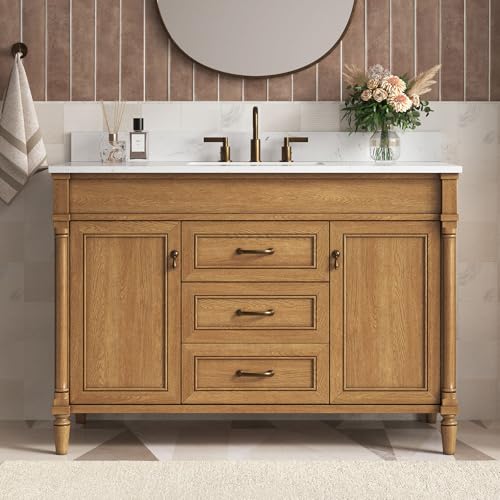
DELUXE LIVING 48 Inch Vanity Light Walnut — Best Light Wood Combo
Where the Amberly’s walnut is mid-century and moody, this DELUXE LIVING combo wears light walnut, the bright Scandinavian-leaning tone that makes small bathrooms feel larger and morning light feel intentional. It arrives as a complete combination: solid wood frame, countertop with backsplash, a ceramic sink, soft-closing doors and three dovetail drawers, which makes it the most self-sufficient forty-eight in this guide.
Light wood is the forgiving finish for real households. It hides dust better than dark tones, splash marks better than white, and pairs with nearly every tile colour a rental or a resale-minded renovation might contain. Three drawers at forty-eight inches is a respectable filing system for one person, and the soft-close doors keep the alcove’s acoustics civilised at six in the morning.
Pick this combo when the alcove is compact, the room is dim, or the project needs one complete purchase that brightens everything it touches. Designers chasing a specific stone top should shop the marble and quartz picks; renovators chasing light, completeness and calm have found their forty-eight.
The light walnut combo is the pick most likely to be bought twice: once for the main bathroom, once for the ensuite, because its brightness and completeness scale down the range without changing character. Matching vanities across a home’s bathrooms give the whole house a quiet coherence that guests feel without naming. If that coherence appeals, note that the combo’s included top and basin make the second purchase even simpler than the first, since every decision arrives already made and already proven in your own daily use.
- Width: 48 inches, single basin
- Cabinet: light walnut, solid wood frame
- Package: countertop, backsplash, ceramic sink
- Storage: soft-close doors, 3 dovetail drawers
- Style: classic light wood
Strengths
- Complete combo in one purchase
- Light walnut brightens compact, dim rooms
- Three dovetail drawers serve one person well
Trade-offs
- Counter material is the combo’s own, not a named stone
- Light finish shows dark dye spills promptly
- Less dramatic than the walnut Amberly
Best for: compact alcoves and bright, calm renovations.
Not suited for: buyers specifying a particular marble or quartz top.
Comparison Table
| Pick | Badge | Format | Top or surface | Storage character |
|---|---|---|---|---|
| Wyndham Collection Sheffield 60 Inch Single Vanity | Best Marble Single in Espresso | 60 in, single | White Carrara marble | Classic cabinet storage |
| Wyndham Collection Sheffield 60 Inch Single Vanity Gray | Best Marble Single in Grey | 60 in, single | White Carrara marble | Classic cabinet storage |
| ARIEL Hepburn 60 Inch Vanity | Best Drawer Single | 60 in, single | Carrara white quartz | Nine dovetail drawers |
| OVE Decors Tahoe 60 Inch Vanity | Best Organised Single | 60 in, single format | Cabinet-led package | Mixed drawers incl. double-deep |
| James Martin Amberly 48 Inch Vanity | Best Walnut Alcove Single | 48 in, single | Rectangular sink package | Walnut cabinet storage |
| DELUXE LIVING 48 Inch Vanity Light Walnut | Best Light Wood Combo | 48 in, single | Combo countertop with backsplash | Doors plus three drawers |
How Should a Single Vanity Be Lit and Mirrored?
A single station deserves portrait lighting: a mirror roughly the basin’s width, centred without apology, and light arriving at the face from the front or sides rather than from a lone ceiling point. One person, one mirror, one good light is the simplest lighting problem in the house, and yet bathrooms fail it constantly by treating the single as a lesser version of a double’s plan.
Because there is only one station, its details can be finer: a framed mirror with presence, a sconce pair chosen for character, a shelf beneath the glass for the objects in active use. Singles are where a bathroom can afford a gesture, since the budget is not divided by two. Renovators should spend that dividend deliberately rather than letting it evaporate into a marginally wider cabinet.
Keep a night-light strategy in the plan, a low warm source for midnight visits that does not blast the station awake. Solo bathrooms serve night as well as morning, and the single’s one mirror will faithfully reflect whatever light you give it, kind or cruel.
What Plumbing Simplicity Does a Single Actually Buy?
One faucet, one drain, one trap, one pair of supply lines: the single’s plumbing is the bathroom’s simplest system, and that simplicity compounds. Install takes half the fitting time of a double, the leak-risk points halve, and future repairs, a cartridge, a trap, a seal, involve one of everything, priced singly and finished in one visit.
The saving should be spent, not banked: on the faucet’s quality, on proper shut-off valves, on the plumber’s time to set the basin and top perfectly level. Singles concentrate a bathroom’s entire washing life through one set of fittings, so that set deserves to be the best in the house rather than the cheapest in the catalogue.
Drawer cabinets are the single’s one plumbing complication, since their boxes route around the trap in fixed geometry. Confirm the trap’s position against the cabinet’s drawing before ordering, as this guide repeats because installers repeat the mistake. With that single check done, a single vanity’s installation is the calmest day of any bathroom renovation.
The Ninety-Second Morning a Single Makes Possible
A well-kept single station offers the fastest dignified morning in domestic life: water on, everything within one step, mirror lit, counter clear, drawer gliding to exactly the object the hand came for. Ninety seconds from door to presentable is not a fantasy of minimalism; it is the arithmetic of a station designed around one person’s sequence, stocked in the order that sequence runs. That is the single format’s final argument, and it is measured not in inches or drawers but in mornings returned, one calm minute at a time, to the only person the room was ever for.
How Do You Pass a Single Vanity to Its Next Home?
Singles migrate better than any other bathroom furniture: one basin’s plumbing is simple to disconnect, the cabinet is a one-or-two-person lift, and its next life, a laundry room, a cottage, a child’s first flat’s bathroom, begins without a plumber’s trilogy. Households that buy a single’s construction properly are buying a piece of furniture the family may use for thirty years across three addresses, which reframes its price entirely.
Prepare the handover when the day comes: clean the cabinet inside and out, photograph the plumbing connections before disconnecting them, keep the documentation with the piece, and note the finish and faucet model on a card taped inside a door. The next household inherits not just a vanity but its whole story, and stories are what separate furniture from flat-pack in the secondhand world.
If the single stays in the house but changes rooms, re-centre its mirror and light in the new location with the same care as the first installation. A vanity moved without its lighting plan arrives as a cabinet; a vanity moved with it arrives as a station. The difference is an afternoon’s work and a decade’s satisfaction.
And if it finally leaves the family, let it go documented and clean, the way this guide has advised buying everything. The secondhand buyer who receives a James Martin or a Wyndham with its papers in order learns the lesson this whole batch of guides exists to teach: objects with stories, honestly kept, are worth more than objects with adjectives, in every room and at every width.
How Do You Choose a Faucet for a Single Vanity?
One basin means one faucet carrying the whole station’s character, so choose it as jewellery rather than plumbing. Its finish should rhyme with the cabinet’s hardware, its height should clear the tallest vessel you actually fill, and its reach should land water in the basin’s centre rather than at its back wall, a geometry check worth performing against the listing’s measurements before the order rather than under the first splash.
Lever handles serve a solo station best, operable with a wrist or the back of a soapy hand, and ceramic cartridges inside decide whether the faucet is still silent and drip-free when the vanity is a decade old. The faucet is the hardest-worked object in the bathroom, cycled more than any drawer, and its quality is felt in the hand every single day, which makes it the wrong place to fund a saving.
Match the faucet’s scale to the vanity’s width. A forty-eight-inch station wants a faucet with presence enough to crown it but not a bridge fixture that swallows the backsplash; a sixty-inch single can carry a taller, more architectural piece because its counter gives the silhouette room. Photograph the combination in your mind at eye level, where you will actually meet it, twice a day, for years.
Keep the aerator’s key and a spare cartridge note in the drawer from the first week. Singles concentrate all risk in one fitting, and the household that can service its only faucet in an evening, from parts already in the house, owns a resilience that doubles distribute by accident. Preparation is the solo station’s substitute for redundancy.
What Makes a Single Vanity Feel Expensive?
Weight, silence and edges. A solid cabinet that does not rock, drawers that close without a report, a top whose edge is finished like an object rather than cut like a board: these are the sensations money buys in a vanity, and all six picks here were chosen because their specifications promise them. Expensive is a tactile verdict delivered by hands, twice a day, and it cannot be faked by a finish photograph.
Light doubles the effect. A well-lit single station, mirror glowing at the edges of the day, makes walnut read as furniture and marble as architecture. The same vanity under a bare ceiling bulb reads as equipment. Renovators chasing the expensive feeling should budget the mirror and its light with the cabinet as one purchase, because the eye prices them together whether the invoices do or not.
Restraint finishes the impression. One beautiful object on the counter, a clear field around the basin, towels with texture rather than logos: the expensive feeling is mostly the absence of noise. A single vanity, alone among bathroom formats, can achieve that absence completely, which is why the format keeps appearing in the bathrooms of people who could afford any format at all.
How Does a Single Vanity Serve a Couple Who Stagger?
Staggering is a schedule, not a compromise, and a good single serves it beautifully: one station, fully equipped, used in sequence by two people whose mornings are offset by design or by chronotype. The station’s completeness is what makes sequence work, because the second user must find everything reset, counter clear, towel dry, mirror unsteamed, which is why the drawer-rich Hepburn and the shape-sorted Tahoe serve staggered couples better than sparse singles do.
The reset ritual is the system’s heart: ninety seconds by the departing user, wiping the top, returning objects to their zones, hanging the towel to dry. Staggered households that keep the ritual describe their single as a hotel station that refreshes itself; households that skip it describe a queue with extra steps. The vanity cannot keep the ritual for you, but deep storage makes it nearly effortless to keep.
Steam is the stagger’s hidden variable. The first user’s shower fogs the room for the second’s arrival, so ventilation that runs on a timer, and a mirror that demists or a habit of cracking the door, belong in a staggered household’s plan. Singles concentrate everything, including moisture, and the plan should admit it.
If the offset between schedules ever shrinks below the reset’s needs, that is the honest signal to price a double, using the finished-station arithmetic elsewhere in these guides. Until then, a well-kept single serves two people in sequence with a grace that cramped doubles never achieve in parallel.
What Is the Best Single for a Small Ensuite?
Small ensuites punish width and reward completeness, which is why the forty-eight-inch combos lead this answer. The light walnut DELUXE LIVING arrives with top, backsplash and basin decided, brightens a dim box of a room, and leaves the floor space a small ensuite needs for a person to turn, dress and breathe. In a small room, the vanity’s restraint is the luxury, and every inch not taken by cabinet is an inch of morning elbow room.
Light is the small ensuite’s second currency. Pale and mid finishes, the light walnut, the grey Sheffield if sixty inches can be spared, return the room’s scarce daylight instead of absorbing it, while the onyx drama that glorifies a big bathroom can swallow a small one whole. Match the finish to the room’s photon budget as honestly as to its tape measure.
Storage in a small ensuite must be vertical or it will be absent. Wall cabinets above the vanity, planned with the mirror rather than instead of it, and the vanity’s own deepest zones reserved for the daily rather than the archival, keep a small room from exporting its clutter to the bedroom. The single’s counter constitution matters most where counter is scarcest.
Ventilation finishes the small-ensuite brief, because a compact room steams completely and a cabinet’s finish pays for it. A fan that actually runs, on a timer, with the door’s undercut allowing air in, protects the walnut and marble in this guide more surely than any coating. Small rooms forgive nothing, and reward planning everything.
How Do You Style a Single Vanity Seasonally?
A single station is the easiest room in the house to redress, because one person’s stage needs one gesture per season. Autumn asks for a rust towel and a candle where the tray allows; spring asks for the pale linens and a stem in a bottle. The vanity itself, walnut, marble or quartz, stays constant and lets textiles carry the calendar, which is the cheapest renovation rhythm a household can sustain.
Keep a small storage zone as the season box: the out-of-season towels, the candle not currently lit, the vase awaiting its month. The Hepburn’s spare drawer or the Tahoe’s deep one swallows a year of seasons in a single compartment, and the rotation takes ten minutes four times a year. Households that store seasons inside the vanity actually perform the rotation; households that store them in an attic perform it once.
Scent is the season’s fastest signal and the single’s private luxury. One fragrance at a time, housed on the tray, changed with the towels, tunes the room to the calendar more completely than any object. A solo bathroom can hold a signature the way a shared one cannot, because there is exactly one nose to please and it is yours.
Resist buying seasonal objects for the vanity itself. The cabinet is the stage, not the cast, and its finishes in this guide, walnut’s warmth, marble’s cool, quartz’s calm, were chosen to host every season without costume. Change what stands on it, never what it is, and the room will feel new four times a year for the price of laundry.
How Do You Arrange the Counter Around One Basin?
Give the basin a clear working field first: nothing permanent within the splash arc except the faucet and a soap vessel that can live wet. Everything else earns its counter place by being used daily and being beautiful or useful enough to look at, because a single’s counter is always in view and always in judgement. A tray gathers the daily objects into one movable island, which keeps the field clearable in a single gesture before cleaning or guests.
Height is the counter’s secret dimension. A tall bottle at the back, the daily tray at the front, nothing medium in between: that skyline keeps a single station looking composed rather than stocked. The Tahoe’s and Hepburn’s storage exist to absorb everything that would break the skyline, and the discipline of returning objects to drawers is what keeps the composition from dissolving by Thursday.
Leave one stretch of counter deliberately, almost defiantly, empty. It is where a book rests during a bath, where a guest sets a washbag, where a plant can live in summer. Empty counter on a single vanity is not wasted width; it is the format’s dividend paid visibly, and owners who spend it all on objects discover they have rebuilt the clutter the single was bought to escape.
Rotate what little stands there seasonally, a candle, a small vase, a different hand soap, and the station will feel renovated four times a year for the price of a drawer swap. Singles reward this kind of small theatre because one person’s stage is easy to redress.
What Is the Best Single Vanity for a Guest Bathroom?
Guests need three things from a vanity: obvious places for their own objects, storage they may borrow without instruction, and a station that makes an unfamiliar room feel considered. The light walnut combo and the Amberly serve the first and third by arriving complete and warm; the Hepburn serves the second with drawers a guest can open without encountering the household’s entire private inventory, provided one drawer is kept as the guest drawer, stocked and surrendered.
Marble in a guest bathroom is a kindness with a caveat. It delights visitors and forgives a weekend’s use easily, but guests cannot be briefed on sealing etiquette, so hosts should expect to wipe the Sheffield’s top after each visit themselves. That small service is the real price of marble hospitality, and households that entertain often should count it honestly against quartz’s indifference.
Mirror and light matter more to guests than to owners, because guests cannot compensate for a bad station with familiarity. A guest single should be lit like a hotel’s, mirror generous, light at the face, towel unmistakably the guest’s towel on its own hook. Spend the guest bathroom’s budget in that order and visitors will describe the room as lovely without knowing why.
Finally, leave the guest station’s counter emptier than your own. Visitors read an empty, beautiful surface as welcome and a crowded one as intrusion into someone else’s routine. The single vanity’s dividend, spent on emptiness, is hospitality in its purest material form.
How Do You Swap a Double for a Single, or the Reverse?
Households change, and bathrooms follow: a couple’s double becomes a solo’s single after a move, a single becomes a double when a partner arrives. The plumbing decides the cost. A double’s wall already carries two sets of supplies, so fitting a single means capping one set neatly inside the wall, a modest job during a renovation and a foolish one to improvise. Keep the capped lines documented in the house file, because a future reverse swap will bless the note.
The reverse direction costs more and should be planned as plumbing first, furniture second. A wall plumbed for one basin can gain a second only by opening it, so the decision to convert belongs at the start of a renovation, not at the vanity showroom. This guide’s doubles all publish their formats plainly so a plumber can judge the wall from the listing before a single tile is lifted.
Counter height and basin position shift with the swap, and mirrors must be re-centred on the new station or stations. Budget the glass as part of the conversion, because a mirror centred on a vanished basin makes the whole room look like a clerical error for a decade.
Whichever direction the swap runs, the old vanity has value: solid cabinets resell, donate or migrate to a laundry room’s second career. A single’s simplicity makes it the most reusable furniture in the house, one more quiet argument for buying its construction properly the first time.
What Accessories Complete a Single Station?
A single basin concentrates a routine, so its accessories should be few and exact: a tray for the daily objects, a tumbler that can live wet, a soap vessel that drains, and a small stool or step if children share the station. Each object should be chosen at the vanity’s own quality level, because on a single’s clear counter every accessory is on permanent display and a cheap tray taxes a fine cabinet daily.
Lighting accessories matter more than decorative ones. A magnifying mirror on an articulated arm serves the close work a single station hosts, shaving, lenses, the occasional splinter, and folds away to restore the composition. Fit it where the main mirror’s light already falls and it needs no wiring of its own.
Storage accessories belong inside the drawers, not on the counter: simple dividers that keep the Hepburn’s or Tahoe’s compartments honest, a small caddy for cleaning supplies under the basin, a hook inside a door for the hair dryer. The single’s discipline is that everything visible is beautiful and everything useful is hidden, and accessories should be bought to serve that rule rather than to decorate its exceptions.
One plant, if the room has any light at all, completes more single stations than any purchasable object. The walnut and marble picks in this guide all compose beautifully against green, and a plant is the cheapest way to make a solo bathroom feel tended rather than merely equipped.
How Do You Keep a Solo Bathroom From Feeling Sparse?
Singles risk spareness because one person’s objects occupy less visual space, and the cure is texture rather than quantity. A woven basket for towels, a wooden stool, linen with a visible weave, a rug with a pattern the tile lacks: these warm a single station without crowding it, and they can be changed seasonally while the vanity, the room’s anchor, stays serenely itself.
Art belongs in solo bathrooms more than anywhere, because the audience is guaranteed and unhurried. One framed print at the mirror’s sightline, chosen for the person who actually stands there, turns a functional room into a personal one. The Amberly’s walnut and the Sheffields’ marble both frame art handsomely, which is a use of their finishes no specification sheet records.
Scent and sound finish the work quietly: a candle or reed diffuser kept on the tray’s edge, a small speaker on a shelf if mornings run on radio. A solo bathroom is the one room whose atmosphere can be tuned to a single taste without negotiation, and that tuning, cheap and personal, is the single format’s emotional dividend to match its counter dividend.
Resist filling the room to prove it is finished. A single station, warmly textured and personally tuned, feels complete at a level of furnishing that would leave a double feeling bare, because completeness is a ratio between a room and its user’s life, and one life, well housed, fills a room exactly.
Should a Single Vanity Be 48 or 60 Inches?
Forty-eight is the width of inheritance: the alcove already framed, the plumbing already centred, the replacement that respects both. Choose it when the renovation is a refresh, when the room is a guest or family bathroom with staggered use, or when the twelve extra inches would be stolen from a door swing or a tub. The walnut pair in this guide exist to prove forty-eight need not feel like settling.
Sixty is the width of intention: a deliberate upgrade that gives one basin a station’s full honours, counter in abundance, storage in depth, and a mirror wall that can breathe. Choose it when the wall is being replumbed anyway, when the bathroom serves one person as a primary retreat, or when the household’s routine genuinely spreads out.
Either way, measure the room’s choreography, not just its wall. A sixty that blocks a linen door will annoy daily; a forty-eight that leaves a graceful passing space will please daily. The tape measure reports both facts, if it is asked about movement as well as length.
How Do You Keep a Single Station Feeling Generous?
Light it like a portrait, not a corridor: a mirror sized to the basin’s width, flanked or topped by light at face height, turns one station into a place a person enjoys standing. The Sheffields leave the mirror to you precisely so this decision gets made deliberately rather than inherited from a bundle.
Give the counter a constitution. A tray for the daily objects, a rule that everything else lives in drawers or cabinets, and a clear zone around the basin that nothing colonises: these three habits keep even a forty-eight feeling like a hotel station. The Hepburn’s and Tahoe’s storage exist to make the constitution easy to keep.
Finally, hang the towel where the hand expects it, on the wall the basin faces or beside the cabinet, not across the room. Generosity in a bathroom is mostly the absence of small journeys, and a single station, well arranged, eliminates nearly all of them.
Which Top Suits a Single Basin Best?
Singles are marble’s best case. One user’s traffic is predictable, one person’s habits can hold the sealing-and-wiping agreement, and the reward, a broad cool field of Carrara around one basin, is the most luxurious surface-per-person in this entire batch of guides. The two Sheffields exist because that case is strong.
Quartz is the single’s practical champion, and the Hepburn wears it: no sealing, no etching anxiety, a consistent Carrara look that keeps a white bathroom serene. For households whose one user is nonetheless a whirlwind of products, quartz’s indifference will out-please marble’s beauty within a month.
Combo tops, like the light walnut DELUXE LIVING’s, trade specification glory for completeness: the top, backsplash and basin arrive matched and warrantied together. In a forty-eight-inch refresh, that completeness often beats a named stone, because the project’s risk and shopping list both shrink at once.
What Mistakes Do Single Vanity Buyers Make?
The first is apologising for the format: buying a single and then cramping it with countertop storage towers to mimic a double’s capacity. A single’s power is its clear surface and deep storage; use the drawers, keep the counter constitution, and the station will feel larger than many doubles.
The second is forgetting the mirror decision on listings that exclude it, as both Sheffields do. The mirror is half the station’s face; budget it, size it to the basin and light it properly, rather than discovering its absence on install day.
The third is placing a sixty-inch single on forty-eight-inch plumbing assumptions. Even one basin moves when the width grows, and drawer cabinets route around pipes in fixed ways. Confirm the basin centre against your stub-outs, or budget the plumber’s adjustment, before the cabinet arrives.
Finally, buyers under-light a single station because it is ‘only one person’. That one person is you, every morning. Spend on the mirror and its light with the same seriousness as the cabinet, and the whole vanity will feel twice its price.
Final Recommendation
Take the Hepburn if your single needs order above all, the Tahoe if it needs shapes for everything, the grey Sheffield for marble calm, the espresso Sheffield for marble drama, the Amberly for walnut warmth in the alcove, and the light walnut combo for a complete, brightening forty-eight. One basin was never the modest option; arranged this well, it is the connoisseur’s.
May your one station be the room where your household’s mornings begin in order, each person in turn, at a counter that is always ready for exactly one of you at a time.
Frequently Asked Questions
Is a single vanity enough for a primary bathroom?
For one occupant, or a couple whose schedules naturally stagger, absolutely, and the counter and storage dividend often serves them better than a cramped double would. Only genuinely simultaneous routines justify two basins; be honest about yours and the single will not disappoint.
What width single vanity is most common?
Forty-eight inches, because it matches the standard alcove and existing plumbing in most homes. Sixty inches is the popular upgrade width in primary bathrooms, giving one basin a generous station without replumbing the room’s whole layout.
Can a single vanity have enough storage?
Yes: the Hepburn’s nine drawers or the Tahoe’s mixed compartments hold a full routine plus spares, exceeding many doubles whose space is split by a second basin’s plumbing. Storage depends on the cabinet’s design intent, not on the basin count.
Should I choose marble or quartz for a single?
Marble if your habits are gentle and you value natural variation, since one user’s traffic is the easiest to keep marble-safe. Quartz if products, dye or haste feature in your routine. Both appear in this guide because both answers are respectable.
Does a single vanity hurt resale value?
In a primary ensuite marketed to couples, a double may photograph as an expectation; in every other bathroom, a well-chosen single reads as intentional and serene. Match the format to the room’s likely users rather than to a generic fear, and choose quality either way.
Related Guides
Round out the project with the heated corner tub guide, the alcove tub specialists, a garage-side vacuum guide from the same batch, and the topped-vanity roundup: Best 2-Person Corner Soaker Bathtubs with Heat Best Acrylic Bathtubs for Alcove Installs Best 12-Volt Wet Dry Car Vacuums Best Bathroom Vanities with Tops.


