What's inside
- Key Takeaways
- Quick Picks
- How Did We Choose These Corner Tub Picks?
- Comparison Table
- How Do You Keep a Two-Person Corner Soak Comfortable?
- What Should You Check Before Any Corner Tub Is Delivered?
- A Final Word on Corners Themselves
- How Do You Winterise and Recommission a Jetted Corner Tub?
- What Do Two-Person Corner Tubs Do to a Bathroom’s Layout?
- How Do You Plan a Weekend Spa Ritual Around a Corner Tub?
- What Alternatives Exist If the Corner Will Not Fit a Triangle?
- How Much Water and Heat Does a Two-Person Corner Soak Use?
- What Safety Details Matter for Two People in One Tub?
- How Do You Clean and Care for a Corner Tub?
- What Should the Surround and Flooring Around a Corner Tub Be?
- How Do You Decide Between This Guide’s Three Linked Tubs?
- How Do You Measure a Corner for a Triangular Tub?
- Jet or Soak: Which Suits Two People Better?
- What Does a Heated Corner Install Require?
- What Mistakes Do Corner Tub Buyers Make?
- Final Recommendation
- Frequently Asked Questions
- Related Guides
As an Amazon Associate I earn from qualifying purchases. This post may contain affiliate links at no extra cost to you.
cottageverdict.com is reader-supported. When you buy through links on our site, we may earn an affiliate commission.
Where to buy: the three linked tubs below are listed on Amazon under their names, where you can check price on Amazon and study dimensions, jet counts and electrical requirements against your corner before ordering.
A corner is the most wasted geometry in most bathrooms, and a triangular tub is how you claim it. The best 2-person corner soaker bathtubs with heat turn that dead angle into a two-person soaking station, and the heat in the title is the detail that separates a long, luxurious soak from a bath that cools into disappointment at the twenty-minute mark. This guide reviews three linked tubs you can actually buy, then discusses three further corner formats in prose, because the honest market for heated two-person corner tubs is small and pretending otherwise would serve nobody.
The linked three divide by philosophy. Empava’s fifty-nine-inch corner tub pairs whirlpool jets with an inline heater, the full heated-jetted proposition. LUTHBAXE’s fifty-nine-inch corner tub adds massage jets, coloured lighting and dual headrests in a clear-panelled acrylic design. Carver Tubs’ CT6060 takes the opposite path: a deep, jet-free triangular soaker, sixty inches each way, for purists who want water, depth and silence, and whose heat strategy is a long hot fill rather than a heater.
Around those three, the prose-only sections cover the wider corner landscape generically: plain triangular soakers without jets, corner soaking tubs without heaters, and what an inline heater actually adds, so you can judge whether the heated premium is yours to pay. Measure your corner in both directions before falling for any of them; triangular tubs forgive many rooms, but never unmeasured ones.
Key Takeaways
- Only a small set of corner tubs genuinely combine two-person size, jets and a heater; three are linked here.
- An inline heater maintains temperature during long soaks instead of reheating the whole bath.
- Jet-free corner soakers, like the Carver, trade massage for silence, depth and simpler upkeep.
- Triangular tubs need the corner measured along both walls, plus floor support checked for filled weight.
- Prose-only formats after the picks cover unheated and non-jetted corners honestly, without links.
Quick Picks
| Pick | Badge | Why it earns its place |
|---|---|---|
| Empava 59 Inch Corner Jetted Tub with Heater | Best Heated Jetted Corner | Two-person whirlpool corner tub with an inline heater for long, warm soaks. |
| LUTHBAXE 59 Inch Corner Jetted Bathtub | Best Feature-Rich Corner Spa | Six massage jets, coloured LED lighting, dual headrests and a clear glass panel. |
| Carver Tubs CT6060 Corner Soaking Bathtub | Best Jet-Free Deep Soaker | A sixty-inch triangular soaker with armrests and a deep, silent, jet-free soak. |
| Non-Jetted Triangular Corner Soakers (General Class) | Prose-Only: The Quiet Class | Discussed generically: deep triangular soakers without jets, sold across the market in several sizes. |
| Corner Soaking Tubs Without Heaters (General Class) | Prose-Only: The Unheated Majority | Discussed generically: the many corner soakers sold without inline heat, and how to live well with one. |
| What an Inline Heater Actually Adds (Buying Decision) | Prose-Only: The Heat Question | Discussed generically: the heater decision itself, what it costs in provision and what it returns in time. |
How Did We Choose These Corner Tub Picks?
The filter was strict: a true corner footprint, room for two adults, and, for the heated brief, either an inline heater with jets or a soaking design deep enough to hold heat honestly. Many tubs market themselves toward couples while seating one and a half; candidates had to offer two genuine positions, with headrests, armrests or a symmetrical layout proving the intention.
Three linked picks survived with verified listings. Rather than pad the list with unverified links, the remaining three places discuss real corner formats in prose: the non-jetted triangular soaker as a class, the unheated corner soaking tub as a class, and the heater question itself as a buying decision. Each prose section is labelled as general guidance, with tier positioning in words rather than invented models.
Construction and upkeep completed the judging. Acrylic shells, jet plumbing that can be flushed, heater circuits that need proper electrical provision, and the filled weight of a two-person tub all matter more in a corner install than in any other, because access after installation is the worst in the bathroom.

Empava 59 Inch Corner Jetted Tub with Heater — Best Heated Jetted Corner
The Empava is the brief executed literally: a fifty-nine-inch corner whirlpool tub built for two people, with jetted massage and an inline heater that maintains the water’s temperature while you soak. That heater changes the experience’s arithmetic. A jetted tub without one slowly cools as the jets circulate water through plumbing; with one, a forty-minute shared soak ends at the temperature it began, which is the difference between a feature and a ritual.
Empava positions the tub as a private spa for couples, and the corner format serves that positioning well: two bathers face into the room or angle toward each other across the triangle, with the corner behind them holding the shell’s deepest geometry. Acrylic construction keeps the shell’s weight manageable for a corner install, and the whirlpool system gives the water movement that pure soakers deliberately refuse.
Choose the Empava when heat maintenance and jets are both non-negotiable and your corner measures a true fifty-nine inches along both walls. Budget for the electrical provision a heater and pump require, and for access planning, because jetted corner tubs ask more of an install than any other pick here and repay it every long evening afterwards.
One ownership note belongs to the Empava alone: jetted systems reward a calendar. A monthly flush cycle, run the jets with clean water and the maker’s recommended cleaner, keeps the lines as fresh as the shell, and couples who fold that flush into a standing routine, the first Sunday soak, report that the tub stays spa-clean for years. The heater shares the benefit, since clean lines circulate warm water efficiently. Features this capable ask for partnership from their owners, and the Empava’s owners, by the evidence of the format’s endurance, mostly provide it.
- Footprint: 59-inch corner format
- Format: two-person whirlpool tub
- Heat: inline heater
- Shell: acrylic jetted construction
- Use: shared heated soaking and massage
Strengths
- Inline heater holds temperature through long soaks
- True two-person corner geometry
- Jets and heat combined in one verified listing
Trade-offs
- Heater and pump need proper electrical provision
- Jetted plumbing needs periodic flushing
- Corner access makes servicing awkward
Best for: couples wanting heated, jetted corner soaks as a ritual.
Not suited for: bathrooms without electrical provision near the corner.
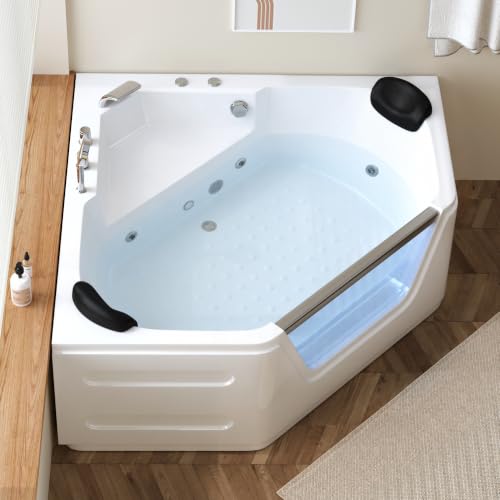
LUTHBAXE 59 Inch Corner Jetted Bathtub — Best Feature-Rich Corner Spa
The LUTHBAXE leans into the spa theatre: a fifty-nine-inch acrylic corner tub for two adults with six massage jets, seven-colour LED lighting, dual headrests and a clear glass panel in the design. Where the Empava is the purist’s heated whirlpool, this is the evening’s entertainment version, built for couples who want the soak to feel like an occasion, lights, warmth and water movement arranged around two proper headrests.
Dual headrests matter more than the lighting. Two-person tubs that seat one bather comfortably and the other apologetically are common; a headrest at each position declares that both seats are real. The glass panel keeps the corner from feeling like a solid wedge of acrylic in smaller bathrooms, returning a little visual lightness to a big object.
Pick the LUTHBAXE when the corner tub is a deliberate indulgence and the household will genuinely use its features rather than admire them once. Confirm the listing’s current specification, including its heating arrangement, before ordering, and plan the same electrical and access care any jetted corner demands. As a feature-rich two-person corner spa, it makes its case with a smile.
The LUTHBAXE’s lighting deserves a practical footnote: coloured light changes how a bathroom reads at night more completely than any fixture swap, because the water itself becomes the lamp. Couples using the tub as an evening ritual will find the chromotherapy genuinely mood-setting; couples bathing children in it will find it turns bath time into an event the children request. Either way, the feature earns its place in use rather than in specification, which is the test every spa feature should have to pass.
- Footprint: 59-inch corner format
- Jets: 6 massage jets
- Features: 7-colour LED lights, dual headrests
- Design: clear glass panel, acrylic shell
- Use: two-adult spa soaking
Strengths
- Dual headrests make both seats genuine
- Lighting turns a soak into an occasion
- Glass panel lightens the corner visually
Trade-offs
- Feature-rich systems mean more to maintain
- Confirm heating specification on the listing
- Bold design suits fewer bathroom styles
Best for: couples wanting a theatrical, feature-rich corner spa.
Not suited for: minimalist bathrooms or low-maintenance households.

Carver Tubs CT6060 Corner Soaking Bathtub — Best Jet-Free Deep Soaker
The Carver CT6060 is the counter-argument in acrylic and fiberglass: a classic triangular corner soaker, sixty inches along each wall and deep enough for a genuine two-person soak, with armrests moulded into the design and not a jet, pump or control in sight. Its heat strategy is the oldest one: fill it hot, fill it deep, and let depth and volume hold the temperature while two people do absolutely nothing, in silence a jetted tub cannot offer.
Jet-free is a maintenance philosophy as much as a bathing one. There is no plumbing loop to flush, no pump to service, nothing behind the shell but the drain, which in a corner install, where access is miserable, is a profound practical virtue. The soak itself is different in kind: still water, conversation-quiet, closer to a hot spring than to a spa appliance.
Choose the Carver when your corner ritual is about depth, warmth and quiet rather than massage, and when the bathroom’s electrical provision cannot or should not grow. It will not heat water that has cooled, so long-soak households should fill generously and top up, the traditional technique its traditional design assumes.
The Carver’s depth has a winter virtue worth stating plainly: deep water over the shoulders keeps two bathers warm by coverage rather than by temperature, so a Carver soak at a moderate fill temperature can feel as warm as a shallower tub filled hotter. That efficiency matters in homes whose water heaters are modest or whose energy bills are watched. The CT6060’s nineteen and a half inches are not a specification to skim; they are the whole argument, depth doing the work that other tubs assign to machinery.
- Footprint: 60 x 60 inch corner triangle
- Depth: 19.5 inches
- Format: two-person soaking tub, armrests
- Construction: acrylic fiberglass
- Systems: jet-free, pump-free
Strengths
- Deep, silent soak with nothing to service
- Generous sixty-inch triangle seats two truly
- Simplest possible corner installation
Trade-offs
- No heater, so long soaks need hot top-ups
- No jets for massage seekers
- Large footprint demands a true corner
Best for: purists wanting a deep, quiet two-person corner soak.
Not suited for: bathers who want jets or maintained heat.
Non-Jetted Triangular Corner Soakers (General Class) — Prose-Only: The Quiet Class
Beyond the Carver, the wider class of non-jetted triangular corner soakers deserves a prose place in this guide, because for many households it is the right answer and it needs no link to be understood. These tubs, offered by various makers in premium and mid tiers, share the Carver’s philosophy: a triangular shell, two-person depth, moulded seating or armrests, and nothing mechanical to maintain. Prices across the class sit in the mid tier for plain models and rise with shell thickness and finish quality.
The class’s strength is longevity. A jet-free acrylic or solid-surface corner soaker has essentially one failure mode, surface damage, and one maintenance task, cleaning, which makes it the corner format most likely to be serving unchanged in twenty years. Its weakness is the mirror of the heated brief: the water’s temperature is set at the fill and only declines, so households should size the water heater for a deep two-person fill and treat top-ups as part of the ritual.
Consider this class when the corner is large, the household is patient, and the renovation budget prefers to buy shell quality over systems. It is discussed here without a link deliberately, as general guidance for comparing any such tub you find, by depth, shell material and the honesty of its two-person seating.
This prose class also contains the corner soakers most often found in rental renovations and guest cottages, where their virtues compound: nothing to break, nothing for a guest to operate wrongly, nothing for a landlord to service between tenancies. If you are furnishing a property other people will use, the quiet class is not the compromise choice but the professional one, and its mid-tier representatives will out-serve a feature-rich tub whose systems confuse or fail under strangers’ hands.
- Format: triangular corner, two-person
- Systems: none, jet-free by definition
- Tier: mid to premium depending on shell
- Heat: fill temperature only
- Evaluate by: depth, shell, seating honesty
Strengths
- Nothing mechanical to maintain or service
- Deep fills hold heat respectably
- Class longevity is the best in this guide
Trade-offs
- No temperature maintenance during the soak
- Quality varies widely between makers
- No massage option at any price in class
Best for: patient households buying shell quality over systems.
Not suited for: soakers who measure a bath in hours.
Corner Soaking Tubs Without Heaters (General Class) — Prose-Only: The Unheated Majority
Most corner soaking tubs on the market have no heater, and this prose section exists to judge that majority fairly rather than treat it as a defect. An unheated corner soaker, typically in the budget-to-mid tier as a class, relies on three honest heat strategies: a deep hot fill, an insulated or thick shell that slows cooling, and a bathroom warm enough that the water is not fighting the room. In a well-heated bathroom with a generous water heater, the difference from a heated tub across a thirty-minute soak is smaller than marketing suggests.
Where the gap genuinely opens is past forty minutes, and with jets, which circulate water through cooler plumbing. A still, deep, unheated soak cools slowly and gracefully; a long, jetted, unheated soak cools like a decision. Households whose ritual is a long shared evening should therefore either buy heat, as the Empava offers, or buy stillness, as the jet-free classes offer, and avoid the unheated-jetted middle.
As general guidance: if you choose from this class, spend on depth and shell insulation before styling, confirm the tub’s filled weight against your floor, and run the hottest fill your heater sustains. The class serves most bathers well; it simply asks its owners to understand the physics it runs on.
For this unheated class, one accessory genuinely changes the experience and costs little: a well-fitted insulated cover or a simple bath caddy ritual that keeps the bather in the water rather than climbing out into cold air for objects. Heat loss in a soak is as much about the bathers’ shoulders as the water’s surface, and a warm room, a towel within reach and everything needed floating nearby extend an unheated soak by many comfortable minutes. Judge the class with its rituals included, as its owners actually live it.
- Format: corner soaking, various sizes
- Heat: none, fill temperature only
- Tier: budget to mid as a class
- Strengths: simplicity, price, silence
- Evaluate by: depth, insulation, filled weight
Strengths
- Simplest and most affordable corner route
- No electrical provision needed
- Still water cools slowly and gracefully
Trade-offs
- Long soaks cool without top-ups
- Jetted unheated models cool fastest of all
- Depends on a capable water heater
Best for: households with thirty-minute soaks and warm bathrooms.
Not suited for: long-soak couples in cool rooms.
What an Inline Heater Actually Adds (Buying Decision) — Prose-Only: The Heat Question
The final prose place belongs to the heater itself, because it is the word in this guide’s title and the premium in its prices. An inline heater, as a class of feature rather than a product, maintains a jetted tub’s water at a set temperature by warming it as it circulates. What it returns is time: the soak stops being a countdown. What it asks is provision: a dedicated electrical supply installed to code, access for servicing, and the discipline of flushing the jet lines it shares.
As tier positioning in words: heated jetted corner tubs sit in the premium tier of the corner market, unheated jetted models in the mid tier, and jet-free soakers from budget to premium depending on shell. The premium buys the heater, the pump’s quietness and usually the thicker shell together, which is why heated models rarely feel like a simple surcharge on an identical tub.
Decide by ritual, honestly timed. If your shared soaks run past forty minutes, the heater is the feature you will thank monthly. If they run twenty-five, it is a premium paying for minutes you do not use, and the same money buys a deeper, better shell in the jet-free classes. Either answer is respectable; the disrespectable move is buying the word ‘heated’ without timing the ritual it serves.
The heater decision has a resale footnote. In homes marketed with a spa bathroom, a heated jetted corner tub photographs and describes as a destination feature, while an unheated equivalent reads as a large tub. That difference does not justify the premium alone, but couples renovating a forever bathroom they may nonetheless sell someday can count it honestly among the heater’s returns, below soak time, above almost everything else the brochure will claim.
- Feature class: inline water heating
- Returns: soak time without cooling
- Asks: dedicated electrical provision
- Tier effect: moves a tub to premium
- Decide by: your honest soak duration
Strengths
- Removes the soak’s countdown entirely
- Makes jetted tubs viable for long evenings
- Usually arrives with thicker, quieter builds
Trade-offs
- Premium pricing across the class
- Electrical provision adds install cost
- Shares the jet system’s flushing discipline
Best for: couples whose shared soaks run long.
Not suited for: quick bathers paying for unused minutes.
Comparison Table
| Pick | Badge | Format | Top or surface | Storage character |
|---|---|---|---|---|
| Empava 59 Inch Corner Jetted Tub with Heater | Best Heated Jetted Corner | 59 in corner | Whirlpool jets | Inline heater: yes |
| LUTHBAXE 59 Inch Corner Jetted Bathtub | Best Feature-Rich Corner Spa | 59 in corner | 6 massage jets, LED | Check listing specification |
| Carver Tubs CT6060 Corner Soaking Bathtub | Best Jet-Free Deep Soaker | 60 x 60 in corner | None, soaking only | No heater, deep fill |
| Non-Jetted Triangular Corner Soakers (General Class) | Prose-Only: The Quiet Class | Various corner sizes | None | No heater |
| Corner Soaking Tubs Without Heaters (General Class) | Prose-Only: The Unheated Majority | Various corner sizes | Soaking, some jetted | No heater |
| What an Inline Heater Actually Adds (Buying Decision) | Prose-Only: The Heat Question | Feature, not a tub | Applies to jetted tubs | The feature itself |
How Do You Keep a Two-Person Corner Soak Comfortable?
Comfort for two is choreography as much as temperature. Enter in turn, settle along each wall with the corner’s depth between you, and agree the tap end and the quiet end before the water rises; couples who improvise positions in a filling triangle negotiate knees for the first five minutes. A bath caddy spanning the widest section keeps drinks and books inside the tub’s world, so nobody climbs out into the cold for a chapter.
Water management is the second half: fill deep rather than merely hot, because depth covers shoulders and shoulders are where bathers feel cold. Top up with hot water in small additions rather than one scalding correction, and keep a folded towel at each position for necks and for drying hands that reach for a page. These are small disciplines, and they are the difference between a soak that lasts and one that dissolves into adjustments.
Afterwards matters too. A corner tub’s surround should give two people somewhere to sit while drying and a rail or sound edge to steady the exit, because wet feet and triangular geometry deserve respect. Plan those graces at install time, a stool that lives by the tub, hooks at each wall, and the ritual completes itself gracefully instead of ending in a scramble.
What Should You Check Before Any Corner Tub Is Delivered?
Reconfirm the corner itself one final time with the chosen tub’s exact footprint taped on the floor in masking tape. Live with the tape for a day: walk the room, open every door and drawer, sit where the toilet sits. Tape reveals the collisions that dimensions conceal, and it costs an evening instead of a restocking fee. More corner tubs are saved by tape than by any other tool in the renovation.
Confirm the delivery route with the same tape logic applied vertically: the tub’s packaged dimensions against the stair turn and the bathroom door, measured, not eyeballed. Agree with the delivery team where the tub will stand if the bathroom is not ready, because a five-foot triangle stored in a hallway becomes the household’s largest daily obstacle within hours.
Finally, assemble the install’s paperwork before the tub arrives: the listing’s specification, the electrical requirement, the drain position drawing and your plumber’s and electrician’s numbers in one folder. Corner installs involve more trades in a tighter space than any other bathroom job, and the folder is what turns their sequence from a negotiation into a schedule.
A Final Word on Corners Themselves
Corners are where rooms keep their promises or break them. A corner left empty in a bathroom collects the stool, the scale, the plant that failed elsewhere, a small museum of afterthoughts. A corner claimed by a two-person tub becomes the room’s destination, the place the whole design was always walking toward. That transformation, from afterthought to destination, is what the tubs and classes in this guide are really selling, underneath the jets and the heaters and the depth measurements.
Claim yours deliberately, with the tape on the floor and the ritual honestly described, and the corner will repay the claim every week the house stands. Few renovations change a room’s meaning as completely as this one, and none of the others ends, as this one does, with two people in warm water watching the evening arrive.
How Do You Winterise and Recommission a Jetted Corner Tub?
In homes that close for winter or bathrooms that sit unheated, a jetted corner tub needs its water managed like any plumbed system: drains and traps protected from freezing, jet lines emptied as fully as the maker directs, and the heater’s circuit left in the state the manual prescribes. The corner location, often on exterior walls, makes this diligence more than a formality in cold climates, and the time to learn the routine is the first autumn, not the first thaw.
Recommissioning in spring is a ritual of inspection: fill, run every system, watch every joint, flush the lines before the first bather trusts them. A tub that sat dry for months deserves one supervised performance before it hosts an evening, and that performance, done with a torch and a towel in hand, is the whole cost of a safe reopening.
Jet-free soakers like the Carver simplify both ends of the season to a drain, a wipe and a cover, which is one more entry in the quiet class’s long ledger of practical virtues. Households with seasonal homes should weigh that ledger heavily; a spa that must be winterised by professionals is a different purchase from one that asks for a towel and ten minutes.
Whichever system you own, write its seasonal routine into the house file the first year you perform it. The second year’s routine then takes half the time and none of the research, and the tub, like every well-documented system in a house, becomes easier to own the longer it is owned.
What Do Two-Person Corner Tubs Do to a Bathroom’s Layout?
They claim the corner so completely that the rest of the room reorganises around the claim. The vanity takes the longest remaining wall, the shower, if separate, takes the other corner’s neighbourhood, and the room’s circulation becomes a gentle orbit around the tub’s wide edge. Planned well, that orbit is the most graceful movement pattern a bathroom can have; planned badly, every journey crosses the tub’s splash zone with a laundry basket.
Storage migrates upward in a corner-tub room, because floor-standing pieces compete with the triangle’s footprint. Wall cabinets, niches in the surround and the vanity’s deepest zones absorb what a linen tower would have held, and the room feels larger for it, since eye-level storage reads as architecture while floor storage reads as furniture. Let the tub’s takeover push the room vertical and the layout will thank it.
Acoustics soften in a corner-tub bathroom, because the big acrylic shell and its water absorb the hard echoes smaller fixtures leave. Evening voices drop naturally in such a room, which is part of why the soak feels like a retreat even before the water is warm. Layout is usually discussed in centimetres; in this room it should also be discussed in decibels and in the feeling of a door closing on the day.
Accept the tub as the room’s premise and design outward from it, and the layout will cohere. Fight it with competing centres, a statement vanity at war with a spa corner, and the room will feel negotiated rather than composed. One premise per bathroom is the rule, and a two-person corner tub is premise enough for any room lucky enough to hold it.
How Do You Plan a Weekend Spa Ritual Around a Corner Tub?
A ritual needs a beginning that is not logistics. Fill the tub before anything else, because a deep corner fill takes its time, and let the room warm while it runs: towels over a rail or radiator, the caddy stocked, drinks decided, phones exiled to another room by agreement. Couples who prepare the room while the water rises arrive at the soak already slowed down, which is half the therapy purchased.
Sequence the water honestly. Bathers enter in turn once the fill is at depth, the heater, if yours is the Empava, set and running before the first entry so the temperature it maintains is the temperature you chose. Add nothing scented to a jetted system that its maker has not approved; the jet-free Carver accepts the bath oils and salts that jetted plumbing refuses, one more practical difference between the philosophies.
Give the soak a middle that is not a screen: conversation, music at room volume, a book on the caddy for the reader of the pair. The corner format helps here, because two people angled across a triangle face each other more naturally than two people in a row, and the ritual becomes social rather than merely warm. That geometry is the corner tub’s oldest selling point and still its best.
End as deliberately as you began: drain while you dry, rinse the shell while it is warm and wipes easily, leave the room aired. A ritual that closes itself in five minutes will be repeated weekly; one that leaves a cold, wet project behind will be repeated monthly, then quarterly, then described in the past tense. The tub you use is the only specification that matters in the end.
What Alternatives Exist If the Corner Will Not Fit a Triangle?
Some corners are spoken for, by a window, a radiator, a door’s swing, and honesty requires naming the exits. A deep freestanding oval placed near the corner keeps the two-person soak and surrenders the triangular footprint; it will not reclaim the angle as completely, but it asks nothing of the walls and can leave the house through the door it entered. Households renting or renovating lightly should weigh that reversibility seriously.
A large rectangular alcove tub with a wide rim is the second exit: two people sit less gracefully than in a triangle, but the plumbing is standard, the cost is lower, and the surround doubles as shelving. It is the pragmatic two-person answer in bathrooms whose corners are structurally unavailable, and it shames nobody.
A walk-in shower built for two is the third exit, and for some households the honest favourite: bench seating, two shower heads, steam if the budget stretches. It abandons soaking entirely, which disqualifies it for the readers of this guide, but households should admit it into the conversation before spending corner-tub money on a ritual they would actually prefer standing up.
Measure first, dream second, and let the corner’s verdict stand. The triangular tubs in this guide reward the rooms that fit them so completely that forcing the format into a resistant room is the one true mistake available, and it is available at every price in the catalogue.
How Much Water and Heat Does a Two-Person Corner Soak Use?
A deep corner tub for two holds roughly the water of two ordinary baths drawn generously, which reframes the indulgence: the couple soaking together uses about what they would use apart, in one vessel, with one heating load. The honest extra cost is depth, since corner soakers are filled deeper than alcove tubs, and households watching consumption should fill to the bathers rather than to the rim, because two bodies displace a surprising volume on entry.
Heat follows the same arithmetic. A full deep fill draws heavily on a tank water heater, and the soak’s comfort is decided in the fill’s first minute: too cool, and no top-up fully rescues it; properly hot, and depth plus body heat carry the hour. Tankless systems serve corner tubs gracefully precisely because the fill cannot outrun them, one reason heated and tankless so often arrive in the same renovation.
The inline heater’s own consumption is modest beside the fill’s, because maintaining temperature is cheaper than creating it. That is the economic shape of the Empava’s proposition: a large honest fill, then a small continuous cost to stop the clock. Households comparing running costs should compare whole rituals, fill plus maintenance, rather than appliance labels.
Insulation quietly governs all of it. A thick acrylic shell, a warm room and a covered tub between uses all reduce the heat the next fill must replace. Corner tubs installed against exterior walls deserve insulation behind the surround, planned before the shell lands, because a cold corner is the one location where the room itself conspires against the soak.
What Safety Details Matter for Two People in One Tub?
Two bathers double the entries and exits, so grip and footing deserve planning rather than hope. A sound grab point at the tub’s wide edge, flooring outside that stays grippy when wet, and a step or stool where the rim is high turn the ritual’s clumsiest moment into a non-event. The Carver’s moulded armrests help inside the water; the room must help outside it.
Water temperature discipline matters more with two, because one person’s comfortable top-up is another’s scald. Agree the fill temperature before entering, add hot water in small amounts with circulation, and keep the maximum temperature conversation in the household rather than at the tap. Thermostatic mixing, where the renovation allows it, removes the negotiation entirely and is the safety upgrade couples praise most after the fact.
Electrical safety around jetted and heated models is a professional matter, full stop: circuits installed to code, protection devices where the code requires them, and access panels that keep water and wiring properly separated for the tub’s whole life. This guide’s insistence on planning the circuit before delivery is safety advice wearing a scheduling costume.
Finally, plan for the bather who feels faint, as hot water occasionally arranges. A corner tub’s wide rim gives a seat while the room steadies, towels live within reach, and the second person is already present, which is the two-person format’s built-in safety feature. Rituals this warm deserve exits this calm, arranged in advance.
How Do You Clean and Care for a Corner Tub?
The triangle’s gift to cleaning is that everything is reachable from one standing position at its wide edge; its curse is that the corner behind it is reachable from none. Clean the shell’s corner zone with a long-handled soft brush on a schedule, before scale makes the job chemical, and keep the surround’s seal line inspected, because the corner joint works hardest and fails quietest.
Jetted models add their flushing routine, which this guide has mentioned for the Empava and repeats as the format’s standing tax: run the system with clean water and the recommended cleaner at the maker’s interval, and the lines stay as sweet as the shell. Households that skip flushes eventually meet a jet’s worth of evidence, and in a corner install the lesson arrives with the worst access in the house.
Acrylic care is gentle by rule: non-abrasive cleaners, soft cloths, prompt attention to dye and bath-oil rings. The Carver’s fiberglass-backed acrylic and the Empava’s shell both reward that gentleness with decades of gloss, and both punish scouring in the first month with a dullness no polish fully reverses. Put the right cleaner under the sink on day one and the wrong one will never be reached for in a hurry.
Drain and overflow hardware should be exercised and inspected twice a year, because corner tubs are used in long, deep fills that test seals ordinary baths never challenge. Five minutes with a torch and a fingertip along each joint is the whole inspection, and it is cheaper than any sentence that begins with a ceiling stain.
What Should the Surround and Flooring Around a Corner Tub Be?
The surround must solve the corner’s one true problem: the unreachable wedge behind the tub. A tiled deck that extends to the walls, a removable access panel where the systems live, and seal lines a hand can actually reach turn that wedge from a dust archive into a maintained surface. Design the surround for the cleaner’s body, not only for the photograph, and the tub will look cared for in year five because it was careable in week one.
Flooring in the splash zone should forgive water in quantity: a two-person exit sheds more water than any other moment in the bathroom’s day. Tile or stone with a grippy finish, a bath mat sized to the tub’s wide edge, and a floor slope or drain strategy where the renovation allows it all serve the same end, a floor that treats a litre of water as weather rather than damage.
Storage belongs at the surround’s ends: a niche or shelf at each wall for the products two bathers bring, so bottles do not colonise the rim where elbows need to be. Build those niches during the surround’s construction and they cost tile; add them afterwards and they cost regret. The corner’s geometry gives two natural shelf positions, one per bather, and using both is the surround’s easiest fairness.
Lighting above a corner tub should be warm, dimmable and never a single downlight glaring off the water. The LUTHBAXE’s own coloured light shows how completely illumination sets a soak’s mood; the room’s fixed lighting should support that mood rather than interrogate it, with the bright light reserved for cleaning day, when it will be welcomed like an inspector.
How Do You Decide Between This Guide’s Three Linked Tubs?
Decide by the soak you actually take, timed and described honestly. If it runs long and you hate the cooling countdown, the Empava’s heater is not a luxury but the point, and its jets serve the same long ritual. If it is an occasion, lights, warmth, two headrests and a sense of event, the LUTHBAXE was designed as your answer and its feature list is a description of your evening rather than a brochure.
If it is quiet, deep and simple, and if the word ‘system’ in a bathroom makes you tired, the Carver is the honest tub, and its lack of features is the feature. Many couples discover, asked properly, that they want opposite things, one jets and one stillness, and for them the Empava with its jets off is the diplomatic vessel: machinery present, silence available, heat maintained for whoever stays in longest.
Budget the whole installation for each candidate before choosing, circuit, plumbing, surround and floor check included, because the tubs’ shelf prices differ less than their installed totals. The Carver’s simplicity compounds into the cheapest honest install; the heated models buy their ritual with trades as well as money. Choose with the totals open and the ritual described, and any of the three will feel, within a month, like the obvious answer it was always going to be.
How Do You Measure a Corner for a Triangular Tub?
Measure along both walls from the corner, at floor level and again at the tub’s rim height, because corners are rarely square and walls rarely plumb. A fifty-nine or sixty-inch tub needs its full measure along each wall; a corner that gives fifty-nine inches one way and fifty-four the other will not accept a symmetrical triangle without a platform or a filler strategy, and discovering that after delivery is a special kind of afternoon.
Then measure the room’s access: the doorway, the turn into the bathroom, and the swing space to rotate a five-foot triangle into its corner. Corner tubs are bulky rather than heavy, and bulk negotiates doorways badly. Photograph the route, compare it with the listing’s packaged dimensions, and be honest about the banister.
Finally, check the floor. A two-person corner tub, filled, carries the water weight of a small car distributed across its footprint, plus two adults. Most modern floors shrug; older bathrooms, especially over long joist spans, deserve a builder’s confirmation before the tub, not a creak afterwards.
Jet or Soak: Which Suits Two People Better?
Jets turn a bath into an activity: moving water, massage pressure, a spa’s vocabulary. For couples whose ritual is unwinding muscles after sport or work, jets earn their plumbing. They also bring the system’s whole entourage, pump noise, flushing routines, and, without a heater, faster cooling, because circulated water sheds heat through every pipe it visits.
Soaking is the older ritual: stillness, depth, heat held by volume, conversation at normal volume. A deep corner soaker serves two people the way a hot spring does, by giving them warm water and leaving them alone in it. Its entourage is empty, which in a corner install, where servicing access is the worst in the house, counts for years of quiet ownership.
The honest tiebreaker is the household’s actual evening. If your shared baths are events with a beginning and an end, jets will be used and loved. If they are long, drifting soaks, stillness and heat, the Empava’s combination or the Carver’s depth, will serve better than any mid-point compromise.
What Does a Heated Corner Install Require?
Electrically, a heater and pump need proper dedicated provision installed to your local code, planned before the tub arrives, because the corner that makes access awkward for plumbing makes it worse for retrofitting circuits. Discuss the tub’s requirements with an electrician using the listing’s specification, and site the access panel where a human can actually reach it after the surround is built.
For water, confirm the heater in your home can fill a two-person corner tub at soaking temperature with capacity to spare; a tub this size empties small tanks into lukewarm regret. If the heater is marginal, a heated tub’s inline system maintains temperature but is not designed to rescue a cold fill, so the fill itself must arrive hot.
Drainage and overflow deserve the same foresight, positioned for the corner’s geometry and tested before the surround closes. Every system in a corner tub should be run, filled, jetted, heated and drained once while access is still open, because the corner forgives preparation and punishes optimism.
What Mistakes Do Corner Tub Buyers Make?
The first is measuring the corner once, along one wall, and assuming symmetry. Corners lie in both directions; measure both walls at two heights, and check the angle itself with a large square or a sheet of board before trusting a triangular footprint to it.
The second is forgetting filled weight. Water for two, the tub and the two bathers together reach a load that older floors should be asked about in advance. A builder’s ten-minute joist check is cheap insurance bought before the one purchase that cannot be returned gracefully.
The third is buying jets without planning their upkeep, or heat without planning its circuit. Jetted corner tubs need flushing and eventual pump access; heated ones need dedicated electrical provision. Both are easy to arrange before installation and miserable afterwards, in the least accessible geometry in the bathroom.
Finally, buyers seat two people in a showroom photograph rather than in the tub’s dimensions. Check the interior length and the positions honestly: a two-person corner tub should let both bathers stretch or sit facing without negotiating knees, and the listings’ measurements, read carefully, will tell you whether yours does.
Final Recommendation
Buy the Empava if your corner ritual is long, warm and jetted, the LUTHBAXE if it is an occasion with lights and headrests, and the Carver if it is deep, still and silent. Let the prose classes guide you if your answer is a plainer soaker or an unheated majority tub, and let the heater question be settled by a stopwatch on your own evenings rather than by anyone’s marketing, including this guide’s. Measure both walls, check the floor, plan the circuit, and the corner will stop being the bathroom’s leftover geometry.
It may become, as it has in more homes than designers admit, the room’s whole reason for existing, one warm triangle at a time.
Frequently Asked Questions
Do corner tubs really fit two adults comfortably?
The true two-person models do: their triangular geometry gives each bather a position along one wall with the corner’s depth between them. Check interior dimensions rather than the headline footprint, and favour designs with two headrests or armrest positions, which signal that both seats were designed rather than implied.
What does an inline heater do in a jetted tub?
It warms the water as the jets circulate it, holding the set temperature through a long soak instead of letting the bath cool through its plumbing. It maintains heat rather than creating it, so the fill should still arrive hot, and the system needs proper dedicated electrical provision.
Are jetted corner tubs hard to maintain?
They ask for a routine, not a ordeal: periodic flushing of the jet lines, sensible use of bath products, and access planning at install time for the pump. Jet-free corner soakers avoid all of it, which is why this guide presents the Carver and the prose soaker class as fully respectable alternatives.
How much water does a two-person corner tub use?
Substantially more than a standard alcove tub, because depth and footprint multiply together. Confirm your water heater can deliver a full hot fill with capacity in reserve; if it cannot, upgrade the heater or choose a shallower model before the first disappointing lukewarm soak teaches the same lesson.
Can a corner tub go where a shower stood?
Sometimes, if the corner’s dimensions, floor support and drainage can be adapted, but the plumbing positions and the filled weight both change. Have the corner assessed in person before ordering; triangular tubs are among the least returnable objects in a renovation, and certainty is cheapest at the measuring stage.
Related Guides
Continue with the general bathtub guide, the air whirlpool specialists, a vacuum guide from the same batch, and the bath sheets that a two-person soak deserves afterwards: Best Bathtubs Best Air Whirlpool Bathtubs Best 2-in-1 Cordless Vacuums Best Bath Sheets and Large Towels.


