What's inside
- Key Takeaways
- Quick Picks
- How did we choose the best air whirlpool bathtubs?
- Comparison Table
- How do air, whirlpool and combination tubs actually differ in the water?
- What should you check before a jetted tub enters your house?
- How do you keep a combination tub clean and healthy?
- How does a combination tub change the rest of the bathroom?
- What mistakes send jetted tub projects off the rails?
- How do jet placement and shell shape change the soak?
- What does living with a combination tub week to week really involve?
- How should you sequence the renovation around the tub?
- Which features are worth paying for, and which are theatre?
- How do you size a combination tub for the people who will use it?
- Final Recommendation
- Frequently Asked Questions
- Related Guides
As an Amazon Associate I earn from qualifying purchases. This post may contain affiliate links at no extra cost to you.
cottageverdict.com is reader-supported. When you buy through links on our site, we may earn an affiliate commission.
Where to buy: each linked tub below points to its Amazon listing, where you can check price on Amazon and confirm drain side, electrical requirements and the exact footprint before ordering. Jetted tubs are freight-scale purchases, so measure your doorway and stair turns as carefully as the alcove itself.
Shopping for the best air whirlpool bathtubs usually starts with a photograph of somebody else’s serene bathroom and ends, some weeks later, with a homeowner crouched beside an access panel wondering where the blower noise is coming from. That gap between the brochure and the plumbing is exactly where this guide lives. A combination tub — water jets for deep, directional pressure plus air jets for a lighter, champagne-style effervescence — is the most versatile bathing machine you can install in an ordinary house, but it is also the easiest to buy badly, because the headline jet count tells you almost nothing about how the bath actually feels at seven in the evening after a long day.
What separates a genuinely good combo tub from a noisy fibreglass disappointment comes down to four unglamorous things: whether the heater holds temperature through a forty-minute soak, whether the air blower warms its output instead of chilling the water, how honestly the interior dimensions match the stated length, and whether a plumber can reach the pump in five years without demolishing tile. Every tub reviewed here was judged against those tests first and against its styling second, because a beautiful shell around a weak pump is simply an expensive soaking tub with extra holes in it.
The six entries below include five linked models verified against current listings and one prose-only discussion of air-bath-only tubs, included because many shoppers comparing combo models are really asking a simpler question: do I need water jets at all? That section answers the air-versus-whirlpool-versus-combo argument plainly, with the maintenance and hygiene trade-offs stated out loud rather than buried. Read the detailed reviews for the tub that fits your room, then read the buying sections even if you have already decided — the electrical and access mistakes described there are the ones that turn a happy delivery day into a month of tradespeople.
Key Takeaways
- Combination tubs pair directional water jets with gentle air bubbles, and the heater matters more than the jet count.
- The Empava 71 Inch leads for tall soakers who want waterfalls and the longest interior in this group.
- WOODBRIDGE’s 60 x 30 alcove model is the rare combo tub that fits a standard replacement opening.
- Air-only tubs, covered as a prose-only pick, are quieter to maintain but cannot deliver deep pressure.
- Budget for a dedicated electrical circuit and an access panel alongside the price of the tub itself.
- Corner installations such as the LUTHBAXE suit two bathers but demand the most floor area.
Quick Picks
| Pick | Badge | Why it made the list |
|---|---|---|
| Empava 71 Inch Jetted Tub with Air Bubble and Heater | Best for tall soakers | Twenty jets, twin waterfalls and an inline heater inside the longest shell reviewed here. |
| Empava 67 Inch Whirlpool Heated Tub | Best back-to-wall all-rounder | Seventeen hydro and air jets, a handshower and chromatherapy in a slightly smaller footprint. |
| WOODBRIDGE 59 Inch Whirlpool and Air Heated Tub | Best compact combo | Sixteen jets and adjustable blower speed squeezed honestly into a 59-inch body. |
| WOODBRIDGE 60 x 30 Alcove Whirlpool and Air Tub | Best alcove replacement | A true 60 by 30 alcove fit with heated whirlpool and air, matte black trim included. |
| LUTHBAXE 59 Inch Corner Jetted Bathtub | Best corner tub for two | Six massage jets, dual headrests and a glass panel shaped for shared corner bathing. |
| Air-bath-only tubs (category discussion) | Best low-maintenance alternative | No water lines through the jets means simpler cleaning, at the cost of deep pressure. |
How did we choose the best air whirlpool bathtubs?
The first filter was honesty of configuration. A tub only belongs in a combination guide if both systems are genuinely present and independently controlled: water jets driven by a pump, air jets fed by a separate blower, and controls that let a bather run either system alone or both together. Models that marketed a handful of air holes as a second system, or that locked both systems to a single button, were set aside, because the entire point of paying for a combo tub is choosing the sensation to suit the evening.
Heat retention came next, and it eliminated more contenders than any other test. An inline heater on the whirlpool circuit keeps circulating water near its starting temperature, while the air side matters just as much: a blower pushing room-temperature air through dozens of small ports will slowly cool a bath, so heated or well-insulated air delivery scored heavily. Tub capacity played into the judgement too, since a 59-gallon shell loses heat differently from a smaller body of water, and a heater working against constant air cooling is a recipe for a lukewarm second half-hour.
Finally, the judging weighed the ownership details that listings prefer to whisper: acrylic thickness and reinforcement, whether the drain and overflow hardware is included or a surprise extra, the warranty’s treatment of pumps and blowers, and whether owners report the control panel surviving steamy rooms. Freight delivery realities counted as well — a 71-inch tub that cannot turn through a bathroom doorway is not a recommendation, it is a problem with a tracking number. The five linked tubs below are the models that survived all three screens in their respective shapes and sizes.

Empava 71 Inch Jetted Tub with Air Bubble and Heater — Best for tall soakers
Length is the Empava 71 Inch tub’s opening argument, and it is a persuasive one. Most jetted tubs quote an exterior dimension that shrinks considerably once sloped ends and jet housings take their share, leaving a six-foot bather folded rather than stretched. Seventy-one inches of shell gives this back-to-wall design enough genuine interior room for long legs to extend while the back rests at a comfortable recline, and that single quality — space to actually lie in the water — shapes every soak more than any feature on the control panel.
The bathing hardware is generous without becoming frantic. Twenty jets divide the work between water jets aimed at the back, sides and feet and air ports that fill the tub with a softer, all-over fizz, and the two systems can be balanced against each other rather than simply switched on together. Twin waterfall fillers add a small ceremony to filling the bath and, more practically, move a large volume of water in reasonable time. The inline heater then holds the temperature steady, which matters enormously in a big tub: seventy-odd gallons cooling by even a few degrees turns the last fifteen minutes of a soak into a negotiation, and here the water simply stays where you set it.
Chromatherapy lighting cycles through colours beneath the water, a feature easy to dismiss until a winter evening proves how much a warm amber glow changes the mood of a tiled room. The acrylic construction feels substantial rather than drum-hollow, the chrome fixtures match mainstream bathroom hardware if you are coordinating a renovation, and ETL certification gives your electrician one less argument to have with the installation. Ownership caveats are mostly about scale: this tub needs a floor that tolerates a heavy filled weight, a water heater sized for a deep fill, and a delivery route measured in advance.
- Format: back-to-wall jetted tub, 71 inches long
- Systems: whirlpool water jets plus air bubble massage, 20 jets total
- Heat: inline heater on the circulation circuit
- Extras: dual waterfall fillers, colour-changing LED lighting, chrome fixtures
- Certification: ETL certified acrylic construction
Strengths
- Longest interior here, genuinely suiting taller bathers
- Heater preserves temperature through extended evening soaks
- Waterfalls fill a large capacity faster than standard spouts
Trade-offs
- Deep fills will tax a small household water heater
- Back-to-wall placement limits access to one long side
- Delivery and positioning need two strong people minimum
Best for: tall soakers renovating a primary bathroom around one generous statement tub. Check price on Amazon.
Not suited for: small alcoves, upstairs rooms with doubtful joists, or anyone wanting a freestanding silhouette.

Empava 67 Inch Whirlpool Heated Tub — Best back-to-wall all-rounder
If the 71-inch Empava is the maximalist sibling, this 67-inch version is the one most bathrooms should actually buy. Four inches sounds trivial on a specification sheet; in a real room it is the difference between a tub that dominates the floor plan and one that leaves space for a stool, a towel ladder and walking past with a laundry basket. The back-to-wall profile keeps the clean look of a freestanding bath while hiding pipework against the wall, which also makes the installer’s day shorter and the silicone lines fewer.
Seventeen jets split between hydro and air duties, and the balance feels well judged rather than padded. The water jets carry enough intent for shoulders and lower back after physical work, while the air system fills in the background with the gentler sensation that many bathers end up preferring for daily use. The inline heater supports the tub’s stated 59-gallon capacity properly, holding a long soak at temperature instead of merely slowing the decline, and the included handshower turns out to be the feature owners mention most: rinsing hair, washing down the tub after a cleaning cycle, and bathing a reluctant dog all become simpler.
Chromatherapy LEDs return here, and on this model they pair with waterfall fillers that give the bath a focal point when the room is dressed for guests. The acrylic shell is ETL certified with the range’s usual tidy moulding, and the back-to-wall footprint means the floor beneath stays reachable at the front edge for cleaning. Where the bigger tub wins on sprawl, this one wins on proportion — in a bathroom under about eighty square feet, it is the Empava that looks designed rather than squeezed.
- Format: back-to-wall whirlpool tub, 67 inches long
- Systems: 17 hydro and air jets with separate control
- Capacity: approximately 59 gallons to the overflow
- Heat: inline heater fitted as standard equipment
- Extras: dual waterfalls, handshower, chromatherapy LED lighting
Strengths
- Balanced size suits the majority of primary bathrooms
- Handshower adds everyday practicality beyond the spa brief
- Heater genuinely maintains temperature at full capacity
Trade-offs
- Two bathers will find it companionable rather than roomy
- Waterfall fillers splash if the pressure runs high
- Air jets alone feel mild compared with the 71-inch model
Best for: renovators wanting one capable combo tub that respects an ordinary floor plan. Check price on Amazon.
Not suited for: couples determined to bathe together nightly, or strict minimalists who dislike waterfall fixtures.

WOODBRIDGE 59 Inch Whirlpool and Air Heated Tub — Best compact combo
Compact jetted tubs usually cheat: the shell shrinks but the bathing well shrinks twice as fast, leaving a product that photographs like a spa and bathes like a bucket. WOODBRIDGE’s 59-inch combo tub avoids the worst of that trap by keeping the interior as rectangular as the jets allow and by treating its 59 by 31.5 inch footprint as a design brief rather than an apology. For a guest bathroom, a converted closet bath or a smaller primary suite, it delivers the full two-system experience where larger tubs simply cannot be made to fit.
Sixteen jets is an honest count at this size, and the arrangement mixes whirlpool jets with air bubbles in a way that lets the bather feel both layers distinctly. The adjustable air blower speed deserves particular praise, because air systems are often binary — off, or a Jacuzzi advertisement — whereas here the bubbles can be dialled down to a murmur for a quiet read or raised for a more animated soak. An LED control panel sits within reach of the bathing position, the matte black drain gives the white acrylic a deliberate, finished contrast, and a chromotherapy light adds the evening glow that makes a small bathroom feel intentional.
The heated soaking function keeps the compact volume at temperature, and smaller volumes have one underappreciated virtue: they fill quickly and ask less of the water heater, so the tub is realistic for weeknight use rather than a weekend production. The compromises are physical and unavoidable. A bather much over six feet will sit rather than recline, two-person bathing is not on the menu, and the pump and blower live in a tighter shell, so the access panel conversation with your installer matters even more than usual.
- Format: compact rectangular tub, 59 by 31.5 inches
- Systems: whirlpool plus air bubble jets, 16 jets combined
- Controls: LED panel with adjustable air blower speed
- Heat: heated soaking function maintains water temperature
- Finish: white acrylic with matte black drain, chromotherapy light
Strengths
- Full combo experience inside a genuinely small footprint
- Adjustable blower makes the air system properly versatile
- Modest capacity fills fast and suits weeknight bathing
Trade-offs
- Tall bathers will sit up rather than stretch out
- Strictly a one-person tub despite the spa styling
- Service access is tight, so panel planning is essential
Best for: smaller bathrooms that refuse to give up on a real jetted soak. Check price on Amazon.
Not suited for: couples, very tall owners, or rooms where a full-size tub already fits comfortably.
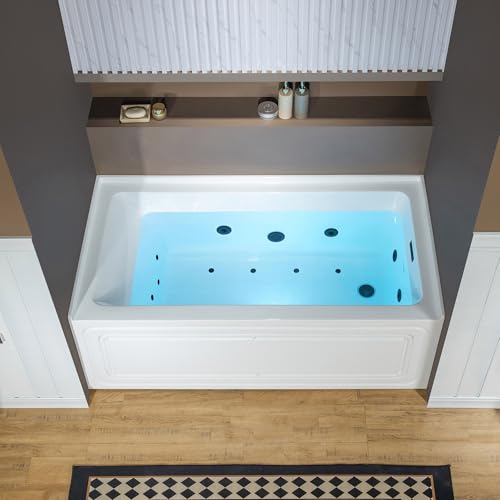
WOODBRIDGE 60 x 30 Alcove Whirlpool and Air Tub — Best alcove replacement
The standard North American bathtub opening — sixty inches long, thirty wide, walled on three sides — is where most jetted-tub dreams quietly die, because the overwhelming majority of combo models are freestanding sculptures or oversized drop-ins. This WOODBRIDGE is built precisely for that opening. It slides into a conventional alcove as a direct conceptual replacement for the plain tub coming out, right-hand drain and all, which means a homeowner can move from a tired builder-grade bath to a heated whirlpool-and-air soak without reframing the room.
That practicality would mean little if the bathing itself felt like a compromise, and it does not. The whirlpool side delivers the focused pressure along the back and legs that post-workout bathers actually want, while the air system softens the whole experience, and the heated function keeps an alcove tub’s modest volume at a steady temperature. Because the tub is smaller than the freestanding models here, fills are quicker, the water heater is under less strain, and the whole ritual fits an ordinary Tuesday — an underrated virtue in a product category that often designs for holidays.
Matte black trim and a matching included drain kit give the installation a designed finish instead of the chrome-afterthought look, and including the drain kit matters more than it sounds: mismatched waste fittings are a classic source of leaks and return trips. The acrylic construction keeps weight manageable for a one-room renovation carried up stairs. Remaining cautions are the alcove format itself — three walls mean the pump access must be planned through the apron or an adjoining closet, and a thirty-inch width will always bathe narrower than a freestanding shell of the same length. Within those honest limits, nothing else in this guide modernises an ordinary bathroom so directly.
- Format: three-wall alcove tub, 60 by 30 inches, right drain
- Systems: whirlpool jets plus air bubble massage, heated
- Trim: matte black finish fittings with drain kit included
- Construction: acrylic, designed for standard replacement openings
- Install note: apron-side access should be agreed before tiling
Strengths
- Fits the commonest bathroom opening in the housing stock
- Included drain kit removes a classic compatibility headache
- Heated combo bathing without any structural reframing
Trade-offs
- Thirty-inch width bathes narrower than freestanding rivals
- Right-drain configuration only suits matching existing plumbing
- Alcove walls limit where a bather can set a book or glass
Best for: straightforward bathroom refreshes that keep the existing alcove and plumbing rough-in. Check price on Amazon.
Not suited for: left-drain rooms without replumbing, or anyone set on a freestanding centrepiece.
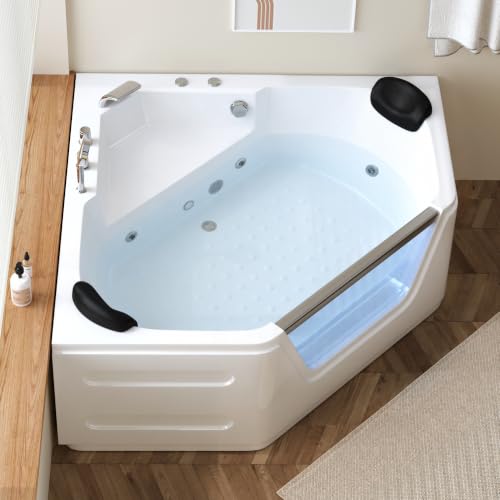
LUTHBAXE 59 Inch Corner Jetted Bathtub — Best corner tub for two
Corner tubs answer a specific architectural prayer: the bathroom with plenty of square footage arranged awkwardly, where a long rectangle wastes the room but a triangular footprint turns dead corner space into the main event. The LUTHBAXE 59 Inch takes that brief seriously, shaping its acrylic shell for two adults facing into the room rather than squeezed along a wall, with dual headrests that acknowledge the social reality of a two-person tub — people bathe in these things to talk, not merely to sit in parallel.
Six massage jets is the smallest count in this guide, and the review should be honest about what that means: this is a soaking-first tub with meaningful hydrotherapy assistance, not a full-body massage machine. The jets that are present are placed for backs and shoulders in the two seated positions, and the seven-colour LED lighting plus the clear glass front panel lean into the shared, occasion side of bathing — this tub dresses a bathroom for the evening in a way the plainer models do not attempt. Couples who mostly want warm depth, room to stretch two pairs of legs and some targeted pressure will find the balance right.
What the corner format demands in return is commitment. The triangular footprint consumes floor area that storage or a larger vanity might have used, the glass panel needs wiping like any glazed surface, and installation in a corner can make the far plumbing connections the least accessible in the whole guide. Water capacity for two is also substantial, so heater sizing deserves the same conversation as with the big Empava. Chosen knowingly, though, the LUTHBAXE turns the least useful part of a large bathroom into the reason the room exists.
- Format: corner installation, 59 inches, seats two adults
- Systems: whirlpool hydrotherapy with 6 massage jets
- Comfort: dual headrests shaped for face-to-face bathing
- Extras: 7-colour LED lighting and clear glass front panel
- Construction: moulded acrylic shell for corner placement
Strengths
- Genuine two-person layout rather than an oversized single
- Converts wasted corner space into the bathroom’s feature
- Lighting and glass panel give it real evening presence
Trade-offs
- Six jets cannot match the coverage of larger systems
- Corner plumbing is awkward to reach after installation
- Footprint competes directly with vanity and storage space
Best for: couples with a large bathroom and an underused corner to devote to bathing. Check price on Amazon.
Not suited for: solo bathers wanting maximum jet coverage, or compact rooms guarding every inch.
Air-bath-only tubs (category discussion) — Best low-maintenance alternative
Every comparison of combination tubs eventually produces the same honest question from the back of the room: what if the water jets are the part I do not actually want? Air-bath-only tubs — a category discussed here generically, at a mid-to-premium tier position, rather than as a single linked model — answer it by deleting the pump, the water lines and the circulating pipework entirely, leaving a blower that pushes warmed air through small ports in the tub floor and walls. The resulting sensation is uniform and gentle, a rising effervescence that surrounds the body instead of pressing on particular muscles.
The maintenance argument is the strongest card these tubs hold. Because bath water never circulates through air channels, there is no pipework quietly collecting residue between soaks, and most designs purge their air lines automatically after draining, blowing the channels dry. Owners who have lived with an older whirlpool’s cleaning routine — filling, dosing, circulating, draining, repeating — tend to speak about air-only ownership with visible relief. The hygiene routine shrinks to wiping the shell and running the purge, which means it actually happens.
Against that, the physics cannot be argued with: air cannot knead a knotted shoulder or work along a spine the way a water jet does, and bathers managing genuinely sore backs after physical labour usually find air-only bathing pleasant but insufficient. Air systems also cool the water gradually as bubbles burst at the surface, and without an inline heater option the long soak shortens. The verdict of this guide is therefore conditional rather than dismissive — choose a combo tub if targeted pressure matters to you, choose air-only if effortless upkeep and a gentle soak matter more, and be suspicious of anyone who claims either format wins on both counts.
- Format: soaking shell with blower-fed air ports only
- Systems: air massage exclusively, no pump or water jets
- Heat: relies on fill temperature, sometimes a heated blower
- Care: automatic line purge, no circulating pipework to dose
- Positioning: mid-to-premium tier across the wider market
Strengths
- Simplest hygiene routine of any jetted bathing format
- Even, gentle effervescence suits sensitive bathers beautifully
- Fewer mechanical parts means fewer eventual repairs
Trade-offs
- No deep pressure for backs that genuinely need it
- Bubbles slowly cool the bath during long soaks
- Blower noise remains, despite the simpler system
Best for: relaxed daily soakers who prize effortless cleaning over massage intensity.
Not suited for: anyone buying a tub specifically to work on sore muscles.
Comparison Table
| Pick | Format | Standout trait |
|---|---|---|
| Empava 71 Inch Jetted Tub with Air Bubble and Heater | Back-to-wall, 71 in | Longest interior, waterfalls |
| Empava 67 Inch Whirlpool Heated Tub | Back-to-wall, 67 in | Heater plus handshower |
| WOODBRIDGE 59 Inch Whirlpool and Air Heated Tub | Compact, 59 in | Adjustable blower speed |
| WOODBRIDGE 60 x 30 Alcove Whirlpool and Air Tub | Alcove, 60 x 30 in | Standard opening fit |
| LUTHBAXE 59 Inch Corner Jetted Bathtub | Corner, two-person | Dual headrests, glass panel |
| Air-bath-only tubs (category discussion) | Soaker with air ports | Simplest hygiene routine |
How do air, whirlpool and combination tubs actually differ in the water?
The cleanest way to understand the three formats is by what moves. In a whirlpool tub, a pump draws bath water in and drives it back out through adjustable jets, so the pressure you feel is water pushed by water — focused, directional and strong enough to work on a specific knot when you position yourself against a jet. In an air tub, a blower pushes air, not water, through many small openings, and the sensation is thousands of bubbles rising around the body: broad, light and impossible to aim. A combination tub installs both machines in one shell and lets the bather layer them, running water jets for the first ten minutes on a sore back, then dropping to air alone for a quieter half-hour of reading.
Ownership diverges as sharply as sensation. Whirlpool pipework holds residual water and needs periodic circulating cleans; air channels stay dry by design and purge themselves; a combo tub carries the whirlpool’s cleaning duties in full, which is the honest price of its versatility. Noise differs too — pumps produce a lower mechanical hum, blowers a higher rushing note — and in a quiet house at night, the air system at full speed is usually the loudest guest in the bathroom. Trying both sensations in a showroom, eyes closed, for a full minute each, remains the single most useful research a buyer can do, because bodies disagree about these formats more than specifications do.
What should you check before a jetted tub enters your house?
Start with structure and water, the two things no retailer can fix after delivery. A filled 67-inch tub with a bather aboard can weigh as much as a small car parked in one spot, so floor joists — especially in older houses and above garages — deserve a professional opinion rather than optimism. Then audit the water heater: a household tank that comfortably serves showers may empty itself into one deep jetted fill, leaving the bath at three-quarter temperature. Stepping up the heater, choosing a smaller tub, or accepting shallower fills are all legitimate answers; discovering the problem mid-soak is not.
Electrical planning comes next, and it is not optional decoration. Pumps, blowers and heaters draw real current, and manufacturers typically call for dedicated protected circuits installed by a licensed electrician, with the access to those connections kept reachable. Agree the access panel’s location with your installer before a single tile is set — through an apron panel, an adjoining closet or a removable section — because the first service visit for a sealed-in pump can cost more than the panel would have. Finally, walk the delivery route with a tape measure, including the turn at the top of the stairs; freight drivers deliver to the kerb or the door, and a 71-inch tub that cannot make the landing turn becomes the homeowner’s geometry problem on the day.
How do you keep a combination tub clean and healthy?
The routine that protects a combo tub is unglamorous and entirely manageable once it becomes habit. After the last bather climbs out, run the air system’s purge if your model offers one, wipe the shell while it is still warm and damp, and leave the bathroom ventilated so the room dries fully. Weekly, the whirlpool circuit earns a proper circulating clean using the product your manufacturer specifies: fill above the jets, add the cleaner, run the pump for the stated time, drain, refill with plain water and run it again briefly before the next bath. Skipping the rinse cycle is the classic error, leaving cleaner residue to greet the next soak.
Monthly attention goes to the parts bathers forget: the suction cover, which should be checked for hair and kept unobstructed; the jet faces, which unscrew or rotate for a wipe on many models; and the area behind the access panel, where a dry look and a sniff for mustiness catch slow leaks while they are still small. Never run the pump dry, never use abrasive powders on acrylic, and treat any persistent biofilm line at the jets as information — it means the circulating clean needs to happen more often, given your household’s bathing frequency. Fifteen honest minutes a week keeps a combo tub the pleasure it was bought to be.
How does a combination tub change the rest of the bathroom?
A jetted tub is never a solo purchase, because its appetites rearrange the room around it. The floor may need reinforcement, the water heater may grow, the electrical panel may gain a circuit, and the ventilation suddenly matters more, since long hot soaks load the air with moisture that a weak fan will distribute to the paintwork. Towel warming, a stool that tolerates splashes, lighting on a dimmer and a bath mat with genuine grip all stop being decorations and become supporting equipment. Budgeting for the tub alone and discovering the entourage later is the financial version of the access-panel mistake, so the wise buyer prices the whole ecosystem — tub, circuit, heater capacity, fan and floor — as one project with one number, and then chooses the model that fits inside it.
What mistakes send jetted tub projects off the rails?
- Buying the jet count instead of the bathing well. A tub advertising dozens of jets in a cramped interior still bathes cramped. Sit in the dry shell in the showroom, or tape its interior dimensions on your floor, before falling for the arithmetic of the brochure.
- Sealing the pump behind finished tile. Every pump and blower eventually wants a service visit. An installation without a planned access route converts a modest repair into demolition, and it remains the costliest unforced error in this entire category.
- Ignoring the water heater until the first fill. Deep jetted tubs drink hot water in quantities showers never approach. Size the heater for the tub you bought, or choose a smaller tub with open eyes.
- Skipping the dedicated electrical circuit. Sharing circuits with bathroom outlets invites nuisance trips at best. The manufacturer’s electrical specification is a requirement written by people who have seen the failures, not a suggestion to negotiate.
- Neglecting the circulating clean for months. Whirlpool pipework rewards routine and punishes delay. A household that knows it will not run monthly cleaning cycles should honestly choose the air-only format instead.
How do jet placement and shell shape change the soak?
Brochures count jets; bodies feel placement. A water jet aimed at the lumbar curve does more for a tired back than three jets washing the calves, and the difference between a thoughtful layout and a scattered one becomes obvious around minute ten, when the novelty fades and only the massage remains. Look for jets clustered where people actually hold tension — either side of the spine, the shoulder blades, the soles of the feet — with at least some adjustability in direction or flow, because a fixed jet that misses your particular sore spot by two inches might as well not exist. Air ports follow the opposite logic: their value is coverage, a field of small openings along the floor and lower walls that lifts the whole body in effervescence rather than treating any single point.
Shell geometry quietly decides how well any jet layout can work. A long, narrow well keeps a solo bather centred in front of the back jets, while a wide shell lets the body drift sideways out of the stream — pleasant for sprawling, useless for targeted pressure. Sloped ends recline the torso and submerge the shoulders, which most bathers prefer, but every degree of slope steals flat floor length, so tall shoppers should judge a tub by its bottom length rather than its rim length. Armrests moulded into the shell, a textured floor, and a rim wide enough to hold a book and a glass are the unphotogenic details that separate a tub used nightly from one used on birthdays, and none of them appear in a jet count.
Depth deserves its own paragraph because it interacts with everything else. A deep well submerges the torso so buoyancy unloads the spine and the water jets reach the back without the bather hunching down to meet them; it also raises the step-over height, the fill volume and the weight on the floor. Households with older bathers or anyone with a cranky knee should weigh entry and exit honestly — grab bars can be added, but a shallower, longer tub is sometimes the kinder purchase. The right shell is the one your household’s actual bodies, at their actual ages and mobilities, will climb into gladly on an ordinary evening.
What does living with a combination tub week to week really involve?
The weekly rhythm of combo-tub ownership settles quickly into something closer to guitar maintenance than to housework. Bath nights themselves ask for nothing unusual: fill, soak, drain, a quick wipe of the waterline while the acrylic is warm, and the air purge running as the tub empties. The waterline wipe matters more than it looks, because the ring left by bath oils and skin is far easier to lift in the first five minutes than after a week of showers have baked it on. Households that bathe with plain water most nights and save the oils and salts for weekends will find even that chore shrinking.
Noise becomes part of the household soundscape, and it is worth planning around rather than discovering. A whirlpool pump under a tiled alcove hums through the structure of the house in a way a freestanding tub on a solid floor does not, and the blower adds its rushing note on top. If the bathroom shares a wall with a child’s bedroom, evening soaks at full power may need scheduling diplomacy; rubber isolation mounts, solid installation and running the air system at gentler speeds all soften the signature. None of this is a reason to avoid the category — it is a reason to ask the installer about isolation before the tub is set, when the fix costs almost nothing.
Guests and resale provoke the two funniest conversations in this category. Guests will ask to try the tub, so keep the instructions simple and the cleaning routine current; a jetted tub is a small luxury hotel feature in a private house, and it photographs accordingly when a home is sold. Estate agents disagree about whether jetted tubs add value, and the honest summary is that a clean, working, well-installed combo tub in a primary bathroom reads as an asset, while a neglected one with stained jets reads as a project. Maintenance, as ever, is the difference between the two listings.
How should you sequence the renovation around the tub?
Order of operations decides whether a jetted tub installation feels like a project or a siege. The tub should be chosen — model, drain side, electrical specification and all — before rough plumbing begins, because its requirements drive the pipe and circuit locations, and swapping models mid-renovation is how budgets catch fire. With the specification fixed, the electrician and plumber rough in their work, the floor gets its structural verdict and any reinforcement, and only then does the tub travel its measured route into the room, ideally before the door casing and final trim narrow the path.
Waterproofing and tiling follow the tub, never precede it, and the access panel location should be photographed before it is closed up, with the images stored somewhere the household can find in six years. Fill the tub and run every system before the tiler leaves: pumps reveal leaks, heaters reveal wiring mistakes and waterfalls reveal splash patterns, and all three are trivial to fix while the trades are still on site and miserable to fix after. Keep the manual, the warranty papers and the installer’s notes in one folder, and write the circuit number on the folder’s cover.
The final step is a shakedown fortnight. Bathe at different fill levels, run the cleaning cycle once while it is still a novelty, test the heater’s hold on the longest soak anyone in the house actually takes, and note anything that rattles, drips or trips while warranties and installer goodwill are at their warmest. A combination tub asks for this much choreography once, at the beginning, and in exchange asks for very little ever again — which is, in the end, the entire bargain this category offers.
Which features are worth paying for, and which are theatre?
Combination tubs accumulate features the way hotel minibars accumulate optimism, so it helps to sort the genuinely useful from the decorative before comparing prices across models. At the top of the worth-it list sits the inline heater, because it changes the physics of every single soak rather than the mood of some of them. Adjustable blower speed ranks next, converting the air system from a novelty into an instrument, followed by a handshower, which quietly becomes the hardest-working fitting in the room. Included drain and overflow hardware belongs on the list too, unglamorous as it sounds, because compatibility certainty is worth real money during an installation.
In the middle tier sit the features whose value depends on the household. Chromotherapy lighting is theatre for some families and a beloved evening ritual for others; the honest test is whether anyone in the house already dims lights and lights candles for a bath, because those people will use the coloured glow weekly. Waterfall fillers divide opinion similarly — they fill fast and look dramatic, yet they splash, they complicate cleaning around the spout and they commit the room to a particular visual style. Extra jets beyond a sensible layout belong here as well: the eighteenth jet adds little that the twelfth did not already provide.
The theatre tier is where marketing budgets go to be admired. Aromatherapy canisters built into air lines sound indulgent and mostly deliver a faint scent for the first month before the cartridges are forgotten. Bluetooth speakers inside a hollow acrylic shell rarely survive comparison with a portable speaker on a shelf, and they add electronics to the wettest room in the house. Television mounts, app control for a bathtub and jets counted in the forties all share the same flaw: they solve no bathing problem anyone actually has. Spend the difference on the heater, the circuit and the access panel instead, and the tub will thank you every winter.
One more distinction deserves airtime, because it hides inside specification sheets: the difference between a tub that holds temperature and a tub that merely starts hot. Any shell filled from a good water heater begins warm; the question is the temperature at minute thirty-five, when the bather is finally fully relaxed. Insulation around the shell, a heater on the circulation loop and a blower that does not blast cold air through the water all pull in the same direction, and a model offering two of the three will out-soak a flashier rival offering none. When two finalists look equal on paper, choose the one that wins minute thirty-five.
How do you size a combination tub for the people who will use it?
Begin with the tallest regular bather and work backwards. That person’s height decides the minimum interior length worth paying for, because a jetted tub that forces its main user into a knees-up crouch will be resented quietly for years. Measure a tub you already enjoy, if one exists, from the inside backrest to the opposite wall at floor level, and treat that number as the floor for any replacement. Then consider frequency honestly: a tub used twice a week justifies the heater, the bigger shell and the dedicated circuit far more easily than a tub reserved for anniversaries, and there is no shame in buying the modest alcove model for occasional soaking.
Household composition shifts the answer further. A house with teenagers who take marathon baths needs capacity and a water heater in diplomatic agreement; a house with a new baby needs a shell that works beautifully with the jets switched off and a rim at a height that does not punish the adult kneeling beside it. Older relatives visiting regularly argue for grab bars, a lower step-over and controls reachable without leaning across the water. None of these considerations appear on a product page, yet together they predict satisfaction far better than any feature list, which is why this guide keeps returning to the room, the bodies and the routine rather than the brochure.
Final Recommendation
Match the tub to the room and the body, in that order, and this category rewards you for a decade. For a primary bathroom with the floor space and the water heater to support it, the Empava 67 Inch Whirlpool Heated Tub is the balanced recommendation of this guide — full combination bathing, a heater that keeps its promises and a handshower that earns its keep weekly — while its 71-inch sibling is the pick when a tall bather is the household’s loudest voice. The WOODBRIDGE alcove model is the smartest upgrade path for the standard bathroom, the compact WOODBRIDGE squeezes the experience into small rooms without fakery, and the LUTHBAXE corner tub is the couples’ occasion piece. If the maintenance sections above read like a burden rather than a routine, take the prose-only hint seriously and shop air-only with a clear conscience.
Whichever shell you choose, spend as much care on the circuit, the access panel and the joists as on the jet layout, because the bathers who love these tubs in year five are the ones whose installations were boring in week one. Keep the manual in the vanity drawer, the cleaning product under the sink where future-you will actually find it, and the installer’s phone number taped inside the access panel itself. For the household that measures twice and soaks long, a combination tub is not an indulgence at all — it is the hardest-working room in the house, one warm hour at a time.
Frequently Asked Questions
Can I run the air and whirlpool systems at the same time?
On the combination models reviewed here, yes — running both together is the format’s defining party trick, and the controls also allow either system alone. Many bathers find the layered sensation too busy for a full soak and instead sequence the systems: water jets early for sore muscles, air alone later for quiet. Experiment during the first week rather than assuming the maximum setting is the correct one.
How much does a jetted tub raise the electricity bill?
Less than folklore suggests. A pump and blower running for half an hour draw roughly what a kettle or a hair dryer uses over a similar span, and the inline heater’s cost depends on how far it must lift the water temperature. The larger household cost is usually hot water itself, which is why heater sizing and fill depth influence running costs more than the motors do.
Are jetted tubs safe for children to bathe in?
With the jets off and ordinary supervision, a jetted tub is simply a deep bath, and depth is the thing to respect: fill shallower for small children, keep the suction cover unobstructed and never leave a young child unattended in any bath. Many families park the jet systems entirely until children are older, using the tub as a generous soaker in the meantime, which is a perfectly sensible way to own one.
How long do pumps and blowers typically last?
Quality pumps and blowers commonly serve for many years, and their lifespan depends more on use patterns and water care than on the calendar. Running the pump dry, letting debris reach the suction intake and skipping cleaning cycles all shorten service life, while the dull virtues — clean water, clear intakes, occasional professional inspection — extend it. Keeping the access panel reachable is what turns an eventual replacement into an afternoon job instead of a renovation.
Can a combination tub replace a shower in a small bathroom?
It can, provided the household is honest about its habits. A tub-shower combination with a jetted base works for families who shower quickly on weekdays and soak on weekends, especially when a glass screen keeps spray contained and the controls sit reachable from a standing position. What it cannot do is make a deep soaking shell comfortable for a tall person to shower in daily, or forgive a household where three people queue for the bathroom before work. In genuinely small rooms, the alcove WOODBRIDGE reviewed above is the format designed for exactly this double duty.
Does a jetted tub need its own circuit breaker?
In practice, plan on it. Manufacturers of heated combination tubs typically specify dedicated protected circuits for the pump, blower and heater loads, and local codes govern exactly how that protection is arranged in a wet room. Have a licensed electrician review the chosen model’s specification sheet before purchase, not after delivery, so the electrical work can be scheduled alongside the plumbing rather than discovered by it.
What is the difference between an inline heater and a heated blower?
They warm different streams. An inline heater sits in the whirlpool circulation and maintains the bath water’s temperature as it passes through the pump loop, which is why it transforms long soaks. A heated blower warms the air feeding the bubble system so the bubbles do not chill the bath. A tub can have either, both or neither, and the distinction explains why two tubs with similar jet counts can feel completely different at minute thirty.
Related Guides
Renovating the whole bathing corner rather than one fixture? Our guide to Best Bathtubs Overall compares every format side by side, and our coverage of Best Robotic Vacuums for Above-Ground Pools handles the outdoor cleaning end of home care. When the wider bathroom is due a refresh, Best Bathroom Vanities Overall covers the storage end of the room, and for the finishing touch underfoot, Best Bath Mats for Cleanliness rounds out the project.


