What's inside
- Quick Picks
- How We Chose These Picks
- Key Takeaways
- Detailed Reviews
- Comparison Table
- How to Choose Commercial Towels Without Wasting a Bulk Order
- How Should a Working Kitchen Rotate and Launder Its Towels?
- Common Mistakes When Stocking a Commercial Kitchen With Towels
- What Changes When a Home Kitchen Buys Commercial Towels?
- How Do the Three Weave Families Age Differently?
- What Does One Service Teach You About Your Towel Stock?
- Why Do Professionals Distrust a Towel That Tries to Do Everything?
- How Should a New Venue Set Up Its First Towel System?
- What About the Towels Nobody Sees?
- Final Recommendation
- Frequently Asked Questions
- Related Guides
As an Amazon Associate I earn from qualifying purchases. This post may contain affiliate links at no extra cost to you.
As an Amazon Associate, cottageverdict.com earns from qualifying purchases made through links in this guide — at no extra cost to you.
Where to buy: all six towel packs below are listed on Amazon, and you can reach each listing from the Quick Picks table, from the heading over its review, or from the comparison table further down, so do check price on Amazon and confirm the pack count and towel dimensions there before committing. Anyone hunting for the best commercial kitchen towels quickly discovers that professional kitchens do not buy towels the way home cooks do, one pretty cloth at a time.
A working kitchen buys towels the way it buys salt: in bulk, in a known size, in a weave chosen for a job, and with the expectation that the cloth will be washed hard, used harder and replaced without sentiment. That is the spirit of every pick in this guide. There is no artwork here, no seasonal motif, no ruffle. There are three distinct weave families, and keeping them separate is the single most useful thing this introduction can do for you, because a towel from the wrong family will disappoint you even if its quality is excellent.
First come the bar mop towels: thick terry cloth, ribbed or looped, built to absorb spills, grip hot pan handles in an emergency fold and survive being wrung out fifty times a shift. The Towels N More 24 pack, the Avalon 60 pack and the Groko Textiles 24 pack all belong to this family. Second come the flat dish towels: smooth, lint-light cloths for drying washed dishes and glassware without leaving fluff behind, represented here by the Zeppoli 15 pack and the Utopia Towels 12 pack. Third comes the herringbone weave, a flat, dense, diagonal-pattern cloth represented by the Bulk Economy 100 pack, the only pick whose listing claims bleach resistance, a claim we attach to that pick alone throughout this guide.
Counts range from twelve to one hundred towels, sizes cluster between 14 and 19 inches, and every listing here states cotton, most of them 100% cotton. Whether you run a café, a food truck, a church kitchen, a busy bar or simply a home kitchen that cooks like a small restaurant, the right question is never which pack is biggest. It is which weave your hands reach for most, and how many clean towels your busiest day actually consumes.
Quick Picks
| Pack | Badge | Reason for its place |
|---|---|---|
| Towels N More Cotton Bar Mop Towels 24 Pack | Best All-Round Bar Mop | Twenty-four 16×19 cotton bar mops in blue, rated in the listing at 30 oz and framed for chefs, restaurants and bars. |
| Avalon Towels Bar Towels Pack of 60 | Best Bulk Terry Supply | Sixty white 14×17 terry cloth towels in 100% cotton for high-turnover cleaning across a whole operation. |
| Zeppoli Classic Dish Towels 15 Pack | Best Flat Dish Towel | Fifteen 14 by 25 inch 100% cotton dish towels in blue, machine washable and built for drying duty. |
| Utopia Towels Blue Dish Towels 12 Pack | Best Ring Spun Set | Twelve 15 x 25 inch ring spun cotton towels at 200 GSM for dishes, tea service and bar work. |
| Groko Textiles Cotton Bar Mops Blue Stripe 24 Pack | Best Bordered Bar Mop | Twenty-four 16 x 19 cotton bar mops, fully bordered, terry weave, with a blue stripe for sorting. |
| Bulk Economy Herringbone Kitchen Dish Towels 100 Pack | Best Herringbone Volume | One hundred white herringbone towels with blue stripes, commercial grade and bleach resistant per the listing. |
How We Chose These Picks
Our first filter was honesty of category: each pack had to present itself as a commercial or bulk kitchen towel in its own listing, with a stated count, a stated size and a stated fibre, because a professional buyer cannot plan a laundry rotation around a photograph. Packs that hid their dimensions or their material were set aside. Our second filter was weave coverage. We deliberately built this guide across the three families a working kitchen actually stocks, terry bar mops for spills and heat, flat dish towels for drying, and herringbone for dense, hard-wearing general duty, rather than crowning six near-identical terry packs.
Third, we weighed the sorting details that decide whether a bulk purchase runs smoothly in practice: a blue stripe or a blue body that lets staff separate kitchen towels from bathroom or bar towels at a glance, borders that keep a terry mop from unravelling at the edges, and counts that map onto real laundry cycles. A pack of sixty serves a venue washing daily; a pack of twelve serves a home that cooks seriously on weekends. Finally, we read every superlative in these listings as listing language, useful for understanding how the maker positions the cloth, and we have kept claims like bleach resistance tied strictly to the one title that states them.
Key Takeaways
- Three weave families do three jobs: terry bar mops absorb and grip, flat dish towels dry dishes cleanly, herringbone gives dense flat durability.
- Every pick here is cotton, and most listings state 100% cotton explicitly, including all three bar mop packs.
- Pack counts span 12 to 100, so size the purchase to your laundry cycle, not to the cupboard you wish you had.
- Only the Bulk Economy herringbone pack claims bleach resistance in its title; do not transfer that claim to any other pick.
- The longest towels are the flat dish towels at 25 inches, while bar mops cluster at 16×19 or 14×17 inches.
- Stripes and blue colourways are sorting tools in a working kitchen, not decoration.
Detailed Reviews
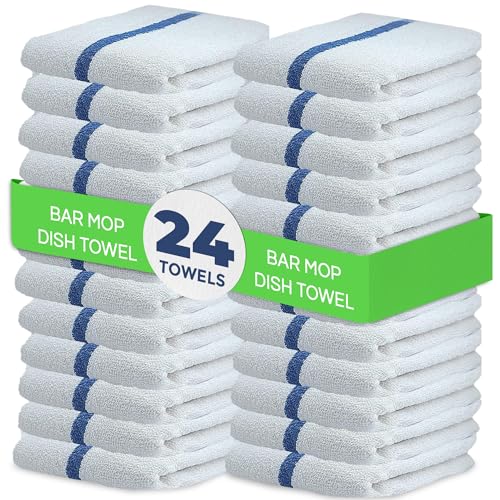
Towels N More Cotton Bar Mop Towels 24 Pack
If a reader buys one pack from this guide without reading further, this is the pack we would point to, because its listing assembles the classic bar mop specification in one place. Twenty-four towels at 16 by 19 inches, cotton, described as 30 oz bar mop towels in blue, reusable, highly absorbent and multi-purpose, and framed for chef, cook, home, restaurant and bar use. Sixteen by nineteen is the bar mop’s traditional footprint for a reason: folded once it fits a hand perfectly, folded twice it becomes a pad thick enough to shift a hot tray, and opened flat it covers a spill the size of a dinner plate.
The blue colour deserves a word of respect. In a mixed laundry stream, colour is information. Blue towels can be assigned to the kitchen and only the kitchen, so a cloth that wiped a raw-chicken board never migrates, even in a clean stack, to the bar top or the dining room. Homes with keen cooks borrow the same trick more often than they admit, dedicating one colour to the kitchen and another to everything else. Twenty-four towels suits a small café washing every other day, or a serious home kitchen washing twice a week, with enough depth that the last clean mop is not being rationed by Sunday.
The trade-offs are those of the family. Terry bar mops are not drying towels for fine glassware; their loops can leave lint on a polished surface and their bulk makes them clumsy inside a narrow glass. They also ask for a laundry routine that keeps them fresh, because a thick terry cloth held damp in a pile will smell before a flat cloth will. Buy this pack for spills, surfaces, handles and hands, and pair it with a flat set for the drying rack, which is exactly how professional kitchens assemble their linen in the first place.
- Count: 24 pack, per the listing title
- Size: 16×19 inches, per the listing title
- Fibre: cotton, per the listing title
- Weight wording: 30 oz, per the listing title
- Colour: blue, per the listing title
- Border style: not stated in the listing title
Strengths
- Classic 16×19 bar mop size folds perfectly for hand and pad use
- Blue colourway makes kitchen-only sorting effortless
- Twenty-four count matches small-venue laundry rhythms
Trade-offs
- Terry loops are wrong for lint-sensitive glass polishing
- Thick cloth needs prompt washing and thorough drying
- No stated border detail for buyers comparing edge finishes
Best for: small restaurants, bars and serious home kitchens needing one dependable bar mop supply. Not suited for: glassware-focused service where flat drying cloths do the main work.
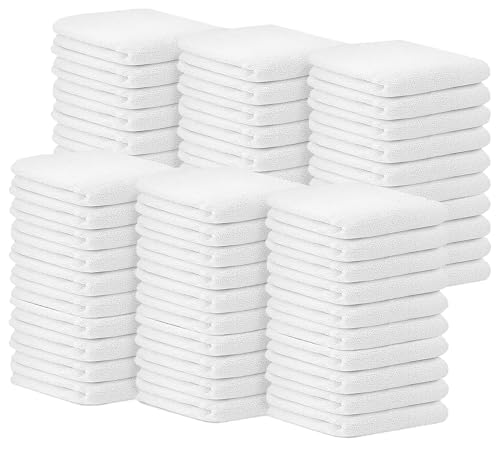
Avalon Towels Bar Towels Pack of 60
Sixty towels is a statement about turnover. The Avalon pack is aimed at an operation that goes through cloth the way it goes through ice: constantly, without counting, and with a laundry cycle industrial enough to keep up. Each towel measures 14 by 17 inches in 100% cotton terry cloth, white, and the listing stretches the roles from bar towels to cleaning rags, multipurpose cleaning towels and durable shop rags. That breadth is honest about what happens to white terry in a working building: the same specification wipes a bar, mops a prep bench, and ends its life, stained and retired, as a general rag.
The slightly smaller footprint, 14 by 17 against the 16 by 19 of the Towels N More and Groko packs, suits the bar and the coffee station particularly well. A smaller towel is quicker to wring, quicker to rinse under a tap between tasks, and less likely to drag through the very spill it is cleaning. White, meanwhile, is the professional’s traditional choice for a reason that has nothing to do with looks: white shows soil honestly, so staff retire a dirty towel sooner, and a white load can be washed hot and hard together without colour sorting.
Sixty white towels also demand a system. Without one, they vanish into every corner of a building and the pack that looked inexhaustible in January is a drawer of mysteries by March. Homes should pause before imitating the count: a household that washes weekly may find sixty terry towels a storage and laundry burden rather than a liberation, and the Zeppoli or Utopia flat packs below will serve a domestic drying rack better. For a venue, though, depth is hygiene, because the towel within reach is always a clean one.
- Count: pack of 60, per the listing title
- Size: 14×17 inches, per the listing title
- Fibre: 100% cotton, per the listing title
- Weave: terry cloth, per the listing title
- Colour: white, per the listing title
- Weight in ounces: not given
Strengths
- Deepest terry supply here for high-turnover venues
- White cloth shows soil and simplifies hot mixed loads
- Handier 14×17 size wrings and rinses quickly at a bar
Trade-offs
- Sixty towels overwhelm a small home laundry routine
- Smaller footprint covers big spills less generously
- White shows every stain the cloth honourably earns
Best for: bars, cafés and venues whose towel use is measured in dozens per day. Not suited for: small households seeking a neat dozen for the drying rack.

Zeppoli Classic Dish Towels 15 Pack
With the Zeppoli pack the guide changes weave families, and the difference should be felt in the hand immediately. These are flat dish towels, fifteen of them, each 14 by 25 inches in 100% cotton, blue, described as reusable bulk cleaning cloths and blue hand towels, super absorbent in the listing’s language and machine washable. The long, narrow 25-inch length is the flat towel’s signature: draped over a shoulder during service, hung over a rail to dry a full rack of plates, or folded lengthways to run around the rim of a glass without bunching.
Flat cloth dries differently from terry. Instead of loops trapping water, the whole surface of the cloth makes contact with the dish, which is why flat towels are the traditional choice for drying washed crockery and glassware and why they leave a cleaner finish on surfaces that show lint. A cook who has only ever used terry for everything will notice the Zeppoli style feels thinner and less thirsty on a flooded counter, and that observation is correct and beside the point: this family’s job begins after the washing up, at the rack, where control and finish matter more than raw soaking capacity.
Fifteen is a well-judged count for its class. It gives a small restaurant a fresh drying towel for each service across a week of daily laundry, or a home a fortnight’s rotation of the towel that lives by the sink. The listing’s own framing as bulk cleaning cloths also hints at the second life of flat towels in a commercial setting: wiping down menus, wrapping cutlery rolls, lining a tray. Buyers who need spill armour should look back at the bar mops; buyers whose bottleneck is a mountain of wet dishes at closing time are home.
- Count: 15 pack, per the listing title
- Size: 14 by 25 inches, per the listing title
- Fibre: 100% cotton, per the listing title
- Colour wording: blue hand towels, per the listing title
- Washing, as titled: machine washable
- GSM figure: none stated in the listing title
Strengths
- Long flat format excels at drying dishes and glassware
- Fifteen count fits daily-laundry service rhythms neatly
- Flat surface leaves a cleaner finish on polished items
Trade-offs
- Flat cloth soaks up major spills more slowly than terry
- Less padding when folded as an emergency pan holder
- Blue body will not suit venues standardised on white linen
Best for: kitchens whose daily bottleneck is drying washed dishes to a clean finish. Not suited for: spill-heavy prep stations that need terry absorbency first.

Utopia Towels Blue Dish Towels 12 Pack
The Utopia pack is the Zeppoli’s closest relative and its most instructive comparison. Twelve towels instead of fifteen, 15 by 25 inches instead of 14 by 25, and two specifications the Zeppoli listing does not offer: the cotton is described as ring spun, and a weight of 200 GSM is stated. Ring spinning produces a smoother, stronger yarn than basic open-end spinning, and in a flat drying towel that smoothness is exactly what slides over glass and crockery without dragging. The stated GSM gives a buyer a rare fixed point in a category full of adjectives, a light-to-medium cloth weight consistent with a drying towel rather than a mop.
Utopia’s listing also spreads the towel’s territory widest of the flat packs, naming cleaning bar, tea and kitchen use alongside dishcloths. Tea service is a telling inclusion: a flat blue towel under a teapot, wrapped around a hot handle, or folded beneath a tray of cups is front-of-house work where appearance counts, and the blue colourway reads tidy and deliberate in a café setting in a way a stained white mop never will. Twelve towels is the smallest count in this guide, which makes this the natural pick for a home kitchen buying commercial cloth for the first time, or a small coffee bar with a daily wash.
The smaller count is also the honest caution. A venue washing every third day will run a twelve pack dry by the second evening service, and no quality of yarn compensates for an empty rail. GSM, meanwhile, should be read as the listing states it and no further: 200 GSM describes this cloth, and tells you nothing about the packs that do not state a figure, whose weight must be judged in the hand on arrival rather than inferred from this one’s honesty.
- Count: 12 pack, per the listing title
- Size: 15 x 25 inches, per the listing title
- Fibre: 100% ring spun cotton, per the listing title
- Weight: 200 GSM, per the listing title
- Colour: blue, per the listing title
- Border detail: not given
Strengths
- Ring spun yarn gives a smooth glide over glassware
- Stated 200 GSM offers a rare measurable specification
- Twelve count suits homes and small coffee bars perfectly
Trade-offs
- Smallest pack here runs short on multi-day rotations
- Flat weave shares the family’s slower spill response
- Blue colourway fixes the look to one scheme
Best for: cafés, tea service and home cooks wanting a specified, smooth drying towel. Not suited for: venues that launder infrequently and need deep stock.
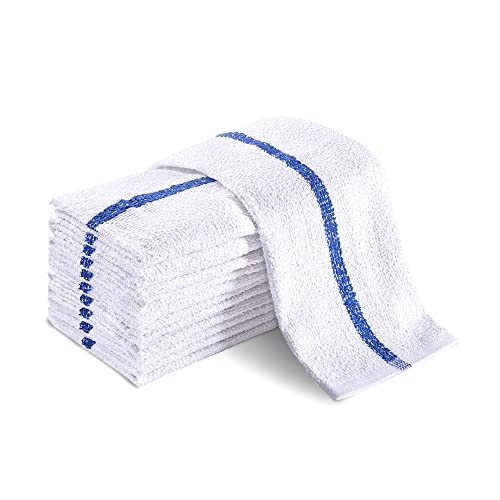
Groko Textiles Cotton Bar Mops Blue Stripe 24 Pack
The Groko pack returns us to terry, but with two construction details its bar mop rivals do not state, and both details are the kind a laundry manager notices. The listing describes 100% cotton bar mops with a blue stripe, 24 in the pack, at a universal 16 by 19 inches, commercial grade, terry weave, fully bordered, in bulk, for everyday restaurant or home use. Fully bordered is the phrase to underline. A terry towel’s edges are its failure point, the place where loops unravel and a mop becomes a fringe of threads, and a complete border is the maker’s answer to that weakness.
The blue stripe does the sorting work that the Towels N More pack’s all-blue body does, but with a white towel’s other advantages retained. A striped white mop can join a hot white wash, show its soil honestly, and still be pulled from a mixed stack at a glance because the stripe announces kitchen duty. In a building where towels migrate between bar, kitchen and washroom, that stripe is a tiny traffic system, and staff learn it in a day. The terry weave at the classic 16 by 19 size keeps the pack squarely in the spill-and-surface family: this is cloth for wiping down a prep bench between orders, catching the drip trail from a leaking tap, and folding into a pad under a hot handle.
Against the Towels N More pack, the choice is genuinely close and comes down to which specification you trust more in your hand: that listing’s stated 30 oz weight language, or this one’s stated border and stripe. Against the Avalon sixty, the Groko’s twenty-four is the count for a venue that launders often and stores little. What the Groko listing does not state is a GSM or ounce figure of its own in the title, so a buyer comparing cloth weight across brands should treat that as an open question to resolve on the listing page rather than assume parity with any rival.
- Count: 24 pack, per the listing title
- Size: 16 x 19 inches, per the listing title
- Fibre: 100% cotton, per the listing title
- Weave: terry weave, per the listing title
- Edge finish: fully bordered, per the listing title
- Stripe colour: blue stripe, per the listing title
Strengths
- Fully bordered edges answer terry’s commonest failure point
- Blue stripe sorts kitchen towels within a white wash system
- Classic 16×19 terry format for spills and surfaces
Trade-offs
- No weight figure stated for cross-brand comparison
- Terry family remains wrong for fine glass finishing
- Stripe system only works if staff actually honour it
Best for: restaurants wanting bordered, sortable bar mops in a manageable count. Not suited for: buyers who compare purchases strictly by stated cloth weight.

Bulk Economy Herringbone Kitchen Dish Towels 100 Pack
One hundred towels is not a purchase, it is a provisioning decision, and the Bulk Economy pack is built for the buyer who thinks in months of service. The specification is the most distinctive in this guide: 100% cotton in a herringbone weave, commercial grade, white with blue stripes, at 24 oz per dozen in the listing’s wording, and, uniquely here, described as bleach resistant. That last phrase belongs to this pick alone. No other title in this guide states it, and this review will not lend it to any rival, because a kitchen that bleaches its linen needs to know exactly which cloth the claim covers.
Herringbone itself deserves explanation, since it is the least familiar weave in the guide. The name comes from the broken diagonal pattern of the weave, which produces a flat, dense cloth with a subtle chevron texture. Flat like a dish towel, so it dries and wipes without terry’s loft, but woven densely, so it wears hard and holds its shape through the kind of laundry a hundred-pack will inevitably receive. In practice herringbone towels live everywhere in a traditional commercial kitchen: drying, wiping, wrapping, lining, and handling warm items with a fold, a generalist cloth for an operation that cannot pause to find the specialised one.
The cautions scale with the count. One hundred towels need storage, a laundry throughput to match, and the discipline to rotate stock so the same twenty towels are not doing all the work while eighty sit compressed. The listing gives no individual towel dimension in its title, an unusual gap that matters if your rails, shelves or drying racks are sized tightly, so confirm the inches on the Amazon listing before provisioning. For a large restaurant, a catering operation, a school or a community kitchen, though, this is the pack that ends towel scarcity as a category of problem, and its bleach resistant claim, read strictly as its own listing states it, speaks directly to institutional laundry reality.
- Count: 100 towels, per the listing title
- Fibre: 100% cotton herringbone, per the listing title
- Grade wording: commercial grade, per the listing title
- Special claim: bleach resistant, per the listing title
- Colour: white with blue stripes, per the listing title
- Individual towel size: not stated in the listing title
Strengths
- Hundred count ends towel scarcity for large operations
- Dense herringbone weave wears hard and stays flat
- Bleach resistant claim stated for institutional laundry
Trade-offs
- Towel dimensions need confirming on the listing first
- Hundred-pack storage and rotation need a real system
- Flat weave will not match terry for flood-level spills
Best for: large restaurants, caterers and institutions provisioning towels by the hundred. Not suited for: small kitchens with one drawer and a weekly wash.
Comparison Table
The six packs divide by weave first and count second, so the table arranges exactly those facts, taken from each listing title, with gaps named where a title leaves a specification out.
| Pack name | Weave family | Towels per order | Dimensions as titled | Sorting signal |
|---|---|---|---|---|
| Towels N More Cotton Bar Mop Towels 24 Pack | Bar mop terry | 24 | 16×19 in | Blue body |
| Avalon Towels Bar Towels Pack of 60 | Terry cloth | 60 | 14×17 in | White |
| Zeppoli Classic Dish Towels 15 Pack | Flat dish towel | 15 | 14 x 25 in | Blue |
| Utopia Towels Blue Dish Towels 12 Pack | Flat dish towel, ring spun | 12 | 15 x 25 in | Blue |
| Groko Textiles Cotton Bar Mops Blue Stripe 24 Pack | Terry weave bar mop | 24 | 16 x 19 in | Blue stripe on white |
| Bulk Economy Herringbone Kitchen Dish Towels 100 Pack | Herringbone flat weave | 100 | Size not in title | Blue stripes on white |
How to Choose Commercial Towels Without Wasting a Bulk Order
Start at the sink of your own operation and watch one busy hour honestly. Count how many times a hand reaches for a towel, and what that towel is asked to do each time. If most reaches are for spills, wet benches and hot handles, your centre of gravity is terry, and the bar mop packs should anchor the order. If most reaches follow the dishwasher, drying rack after rack of crockery, flat cloth is your anchor and terry becomes the supporting act. If your kitchen does everything with whatever is nearest, as small kitchens honestly do, a herringbone generalist or a deliberate half-and-half split will serve you better than doubling down on either family.
Then size the count to the laundry, because a towel stock and a wash cycle are one system. Daily laundry can run lean, twelve to twenty-four towels cycling fast. A twice-weekly wash needs the forties and sixties to avoid the shameful evening when staff are drying hands on the last clean cloth. Storage is the third check: terry is bulky even folded, flat cloth stacks thin, and a hundred-pack of anything needs a shelf assigned before it arrives, not after. Finally, decide your colour system on day one and write it where staff can see it. Blue means kitchen, stripe means kitchen, white means bar, whatever the rule, a rule everyone knows beats a perfect rule one manager remembers.
Weight figures deserve a calm word. Two listings here state them, the Towels N More pack in ounces and the Utopia pack at 200 GSM, and the Bulk Economy pack states 24 oz per dozen. These numbers describe their own cloth in their own conventions and are not a league table you can rank the other packs against, because the others simply do not state a comparable figure in their titles. Judge unstated weight in the hand during the first week, when a return or a re-order decision is still cheap, rather than pretending an absent number can be borrowed from a rival.
How Should a Working Kitchen Rotate and Launder Its Towels?
A towel system fails at the laundry far more often than at the purchase. The professional pattern is simple to describe and strict to keep: a towel used on raw food mess, on the floor, or on anything chemical leaves service immediately and goes to the wash bin, not back to the rail. Towels rotate by station, with the drying towel at the rack kept for washed items only, because a cloth that wiped a bench has no business finishing a clean glass. Colour and stripe systems exist precisely to make those boundaries visible at speed, in a noisy room, to a new starter on a first shift.
Wash kitchen towels hot and separately from anything that should stay soft, and dry them fully before they return to a drawer or a stack, because a terry mop folded damp will smell sour within a day and take its neighbours with it. Avoid fabric softener on working towels for the same reason home cooks are told to avoid it: the coating that makes a bath towel feel plush makes a kitchen towel push water around instead of taking it up. Retire towels by inspection rather than by age. A bar mop whose border has burst, a flat towel thinned to transparency at the centre, a herringbone cloth with a hole at the fold have all finished their service honourably, and demoting them to the rag bin before they fail mid-shift is the mark of a kitchen that runs its linen instead of being run by it.
Common Mistakes When Stocking a Commercial Kitchen With Towels
The first mistake is buying one weave for every job, usually terry, because it feels like the safest all-rounder, and then wondering why glasses dry streaked and linty. The second is the mirror error: elegant flat towels everywhere, and a prep cook folding one six times to lift a roasting tin because no terry pad exists in the building. The third mistake is count vanity, ordering the hundred-pack for a kitchen whose laundry and storage can support thirty, so that towels age in a compressed bale while the working twenty wear out. The fourth is ignoring the sorting signal, mixing colours and stripes until the system means nothing and a floor cloth can plausibly reach a food surface.
Fifth, buyers transfer claims between products in their heads. Bleach resistance is stated for one pack in this guide and for no other, yet it is easy to leave this page believing commercial cotton generally shrugs off bleach; it does not, and the honest habit is to attach every claim to the exact listing that made it. Sixth, managers forget that towels are a consumable with a retirement rhythm, budgeting for the first order and never for the steady replacement that keeps the average towel in the drawer young. A small standing re-order, timed to the laundry’s own reports of thinning cloth, costs less than the emergency bulk buy that follows a drawer of rags.
What Changes When a Home Kitchen Buys Commercial Towels?
Home cooks are increasingly the buyers of packs like these, and the translation mostly works, with three adjustments. First, scale the count down without embarrassment: a household that cooks daily and washes twice a week lives well on twelve flat towels plus a dozen bar mops, and will store, wash and actually rotate them, which a bale of one hundred will never allow. Second, enjoy the sorting system at domestic scale, where one colour for the kitchen quietly ends the mystery of why the good towel smells of bathroom cleaner. Third, reset your expectations of beauty. Commercial cloth is honest cloth, blue, white and striped, made to be boiled and bleached through a working life rather than to coordinate with a kettle, and the home kitchens that love it most are the ones that find that honesty beautiful in itself.
What does not change at home is the weave logic. A domestic drying rack still wants flat cloth, a domestic spill still wants terry, and a household that fries, bakes and preserves in autumn glut will still bless the day it stocked both families deliberately. The Utopia twelve and the Zeppoli fifteen exist at exactly the scale where commercial specification meets a domestic drawer, which is why this guide keeps them in the same conversation as the sixty and the hundred without pretending the audiences are identical.
How Do the Three Weave Families Age Differently?
Terry ages at its edges and in its loops. A bar mop’s centre stays thirsty long after the border frays or a loop pulls into a run, which is why the Groko pack’s fully bordered construction is a longevity claim in disguise, and why inspection should start at the corners. Terry also thickens its own laundry problem as it ages, holding more water, taking longer to dry, and punishing any damp storage with smell. Flat dish towels age at the centre, where thousands of passes over crockery thin the cloth evenly until light shows through; the failure is gradual and visible, and a flat towel rarely betrays you suddenly. Herringbone ages slowest in appearance of the three, its dense flat weave holding shape and surface through heavy institutional washing, though its edges and fold lines still deserve the same inspection as any working cloth.
Knowing the failure pattern of your family turns re-ordering from a crisis into a calendar. When the terry borders begin to burst in the same wash week, the pack is telling you its cohort has reached the end together, because towels bought together and rotated fairly also retire together. Smart kitchens stagger a second purchase a few months after the first, so the stock always mixes ages and never collapses all at once, a trick borrowed from battery rotation and just as unglamorous and effective here.
What Does One Service Teach You About Your Towel Stock?
Watch a single Friday service with a notebook and your next order writes itself. At six o’clock the prep cook reaches for a mop to wipe the bench after breaking down vegetables, then again after portioning raw chicken, and each reach, properly handled, retires a towel to the wash bin rather than returning it to the rail. By seven the bar is rinsing its smaller terry towels under the tap between rushes, grateful for a 14 by 17 cloth that wrings nearly dry in two twists. At eight the dishwasher’s output peaks, and the flat towels at the rack become the bottleneck of the whole building: plates cannot go out until they are dry, dry requires cloth, and the cook who counted towels by the dozen in a quiet week discovers the true arithmetic of a full house.
Nine o’clock brings the spill, a litre of something across a floor that must be made safe in seconds, and this is terry’s finest moment and flat cloth’s honest limitation, because a mop absorbs where a dish towel merely spreads. Ten o’clock brings the wipe-down, station by station, and midnight brings the count that matters: how many towels are in the bin, how many remain clean, and whether tomorrow’s prep can start before the laundry returns. An operation that runs that count for one week knows its real consumption to the towel, and every pack size in this guide, twelve, fifteen, twenty-four, sixty, one hundred, is simply a different answer to that midnight question.
The service also teaches the geography of towels. Cloth stored far from its station will be substituted, and substitution is how a drying towel becomes a floor towel and a system quietly collapses. Put bar mops within arm’s reach of prep, flat towels at the rack and nowhere else, and a small reserve at the bar, and the weave families police themselves. The best towel stock is not the largest; it is the one whose geography matches the building, so that the right cloth is always the nearest cloth.
Why Do Professionals Distrust a Towel That Tries to Do Everything?
Every industry has its universal tool that does three jobs adequately and none well, and the kitchen version is the medium towel bought in one weave, one size, for every station. It dries glasses with lint, pads a hot handle too thinly, and spreads a spill instead of drinking it. Professional kitchens evolved separate cloths for the same reason surgeons evolved separate instruments: the tasks differ in ways that matter at speed. Drying asks for surface contact and a lint-light finish. Spilling asks for volume and thirst. Heat asks for folded thickness. A cloth optimised for one of those is compromised for the others by its very construction, loops against flatness, loft against contact.
That is why this guide refuses to crown a single winner across families and instead keeps asking which job is yours. It is also why the herringbone pack is so interesting to traditionalists: the dense flat weave is the closest thing the trade has to a generalist that does not embarrass itself, drying respectably, wiping firmly and folding into a serviceable pad, which is precisely why institutions that cannot manage a two-family system have relied on it for generations. Generalism is a legitimate strategy when a system must be simple enough for any new pair of hands; it is only a mistake when it is chosen by accident, in ignorance that a choice existed.
How Should a New Venue Set Up Its First Towel System?
Begin smaller than your ambition and more organised than your size seems to require. Order one terry pack and one flat pack in counts matched to a daily wash, assign the colour rule on the first morning, and label the shelves before the first towel is folded, because retrofitting order onto a running kitchen is ten times harder than starting with it. Keep a simple tally for the first month: towels issued, towels retired, towels lost to the mysterious migration that every venue experiences. That tally, unglamorous as it sounds, is the difference between a second order placed calmly at the right count and a panic order placed at midnight at the wrong one.
Train the retirement habit early, too. Give staff permission, indeed instruction, to demote a damaged towel to the rag bin without seeking approval, because a culture that hoards failing cloth ends up with a drawer where every third towel disappoints someone mid-service. And review the system whenever the menu changes: a venue that adds a fryer, a bakery case or a raw bar has changed its spill profile, its heat work and its drying load, and the towel stock should be rebalanced with the same seriousness as the ingredient order. Linen is a small line in the budget and a large presence in the working day, which is exactly the combination that rewards a little deliberate thought.
What About the Towels Nobody Sees?
For every towel on a rail there is another class doing invisible work: the cloth under the chopping board that stops it skating, the towel wrapped around a resting joint, the one lining a basket of rolls on its way to a table, the one folded beneath a mixing bowl, the one that lives in the pastry section for hands that must stay flour-dry. These background roles consume stock just as surely as the dramatic spill does, and a buyer counting only the visible stations will under-order by a third without ever understanding why the drawer empties early. Background work also explains why flat towels disappear faster than their count suggests: a flat cloth is a liner, a wrapper, a tray cover and a napkin substitute in a pinch, and each borrowed role takes it out of drying circulation for hours.
The wise response is to budget a background allowance into the first order and to give the most borrowed roles a cloth of their own. A dedicated handful of flat towels for lining and wrapping, marked if your system allows it, protects the drying rotation from constant raids. Bar mops pressed into service as board anchors should be retired ones, already demoted, because a board anchor lives a damp, compressed life that shortens a good towel for no benefit. Seeing the invisible stock clearly is the final step from buying towels to running a linen system, and it is the step that separates the kitchen that always has cloth from the kitchen that always nearly has cloth.
There is a courtesy dimension too. The towel handed to a guest cook, a trainee or a visiting inspector tells them what kind of kitchen they are standing in before a word is spoken. Clean, sound, appropriate cloth at every station is a quiet promise that the invisible things in this building are handled properly, and in food work that promise is the business itself.
That courtesy extends to the person doing the laundry, the least thanked role in any food business. A stock that arrives back from the wash sorted by a stripe, folded to a standard size and free of the one fused, ruined towel that jams the whole pile is a kindness measured in minutes every day. When you choose between two otherwise equal packs, choose the one whose size folds to your shelves, whose colour survives your wash chemistry, and whose edges survive your machines, because the laundry’s verdict, delivered quietly over months, is the truest review any commercial towel ever receives. Ask the person who washes them which pack they would re-order, and you will learn more in one sentence than in a page of product description.
Keep that conversation going at every re-order. Laundry sees the thinning centres, the bursting borders and the mysterious losses first, and a buyer who listens will adjust counts by family, retire a weave that is failing early, or double the one that is quietly carrying the building. Towels are humble goods, but the system around them is management in miniature: specification, geography, rotation, retirement and feedback, all in a drawer.
One final measure belongs in that feedback loop: cost per month of service rather than cost per pack. A cheap towel retired in eight weeks is dearer than a sound towel retired in eight months, and the pack that looked extravagant at ordering can prove the economical one by spring. Record the month a cohort enters service, even if only as a chalk mark on the storage shelf, and the retirement date will teach your buying more honestly than any catalogue. Commercial linen rewards the buyer who treats it as a small fleet to be managed, not a one-off purchase to be forgotten in a drawer.
That fleet thinking also protects you at the busiest moment of the year, the week when a full house, a short staff and a broken washing machine can coincide without asking permission. A stock sized with a genuine reserve, split across two weave families and two delivery dates, bends under that week instead of breaking, and the manager who arranged it will never have to send a trainee to a shop for emergency cloth while the tickets pile up. Reserve is not waste in a towel system; reserve is the difference between a hard week and a failed one.
Hold a small part of that reserve back untouched, still folded from its pack, as the true emergency layer, because a reserve that circulates is not a reserve at all. Rotate it into service each quarter and replace it with fresh stock, so the emergency towels never age in their wrapping while the working stock wears around them.
That single shelf of untouched cloth, quietly rotated, is the cheapest insurance a kitchen buys all year.
Final Recommendation
Most small venues and serious home kitchens should build around the Towels N More Cotton Bar Mop Towels 24 Pack for spills and surfaces, then add the Zeppoli Classic Dish Towels 15 Pack at the drying rack where flat cloth belongs. Operations washing for a crowd should look instead at the Bulk Economy Herringbone Kitchen Dish Towels 100 Pack and provision herringbone by the hundred. Stock the weave your busiest hour actually reaches for, and the quiet satisfaction of always finding a clean towel where your hand expects one will repay the order every single shift.
Frequently Asked Questions
What is the difference between a bar mop and a dish towel?
A bar mop is thick terry cloth built for absorbing spills, wiping surfaces and folding into a pad, while a dish towel is flat cloth built for drying washed dishes and glassware to a clean finish. Working kitchens stock both because each does the other’s job noticeably worse.
How many towels does a small restaurant need?
Work backwards from your laundry cycle. A venue washing daily can run on two to three dozen towels across both weave families, while a venue washing twice a week should hold sixty or more so the last service of the cycle still finds clean cloth.
Can I bleach all of these towels?
Only one listing here states bleach resistance, the Bulk Economy herringbone pack, and that claim belongs to it alone. For every other pack, follow the care guidance on its own listing and treat bleach as a question to verify rather than an assumption to make.
Why do commercial towels come in blue or with blue stripes?
Colour is a sorting system. Assigning blue or a blue stripe to kitchen duty lets staff identify a towel’s proper station at a glance, even in a mixed clean stack, which supports hygiene in a fast room. White plays the same role by showing soil honestly.
Should home cooks buy commercial packs?
Yes, at the smaller counts. A twelve or fifteen pack of flat towels and a modest bar mop pack bring professional weave logic into a domestic drawer without overwhelming storage or laundry, and the cloth will outlast most decorative kitchen linen.
How often should working towels be replaced?
Replace by condition rather than calendar: burst borders on terry, a thinned transparent centre on flat cloth, holes at the fold on any weave. Rotating stock fairly means a pack tends to reach retirement together, which makes re-ordering predictable.
Related Guides
The guides below continue the towel library and beyond.
Best Cooling Towels for Sports


