What's inside
- Key Takeaways
- Quick Picks
- How Did We Choose Hand Towels for the Sink-Side Station?
- What Does One Day on the Hook Actually Look Like?
- Comparison Table
- Where Exactly Should a Kitchen Hand Towel Hang?
- How Many Kitchen Hand Towels Does a Household Really Need?
- What Mistakes Shorten a Kitchen Hand Towel’s Life?
- Terry, Waffle, or Flour Sack — Which Weave Belongs on Your Hook?
- How Do You Keep a Much-Handled Towel Hygienic Without Fuss?
- What About the Second Sink, the Utility Room, and the Downstairs Loo?
- How Should You Actually Dry Dishes With a Hand Towel Without Ruining It?
- How Do You Teach a Household to Actually Use the Rotation?
- What Does a Higher Tier Actually Buy at This Small Size?
- Which Hand Towel Suits Hands That Are Washed Raw All Winter?
- How Should You Choose Colours for the Busiest Hook in the House?
- How Do You Break In New Kitchen Hand Towels?
- Final Recommendation
- Frequently Asked Questions
- Related Guides
As an Amazon Associate I earn from qualifying purchases. This post may contain affiliate links at no extra cost to you.
cottageverdict.com is reader-supported. When you buy through links on our site, we may earn an affiliate commission.
Where to buy: All six picks are sold on Amazon. Follow a linked pick name to its listing to check price on Amazon, confirm the dimensions and pack count, and read the care label before you order.
The most-used towel in any kitchen is not the big dish towel in the drawer. It is the hand towel on the hook beside the sink — grabbed after every handwash, every rinse of a knife, every wipe of a child’s fingers, dozens of times a day. The best absorbent kitchen hand towels are chosen for that specific station: a true hand-towel size that hangs neatly by the tap, drinks instantly on contact with wet hands, takes light dish duty without complaint, and rotates through the wash often enough that the towel on the hook always feels fresh.
Size is the quiet headline here. A hand towel around sixteen by twenty-six inches drapes over a rail or hook without pooling on the counter, presents enough dry surface for a full day of hand drying, and launders in a bundle without swallowing the machine. Oversized kitchen towels trail in the sink and stay damp in their folds; undersized cloths saturate by midday. This guide keeps the focus on that sink-side format and on the rotation it demands, which is a different conversation from the big cotton kitchen towels chosen mainly for fabric and drying racks of dishes — a neighbouring guide on this site covers that material-first angle.
A note on expectations before the reviews: no hand towel at any tier stays pleasant through a full day of heavy cooking in a family kitchen, and any guide promising otherwise is selling something. What the best sets buy you is a towel that still performs at hour ten and a rotation deep enough that hour eleven starts with a fresh one. Judge the picks below by that honest standard — performance across the day, inside a system — rather than by a single heroic soak.
Absorbency at this station has its own meaning. Hands arrive wet in small amounts but constantly, so the towel’s first-touch grab matters more than its total capacity. Terry loops drink fastest on skin; waffle weave trades a little grab for quicker drying between uses and a scrubbing texture; flour sack cotton, thin and smooth, is the lint-free specialist for glassware but needs a partner towel for hand duty. Every pick below is placed honestly within that triangle of grab, dry-back speed, and texture.
Key Takeaways
- The sink-side hand towel is a high-frequency tool: judge it on first-touch grab across dozens of daily uses, not on one big soak test.
- Sixteen by twenty-six inches, give or take an inch, is the format that hangs cleanly, dries hands fully, and launders in bundles.
- Rotation decides freshness — a working set needs enough towels that one is always clean, one is working, and the rest are in wash or rest.
- Terry grabs fastest on skin, waffle dries back quickest and scrubs lightly, flour sack leaves glassware lint-free.
- A hanging loop or a dedicated hook keeps the towel off the counter, where a bunched towel stays damp and picks up everything it touches.
- Wash kitchen hand towels hot and often, without softener, and retire any towel that smells sour straight out of the drawer.
Quick Picks
| Pick | Badge | Why it earns its place |
|---|---|---|
| KitchenAid Albany Kitchen Towels | Best classic hand towel | A trusted four-pack in a true 16×26 hand format with the soft, thirsty feel cooks expect by the sink. |
| Homaxy Large Cotton Kitchen Towels | Best with hanging loop | Ring-spun cotton terry at 16×28 with a loop that keeps it parked on its hook, in a six-pack grey rotation. |
| Mordimy Cotton Terry Kitchen Towels | Best everyday value set | Six soft terry towels in mixed colours at 16×25 that make a colour-coded family rotation effortless. |
| vfaejll Waffle Kitchen Towels | Best compact waffle set | Six colours of waffle-weave cotton squares for quick hand dabs, dish help, and fast dry-back between uses. |
| Simpli-Magic Flour Sack Towels | Best lint-free for glassware | A dozen smooth 24×24 flour sack towels that leave glasses spotless and double for baking and proofing duty. |
| COTTON CRAFT Waffle Terry Kitchen Towels | Best bulk white set | Twelve white waffle-terry towels at 16×28 that wash hot, hide nothing, and stock a serious kitchen rotation. |
How Did We Choose Hand Towels for the Sink-Side Station?
We judged these towels at the hook, not at the dining table. Each candidate had to fit the station first: a hand-towel footprint that hangs from a rail, hook, or oven handle without trailing, enough surface to dry two hands completely, and a build that tolerates being grabbed with wet, floury, or oily fingers many times a day. Towels that were really bath hand towels in disguise, or dish towels too large to hang neatly, were set aside even when their fabric was lovely.
Absorbency was tested the way the station uses it: repeated small drinks. A towel that grabs the water off wet hands in one pass, then does it again an hour later without feeling clammy, beats a towel with heroic total capacity that stays damp between uses. That is why mid-weight terry and waffle dominate this list and why the heaviest, plushest kitchen towels you can buy are absent — at this station, dry-back speed is a form of absorbency, because a damp towel absorbs nothing.
Rotation economics counted heavily. Hand towels wash more often than any other kitchen textile, so pack counts of four, six, and twelve were scored as systems: can this purchase keep a hook supplied through a realistic wash cycle for a household of two, four, six? Colour strategy counted too — whites that prove cleanliness, greys that forgive a hard week, mixed colours that let a family assign towels by person or by day. Sizes, counts, and materials quoted below come from each listing as verified for this guide.
Finally, we checked the second job. A sink-side towel inevitably dries a few dishes, wipes a rim, and lifts a hot lid at some point in its day. Picks that could only dry hands were marked narrower than picks that could help with light dish duty without shedding lint or going limp — with the flour sack entry deliberately specialised the other way, as the glassware finisher a serious kitchen pairs with a terry workhorse.
What Does One Day on the Hook Actually Look Like?
The towel’s day starts before breakfast, drying hands after the first rinse of fruit and the filling of a kettle. It takes the splash when the sink is rinsed after washing up, dries the cook’s hands between every stage of prep — after chicken, after eggs, after the board is scrubbed — and wipes the counter edge where the sink’s water always creeps. By lunch it has worked perhaps twenty times, and a towel that cannot dry back between those turns starts leaving hands faintly damp, which is when people begin drying their hands on their clothes and the towel has silently failed.
Afternoon brings children, cups of tea, and the baking hour if the house is lucky: floury hands, a wipedown of the mixer, a quick dry of a measuring jug. Evening is the heavy shift — cooking, serving, washing up in stages — and the towel that began the day is ready for the wash basket by the time the kitchen closes. That full arc is why the rotation in this guide runs deep: one towel per day per busy sink is a realistic rhythm, and a household should own enough towels to run it without laundry panic.
Weekends stress the system differently, with guests washing hands at the kitchen sink and a second pair of hands cooking. A spare clean towel staged in the drawer — not the bathroom, the kitchen drawer — is the mark of a household that has thought about this station properly. The picks below are all priced and packed with that rhythm in mind, at tiers described in words rather than numbers, so you can stock the hook the way a café stocks its rail.

KitchenAid Albany Kitchen Towels — Best classic hand towel
KitchenAid’s Albany set is the reference point for what a kitchen hand towel should feel like: soft cotton with a genuine thirst, in a four-pack sized sixteen by twenty-six inches, finished in a milkshake tan and white combination that sits comfortably in most kitchens. On the hook it behaves exactly as the station demands — hands dry in one unhurried pass, the towel hangs flat rather than bunching, and the fabric keeps its composure through the constant washing this job requires.
Four towels is a starter rotation for a smaller household: one on the hook, one in the wash, one resting, one spare for the weekend. The Albany’s appeal is that nothing about it needs explaining to anyone in the house — it feels like the towel people expect to find, which means it gets used properly instead of being saved or avoided. Cooks who entertain will appreciate that it also looks presentable when guests are drying hands at the kitchen sink rather than the bathroom.
- Size: 16 x 26 inches per towel
- Count: 4 towels per pack
- Colour: Milkshake Tan/White
- Best jobs: hand drying, light dish duty, guest-ready kitchen sink
- Care: machine washable; avoid softener to protect absorbency
Strengths
- Classic hand-towel format that hangs neatly and dries hands in one pass.
- Soft, familiar cotton feel that the whole household uses without thinking.
- Neutral colourway looks intentional on display in a guest-facing kitchen.
Trade-offs
- Four-pack is a starter rotation; busy family kitchens will want a second set.
- Light colourway shows cooking stains sooner than grey or mixed sets.
- Mid-weight cotton dries back slower than the waffle picks here.
Best for: smaller households wanting the classic sink-side towel done properly. Not suited for: very large families, who need the deeper rotations further down this list.
Homaxy Large Cotton Kitchen Towels — Best with hanging loop
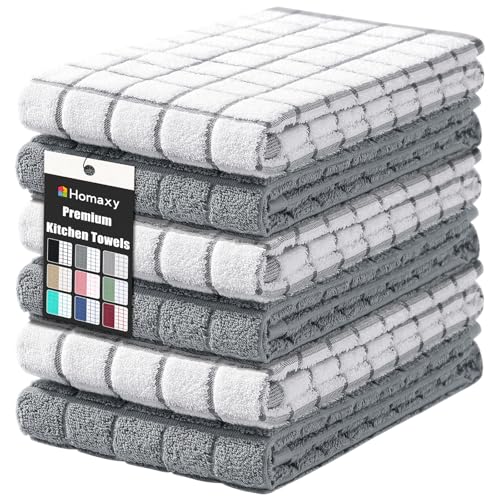
The hanging loop is a small feature that changes a towel’s whole life. Homaxy’s ring-spun cotton towels, sixteen by twenty-eight inches at a substantial 390 GSM, come with a loop that parks the towel on a hook decisively — no sliding off the oven handle onto the floor, no bunching on the counter where it would stay damp. Six grey towels complete the system: a full rotation in the colour that forgives kitchen reality best.
The terry is genuinely thirsty, with the dense, even pile that ring-spun cotton produces, and the slightly larger format gives big hands and busy cooks more dry surface per grab. These towels straddle the line between hand towel and light dish towel gracefully, drying a rack of everyday glasses without going limp. If your kitchen has a hook rather than a rail, this is the pick designed around your furniture.
- Size: 16 x 28 inches per towel
- Weight: 390 GSM ring-spun cotton terry
- Count: 6 towels per pack, grey
- Feature: hanging loop on each towel
- Care: machine washable; tumble dry low
Strengths
- Hanging loop keeps the towel parked, aired, and off the counter.
- Dense ring-spun terry grabs water off hands instantly, all day.
- Six-pack grey rotation hides stains and covers a full wash cycle.
Trade-offs
- Heavier terry dries back slower than waffle between very frequent uses.
- Grey only — no colour-coding options for multi-cook households.
- The larger format may overwhelm a very small sink rail.
Best for: hook-based kitchens and cooks who want one towel for hands and light dishes. Not suited for: tiny galley rails, or anyone wanting colour variety.

Mordimy Cotton Terry Kitchen Towels — Best everyday value set
Mordimy’s six-pack of cotton terry towels, sixteen by twenty-five inches in mixed colours, is the set that makes a family rotation click. The mixed colours are not decoration — they are administration. Assign a colour per person in a house where hand hygiene matters, or a colour per day of the week, and the question of whether the towel on the hook is fresh answers itself at a glance. The terry is soft and properly absorbent, and the listing’s quick-drying positioning fits the mid-weight build.
As an everyday proposition this is the set most households will actually live with: soft enough for children’s hands, sturdy enough for the constant wash cycle, and inexpensive in tier terms to replace without ceremony when the set eventually tires. The slightly shorter length hangs especially neatly on oven handles and short rails. Nothing here is precious, and that is precisely the virtue — a hand towel should be a tool the whole family uses hard.
- Size: 16 x 25 inches per towel
- Count: 6 towels per pack, mixed colours
- Material: cotton terry
- Best jobs: family hand drying, everyday sink duty, colour-coded rotation
- Care: machine washable; wash colours with care initially
Strengths
- Mixed colours enable per-person or per-day rotation at a glance.
- Soft terry that children and guests use willingly, all day long.
- Everyday tier makes whole-set replacement painless when the time comes.
Trade-offs
- Mixed colours need a careful first wash to keep them true.
- Mid-weight build saturates sooner than the Homaxy on very heavy days.
- No hanging loop, so it relies on a rail or handle to hang well.
Best for: families wanting a friendly, colour-coded everyday rotation. Not suited for: cooks who want a single-colour, display-grade kitchen look.

vfaejll Waffle Kitchen Towels — Best compact waffle set
Honesty about size first: at thirteen by thirteen inches, these waffle-weave cotton towels are compact squares rather than full hand towels, and they earn their place as the quick-turnover specialists of the station. Six colours of waffle cotton, each square light enough to dry back remarkably fast, make an excellent second string beside a terry main towel — the cloth you grab for a quick hand dab, a wipedown of a small spill, drying a single pan, or lining a bread basket.
Waffle weave is doing real work here. The pockets give the little squares more absorbency than their weight suggests, and the texture scrubs lightly at dried splashes around the tap. Because they dry so quickly, a set of six can cycle through a day’s small jobs with none of the clamminess that ends a big towel’s shift early. Households that cook constantly and hate the feeling of a damp towel will understand this set immediately; households wanting one towel to do everything should look at the larger picks instead.
- Size: 13 x 13 inches per towel
- Count: 6 towels per pack, 6 colours
- Material: 100% cotton waffle weave
- Best jobs: quick hand dabs, small dishes, wiping, basket lining
- Care: machine washable; dries very quickly
Strengths
- Fastest dry-back in this guide; almost never feels clammy in use.
- Six colours support rotation and job-coding in a busy kitchen.
- Compact squares store anywhere and travel to picnics and lunchboxes easily.
Trade-offs
- Too small to serve as the kitchen’s only hand towel for big hands.
- Lower total capacity; a soaked square needs swapping sooner than terry.
- Waffle texture is a lighter scrub than some dried-on messes want.
Best for: a quick-turnover second string beside a main hand towel. Not suited for: serving as the sole towel at a busy family sink.

Simpli-Magic Flour Sack Towels — Best lint-free for glassware
Every serious kitchen needs one towel that leaves glassware truly clean, and flour sack cotton is the classic answer. Simpli-Magic’s twelve-pack of twenty-four-by-twenty-four-inch towels is woven smooth and lint-free, so a wine glass or a window of the oven door comes up polished instead of freckled with fibres. The generous square folds to whatever the job needs — a pad for drying, a sheet for covering proofing dough, a liner for a drained salad spinner’s greens.
As hand towels they are a deliberate trade: thin cotton dries hands adequately and dries itself quickly on the rail, but it lacks terry’s instant grab, so most cooks pair a flour sack set with a terry main towel and deploy each where it shines. Bakers will claim this set first — flour sack towels are the traditional cover for rising dough and the gentlest wrap for warm bread — and the twelve-count means the kitchen never has to choose between the dough and the dishes.
- Size: 24 x 24 inches per towel
- Count: 12 towels per pack
- Material: 100% cotton flour sack weave
- Best jobs: glassware, polishing, baking covers, gentle drying
- Care: machine washable; improves with washing
Strengths
- Lint-free finish leaves glass, mirrors, and screens genuinely spotless.
- Large square folds to many jobs, from dish pad to dough cover.
- Thin cotton dries itself quickly and washes without bulk.
Trade-offs
- Slower first-touch grab on wet hands than terry or waffle.
- Thin fabric offers little insulation against hot pan handles.
- White shows stains; expect a working patina in a busy kitchen.
Best for: glassware perfectionists and bakers who need one set for both crafts. Not suited for: serving as the only hand towel where terry’s grab is expected.
COTTON CRAFT Waffle Terry Kitchen Towels — Best bulk white set
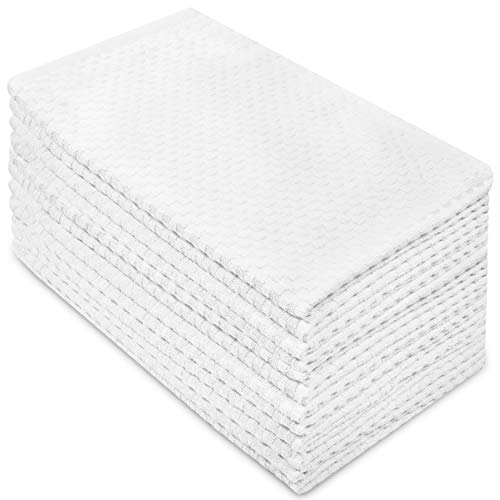
COTTON CRAFT’s twelve-pack is the professional’s format: white waffle-terry towels at sixteen by twenty-eight inches, in a count that lets a serious kitchen run a café-style rail. The waffle-terry hybrid weave is the interesting part — terry’s loops for grab, waffle’s structure for airflow — and the listing’s café positioning is honest: this is the towel style that high-turnover kitchens choose because it dries hands, dries back quickly, and washes hot without complaint.
White is a commitment and a signal. It shows every stain, which forces the honest rotation that keeps a kitchen hygienic, and it tolerates the hot, thorough washing that coloured towels sometimes cannot. Twelve towels means the wash cycle never leaves the rail bare, and a household that cooks daily will find the set pays for its shelf space within the first month. If your kitchen runs more like a small restaurant than a showroom, start here.
- Size: 16 x 28 inches per towel
- Count: 12 towels per pack, white
- Material: 100% cotton waffle terry
- Best jobs: high-turnover hand drying, dish help, café-style home kitchens
- Care: machine wash hot; low lint by design
Strengths
- Hybrid weave balances terry grab with waffle dry-back speed.
- Twelve-pack supports a true professional-style rotation at home.
- White takes hot washing and proves cleanliness at a glance.
Trade-offs
- White demands prompt washing; stains set if towels sit in the basket.
- Utilitarian look will not flatter a styled, display-first kitchen.
- Twelve towels is a real storage commitment in a small kitchen.
Best for: daily cooks running a high-turnover, hygiene-first kitchen. Not suited for: households wanting decorative colour at the sink.
Comparison Table
| Pick | Weave | Size | Count | Station strength |
|---|---|---|---|---|
| KitchenAid Albany Kitchen Towels | Cotton | 16 x 26 in | 4 | Classic all-round hand drying |
| Homaxy Large Cotton Kitchen Towels | Cotton terry 390 GSM | 16 x 28 in | 6 | Hook hanging and heavy grab |
| Mordimy Cotton Terry Kitchen Towels | Cotton terry | 16 x 25 in | 6 | Colour-coded family rotation |
| vfaejll Waffle Kitchen Towels | Cotton waffle | 13 x 13 in | 6 | Fastest dry-back, small jobs |
| Simpli-Magic Flour Sack Towels | Cotton flour sack | 24 x 24 in | 12 | Lint-free glassware and baking |
| COTTON CRAFT Waffle Terry Kitchen Towels | Cotton waffle terry | 16 x 28 in | 12 | Bulk white café-style rotation |
Where Exactly Should a Kitchen Hand Towel Hang?
Within one step of the sink, at a height where wet hands find it without dripping across the floor — that is the whole science, and kitchens that break it pay in puddles and clammy towels. A hook on the wall beside the tap or a short rail under the counter’s edge beats the oven handle for households that cook with the oven daily, because the handle towel gets cooked, splashed, and pulled off by passing hips. The oven handle remains fine for gentler kitchens, provided the towel hangs clear of the door’s heat vent.
Airflow decides the rest. A towel spread over a rail dries on both faces; a towel bunched on a hook dries where it can. If your only option is a hook, choose towels with loops — the Homaxy design above — and shake the towel out when you hang it so the folds open. In steamy kitchens, moving the hand towel’s home to the side of a cabinet near a doorway can halve its damp hours, because every passing person moves the air around it.
Renters take note: the best hanging solutions here need no screws. Over-cabinet rails, adhesive hooks rated for damp rooms, and the oven handle all hold a sixteen-inch towel happily, and a loop-equipped towel like the Homaxy turns even a cupboard knob into a workable station. Landlords forgive towel rails far more readily than the water damage a badly placed towel habit can cause, so set the station up properly from the first week.
Give the towel a boundary as well as a home. The hand towel is for hands and light duty; the moment it becomes the floor mop, the oven mitt, and the child’s face cloth, its hygiene and its absorbency both collapse. A second, clearly different cloth for rough jobs — a waffle square from the vfaejll set, say — protects the main towel’s role and makes the whole station easier to keep honest.
How Many Kitchen Hand Towels Does a Household Really Need?
Count from the wash cycle backwards. If laundry runs twice a week, each busy sink needs at least four towels in the system: one working today, one working tomorrow, and two in the wash-or-rest pipeline, with a spare for guests and accidents pushing the honest number to six. Households that wash weekly should double it — which is exactly why the twelve-packs in this guide exist, and why they are not the extravagance they first appear.
Children change the arithmetic more than any appliance. Small children wash hands more often, dry them less thoroughly, and leave towels on the floor with a reliability that borders on the scientific. A family kitchen can easily run two towels a day in term time. Colour-coding, as the Mordimy set allows, turns that volume into a system children can actually follow: your colour is your towel, and a fresh colour means a fresh towel.
Singles and couples in small kitchens can run leaner — a four-pack like the KitchenAid set, washed twice a week — provided the rest day is respected. The failure mode to avoid at any household size is the single heroic towel, expected to work a week between washes. No fabric survives that expectation with its freshness or its absorbency intact, and the replacement cost of one good rotation is lower than the drip trays, paper towels, and ruined tempers the single-towel system produces.
What Mistakes Shorten a Kitchen Hand Towel’s Life?
The first is fabric softener, the quiet assassin of every absorbent textile: it coats cotton loops until they repel the water they exist to drink. Wash these towels plainly and they stay thirsty for years. The second is the forgotten basket — a damp hand towel left balled in laundry for days emerges smelling sour, and that smell can survive washing once it has set into the fibres. Hang used towels to dry before they join the basket, or wash the day they retire.
Third, people use the hand towel as a potholder. A folded dry towel insulates briefly, but a damp one conducts heat straight to the hand, and repeated heat exposure scorches and weakens the cotton at the fold. Keep a real mitt within reach of the oven and the towel’s life doubles. Fourth, they bleach coloured towels into patchiness or wash whites so gently that kitchen grease builds up; match the wash to the colour strategy you bought — whites hot and thorough, colours prompt and separate at first.
Finally, households keep towels in service past their honest end. When a towel’s loops lie flat, its edges fray, and it pushes water around the hands instead of drinking it, the towel is done at the sink — demote it to floor and garage duty, where its remaining life is useful, and promote a fresh one. A rotation refreshed in whole sets, as several picks here allow, keeps the station’s performance even instead of slowly declining one towel at a time.
Terry, Waffle, or Flour Sack — Which Weave Belongs on Your Hook?
Terry is the instinctive choice and, for pure hand drying, the right one. Its loops stand off the fabric like a field of tiny sponges, meeting wet skin at hundreds of points and pulling water in on contact. That first-touch grab is what people mean when they call a towel absorbent, and it is why four of the six picks here use terry or a terry hybrid. Terry’s cost is time: those same loops hold water deep, so a terry towel needs real airflow and a rest day to return to its best. In a kitchen where the towel works hourly, terry wants partners.
Waffle answers terry’s weakness with structure. The woven pockets thin the fabric where air needs to reach and thicken it where wiping happens, so a waffle towel dries back noticeably faster and adds a gentle scrubbing action around taps and handles. Its grab on skin is a beat slower than terry’s — a press rather than an instant drink — which is why waffle shines as the second towel, the dish helper, and the choice for steamy kitchens where dry-back speed decides everything. The COTTON CRAFT hybrid in this guide exists because the two weaves genuinely complete each other.
Flour sack is the specialist that every weave comparison should respect. Smooth, thin, and lint-free, it is mediocre at the hand towel’s main job and unmatched at the finishing jobs: glassware without freckles, polished taps, a gentle wrap for herbs and greens, a cover for dough. Kitchens that try to make one weave do everything end up with a compromise towel; kitchens that run terry for hands and flour sack for finishing have two tools that are each excellent. The twelve-pack pricing in tier terms makes that two-tool system easy to adopt.
Read your kitchen honestly before choosing. A dry, airy kitchen with a rail and a twice-weekly wash can run pure terry happily. A steamy flat kitchen should weight waffle heavily. A household that entertains with real glassware should budget the flour sack set regardless of what hangs on the hook. The picks in this guide were assembled so those three kitchens can each build their system from one list.
How Do You Keep a Much-Handled Towel Hygienic Without Fuss?
None of this requires special products or anxious routines. It requires a towel count that makes the clean choice the easy choice, which is a purchasing decision long before it is a hygiene habit — and the packs gathered here are sized to make that decision once, properly.
Start from what the towel touches: hands after raw ingredients, hands after the bin, hands after the dog. The hand towel is a shared surface, so its hygiene is a rhythm rather than a product feature — change it on schedule, wash it hot, dry it completely. The schedule matters more than any fibre technology: a plain cotton towel changed daily is a cleaner tool than a premium towel changed weekly, and every pick in this guide is priced in tiers that make the daily rhythm affordable.
Separation does the next share of the work. The towel for hands should never be the towel that wiped the floor spill or the raw-chicken board’s edge; those jobs belong to the rough-duty cloth, and keeping the two visibly different — different colour, different weave, different home — is what makes the rule survive a busy evening. Households with children can make the boundary physical: hand towel on the high hook, rough cloth in the under-sink basket, no negotiations.
Drying is the third leg. A towel dried fully between shifts carries far less of yesterday into today, which is why the placement and airflow advice elsewhere in this guide is really hygiene advice in disguise. If a towel comes out of the wash smelling faintly sour, wash it again hot before it returns to the hook; that smell is residue announcing itself, and one honest rewash early saves the towel. With those three habits — schedule, separation, drying — the humble hand towel stays what it should be: the cleanest thing in the kitchen.
What About the Second Sink, the Utility Room, and the Downstairs Loo?
Every home has satellite stations that borrow the kitchen towel’s logic. The utility room sink, where hands are washed after gardening and the dog’s bowls are rinsed, needs a tougher, darker towel that nobody minds abusing — a grey terry from the Homaxy set or a retired kitchen towel promoted sideways. The downstairs loo, where guests dry hands in view of your standards, deserves the presentable end of the rotation: the KitchenAid set’s colourway was practically designed for that hook.
Stocking satellites from the same packs keeps the whole house coherent. A twelve-pack divides naturally — six for the kitchen, three for the utility room, three for guest duty — and because the towels match, laundry sorts itself. The mistake is buying satellites as afterthought singles, which creates a drawer of mismatched towels that nobody rotates properly. Buy the system once, divide it deliberately, and every sink in the house runs the same reliable rhythm.
Seasonal stations deserve a thought too. Summer adds the garden tap and the paddling-pool towel crisis; winter adds the radiator-adjacent hand drying of a house full of colds. A small reserve from a bulk pack, kept folded in the airing cupboard, absorbs both without a special purchase. That reserve is the final argument for the bigger packs in this guide: they are not excess, they are the house’s whole towel infrastructure in one box.
How Should You Actually Dry Dishes With a Hand Towel Without Ruining It?
Light dish duty is part of the station’s life, so do it in a way that respects the towel. Dry dishes with a towel that starts dry — a towel already damp from hands will smear more than it dries — and work from glasses to plates to pans, so the cleanest items meet the freshest fabric. Glasses deserve the flour sack treatment where possible: twist a corner gently inside the bowl of the glass rather than forcing a bunched terry towel in, which is how rims chip and fibres shed.
Hot items change the rules. A hand towel can steady a warm plate, but lifting cookware from the oven with it is a burn risk and a fabric killer; the mitt exists for that job. Similarly, a towel used to dry a full rack should then be hung spread to recover, not sent straight back to hand duty — the rotation absorbs this easily if you swap in the resting towel. These small disciplines are what let one set of towels cover both jobs for years instead of months.
Air-drying loyalists sometimes ask why a hand towel needs dish skills at all. The honest answer is the single glass, the lunch plate, the pan needed again in ten minutes: real kitchens dry individual items constantly, and the towel on the hook is the tool in reach. Choosing picks that handle that reality — as all six here do, each in its own register — beats pretending the station has only one job.
How Do You Teach a Household to Actually Use the Rotation?
Systems fail at the human layer, so design for the humans you have. Put the clean towels where the used ones come off — a small stack in the drawer directly under the hook — so swapping takes five seconds and no decision. Make the swap trigger objective: a fresh towel every morning, or whenever the working towel feels damp at midday, whichever comes first. Objective triggers survive busy weeks; judgement calls do not.
Children respond to ownership and colour. The Mordimy set’s mixed colours let each child claim a towel, and a claimed towel gets hung up, kept off the floor, and surrendered to the wash with noticeably less theatre. Adults respond to removing friction: if the wash basket for kitchen towels lives in the kitchen rather than upstairs, towels actually reach it. A small lidded basket under the sink outperforms every household resolution ever made about laundry.
Finally, let the system be visibly self-maintaining. When guests see a neat rail, a spare stack, and a basket doing its job, they follow the pattern without instruction — which is the real test of any household system. The picks and pack sizes in this guide were chosen to make that quiet order easy to reach: enough towels, in the right sizes, at tiers that let you replace the whole set the year it finally tires.
What Does a Higher Tier Actually Buy at This Small Size?
At hand-towel scale, money buys three things: fibre quality, weave density, and finishing. Better cotton — longer, more evenly spun yarn like the ring-spun terry in the Homaxy set — drinks faster, sheds less, and stays soft through far more washes than short-fibre cotton. Denser weave puts more loops or pockets on the same footprint, which is absorbency you can feel in a single pass. Better finishing means hems that survive the constant wash cycle instead of unravelling by spring, and loops or labels placed where they do not snag.
What money does not buy is immunity from the station’s physics. A premium hand towel used alone, without rotation, still goes clammy and sour; a modest towel inside a good rotation still performs. That is why this guide ranks systems — pack count and size honesty — alongside fabric quality, and why the everyday-tier Mordimy set can be the right answer for a family while the denser Homaxy suits a two-cook household. Spend first on enough towels, then on better towels.
The flour sack set is the exception that proves the tier rule: its value is not fibre luxury but weave honesty, a smooth lint-free finish that no amount of plushness can imitate. Judge each pick by the job it headlines, and the tiers across this list arrange themselves sensibly — everyday workhorses, denser upgrades, and one specialist — rather than a simple ladder from cheap to dear.
Which Hand Towel Suits Hands That Are Washed Raw All Winter?
Cooks, carers, health workers, and parents of small children all know the winter problem: hands washed twenty times a day, dried on whatever hangs by the sink, ending the season sore. Towel choice cannot fix the washing, but it can stop adding insult. Soft, well-laundered cotton terry with no rough hems or scratchy labels is the kindest surface in this guide — the KitchenAid and Mordimy sets both qualify — and a towel changed frequently feels gentler than a damp one, because dragging wet skin across damp fabric is where the rawness compounds.
Technique helps as much as textile. Patting hands dry instead of rubbing them, especially between the fingers where moisture lingers, treats skin noticeably better across a long day, and a towel with enough surface — the full sixteen-by-twenty-six format rather than a small square — makes patting practical instead of fiddly. Keep the small waffle squares for dishes and quick dabs, and let the big soft terry do the skin work.
One more comfort note: fragrance and softener residues left in a towel meet freshly washed skin all day, which is another practical reason — beyond absorbency — to wash these towels plainly. The gentlest hand towel in the world is simply a clean, soft, dry one, in generous supply, and every recommendation in this guide bends towards making that supply easy to keep.
How Should You Choose Colours for the Busiest Hook in the House?
Colour at this station is a working decision disguised as a decorating one. White argues for itself in kitchens that prize visible cleanliness: it shows soil instantly, tolerates the hottest and most thorough washing, and never clashes with a changing kitchen. Its price is honesty — white towels in a curry-and-tomato household will carry a working patina within the month, clean but marked. Households at peace with that patina get the easiest laundry life in this guide; households that are not should not buy white and then resent it.
Grey is the diplomat’s choice, and its popularity in this list — the Homaxy set above all — is earned. It hides the faint shadowing that terry collects, reads clean to guests, and washes without the sorting anxiety of brights. In a hard-water area, grey also disguises the mineral dullness that makes white towels look tired before their time. If a household cannot agree on a colour strategy, grey is the answer that nobody regrets.
Mixed colours solve a different problem: administration. Per-person colours end arguments about whose towel is whose, per-day colours make the rotation self-evident, and a bright set cheers a rental kitchen whose fittings cannot change. The discipline mixed colours demand is a careful first wash and a willingness to replace the set as a set when one colour fades faster than its siblings. The Mordimy and vfaejll packs both lean into this strategy at friendly tiers.
Pattern and texture play a quieter role. A subtle stripe or a waffle’s shadow-play forgives small marks that flat colour exposes, and textured towels photograph less starkly under harsh kitchen light — a real consideration in the open-plan kitchens where the sink sits in the living space. Choose the colour system that matches your laundry temperament, because the best colour is the one whose washing rules your household will actually keep.
How Do You Break In New Kitchen Hand Towels?
New cotton towels arrive with factory finishes that make them feel smooth and drink slowly, so the first wash is a genuine part of the product. Wash a new set before its first shift — warm or hot, no softener — to strip the finish and open the loops, and expect absorbency to climb over the first three or four washes as the cotton settles into its working state. Judging a cotton hand towel on day one is like judging a cast-iron pan before seasoning; the tool improves into its job.
Wash new colours separately the first time, especially the mixed sets, and keep the first tumble dry gentle while hems and loops find their shape. If a new towel still feels reluctant after three washes, check the detergent dose — heavy residue from an overfilled scoop mimics factory finish almost exactly, and one clear-water rinse cycle usually reveals a perfectly thirsty towel underneath. A towel that sheds a little lint in its first washes is behaving normally — that is loose surface fibre leaving — and the lint-free flour sack set is the exception that proves the rule, arriving nearly ready for glassware. After the break-in, fold the set into the rotation one towel at a time if you want to feel the difference a rested, seasoned towel makes against a brand-new one.
Final Recommendation
For most kitchens, the Homaxy six-pack is the station’s best foundation: the loop keeps it parked, the terry keeps hands dry, and grey keeps it honest-looking through a hard week. Families will get more joy from the Mordimy colours, serious cooks from the COTTON CRAFT dozen, and anyone whose glasses matter should add the Simpli-Magic flour sacks as the finishing towel the others cannot be. Start with the KitchenAid four-pack if your kitchen is small and your laundry frequent, and let the vfaejll waffle squares ride as the quick-draw second string. Stock the hook like you mean it, and the hardest-working towel in the house will finally work the way it should.
Frequently Asked Questions
How often should a kitchen hand towel be changed?
In a busy family kitchen, daily is the rhythm that keeps it fresh; a quieter household can stretch to two days if the towel dries fully between uses. Any towel that smells sour, feels slimy, or has handled raw meat juices goes to the wash immediately, whatever the schedule says.
What size is a kitchen hand towel supposed to be?
Around sixteen by twenty-six inches is the classic format — enough to dry two hands completely and hang neatly on a rail. Smaller squares like the thirteen-inch waffle set in this guide serve as quick-turnover helpers rather than the main towel.
Why does my kitchen hand towel feel damp all the time?
Usually a rotation or airflow problem rather than a fabric problem: one towel working without rest, bunched on a hook in a steamy room. Add towels to the rotation, spread the working towel over a rail, and check that softener is not coating the loops.
Can I use the same towel for hands and dishes?
Light overlap is normal in home kitchens — the picks here all take light dish duty — but a towel that has dried a full rack should rest before returning to hands. Many cooks keep the flour sack set for dishes and glassware and terry for hands, which is the cleanest split.
Are waffle or terry towels better beside the sink?
Terry grabs water off skin faster; waffle dries itself faster and scrubs lightly. Busy sinks often run both — terry as the main towel, waffle squares as the quick-draw helpers — which is why this guide includes strong options in each weave.
Should the kitchen hand towel match my other kitchen towels?
Matching is a pleasure, not a requirement, and at this station function should lead. Many households run a coordinated colour family — greys and whites across hand and dish towels — while letting weave and size differ by job. If you do want a matched look, buy the hand towels from the same colour story as your dish towels and let the flour sack whites act as the neutral that ties them together.
How do I stop kitchen hand towels smelling sour?
Wash them hot and promptly, dry them completely before folding, and never let a damp towel wait balled in the basket. A towel that stays sour after two honest hot washes has residue deep in its fibres and should be demoted to rough duty.
Related Guides
The material-first view of larger cotton kitchen towels lives in Best Absorbent Cotton Kitchen Towels, which suits cooks choosing by fabric above format. For the detailing corner where microfiber meets wood and leather as well as paintwork, see Best Affordable Microfiber Towels for Detailing. Dorm kitchens and first flats get their own towel logic in Best Bath Towels for College Students, and households ready to buy coordinated sizes in one purchase should read Best Bath Towel Sets.


