What's inside
- Key Takeaways
- Quick Picks
- How Did We Weigh the Different Kinds of Adjustment?
- How Do the Six Compare at a Glance?
- How Do You Set Brush Height Correctly for Each Pile?
- When Does Suction Control Matter More Than Raw Power?
- What Mistakes Do Owners Make with Adjustable Machines?
- How Do Reach and Hose Length Redefine Adjustment Upstairs?
- Which Adjustments Matter Most to Which Household Members?
- How Should You Maintain the Adjustment Mechanisms Themselves?
- How Do the Tiers Divide Among Adjustable Uprights?
- How Do Automatic and Manual Adjustments Compare in Daily Life?
- What Should You Test in the First Week with a New Machine?
- What Is Pile Depth, and Why Does Half an Inch Decide Everything?
- How Did the Height Dial Earn Its Place on the Upright?
- How Should Your Adjustments Change with the Seasons?
- Final Recommendation
- Frequently Asked Questions
- Related Guides
As an Amazon Associate I earn from qualifying purchases. This post may contain affiliate links at no extra cost to you.
cottageverdict.com is reader-supported. When you buy through links on our site, we may earn an affiliate commission.
Where to buy: the five linked machines below are sold on Amazon, and their names lead to the listings where you can check price on Amazon and confirm the exact adjustment range, tool bundle and cord or battery arrangement each model offers before it joins your cleaning cupboard for good.
The case for the best adjustable vacuums starts with a small failure everyone who cleans recognises: a vacuum set for one floor rolling hopefully onto another. The upright that glides so happily across kitchen tiles arrives at the thick hallway rug and suddenly needs to be shoved with both hands; the machine tuned for deep carpet skims across bathroom lino, sucking importantly at nothing while the grit watches it pass. Floors changed; the vacuum did not. Adjustability is the quality that closes that gap, and it wears more faces — dial, pedal, swivel, wand, dial again — than most shoppers realise when they first go looking.
Height adjustment is the famous one — the brush roll raised or lowered a few crucial millimetres so its bristles meet the pile at the right depth, biting into carpet without strangling airflow or skating uselessly above it. But suction control matters too, especially on the hose, where full upright power can seal a nozzle hard to upholstery or drag a lightweight rug giggling across the room. Swivel steering adjusts the machine to the furniture’s geography; wand reach adjusts it to yours, extending the clean to ceilings, stairs and the dusty tops of cupboards without a chair being dragged into wobbling service. A genuinely adjustable vacuum is not one with a single dial, however satisfying that dial feels in the shop — it is one that adapts along several axes at once, in the order your route demands them.
The five linked picks below span that idea generously: corded uprights with multi-height brush rolls and rewind cords, swivel-steering pet models, featherweight Eurekas with five height settings, and a cordless Shark whose adjustability lives in its conversion and reach. A sixth pick, discussed in prose, salutes the canister vacuums whose suction dials remain the most elegant adjustment in the whole category. Read each pick for the adjustments your floors will actually demand, because a setting you never touch is not a feature — it is decoration.
One warning before the details: adjustability only pays when it is used, and the graveyard of good vacuuming is paved with height settings left on medium forever. The best adjustable vacuum for your home is therefore partly a question about you — whether you will turn the dial as you cross from rug to boards, or whether you need a machine whose automatic manners cover your indifference. Both kinds of owner are served below, and we will tell you plainly which pick suits which temperament. Bring a mental floor plan to the reading — room by room, surface by surface, with the stairs and the good rug marked — because adjustability is a property that only exists in the encounter between a particular machine and a particular home, and the encounter is what the next several thousand words are staging, one pick at a time.
Key Takeaways
- Adjustable means several things at once: brush height for pile depth, suction control for tools and delicate work, swivel for furnished rooms, and reach for stairs and ceilings.
- The Eureka NEU182B names five height settings in its listing, the most explicit pile adjustment among the linked picks and the easiest to shop for by number.
- Height set wrong in either direction costs cleaning: too low strangles airflow and strains the motor, too high skims serenely above the grit it was bought to remove.
- The Hoover WindTunnel 2 pairs its adjustments with a rewind cord and HEPA media filtration for whole-house duty across a full tour of rooms.
- Canister vacuums with suction dials, covered in prose below, remain the benchmark for delicate tool work on curtains, fringes and upholstery that matters.
- Buy the adjustments your floors demand and your habits will actually use, not the longest settings list in the shop window that day.
Quick Picks
| Pick | Badge | Why it made the list |
|---|---|---|
| Hoover WindTunnel 2 Whole House Rewind | Whole-house adjuster | Multi-surface height settings, a reach wand and a cord that rewinds itself when the tour ends. |
| Bissell CleanView Swivel Pet Upright 2252 | Steering specialist | Swivel steering adjusts the machine to the furniture while its brush handles pet territory. |
| Eureka PowerSpeed Upright NEU181A | Lightweight all-rounder | Easy-carry weight, a big cup and pet tools for homes that adjust by moving rooms often. |
| Eureka PowerSpeed Bagless Upright NEU182B | Five-height champion | Five brush-roll height settings across carpet depths, in a body of around ten pounds. |
| Shark PowerPro Reveal Plus Cordless Vacuum | Cordless reach pick | Conversion and tool reach replace the cord, with a light that adjusts your aim to hidden dust. |
| Canister Vacuums with Suction Dials | Prose-only benchmark | A dial that trims suction continuously, for curtains, upholstery and delicate rugs. |
How Did We Weigh the Different Kinds of Adjustment?
We scored four axes separately, because a machine can be brilliant on one and absent on another. Pile adjustment came first: how many height settings, how honestly they span the distance between bare floor and deep carpet, and how the mechanism — pedal, dial or automatic float — invites use mid-clean. The Eureka NEU182B’s five named settings set the standard here, while the Hoover’s whole-house brief implies a range designed to be used daily rather than admired.
Suction control came second, and it is the axis where uprights traditionally underperform canisters. A hose at full upright power can be a wrestling partner on upholstery and a menace to light rugs, so we looked for any means of tempering it — and credited the prose-only canister class with the benchmark, a continuous dial, against which the linked uprights’ workarounds are honestly compared. Steering and reach formed the third and fourth axes: swivel heads that adjust the machine’s path around furniture, and wands or hoses that adjust its altitude from skirting to cornice.
Finally we weighed temperament. Some owners adjust joyfully, treating settings as instruments; others want the machine to cope while they think about dinner. The list below serves both, and each pick’s verdict names its temperament plainly, because the finest five-height dial in the world cleans nothing in the hands of an owner who will never touch it — while an automatic machine in a tweaker’s hands can feel like a car that refuses to leave its lane. Every claim in the sections that follow is drawn from the listings themselves or from the settled mechanics of how brush rolls, airflow and pile interact; where a listing is silent about a mechanism, we describe the class behaviour and say that is what we are doing, rather than dressing a guess in a model’s clothing.

Hoover WindTunnel 2 Whole House Rewind — Whole-house adjuster
The WindTunnel 2 Whole House Rewind was designed around a tour: the kind of cleaning session that crosses tiles, boards, rugs and carpet in a single outing and asks the machine to keep adapting. Its listing leads with the rewind cord — press, and the cord retracts into the body — which sounds like a convenience until you realise it is an adjustment of the working radius, letting the machine roam a whole floor without the plug-hopping that breaks a clean into fragments. Hoover’s WindTunnel technology channels suction across the head’s width, and the height settings let the brush meet each surface at its own depth as the tour proceeds.
Filtration earns its mention in an adjustability guide for a subtle reason: the listing specifies HEPA media filtration that blocks allergens and absorbs odours, and a machine whose filtration handles the fine fraction lets the owner use full suction on soft furnishings without redistributing dust into the room’s air. Reach completes the whole-house brief — an upright that can only clean floors is half a tour — and Hoover equips this class of machine with hose-and-tool reach for the stairs and edges the head cannot visit.
Its compromises are those of a corded thoroughbred. The cord that frees it from batteries also tethers it to sockets, the body is a substantial thing to carry between floors, and owners in small flats will find its whole-house talents underemployed. But for the home its name describes — several rooms, several surfaces, one continuous clean — it remains the most complete expression here of adjustment as a philosophy: height for the pile, reach for the altitude, filtration for the air, and a cord that tidies itself when the argument is over.
- Type: corded bagless upright
- Signature adjustment: multi-height brush for whole-house surfaces
- Cord: automatic rewind, extending the working radius
- Filtration: HEPA media, blocking allergens and absorbing odours
- Brief: whole-house tours across mixed flooring
Strengths
- Height range and reach suit a full tour of mixed floors.
- Rewind cord removes the plug-hopping that fragments big cleans.
- HEPA media filtration supports confident tool work on furnishings.
Trade-offs
- Corded body is a heavier carry between floors than the Eurekas.
- Small flats will underuse its whole-house stamina.
- Full suction on the hose asks for care around light rugs.
Best for: larger homes with several surfaces cleaned in one session. Not suited for: small flats or owners wanting cordless spot-clean freedom.
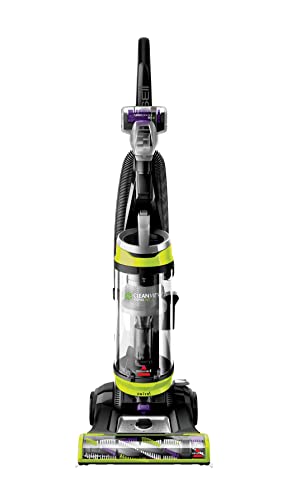
Bissell CleanView Swivel Pet Upright 2252 — Steering specialist
The 2252 adjusts along the axis other uprights neglect: direction. Its listing headlines swivel steering, and in a furnished room that is not a flourish — it is the difference between a vacuum that orbits the dining table in one flowing pass and one that performs a three-point turn at every chair leg. Pet homes, which are also usually furniture-dense homes, feel that difference in their shoulders by the end of a clean. The triple action brush roll named in the listing works the other axis, loosening and lifting the hair that pet territory embeds in carpet.
Capacity supports the steering: a large dirt tank means the clean is not interrupted at the moment the machine has found its rhythm, and Bissell’s pet focus shows in the way the whole package assumes fur as the default debris rather than an edge case. Height adjustment for pile is present in the CleanView manner — the machine expects to travel between the rug the dog owns and the boards it merely crosses — and the swivel head keeps its contact through those transitions better than a fixed neck, which tends to lift at the rug’s edge exactly where grit accumulates.
Where does it ask compromise? Swivel steering rewards a lighter guiding hand and can feel eager to owners who prefer a machine that tracks like a train; the pet specialisation means its tool story leans toward hair rather than, say, delicate fabrics; and like most uprights its hose suction at full strength deserves respect near loose mats. For the furnished, fur-bearing home, though, its central insight stands: the most-used adjustment is the one your wrist performs a hundred times a clean, and this machine makes that adjustment nearly free.
- Type: corded upright with swivel steering
- Brush: triple action brush roll per the listing
- Capacity: large dirt tank for uninterrupted pet cleans
- Focus: pet hair pickup across carpet and hard floors
- Adjustment star: steering that adapts to furnished rooms
Strengths
- Swivel steering removes the furniture wrestling from pet cleans.
- Brush and tank are sized for hair as the default debris.
- Head contact holds through rug-to-board transitions gracefully.
Trade-offs
- Eager steering takes a session to feel natural to new owners.
- Tool emphasis leans to pet work over delicate-fabric finesse.
- Full hose power needs care around lightweight loose rugs.
Best for: furnished pet homes with mixed rugs and boards. Not suited for: owners who prefer a fixed, train-like steering feel.
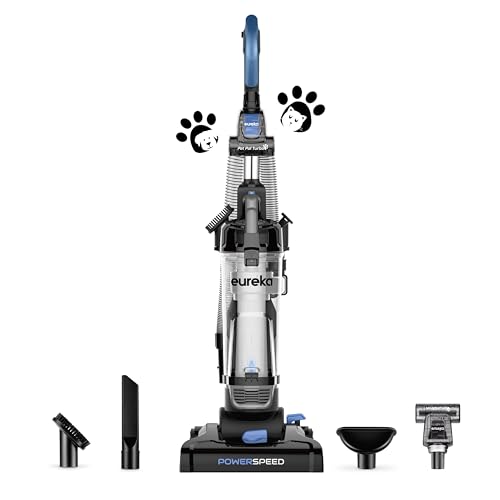
Eureka PowerSpeed Upright NEU181A — Lightweight all-rounder
The NEU181A’s adjustment story is written in weight. Eureka’s PowerSpeed line is built light, and a light upright changes what adjustment means in practice: the machine gets carried to the mess, tipped onto the rug, lifted over the threshold and guided around the furniture by owners who would negotiate with a heavier machine. Its listing pairs that lightness with a 2.6-litre dust cup — large for the class — plus a pet turbo brush and crevice and upholstery tools, which extends its adjustability upward: the wand and tools take the clean to the stairs, the sofa and the car’s edge of the driveway conversation.
On floors it covers pet hair, carpet and hard floor per its listing, and the PowerSpeed manner is to make the transitions frequent and painless rather than to offer the deepest settings menu here. That is a legitimate philosophy. Most homes do not own five depths of carpet; they own two surfaces and a staircase, and a machine that moves between them without ceremony will be adjusted by being moved — the oldest adjustment of all. The big cup supports the pattern, swallowing a whole home’s worth of daily debris before asking for the bin.
The compromises ride along with the lightness. A featherweight body can feel less planted on deep pile than the Hoover, the settings range is not the five-position showcase of its NEU182B sibling, and pet turbo tools depend on airflow that a loaded filter will tax — keep it rinsed. But as the pick for smaller homes, older owners, and anyone whose cleaning is a series of short sorties rather than a weekly campaign, the NEU181A argues that the most valuable adjustment is the one between the cupboard and the floor: how willingly the machine comes out at all.
- Type: lightweight bagless upright
- Dust cup: 2.6 litres per the listing
- Tools: pet turbo brush, crevice and upholstery tools
- Surfaces: pet hair, carpet and hard floor per the listing
- Adjustment star: weight that makes repositioning effortless
Strengths
- Light body turns room-to-room adjustment into a non-event.
- Generous cup suits whole-home sorties without mid-clean emptying.
- Pet turbo brush extends its reach to stairs and upholstery.
Trade-offs
- Less planted feel on deep pile than heavier rivals.
- Height range is outshone by its five-setting sibling below.
- Turbo tool performance depends on a clean, free-flowing filter.
Best for: smaller homes and owners who clean in short, frequent sorties. Not suited for: deep-pile palaces wanting maximum settings and heft.
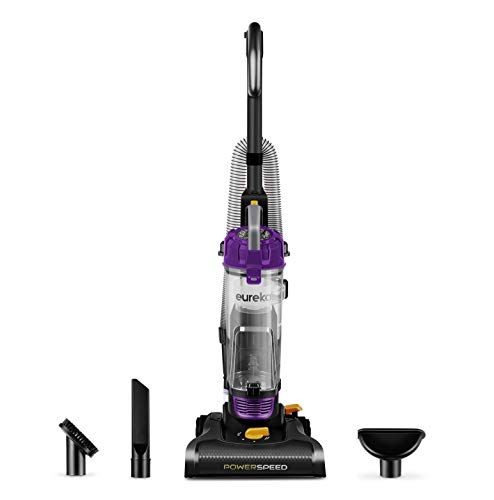
Eureka PowerSpeed Bagless Upright NEU182B — Five-height champion
Here is the guide’s headline act: an upright whose listing states, in plain terms, a five-height brush roll adjustment. Five positions span the journey from bare floor — brush low and close, sealing against boards — through the everyday carpets of bedrooms and halls, up to the deep pile that swallows lesser machines’ bristles and stalls their airflow. Each step is a different machine, effectively, tuned to a different depth of fibre, and the owner who learns the two settings their home actually uses has extracted ninety percent of this model’s genius.
The supporting numbers keep the promise credible: around ten pounds of weight, a 2.6-litre dust cup, and a brief covering pet hair, carpet and hard floor. Lightness matters to height adjustment more than shoppers expect, because a setting is only real if the machine’s head can hold it under the owner’s guiding pressure — a heavy head forces its own depth, while the NEU182B’s lighter head obeys the dial. The result is an upright that behaves on a shaggy rug like a different species from the one that just sealed itself to the kitchen tiles, which is precisely the transformation this entire category exists to perform.
Honesty requires the usual footnotes. Five settings invite the five-setting mistake — leaving it on the middle one — and the model’s value collapses to ordinary if the dial never turns; the purple finish will divide households; and like its sibling it asks for filter discipline to keep the airflow that height adjustment organises. But for the mixed-pile home — boards in the kitchen, low carpet in the hall, something luxurious and unreasonable in the bedroom — no linked pick states its core competence as clearly as this one does. It is the adjustable vacuum in the most literal sense on this page.
- Type: bagless upright, purple finish
- Height adjustment: 5 brush-roll settings per the listing
- Weight: around 10 pounds per the listing
- Dust cup: 2.6 litres
- Surfaces: pet hair, carpet and hard floor
Strengths
- Five explicit heights cover bare floor to deep pile honestly.
- Light head obeys the dial instead of forcing its own depth.
- Big cup and low weight keep whole-home cleans uninterrupted.
Trade-offs
- Value depends on the owner actually changing the setting.
- Light build feels less anchored than the Hoover on thick rugs.
- Filter neglect taxes the airflow the settings organise.
Best for: mixed-pile homes that will genuinely use a height dial. Not suited for: set-and-forget owners who never touch a machine’s settings.

Shark PowerPro Reveal Plus Cordless Vacuum — Cordless reach pick
The PowerPro Reveal Plus adjusts by transformation. As a cordless stick it owns the floors; released into its handheld form, it owns the shelves, stairs and car; and with the upholstery and crevice tools named in its listing attached, it owns the seams and fabrics between. Where the uprights above adjust a brush, this machine adjusts its entire shape — and for homes whose dirt lives at many altitudes, shape-shifting is the adjustment that subsumes the others. Its 40-minute listed runtime bounds the performance honestly: a cordless tour is a series of sorties, not a whole-house campaign.
The Reveal light adds a subtler adjustability — of aim. By raking a beam across the floor that exposes fine dust invisible in ordinary light, it lets the operator adjust effort in real time, slowing where the film is thick and gliding where the boards are already honest. On hardwood and carpet alike, that feedback loop quietly raises the standard of a clean without lengthening it, because passes stop being wasted on clean metres. Few features in this guide so directly convert information into adjustment.
Its limits are the cordless family’s: runtime instead of a cord, a bin sized for sorties, and no multi-height brush story to rival the NEU182B’s dial for the deep-pile specialist. It also shares the household with the uprights rather than replacing them in larger carpeted homes. But as the pick for flats, stairs, hard floors and the altitude problem — the cobweb, the shelf, the car seat — it is the most adjustable machine here in the dimension that uprights cannot enter at all.
- Type: cordless stick converting to handheld
- Runtime: 40 minutes per the listing
- Tools: upholstery and crevice tools included
- Signature: Reveal light that exposes fine dust for targeted passes
- Surfaces: hardwood floors and carpet per the listing
Strengths
- Shape-shifting covers altitudes no upright can reach unaided.
- Reveal light turns dust visibility into real-time effort adjustment.
- Light build keeps overhead and stair work comfortable.
Trade-offs
- Runtime bounds it to sorties rather than whole-house campaigns.
- No multi-height dial to match the Eureka’s pile specialism.
- Bin capacity suits frequent small cleans over deep rescues.
Best for: flats, stairs and hard-floor homes with dirt at many heights. Not suited for: large deep-carpet homes wanting one corded campaign machine.
Canister Vacuums with Suction Dials — Prose-only benchmark
The canister class earns its prose place by owning the adjustment the uprights approximate: a continuous suction dial, often joined by a bleed valve on the hose handle, that trims power smoothly from full carpet force down to a breath suitable for curtains. Discussed generically, this is adjustment as an instrument rather than a menu — the operator feathers the suction while cleaning a delicate rug’s fringe, a lampshade, a speaker grille, feeling the moment the nozzle begins to grab and backing off a degree. No stepped setting on any upright offers that analogue finesse.
The canister’s other adjustments support the dial’s artistry: the body trails behind on wheels while the wand works light in the hand, heads swap for floors, fabrics and crevices, and the long hose adjusts the working radius without moving the machine. The class’s costs are equally structural — a body to tow around chair legs, a cupboard footprint larger than a stick’s, and a cleaning posture some owners simply dislike. We include the class here as the benchmark and the alternative: if your home’s defining jobs are delicate — antique rugs, drapes, upholstery that matters — the dialled canister remains the connoisseur’s answer, and the uprights above are the generalists it quietly outclasses at that single, refined task.
- Type: canister body with hose, wand and swappable heads
- Signature adjustment: continuous suction dial plus handle bleed valve
- Home ground: curtains, delicate rugs, upholstery and fringes
- Reach: long hose radius with a light in-hand wand
- Tier: mid to premium depending on build and filtration
Strengths
- Continuous suction control no stepped upright can imitate.
- Light wand makes delicate and overhead work precise.
- Head swapping tailors the machine to each surface exactly.
Trade-offs
- Towing a body around furniture divides owners permanently.
- Storage footprint exceeds a stick or compact upright’s.
- Quick floor sorties carry more setup than grabbing a cordless.
Best for: delicate furnishings, drapes and owners who clean by feel. Not suited for: anyone who hates towing or wants grab-and-go cleaning.
How Do the Six Compare at a Glance?
| Pick | Height adjustment | Suction control | Reach and steering |
|---|---|---|---|
| Hoover WindTunnel 2 Whole House Rewind | Multi-height for whole-house tours | Full-power hose; use with care | Rewind cord extends radius |
| Bissell CleanView Swivel Pet Upright 2252 | Settings for rug-to-board travel | Pet-focused full power | Swivel steering leads the class |
| Eureka PowerSpeed Upright NEU181A | Everyday range, easily worked | Turbo tool airflow-dependent | Light body, wand and pet tools |
| Eureka PowerSpeed Bagless Upright NEU182B | Five named settings | Standard upright power | Light head obeys the dial |
| Shark PowerPro Reveal Plus Cordless Vacuum | Conversion instead of a dial | Mode-based, cordless | Handheld reach to shelves and cars |
| Canister Vacuums with Suction Dials | Head-dependent | Continuous dial — the benchmark | Long hose, light wand |
The table’s lesson is that no column crowns a single winner: the Eureka owns height, the canister owns suction finesse, the Bissell owns direction and the Shark owns altitude. Your floors vote on which column matters, and they vote with their pile depths, their furniture density and their altitude — which is why two neighbours with identical budgets can read this same table and correctly arrive at different machines, each certain the other chose strangely.
How Do You Set Brush Height Correctly for Each Pile?
Start high and lower gradually — the reverse of most owners’ instinct. With the machine running on the carpet in question, lower the setting one step at a time until the brush’s note changes and the head begins to pull itself forward gently; that is contact. One step lower and the head will labour, the airflow will choke and the motor’s note will strain, which is the sound of a setting that cleans worse while working harder. On bare floors, choose the lowest or dedicated bare-floor setting so the brush seals close without scattering grit ahead of the head.
Learn your home’s map of settings as you would learn its light switches: boards on one number, the hall carpet on another, the deep bedroom rug on a third. The NEU182B’s five positions exist to be memorised this way, two or three of them becoming your household’s whole vocabulary. Recheck the map when a new rug arrives or a carpet is replaced, because pile depth is a property of the floor, not of the house — and the thirty seconds spent re-tuning pays out on every pass that follows.
When Does Suction Control Matter More Than Raw Power?
Whenever the thing being cleaned can move, tear or seal. Lightweight rugs lift and wrinkle under full upright suction, ruining the pass and occasionally the rug’s backing; upholstery fabrics pull into the nozzle and stall the airflow they were meant to receive; curtains, lampshades and speaker cloth simply surrender and wrap the tool. In each case the cleaning improves as power is withdrawn — the paradox at the heart of this guide — because controlled suction keeps the surface still, the airflow moving and the debris travelling in the intended direction.
The uprights here manage that paradox with technique: a partially opened tool, a lighter guiding hand, a pass taken at an angle. The canister’s dial manages it by design, which is why delicate homes keep canisters in service for decades. Whichever machine you own, treat any moment the nozzle grabs and holds as information — the vacuum is asking to be adjusted, and the owner who listens cleans the fringe instead of eating it.
What Mistakes Do Owners Make with Adjustable Machines?
Leaving the height on the middle setting forever is the signature error, converting a five-position instrument into a fixed machine with extra parts. Its cousin is setting height by habit from the last room, so the deep rug gets the boards setting and the boards get a brush hovering like a helicopter. Both errors share a cure: adjust at the threshold, as a ritual of crossing between rooms, until the hand learns to reach for the control the way it reaches for a light switch.
Second, owners use full hose suction on everything the hose touches, then blame the machine for eaten fringes and dragged mats. Third, they ignore the filter, forgetting that every adjustment organises an airflow the filter must first permit. Fourth, they buy the longest settings list for a home with two surfaces, paying for a dial whose outer positions will never turn. Adjustability is a conversation between a machine and a floor; buying more vocabulary than your floors speak is not fluency.
How Do Reach and Hose Length Redefine Adjustment Upstairs?
Every upright in this guide is really two machines: the floor head, and the hose-and-wand system that detaches to work above the floor. That second machine has its own adjustability, and it is measured in metres and grams rather than settings. A hose that stretches generously lets the body stand at the stair’s foot while the tool climbs; a wand that extends turns ceiling corners and curtain rails from chair-standing adventures into floor-standing routines. When you compare the linked picks, weigh the reach story with the same seriousness as the height dial, because in most homes the above-floor jobs are where cleaning goes to be postponed.
Stairs are the examination. A heavy upright parked on a landing while its hose strains upward is an accident rehearsing; a light machine like the NEU181A carried to the half-landing, or a cordless handheld like the Shark’s simply climbing in your fist, changes the risk arithmetic entirely. Owners of tall houses should therefore read this guide’s picks as a staircase shortlist as much as a floor one — and the honest verdict is that reach and weight, the unglamorous specifications, decide stair safety more than any suction figure.
Reach also governs the dust you cannot see. The tops of wardrobes, the pelmets, the extractor fan’s greasy halo — these surfaces feed a room’s dust for months between cleans, and they are only ever cleaned by machines whose reach makes the job a two-minute extension of a floor session. An adjustable vacuum, fully understood, is one whose clean can expand upward without new equipment or furniture rearrangement. Judge the wand as you judge the dial: by whether you will actually use it on an ordinary Tuesday.
Which Adjustments Matter Most to Which Household Members?
For older owners and anyone whose joints negotiate, weight and steering outrank every dial. A swivel head like the Bissell’s converts pushing into guiding; a ten-pound body like the Eurekas’ converts carrying into a non-decision. Height settings still matter — a wrongly set head is heavy to push, which is a settings problem disguised as a strength problem — but the kindest adjustment in an older owner’s home is the machine’s willingness to be used at all, and lightness is that willingness made physical.
For tall owners, the neglected specification is handle and wand length: a machine that forces a stoop taxes the back across every room, and an extending wand quietly refunds the tax. For households with small children, adjustment means speed and containment — a machine that adapts from rug to boards in one motion, at the hour when the mess is fresh, without a settings ceremony. For pet owners, as the Bissell and both Eurekas assume, adjustment means the brush and tools agree that hair is the main event.
The lesson generalises: an adjustment is only a feature if it matches a body and a habit in your house. Read the picks above as a fitting exercise — whose wrist, whose back, whose staircase, whose dog — and the right machine usually identifies itself before the comparison table is even consulted.
How Should You Maintain the Adjustment Mechanisms Themselves?
Height mechanisms fail by grit. The pedal, dial and the head’s pivoting neck all live at floor level, in the dust stream, and a season of neglect can stiffen a dial until owners stop turning it — at which point the adjustable vacuum has quietly become a fixed one. A monthly wipe of the head’s underside and pivots, with the machine unplugged, plus a check that the setting indicator still matches the head’s actual height, keeps the instrument honest. If the dial turns but the head does not move, the linkage, not the dial, wants attention.
Swivel joints ask for hair patrol: the neck that steers also collects wound fibres, and a swivel that drags is usually a swivel that is dressed. Hoses and wands ask for the opposite care — stored without sharp kinks, checked at the cuffs where flexing fatigues the material, and cleared of the sock or leaf that turns reach into wheeze. The canister’s dial, being electrical or a mechanical valve depending on design, asks only to be exercised occasionally through its range so its travel stays smooth.
None of this exceeds minutes, and all of it defends the premise of the purchase. An adjustable machine is a small system of moving agreements between its parts; maintenance is how the owner keeps those agreements in force. The filter still matters most — no adjustment organises an airflow that never arrives — but a close second is the dial that still turns in year three, inviting its owner to keep having the conversation with the floors that this guide has been describing.
How Do the Tiers Divide Among Adjustable Uprights?
At the budget tier, adjustment is honest but narrow: a few height positions, a basic hose, a head that asks the owner to supply the finesse. The Eureka pair demonstrate how far that tier now reaches — five named settings and a 2.6-litre cup would have been mid-market boasts not long ago — and for two-surface homes the budget tier’s narrowness may never be felt. What it cannot offer is the canister’s suction finesse or the Hoover’s whole-house filtration story; those who need either should climb deliberately rather than hopefully.
The middle tier buys breadth: steering systems, pet-specialised brushes, larger tanks, better filtration and cords that manage themselves. The Bissell and the Hoover live here, and their premium over the Eurekas is paid for in the currency of furnished, pet-bearing, multi-room reality. The premium tier, represented in this guide by the canister class and the cordless Shark’s transformation act, buys a different kind of adjustment altogether — continuous dials, shape-shifting formats — for homes whose cleaning problems are genuinely unusual: delicate treasures, many altitudes, no patience for cords.
As always in this series, we print no figures, because the tiers hold while prices wander; check price on Amazon for the configuration you choose, and remember that within a tier, the deciding factor is rarely the badge. It is the fit between a machine’s particular adjustments and a home’s particular floors — a fit this guide has tried to make legible enough that you can judge it from your own hallway, tape measure and rug collection in hand.
How Do Automatic and Manual Adjustments Compare in Daily Life?
Automatic adjustment — the floating head that rides pile height on its own springs and seals — sells a seductive promise: never think about settings again. In daily life it largely keeps that promise across the broad middle of flooring, gliding from boards to ordinary carpet with a competence that manual owners achieve only when they remember to turn the dial. For households that know themselves to be forgetful, automatic design is not a compromise; it is the honest engineering of a human truth, and it will out-clean a neglected five-setting dial across any given month.
Manual adjustment wins at the territory’s edges. Deep shag swallows a floating head’s travel; bare boards reward a brush dropped lower than a float dares; a delicate rug wants suction judgement no spring can supply. The manual owner who actually adjusts owns the wider range — but the conditional is the product. This is why our recommendations split by temperament rather than declaring a technology winner: the NEU182B for the hands-on, the swivel Bissell’s easy manners for the hands-busy, and sympathy for both.
There is a hybrid wisdom worth stating: whichever you buy, spend the first fortnight deliberately. Manual owners should practise the threshold ritual until it is reflex; automatic owners should learn the two places their machine’s float gives up — usually the deepest rug and the last centimetre at the skirting — and plan a tool pass for those spots. Adjustment, automatic or manual, is finally a relationship between an owner and a floor, and like all relationships it rewards a thoughtful first fortnight disproportionately.
What Should You Test in the First Week with a New Machine?
Test the transitions, because they are the product. Run the same route you will run all year — boards, hall carpet, the good rug, the bathroom’s hard floor — and change settings at every threshold, timing nothing, judging only feel: where does the head labour, where does it skim, where does the swivel save you a step, where does the hose reach without moving the body? A machine that passes its first week on your actual route will pass the year; one that annoys you on the route will annoy you with compound interest.
Test the delicate jobs while the return window is open. Take the hose to the lightest rug and the upholstery you care about, and learn whether the machine’s suction manners suit your treasures or whether the canister’s dial is calling you after all. Test the stairs with the machine you bought rather than the one you imagined: carry it, park it, work the wand, and be honest about the half-landing. Test the emptying and the filter rinse, because those two chores, repeated weekly, are the ownership you are actually purchasing.
Finally, test the household, not just the vacuum. Show the second operator where the height control lives and what your floors’ settings are; write the two or three numbers on a card in the cleaning cupboard if your home is a multi-operator one. An adjustable machine whose settings live in one person’s memory is a fixed machine whenever that person is away — and the card, humble as it is, may be the most effective adjustment accessory in this entire guide.
What Is Pile Depth, and Why Does Half an Inch Decide Everything?
Pile is the carpet’s working surface — the fibres standing above the backing — and its depth is measured in fractions of an inch that behave like feet. In low pile, grit rests near the backing in a thin layer that a brush set low can sweep into the airflow completely. In deep pile, the same grit migrates downward through a forest of fibres, and the brush must descend into that forest, parting and beating, while the head maintains enough seal for the airflow to carry what the bristles free. A setting that is perfect for the forest hovers uselessly over the low pile’s grit; a setting tuned to low pile bogs and strangles in the forest. That is the whole physics of the height dial, and it is unforgiving of the one-setting habit.
Rugs complicate the map because they are islands of one depth in a sea of another, often with a fringe that wants canister manners and a backing that full suction can wrinkle. The adjustable upright’s craft is to cross these islands as a traveller changes pace — dial down at the edge, work the island, dial back at the far shore. Owners who learn that rhythm stop experiencing rugs as obstacles and start experiencing them as the rooms within rooms they were bought to be.
How Did the Height Dial Earn Its Place on the Upright?
Early uprights assumed a uniform carpeted world and offered a fixed head, because the homes they were sold into largely had one. As flooring diversified — wall-to-wall giving way to boards with rugs, then to the modern mosaic of tile, laminate, low carpet and statement shag — the fixed head’s failures multiplied, and manufacturers answered first with crude pedal steps, then with the multi-position dials and floating heads we now take for granted. The five-setting Eureka in this guide is a descendant of that long negotiation between machines and floors.
The negotiation continues in the cordless era, where the Shark’s answer is to sidestep the dial entirely — conversion, modes and reach substituting for brush height across the surfaces a stick typically serves. Neither answer has won, because the floors have not settled either. What the history teaches the buyer is simple: adjustment features appear where floors demand them, so read any machine’s adjustment story as a map of the homes its maker imagined — and check that yours is on the map before you buy the machine.
How Should Your Adjustments Change with the Seasons?
Winter brings grit with intent: salt, sand and mud tracked from paths, ground into the hallway rug by boots that mean business. The hallway setting earns a notch more aggression in January — brush a step lower on that rug, passes a touch slower — while the doormat itself graduates to a shake outside and a tool pass, because no height setting yet invented cleans a mat better than gravity and fresh air. Winter also loads filters faster, and every adjustment in this guide presumes an airflow that a clogged filter quietly cancels, so the rinse calendar tightens with the weather.
Summer reverses the debris: lighter, drier, more hair and fibre than grit, with doors open and the garden migrating inward on feet and paws. Bare-floor settings get their longest season of use, and the hose-and-wand work expands to window tracks, fan blades and the tops of the doors themselves. Autumn, the shedding season for trees and many pets alike, asks the pet tools to justify their existence and reminds swivel owners why they paid for steering: the furniture is where the tumbleweeds gather, and the machine that turns sweetly collects them before they colonise the skirting.
The point of the calendar is that adjustment is not a one-time setup but a continuing fit between a machine and a home that changes its floors’ behaviour four times a year. Owners who re-tune quarterly — settings, filters, brush checks — own a machine that always feels current. Owners who set and forget own, by December, a vacuum adjusted for a house that no longer exists.
Final Recommendation
For the classic mixed-pile home, the Eureka NEU182B is the purest answer to this guide’s question: five honest height settings in a light, big-cupped body that will actually be adjusted. Homes touring many rooms at once should take the Hoover’s whole-house stamina, furnished pet homes the Bissell’s steering, and smaller or altitude-troubled homes the Eureka NEU181A’s lightness or the Shark’s transforming reach. And if your treasures are delicate, let the canister’s dial have the final word — because the best adjustable vacuum is the one whose adjustments match the floors, fabrics and habits waiting for it at home.
Frequently Asked Questions
How do I know if my brush height is set too low?
The machine tells you: the head labours, the motor’s note strains, the vacuum resists being pushed and the carpet shows drag lines while picking up less, not more. Raise one setting and the head should pull gently and glide — correct height feels like the machine helping, incorrect height feels like an argument.
Do automatic height adjustments work as well as manual settings?
Floating heads that ride the pile automatically are genuinely convenient and work well on everyday carpets, but a manual range still wins at the extremes — the deepest pile and the barest boards — where a floating head compromises. Owners of ordinary mixed floors can trust automatic designs; owners of extremes should keep the dial.
Can suction be too strong for a vacuum’s own good?
It can be too strong for the surface’s good, which amounts to the same thing in practice: sealed nozzles stall airflow, strain motors and can damage delicate materials. That is why control, not maximum power, is the professional’s specification — and why this guide treats a dial as a cleaning feature rather than a luxury.
Is swivel steering just a comfort feature?
No — it changes cleaning outcomes in furnished rooms. A head that turns tightly keeps brush contact through corners and around legs where grit collects, while a fixed head forces lifting and re-aiming that skips exactly those zones. Comfort is the visible benefit; coverage is the real one.
How often should height settings be revisited?
At every change of surface during a clean, briefly, and as a deliberate review whenever flooring changes — a new rug, a replaced carpet, a room converted from carpet to boards. Settings are a map of your floors, and the map should be redrawn when the territory changes.
Does a heavier vacuum adjust better than a light one?
Not inherently. Weight helps a head stay planted on springy deep pile, but it also lets the head impose its own depth against the dial’s intention, and it taxes the owner through every carry and threshold. The light machines in this guide hold their settings because their heads are designed to obey them; judge the pairing of weight and mechanism, not weight alone, and remember that the best-adjusted vacuum is worthless in the cupboard it was too heavy to leave.
Related Guides
Budget-minded shoppers should continue straight to Best Affordable Bagless Upright Vacuums, where several of these machines reappear under a price-tier lens. Renovators can browse Best 2-Person Corner Soaker Bathtubs with Heat and Best Acrylic Bathtubs for Alcove Installs, while our published guide to Best Affordable Air Purifiers for a Single Room covers adjustable comfort of a different, airborne kind.


