What's inside
- Key Takeaways
- Quick Picks
- How We Chose These Picks
- The Best Briquettes for Smokers, Reviewed in Detail
- How Do the Six Fuels Compare Side by Side?
- Briquettes or Lump Charcoal — What Is the Real Difference in a Smoker?
- How Do Binders and Additives Change the Smoke You Taste?
- How Do You Build a Briquette Fire That Burns for Eight Hours?
- How Does Ash Quietly Ruin Long Cooks, and How Do You Prevent It?
- How Should You Store Charcoal So It Burns Like the Day You Bought It?
- How Do You Light Briquettes Cleanly, Without Lighter Fluid?
- How Do Weather and Season Change the Fuel You Should Load?
- Which Fuel Suits Which Smoker Design?
- What Does a Season of Smoking Cost in Fuel?
- What Are the Most Common Mistakes When Buying Briquettes for a Smoker?
- Final Recommendation
- Frequently Asked Questions
- Related Guides
As an Amazon Associate I earn from qualifying purchases. This post may contain affiliate links at no extra cost to you.
cottageverdict.com is reader-supported. When you buy through links on our site, we may earn an affiliate commission.
Where to buy: all six fuels below are sold on Amazon, and the names in the Quick Picks table and the detailed reviews link to their listings so you can check price on Amazon before you stock the shed. This guide to the best briquettes for smokers is about the least photographed and most consequential purchase in barbecue: the fuel bed itself. A smoker is only a chamber and a hope; the briquettes decide how steadily it heats, how long it holds the low-and-slow band without refuelling, how much ash chokes its airflow by hour six, and — through the binders and additives pressed into each pillow of charcoal — how clean the smoke tastes on the meat. Get the fuel right and an ordinary smoker cooks like a calm professional. Get it wrong and the best steel in the world spends the day swinging, stalling and seasoning dinner with its own ash.
The best briquettes for smokers earn the title on three measures this guide returns to constantly: burn consistency, ash behaviour and ingredient honesty. Around those measures the six picks arrange themselves into a small, instructive spectrum — the classic American briquette in two bag sizes, a store-brand briquette with a shorter ingredient list, a binchotan-style briquette built for extreme heat and low ash, a bag of true lump charcoal included deliberately as the contrast every briquette buyer should understand, and a box of ceramic briquettes that is not a fuel at all, included because confusing it with one is the commonest buying error in this aisle. Read the spectrum whole and you will never shop this shelf by habit again.
Key Takeaways
- Briquettes are manufactured for consistency: uniform size and density mean a predictable burn rate that long smokes depend on.
- Ash is the hidden cost of cheap fuel — high-ash briquettes insulate the coals and strangle airflow in the small hours of a cook.
- Binders and mineral additives are what separate brands: they shape ignition, burn steadiness and how clean the smoke smells.
- Lump charcoal burns hotter and cleaner with less ash, but its irregular pieces make long, even smoker burns harder to repeat.
- Binchotan-style briquettes are the marathon fuel: very long, very hot, very low ash — and priced like it.
- Ceramic briquettes are reusable heat media for gas grills, not a smoker fuel; do not put them in a charcoal firebox expecting dinner.
Quick Picks
| Pick | Badge | Why it earns its place |
|---|---|---|
| Kingsford Original Charcoal Briquettes 16 lb | Best All-Round Smoker Fuel | The benchmark briquette: predictable burn, wide availability and a size that suits regular smokers |
| Kingsford Original Charcoal Briquettes 8 lb | Best for Occasional Smokers | The same benchmark fuel in a half-size bag that stays fresher in infrequent hands |
| Mr. Bar-B-Q Hardwood Lump Charcoal 8 lb | Best Lump Contrast Pick | All-natural hardwood lump that burns hotter with low ash — the comparison every smoker should run once |
| 365 by Whole Foods Market Charcoal Briquettes | Best Store-Brand Briquette | A straightforward hardwood briquette in a generous bag for cooks who read ingredient lists |
| Dong LIM Binchotan Style Charcoal Briquettes 5 lbs | Best for Heat and Low Ash | Binchotan-style density: high heat, long burn and minimal ash for precision grilling and smoking |
| Mr. Bar-B-Q Ceramic Briquettes for Gas Grills 60-Pack | Best Reusable Heat Media — Not a Fuel | Sixty self-cleaning ceramic briquettes that spread gas-grill heat; included to end a common confusion |
How We Chose These Picks
Fuel cannot be judged from a bag’s front, so this guide graded candidates on the three behaviours a smoker’s owner actually lives with. Burn consistency came first: in a smoker, fuel is a metronome, and briquettes that ignite evenly, settle into a steady glow and surrender their heat over hours — rather than flaring early and fading — are what let a cook hold 225 to 250 degrees Fahrenheit through a shoulder’s long afternoon. Ash came second, because ash is not inert: it coats the coals, insulates them from the air they need, and accumulates in the firebox until airflow itself is rationed, which is why two fuels with identical heat can produce utterly different cooks at hour seven.
Ingredient honesty was the third measure, and the most argued-over in barbecue. A briquette is charcoal dust and fragments bound into a uniform pillow, and what does the binding — starch in the cleaner recipes, various mineral additions in others — plus what the maker adds for ignition or ash colour, all burns in your firebox and perfumes your food. We favoured fuels whose smoke runs clean once the fire is established, and we have described each pick’s character plainly, including where the market’s favourite carries a longer additive story than its rivals. The lump and the ceramic entries were chosen as instruments of comparison: you cannot understand what a briquette is until you have burned what it is not.
Practicalities closed the selection. Bag size matters because charcoal is hygroscopic — it drinks humidity from a damp shed and lights reluctantly ever after — so the right bag is the one a household finishes while it is still lively. Availability matters because a fuel you cannot rebuy locally mid-season is a hobby with a supply problem. And every pick here is sold in the open, ordinary way, because a smoker’s fuel should be the least exotic purchase in the entire barbecue economy.
The Best Briquettes for Smokers, Reviewed in Detail

Kingsford Original Charcoal Briquettes 16 lb — Best All-Round Smoker Fuel
Kingsford Original is the fuel the American backyard runs on, and in a smoker its virtues are the unglamorous ones that long cooks are made of. Each briquette is a uniform pillow of charcoal with grooved edges designed to light readily and burn at a rate its makers have kept consistent for generations, which means a snake or minion-method fire built from them behaves like a timed instrument: light one end, and the burn travels at a pace an experienced cook can set a shoulder by. The sixteen-pound bag is the working size for anyone who smokes monthly or more — enough for several long cooks, small enough to finish before the shed’s humidity gets its vote.
The honest discussion about Kingsford concerns what else is in the pillow. The recipe has historically included mineral components and borax among its binders and processing aids, alongside the wood char and starch, and while the fire burns clean once established — the working rule is to let any briquette fire settle until its smoke runs pale before food goes on — cooks who want the shortest possible ingredient story should read this guide’s store-brand and lump entries with attention. Ash production sits in the middle of the field: noticeable across a twelve-hour cook, manageable with a mid-cook ash knock in an offset, and rarely the deciding factor its critics claim at family scale.
What cannot be argued is the ecosystem. Kingsford is sold everywhere charcoal is sold, behaves identically from bag to bag and coast to coast, and anchors every fuel technique in the literature, from chimney counts to snake layouts. For a smoker building reliable habits, that predictability is itself a flavour: the fuel disappears as a variable, and the cook’s attention is freed for the meat. Benchmarks become benchmarks by being boring in exactly this way.
- Format: classic pillow briquettes, 16 lb bag
- Burn character: even, steady and highly repeatable
- Ash: moderate; plan a mid-cook clearance on long smokes
- Ingredients: wood char with binders and mineral processing aids
- Best role: the default fuel for regular smoker households
Strengths
- The most predictable burn in the category
- Available everywhere, identical bag after bag
- Every published fuel technique assumes it
Trade-offs
- Longer additive list than purist rivals
- Ash accumulates noticeably on very long cooks
- Needs a full settle before food meets its smoke
Best for: regular smokers who value a repeatable, metronome burn above all.
Not suited for: cooks committed to the shortest ingredient list possible.
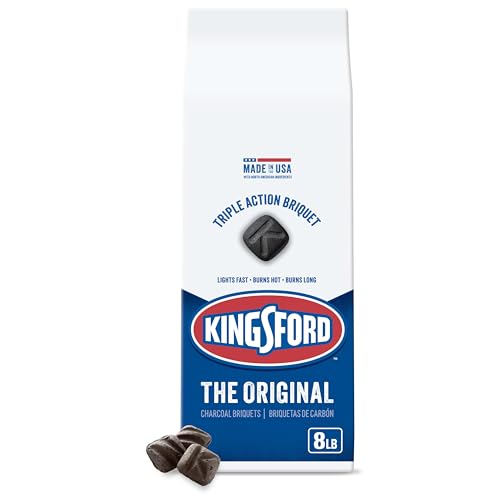
Kingsford Original Charcoal Briquettes 8 lb — Best for Occasional Smokers
This is the same benchmark briquette in half the bag, and the review is therefore about freshness rather than formula — a variable occasional smokers chronically underestimate. Charcoal is a sponge wearing a fuel’s clothing: left for months in a opened bag in a humid garage, it absorbs moisture until it lights sullenly, burns cooler and smokes dirtier, and the owner blames their technique for the fuel’s quiet decline. An eight-pound bag in the hands of a household that smokes six or eight times a year is finished while it is still itself, which makes this the rational size for the majority of gardens, whatever the per-pound arithmetic whispers.
In the firebox it behaves exactly as its larger sibling does — the same grooved pillows, the same steady travel of a snake burn, the same mid-field ash — so every technique and timing in the smoker’s literature transfers without translation. Two or three long cooks live in this bag, or a season of shorter smokes, and its modest size stores in a lidded bin or a dry cupboard corner where a sixteen-pound sack would slump in the shed. There is a discipline attached: buy the small bag fresh each season rather than stockpiling last year’s bargain, because charcoal’s shelf life is a climate, not a date.
Households graduating to monthly smoking should graduate to the larger bag without nostalgia; the fuel is identical and the economics turn. But the occasional smoker who buys big to save pennies and then fights damp briquettes all summer has purchased the most expensive fuel in this guide, measured in ruined afternoons. Size the bag to the season you will actually live.
- Format: classic pillow briquettes, 8 lb bag
- Burn character: identical to the 16 lb benchmark
- Ash: moderate, proportionate to the burn
- Storage: small enough for a dry indoor bin
- Best role: a season’s fuel for infrequent smokers
Strengths
- Stays fresh in an occasional smoker’s hands
- Benchmark behaviour in a storable size
- Encourages buying fresh fuel each season
Trade-offs
- Higher cost per pound than the big bag
- Only a few long cooks per purchase
- Same additive profile as the benchmark
Best for: households smoking a handful of times each year.
Not suited for: weekly smokers, who should buy the sixteen-pound bag.

Mr. Bar-B-Q Hardwood Lump Charcoal 8 lb — Best Lump Contrast Pick
This bag is in a briquettes guide on purpose, as the control experiment. Lump charcoal is what briquettes were invented to improve upon and what purists never left: actual pieces of hardwood, carbonised whole, with nothing added and nothing bound — the ingredient list is the tree. Mr. Bar-B-Q’s eight-pound bag of all-natural hardwood lump burns the way its composition promises: hotter than briquettes when asked, with very low ash because there is nothing in it to leave ash behind, and a clean, wood-forward smoke that many cooks judge the finest flavour in solid fuel. Its maker claims it burns hotter and longer, and the hotter half of that claim is easy to verify at any grill.
In a smoker, the lump bargain reveals its price. The pieces are irregular — fist-sized chunks beside shards — so a fuel bed built from them has irregular airflow, and its burn travels unevenly compared with the briquette’s engineered march. Long, unattended low-and-slow cooks are therefore harder to repeat: the fire may surge where a void collapses, then sulk where fines settle. Skilled lump smokers manage this by sorting pieces, packing the bed deliberately and knowing their pit; everyone else discovers why the uniform pillow conquered the market. Bag quality varies more, too — the bottom of any lump bag is a democracy of dust and chips that burn in minutes.
Every smoker should burn a bag of lump at least once, ideally on a forgiving cook, because the comparison teaches what briquettes trade away — peak heat, minimal ash, ingredient purity — to buy their consistency. Many cooks emerge as hybrids: lump for grilling and hot smokes, briquettes for the overnight campaign. That is not indecision; it is fluency, and this bag is the cheapest tuition in it.
- Format: natural hardwood chunks, 8 lb bag
- Burn character: hotter and less even than briquettes
- Ash: very low, the cleanest firebox in this guide
- Ingredients: hardwood only, nothing bound or added
- Best role: grilling, hot smokes and the great comparison
Strengths
- Purest ingredient story in solid fuel
- Highest heat and lowest ash of the six
- Clean, distinctly woody smoke flavour
Trade-offs
- Uneven pieces make long burns less repeatable
- Bag bottoms carry dust and small fragments
- Burns through faster at grilling heat
Best for: purists and grillers who want to taste the lump difference.
Not suited for: overnight smokes that must run unattended.

365 by Whole Foods Market Charcoal Briquettes — Best Store-Brand Briquette
Store-brand charcoal used to be a gamble; this 365 bag — 192 ounces, a full twelve pounds — represents the modern store brand’s better self, a hardwood briquette made for a retailer whose customers read ingredient panels as a hobby. The appeal for the smoker is straightforwardness: a uniform pillow briquette, built for a steady grill-and-smoke burn, without the flagship brands’ marketing apparatus or their most debated mineral additions dominating the conversation. In the firebox it behaves like what it is — a competent, even briquette that lights in a chimney, settles to a pale smoke and holds a working temperature band across a family cook.
Its burn consistency sits a half-step behind the benchmark’s metronome: bag-to-bag and pillow-to-pillow uniformity is good rather than legendary, which a cook experiences as slightly wider temperature wanderings on a very long smoke and nothing at all on a ribs-length afternoon. Ash is moderate, in the same family as the other bound fuels here, and the smoke, once the fire is established, is clean and neutral — a background singer rather than a soloist, which many cooks prefer under a rub they worked hard on. The generous bag size suits a household that smokes regularly through a season and stores fuel dry.
Choose this bag if your buying philosophy already runs through its retailer, if a shorter ingredient story matters to you, or if you simply want a competent briquette without the flagship’s price of admission. Keep the same discipline as with any fuel: buy it dry, store it drier, and let the fire settle before the meat goes on. Store brands live or die on whether the second bag matches the first; this one has built its following by matching.
- Format: hardwood pillow briquettes, 192 oz bag
- Burn character: even and dependable for family cooks
- Ash: moderate, typical of bound fuels
- Profile: neutral smoke that lets rubs lead
- Best role: regular smoking with a store-brand conscience
Strengths
- Generous bag from an ingredient-conscious retailer
- Clean, neutral smoke once the fire settles
- Solid consistency for everyday smoking
Trade-offs
- A half-step behind the benchmark’s uniformity
- Availability follows one retailer’s channels
- Less technique literature assumes this fuel
Best for: regular smokers who shop the 365 aisle and read labels.
Not suited for: cooks wanting the most documented burn in barbecue.

Dong LIM Binchotan Style Charcoal Briquettes 5 lbs — Best for Heat and Low Ash
Binchotan is charcoal taken to its extreme — hardwood carbonised at fierce temperatures until it is nearly pure carbon, ringing faintly like ceramic when pieces strike, burning with almost no flame, smoke or smell — and true Japanese binchotan is priced accordingly. This Dong LIM bag offers the binchotan style in briquette form: densely compressed, engineered for the family’s defining traits of high heat, long burning and low ash, in a five-pound box aimed at Japanese and Korean barbecue, kettles and kamado grills. In a smoker’s world, it is the specialist instrument: not the everyday metronome, but the fuel for cooks who need heat that outlasts the recipe.
The behaviours that matter here are duration and cleanliness. A dense binchotan-style briquette burns down slowly and evenly, holding its structure instead of crumbling, and leaves a fraction of the ash a standard pillow leaves — which, in a kamado or a tight kettle where ash strangles airflow, translates directly into hours of stable temperature. Its near-smokeless character cuts both ways for a smoker: it will not perfume meat the way a wood fire does, so its best smoking role is as the heat engine beneath wood chunks added deliberately for flavour, a division of labour that precision cooks swear by. It is also famously reluctant to light — budget a longer chimney session and do not mistake its patience for failure.
Price per pound is the highest in this guide by a wide margin, and the five-pound box is sized for grilling sessions and targeted smokes rather than a season of shoulders. Buy it as you would a fine tool: for the cooks where its virtues are the point — a long kamado session, a yakitori evening, a burn that must not fade — and let the benchmark briquettes carry the ordinary weekends. Specialists are not indulgences when they are this distinct; they are simply not defaults.
- Format: dense binchotan-style briquettes, 5 lbs
- Burn character: very long, very steady, high heat
- Ash: minimal, the lowest of any briquette here
- Smoke: nearly neutral; pair with wood for flavour
- Best role: kamado, kettle and precision heat work
Strengths
- Exceptional burn duration for its weight
- Minimal ash keeps airflow open for hours
- Clean heat that never overpowers food
Trade-offs
- Premium price and a small box
- Slow and stubborn to ignite
- Adds little smoke flavour of its own
Best for: kamado and kettle cooks who prize duration and clean heat.
Not suited for: bulk smoking on a budget or smoke-first cooking.

Mr. Bar-B-Q Ceramic Briquettes for Gas Grills 60-Pack — Best Reusable Heat Media — Not a Fuel
This final pick requires the guide’s plainest sentence: these are not charcoal, they do not burn, and they will not smoke anything. Mr. Bar-B-Q’s ceramic briquettes are reusable heat media for gas grills — sixty uniform ceramic pieces that sit in a tray above the burners, absorb the flame’s output and re-radiate it as even heat, vaporising drippings and calming flare-ups in the process. They appear in this guide because the word briquette on their box sends a steady stream of shoppers into this aisle by mistake, and because a smoker’s household often owns a gas grill too, for which these are genuinely the right purchase.
Judged in their own category, they are excellent: the uniform shapes tile a tray without the gaps and boulders of lava rock, the ceramic tolerates being flipped and burned clean when grease accumulates, and a single purchase lasts for years of grilling rather than a single cook. The self-cleaning design means the maintenance is a hot burn with the lid down, not a replacement schedule. If your gas grill cooks in hot stripes and flares at every burger, this box is a legitimate upgrade and this guide recommends it warmly — for that grill, on that patio, doing that job.
But in a charcoal smoker’s firebox they are inert stones, and in an electric smoker they are a misunderstanding with a receipt. Fuel is the thing that burns; media is the thing that glows. Keep the two words separate and both products make sense. The smoker fuels above will feed your fire; this box will civilise your gas grill; and the cook who knows which shelf each belongs on has understood the deepest lesson this aisle teaches — that in barbecue, the material under the food is never a detail.
- Format: 60 reusable ceramic briquettes
- Function: heat diffusion over gas burners, not combustion
- Maintenance: flip and burn clean in place
- Compatibility: gas grills designed for a briquette tray
- Best role: evening heat and taming flare-ups on gas
Strengths
- Years of service from a single purchase
- The most even gas-grill heat of any media
- Self-cleaning by a simple hot burn
Trade-offs
- Not a fuel: produces no heat or smoke itself
- Useless inside a charcoal or electric smoker
- Can crack after years of thermal cycling
Best for: gas grill owners wanting even heat and fewer flare-ups.
Not suited for: anyone shopping for smoker fuel — see the five picks above.
How Do the Six Fuels Compare Side by Side?
| Pick | Form | Burn style | Ash level |
|---|---|---|---|
| Kingsford 16 lb | Briquette | Steady metronome | Moderate |
| Kingsford 8 lb | Briquette | Steady metronome | Moderate |
| Mr. Bar-B-Q Lump | Lump charcoal | Hot, less even | Very low |
| 365 Briquettes | Briquette | Even, neutral | Moderate |
| Dong LIM Binchotan Style | Dense briquette | Very long, high heat | Minimal |
| Mr. Bar-B-Q Ceramic | Ceramic media | Does not burn | None — reusable |
The table’s last two columns are where smoker fuel is truly bought. Burn style decides whether your fire behaves like a metronome or a bonfire; ash decides whether hour seven resembles hour one. Notice the trade the whole category is built on: the more engineered the fuel, the steadier and ashier it tends to be; the more natural the fuel, the cleaner its firebox and the wilder its temperament. The binchotan style is the exception that proves engineering can buy both steadiness and low ash — at a price that explains why it remains the exception.
Briquettes or Lump Charcoal — What Is the Real Difference in a Smoker?
Start with manufacture. A briquette is an engineered object: charcoal fines and fragments, sometimes with coal-derived char in industrial recipes, bound with starch or other agents and pressed into a uniform pillow with a consistent density. Lump is an unprocessed one: pieces of hardwood converted to charcoal whole, retaining the wood’s shape, grain and irregularity. Everything else in this comparison flows from that single difference, the way a river flows from its source. Uniformity is the briquette’s entire argument — every piece lights alike, burns alike and ashes alike, so a fire built from them is a system a cook can model, repeat and teach.
In a smoker, that repeatability is worth more than at a grill, because the cook lasts not twenty minutes but ten hours, and its enemy is drift. A briquette snake burns from end to end at a pace the cook chose when laying it; a lump bed burns at the pace its voids and chunks decide. Lump answers with purity and peaks: higher maximum heat for searing, a cleaner and more distinctly woody smoke, and an ash output so low the firebox seems to tidy itself. Its costs are inconsistency between bags, fines at the bottom, and a burn that asks the cook to stay in the conversation. The mature position, held by most experienced smokers, is bilingual: briquettes when the cook is long and the cook is busy, lump when the cook is hot, short or deliberately flavour-led. The fuels are not rivals for a throne; they are tools whose handles are labelled by the job.
How Do Binders and Additives Change the Smoke You Taste?
Everything in the firebox burns, and everything that burns is tasted — that is the whole science of this section. A briquette’s starch binder burns away early and nearly neutrally, which is why the cleaner recipes lean on it. Mineral additions behave differently across the fire’s life: limestone, sometimes added to turn ash a reassuring white, is inert in the eating sense but adds to ash volume; borax, used in mould release during manufacture, is present in trace amounts that alarm ingredient readers more than toxicologists. Lighter-fluid shortcuts and instant-light treatments are the one category a smoker should refuse outright, because petroleum notes in the first hour of smoke will find the meat and stay for dinner.
The cook’s control over all of this is timing. Whatever a briquette contains, its most volatile compounds leave during ignition and the early, billowing phase — which is why the universal rule of this craft is to let the fire establish, ash over and settle to a pale, thin smoke before any food enters the chamber. A cook who obeys that rule can use the benchmark fuels of this guide with a clear palate; a cook who loads meat over a fresh, smoking chimney has seasoned it with the fire’s worst five minutes, whatever bag the fuel came from. Additives matter, and this guide has weighed them in every review — but the match and the wait matter more, and both are free.
How Do You Build a Briquette Fire That Burns for Eight Hours?
Two architectures dominate, and both exploit the briquette’s uniformity. The snake lays briquettes in a long, two-wide, two-deep trail around the firebox or kettle’s perimeter, with wood chunks spaced along its length; light one end and the burn creeps along the trail for hours, igniting each chunk as it arrives, delivering smoke in chapters rather than all at once. The minion method fills the firebox with unlit briquettes and buries a small number of lit ones in the centre; the fire spreads slowly outward and downward, governed by the dampers, and can hold a working band through a whole brisket with one mid-cook ash clearance. Both methods fail with irregular fuel, which is the practical core of the briquette’s case.
Execution details decide success. Pack the snake snugly so each briquette touches the next — a gap is a full stop. Keep the intake vents barely open once temperature settles, because a smoker fire is throttled by air, not by fuel, and every correction should be small and patient. Place a water pan where the design allows, to steady the chamber’s climate. And record the layout that worked — how many briquettes, how arranged, what the weather did — because the entire promise of engineered fuel is that a recorded success can be repeated on demand, which is as close as barbecue gets to a guarantee.
How Does Ash Quietly Ruin Long Cooks, and How Do You Prevent It?
Ash is unburned mineral residue, and in a firebox it behaves like snow in a carburettor. As briquettes burn down, their ash coats the survivors, insulating each coal from the oxygen that is its food; simultaneously it accumulates in the bed, filling the voids the air travels through, until the fire is breathing through a blanket of its own making. The symptoms arrive disguised as other problems: temperatures sag despite open vents, the fire responds sluggishly to correction, and the smoke turns lazy and grey as combustion starves. Many a cook has cursed a smoker’s design at hour eight for what was, in truth, an ash management failure at hour five.
Prevention is a rhythm rather than a rescue. Choose lower-ash fuel when the cook is longest — the calculus behind this guide’s binchotan and lump entries. Build the bed so ash can fall away from the coals, on a grate with clearance beneath, rather than into a solid pan where it ponds. On very long cooks, knock the ash down once, gently, midway — a few careful taps or a poker through the coals, done without scattering the fire’s arrangement. And empty the ash catcher between cooks as a religion, because yesterday’s ash is hygroscopic, corrosive company for steel, and the first ingredient of tomorrow’s airflow problems.
How Should You Store Charcoal So It Burns Like the Day You Bought It?
Charcoal’s enemies are moisture and time, in that order. An opened bag in a damp shed will drink the air’s humidity for weeks, and damp charcoal announces itself by lighting reluctantly, spitting, burning cooler and smoking with a sour, steamy character that no technique fully corrects. The storage answer is unglamorous: a lidded, airtight bin — metal or heavy plastic — kept indoors or under true cover, with the bag rolled tight inside it. Decant the bin’s contents by the cook rather than leaving it open to the weather of the garage, and keep it off a cold concrete floor, which sweats moisture into anything resting on it.
Rotation completes the discipline. Burn the oldest fuel first, resist the autumn temptation to stockpile a winter’s worth at a discount unless your storage is genuinely dry, and treat any bag that has survived a flood, a leak or a season in an open shed as kindling-grade rather than dinner-grade. None of this is costly; all of it is the difference between the fuel the reviews in this guide describe and the fuel a careless shed delivers. In barbecue, as in baking, ingredients stored badly become different ingredients.
How Do You Light Briquettes Cleanly, Without Lighter Fluid?
The chimney starter is the smoker’s answer to clean ignition: a metal cylinder that uses newspaper or a paraffin cube beneath a column of briquettes to light them by convection, evenly and without a drop of fluid. Fifteen to twenty minutes after the flame catches, the top coals ash over and the whole column is ready to pour — into a snake’s starting end, a minion bed’s centre, or a kettle’s banked pile. The chimney’s virtues compound: it measures fuel by volume as a side effect, it lights the same way in wind that defeats matches, and it keeps the petroleum family entirely out of a cook whose whole purpose is clean smoke. Any briquette in this guide lights beautifully in one; the binchotan style simply asks for a longer session and a little faith.
Electric starters and heat guns serve the same principle for cooks who dislike smoke at the ignition stage, and both beat the fluid bottle they replace. What matters is the discipline at the end of lighting, not the tool at its start: coals go into the smoker when they are ashed and settled, the chamber comes to temperature, the exhaust runs pale — and only then does meat enter. Beginners often ask how long the whole ritual takes; the honest answer is that the fire is ready when it is ready, usually inside half an hour, and that the cooks who respect that half hour are repaid in every hour that follows.
How Do Weather and Season Change the Fuel You Should Load?
A fire is a negotiation with the air around it, and the seasons change the terms. Winter smoking asks more of every fuel: cold air densifies the draw, wind strips heat from the chamber’s walls, and the bed must be loaded larger and lit earlier to hold the same band that summer achieves lazily. Briquettes answer winter best precisely because their burn is a known rate — the cook adds a measured extra length to the snake rather than guessing at a bonfire. Rain is the sterner test, not for the fire, which lives under a lid, but for the fuel store: a season’s briquettes kept in a wet shed will underperform in January exactly as they would in July, which is why the storage sermon elsewhere in this guide is really a winter sermon.
Summer brings the opposite discipline. In hot weather a smoker idles near the target band with very little encouragement, and the risk becomes overshoot — a fire built for spring enthusiasm surging past the low zone and taking the bark with it. Smaller lit starts, tighter vents and the patience to let the chamber settle below target before loading meat are the summer skills, and they favour, once again, the predictable fuels: a briquette bed can be built small on purpose, while a lump bed’s voids make small fires temperamental. The cook who logs fuel quantities against the season in a notebook owns, within a year, a private almanac no guide can sell them.
Which Fuel Suits Which Smoker Design?
Offsets are the briquette’s natural home and its sternest test: a firebox burn measured in many hours, where the snake or a managed coal bed of benchmark briquettes delivers the steadiness a horizontal chamber cannot create by itself, and where lump’s surges would keep the damper hand busy all day. Kettles split the difference — a banked briquette fire with wood chunks is the classic indirect setup, while lump serves the same grill’s direct, searing moods — which is why kettle owners so often end up bilingual in fuel. Kamados, insulated and miserly with air, magnify every fuel trait: lump is their traditional partner because its low ash protects their narrow airflow across very long cooks, and the binchotan-style briquette earns its premium in exactly the same role, trading a little purity for a lot of duration.
Electric and pellet machines stand outside this comparison, and a word of clarity prevents a common shopping error: an electric smoker does not burn briquettes at all. Its smoke comes from wood chips in a tray, its heat from an element, and buying charcoal for it is buying gravel for a fish tank. The ceramic briquettes in this guide belong to yet another appliance family, the gas grill, as heat media. Fuel literacy is largely appliance literacy — knowing which fire your machine actually makes — and the smoker owner who internalises that sentence will never waste money in this aisle again.
What Does a Season of Smoking Cost in Fuel?
Run the arithmetic honestly and the briquette’s economy becomes vivid. A household smoking twice a month through a long season might burn through three or four sixteen-pound bags of benchmark briquettes across the whole campaign — a fuel bill smaller than the cost of the meat in a single brisket cook. Lump, burned at grilling temperatures, spends faster per session; burned in a kamado’s miserly airflow, it can outlast expectations entirely. The binchotan style inverts the picture: its cost per cook is the highest in this guide, justified only where its duration and cleanliness replace a second fuel entirely or rescue a cook that ash would otherwise strangle.
The hidden line items deserve their line. Wood chunks for flavour ride on top of any charcoal budget, a chimney and gloves are one-time purchases, and damp fuel thrown away mid-season is the purest waste in the ledger — which returns the economics, as everything in this guide returns, to storage. The cheapest fuel is the bag you finish; the most expensive is the bag the shed finished first. Buy the size your season consumes, keep it dry, and solid fuel remains what it has been for a century: the least expensive way to turn time into flavour that a garden owns.
What Are the Most Common Mistakes When Buying Briquettes for a Smoker?
Instant-light briquettes lead the list: pre-soaked in lighting fluid, they are a grilling convenience and a smoking contaminant, and no amount of settling fully launders their first hour. Second is buying by the biggest bag regardless of household rhythm, which fills sheds with slowly damping fuel and smokers with mediocre fires. Third is judging fuel by ignition speed, when a smoker’s virtues are the opposite — the cook wants a fuel that lights reluctantly, settles and then refuses to hurry for eight hours, which is why the binchotan style’s stubbornness is a feature wearing a disguise.
Fourth, cooks blame fuel for technique: meat loaded over unsettled smoke, vents managed in panic, ash left to strangle the bed — then a new bag is bought to fix what a notebook would have. And fifth is the category error this guide built its last pick around: confusing ceramic heat media with charcoal, or expecting any briquette to behave like lump, or lump like a briquette. Fuel literacy — knowing what each form is for — is the cheapest upgrade in the entire craft, and it is available free, in guides like this one, before a single bag is bought.
Final Recommendation
Make the Kingsford Original Charcoal Briquettes 16 lb your default if you smoke regularly — its metronome burn is the foundation every long-cook technique is written on — and the eight-pound bag your default if you do not, because fresh fuel beats cheap fuel every single Saturday. Keep a bag of the Mr. Bar-B-Q Hardwood Lump Charcoal 8 lb for grilling and for the comparison every smoker should taste once, and reach for the Dong LIM Binchotan Style Charcoal Briquettes 5 lbs when a kamado or kettle cook demands hours of clean, low-ash heat. The 365 bag serves label-readers well, and the ceramic box belongs on the gas grill, glowing honestly at a different job. Choose fuel by burn, ash and ingredients — in that order — and your smoker will finally cook the way its maker promised.
Frequently Asked Questions
Can I reuse briquettes that did not fully burn?
Yes — partially burned briquettes, shaken free of loose ash once cold, make excellent starters for the next cook and a thrifty base layer under fresh fuel. Knock off the ash, store them dry like any charcoal, and expect them to light faster and burn a little shorter than new pillows, which suits chimney duty perfectly. What should not be reused is ash itself or any charcoal that got wet in storage; damp fuel belongs to the garden path, not the firebox.
How many briquettes does a long smoke actually use?
It depends on the smoker’s size, the weather and the method, but a useful planning picture for a kettle or offset running a snake or minion fire is that a full chimney’s worth is roughly a pound and a half of briquettes, and a long cook may consume the equivalent of several chimneys laid unlit in the bed. Wind and cold tax the fire noticeably. The practical habit is to load the bed generously — unburned fuel survives to cook another day, while a fire that starves at hour nine cannot be forgiven by any brisket.
Why do my briquettes go out halfway through a cook?
Almost always airflow, not fuel quality. Ash accumulates around the coals and in the vents until the fire suffocates in place, a failure that arrives disguised as a dying fire. Clear the ash path, confirm the intake is genuinely open, and check that the bed was built with room for ash to fall away from the coals. Damp fuel is the second suspect — if the bag lived in a humid shed, its briquettes burn cooler and die younger. Both causes are storage and housekeeping, which is good news: they are fixable by Friday.
Is lump charcoal always better than briquettes?
No — it is different, and the difference cuts both ways. Lump offers purity, high heat and minimal ash; briquettes offer uniformity, duration and repeatability. A grill searing steaks for six minutes rewards lump’s virtues and never meets its vices. An overnight brisket rewards the briquette’s metronome and punishes lump’s irregularity. Cooks who declare one universally superior are usually describing the last thing they cooked. Keep both, as this guide recommends, and let the menu choose.
Do briquettes expire?
They carry no meaningful use-by date, but they degrade with their storage: dry, sealed charcoal is effectively immortal, while charcoal stored open in humidity declines month by month until it lights like gravel. Buy sizes your household finishes within a season or two, store the bag inside a lidded bin, and let freshness — not the calendar — be your standard. If a briquette feels light, chalky and reluctant in the chimney, believe it, and demote the bag to fire-starting duty.
Are expensive briquettes worth it for everyday smoking?
For everyday smoking, mostly no — and the reason is arithmetic wearing a chef’s hat. The benchmark briquettes already deliver the steady burn an ordinary shoulder or rack of ribs requires, and the premium fuels’ advantages in ash and duration only become visible on very long cooks or in airflow-sensitive kamados. Spending specialist money on a three-hour rib cook buys performance the cook cannot perceive. Reserve the binchotan style for the marathon sessions and the precision grills where its traits are the difference between holding temperature and fighting for it, and let the workhorse bags carry the weekly load. That division — default fuel for default days, specialist fuel for specialist days — is how experienced smokers keep both their standards and their budgets intact across a whole season.
Can I mix briquettes and lump in the same fire?
Yes, and many experienced cooks do it deliberately: a briquette bed laid for duration, with lump pieces or wood chunks set along it for flavour and for hotter zones where a sear will happen later. The mixture works because each fuel does the job it is good at — the pillows keep the metronome, the chunks sing the melody. The one caution is proportion: a fire that is mostly lump with a few briquettes behaves like lump, with all its surges, while a fire that is mostly briquettes with lump accents keeps the metronome and borrows the voice. Build the base from the fuel whose temperament you want, and season it with the other.
How do I tell if a bag of lump is good quality?
Shake and listen, then look. Good lump sounds dense and clinks rather than thuds when the bag is handled, and once opened it should show a majority of fist-sized and larger pieces with a modest fraction of smalls — not a bag of gravel wearing three heroes on top. The pieces should feel dry and light for their size, with visible wood grain and no smell of anything except faint, clean char. A bag heavy with dust and fragments is not fraudulent, exactly, but it is a grilling fuel for short, hot work, not a smoker’s foundation, and it should be priced in your mind accordingly.
What is the white ash on some briquettes?
It is mineral residue — in many classic recipes, limestone-related ingredients are included partly so the ash coats the briquette in a visible white-grey layer, which generations of cooks have used as a readiness signal: a fully ashed-over coal is a settled, cooking-ready coal. The ash itself is inert and is shaken or blown from the coals before and during cooking as a matter of course. Its real significance for a smoker is volume, not colour — every gram of it is a gram that will eventually need clearing from the fire’s air path.
Related Guides
Finish the fuel-and-fire syllabus with Best Finish for Kitchen Faucets for the tap that fills the water pan, Best Drain Cleaner for Kitchen Sinks with Garbage Disposal for the sink that survives barbecue cleanup, and Best Portable Microwaves (0.7 Cu Ft Class) for reheating the brisket on the quiet Tuesday after.


