What's inside
- Where to Buy a Motorised Roller, and What This Page Refuses to Confuse It With
- Key Takeaways
- Quick Picks
- How Did We Draw the Line Around This Category?
- Six Powered Rollers, Reviewed One Sheet at a Time
- The Powered Sheet, Compared Pick by Pick
- How Do You Choose a Motorised Roller by the Dinners You Actually Cook?
- What Does a Weeknight Session on a Powered Roller Look Like?
- What Mistakes Do New Owners of Motorised Rollers Make?
- How Does Counter Space Decide Between These Six in a Real Kitchen?
- What Doughs Beyond Pasta Justify a Powered Roller?
- What Does the Motor Actually Change About Your Hands and Shoulders?
- How Do Settings Translate Between Machines, and Why Should You Keep Your Own Table?
- How Should a Powered Roller Be Cleaned, Given That It Cannot Be Washed?
- When Does the Automatic Machine Deserve the Counter Instead?
- What Should a Buyer Verify in Writing Before Ordering?
- How Long Should a Machine Like This Last, and What Decides It?
- A Note for Households Upgrading From a Crank Machine
- What Does the First Month’s Learning Curve Look Like on a Powered Roller?
- Why Does Sheet Texture Differ From Extruded Texture, in Plain Terms?
- Final Recommendation
- Frequently Asked Questions
- Related Guides
As an Amazon Associate I earn from qualifying purchases. This post may contain affiliate links at no extra cost to you.
cottageverdict.com is reader-supported. When you buy through links on our site, we may earn an affiliate commission.
Where to Buy a Motorised Roller, and What This Page Refuses to Confuse It With
The best electric pasta machines on this page share one precise definition: they are rollers with motors. The best electric pasta machines take dough you mixed and rested, flatten it through powered rollers to a chosen thickness, and cut it into noodles or ribbons — the same sheet-first craft as a hand-crank machine, with a motor doing the turning so both of your hands are free to feed and catch the sheet. That definition excludes two neighbours on purpose. It excludes the automatic machines that mix, knead and extrude pasta from flour and water at the press of a button; that class is genuinely useful and genuinely different, and it is covered by our separate live guide to automatic pasta makers, so it appears here only as a cross-reference, never as a pick. It also excludes the heavy commercial sheeters rated for restaurant duty cycles, which belong to the commercial guide in this series.
Within that definition, the six picks spread across the questions a home buyer actually faces. Do you want a motor with a hand crank in reserve, as the Shule offers with its two operating modes? Raw stated power, as the GVODE advertises with its 700W maximum? A gentle 135W roller for flat noodles, as the WICHEMI describes? A dual-mode ramen specialist that sheets exceptionally thin, as the Newhai QM-1 promises? Or a stainless generalist — the Maxceysen or the KEARIXM — whose title lists the widest supper repertoire? Every claim in the reviews comes from the listing titles; where a title is silent, the review says so and sends you to the seller’s documentation rather than guessing.
Names link to their Amazon listings, where you can check price on Amazon and confirm the configuration in the box. No prices are printed here, because a motorised roller’s worth is measured in weeknight dinners rescued and weekend batches halved in effort, and both outlast any discount window. Read the six as a family portrait of one idea — the powered sheet — executed at six different balances of power, thinness and versatility.
Key Takeaways
- Every pick is a motorised roller or sheeter for home kitchens — none mixes or extrudes, and none is a commercial-duty machine.
- Two picks keep a hand crank beside the motor: the Shule (two operating modes) and the Newhai QM-1 (motorised or hand-crank, 110V).
- Stated power spans 135W (WICHEMI) to a 700W maximum (GVODE); the Shule, Maxceysen and KEARIXM titles print no wattage, and their reviews say so.
- The thinnest stated sheet belongs to the ramen-leaning QM-1 at 0.2–0.5 mm; the GVODE states the widest home band at 0.4–2 mm across eight settings.
- Ravioli appears once, in the Shule’s title, as a roller attachment — the filled-pasta door inside an electric guide.
Quick Picks
| Machine | Calling card | The one-line verdict |
|---|---|---|
| Shule Electric Pasta Maker with Motor | Motor, crank and ravioli roller | Two operating modes, seven dough settings and the only ravioli roller in the group. |
| GVODE Electric Pasta Maker 700W | The power headline | 700W maximum, eight settings from 0.4 to 2 mm, two speeds and a reverse gear. |
| WICHEMI Electric Pasta Roller 135W | The modest flat-noodle roller | 135W of stated power aimed at 4 mm and 9 mm flat noodles in stainless steel. |
| Newhai QM-1 Ramen Pasta Maker | The thin-sheet ramen specialist | Sheets 0.2–0.5 mm thin, cuts 1.5 mm and 6 mm noodles, runs by motor or by hand. |
| Maxceysen Electric Pasta Maker | The repertoire generalist | Adjustable roller and cutter titled for spaghetti, fettuccini, lasagna, pie crust, dumpling and wonton. |
| KEARIXM Electric Pasta Maker | The stainless sheeter | A stainless roller and dough sheeter titled for spaghetti, lasagna and dumplings in silver. |
How Did We Draw the Line Around This Category?
Three candidate classes were separated before any pick was chosen. The first class — automatic mix-knead-extrude machines — was set aside entirely, however good individual models may be, because it answers a different question: not “how do I sheet dough with less effort?” but “how do I skip dough-making altogether?” Readers who want that answer have a dedicated live guide waiting, and mixing the classes here would blur the very comparison this page exists to make. The second class — commercial sheeters with restaurant duty ratings — was likewise returned to its own guide, since a home buyer comparing a 135W roller against a 750W restaurant press is being failed by the page, not served by it.
What remained was the true family: countertop motorised rollers for home kitchens. Within it, selection favoured stated evidence. Titles that print their wattage, their thickness band, their cutter widths and their speeds were weighted as more useful to a buyer than titles that print adjectives, and every review below mirrors its title’s evidence exactly — including the silences. The Shule’s title, for example, promises seven dough settings without printing their span in millimetres; the review reports the seven and flags the span. The GVODE prints everything; its review is correspondingly exact. A page that invents the missing numbers would read more smoothly and deserve less trust.
The final filter was household fit. A motorised roller earns its counter space by removing the one chore that makes manual pasta a two-person job — the cranking — while keeping the cook in command of the sheet. Each pick was asked whether a single cook, alone on a weeknight, could mix, rest, sheet, cut and clean without wishing for a second pair of hands or a different machine. Six said yes in six different accents, and those six are below. Households equipping a broader baking bench at the same time often pair this purchase with the counter’s other dough worker, surveyed in Best Hamilton Beach Bread Machines — a different machine for a different dough, chosen with the same title-evidence discipline.
Six Powered Rollers, Reviewed One Sheet at a Time
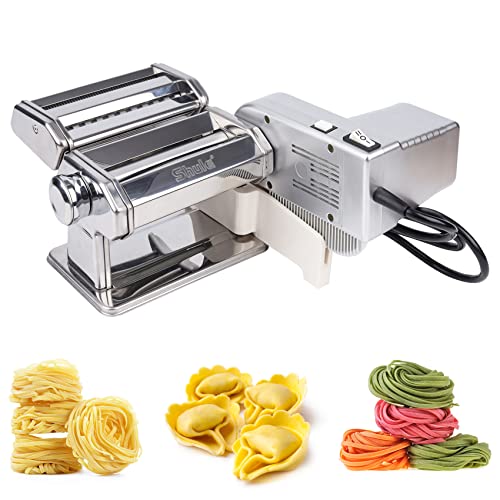
Shule Electric Pasta Maker with Motor — Two Modes and a Ravioli Roller
The Shule is the diplomat of this guide: it refuses to make you choose between the crank and the motor. Its title lists an electric motor, a hand crank and a ravioli roller in one machine, with two operating modes, seven dough settings, noodle cutting and filled-pasta preparation. That combination speaks to a real household pattern — motor for the Tuesday batch when you are cooking alone and tired, crank for the Sunday session when the process is the pleasure — and it makes the Shule the only pick here that can follow a cook’s mood rather than dictating one.
The ravioli roller deserves its sentence. Filled pasta is where roller machines usually hand the cook back to hand tools, so a title that names filled-pasta preparation and includes a ravioli roller is promising to keep the whole dish inside one appliance. Seven dough settings give the sheet programme its staircase; the title does not print the millimetre span those settings cover, nor a wattage for the motor, so both belong on the pre-purchase checklist — ask the seller, and read the listing’s specification block before assuming the span matches the GVODE’s printed 0.4–2 mm. What the title does establish is breadth: sheeting, cutting and filling, by power or by hand, is the widest single-box brief in this guide.
- Operating modes: 2 — motor and hand crank, per the title
- Dough settings: 7; the millimetre span is not printed in the listing title — confirm it with the seller
- Attachments named in the title: ravioli roller; noodle cutting included
- Motor wattage: the figure does not appear in the listing title — check the Shule Electric Pasta Maker with Motor specification on its listing and check price on Amazon
- Filled pasta: named directly in the title as a preparation the machine supports
Strengths
- Motor and crank in one frame serves both weeknight haste and weekend ritual.
- The ravioli roller keeps filled pasta inside the same appliance.
- Seven settings give a proper staircase for sheet work.
Trade-offs
- Wattage and thickness span are both unstated in the title — two verifications before buying.
- Dual-mode machinery is more complex than a motor-only roller to clean and store.
- Cooks who will never crank by hand are paying for a second mode they will not use.
Best for: households torn between the manual romance and the electric convenience, and ravioli makers who want one appliance for the whole dish. Not suited for: buyers who want every number printed in the title before they will consider a machine.

GVODE Electric Pasta Maker 700W — The Fully Documented Powerhouse
The GVODE’s title reads like a specification sheet that wandered into a headline: a 3-in-1 roller and cutter with a 700W maximum, eight thickness settings spanning 0.4 to 2 mm, a stainless steel sheet roller, fettuccine and spaghetti cutters, two speeds, a reverse function and a brush. Take the numbers in order. The 0.4–2 mm band is the classic home sheet range — thin enough for delicate ribbons, thick enough for a lasagne sheet with presence — and eight settings divide it finely. Two speeds let the operator match the roller to the dough’s mood, and reverse is the feature nobody values until a sheet misfeeds at the worst moment, when it becomes the only feature that matters.
Power claims deserve their customary caution: 700W is printed as a maximum, which describes the motor’s ceiling rather than its cruising effort, and sheeting dough inside a 2 mm ceiling rarely asks for a ceiling effort anyway. The honest reading is that this machine is unlikely to be the weak link when a stiff dough meets a wide sheet. The included brush, named in the title, signals the correct cleaning religion — dry, frequent, flour-first — and the stainless roller suits it. For buyers who comparison-shop by documented fact, this is the easiest pick in the guide to evaluate, because its title leaves almost nothing to ask the seller.
- Stated power: 700W maximum
- Thickness: 8 settings, 0.4–2 mm, per the title
- Speeds: 2, plus reverse
- Cutters named in the title: fettuccine and spaghetti
- Construction and kit: stainless steel sheet roller; cleaning brush included
- Buying route: the GVODE Electric Pasta Maker 700W listing confirms the current box — check price on Amazon there
Strengths
- The most completely documented title in the guide: power, span, speeds and cutters all printed.
- Reverse gear rescues misfeeds without dismantling the session.
- Eight settings across the classic home band suit nearly every sheet dish.
Trade-offs
- The 2 mm ceiling excludes thick dough pressing and rustic, heavy sheets.
- No ravioli or filled-pasta provision is named in the title.
- Maximum-wattage marketing should be read as a ceiling, not a duty rating.
Best for: specification-led buyers who want the strongest documented motor and a complete ribbon programme in one box. Not suited for: filled-pasta specialists or cooks who sheet thick doughs for pressing work.

WICHEMI Electric Pasta Roller 135W — The Quiet Flat-Noodle Specialist
The WICHEMI is the modest entry, and its modesty is specific rather than vague. The title states 135W of power, an automatic dough pasta roller in stainless steel, and a purpose: making 4 mm and 9 mm flat noodles, for home and restaurant use. Two flat widths, honestly named. A household whose noodle life runs through flat ribbons — the 4 mm for everyday bowls, the 9 mm for wide, sauce-carrying strands — will find this focus refreshing after pages of machines promising everything. The lower wattage matches the brief: flat noodle dough, sheeted within a home band, does not need a powerhouse, and a smaller motor usually means a smaller, quieter, more storable machine.
Restraint in the title cuts both ways, and the review follows it faithfully. The thickness span and the number of settings are not printed, so a cook who follows numbered recipes should confirm them with the seller. No round-noodle or spaghetti cut is named, so spaghetti households should look at the GVODE or the Maxceysen instead. What the WICHEMI offers is a clean answer to a narrow question, in stainless steel, at the gentlest power figure in the guide — and narrow questions, honestly answered, are how good kitchens get equipped.
- Stated power: 135W
- Cuts named in the title: 4 mm and 9 mm flat noodles
- Construction: stainless steel
- Stated arena: home and restaurant use, per the title
- Thickness settings: the count and span are not printed in the listing title — verify them for the WICHEMI Electric Pasta Roller 135W with the seller and check price on Amazon
Strengths
- A focused flat-noodle brief in two genuinely useful widths.
- Stainless construction at the gentlest power point in the guide.
- An unpretentious title that promises exactly what it describes.
Trade-offs
- No spaghetti or round cut is named in the title.
- Thickness settings and span require a seller confirmation.
- 135W is the wrong tool for stiff doughs sheeted wide and thick.
Best for: flat-noodle households that know their two widths and want them motorised without ceremony. Not suited for: spaghetti-first cooks, or anyone whose dough work runs thick and demanding.
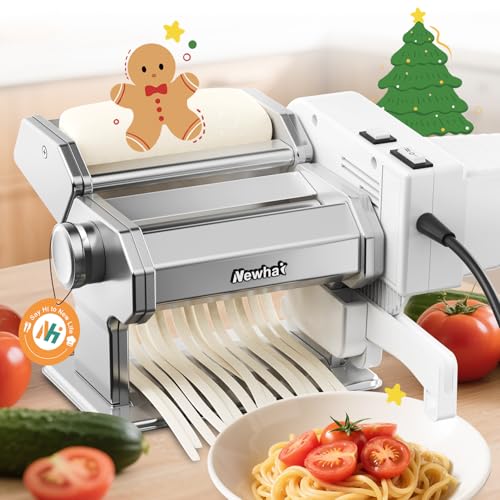
Newhai QM-1 Ramen Pasta Maker — Thin Sheets for Serious Noodles
The QM-1 is the specialist’s specialist. Its title names ramen in the product name itself, then specifies a thickness of 0.2–0.5 mm — by far the thinnest band in this guide — with 1.5 mm and 6 mm noodle cuts, an adjustable roller and cutter, a 110V motor with a hand-crank alternative, and 430 steel construction for home kitchen use. Read that thickness band carefully: it does not reach the 2 mm ceiling of a lasagne sheet, because it is not trying to. Ramen and fine noodle doughs live in the sub-millimetre world, and this machine’s entire adjustment range is spent there, which buys granularity exactly where a noodle maker wants it.
The dual drive matters for this cuisine in a particular way. Noodle dough for ramen-style strands is famously stiff — low hydration, hard work — and a motor earns its keep across a batch, while the hand-crank fallback keeps the machine useful during a power cut or at a holiday house. The 1.5 mm cut is the fine strand; the 6 mm is the flat, broad noodle; between the two, most of the noodle map is covered. Households whose pasta identity is Italian should note the absence of fettuccine and lasagne language in the title and choose accordingly — the QM-1’s honesty about its cuisine is a feature, and this review honours it by not dressing the machine in a repertoire it never claimed.
- Thickness band: 0.2–0.5 mm, per the title — the thinnest in this guide
- Cuts named in the title: 1.5 mm and 6 mm noodles
- Drive: 110V motorised or hand-crank
- Steel: 430 steel, per the title
- Stated arena: home kitchen use
- Ordering note: the Newhai QM-1 Ramen Pasta Maker listing carries the current configuration — check price on Amazon there
Strengths
- An adjustment band spent entirely in the sub-millimetre noodle zone.
- Motor or crank drive suits stiff doughs and uncertain power alike.
- Ramen named in the product itself: the brief could not be clearer.
Trade-offs
- The 0.5 mm ceiling excludes lasagne sheets and thick ribbons entirely.
- Italian repertoires are not this machine’s language.
- Fine bands punish dough errors; hydration discipline is mandatory.
Best for: ramen and fine-noodle devotees who sheet thin, cut two widths and want motor help with stiff dough. Not suited for: lasagne builders or any household whose pasta centre of gravity is Italian.
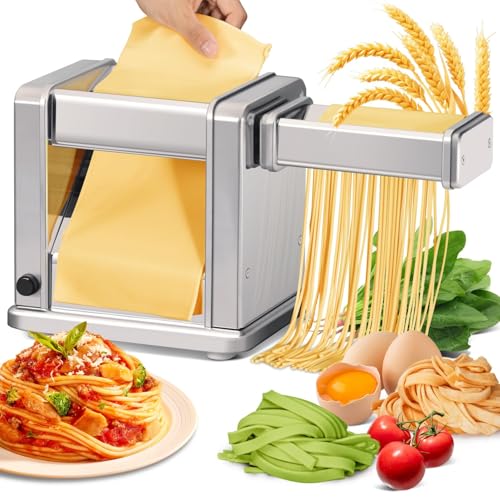
Maxceysen Electric Pasta Maker — The Repertoire Generalist in Stainless
The Maxceysen’s title is a supper list: a domestic electric machine in stainless steel with an adjustable dough roller and cutter for handmade spaghetti, fettuccini, lasagna, pie crust, dumpling and wonton. Pie crust is the tell — it signals a roller the maker expects to be used for sheet work beyond pasta, which is exactly how generalist machines earn their counter space in real homes: the same rollers that sheet Sunday’s lasagna flatten Friday’s pie dough and roll out the dumpling skins for the freezer. Six named applications is the widest repertoire claim in this guide, wider even than the Shule’s, though without the Shule’s ravioli roller or second operating mode.
The title’s silences are the counterweight, and they are the usual two: no wattage and no millimetre span are printed. A generalist purchase therefore leans on the listing’s specification block and the seller’s answers more than a GVODE purchase does, and this review advises that homework without embarrassment — the machine’s promise is breadth, and breadth is verified by reading, not by assuming. For households whose cooking genuinely roams across the six named applications, the Maxceysen is the natural centre of the shortlist: one stainless roller, one adjustable cutter, and a week of different dinners.
- Construction: stainless steel, per the title
- Roller and cutter: adjustable, per the title
- Applications named in the title: spaghetti, fettuccini, lasagna, pie crust, dumpling and wonton
- Motor wattage: not printed in the listing title — confirm the figure for the Maxceysen Electric Pasta Maker with the seller
- Thickness span: not printed in the listing title either — verify it on the listing and check price on Amazon
Strengths
- The widest named repertoire in the guide, pie crust included.
- Stainless build suits a machine expected to work across cuisines.
- Adjustable roller and cutter keep sheets and strands in one unit.
Trade-offs
- Wattage and thickness span both require verification before purchase.
- No filled-pasta attachment is named, despite the dumpling and wonton sheet work.
- Generalist breadth trades the QM-1’s thin-end finesse and the GVODE’s documentation.
Best for: roaming home cooks whose rollers serve Italian, Chinese and baking duties in the same week. Not suited for: number-first buyers, or ramen specialists chasing sub-millimetre control.

KEARIXM Electric Pasta Maker — The Stainless Sheeter in Silver
The KEARIXM closes the guide with the sheeter’s creed stated plainly: an electric noodle maker and stainless steel pasta roller — described in its title with the Spanish laminadora de masa, a dough sheeter — for spaghetti, lasagna and dumplings, as a dough sheeter for the home kitchen, in silver. The three named applications are a sensible home triangle: a strand, a sheet and a skin. A household that makes those three, in rotation, has a pasta programme; the KEARIXM is titled to be its engine, without reaching for the Maxceysen’s six-item repertoire or the GVODE’s specification fireworks.
As with several picks here, the title leaves wattage and thickness figures unprinted, and the review’s advice is by now familiar: the listing and the seller hold those numbers, and a buyer should collect them before the box is ordered. What the title does give is the material and the mission, and for many households that is the right order of information — stainless construction for a machine that will live with flour and water vapour, and a three-application brief that matches the actual weeknight map. The silver finish, named in the title, is the aesthetic footnote: a machine that lives on the counter rather than in a cupboard should not offend the eye that cooks beside it.
- Construction: stainless steel pasta roller, silver finish
- Applications named in the title: spaghetti, lasagna and dumplings
- Role named in the title: electric noodle maker and dough sheeter for the home kitchen
- Motor wattage: the figure is absent from the listing title — ask the seller for the KEARIXM Electric Pasta Maker rating before ordering
- Thickness span: likewise absent from the title — verify it on the listing and check price on Amazon
Strengths
- A home triangle of applications — strand, sheet, skin — in one stainless unit.
- Sheeter identity stated in two languages; the machine knows its job.
- Counter-worthy silver finish for a machine that will live in view.
Trade-offs
- Wattage and thickness span are both listing-check items.
- No fettuccine-width or ravioli provision is named in the title.
- Buyers wanting documented speeds or reverse will look to the GVODE instead.
Best for: households whose pasta week is spaghetti, lasagne and dumpling skins, wanting them motorised in stainless. Not suited for: specification maximalists or filled-pasta devotees needing a ravioli attachment.
The Powered Sheet, Compared Pick by Pick
| Machine | Power in title | Thickness in title | Signature |
|---|---|---|---|
| Shule Electric Pasta Maker with Motor | Not printed | 7 settings; span not printed | Motor + crank + ravioli roller |
| GVODE Electric Pasta Maker 700W | 700W maximum | 8 settings, 0.4–2 mm | Two speeds and reverse |
| WICHEMI Electric Pasta Roller 135W | 135W | Not printed | 4 mm / 9 mm flat noodles |
| Newhai QM-1 Ramen Pasta Maker | 110V motor; wattage not printed | 0.2–0.5 mm | Ramen-thin specialist, dual drive |
| Maxceysen Electric Pasta Maker | Not printed | Not printed | Six named applications |
| KEARIXM Electric Pasta Maker | Not printed | Not printed | Stainless sheeter, silver |
How Do You Choose a Motorised Roller by the Dinners You Actually Cook?
List your last ten pasta dinners and let them vote. If the list is ribbons and lasagne, the GVODE’s documented 0.4–2 mm band and two cutters answer it directly, and the Maxceysen and KEARIXM stand by as repertoire alternatives. If the list is noodle bowls — especially ramen — the QM-1 is not a niche indulgence but the only machine here whose whole adjustment range lives where your dough lives. If flat noodles dominate in two widths, the WICHEMI’s focus is a virtue. If filled pasta anchors the list, the Shule’s ravioli roller ends the debate. And if the list is honestly mixed, the generalists earn their breadth. The exercise sounds obvious, yet most disappointing purchases in this category come from buying the machine that flattered an imagined repertoire instead of the one that matched a written one.
Two secondary questions refine the choice. First, hands: a cook with tired wrists or grip issues should weight the motor-only machines and treat the dual-mode picks’ cranks as a bonus for other people’s Sundays, while a cook who loves the manual ritual on weekends should take the Shule or QM-1 seriously precisely because the crank survives. Second, documentation temperament: some buyers want every number in print before purchase — the GVODE exists for them — while others are content to verify two figures with a seller in exchange for a wider repertoire. Craft hobbies teach the same temperament split; readers outfitting a sewing corner will meet it again in Best Sewing Machines for Applique, where stitch libraries play the role thickness bands play here.
What Does a Weeknight Session on a Powered Roller Look Like?
Dough first, as always: mixed, kneaded and rested while the cook does something else, because no motor in this guide shortens gluten’s need to relax — the machines that do skip that step are the automatics in the separate guide, working by extrusion rather than sheeting. With the dough rested, the powered session diverges from the manual one at the pass. Both hands stay free: one feeds, one receives, and the sheet can be guided, folded and re-fed in a continuous rhythm that a single cook can sustain without the stop-start of cranking. Settings step down one at a time, exactly as with a crank, because dough physics does not care what turns the rollers.
Cutting follows in the same flow, and the finished pasta goes to dusted trays while the machine is brushed down — dry, always dry — before it cools into tomorrow’s problem. The whole session, for a family batch, compresses into the time the sauce needs to simmer, which is the entire weeknight argument for the category: fresh pasta stops being a project and becomes a Tuesday. Kitchens that run this rhythm weekly discover the second benefit quietly — consistency. A motor turns at one speed, so the sheet’s tenth pass resembles its first, and the cook’s notebook of settings becomes a reliable household document rather than a fair-weather suggestion.
What Mistakes Do New Owners of Motorised Rollers Make?
The first is feeding the machine dough mixed for an automatic — too wet, expecting the rollers to cope — when sheet dough should be firm and rested. The second is skipping settings under motor power, which tears sheets faster than a crank ever could because the machine cannot feel resistance; the operator’s eyes must do the feeling the crank used to do. The third is neglecting the brush because the session felt clean: flour migrates into cutter combs invisibly and hardens there. The fourth is storing the machine with its cord wrapped tight against the housing in a steamy cupboard, an insult to both motor and metal. Each mistake is small, and together they are the difference between a machine that serves for years and one that is replaced in eighteen months by a disappointed household that blames the category.
How Does Counter Space Decide Between These Six in a Real Kitchen?
A motorised roller is a resident, not a visitor. Unlike a crank machine that can be clamped to a table’s edge for an afternoon and cupboarded by dinner, a powered roller wants a settled station: a stretch of counter with landing room on the outfeed side, a socket within honest reach of its cord, and storage for the trays and flour that constitute its entourage. Kitchens should measure that station before choosing among these six, because the differences that matter daily — how the sheet exits, where the controls sit, whether the unit wipes down in place — are spatial as much as mechanical. A machine that must be hauled from a high shelf will be used monthly; the same machine resident on the counter will be used weekly, and weekly is where its cost dissolves into dinners.
The socket question deserves its own honesty. These are countertop appliances sharing circuits with kettles, mixers and the rest of the bench’s population, and a roller that trips protection mid-sheet teaches the household to dread pasta night. Survey the bench’s electrical reality as part of the purchase — the same survey any serious countertop programme needs, as readers planning a drinks station from Best Professional Coffee Machines will recognise, since espresso equipment and pasta rollers alike punish optimistic wiring. None of the titles here print circuit demands beyond the QM-1’s 110V, so the seller check that recurs through this guide applies to power draw as well.
What Doughs Beyond Pasta Justify a Powered Roller?
The Maxceysen’s title names pie crust, and the thought extends further than one dish. Any dough that must arrive at an even thickness — dumpling and wonton skins, flatbread bases, cracker doughs, the laminated layers a patient cook folds for pastry — is a candidate for the roller’s even pressure, which hands cannot match across a whole sheet no matter how skilled they are. This is the generalist’s deepest argument: the machine is not a pasta appliance with hobbies, it is a sheeting appliance whose most famous product is pasta. Households that bake, wrap and roll across cuisines will find the roller working three days a week; households that only ever make fettuccine should buy for fettuccine and let the narrower picks’ focus serve them.
Evenness is the quality to prize in all of these uses, because evenness is what cooking rewards. A pie crust of uniform thickness browns uniformly; a wonton skin of uniform thinness seals uniformly; a cracker sheet of uniform gauge crisps uniformly. The motor’s contribution is not speed but sameness — pass after pass at one pace — and sameness, in a sheet, is the difference between a recipe that works on Tuesdays and one that works when the cook’s arm happens to be fresh.
What Does the Motor Actually Change About Your Hands and Shoulders?
Cranking is honest exercise, and like all exercise it selects its practitioners. A long manual session loads the shoulder and forearm in a steady circular rhythm; most cooks find it pleasant for a batch and punishing for three. The motor removes that load entirely and replaces it with a subtler demand: attention. With both hands free, the operator becomes a guide rather than an engine — feeding squarely, catching without stretching, watching the sheet’s edges for the first sign of a tear. Cooks with arthritis, recovering shoulders or simply a household of six to feed will find the trade obviously worth it. Cooks who meditate at the crank should hear the counter-argument plainly: the powered session is quicker and quieter in the body, and some of the ritual goes with the effort.
Children change the calculation in an interesting direction. A crank machine invites a child’s hand onto the handle under supervision, which is one of its household joys; a motorised roller demands a clearer boundary — small hands feed nothing, ever, and the machine’s on-off discipline becomes a house rule stated before the first session. Families solve this by assigning children the flour, the trays and the resting dough, reserving the powered pass for adults. The Shule and QM-1, with their cranks in reserve, offer a genuinely elegant compromise: motor for the adult production run, crank for the supervised weekend lesson, one machine serving both registers of family life.
How Do Settings Translate Between Machines, and Why Should You Keep Your Own Table?
A setting number is a local dialect, not a universal language. The GVODE’s eight settings span 0.4–2 mm, so each step is a fine gradation; the Shule’s seven settings cover a span its title does not print, so its step sizes are unknown until the listing or the first sheet reveals them; the QM-1 spends its whole adjustment inside half a millimetre, where a single step is a whisper. A recipe that says “roll to setting five” is therefore giving you a starting hypothesis, not an instruction, and the cook who converts recipes into millimetres — by measuring a sheet once with a gauge or even a careful eye against a coin’s edge — owns a table that survives every future machine purchase.
Building that table is a one-afternoon project with permanent returns. Roll a rested dough through each setting of your machine, note the sheet’s behaviour and its best dish beside the number, and tape the result inside a cupboard door. Lasagne at this setting, ribbons at that one, skins at the finest — the household’s own atlas. New owners consistently report that this small act is when the machine stops being an appliance and becomes an instrument, because an instrument is precisely a tool whose responses its owner has mapped.
How Should a Powered Roller Be Cleaned, Given That It Cannot Be Washed?
The rule from the manual world survives electrification intact: dry cleaning, every time, with a brush — which is why the GVODE’s title bothers to include one. Flour is the daily residue and brushes away in a minute while it is loose; dough film is the dangerous residue, and it must be encouraged off with a soft scraper or a dry cloth while the session’s warmth still makes it cooperative. What must never happen is the sink. A motorised roller contains a motor, bearings and electrical paths that water reaches with destructive patience, and a machine rinsed “just this once” in month two is a machine failing mysteriously in month nine.
Monthly, the routine deepens slightly: run the rollers empty through their settings while brushing, so surfaces that hide at one thickness present themselves at another; check the cutter combs for the flour paste that forms where dust meets kitchen humidity; wipe the housing and the cord with a barely damp cloth and dry both immediately. Storage completes the discipline — a dry shelf, the cord loosely coiled rather than kinked, nothing stacked on top. None of this exceeds ten minutes a month, and it is the entire maintenance contract for a category with no filters, no descaling and no service visits: a fair trade, honestly printed.
When Does the Automatic Machine Deserve the Counter Instead?
Honesty requires this section, because some readers of a roller guide actually want the other machine. If the sentence that brought you here is “I want fresh pasta without making dough,” the answer is the automatic class — mix, knead, extrude — surveyed in our separate live guide, and no roller on this page will satisfy you, because rollers begin where dough already exists. If your sentence is “I love making dough and hate cranking,” or “my sheets must be sheets — lasagne, skins, ribbons with a rolled texture” — then the automatic cannot help you either, because extrusion produces shapes, not sheets, and its pasta has a different bite. The two classes are answers to different hungers, and the worst purchase in this whole category is the one made in confusion between them.
Texture is the connoisseur’s version of the same point. A rolled sheet, laminated by passes and folds, has a layered delicacy that filled pasta and fine ribbons depend on; an extruded shape has the dense chew that a hearty sauce wants. Serious pasta households sometimes own both, using each where it is strong, and the existence of that pattern is the final proof that neither class is the other’s upgrade. This guide’s six picks were chosen to be the best of the sheet family for homes — judged as rollers, against rollers, for the dinners rollers make possible.
What Should a Buyer Verify in Writing Before Ordering?
Three verifications cover nearly every disappointment this category produces. First, the thickness span in millimetres, for the four picks whose titles leave it open — the Shule, WICHEMI, Maxceysen and KEARIXM — because your dishes live at specific gauges and a span that misses your gauge misses your kitchen. Second, the cutter inventory in the box: which widths, whether the ravioli provision on the Shule is the roller attachment its title names, and what a spare cutter costs. Third, the motor’s wattage where the title omits it, less for power’s sake than for circuit planning on a crowded bench. Sellers answer these questions routinely through the listing; ask them before the order, keep the answers with the receipt, and the machine that arrives will be the machine you thought you bought.
A fourth, softer verification concerns expectations. Read your chosen title once more and list what it does not promise: if it never mentions lasagne, do not be surprised by its sheet width; if it never mentions a crank, do not plan a power-cut session around it. The titles in this guide are unusually informative as a set — bands, widths, speeds and modes are printed for most picks — and a buyer who treats the title as the contract will find every machine here honours it.
How Long Should a Machine Like This Last, and What Decides It?
A motorised roller has three mortal parts: the motor, the rollers’ surfaces and the cutters’ edges. The motor’s life is decided mostly by mercy — dough fed within the machine’s band, settings stepped rather than jumped, sessions that end with a brush rather than a backlog of hardened flour forcing tomorrow’s first pass. Roller surfaces die by scratching, usually from metal tools used in a hurry, which is why this guide keeps returning to soft scrapers and dry cloths. Cutters dull by honest work and by one dishonest shortcut, cutting on a hard surface or through dough with hard inclusions; both are avoidable, and a cutter treated well keeps its edge through years of ribbons.
The buyer’s part in longevity is played at purchase time. A machine whose span and cutters match the household’s real repertoire is a machine never forced beyond its brief, and forced work is what shortens appliance lives more reliably than time does. The QM-1 asked to sheet lasagne will suffer; the GVODE asked to produce ramen-thin strands will be cursed unfairly; each, kept to its titled purpose, should serve through hundreds of sessions. Longevity, in this category, is mostly the compound interest of a correct first choice — which is the entire argument for the title-evidence discipline this guide has practised from its first paragraph.
A Note for Households Upgrading From a Crank Machine
Your dough knowledge transfers completely; your settings table transfers approximately; your session rhythm transfers after one adjustment. The dough that behaved on the crank will behave on the motor, because the rollers ask the same questions — the difference is that your hands, freed from turning, must learn their new jobs of feeding and catching without the crank’s built-in pacing. Expect the first two sessions to feel oddly rushed, as if the machine were hurrying you; it is simply keeping its own tempo, and the cook’s task is to prepare further ahead — dough portioned, trays dusted, cutters staged — so the tempo becomes a gift rather than a pressure. Most upgraders report the conversion complete within a month, and many keep the old crank machine for the teaching sessions and the power cuts, which is the happiest ending an appliance can earn.
What Does the First Month’s Learning Curve Look Like on a Powered Roller?
Session one is for ribbons and humility: a forgiving egg dough, a mid-range setting path, and no guests. The sheet will teach the feeding hand its angle and the catching hand its patience, and the pasta will be good without being perfect. Session two repeats the same dish deliberately, because repetition is where the settings table gets its first trustworthy entries. By the second week, most households attempt their machine’s signature dish — the QM-1 household makes ramen in earnest, the Shule household fills its first ravioli, the GVODE household tests the reverse gear on purpose so the rescue is rehearsed before it is needed.
The month ends with a quieter skill that no title advertises: knowing when not to roll. Dough mixed in a rush, a counter crowded with another project’s debris, a cook too tired to watch a sheet — the powered roller forgives none of these more than the crank did, and the household that learns to postpone a session rather than force one keeps both its pasta and its machine in better condition. Mastery in this category looks undramatic from outside: rested dough, stepped settings, brushed cutters, a notebook filling slowly. It tastes dramatic enough.
One final consideration belongs to the household’s future rather than its present. A powered roller bought for two people’s Tuesday dinners may, within a year, be sheeting for a pasta night of eight, or teaching a teenager the family trade, or producing the freezer’s stock of skins in a single autumn afternoon. The machines here were chosen with that growth in mind — bands wide enough to learn in, cutters broad enough to grow into, and in two cases a crank waiting for the day the lesson matters more than the speed. Buy for the cook you are, certainly; but where two picks are otherwise equal, buy for the cook you are visibly becoming.
And a word for the cook reading this page at midnight with flour already on the counter: the best session is the next one, on whichever machine you chose, with the dough rested longer than feels necessary and the settings stepped one at a time. The titles and tables above exist to make that session start well; the session itself will do the rest of the teaching, as it has for every cook who ever traded a crank for a motor and kept the craft intact.
Why Does Sheet Texture Differ From Extruded Texture, in Plain Terms?
Rolling organises dough. Each pass aligns and layers the gluten network in the direction of travel, and the folds between passes laminate the sheet the way a baker laminates pastry — less dramatically, but in the same spirit. The cooked result is a strand or sheet with a delicate, slightly layered bite that tears cleanly and carries sauce on a surface with microscopic texture. Extrusion, by contrast, compresses dough through a die under pressure, producing a denser, more uniform strand with the firm chew that rustic sauces and baked dishes prize. Neither texture is the other’s failure; they are different instruments playing different dishes, which is why this guide guards the border between the classes so carefully.
For the home cook, the practical translation is a menu instinct: choose the roller when the dish is about the sheet itself — filled pasta whose wrapper must be tender, ribbons meant to be silky, skins meant to disappear around a filling. The six machines above exist to make that instinct effortless on a weeknight, and their motors, bands and cutters should all be read as servants of that single quality: an even, layered sheet, produced without wearing out the cook who has to sauce it, serve it and wash up after it.
Final Recommendation
Choose the GVODE if you buy by documented numbers and cook the classic sheet repertoire; choose the QM-1 if noodles — real, thin, ramen-minded noodles — are your centre of gravity. Take the Shule for the household that wants every mode and a ravioli roller besides, the WICHEMI for flat noodles without fuss, and the Maxceysen or KEARIXM when the roller’s week spans cuisines. Verify the two figures your chosen title leaves open, rest your dough as if the motor did not exist, and the powered sheet will do the rest — this is the rare upgrade that gives a cook both hands back and takes nothing from the pasta.
Frequently Asked Questions
Are these machines the same as automatic pasta makers?
No, and the distinction is this page’s foundation. These are motorised rollers: you mix and rest the dough, they sheet and cut it. Automatic machines mix, knead and extrude shaped pasta from raw ingredients; that class has its own live guide and is cross-referenced here in prose only, with none of its models appearing as picks.
Is more wattage always better in a motorised roller?
Not within a home sheet band. The GVODE’s stated 700W maximum is headroom; the WICHEMI’s 135W suits its flat-noodle brief. What decides your day is the thickness band and the cutters, with power as supporting evidence — which is why several titles here print no wattage and their reviews decline to invent one.
Can a motorised roller handle stiff ramen dough?
That is the Newhai QM-1’s stated purpose: a 0.2–0.5 mm band, 1.5 mm and 6 mm cuts, and a motor with a hand-crank alternative for a dough style famous for resisting both. Rest and hydration discipline still apply; the motor supplies force, not forgiveness.
Which pick should a filled-pasta cook choose?
The Shule, on its title’s evidence: it names a ravioli roller and filled-pasta preparation outright. The Maxceysen and KEARIXM sheet dumpling and wonton skins admirably, but the filling and forming there remain hand work, as their reviews state.
How are motorised rollers cleaned?
Dry, with a brush, after every session — the GVODE even includes the brush in its title. Water and rollers are enemies unless a manufacturer explicitly says otherwise, and flour left in cutter combs hardens into the next session’s torn sheets.
Related Guides
Steam has its own chapter in the dough kitchen, from proofing to reheating, and it is surveyed in Best Home Steam Ovens, a live companion for readers building a bench where sheets, steam and suppers meet.


