What's inside
- Buying a Hamilton Beach Loaf Machine: A Short List, Honestly Explained
- Key Takeaways
- Quick Picks
- How Did We Establish That Three Is the Whole Story?
- The Three Current Models, Taken One Loaf at a Time
- Three Models, One Table
- What About the Older Hamilton Beach Models You Will Find Second-Hand?
- What Do the Programme Counts Actually Buy a Home Baker?
- When Should You Honestly Buy a Different Brand Instead?
- What Does a Week of Machine Bread Actually Look Like?
- What Mistakes Do New Bread Machine Owners Make?
- How Do the Three Models Compare When the Same Loaf Is Baked in Each?
- What Flour, Yeast and Water Behaviour Should a New Owner Understand?
- How Should the Pan and Paddle Be Cared For Across Years of Loaves?
- What Does a Loaf From One of These Machines Cost a Household in Practice?
- How Do Gluten-Free and Keto Programmes Differ From the Standard Cycle?
- What Troubleshooting Path Fixes the Five Commonest Loaf Failures?
- How Should a Household Choose Its First Month’s Baking Curriculum?
- What Place Does a Bread Machine Hold in a Kitchen That Also Bakes in an Oven?
- A Buyer’s Checklist for a Three-Model Range
- What Should Be in the Pantry Before the Machine Arrives?
- How Does Slicing, Storing and Freezing Machine Bread Work Best?
- Why Does This Brand Keep Its Range Small, and Is That a Strength?
- What Should a Gift Buyer Know About Giving One of These Three?
- Final Recommendation
- Frequently Asked Questions
- Related Guides
As an Amazon Associate I earn from qualifying purchases. This post may contain affiliate links at no extra cost to you.
cottageverdict.com is reader-supported. When you buy through links on our site, we may earn an affiliate commission.
Buying a Hamilton Beach Loaf Machine: A Short List, Honestly Explained
Here is the fact this whole guide is built on, stated in its first breath: the best Hamilton Beach bread machines are three in number. Hamilton Beach currently sells exactly three bread maker models on Amazon — the best Hamilton Beach bread machines are not a long catalogue to be ranked ten deep, and any page pretending otherwise is padding. This guide therefore does something more useful than padding: it reviews the three real machines closely, explains precisely how they differ, gives the discontinued and older models their honest prose chapter, and tells you plainly when a different brand would serve your kitchen better. Three linked picks, no invented fourth, and the depth a buyer of a single-brand shortlist actually needs.
The three share a family resemblance that makes the comparison clean. All three bake a 2 lb loaf — that capacity is stated in every title. All three are digital and programmable, all three offer a delay start, and all three carry a gluten-free setting in their counts. They diverge where it matters: the number of programmable settings runs from 12 to 14 to 21, one adds an automatic fruit and nut dispenser, one specifies a PFAS-free nonstick pan, and they wear three different finishes — white and stainless, stainless, and black. A household choosing among them is really choosing which of those divergences matches its baking week.
Each name links to its Amazon listing, where you can check price on Amazon and confirm the current box contents; no prices are printed on this page, since a bread machine’s value amortises over hundreds of loaves and should be weighed against years, not promotions. What follows is organised to honour the short list: three full reviews, then the wider story — the models that came before, the settings explained, the three compared head to head, and the circumstances under which the honest recommendation is to buy another brand entirely.
Key Takeaways
- There are exactly three current Hamilton Beach bread makers on Amazon; this guide links those three and invents no others.
- All three bake a 2 lb loaf, are digital and programmable, offer delay start, and include a gluten-free setting.
- The settings ladder is the spine of the range: 12 on the Automatic, 14 on the Digital 29987 (artisan named), 21 on the Premium (keto named).
- Only the Premium adds an automatic fruit and nut dispenser, per its title; only the Automatic specifies a PFAS-free nonstick pan, per its title.
- Older and discontinued Hamilton Beach models are covered in prose, without links, so second-hand shoppers can place what they find.
Quick Picks
| Model | Position in the range | Why it is here |
|---|---|---|
| Hamilton Beach Digital Bread Maker 29987 | The balanced middle | 14 settings including artisan and gluten-free, delay start, white and stainless finish. |
| Hamilton Beach Premium Dough & Bread Maker | The range-topper | 21 settings including gluten free and keto, plus the automatic fruit and nut dispenser. |
| Hamilton Beach Automatic Bread Maker | The straightforward baker | 12 settings plus gluten free, with a PFAS-free nonstick pan and kneading paddle in black. |
How Did We Establish That Three Is the Whole Story?
By counting what the marketplace actually lists, and by refusing to be embarrassed about the total. Brand shortlists invite inflation: a writer who needs six picks will quietly promote discontinued models, marketplace leftovers and near-identical regional variants into the ranking, and the reader pays for the fiction with a purchase decision built on ghosts. This guide took the opposite discipline. The pool for this article was verified model by model, and it returned three current machines. Everything else wearing this badge — and there is history to discuss — is handled in the prose chapter on older models, clearly labelled as background rather than dressed as a buyable pick.
That discipline shapes the comparison method too. With three machines sharing a 2 lb capacity, a delay start and a digital interface, the meaningful work is not ranking but differentiation: which settings each count contains, which convenience each adds, which finish suits which kitchen. The reviews below therefore read like a family meeting — the resemblances assumed, the differences interrogated. Readers who arrived hoping for a ten-model shootout are invited to consider that a three-model truth, examined properly, is worth more than a ten-model fiction, and that the same suspicion should be carried to any single-brand guide, including the beverage equivalent in Best Commercial Coffee and Tea Machines, where urns and brewers likewise reward buyers who count what is actually sold.
One more methodological note: settings counts are quoted from the titles, and the specific programmes each title names — artisan, gluten-free, keto — are reported exactly as named. Where a title does not enumerate its full programme list, this guide does not reconstruct one from sibling models or from memory; the listing itself holds the complete menu, and the reviews point you there.
The Three Current Models, Taken One Loaf at a Time

Hamilton Beach Digital Bread Maker 29987 — The Balanced Middle of the Range
The 29987 is where most Hamilton Beach buyers should start their thinking, because its title describes the range’s centre of gravity: a digital machine with delay start, a 2 lb loaf capacity, and 14 programmable settings including artisan and gluten-free, finished in white and stainless steel. The artisan mention is the interesting word. It signals a programme aimed at the slower, crustier end of home baking — the loaves a household graduates to after the sandwich bread is mastered — and its presence at the middle tier says something generous about how this range is specced: the interesting programmes are not all hoarded by the flagship.
Fourteen settings is a count that rewards a moment’s reflection. It is enough to cover the working repertoire of a home bakery — the daily loaf, the whole-grain variation, the sweet loaf, the dough-only cycle for rolls and pizza bases, the gluten-free programme the title names — without the menu fatigue of a flagship’s twenty-one. Delay start, shared across all three models, is the feature that changes a household’s relationship with the machine: ingredients loaded at night, a loaf timed to the morning, the kitchen smelling of bread before the kettle boils. The white and stainless finish is the lightest of the three, suited to bright kitchens and to buyers who find black appliances visually heavy. Model number 29987 is printed in the title itself, which helps when comparing listings.
- Loaf capacity: 2 lbs, per the title
- Programmable settings: 14, including artisan and gluten-free
- Timing: delay start included
- Finish: white and stainless steel; model 29987
- Full programme list: the title names two settings of the fourteen — see the complete menu and check price on Amazon via the Hamilton Beach Digital Bread Maker 29987 listing
Strengths
- Artisan and gluten-free programmes named at the middle tier, not reserved for the flagship.
- Fourteen settings cover the working repertoire without menu sprawl.
- The lightest finish of the three suits bright kitchens.
Trade-offs
- No fruit and nut dispenser is named in the title; additions are a manual, mid-cycle task.
- Buyers chasing the keto programme named on the Premium will not find it named here.
- The full fourteen-programme list must be read on the listing, since the title names only two.
Best for: the household that wants the complete everyday repertoire with an artisan door left open, in a light finish. Not suited for: bakers who want additions dispensed automatically, or a named keto programme.

Hamilton Beach Premium Dough & Bread Maker — Twenty-One Settings and a Dispenser
The Premium is the range’s maximalist, and its title spends its words accordingly: delay start, an automatic fruit and nut dispenser, a 2 lb loaf capacity, and 21 programmable settings including gluten free and keto, in stainless steel. Begin with the dispenser, because it is the only hardware addition in the entire three-model range. Fruit and nut loaves live or die by timing — additions kneaded in too early are shredded, too late and they never distribute — and a dispenser automates exactly that judgement, releasing the raisins, nuts or seeds at the moment the dough can receive them. For a household whose signature loaf is a fruit loaf, this single feature can justify the flagship on its own.
The 21 settings are the other headline, and they should be read as a library rather than a score. Keto, named in the title, serves the low-carbohydrate baking that has become a permanent constituency rather than a fad; gluten free appears here as it does across the range. Twenty-one programmes will include dough work — the model’s very name pairs Dough with Bread Maker — which matters to households that use the machine as a tireless kneader for rolls, flatbreads and pizza bases finished in the oven. The stainless finish is the range’s most conventional professional look. Buyers should still read the full programme list on the listing, because the title names two of twenty-one, and a library should be browsed before it is bought.
- Loaf capacity: 2 lbs, per the title
- Programmable settings: 21, including gluten free and keto
- Additions: automatic fruit and nut dispenser — unique in this range
- Timing: delay start included
- Finish: stainless steel
- Full programme list: twenty-one is the count; the Hamilton Beach Premium Dough & Bread Maker listing enumerates them — check price on Amazon there
Strengths
- The automatic dispenser perfects fruit and nut loaves without mid-cycle attendance.
- Twenty-one settings with keto named is the widest library in the range.
- Dough work is in the model’s name: a kneader as well as a baker.
Trade-offs
- The widest library is wasted on households that bake one loaf on repeat.
- Stainless shows flour dust and fingerprints more honestly than the other finishes.
- The title names only two of its twenty-one programmes; the rest require listing reading.
Best for: fruit-loaf devotees, keto and gluten-free households, and bakers who use dough cycles as a second pair of hands. Not suited for: one-loaf households that would leave most of the library unread.
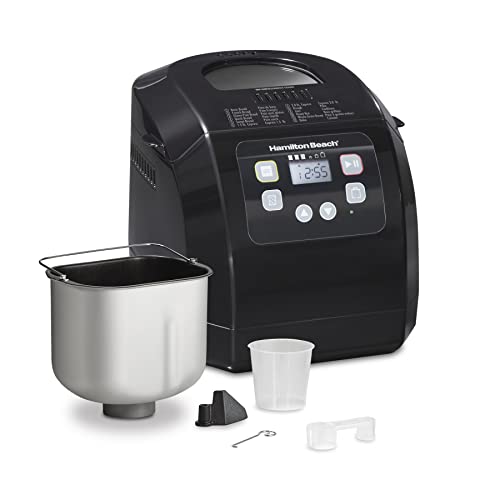
Hamilton Beach Automatic Bread Maker — Twelve Settings and a PFAS-Free Pan
The Automatic is the range’s straightforward baker, and its title’s most distinctive claim is not a programme at all: a PFAS-free nonstick pan with its kneading paddle, stated outright. For a growing number of households, the pan’s coating is a first-order concern — it is the surface the food touches, at temperature, for hours — and a title that specifies PFAS-free is answering that concern in print rather than leaving it to a questions page. Around that pan, the machine is digital and programmable with 12 settings plus gluten free, a 2 lb capacity, and a black finish: the essential repertoire, honestly counted, in the range’s darkest dress.
Twelve settings deserves defending against the assumption that more is better. The daily reality of home bread is a handful of programmes in rotation — the house loaf, a whole-grain, a sweet loaf for weekends, a dough cycle — and twelve covers that rotation with room to spare. What the Automatic omits, relative to its siblings, is the named artisan programme of the 29987, the dispenser’s convenience and the keto programme of the Premium; what it adds is the pan specification neither sibling states. A household that ranks coating transparency above programme breadth will find this the most interesting machine of the three, and its black finish suits kitchens built around dark appliances and worktops.
- Loaf capacity: 2 lb, per the title
- Programmable settings: 12, plus gluten free
- Pan: PFAS-free nonstick pan and kneading paddle, stated in the title
- Interface: digital, programmable
- Finish: black
- Pan care and programme detail: the Hamilton Beach Automatic Bread Maker listing carries both — check price on Amazon there
Strengths
- A PFAS-free nonstick pan stated in the title — the range’s clearest coating claim.
- Twelve settings cover the honest daily rotation without bloat.
- Black finish integrates with dark appliance suites.
Trade-offs
- No artisan or keto programme is named in the title.
- No dispenser; additions go in by hand at the signal.
- Delay start is not named in this model’s title, though its siblings state it — verify on the listing if overnight timing is essential.
Best for: coating-conscious households and straightforward bakers who want the essential repertoire in black. Not suited for: programme collectors, or anyone for whom a named delay start must appear in the title before purchase.
Three Models, One Table
| Model | Settings in title | Named programmes | Distinguishing claim | Finish |
|---|---|---|---|---|
| Hamilton Beach Digital Bread Maker 29987 | 14 | Artisan, gluten-free | Delay start; the balanced middle | White and stainless |
| Hamilton Beach Premium Dough & Bread Maker | 21 | Gluten free, keto | Automatic fruit and nut dispenser | Stainless |
| Hamilton Beach Automatic Bread Maker | 12 + gluten free | Gluten free | PFAS-free nonstick pan and paddle | Black |
What About the Older Hamilton Beach Models You Will Find Second-Hand?
Search long enough and the ghosts appear: earlier Hamilton Beach bread makers with lower settings counts, previous model numbers, and listings from the years when the range wore different styling. This guide links none of them, because the verified current range is three machines — but a second-hand shopper deserves orientation rather than silence. Older models in this family generally offered the same fundamental proposition — a 2 lb class loaf, a programme dial in the low teens, a delay timer — with fewer of the named special programmes that mark the current range: no keto, dispensers absent, pan coatings described in the language of their day rather than with a PFAS-free specification.
The practical advice for anyone holding a second-hand unit, or eyeing one at a price that tempts, is threefold. First, the pan and paddle are the machine: inspect them as you would a used car”s tyres, because a scratched pan or a missing paddle ends the bargain regardless of the motor’s health, and replacement availability for a discontinued model is a question to answer before money moves. Second, test with the simplest loaf in the manual and judge the machine on that evidence alone. Third, weigh the total honestly against the current Automatic, whose title-stated pan claim and full warranty may be worth more than the saving. Discontinued is not a synonym for bad — many of those machines are baking still — but it is a synonym for unverified, and this guide’s links stay with the verified three.
What Do the Programme Counts Actually Buy a Home Baker?
A settings count is a library size, and like a library, its value depends on the reader. The programmes a household will genuinely rotate through are fewer than any count here: a basic loaf, a whole-wheat, a sweet or enriched loaf, a rapid option for the day the bread box is discovered empty at four o’clock, a dough cycle, and — for the households that need it — gluten free. That is six. The counts of 12, 14 and 21 therefore describe headroom: the 29987’s artisan programme for the crusty chapter, the Premium’s keto for a dietary chapter, and a tail of speciality programmes that a household may use twice a year and be glad of both times.
The dough cycle deserves its own paragraph in any count discussion, because it quietly doubles a bread machine’s usefulness. Dough programmes turn the appliance into a kneading and proofing station whose output finishes elsewhere — rolls and pizza in the oven, flatbreads on a griddle, curtain-call projects like the shaped doughs discussed in Best Sewing Machine for Curtains‘s neighbouring craft pages, where patience with materials is likewise the whole skill. A household that only ever bakes loaves in the pan is using half its machine, whichever of the three it buys, and the Premium’s very name — Dough & Bread Maker — is the range’s own reminder of that second life.
When Should You Honestly Buy a Different Brand Instead?
Three circumstances, stated without brand loyalty. First, capacity: every current Hamilton Beach here bakes a 2 lb loaf, so a household that needs a substantially larger loaf, or a small 1 lb loaf for a single-person kitchen that hates waste, is outside this range’s design and should shop where those sizes live. Second, shape: these are vertical-pan machines in the classic bread maker form, and a baker determined to produce long, horizontal, bakery-silhouette loaves should look at brands whose pans are built that way. Third, specialisation: a household whose baking is entirely gluten-free may prefer a specialist machine whose whole programme architecture centres that flour, rather than a generalist range where gluten free is one setting among many — excellent, named, but one among many.
None of those exits diminishes the three machines reviewed here; they are the boundaries of an honest range, and knowing them is part of choosing well. High-volume households face a related boundary — a single 2 lb loaf per cycle is a rhythm, not a factory — and readers planning bread service at community scale will find the same capacity honesty applied to beverages in Best Commercial Self-Serve Coffee Machines, where urn sizes are likewise stated and respected. Buy inside the range when your week fits it; buy outside it when it does not; but do not buy a fourth Hamilton Beach model that does not currently exist, however confidently a lesser page lists it.
What Does a Week of Machine Bread Actually Look Like?
Monday’s loaf goes on delay start Sunday night — flour, water, yeast kept apart from the liquid until the machine’s hour arrives, which is the one technique delay baking demands. Wednesday is the dough cycle’s evening: pizza bases proofed by the machine and finished in a hot oven while the cook makes the sauce. Friday invites the special programme — the artisan loaf on the 29987, a fruit loaf under the Premium’s dispenser, the sweet loaf on the Automatic — and the weekend judges it. Across that week the machine has been a baker three times and a kneader once, and the household’s flour order, not its bread order, is what grows.
The habits that make the week work are small and learnable. Ingredients measured by weight rather than scooped behave the same every time, and a bread machine rewards sameness above all virtues. The pan is twisted out, the loaf shaken free, the paddle retrieved before it is baked into somebody’s slice as a surprise. The machine cools with its lid open; the pan is washed by hand, whatever the coating, because pans outlive machines whose pans were mistreated. None of this is burdensome, and all of it compounds: a household six months into this rhythm has a house loaf with a name, a settings notebook, and strong opinions about crust settings — which is to say, it has become a baking household that happens to use a machine.
What Mistakes Do New Bread Machine Owners Make?
The sunken loaf is the rite of passage, and its causes are a short litany: yeast that met hot liquid, flour measured by the scoop and therefore by the weather, a lid lifted mid-bake to admire the progress and letting the heat out at the critical moment. The second mistake is treating the delay timer as a refrigerator — perishable ingredients should not sit for hours at room temperature inside the pan, so overnight loaves are built from shelf-stable ingredients or not built overnight at all. The third is ignoring the paddle’s small tyranny: a loaf left sitting in the pan steams its own crust soft, so the shake-out promptness matters. Each of these is learned once and never repeated, which is precisely why this guide lists them — so they can be learned by reading instead.
How Do the Three Models Compare When the Same Loaf Is Baked in Each?
Imagine the house loaf — the same flour, the same yeast, the same water — loaded into all three machines on the same morning. The shared 2 lb architecture means the loaves emerge as cousins: same pan geometry family, same fundamental cycle of knead, rise and bake, same delay-start option on the two models whose titles state it. The differences appear at the margins where households actually live. The Premium’s owner, baking the fruit version, loads the dispenser and walks away; the other two owners set a mental note to return at the additions signal. The 29987’s owner, baking the crusty version, reaches for the artisan programme the others’ titles do not name. The Automatic’s owner, questioned at a dinner party about coatings, answers with a specification the others cannot quote from their titles.
That thought experiment is the honest core of this range: the bread is shared, the divergences are conveniences and specialities. It follows that price — checked on the listings, since this page prints none — should be weighed against how often a household will use the divergence, not against the loaf itself. A dispenser used weekly is worth a great deal; a dispenser used at Christmas is worth a sentence in a listing description. A keto programme used by a household that bakes keto is essential; to another household it is a word in a title. The three-model range, read this way, is less a ladder than a fork with three well-signposted paths, and the signposts are the named programmes and the one named pan.
What Flour, Yeast and Water Behaviour Should a New Owner Understand?
A bread machine is a small, obedient bakery that cannot taste, smell or adjust — which means the baker’s understanding must cover what the machine cannot do. Flour varies: the same branded flour absorbs differently across seasons and storage, and a dough that was perfect in January may want a spoon more water in August. The window in the lid exists for the first minutes of kneading, when the dough ball should be watched once — smooth, slightly tacky, clearing the pan’s sides — and corrected then, in spoonfuls, rather than judged hours later from a collapsed loaf. Yeast has its own etiquette: it fears direct contact with salt before mixing, fears hot liquid absolutely, and rewards being fresh, dry and measured rather than tipped from the jar by optimism.
Water temperature is the beginner’s most common silent error. Liquid that feels warm to a hand can be hot enough to kill yeast outright, producing the famous brick; liquid that is cold merely slows the rise and the machine’s fixed timetable may not forgive the delay. Room-temperature liquid is the safe household standard. Sugar, fat and enrichments each bend the loaf — tenderness, keeping quality, crust colour — and the programmes on these machines assume recipes balanced for them, which is why the guide’s recurring advice is to begin with the manufacturer’s own recipes for the first month: they are calibrated to these pans, these paddles and these cycles, and a household that masters them owns a baseline from which every experiment can be measured.
How Should the Pan and Paddle Be Cared For Across Years of Loaves?
The pan is the machine’s consumable soul. Its nonstick surface — PFAS-free on the Automatic, per its title — decides whether loaves release cleanly in year three as they did in week one, and its enemies are metal utensils, abrasive pads and the dishwasher’s long hot soak. The household ritual that preserves it is brief: soak briefly in warm water if residue insists, wash with a soft cloth, dry fully, and never pry a loaf loose with anything harder than a plastic or silicone tool. The paddle deserves the same gentleness and one extra habit — remove it, or at least account for it, before slicing, and store it somewhere findable, because a paddle lost in a loaf or a drawer is the smallest part capable of stopping an entire baking programme.
Between bakes, the machine itself asks little: crumbs brushed from the chamber, the lid left ajar so yesterday’s steam does not become tomorrow’s odour, the exterior wiped of the flour dust that baking households generate like weather. Delay-start users add one discipline — the pan loaded at night should be checked in the morning before the machine is opened fully, and any loaf that sat through a power cut mid-cycle should be judged with a nose and discarded on suspicion rather than optimism. Machines treated this way routinely outlast the kitchens they were bought for, which is why the second-hand chapter of this guide could be written with a straight face.
What Does a Loaf From One of These Machines Cost a Household in Practice?
The arithmetic is worth doing once, honestly, with your own local prices for flour and yeast rather than with numbers printed here — ingredient prices move, and this page’s no-static-price rule extends to groceries as much as to appliances. The shape of the answer, though, is stable across kitchens: a 2 lb machine loaf is built from roughly a pound and a half of flour’s worth of ingredients, a measure of yeast, water, salt and a little fat or sweetener, plus a baking cycle’s electricity. Against that, weigh the bakery loaf it replaces — and weigh it fairly, because the machine loaf’s true competitors are the good bakery’s output, not the cheapest wrapped loaf, since households that bake at home are usually chasing quality and freshness rather than the floor price of bread.
The less countable returns belong in the ledger too. A loaf timed to breakfast changes a morning; a dough cycle that produces pizza bases on demand changes a Friday; a fruit loaf from the Premium’s dispenser changes what a household gives as gifts in December. Machines are usually justified in spreadsheets and actually justified in routines, and the routine test for any of these three is simple: will the household bake weekly by the second month? If yes, the economics resolve themselves across the machine’s long life. If the honest answer is monthly, the purchase can still be right — but it should be made as a pleasure purchase, eyes open, rather than as a savings scheme.
How Do Gluten-Free and Keto Programmes Differ From the Standard Cycle?
Gluten-free dough is not dough with a substitution; it is a batter with ambitions, and it behaves differently at every stage — it does not knead into an elastic ball, it does not rise on the same gases in the same way, and it punishes a cycle designed for wheat. A named gluten-free programme, present in all three titles here, exists to change the machine’s timing and handling for that batter: gentler mixing, a rise profile suited to alternative flours and gums, a bake that sets the structure before it can slump. Households baking gluten-free should treat the named programme as essential infrastructure rather than a badge, and should begin with recipes written for machines, because gluten-free baking forgives improvisation even less than wheat baking does.
Keto baking, named on the Premium, is a different negotiation: low-carbohydrate flours such as almond and coconut absorb liquid at rates that surprise wheat bakers, and the resulting loaves are smaller in spirit even at the same pan size, denser, and judged by different pleasures. A named keto programme signals that the machine’s library includes timing for such mixtures. Neither programme turns its machine into a medical device or a diet plan — they are baking cycles, and this guide describes them as such — but for households whose bread must fit those frameworks, the difference between a named programme and a hopeful guess at the basic cycle is the difference between a loaf and a lesson.
What Troubleshooting Path Fixes the Five Commonest Loaf Failures?
The brick — dense, low, gummy — is usually yeast: dead from hot liquid, old from an open jar, or smothered by salt contact before mixing. Change one variable, retest with the basic loaf, and the brick rarely survives the week. The mushroom — a loaf that over-rises and collapses or spills its crown — is usually abundance: too much yeast or sugar for the pan, or a warm kitchen hurrying a delay cycle. The pale loaf points at sugar or milk solids reduced by a well-meant recipe edit, or a crust setting chosen too light for the household’s taste. The holey loaf, full of tunnels, often traces to dough a touch too wet, which the kneading-window check described earlier exists to catch. The loaf welded to its pan is a care issue, not a baking one, and its fix is in the pan chapter above.
Notice what this list is not: it contains no machine faults. In the first year of ownership, nearly every failed loaf is an ingredient or technique event, which is encouraging news disguised as blame — it means the fix is in the baker’s hands and costs a loaf’s worth of flour. Keep a notebook beside the machine for the first month, recording recipe, any change, and the result in a sentence. By the second month the notebook will have converted your machine from an appliance with settings into a bakery with a house style, and failures will have become rare enough to be interesting rather than discouraging.
How Should a Household Choose Its First Month’s Baking Curriculum?
Week one is the basic loaf, baked twice, with nothing changed between the two bakes except the baker’s attention — the second loaf teaches what the machine does when the recipe holds still. Week two introduces the whole-grain variation, where flour’s thirst becomes visible and the kneading-window check earns its keep. Week three belongs to the dough cycle: pizza or rolls, shaped by hand and finished in the oven, which is the week the machine stops being a loaf appliance and becomes a bakery colleague. Week four is the signature experiment — the artisan programme on the 29987, a dispenser fruit loaf on the Premium, a sweet loaf on the Automatic — chosen to test the very feature that decided the purchase.
That curriculum is deliberately conservative, because bread machines reward foundations in a way that scattered experimentation does not. Each week isolates a variable — flour type, cycle type, programme type — and the notebook records the outcome while the variable is still identifiable. Households that skip the curriculum and begin with a heavily adapted internet recipe spend their first month unable to say whether the machine, the recipe or the adaptation failed, and a discouraging fraction of them conclude, wrongly, that the machine did. The machine is the constant; the curriculum makes the baker the variable who improves.
What Place Does a Bread Machine Hold in a Kitchen That Also Bakes in an Oven?
Partnership, not rivalry. The oven remains the instrument of crust, scale and shape — the boule, the baguette, the tray of rolls for a crowd — while the machine owns the weekday loaf, the timed breakfast loaf and the tireless kneading that hands resent in July. Many serious home bakers run exactly this division of labour and consider the machine the reason their oven baking improved: daily bread stopped depending on their time, so oven sessions became occasions rather than obligations. The dough cycle is the treaty between the two instruments, and the household that discovers it usually finds the machine’s counter space defended thereafter by the whole family.
There is also the matter of the cook’s hands across a lifetime. Kneading is joyful in one’s twenties and a negotiation in one’s sixties, and a machine that kneads without complaint extends a baker’s active years in a way that deserves plain statement. The three models here, with their shared 2 lb architecture and their dough provisions, serve that long view as faithfully as they serve next Tuesday’s sandwiches.
A Buyer’s Checklist for a Three-Model Range
Because the range is small, the checklist can be short and complete. First, name your non-negotiable programme — artisan, keto, or neither — and let it strike the models it strikes. Second, decide whether additions are a weekly habit or a yearly event, because that answer alone values the Premium’s dispenser correctly. Third, take a position on pan coating: if the PFAS-free specification matters to your household, the Automatic has already won its argument and the remaining questions are formalities. Fourth, choose the finish by the kitchen the machine will live in, without embarrassment — an appliance used daily for a decade is furniture, and furniture is allowed to be chosen partly by eye. Fifth, read the full programme list of your chosen model on its listing before ordering, because the titles here name only the headline settings, and the complete menu is part of what you are buying.
Sixth — and this is the checklist item unique to a small range — resist the urge to keep shopping for a fourth option inside the brand. It does not exist in the current line, and hours spent hunting it are hours taken from the first month’s baking curriculum, which is where the machine’s value is actually created. The three machines in this guide are the range; the range is enough; the bread is waiting.
What Should Be in the Pantry Before the Machine Arrives?
Strong bread flour in a quantity that assumes enthusiasm, a fresh supply of yeast stored as its maker directs, fine salt, a neutral oil or butter as your household prefers, and the patience to weigh rather than scoop. Add whole-wheat flour for week two, and the fruit and nuts the Premium’s dispenser exists for if that is your model. A simple kitchen scale is the one accessory this guide will actively campaign for: bread machines are consistency engines, and weighed ingredients are the fuel consistency runs on. Everything else — the notebook, the bench scraper, the cooling rack — most kitchens already own, and the rest can be acquired at the pace the baking itself dictates.
How Does Slicing, Storing and Freezing Machine Bread Work Best?
A machine loaf should cool completely before it meets a knife — an hour on a rack is the honest wait — because a warm loaf’s crumb is still setting, and slicing early compresses it into gumminess that no programme can be blamed for. Slice with a long serrated knife in a sawing motion, letting the blade do the work, and slice only what the meal needs if the loaf is to stay at its best for days; a cut face dries faster than a crust does. For the household’s routine keeping, a bread box or a cloth bag at room temperature serves a two-to-three-day loaf better than the refrigerator, whose cold accelerates staling in a way that surprises everyone who learns it.
Freezing is the machine loaf’s superpower, and the 2 lb format conspires in its favour. Slice the whole cooled loaf, freeze the slices with small separations or in a bag they can be pried from individually, and the household gains toast-on-demand for weeks — which is also the small household’s answer to the capacity question raised earlier in this guide. Frozen slices go directly to the toaster; a whole frozen loaf thaws on the counter in its bag. Households that bake ahead this way often settle into a fortnightly rhythm of two loaves in an afternoon, one for the week and one for the freezer, and the machine’s delay start becomes a bonus rather than a necessity.
Why Does This Brand Keep Its Range Small, and Is That a Strength?
Appliance ranges usually sprawl because shelf space rewards sprawl: more models, more listings, more chances to catch a searching eye. A three-model range is the opposite strategy, and it carries information a sprawling range cannot — it says the maker believes the category’s real questions are few. Capacity is settled at 2 lb. The interface is digital across the board. The remaining questions are the ones this guide has spent its length on: how wide a programme library, whether additions should be automated, and what the pan should be made of. A buyer can hold three questions in mind; nobody can hold fourteen.
Small ranges also age more honestly. When a model is discontinued in a three-model family, the gap is visible and the successor is usually legible; in a sprawling range, models blur into one another until nobody — including, one suspects, the maker — can say which machine is the recommendation. This guide’s prose chapter on older models exists because readers will meet the ghosts regardless, but the current family’s clarity is the reason the chapter could stay short. Three machines, three arguments, one loaf size: it is a range a buyer can finish reading about, which in this category counts as a luxury.
A last word on expectations, offered because a three-model guide can afford candour. None of these machines will make a household love bread it does not already love, and none will rescue a recipe that was never balanced. What they do — reliably, on a timer, with a kneading arm that never tires — is convert flour and intention into a warm loaf at the hour of your choosing, hundreds of times, for years. Households that understand the bargain in those terms are the ones still baking, happily and unremarkably, long after the purchase debates are forgotten. Choose your of the three, weigh the flour, and let the first month’s curriculum begin.
What Should a Gift Buyer Know About Giving One of These Three?
A bread machine is a gift with a follow-through: it proposes a habit, and the giver who understands that gives the machine its best start. Choose the model by the recipient’s kitchen as honestly as you would choose for your own — the fruit-loaf baker gets the Premium’s dispenser, the coating-conscious household gets the Automatic’s pan, the all-round cook gets the 29987 — and then commit the small generosity that decides whether the machine is used in its first week: a bag of strong bread flour, fresh yeast, and a note naming the first recipe to try. Gifts that arrive with their first session provisioned get used; gifts that arrive as bare hardware wait for a shopping trip that may take a month to happen.
There is one recipient for whom this gift should not be given, and candour requires naming them: the baker who loves the full manual craft and has said so. For that cook, the machine is not a labour-saver but an interruption, and the thoughtful gift is flour, a banneton, or the oven companion surveyed in the Related Guides below. Everyone else — the busy parent, the new homeowner, the grandparent whose hands have begun to negotiate with dough — is a candidate for whom one of these three machines, chosen by the arguments in this guide, can be a genuinely liberating present.
And if the choice between the three still feels finely balanced after all of the above, let the tie be broken by the loaf you can picture most clearly. The fruit loaf sliding from the pan on a winter morning, the crusty artisan round beside a soup pot, the plain dependable sandwich loaf sliced for the week’s lunches — whichever image arrived first and stayed longest is the household’s true order. Machines are bought with specifications, but they are kept with pictures like those, and a range of three honest models makes following the picture unusually safe: every path from it leads to a machine that will bake it well.
One practical footnote for households converting from oven-only baking: your flour stock will turn over faster than you expect, and your yeast discipline will matter more, because the machine’s reliability exposes ingredient staleness that irregular hand baking used to hide. Buy yeast in quantities matched to a weekly rhythm, store it as directed, and date the bag. The machine will do its part with complete fidelity; the pantry’s part is simply to be worthy of it.
Finally, a note on where the machine should live. A bread machine exiled to a high cupboard becomes a monthly appliance; a bread machine resident on the counter becomes a weekly one, and the difference between those two lives is larger than any difference among the three models in this guide. Claim the counter space before the box arrives — a stretch with a socket, room for the pan to cool and the loaf to rest — and the purchase has already half succeeded. The other half is the first loaf, baked within forty-eight hours of delivery, while enthusiasm is still the household’s prevailing weather.
Final Recommendation
Start with the 29987 if your baking is the full everyday repertoire with ambitions toward artisan loaves; step up to the Premium if fruit loaves, keto baking or the widest dough library describe your kitchen; choose the Automatic if the PFAS-free pan and a clean dozen settings are the honest match. All three bake the same 2 lb promise, and the range’s smallness is its integrity — three real machines, each with a reason to exist. Buy the one whose named programmes match the loaves you actually described to yourself while reading, and this short list will have done what long lists promise and rarely deliver.
Frequently Asked Questions
Why does this guide only have three picks?
Because three is the truth: Hamilton Beach currently sells exactly three bread maker models on Amazon, verified for this guide. Older models are discussed in prose so second-hand shoppers can place them, but they are not dressed up as current picks, and no fourth model has been invented to fill a table.
Which model is best for gluten-free baking?
All three name a gluten-free setting in their titles, so the choice turns on the rest of your baking: the Premium adds keto and the dispenser, the 29987 adds artisan, the Automatic adds the PFAS-free pan. A wholly gluten-free household may also weigh the specialist-brand option discussed in the guide.
What does the fruit and nut dispenser actually do?
It holds additions — raisins, nuts, seeds — and releases them into the dough at the point in the cycle when they will distribute without being shredded by early kneading. It appears only on the Premium in this range, and for fruit-loaf households it is the single feature most likely to decide the purchase.
Can these machines make dough for the oven?
Dough work is central to the range — the Premium carries Dough in its model name. A dough cycle kneads and proofs dough that you then shape and bake in a conventional oven, which is how these machines serve pizza nights and roll batches as well as loaves.
Is a 2 lb loaf the right size for a small household?
It is the only size this current range offers, stated in all three titles. Small households typically bake the 2 lb loaf and freeze slices, which toasts from frozen admirably; a household that truly needs a smaller loaf should heed the guide’s section on when another brand fits better.
Related Guides
Bread is dough with patience, and the ovens that finish a baker’s ambitions are surveyed in Best Bread Ovens, a live companion for readers whose dough cycle output deserves a worthy bake.


