What's inside
- Buying a Washer With Its Soap Supply Built In: Where to Shop and What to Check First
- Key Takeaways
- Quick Picks
- Why Does a Whole Category Come Down to Two Manufacturers?
- The Six Tank-Equipped Washers, Compared on Their Own Paperwork
- What Separates a Real Onboard Tank From a Bottle Hanging Off the Gun?
- How Do You Actually Wash With Detergent — Tank, Dwell, Rinse?
- What Should You Check Before Trusting Any Tank Washer’s Numbers?
- Which Mistakes Ruin Detergent Washing Sessions?
- Final Recommendation
- Frequently Asked Questions
- Related Guides
As an Amazon Associate I earn from qualifying purchases. This post may contain affiliate links at no extra cost to you.
cottageverdict.com is reader-supported. When you buy through links on our site, we may earn an affiliate commission.
Buying a Washer With Its Soap Supply Built In: Where to Shop and What to Check First
The best pressure washers with onboard detergent tanks solve a small, specific annoyance: where the soap lives while you work. On a conventional washer, detergent means a foam cannon clipped to the gun, a siphon tube dangling into a bottle at your feet, or a bucket you keep kicking across the driveway. An onboard tank moves the chemistry into the machine itself, filled once at the tap and metered as you pull the trigger. Every pick below is sold on Amazon, each name links to its listing so you can check price on Amazon and read the exact title wording, and all six listings state the tank in plain language — that was the entry ticket for this guide.
Honesty about the shape of this market has to come before any ranking, because the shape is unusual. Shop for washers with genuinely onboard detergent storage — a tank named in the listing, not an accessory bottle — and you will find the shelf is dominated by just two brands: Westinghouse and WEN. That is why this guide contains four Westinghouse machines and two from WEN, and nothing else. It is not favouritism and it is not a sponsored arrangement; it is what the category actually looks like when the tank has to be part of the machine rather than an afterthought clipped onto it. Other famous washer brands mostly treat detergent as an attachment business, and their machines were therefore ineligible here by the guide’s own rule.
One more piece of upfront honesty: five of these six machines are electric, and one — the Westinghouse WPX2700 — runs on gasoline. It is flagged everywhere it appears, because a buyer filtering for a quiet, corded, maintenance-light machine should never discover a fuel tank waiting in the box. Beyond that divide, the six separate on declared pressure and flow, on motor type (two are brushless), on nozzle counts, and on one genuinely thoughtful stability feature that Westinghouse repeats across its electric line.
Key Takeaways
- This is a two-brand niche in practice: four Westinghouse models and two WEN models make up the whole credible field of washers whose own listings declare an onboard detergent or soap tank.
- Every listing here states its numbers, but read the qualifiers — Westinghouse quotes maximum pressure and maximum flow on its electric models, while both WEN machines and the gasoline WPX2700 state their figures without the word “max”.
- The WPX2700 is a gasoline machine, the only one in the guide; it also posts the highest declared flow at 2.3 GPM and needs no power outlet at all.
- Brushless motors appear twice: the WEN PW3000E and the Westinghouse WPX3400e, which also carries the highest declared pressure in the group at 3400 Max PSI.
- Westinghouse’s electric trio share a recognisable kit — anti-tipping design, a pro-style steel wand and a five-nozzle set — while the WEN pair keep their titles shorter and their nozzle arrangements unstated.
Quick Picks
| Washer | Badge | The one-line case for it |
|---|---|---|
| WEN PW3000E 3000 PSI | Brushless soap flagship | The strongest WEN here, pairing a brushless motor and 2.0 GPM with the tank this category exists for. |
| WEN PW2200 2200 PSI | The modest WEN | A simpler, gentler route into onboard detergent at 2200 PSI and 1.65 GPM. |
| Westinghouse ePX3100 | Anti-tipping compact | 2300 Max PSI with a steel wand, five nozzles and a design that resists being pulled over by its own hose. |
| Westinghouse ePX3500 | The stronger twin | Same kit and flow as the ePX3100 with the pressure ceiling raised to 2500 Max PSI. |
| Westinghouse WPX3400e | Top declared numbers | 3400 Max PSI, 2.0 Max GPM and a brushless motor — the biggest paperwork in the guide. |
| Westinghouse WPX2700 | The lone gasoline pick | 2700 PSI and a field-leading 2.3 GPM with no cord, for properties where outlets are the problem. |
Why Does a Whole Category Come Down to Two Manufacturers?
Start with what “onboard” has to mean to be worth anything. A useful tank is plumbed into the machine, sized for a real session rather than a demonstration, and filled and rinsed without tools. Building that into a washer costs money in moulds, seals and warranty exposure — detergent is mildly corrosive, and a tank that leaks into a pump is a failure the manufacturer owns. Many brands look at that bill and choose the cheaper theatre of accessories: a foam bottle in the box, a siphon tube in the manual, and the word “detergent” in the marketing without any tank in the machine. Those washers were excluded here, and excluding them is what leaves the shelf looking so narrow.
Westinghouse and WEN, for different reasons, both committed to the plumbed tank. Westinghouse built an entire electric family around it — the ePX and WPX lines repeat the same soap-tank promise across several pressure classes, which suggests the tank is part of the platform rather than a trim level. WEN, a brand better known for generators and woodworking tools, put the tank at the centre of its washer pitch: both of its listings here name the onboard detergent tank in the same breath as the pressure figure. When two manufacturers design around a feature and everyone else accessories around it, a buyer’s guide has two honest options — pad the list with near-misses, or present the real field and explain it. This guide explains it.
It is worth pausing on why the tank, of all features, became the dividing line. Pressure washing spent its first decades as a force business — the marketing was a single escalating number — and detergent was treated as the owner’s problem, solved with whatever bottle came to hand. The shift visible in these two brands is a maturity shift: the recognition that most household dirt is held by films and bonds that chemistry breaks better than force does, and that a machine which carries its own chemistry gets used more gently, more often and to better effect. A category defined by a tank is really a category defined by that philosophy, and the narrowness of the field simply shows how recently the philosophy arrived.
The practical consequence for you is that choosing within this category is less about brand and more about tier. Decide your pressure class, decide electric or gasoline, decide whether a brushless motor matters to you, and the field of six collapses into a shortlist of one or two almost immediately. The sections below are organised to make exactly those decisions easy, using only figures and features the listings themselves declare.

WEN PW3000E 3000 PSI — Brushless soap flagship
The PW3000E is WEN’s full-strength answer in this niche: a stated 3000 PSI, a stated 2.0 GPM, a brushless electric motor and the onboard detergent tank named in the same title. Note what WEN does not write — there is no “max” attached to either figure, which makes its paperwork read more plainly than Westinghouse’s. That does not prove the WEN delivers more in practice; rating conventions differ between brands, and this guide compares declared figures rather than inventing a conversion. It does mean the PW3000E’s claims are stated in the least qualified language of any electric pick here.
Brushless is the word to dwell on. A brushless motor has no carbon brushes wearing against a commutator, which generally translates into a longer service life, less maintenance and a motor that runs more efficiently for its size. In a pressure washer — a tool that lives in garages, gets used in bursts and is expected to work for years — that durability argument matters more than it would in a gadget. Pair it with the highest electric flow figure in this guide, matched only by the WPX3400e’s maximum, and the PW3000E becomes the soap-and-rinse specialist: lay detergent from the tank, then move a genuinely generous volume of water to carry the loosened film away.
Picture its natural session. A pair of family cars wearing a month of road film, a caravan or trailer with green streaks down one side, a run of vinyl fencing gone grey at the base. Each of those is a chemistry job wearing a pressure costume: the tank does the persuading, the flow does the carrying, and the pressure is mostly there to keep the fan energetic at a safe working distance. Owners whose washing calendar looks like that will find this WEN’s declared balance — strong figures, brushless motor, tank front and centre — aimed squarely at them.
One further thought on positioning: the PW3000E is the machine in this guide most likely to satisfy a buyer who cross-shops the wider washer market and keeps returning to the tank requirement. Its figures stand comparison with mainstream mid-range electrics that offer no tank at all, which removes the usual niche tax — the sense that choosing the special feature means accepting a weaker base machine. Here the base machine is the strongest WEN on the page and the feature is plumbed in. That combination, more than any single number, is the PW3000E’s real claim on your attention.
- Pressure as listed: 3000 PSI, stated without a maximum qualifier
- Flow as listed: 2.0 GPM
- Motor: brushless, electric
- Detergent storage: onboard detergent tank, named in the title
- Nozzle set: the title does not enumerate a nozzle count for this model
- Power source: corded electric — no fuel, no exhaust
Strengths
- Brushless motor promises a long, low-maintenance service life.
- Plainly stated pressure and the joint-best electric flow in the guide.
- Tank is central to the design rather than an accessory afterthought.
Trade-offs
- No nozzle count is declared, so pattern variety is unverified from the title.
- WEN’s washer support network is thinner than its generator reputation suggests.
- As WEN’s flagship here, it sits in the brand’s upper tier for this category.
Best for: soap-heavy routines — vehicles, trailers, fencing — where flow and motor longevity matter daily.
Skip this one if you want a declared, counted nozzle set confirmed before purchase.
Our verdict: the PW3000E is the most persuasive electric all-rounder in this two-brand field — check its price on Amazon under the full PW3000E name.

WEN PW2200 2200 PSI — The modest WEN
The PW2200 keeps the family’s defining feature — the onboard detergent tank is right there in its title — and trims everything else down a class: 2200 PSI stated plainly, 1.65 GPM, and no brushless claim. That is not a lesser machine so much as a more honest match for a large share of real washing. Most detergent work is gentle work. Soap is applied at low energy, dwell time does the loosening, and the rinse that follows wants volume and control rather than force. A 2200 PSI ceiling, used at sensible distances, covers vehicles, patio furniture, siding, bikes, bins and the average cottage deck without ever approaching the numbers that strip paint.
The flow figure deserves respect rather than apology. At 1.65 GPM the PW2200 moves noticeably more water than the entry-level washers that crowd the bottom of the wider market, and flow is the figure that decides how a rinse feels: whether foam sheets off a car panel in one pass or needs three, whether a soaped fence run clears before the detergent dries. Owners stepping up from a bargain washer often report that the flow, not the pressure, is the upgrade they actually notice, and on declared numbers this modest WEN has flow to spare for its class.
Where the PW2200 asks for faith is in the details its short title omits. No nozzle count is declared, no wand material is named, no stability feature is claimed. WEN’s title style is terse across both its picks here, and terseness cuts both ways — fewer claims means fewer claims to be wrong about, but a buyer who cares about pattern variety should read the full listing’s contents list carefully before ordering, and treat anything not written there as unconfirmed.
There is also a confidence argument for starting here. New pressure-washer owners make their mistakes in the first month — too close, too narrow, too long on one spot — and a gentler ceiling shrinks the cost of every one of those lessons. The PW2200 lets a beginner learn distance and rhythm on a machine whose worst behaviour is comparatively forgiving, while still teaching the full detergent routine, tank and all, that carries over unchanged if they ever step up. Skills transfer upward perfectly; caution learned on a strong machine usually arrives via a damaged surface.
- Pressure as listed: 2200 PSI, stated without a maximum qualifier
- Flow as listed: 1.65 GPM
- Motor: electric; the title makes no brushless claim for this model
- Detergent storage: onboard detergent tank, named in the title
- Nozzle set: no count is given in this listing’s title — confirm the contents on the full listing page
- Power source: corded electric
Strengths
- The tank feature at the gentlest, most forgiving pressure class in the guide.
- Flow is strong for the class, which is what detergent rinsing actually consumes.
- Plainly worded figures with no maximum qualifiers to decode.
Trade-offs
- Least headroom here for ground-in driveway staining or heavy moss.
- Short title leaves nozzle and wand details undeclared.
- No brushless motor claim, unlike its bigger sibling.
Best for: vehicle-and-patio households that want onboard soap without flagship force or flagship fuss.
Not suited for: large stained hardscapes that need every declared unit of pressure available.
Bottom line: judge the PW2200 as a detergent machine first and a pressure machine second — see the PW2200 on Amazon and read its contents list closely.

Westinghouse ePX3100 — Anti-tipping compact
The ePX3100 introduces the Westinghouse electric formula: 2300 Max PSI, 1.76 Max GPM, an onboard soap tank, a pro-style steel wand, a five-nozzle set, and a feature with a name that tells a story — Anti-Tipping Technology. Anyone who has used a tall, narrow electric washer knows the story. You walk away from the machine, the hose goes taut, and the whole unit topples onto the concrete with a crack that makes you check the casing before you check your work. A design that plants itself against that tug is not a gimmick; it addresses the single most common way these machines get damaged.
The qualifiers need their moment. Westinghouse writes “Max” in front of both figures on this model, so the honest reading is a ceiling of 2300 PSI and a ceiling of 1.76 GPM rather than a guarantee of either at every moment. Even discounted, the package is well judged for its class: five nozzles is the most generous declared pattern set in this guide, shared with its Westinghouse siblings, and a steel wand outlasts and out-feels the plastic lances that flex in the hand on cheaper machines. The title’s own job list — cars, fences, driveways, home, patios — is the standard circuit, and the ePX3100’s declared kit covers it without strain.
Consider this the control sample of the Westinghouse line. Everything above it in the family is a variation on its theme — more pressure, or a brushless motor — so the ePX3100 is where to start if you want the platform’s tank, wand, nozzles and stability at the entry rung. Owners with small-to-medium properties, a car or two and no ambitions toward restoring neglected concrete will rarely find its ceiling in normal use, and its stability manners will suit households where the machine gets pulled around by different family members of different strengths.
The job list in its title is worth a second look, because it quietly includes fences — the surface where an onboard tank and a five-nozzle set cooperate best. Fence runs are long, vertical and uniformly dirty, which means detergent applied evenly, a fan pattern wide enough to keep pace, and a machine that stays upright when the hose snags on a post base mid-run. The ePX3100 reads as if it were specified by someone who has washed exactly that fence, in exactly that order, and got tired of picking the machine up.
- Pressure as listed: 2300 Max PSI — a ceiling figure, in the manufacturer’s wording
- Flow as listed: 1.76 Max GPM, likewise a maximum
- Detergent storage: onboard soap tank, named in the title
- Wand: pro-style steel wand
- Nozzles: 5-nozzle set
- Stability: Anti-Tipping Technology, per the title
Strengths
- Anti-tipping design answers the most common real-world washer accident.
- Five declared nozzles and a steel wand give it the fullest kit list of the electrics.
- The platform’s entry point — same tank and wand story as its pricier siblings.
Trade-offs
- Both headline figures are maximums, so everyday output sits somewhere below them.
- Lowest pressure ceiling among the Westinghouse electrics here.
- No brushless motor is claimed for this model.
Best for: smaller properties and shared households that value stability and a complete nozzle kit.
Not suited for: people who read maximum figures as everyday figures and would feel short-changed.
The honest summary: the ePX3100 is the sensible front door to the Westinghouse tank family — look up the ePX3100 on Amazon and note the “Max” wording in its title.
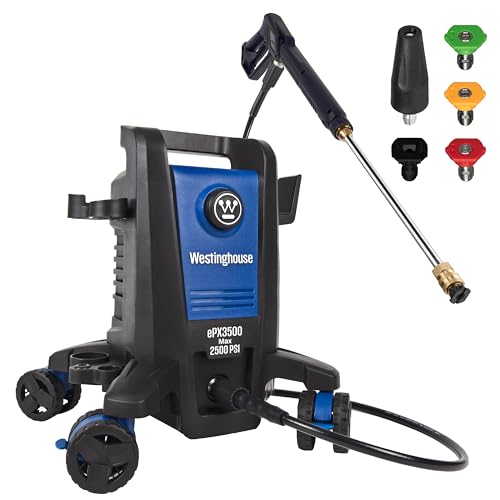
Westinghouse ePX3500 — The stronger twin
Place the ePX3500’s title beside its sibling’s and the two read almost identically — same anti-tipping design, same onboard soap tank, same pro-style steel wand, same five-nozzle set, same job list, same 1.76 Max GPM — with a single difference: the pressure ceiling rises from 2300 to 2500 Max PSI. Westinghouse is selling a step, not a different machine, and this guide treats it that way rather than inventing distinctions the listings do not support. The question the ePX3500 poses is narrow and practical: is the extra declared headroom worth stepping up for?
Headroom buys two things. The first is distance tolerance: a stronger ceiling lets you hold the wand a little further from a stubborn surface and still move the dirt, which keeps the fan wider, the pass quicker and the risk of etching lower. The second is reserve for the worst jobs of the year — the spring driveway, the mossy north wall — where a machine at its absolute limit works slowly and a machine with something in hand works calmly. For weekly car-and-patio duty, the extra ceiling will go unused for months at a time; for a property with real hardscape, it earns its place a few times a year and is merely reassuring the rest.
Flow being identical between the twins sharpens the choice, because rinsing — the thing you do most — will feel the same on both. If your washing is rinse-led and soap-led, the ePX3100’s case is strong; if it is stain-led, the ePX3500’s ceiling is the honest reason to climb. Either way you are buying into the same tank, wand and stability package, and that package, not the badge number, is the platform’s real identity.
Sibling steps like this one also reveal how to shop the wider Westinghouse line with clear eyes. When two titles differ by a single figure, the manufacturer is telling you the platform is constant and the ceiling is the product. That honesty is useful beyond this pair: it means accessories, nozzles and ownership experience carry across the step, so an owner who starts with the ePX3100 and later meets a bigger property already knows exactly what the ePX3500 will feel like — the same machine with more in reserve. Product lines that change everything between rungs make upgrading a gamble; this one makes it arithmetic.
- Pressure as listed: 2500 Max PSI, a step above its sibling’s ceiling
- Flow as listed: 1.76 Max GPM, identical to the ePX3100
- Detergent storage: onboard soap tank, named in the title
- Wand: pro-style steel wand
- Nozzles: 5-nozzle set
- Stability: Anti-Tipping Technology, per the title
Strengths
- Extra pressure headroom for the year’s worst jobs without changing anything else.
- Full platform kit: tank, steel wand, five nozzles, anti-tipping stance.
- Identical flow to its sibling keeps rinsing performance constant across the step.
Trade-offs
- The step buys ceiling, not a different machine — gentle users may never feel it.
- Figures remain maximums, with the same reading discipline required.
- No brushless claim; that distinction is reserved for the WPX3400e above it.
Best for: owners with genuine hardscape — drives, stone, moss-prone walls — who want the platform plus reserve.
Not suited for: rinse-and-soap households, for whom the ceiling would be decoration.
Where it lands: the ePX3500 is a deliberate, single-variable upgrade — find the ePX3500 on Amazon and compare its title line against the ePX3100’s before paying for the step.
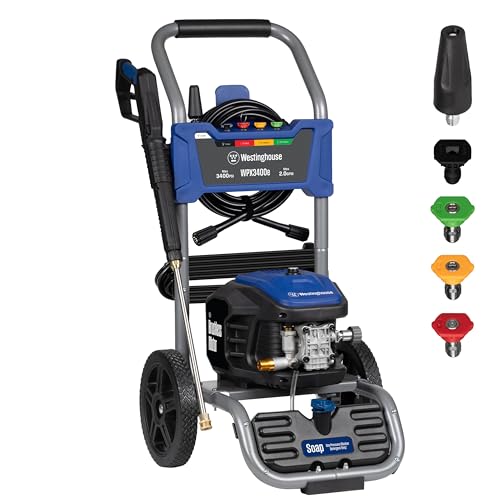
Westinghouse WPX3400e — Top declared numbers
The WPX3400e is where the Westinghouse electric line stops being modest: 3400 Max PSI, 2.0 Max GPM, a brushless motor, the onboard soap tank, a spray gun and wand, and a five-nozzle set. Every headline item in the family’s vocabulary appears in this one title, and the pressure ceiling is the highest declared by any electric pick in the guide. It is also, read carefully, the most qualified paperwork here — both figures carry “Max”, and no steel-wand or anti-tipping language appears, so the honest summary is that this model trades some of the ePX line’s named hardware details for a brushless motor and substantially bigger ceilings.
Who needs an electric washer claiming this class of pressure? Owners whose properties mix the delicate and the brutal: a car and a boat on the same Saturday as a stained concrete apron, oil-marked garage threshold or a long, green retaining wall. The five-nozzle set is the mediator — patterns let a strong machine behave gently — and the brushless motor suits the heavier workload, since machines bought for big properties tend to run longer per session and more sessions per year. The tank keeps the detergent half of those marathons self-contained, which matters more the longer the job runs: nobody wants to manage a siphon bottle across a two-hour wash.
Treat the ceiling with the respect due to any strong tool. At the top of its range this machine can damage soft timber, lift paint and scar softer stone if the wrong nozzle meets the wrong surface at close range, so the discipline described later in this guide — test on a discreet patch, start wide, close distance gradually — applies with double force. Power in reserve is a virtue; power used carelessly is a repair bill, and the WPX3400e simply widens both sides of that equation.
Notice, too, what the WPX3400e’s title does with the word “furniture” — its job list is the only one here that adds patios and furniture explicitly to the usual cars, fences, driveways and homes. That small expansion hints at the intended owner: someone whose washing round includes the outdoor room itself, table legs, chair frames and all, in the same session as the drive. A machine pitched that way needs range more than it needs any single extreme, and range — from a soap-soft fan to a ceiling few electrics declare — is exactly what this title assembles.
- Pressure as listed: 3400 Max PSI, the highest electric ceiling here
- Flow as listed: 2.0 Max GPM, matching the PW3000E’s stated flow as a maximum
- Motor: brushless, per the title
- Detergent storage: onboard soap tank, named in the title
- Nozzles: 5 nozzle set; spray gun and wand included
- Not claimed in this title: the steel wand wording and anti-tipping line of the ePX models — check the full listing if either matters to you
Strengths
- Biggest declared electric numbers in the guide, with a brushless motor behind them.
- Five nozzles let a strong machine throttle its behaviour down for delicate work.
- Tank capacity thinking suits long, mixed sessions on larger properties.
Trade-offs
- Maximum-qualified figures demand the usual discount when comparing across brands.
- Some ePX hardware details are not repeated in this title.
- Its ceiling is genuinely capable of damaging soft surfaces in careless hands.
Best for: larger, mixed properties where one electric machine must cover cars and concrete alike.
Not suited for: small, delicate-only routines where its headroom would never be touched.
In short: the WPX3400e is the electric ceiling of this niche — view the WPX3400e listing on Amazon and read its full contents against the ePX pair.

Westinghouse WPX2700 — The lone gasoline pick
Now the exception, stated as plainly as its title states it: the WPX2700 is a gas pressure washer. It burns fuel, it makes engine noise, it needs the small-engine care that electrics never ask for — and it earns its place in a guide otherwise built around corded machines because its listing declares the same onboard soap tank, the same five-nozzle set and the same spray gun and wand arrangement, while posting figures no electric here matches for flow: 2700 PSI and 2.3 GPM, both stated without maximum qualifiers.
Freedom from the cord is the entire argument, and on some properties it is decisive. A long rural drive, a barn yard, a boat on a hard standing far from the house, fences that run beyond any extension lead — electric washers simply cannot work those places, and a gasoline machine with its soap supply onboard turns them into ordinary Saturday jobs. The flow figure amplifies the point: at 2.3 GPM this machine rinses like nothing else in the guide, and rinsing is most of what remote washing is, since you are usually moving mud, dust and organic film rather than etching stains at close range.
The costs are equally real and should be weighed without romance. Fuel must be bought, stored and kept fresh; the engine wants oil attention and a winter routine; the noise changes the social contract with neighbours; and exhaust means positioning the machine with the same care you would give a generator. Households whose washing all happens within hose-and-cord reach of the house gain nothing from those burdens, which is why this guide keeps the WPX2700 clearly fenced as the specialist it is — the answer to a geography problem, not an upgrade over the electrics.
One scenario deserves spelling out because it recurs constantly in rural ownership: the outbuilding wash. Barns, workshops and equipment sheds accumulate a gritty film that hose water alone will not shift, and they are precisely the buildings least likely to offer a spare outdoor socket in a convenient place. A gasoline washer with onboard soap turns that building’s annual clean from a generator-and-extension-lead expedition into a self-contained job — machine, fuel, water feed, done. If that sentence describes your property, the WPX2700 is not the eccentric pick in this guide; it is the only one actually designed for your map.
- Power source: gasoline engine — the only non-electric pick in this guide
- Pressure as listed: 2700 PSI, stated without a maximum qualifier
- Flow as listed: 2.3 GPM, the highest declared flow of the six
- Detergent storage: onboard soap tank, named in the title
- Nozzles: 5 nozzle set; spray gun and wand included
- Running costs to plan for: fuel, oil and engine storage care — none of which the electrics require
Strengths
- Works anywhere water reaches, with no outlet, cord or extension lead involved.
- Highest declared flow here makes remote rinsing genuinely fast.
- Same tank and five-nozzle kit as the electric Westinghouse models.
Trade-offs
- Engine noise, exhaust and fuel storage come with the territory.
- Small-engine maintenance is an ongoing obligation, not a one-off.
- Heavier, more involved sessions than pushing a button on an electric.
Best for: rural and large properties where the washing happens far from any socket.
Not suited for: suburban driveways within easy cord reach, where its burdens buy nothing.
The call: choose the WPX2700 for geography, not for glory — pull up the WPX2700 on Amazon and confirm the gasoline designation in its title before anything else.
The Six Tank-Equipped Washers, Compared on Their Own Paperwork
| Washer | Power source | Pressure as listed | Flow as listed | Soap and spray kit |
|---|---|---|---|---|
| WEN PW3000E 3000 PSI | Electric, brushless | 3000 PSI | 2.0 GPM | Onboard detergent tank; nozzle count not stated |
| WEN PW2200 2200 PSI | Electric | 2200 PSI | 1.65 GPM | Onboard detergent tank; nozzle count not stated |
| Westinghouse ePX3100 | Electric | 2300 Max PSI | 1.76 Max GPM | Onboard soap tank; steel wand; 5 nozzles |
| Westinghouse ePX3500 | Electric | 2500 Max PSI | 1.76 Max GPM | Onboard soap tank; steel wand; 5 nozzles |
| Westinghouse WPX3400e | Electric, brushless | 3400 Max PSI | 2.0 Max GPM | Onboard soap tank; 5 nozzles |
| Westinghouse WPX2700 | Gasoline | 2700 PSI | 2.3 GPM | Onboard soap tank; 5 nozzles |
Two reading lessons hide in that table. The first is the qualifier column that is not printed: half the pressure figures are ceilings and half are plain statements, and cross-brand comparisons that ignore the difference are meaningless. The second is how quickly the field sorts itself once your constraints are honest — need a socket-free machine and one row survives; need a brushless motor and two rows survive; need the gentlest ceiling and one row survives. Narrow fields are only frustrating when a guide pretends they are wide.
What Separates a Real Onboard Tank From a Bottle Hanging Off the Gun?
Plumbing, above all. A genuine onboard tank feeds detergent into the water stream inside the machine, under the control of the machine’s own system, so the soap arrives consistently whether the wand is near or far and whether the session lasts five minutes or fifty. A siphon arrangement, by contrast, depends on suction that weakens with distance, kinks and nozzle choice, which is why bottle-fed washers so often deliver a heroic foam for the first panel and scented water by the third. A foam cannon is a different tool again — excellent at laying thick foam for car enthusiasts, but it is an attachment you fill, carry on the gun’s nose and rinse separately, not storage the machine provides.
Capacity behaviour matters in a quieter way. A tank sized for a real session lets you soap a whole car, or a whole fence run, in one fill, which preserves the dwell rhythm described below: everything gets its chemistry within the same few minutes, so everything rinses in the same window. Undersized or improvised reservoirs break that rhythm into fill-soap-rinse fragments, and fragmented detergent work is where streaks and dried-soap marks come from. None of the six listings in this guide prints a tank volume in its title — a shared silence we note rather than paper over — so buyers for whom capacity is decisive should confirm the figure on the full listing page, where manufacturers do publish it, before choosing between otherwise close picks.
The tank also changes who can wash. A siphon bottle demands a free hand’s worth of attention and a flat place to stand the bottle; a foam cannon adds weight to the gun’s nose for the whole application pass. An onboard tank asks nothing of the operator beyond pulling the trigger, which makes detergent work accessible to whoever in the household draws the chore — including the teenager washing the family car and the grandparent sprucing a patio before visitors. Features that lower the effort of a job get the job done more often, and a washer that gets used is worth more than a stronger one that stays in the shed.
There is also a tidiness dividend that only shows up in storage. A tank machine is one object on the garage floor. A bottle system is a machine plus a bottle plus a tube plus the bucket the tube wanted to live in, and those satellites migrate, crack and get borrowed. Owners who keep compact outdoor storage — a cottage shed, a lean-to, a single garage bay shared with everything else — feel that difference every single week, long after the pressure figures have faded into the background of ownership.
How Do You Actually Wash With Detergent — Tank, Dwell, Rinse?
Detergent washing is a three-act play, and the tank only stars in the first. Act one is application: soap goes on at low energy, in a wide, soft delivery, working from the bottom of a vertical surface upward so the chemistry does not streak clean lines down a dirty wall. On a vehicle, work panel by panel in shade where you can, because detergent drying on hot paint creates more work than it removes. Act two is dwell — a few patient minutes in which the chemistry loosens traffic film, softens bug residue and releases the grey bloom on fencing. This is the act beginners skip and professionals never do. Act three is the rinse: clean water, top down this time, at whatever energy the surface safely allows, carrying everything the soap persuaded to let go.
Tank hygiene decides whether that routine stays pleasant. Fill with detergent diluted as its own label directs, never guess a concentrate ratio, and rinse the tank and line with plain water at the end of a soaping session so residue never dries inside the plumbing. Keep different chemistries in different sessions — a vehicle shampoo day and a siding solution day — rather than layering mixtures in one tank. And remember that the tank changes what “finishing a job” means: the last five minutes belong to the machine, flushing its system, so the next session starts with clean water instead of last month’s soap.
Water supply is the unglamorous precondition nobody titles about. Every figure in this guide assumes the machine is fed properly, and a starved washer — a kinked garden hose, a half-open tap, a long run of narrow hose — delivers a weaker, pulsing jet that owners misdiagnose as a faulty pump. Before judging any new machine’s first session, give it a short, fat, unkinked feed and a fully open tap. It is the cheapest performance upgrade in the entire category, and it costs one walk back to the faucet.
Surfaces divide by appetite. Cars, boats and caravans are soap-first jobs where pressure is a servant. Fences and siding are soap-and-flow jobs. Driveways and stone are pressure jobs where detergent plays a supporting role on oil spots and tyre marks. Match the machine to the appetite you feed most often — and if your outdoor life also runs to cooking on the same patio you keep washing, our guide to the Best Outdoor Flat Top Grills covers the flat-top stations that share that slab with your washer.
What Should You Check Before Trusting Any Tank Washer’s Numbers?
Begin with the qualifier habit this guide has modelled throughout: find the word “Max” and let it change how you hold the figure. A maximum is a ceiling measured under the manufacturer’s chosen conditions; a plainly stated figure is at least presented as a plain fact. Neither convention makes a brand dishonest — both appear in this guide’s picks — but mixing them in a comparison without noticing is how buyers end up believing one machine is stronger than another on evidence that says no such thing.
Also verify the things no title in this guide states, so the absence is a decision rather than a surprise. Tank volume appears in none of the six titles, and neither do hose lengths — yet both shape a session: volume decides how often the soap rhythm breaks for a refill, and hose length decides how often the machine itself must be moved, which interacts directly with the tipping problem the ePX models address. Treat those two figures as your personal homework on whichever listing you favour; they are published on the full product pages even though the titles omit them, and five minutes there is worth more than an hour of comparing headline pressure numbers whose qualifiers differ.
Next, check what the tank claim actually consists of. The listings here name an onboard tank in the title itself, which is the strongest form of the claim. In the wider market you will meet weaker forms — “detergent capable”, “soap ready”, a bottle pictured beside the machine — and those phrases describe accessories, not plumbing. If the tank matters to you, buy the claim in its strong form. Finally, verify the unglamorous contents: nozzle count where it matters to you, wand construction, and what arrives in the box, because two of the six titles above are terse enough that the full listing page has to finish the sentence.
There is a planning lesson in this category that reaches beyond washers. Any appliance bought around one defining feature — a tank, a capacity, a burner arrangement — deserves the same title-first reading. Readers equipping a serious outdoor kitchen, for instance, work through exactly the same discipline with ovens that fire on propane alone, which is why our roundup of the Best Pizza Ovens Propane insists on separating gas-only claims from dual-fuel fine print before comparing a single temperature figure.
Which Mistakes Ruin Detergent Washing Sessions?
The classic error is impatience: soap sprayed and instantly blasted off, before chemistry has had its minutes. The second is concentration guesswork — too strong risks finishes and planting, too weak wastes the tank’s whole purpose. Third comes the dried-soap trap, where detergent bakes onto a sunlit panel or a hot driveway because the washer worked too large an area at once; small sections, kept wet, are the entire cure. Fourth, owners forget the machine’s own rinse and store it with soap in the lines, then blame the pump in spring for a blockage they bottled themselves.
There is a seventh mistake, quieter than the rest: buying the tank and then never using detergent worthy of it. Owners fill the tank with whatever was under the sink, get a mediocre result, and conclude the feature was marketing. The tank is a delivery system, not a chemistry set — feed it a proper washer detergent at its labelled dilution and the category’s whole argument becomes visible in one fence run. Feed it leftovers and you have bought plumbing for scented water.
Fifth, and specific to this guide’s exception: treating the gasoline WPX2700 like an electric — storing it with stale fuel, skipping its oil checks, running it in an enclosed space where exhaust gathers. Sixth is subtler and applies to every pick: using the strongest nozzle as the default because it feels productive, when detergent work specifically rewards the softest delivery that keeps the surface wet. In a category bought for its chemistry, force is the supporting act; owners who reverse that billing get neither clean surfaces nor a long-lived machine.
Final Recommendation
One closing observation about this niche as a whole: it rewards buyers who know their own washing. Every pick here carries the same defining feature, so the feature cannot choose for you — your surfaces, your distances from the nearest socket, and your appetite for engine care have to do it. That is a healthier kind of shopping than the wider washer market usually offers, where a single escalating number pretends to make the decision. Here, the decision stays yours, and the six titles above give you honest material to make it with.
Match the tier to the territory. Small-to-medium properties with ordinary cars and patios are honestly served by the WEN PW2200 or the Westinghouse ePX3100 — the gentler WEN for soap-led simplicity, the ePX for its steel wand, counted nozzles and anti-tipping manners. Step to the ePX3500 when real hardscape justifies a higher ceiling, to the WEN PW3000E when brushless longevity and plainly stated figures appeal, and to the WPX3400e when one electric machine must cover a large, mixed property at full stretch. Reserve the gasoline WPX2700 for the places cords cannot go, and respect it as the different species it is. Households kitting out a wash-and-maintain workspace sometimes extend the same feature-first logic indoors, comparing serious bench appliances the way our guide to the Best Freestanding Commercial Mixers compares capacity and drive types before anything else — the habit of reading for the defining feature first travels well.
Frequently Asked Questions
Why are there only two brands in this entire guide?
Because the entry rule — an onboard detergent tank declared in the machine’s own listing — describes a niche that Westinghouse and WEN genuinely dominate. Most other manufacturers handle detergent through accessory bottles and siphon arrangements instead of a plumbed tank. Rather than pad the list with those near-misses, we present the real field and say so plainly.
Is the WPX2700 really a gasoline machine in an electric-looking lineup?
Yes, and its title says so outright. It is included because it declares the same onboard soap tank and five-nozzle kit while offering the highest flow in the guide and complete freedom from power outlets. Buy it only if your property’s geography demands that freedom, because fuel, noise and engine care come with it.
What does “Max PSI” mean next to the Westinghouse electric figures?
It means the figure is a ceiling. Everyday working pressure will sit below the printed maximum, which is why this guide always reproduces the qualifier and why the WEN figures — stated without it — should not be compared against Westinghouse’s as if the conventions were identical.
Does an onboard tank replace a foam cannon for car washing?
For most owners, yes in practice. A tank meters detergent through the machine for general washing, which covers routine vehicle care well. Enthusiasts chasing very thick foam may still prefer a dedicated cannon as an accessory, but that is an optimisation, not a necessity — the tank exists precisely to remove the extra hardware from ordinary sessions.
Which pick is best if I mostly wash cars and a small patio?
The WEN PW2200 is the gentlest route to the tank feature, and its flow is ample for rinsing vehicles and small slabs. If you want a declared five-nozzle set and a steel wand at a similar duty level, the Westinghouse ePX3100 is the alternative — the choice is between WEN’s plain figures and Westinghouse’s fuller kit list.
Can I put any detergent in an onboard tank?
Use detergents made for pressure washers, diluted exactly as their labels direct, and keep household improvisations — bleach mixtures, washing-up liquid experiments, solvent cleaners — out of the tank. The machine’s seals and plumbing were chosen for washer detergents, and the wrong chemistry can damage both the pump and the surface you are washing. When in doubt, the conservative route is a plain-water wash now and the correct detergent bought before the next session.
Does the tank work with every nozzle in the set?
On typical tank-equipped designs, detergent draw is associated with low-pressure application settings, since soap is meant to be laid on gently rather than blasted. The listings here do not spell out each model’s draw arrangement, so treat the specifics as a full-listing check — but plan your technique around the principle regardless: apply soft, dwell, then switch to your rinsing pattern for the energetic work.
How should I care for the detergent tank itself?
Dilute detergent as its own label directs, flush the tank and line with plain water after soaping sessions, and never leave mixed chemistry sitting in the machine through storage. Those three habits prevent nearly all tank and line blockages and keep the first spray of the next session clean.
Related Guides
Detergent washing earns its keep indoors-adjacent too: the outdoor rugs that sit under patio furniture collect a season of dust, pollen and mildew spots, and a gentle soaped rinse from a tank-equipped washer is often what brings them back. If yours are past rescuing, our guide to the Best Affordable Outdoor Rugs will help you choose replacements that shrug off exactly this kind of weather and washing.


