What's inside
- Key Takeaways
- Quick Picks
- What Were We Looking For in a Home Roaster?
- Roasters at a Glance: Heat Source, Batch, and Temperament
- Air, Drum, Pan, or Flame: Which Roasting Physics Suits Your Palate?
- How Does a Roast Actually Unfold, Minute by Minute?
- How Much Green Coffee Should You Actually Buy?
- Where Do New Roasters Go Wrong?
- What Do Light, Medium, and Dark Actually Mean at Home?
- How Should You Store Green and Roasted Coffee?
- How Do You Clean and Care for a Roaster?
- What Safety Rules Apply to Roasting at Home?
- What Should Your First Month of Roasting Look Like?
- Which Faults Show Up in the Cup, and What Fixes Them?
- Which Green Beans Should a Beginner Start With?
- Does the Maths of Home Roasting Actually Work?
- Should You Roast Differently for Espresso and for Filter?
- Final Recommendation
- Frequently Asked Questions
- Related Guides
As an Amazon Associate I earn from qualifying purchases. This post may contain affiliate links at no extra cost to you.
cottageverdict.com is reader-supported. When you buy through links on our site, we may earn an affiliate commission.
Where these roasters come from: each machine below is sold through its Amazon listing, where you can check price on Amazon, confirm the voltage and included accessories, and read what actually ships in the box — a detail that matters here, because one pick is sold as a bundle with extras while its sibling is the bare machine. Roasters are niche equipment with thin retail distribution, so the listing page is effectively the showroom.
Let us clear the biggest misunderstanding first: the best coffee roasters machines roast green coffee beans; they do not brew anything. A roaster takes hard, grassy, unroasted beans and, through controlled heat and airflow over roughly ten minutes, turns them into the fragrant brown beans a grinder and brewer can work with. If your kitchen ambition is a better cup tomorrow morning, a roaster is the long way around — but if you have ever tasted coffee two days off the roast, still degassing, sweet in a way shelf beans never are, you already understand why this category exists.
The six machines here divide by physics. Two Fresh Roast models and the CAFEMASY use fluid-bed roasting: a column of hot air that levitates the beans, stirring them with the roast medium itself. The MAGO MAGA Roma Pro and the JIAWANSHUN take mechanical routes — a smart electric unit with a viewing chamber, and a heated non-stick pan design respectively. And the DYVEE stands apart from all five: it is a quartz glass drum that turns over a gas burner, the only non-electric machine in the group, and this guide will keep that difference in plain sight because it changes where and how you can roast.
Capacities, claimed strictly where listing titles state them, run from the SR800’s stated 6–8 ounces per batch through the MAGO MAGA’s 300 grams and the DYVEE’s 400 grams to the JIAWANSHUN’s 1.1 pounds. Where a title does not state a capacity — the SR540 bundle and the CAFEMASY — the spec boxes below say so rather than estimating. Roasting is a hobby of small numbers that matter: batch size decides how often you roast, how consistent each batch is, and how much green coffee you should keep on hand.
Who belongs in this category? Curious home brewers ready to control the last unexamined variable in their coffee, gift-buyers for the coffee obsessive who already owns every brewer, and small-scale experimenters who want to taste a single-origin bean at five roast levels in one afternoon. Who should wait? Anyone expecting café volume from a countertop machine, and anyone unwilling to roast with ventilation — roasting produces smoke and chaff, and every machine here asks for a range hood, an open window, or a garage doorway.
Key Takeaways
- Roasters cook green beans; brewers cook ground coffee. This guide is entirely about the first craft.
- Fluid-bed machines (Fresh Roast, CAFEMASY) roast fast and bright with hot air; drum and pan designs roast with contact heat and a different flavour curve.
- The DYVEE is the group’s gas-fired outlier — a quartz drum over a burner — while the other five plug in.
- Batch capacity is the spec that shapes your routine; only claim the numbers the listing titles actually print.
- Every home roast needs a smoke plan: hood, window, or doorway, plus somewhere for chaff to go.
Quick Picks
| Roaster | Badge | Why it earns its place |
|---|---|---|
| Fresh Roast SR800 | Fluid-Bed Flagship | Variable heat and fan control with a digital display and a stated 6–8 oz batch. |
| Fresh Roast SR540 Bundle | Starter Kit in a Box | The SR540 bundled with a glass extension tube, a scale, and green beans to roast first. |
| MAGO MAGA Roma Pro | Smart Countertop Pick | 300g capacity, auto and manual modes, auto-cooling, and a chaff collection system. |
| CAFEMASY Air Coffee Roaster | Timer-Led Air Roaster | Adjustable timer, heating, and fan settings in a home air-roaster format. |
| DYVEE Gas Burner Coffee Roaster | The Gas-Fired Outlier | A 400g quartz glass drum over a gas burner — no electricity in the roast itself. |
| JIAWANSHUN 1.1LB Electric Coffee Roaster | Largest Stated Batch | A 1200W non-stick pan roaster with 0–240°C adjustable temperature and a 1.1 lb nameplate. |
What Were We Looking For in a Home Roaster?
Three filters built this list. First, the machine had to roast green coffee as its primary job — popcorn poppers, oven methods, and heat guns are honourable improvisation, but they are not coffee roasters machines and they are not reviewed here. Second, the listing title had to tell us something true and checkable: a capacity, a power figure, a control type, a construction material. Third, the group as a whole had to span the category’s real technologies, so a reader could choose a philosophy — air, drum, pan, or flame — rather than six colours of the same idea.
Control philosophy weighed heavily. Roasting is a curve, not a switch: beans pass through drying, yellowing, first crack, and development, and the machine’s job is to let the operator stretch or compress those phases. Variable heat and fan controls, digital displays, timers, and auto or manual modes are therefore not gadget garnish; they are the difference between repeating a roast you loved and merely remembering it fondly. Readers equipping a serious home coffee corner often pair the roaster with the heavy machinery in Best Freestanding Commercial Mixers territory for café-style baking projects — different machines, same respect for controlled process.
We also weighed the unglamorous logistics: chaff collection, cooling behaviour, smoke output, and how a machine behaves in a real kitchen at seven in the morning. A roaster that cools its beans in the chamber saves a step and a colander; one that asks you to dump and stir asks for your attention instead. Neither is wrong. They suit different temperaments, and the pick sections below try to name which temperament each machine flatters.

Fresh Roast SR800 — Fluid-Bed Flagship
The SR800 is the machine most home roasters graduate to and many never leave. Its listing title states the essentials with unusual completeness: variable heat and fan control, a digital display, and a batch capacity of 6–8 ounces (170–226 grams) per roast. In fluid-bed terms that capacity is generous — enough for roughly a week of two-cup mornings from one roast — and the two control axes matter more than the number. Fan speed governs how vigorously the beans circulate and how much heat the air surrenders to them; heat setting governs the air itself. Between the two, a roaster can slow a first crack or push through it, which is the whole craft in miniature.
Fluid-bed roasting has a signature in the cup: bright, clean, and quick to reveal a bean’s acidity and origin character, because the beans roast in moving air rather than against hot metal. Roasts are fast — the title itself advertises a fast roast time — and fast roasts reward attention. The window between a developed light roast and an overdone one can be under a minute, so the SR800 suits operators who enjoy standing at the controls, watching colour and listening for cracks, rather than loading a machine and leaving the room.
The digital display closes the feedback loop that makes improvement possible. Note the settings beside the result in the cup, adjust one variable, and roast again; within a few batches a pattern emerges that no amount of reading can substitute for. Ownership expectations are straightforward: it is a dedicated appliance with a glass chamber that wants gentle handling, a chaff collector that wants emptying, and a spot near ventilation. Treat it as the serious hobby instrument it is, and it anchors a home coffee practice for years.
- Technology: fluid-bed (hot air), electric
- Batch capacity: 6–8 oz (170–226g) per batch, per the listing title
- Controls: variable heat and fan control, per the title
- Display: digital, per the title
- Roast character: fast roast time, per the title
Strengths
- Two-axis control (heat plus fan) enables real roast-curve shaping.
- Stated capacity suits a household’s weekly consumption in one batch.
- Digital display makes successful roasts repeatable.
Trade-offs
- Fast roasts punish inattention near first crack.
- Glass chamber demands careful handling and storage.
- Fluid-bed brightness will not flatter drinkers chasing heavy body.
Best for: engaged home roasters who want control and a documented, repeatable process.
Not suited for: set-and-forget operators or anyone roasting for a large household’s full week in one go.
Pull up the Fresh Roast SR800’s listing to check price on Amazon and see the current configuration.

Fresh Roast SR540 Bundle — Starter Kit in a Box
Where the SR800 above is a bare instrument, this listing is an onboarding experience: the Fresh Roast SR540 roaster bundled with a glass extension tube, a digital coffee scale, and green coffee beans. Each extra earns its place in the box. The beans mean the machine can roast on the day it arrives, which sounds trivial until you picture a new roaster waiting a week for a separate green-coffee order while enthusiasm cools. The scale matters because batch weight is a roast variable — the same settings behave differently under different loads — and weighing green and roasted beans teaches the moisture-loss arithmetic every roaster eventually learns.
The extension tube deserves its own explanation. In fluid-bed roasting, chamber geometry shapes circulation; an extension tube changes the column’s height and the beans’ movement within it, which owners use to even out roasts and handle batch sizes that bunch or stall in a shorter chamber. Its inclusion signals that this bundle aims at a beginner who intends to keep learning rather than a dabbler buying a novelty.
Honesty about the gaps: the bundle’s listing title does not state the SR540’s batch capacity or enumerate its controls, and this guide will not recite figures from the sibling SR800 and pretend they transfer. The two are different models — that is precisely why both appear here — and a buyer comparing them should pull the SR540’s own figures from its documentation. What the title does establish is the concept: a smaller Fresh Roast, sold as a complete first-roasting kit. For a gift or a first machine, completeness is a genuine feature; half the hobby’s early frustration is missing kit, not bad roasting.
- Technology: fluid-bed (hot air), electric
- Bundle contents: glass extension tube, digital coffee scale, green coffee beans, per the listing title
- Batch capacity: not a figure the bundle’s listing title states — confirm it in the product documentation
- Controls: not enumerated in the title, so review them on the listing before purchase
- Position in range: the smaller Fresh Roast sibling to the SR800
Strengths
- Roast-ready on arrival — beans and scale included.
- Extension tube supports more even circulation and learning.
- Same fluid-bed philosophy as the flagship, in a starter package.
Trade-offs
- Capacity and controls unstated in the title — homework required.
- Bundle extras duplicate kit an equipped coffee corner may own.
- Smaller batches mean roasting more often for heavy households.
Best for: first-time roasters and gift buyers who want one box to start the hobby.
Not suited for: experienced roasters who already own scales, tubes, and a green-bean stash.
For the Fresh Roast SR540 Bundle, check price on Amazon on the listing page and confirm what the current bundle includes.

MAGO MAGA Roma Pro — Smart Countertop Pick
The Roma Pro is the appliance-minded entry: a smart home coffee bean roaster whose title lists a 300-gram capacity, a digital display, transparent viewing, auto and manual modes, auto-cooling, and an ultra-low smoke chaff collection system, running on 120V. Read that list slowly, because it addresses — point by point — the frictions that make people abandon home roasting. Smoke is managed rather than merely endured. Cooling happens in the machine rather than in a colander on the porch. And a transparent chamber restores the oldest roasting instrument of all: the operator’s eyes, watching colour develop.
Auto and manual modes describe a sensible learning path. Auto mode gives a new owner drinkable results and a baseline; manual mode hands over the variables once curiosity outgrows the presets. The 300-gram capacity sits at the generous end of home machines — larger than the SR800’s stated batch — which suits households that drink more or entertain often, though bigger batches also forgive less: a large, dense load can roast unevenly if the machine’s agitation and airflow are not up to it, so the viewing window earns its keep on full loads.
The chaff claim deserves a measured reading. The title describes an ultra-low smoke chaff collection system; treat that as the manufacturer engineering seriously for indoor use, not as a licence to roast in a sealed room. Roasting still produces aroma and some smoke at darker levels, and a hood or window remains wise. What the Roma Pro plausibly changes is degree — less mess on the counter, less chaff in the air, less cleanup tax per batch — and degree is what decides whether a hobby happens weekly or annually.
- Technology: smart electric home roaster, 120V, per the listing title
- Batch capacity: 300g, per the title
- Modes: auto and manual, per the title
- Cooling: auto-cooling, per the title
- Chaff and smoke: ultra-low smoke chaff collection and transparent viewing, per the title
Strengths
- Feature list targets real friction: smoke, chaff, cooling, visibility.
- 300g batches reduce roasting frequency for bigger households.
- Auto mode lowers the entry barrier without capping the ceiling.
Trade-offs
- Smart features mean more systems to trust and eventually service.
- Large batches punish uneven loading and inattention.
- Low-smoke engineering reduces ventilation needs; it does not erase them.
Best for: indoor roasters who need smoke and chaff discipline in an apartment kitchen.
Not suited for: minimalists who want a two-knob machine with nothing to configure.
The MAGO MAGA Roma Pro’s Amazon page carries its full feature breakdown — head there to check price on Amazon.
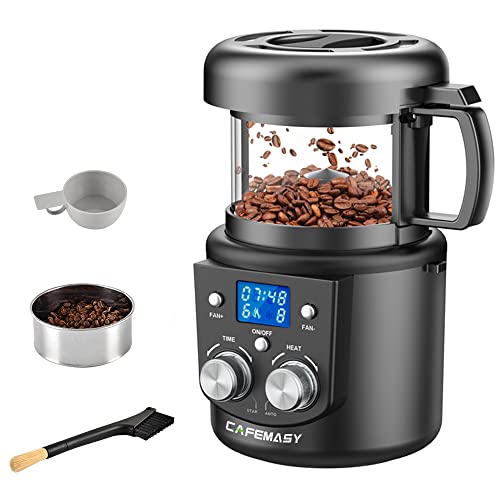
CAFEMASY Air Coffee Roaster — Timer-Led Air Roaster
CAFEMASY’s entry keeps its proposition compact: a home-use air coffee roaster with adjustable timer roasting, heating, and air fan settings. That trio of adjustments maps directly onto how fluid-bed roasting actually works — time, heat, and airflow are the process — so even a short title tells an experienced reader that this machine exposes the right variables. The timer in particular changes the rhythm of a roast session: instead of hovering with a stopwatch, the operator sets a working window and manages heat and fan against it, which suits methodical roasters who log their sessions.
Air roasting’s house style applies here as it did to the Fresh Roast machines: quick, bright roasts with clean origin character, and a process audible enough — cracks announce themselves over the fan if you learn to listen — to roast by ear as well as eye. CAFEMASY positions the machine plainly for home use, and its appeal is the straightforward one of a focused appliance: no bundle, no smart platform, just the three controls and a chamber.
The title withholds capacity and power figures, and those omissions matter enough to repeat the standing advice: pull them from the listing documentation before deciding, because batch size shapes everything from green-bean ordering to how a roast curve behaves. Buyers cross-shopping the SR800 should compare stated capacity and display provision directly, then decide whether the CAFEMASY’s timer-led simplicity or the Fresh Roast’s documented numbers serve them better. Choice between honest alternatives is the entire point of a shortlist.
- Technology: air (fluid-bed) roaster for home use, electric
- Controls: adjustable timer, heating, and air fan settings, per the listing title
- Batch capacity: not printed in the listing title — look it up in the manufacturer documentation
- Power rating: likewise unstated in the title, so verify it on the listing page
- Display provision: not described in the title
Strengths
- The three adjustments it offers are the three that matter.
- Timer-led operation suits logged, repeatable roast sessions.
- Focused appliance without bundle or platform extras.
Trade-offs
- Key figures absent from the title require verification before buying.
- Air-roast brightness is a house style, not a universal preference.
- Less hand-holding for absolute beginners than the bundle pick.
Best for: methodical home roasters who want the core controls and a timer.
Skip this one if a sparse title bothers you — the CAFEMASY rewards owners who are happy confirming its capacity and power figures on the listing page before the first roast.
See the CAFEMASY Air Coffee Roaster on Amazon to check price on Amazon and review its stated capacity.
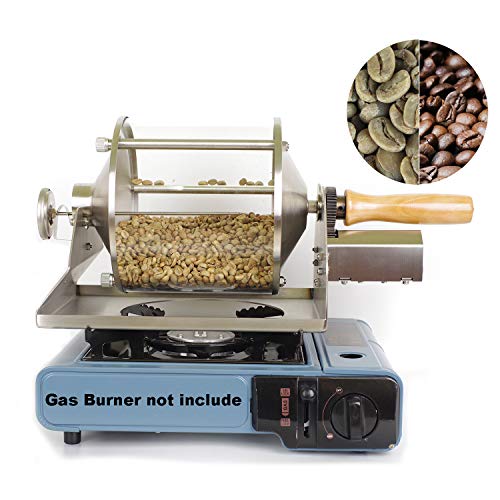
DYVEE Gas Burner Coffee Roaster — The Gas-Fired Outlier
Everything else in this guide plugs into a wall. The DYVEE plugs into nothing: it is a coffee roasting machine built around a gas burner, with a 400-gram capacity, a quartz glass drum, and a stainless steel frame — and the title adds, almost casually, that it doubles as a peanut and nut roaster. That construction describes a fundamentally different ritual. The drum turns over open flame, the operator manages heat by managing fire, and the roast happens wherever a gas burner can safely stand: a workshop bench, a garage, a market stall, a patio. Five electric machines offer controls; this one offers combustion.
The quartz glass drum is the design’s clever heart. Glass lets the operator watch colour development continuously — no peeking, no sampling spoon gymnastics — while the drum’s rotation keeps beans moving through the heat. Quartz tolerates the thermal environment a burner creates, and the stainless frame gives the assembly its working stiffness. At 400 grams, the stated capacity is the largest in this guide alongside the pan roaster’s, which suits small-batch sellers and big households alike.
Now the obligations, stated plainly. Gas roasting demands the safety posture of gas anything: ventilation, a stable burner setup, attention for the entire roast, and storage discipline for fuel. It cannot run on a kitchen counter under low cabinets, and it should not run indoors without a serious ventilation plan. In exchange, it frees the roast from electrical limits entirely — no circuit to trip, no element to burn out — and connects the operator to a much older roasting tradition. The home coffee scene’s other flame-based rituals, like the stovetop brewing covered in Best Outdoor Flat Top Grills readers’ outdoor kitchens, share that same appeal of direct fire honestly managed. Choose the DYVEE with eyes open and it is the most characterful machine here.
- Technology: gas burner roaster — the only non-electric pick in this guide
- Batch capacity: 400g, per the listing title
- Drum: quartz glass, per the title
- Frame: stainless steel, per the title
- Also described in the title as a peanut and nut roaster
Strengths
- No electrical dependency — roasts anywhere a burner can stand.
- Transparent quartz drum gives continuous colour visibility.
- 400g batches serve big households or micro-sellers.
Trade-offs
- Open flame imposes real ventilation and supervision duties.
- Not a countertop appliance for ordinary indoor kitchens.
- Heat control is manual fire craft, not a dial setting.
Best for: experienced roasters wanting flame craft and location freedom.
Not suited for: apartment kitchens, unattended roasting, or beginners.
The DYVEE Gas Burner’s listing shows its burner arrangement in full — visit it to check price on Amazon.

JIAWANSHUN 1.1LB Electric Coffee Roaster — Largest Stated Batch
The JIAWANSHUN takes the oldest roasting geometry — a heated pan — and electrifies it: a 1.1-pound electric coffee bean roaster rated at 1200W, with temperature adjustable from 0–240°C, a non-stick pan, and an intended home for green coffee beans. Pan roasting is contact roasting; beans take heat from the surface they rest and tumble on, which produces a different development profile from air machines — rounder, less bright, with the operator’s stirring and the pan’s heat distribution doing the work that airflow does elsewhere.
The stated numbers reward a close read. A 1.1-pound nameplate batch is the biggest claim in this guide, and the 1200W element behind a wide temperature range suggests a machine built to bring that mass to roasting heat without drowning. But mass is also the risk: a full pan of beans insulates itself, and uneven roasting — scorched bottoms, pale tops — is the classic failure of the format when loads max out and stirring lags. Sensible owners roast below the ceiling while learning the machine, then push capacity once their stirring rhythm and temperature choices are proven.
The non-stick pan is a pragmatic touch in a category where chaff and coffee oils bake onto every surface; cleanup after a pan roast can be the difference between a weekly habit and a monthly chore. Temperature adjustment across a stated range gives the operator a real lever, though pan roasting still rewards presence — this is a machine you work, not a machine you set. For households that drink a lot of coffee and prefer a fuller, less acidic cup, the JIAWANSHUN’s combination of capacity and contact heat is a legitimate philosophy, not a compromise.
- Technology: electric pan roaster with non-stick pan, per the listing title
- Batch capacity: 1.1 lb, per the title
- Power: 1200W, per the title
- Temperature: adjustable 0–240°C, per the title
- Intended beans: green coffee beans for home use, per the title
Strengths
- Largest stated batch in this guide for high-consumption homes.
- Contact heat suits drinkers who prefer roundness over brightness.
- Non-stick pan keeps the cleanup tax low.
Trade-offs
- Full loads risk uneven roasts without disciplined stirring.
- Pan roasting demands the operator’s presence throughout.
- Contact-heat character will not replicate fluid-bed clarity.
Best for: high-volume households that favour a fuller cup and hands-on roasting.
Not suited for: small-batch experimenters running five tiny test roasts a day.
Open the JIAWANSHUN 1.1LB’s Amazon listing to check price on Amazon and inspect the pan design.
Roasters at a Glance: Heat Source, Batch, and Temperament
| Roaster | Heat and motion | Stated batch | Temperament |
|---|---|---|---|
| Fresh Roast SR800 | Electric fluid-bed | 6–8 oz (170–226g) | Hands-on, documented, bright |
| Fresh Roast SR540 Bundle | Electric fluid-bed | Not stated in title | Starter kit, roast on day one |
| MAGO MAGA Roma Pro | Electric, smart modes | 300g | Indoor-friendly, auto then manual |
| CAFEMASY Air Coffee Roaster | Electric air | Not stated in title | Timer-led, methodical |
| DYVEE Gas Burner Coffee Roaster | Gas burner, quartz drum | 400g | Flame craft, location-free |
| JIAWANSHUN 1.1LB Electric Coffee Roaster | Electric pan, 1200W | 1.1 lb | High-volume, contact heat |
Air, Drum, Pan, or Flame: Which Roasting Physics Suits Your Palate?
Technology choice is flavour choice, so decide with your tongue. Fluid-bed machines — both Fresh Roast models and the CAFEMASY — suspend beans in hot air, roasting quickly and evenly with minimal contact scorching. The cup tends toward clarity: acidity articulated, origin character forward, body lighter. Drinkers who love Ethiopian and Kenyan coffees for their sparkle usually land here, and so do beginners, because air roasts are comparatively forgiving of small timing errors at light-to-medium levels.
Contact methods trade some of that sparkle for weight. The JIAWANSHUN’s pan and the DYVEE’s drum-over-flame both conduct heat through surfaces, encouraging the sugar development and body that espresso drinkers and milk-coffee households prize. They also demand more of the operator: stirring discipline in the pan, fire discipline at the burner. Neither family is better; they are answers to different questions about what coffee should taste like at your table.
The Roma Pro complicates the taxonomy usefully by wrapping its process in automation — auto modes that standardise the curve, cooling handled in-chamber, chaff collected by design. If your honest goal is fresh beans with minimal ritual, automation is not cheating; it is the feature. The outdoor-cooking crowd reading our notes on Best Pizza Ovens Propane will recognise the same fork in the road: some cooks want fire as participation, others want fire as appliance, and both eat well.
How Does a Roast Actually Unfold, Minute by Minute?
Green beans enter the chamber pale and grassy, smelling of hay. The first minutes are drying: moisture drives off, the beans yellow, and the aroma turns to warm bread. Somewhere in the middle, sugars begin their browning reactions and the smell deepens toward toast. Then comes first crack — an audible popping, like tiny twigs snapping — as steam fractures the bean’s structure. Everything before first crack is cooking; everything after it is development, where the operator chooses how much caramelisation and body to build before cooling.
Stop the roast and cool the beans fast, because carryover heat keeps cooking them in the pile. Machines with auto-cooling, like the Roma Pro, handle this in-chamber; others ask you to dump the beans into a colander and stir in moving air. After cooling, beans need rest — a day or several — while carbon dioxide from roasting escapes; brew too soon and the cup tastes sharp and gassy, wait too long and the aromatics you worked for fade. Home roasting’s rhythm is therefore weekly: roast, rest, drink, repeat, with each cycle informing the next.
Keep a notebook from the first batch. Bean, batch weight, settings, time to first crack, total time, and a sentence about the cup three days later. Six entries in, patterns appear that no forum thread can give you, because they are patterns about your machine, your beans, and your palate.
How Much Green Coffee Should You Actually Buy?
Batch size answers this. A household roasting 200-gram batches twice a week consumes roughly a kilogram and a half of green coffee a month, accounting for the weight beans lose in roasting. Green coffee stores far better than roasted — months in a cool, dry cupboard rather than weeks — which is the hobby’s quiet economic argument: buy green in modest bulk, roast in small freshness, and the per-cup cost undercuts specialty roasted beans while the quality ceiling rises.
Resist the collector’s urge at the start. Two or three origins, bought in small quantities, teach more than ten, because repetition against a known bean isolates your technique as the variable. When a roast disappoints, a familiar bean tells you the machine settings were wrong; an unfamiliar bean leaves you guessing whether the coffee or the cook failed. Graduate to a wider green cellar once your notebook shows consistent results on the home rotation.
Where Do New Roasters Go Wrong?
Roasting without a smoke plan. Even the tidiest machine perfumes a house for hours and darker roasts smoke visibly. Decide where the roast happens — under a strong hood, beside an open window with a fan, in a garage — before the beans arrive, not during the first batch.
Judging the roast hot. Fresh-roasted coffee tastes muted and gassy straight off the roast. Owners who tweak settings based on a same-day cup chase their tails; rest the beans at least a day before drawing conclusions.
Maxing the batch on day one. Full loads roast least evenly in every technology here. Learn your machine at two-thirds capacity, where airflow and agitation work as designed, and earn the ceiling later.
Skipping the notebook. Memory edits itself generously. Written settings beside honest cup notes are the only route from lucky roasts to repeatable ones.
Treating the gas roaster like a countertop appliance. The DYVEE’s burner is open flame; it belongs in ventilated, stable, supervised settings. Convenience thinking around fire is how hobbies end badly.
What Do Light, Medium, and Dark Actually Mean at Home?
Roast level is a decision about where to stop, and home roasting makes that decision yours for the first time. A light roast ends shortly after first crack: the bean’s origin character — fruit, florals, acidity — survives largely intact, and the cup rewards careful brewing. A medium roast develops further, trading some sparkle for sweetness and balance as sugars caramelise; it is where most home roasters settle for their daily bean because it forgives both brewing errors and bean imperfections. A dark roast pushes toward and beyond the second, softer crackling stage, where roast character itself — smoke, dark chocolate, char at the extreme — becomes the dominant flavour and origin differences narrow.
Each machine here has a natural level range. Fluid-bed roasters excel at light-to-medium work because their speed and evenness preserve clarity, though they can certainly go dark with attention. Pan and flame machines build development flavours readily, which flatters medium-dark profiles. The practical lesson is to buy beans that suit your machine’s strengths: a delicate washed Ethiopian will sing in the SR800 and can taste blunt from an overdeveloped pan roast, while a Brazilian bean destined for espresso drinks may prefer the pan or the Roma Pro’s longer development.
Whatever level you chase, change one variable at a time and write down the result. The difference between a roast stopped thirty seconds apart is real and repeatable, but only a notebook can prove which side of that line your household prefers.
How Should You Store Green and Roasted Coffee?
Green coffee is a stable pantry good: keep it in a breathable or loosely sealed container, in a cool, dry, dark cupboard, away from the spice rack’s strongest aromatics. It does not need refrigeration and should never be frozen casually, where condensation becomes its enemy. Bought in reasonable quantities, a green stash stays lively for many months, which is precisely what makes the roast-at-home economy work.
Roasted coffee lives on the opposite clock. Oxygen is the thief: store roasted beans in an opaque, airtight container with a one-way valve if possible, at room temperature, and grind only what you brew. The freezer debate splits the hobby, but the safe consensus for daily drinkers is simpler — roast in quantities your household finishes within two weeks, and storage heroics become unnecessary. This is the deeper reason batch size matters: a machine whose batch matches your fortnight’s drinking keeps every cup inside the freshness window without effort.
Label everything. Bean name, roast date, and one line about settings, on painter’s tape on the jar. Three unlabeled jars of similar-looking beans will teach you why in a single confusing morning.
How Do You Clean and Care for a Roaster?
Chaff is the daily reality: the papery skin that sheds from beans mid-roast collects in chambers, collectors, and — in pan roasting — across the work surface. Empty collectors after every session while the machine is still slightly warm and the chaff releases easily, and brush the chamber before residue bakes into varnish. Coffee oils are the slower enemy; they coat glass and metal, turn rancid over weeks, and flavour new roasts with old ones. A periodic wipe-down of accessible surfaces with a suitable cleaner, followed by a thorough dry, keeps the flavour ledger clean.
Glass components — the Fresh Roast chambers, the DYVEE’s quartz drum — deserve the respect due to anything hot and breakable: cool before washing, wash by hand, and store where they cannot roll. Motors and fans dislike chaff dust, so a soft brush around vents and intakes after heavy sessions is cheap insurance. The gas machine adds burner care: keep ports clear, check connections with the diligence any gas appliance receives, and store fuel according to its own rules, away from the roaster itself.
None of this is burdensome — five minutes per session, a deeper clean monthly — but skipping it is the most common reason a good machine starts producing mediocre coffee while its owner blames the beans.
What Safety Rules Apply to Roasting at Home?
Roasting is controlled cooking at high temperature, and it asks for the standard respects. Never leave any roaster unattended mid-batch; a roast’s most eventful minutes are its last ones, and beans can scorch or, neglected badly, smoke heavily. Keep the work area clear of towels and paper, give the machine the ventilation your smoke plan promised, and let everything cool before storage — a glass chamber on a shelf should be room-temperature, not merely touchable.
The DYVEE raises the stakes because its heat source is open flame. Burner stability, fuel handling, and ventilation stop being tips and become requirements; roast outdoors or in a properly ventilated workspace, keep children and pets out of the work zone, and treat the setup with the same ceremony you would give a gas grill being lit. Electric machines have their own quieter rule: do not defeat their thermal limits by roasting batch after batch without the cooling pauses the manufacturer expects. Motors and elements that rest between sessions live longer and behave more predictably.
Finally, respect the beans themselves as a hot material. Fresh-roasted coffee leaves the chamber near the temperature it roasted at; the colander-and-stir cooling method means handling a pan of very hot beans, so gloves and a stable surface are part of the kit, not an afterthought.
What Should Your First Month of Roasting Look Like?
Week one is for calibration, not glory. Roast one familiar bean at three stopping points — just after first crack, a minute deeper, and deeper still — then cup them side by side after two days of rest. That single exercise teaches your machine’s timing, your palate’s preference, and the notebook habit in one stroke. Expect the middle roast to win the household vote; expect also to be surprised by someone.
Week two varies the bean, not the settings. Run the same profile against a second origin and watch what changes: density and moisture differences between beans will move first crack earlier or later, and your notes from week one become the baseline that makes those differences legible. Week three is for batch discipline — roast at two different load sizes with matched settings and taste whether the bigger batch lagged or scorched, because that answer sets your household’s standard batch for the machine you own.
By week four, give the hobby its first real job: roast the household’s actual drinking coffee for a full week and stop buying roasted beans. The small anxieties of production — timing the rest period, labelling jars, keeping the green stash ahead of demand — are the hobby’s true content, and they only appear under real responsibility. Most roasters who reach this point do not go back; the cupboard gains a green-bean shelf, and the coffee improves in a way visitors notice before they can name.
Which Faults Show Up in the Cup, and What Fixes Them?
A sour, thin cup usually means underdevelopment: the roast stopped before sugars and acids balanced. The fix is rarely more heat at the start; it is more time after first crack, so extend development on the next batch and change nothing else. A flat, baked flavour — coffee that tastes like warm cardboard — points the other way: the roast stalled, spending too long at middling heat without momentum. Tighten the middle phase, keep the curve climbing, and the liveliness returns.
Scorched or ashy notes mean surface damage: beans met too-hot metal in a pan or drum, or an air roast ran away at the end. Stir more, load less, or trim the final heat. Uneven colour within a batch — pale beans beside dark ones — is an agitation problem before it is anything else: check that the fluid-bed load is circulating freely, that the pan is being stirred in earnest, and that batch size has not crept past the machine’s honest capacity.
Notice what all these fixes share: one variable, changed once, recorded. Roasting faults feel mysterious only when three things changed between batches. The discipline this guide keeps recommending — notebook, patience, single adjustments — is not fussiness. It is the entire method by which a kitchen hobby becomes a reliable craft.
Which Green Beans Should a Beginner Start With?
Forgiving beans teach faster than famous ones. Brazilian naturals are the classic first purchase: dense enough to roast evenly, sweet at medium levels, and tolerant of small timing errors, with a chocolate-and-nut profile that pleases nearly everyone at the table. Colombian washed coffees run a close second — clean, balanced, and articulate enough that you can taste your own adjustments clearly. Both are widely available green in small quantities, which matters more than prestige at this stage.
Save the delicate and the temperamental for month two. High-grown Ethiopian beans can be small and uneven in size, roasting less uniformly in fluid-bed machines until your load sizes are dialled in; their brilliance rewards the wait. Dark-roast projects deserve a bean bought for the purpose — something with the body to carry development — rather than a bright bean pushed past its nature. And buy decaf green at least once if your household drinks it: fresh-roasted decaf is the category’s best-kept secret, because commercial decaf sits roasted for months while yours can be days old.
One buying rule protects beginners from the most common disappointment: purchase green coffee from sellers who serve home roasters, in quantities you will finish within a few months. A bargain sack that outlives its freshness teaches you stale-bean lessons you never signed up for.
Does the Maths of Home Roasting Actually Work?
Run the arithmetic with your own household’s numbers, but the shape of the answer is consistent. Green coffee from a home-roaster supplier typically lands well below the per-pound price of roasted specialty coffee, and the weight lost in roasting still leaves the home roaster ahead per brewed cup. Against that saving, set the machine’s price, a modest green-bean inventory, and your time — ten to fifteen attended minutes per batch. A two-coffee-a-day household roasting weekly typically recovers a mid-range machine’s cost within its first year or so, and every year after that runs at the green-bean rate.
The less countable returns arrive sooner. Freshness is the obvious one: coffee roasted at home is, by construction, never more than a fortnight old, a condition specialty shops charge a premium to approximate. Control is the second: roast level, blend composition, and single-origin exploration all become household decisions rather than retail accidents. And there is a third return nobody budgets for — the roast session itself, ten minutes of smell and sound and attention that many owners come to value as a ritual rather than a chore. If that ritual sounds like a tax instead, believe yourself, and buy good roasted beans without a flicker of guilt.
Should You Roast Differently for Espresso and for Filter?
Yes, though the difference is one of degree rather than kind. Espresso extraction is violent and fast, amplifying acidity and any underdevelopment into sourness; beans destined for espresso usually benefit from a touch more development after first crack, which rounds the acids and builds the sugars that survive a thirty-second extraction. Filter brewing is gentler and more transparent, rewarding the clarity of a lighter hand — which is why the same bean, roasted two ways, can honestly be two different coffees.
Practical households simplify this into a two-jar system: one batch roasted a shade deeper for the espresso machine, one kept brighter for the pour-over, both from the same green bag. The exercise doubles as education, because tasting one bean at two developments side by side teaches the development variable faster than any description. Machines with fine control — the SR800’s two axes, the Roma Pro’s manual mode — make that split easy to repeat once you find your two stopping points.
Milk drinks forgive nearly everything except staleness, so households whose coffee mostly disappears into lattes should optimise for freshness and body rather than nuance: medium development, rested a few days, from whichever machine here matches their batch size. Save the delicate light roasts for the black-coffee drinkers, who will actually taste what you worked for.
Final Recommendation
Match the machine to the roaster you honestly are. Beginners should start with the SR540 Bundle’s completeness or the Roma Pro’s auto modes and smoke discipline; both forgive while teaching. Committed hobbyists who want curve control and documentation should take the SR800, the list’s most instrumented fluid-bed. The CAFEMASY serves methodical air-roast fans who like a timer at the centre of the process. The JIAWANSHUN owns the high-volume, full-cup brief, and the DYVEE belongs to the flame-confident few who will roast outdoors and love it for exactly that reason.
Whichever machine arrives, roast the same bean five ways in your first week and taste them side by side; no article, including this one, can teach your palate what that single afternoon will.
Frequently Asked Questions
Is home roasting actually cheaper than buying roasted beans?
Green coffee generally costs less per pound than specialty roasted coffee, and it keeps for months, so a regular roasting habit usually wins on cost per cup — provided the machine’s price is spread over steady use. The honest exception is the occasional roaster: a machine used twice a year never amortises.
How long should roasted beans rest before brewing?
At least overnight, and most beans show their best character somewhere between two days and two weeks off the roast, depending on roast level and brewing method. Espresso drinkers often prefer the longer end of that window; filter drinkers can start earlier.
Can I roast indoors with these machines?
The five electric picks are designed for home use, and the Roma Pro explicitly engineers for reduced smoke and chaff collection — but roasting still produces aroma and some smoke, so run a hood or open a window regardless. The gas-fired DYVEE belongs in ventilated, workshop-style settings, not under kitchen cabinets.
What is first crack, and why does everyone talk about it?
First crack is the audible popping stage when steam fractures the bean’s internal structure. It marks the boundary between cooking and development: roasts stopped just after it taste light and bright, while roasts carried further build body and caramelisation. Hearing it reliably is the home roaster’s core skill.
How much weight do beans lose during roasting?
Expect a noticeable fraction of the green weight — moisture and some dry matter — to leave during the roast, with darker roasts losing more than lighter ones. This is why the bundle’s included scale matters: weighing before and after turns a surprise into a tracked variable.
Can one machine serve a small café or market stall?
These are home machines with home batch sizes; a stall selling a few bags a day would spend its life roasting back-to-back, which the duty cycles of countertop units are not built for. The DYVEE’s burner design and 400g drum come closest to that world in spirit, but volume sellers should treat every pick here as a starting point, not a production line.
Do I need a special grinder once I start roasting?
No new grinder is required by roasting itself — whatever grinder serves your brewing works on beans you roasted. What changes is that fresher beans expose grinder inconsistency more clearly, which is why many home roasters upgrade their grinder a season after their roaster, in that order.
How loud and smoky is a typical home roast session?
Expect fan noise comparable to a hair dryer on the air machines, a crackling soundtrack near first crack, and an aroma strong enough to announce itself through the house — most households find it pleasant, all households find it noticeable. Visible smoke stays modest at light and medium roasts under a working hood, and grows at darker levels, which is why the smoke plan in this guide is a plan and not a suggestion.
Related Guides
Roasting is the step before brewing, and readers setting up a complete home coffee station will want the brewing side covered too. Our guide to Best Coffee Machines for Cafes looks at machines built to serve cup after cup, for readers whose home counter ambitions lean café-ward.


