What's inside
- Key Takeaways
- Quick Picks
- How Did We Build This Shortlist?
- Side by Side: The Six Columns Compared
- Which Diameter Actually Fits Your Cooking?
- How Does Temperature Control Work in a Charcoal Column?
- How Do You Run Your First Cook?
- What Trips Up First-Time Column Owners?
- What Charcoal Should You Burn, and How Much of It?
- How Should You Maintain a Vertical Smoker Season After Season?
- Which Accessories Actually Earn Their Space?
- How Do You Read Smoke, Bark, and Doneness Without Gadgets?
- What Does a Full Cook Day Look Like, Hour by Hour?
- Where Should a Vertical Smoker Live, and What Does a Season Cost?
- How Do the Three Mid-Size Options Differ in Daily Life?
- Why Does a New Smoker Need a Seasoning Burn?
- Final Recommendation
- Frequently Asked Questions
- Related Guides
As an Amazon Associate I earn from qualifying purchases. This post may contain affiliate links at no extra cost to you.
cottageverdict.com is reader-supported. When you buy through links on our site, we may earn an affiliate commission.
Ordering a smoker online: every model below ships through its Amazon listing, where the current price, the delivery window, and the assembly notes sit on one page before you commit. A vertical smoker is a friendly freight item compared with a full offset rig — tall rather than wide, usually one box, and light enough that one person can wheel it to the patio — but read the listing anyway, because grate sizes and included accessories differ between sellers of the same model.
The best vertical charcoal smokers share one elegant idea: stack the fire at the bottom, the water pan in the middle, and the food above, then let heat and smoke rise through the column the way warmth rises through a chimney. That single geometry decision explains almost everything good and bad about the format. The footprint stays small enough for a balcony corner or a crowded deck. The cooking levels multiply without the cooker getting wider. And the cook manages temperature from one fire, through vents, with a water pan buffering the swings that ruin brisket at hour nine.
Six cookers make this list, and they split into two families. Five are bullet smokers — rounded or straight-sided columns where the grates stack directly over the pan. One, the GHP Group entry, bends the column sideways into a vertical offset layout, separating the firebox from the cooking chamber while keeping the tall, narrow stance. Sizes run from the compact 14-inch Weber Smokey Mountain up to a 20-inch Realcook, and that spread matters more than brand loyalty: grate diameter decides whether a whole brisket lies flat or gets draped, whether ribs hang or curl, and how many chickens stand upright at once.
A word about naming before we begin. One listing here comes from GHP Group, a manufacturer whose name appears on the box without any sub-brand printed in its listing title, so this guide calls the cooker by the name its title actually carries. Where a title stays silent about a specification — a grate count, a steel gauge, a total cooking area — the spec boxes below say so plainly instead of borrowing numbers from a sibling model. Honest gaps beat confident inventions, especially on equipment you will feed for a decade.
Who thrives with a vertical charcoal smoker? The patio cook with more patience than floor space, the apartment-adjacent griller whose deck fits a column but not a barrel, and anyone who wants real charcoal smoke flavour without tending a firebox every forty minutes. Who should keep scrolling past the whole category? Cooks feeding twenty people at once, and cooks who want to set a dial and walk away until dinner — the pellet world serves that second group better, and there is no shame in admitting which cook you are.
Key Takeaways
- Vertical columns trade width for height: two stacked grates in a 16- or 18-inch footprint can out-cook a kettle twice as wide.
- The water pan is not an accessory; it is the temperature stabiliser that makes overnight charcoal cooks survivable.
- Grate diameter, not total height, decides what fits — measure your brisket against the grate before you fall for a tall silhouette.
- Vent control is the whole skill. Every pick here manages temperature through adjustable dampers or air vents, and learning yours takes two cooks, not twenty.
- One pick on this list, the GHP Group cooker, offsets its firebox to the side; the other five burn directly beneath the food.
Quick Picks
| Smoker | Badge | Why it earns its place |
|---|---|---|
| Weber Smokey Mountain 14-Inch | Small-Space Benchmark | The porcelain-enameled bullet that defined the category, sized for balconies and couples. |
| Char-Broil Bullet 16-Inch | Straightforward Step Up | A 16-inch bullet from a mainstream maker for cooks who outgrow the smallest grate. |
| Realcook 20-Inch Vertical Smoker | Widest Grates Here | The broadest column in the group, built for full packer briskets laid flat. |
| GHP Group Vertical Offset Charcoal Smoker | The Offset Outlier | Side firebox, vertical chamber: offset smoke management in a narrow stance. |
| Giantex Vertical Charcoal Smoker | Door-Access Design | Double doors and four adjustable vents for cooks who hate lifting the whole stack. |
| Amazon Basics 16-Inch Vertical Smoker | Entry Ticket | A two-layer 16-inch starter bullet with a built-in thermometer and adjustable air supply. |
How Did We Build This Shortlist?
We started from the shape itself. Any cooker whose fire did not sit below — or, in the offset case, directly beside — a vertical cooking column was excluded, which removed horizontal barrels, cabinet smokers fed by propane, and pellet towers from contention. What remained had to burn charcoal as its primary fuel, stack at least two cooking levels or offer a genuinely tall single chamber, and come from a listing whose title confirmed the format rather than leaving us to guess from a photograph.
From there we weighted four things. First, grate diameter, because it gates the menu. Second, temperature hardware: dampers, vents, and thermometers named in the listing. Third, access design — a cooker you load through doors behaves differently at hour six from one you unstack. Fourth, the honesty of the listing itself; titles that stated their format and features plainly scored better than titles padded with promises. Readers who also roast over open flame on weeknights might enjoy our companion reading on Best Coffee Roasters Machines — a different kind of small-batch fire management, conducted indoors with green beans instead of brisket.
One more filter deserves stating. This guide covers charcoal only. Propane vertical smokers exist and suit some cooks, but mixing fuel philosophies inside one shortlist muddies every comparison that follows, so gas cabinets were left to their own guide.
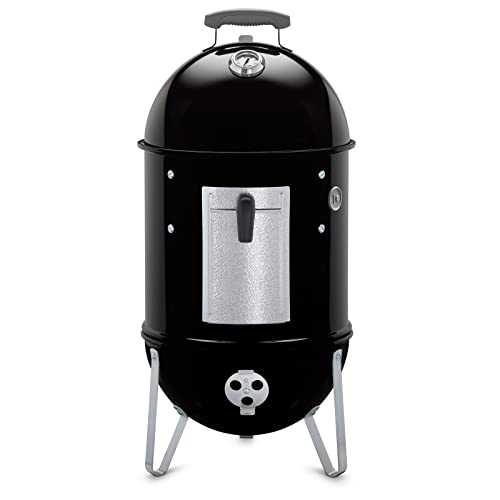
Weber Smokey Mountain 14-Inch — Small-Space Benchmark
The smallest cooker here is also the most famous. Weber’s 14-inch Smokey Mountain packs the classic bullet architecture — charcoal bowl at the base, water pan above it, two cooking grates stacked in a porcelain-enameled middle section, and a domed lid with temperature control dampers — into a column a renter can carry through a doorway. The listing title confirms the dual cooking grates and the porcelain-enameled kettle construction, and those two facts carry most of the ownership experience: the enamel shrugs off weather and wipes clean, and the twin grates let a pork shoulder ride above a pan of beans catching its drippings.
Fourteen inches is a real constraint and this guide will not soften it. A full brisket will not lie flat on a 14-inch grate; cooks drape it over a rib rack or a wood chunk until it shrinks, or they simply cook brisket points and flats separately. What fits beautifully is the everyday menu of small households: two chickens, a single shoulder, a rack or two of ribs cut in half, a modest salmon fillet for hot-smoking. For a couple learning low-and-slow, that menu is not a limitation — it is the curriculum.
The dampers deserve a sentence of their own, because on a cooker this small they are unusually effective. Tiny vent adjustments move the needle quickly in a compact chamber, which makes the Smokey Mountain a forgiving teacher: overcorrect, watch the temperature respond within minutes, and build intuition fast. Fuel use is equally modest. A small charcoal load carries a shoulder cook, and the water pan’s buffering matters proportionally more in a small volume of air.
- Format: bullet-style vertical charcoal smoker, 14-inch
- Cooking levels: dual cooking grates, per the listing title
- Construction: porcelain-enameled, per the listing title
- Temperature hardware: control dampers named in the title
- Total cooking area: the listing title gives no square-inch figure — confirm it in the manufacturer documentation
Strengths
- Porcelain enamel resists rust and cleans up faster than painted steel.
- Compact column stores in a corner and travels to campsites easily.
- Responsive dampers make temperature lessons quick and cheap.
Trade-offs
- Fourteen-inch grates exclude full packer briskets laid flat.
- Small chamber means small batches — this is not party equipment.
- Accessing the lower grate means lifting the upper one mid-cook.
Best for: balcony and small-patio cooks, couples, and beginners who want the category’s reference design in miniature.
Not suited for: anyone whose standard cook is a whole brisket plus two shoulders for a crowd.
Find the Weber Smokey Mountain 14-Inch on its Amazon listing to check price on Amazon and confirm the current bundle.

Char-Broil Bullet 16-Inch — Straightforward Step Up
Char-Broil’s Bullet keeps its listing title admirably short — a 16-inch charcoal smoker, model 18202075, in black — and this guide respects that brevity by claiming only what the format guarantees. Sixteen inches is the quiet sweet spot of the bullet world: wide enough that a trimmed brisket flat fits without acrobatics, narrow enough that the column still parks in the corner of a modest deck. The bullet silhouette stacks the fire low and the food high, exactly as the category promises.
Because the title declines to enumerate grates, pans, and hardware, the spec box below marks those points as unstated rather than dressing the cooker in borrowed features. That restraint cuts both ways for a buyer. On one hand, Char-Broil is a mainstream manufacturer with a real parts pipeline, and a bullet smoker is mechanically simple — bowl, body, lid, grates, pan. On the other hand, anyone comparing grate counts line by line should open the listing and the manual before ordering, and this guide flags that homework instead of hiding it.
In use, expect the standard bullet rhythm: light a chimney, settle the coals in the base, fill the pan, stack the body, and manage the cook through the vents while the column does its quiet work. The extra two inches over the smallest pick sound trivial until a rack of ribs lies flat instead of curling against the wall — small numbers, large dinners. Cooks graduating from a kettle grill will find the transition gentle; the fuel is the same, only the geometry changes.
- Format: bullet charcoal smoker, 16-inch
- Model: 18202075, per the listing title
- Colour: black, per the listing title
- Grate count and pan details: not spelled out in the listing title — check the product documentation before ordering
- Thermometer provision: likewise unstated in the title, so verify it on the listing page
Strengths
- Sixteen-inch grates handle the mainstream barbecue menu without draping tricks.
- Simple bullet mechanics mean little to break and little to learn.
- Mainstream brand with an established replacement-parts channel.
Trade-offs
- Sparse listing title leaves several specifications to verify yourself.
- Mid-size chamber still caps batch cooking for large gatherings.
- Like all bullets, mid-cook access to lower food is a lift-and-reach exercise.
Best for: kettle converts who want a dedicated smoker one size up from the minimum.
Not suited for: spec-sheet shoppers who want every dimension certified before they buy.
The Char-Broil Bullet 16-Inch listing carries the details its title omits — head there to check price on Amazon.

Realcook 20-Inch Vertical Smoker — Widest Grates Here
Twenty inches changes the conversation. Realcook’s vertical smoker is the broadest column on this list, and width is the specification that decides menus: a full packer brisket lies flat, spare ribs stretch out uncut, and a holiday turkey sits without its breast grazing the walls. The listing title frames it plainly as a charcoal barbecue smoker grill, 20 inches, vertical, for outdoor cooking and grilling — and that dual smoker-grill framing hints at the flexibility a big chamber offers when the water pan comes out and the fire runs hotter.
Large chambers behave differently, and buyers should walk in knowing it. More air volume means a bigger charcoal load to bring the column to temperature and a slower response when you open vents — the ship turns, but it turns like a ship. The compensations are stability and capacity: once a 20-inch column settles at temperature, its thermal mass shrugs off a windy gust or a brief lid lift better than a small cooker does. Overnight cooks, the true test of any smoker, are where that steadiness earns its keep.
Realcook is a value-oriented brand, and the honest expectation is competent steel and hardware rather than heirloom fit and finish. For many cooks that trade is exactly right: the money saved against premium names buys a lot of charcoal, wood chunks, and briskets to practise on. Season the interior thoroughly on the first burn, learn where its thermometer disagrees with a probe at grate level, and the cooker will repay the attention in capacity per dollar that nothing smaller here can match.
- Format: vertical charcoal smoker and grill, 20-inch
- Intended use: outdoor cooking and grilling, per the listing title
- Grate count: the listing title does not enumerate the grates — confirm the layout in the documentation
- Thermometer and vent details: not itemised in the title, so verify them on the listing before purchase
- Fuel: charcoal, per the listing title
Strengths
- Widest grates in this guide — briskets and ribs fit flat and whole.
- Large chamber holds temperature steadily once settled.
- Value pricing leaves budget for fuel, probes, and practise meat.
Trade-offs
- Bigger charcoal loads and slower temperature responses than small bullets.
- Fit and finish sit a tier below the premium names.
- Its footprint and height need a real patio corner, not a balcony rail.
Best for: hosts who cook whole briskets and full racks, and value hunters who prioritise capacity.
Not suited for: small-balcony cooks or anyone chasing one-person weeknight portions.
See the Realcook 20-Inch on Amazon to check price on Amazon and review its grate layout up close.

GHP Group Vertical Offset Charcoal Smoker — The Offset Outlier
Every other pick here burns its charcoal in a bowl directly beneath the food. This one refuses. The GHP Group cooker — model DGLDGO1176BDC-D, to use the designation its listing title carries — hangs a separate firebox beside a tall vertical cooking chamber, so smoke and heat travel sideways and then rise, offset-style, while the chamber keeps the narrow footprint that defines this guide. A quick note on the name: the listing title says GHP Group and nothing more, so that is the name this guide uses throughout; we do not attach any sub-brand label the title itself does not print.
The offset arrangement buys two genuine advantages. The fire can be fed, raked, and rebuilt without opening the cooking chamber and dumping its heat — the single most disruptive act in bullet-smoker cooking simply disappears. And direct radiant heat from coals beneath the lowest grate stops being a variable; the chamber receives convected smoke and heat only, which gentles the bottom level considerably. Cooks who have scorched the underside of a first brisket on a bullet will understand both points immediately.
The costs are equally real. Two boxes mean two sets of seams, and offset smokers at household prices are famous for leaking smoke at every joint — budget time for gasket tape and latch adjustments if you chase thin blue smoke. The firebox also demands more frequent attention than a bullet’s big charcoal bowl, trading the bullet’s set-and-settle rhythm for smaller, more regular feedings. It is the right trade for cooks who enjoy fire management as participation rather than chore. Gardeners who spend the same afternoons pressure-washing the patio between cooks may browse Best Pressure Washers with Onboard Detergent Tanks for the clean-up side of outdoor season.
- Format: vertical offset charcoal smoker — side firebox, vertical chamber
- Model: DGLDGO1176BDC-D, per the listing title
- Brand as listed: GHP Group (no sub-brand named in the title)
- Chamber dimensions and grate count: not given in the listing title — pull them from the manufacturer documentation
- Fuel: charcoal, per the listing title
Strengths
- Firebox access never disturbs the cooking chamber’s heat.
- No direct radiant heat under the lowest grate — gentler bottom level.
- Offset smoke path in a footprint no wider than a bullet’s.
Trade-offs
- More seams to seal; expect some smoke leakage to manage.
- Firebox wants smaller, more frequent feedings than a bullet bowl.
- Heavier and more awkward to move than a single-column cooker.
Best for: fire-tenders who want offset behaviour without a horizontal barrel’s footprint.
Not suited for: cooks seeking the longest unattended burns a bullet bowl provides.
The GHP Group Vertical Offset’s Amazon page holds its full dimensions — visit it to check price on Amazon.

Giantex Vertical Charcoal Smoker — Door-Access Design
The Giantex answers the bullet format’s oldest annoyance — having to unstack a hot cooker to reach anything — with doors. Its listing title promises double doors, a thermometer, two removable components described as a water pan and grill grates, and four adjustable air vents, and together those features describe a cabinet-leaning column: open a door to baste, to refill the pan, to check the lower grate, all while the lid and the upper food stay exactly where they were.
Four vents is generous control hardware for this class. Temperature management on a charcoal column is nothing more than rationing oxygen, and more vent points mean finer rationing — crack the uppers to bleed heat without touching the fire’s air supply, or open the lowers to push through a stall. Combined with the built-in thermometer the title names, the Giantex gives a new cook more instruments and more levers than most rivals here, which shortens the learning curve even if a probe thermometer at grate level remains the wiser investment eventually.
Doors cut both ways, and honesty requires the other edge: every door is a seam, and every seam is a potential smoke leak and a hinge to keep aligned. Column purists accept unstacking as the price of a sealed drum; the Giantex bets that convenience wins more cooks than it loses. For weeknight-adjacent smoking — a Saturday chicken you want to baste twice without a wrestling match — that bet looks sound. The title also frames the cooker for camping and backyard parties, and its door-fed design does suit cooks who open the chamber often to feed a rotating cast of food.
- Format: vertical charcoal smoker with double doors
- Access: double doors, per the listing title
- Temperature hardware: built-in thermometer and 4 adjustable air vents, per the title
- Included components: 2 removable items described in the title as water pan and grill grates
- Chamber diameter: the title does not state a size figure — verify it in the manufacturer documentation
Strengths
- Doors end the unstacking ritual for basting and pan refills.
- Four adjustable vents give unusually fine airflow control.
- Built-in thermometer named in the title, not left to chance.
Trade-offs
- Door seams can leak smoke and may need gasket attention.
- Hinges and latches add parts to align and maintain.
- Diameter unstated in the title — measure twice before ordering.
Best for: hands-on cooks who baste, spritz, and rearrange throughout a cook.
Not suited for: seal-obsessed purists chasing the thinnest smoke in a drum.
Open the Giantex Vertical’s listing to check price on Amazon and inspect the door layout.
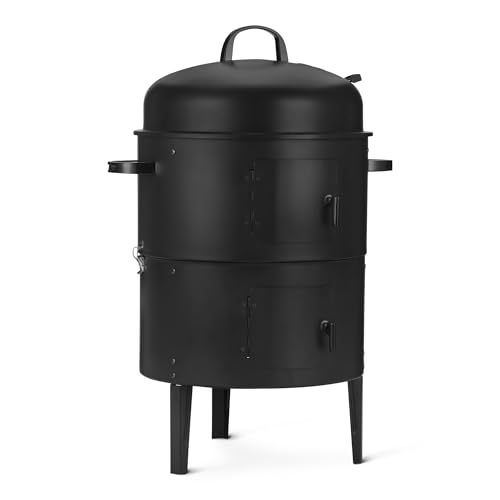
Amazon Basics 16-Inch Vertical Smoker — Entry Ticket
Every category needs its low-risk first step, and the Amazon Basics 16-inch vertical smoker is this one’s. The listing title is usefully complete: a 16-inch vertical charcoal outdoor smoker and barbecue grill with a built-in thermometer, a two-layer design, and adjustable air supply control, finished in black. Two layers at 16 inches is the mainstream bullet formula — a shoulder below, ribs above, or two chickens side by side across levels — delivered under a house brand whose entire proposition is adequacy without ceremony.
That proposition deserves respect rather than condescension. A first smoker’s job is educational: it must hold temperature well enough to teach fire management, survive a season of mistakes, and reveal whether its owner actually enjoys the hobby. A two-layer column with adjustable air supply does all three. If the hobby sticks, the cooker becomes the second unit — the one that handles sides, wings, and overflow while a larger smoker runs the brisket. If it does not stick, the financial wound is small and the patio space reclaimed is modest.
Set expectations at the door, though. House-brand steel and hardware will not match the enamelled fit of the premium pick here, latches and handles will feel utilitarian, and long-term parts support is a question the listing cannot answer. None of that prevents good barbecue this summer. Season it, learn its vents, run a probe thermometer alongside the built-in dial until you know its offset, and the food will not know what the cooker cost.
- Format: vertical charcoal smoker and grill, 16-inch
- Design: 2-layer, per the listing title
- Temperature hardware: built-in thermometer and adjustable air supply control, per the title
- Colour: black, per the listing title
- Steel gauge and total cooking area: not figures the listing title provides — consult the manufacturer documentation
Strengths
- Complete starter formula — thermometer and air control included by name.
- Sixteen-inch two-layer layout covers the everyday family menu.
- Lowest-commitment route into charcoal smoking on this list.
Trade-offs
- Utilitarian hardware and finish compared with premium rivals.
- Long-term spare-parts outlook is unclear for a house brand.
- Serious cooks will outgrow its capacity within a season or two.
Best for: first-time smokers buyers who want the full formula at an entry price.
Not suited for: buy-it-for-life shoppers or high-volume weekend hosts.
For the Amazon Basics 16-Inch, check price on Amazon on its listing and note the current configuration.
Side by Side: The Six Columns Compared
| Smoker | Layout | Size signal | Defining hardware |
|---|---|---|---|
| Weber Smokey Mountain 14-Inch | Bullet | 14-inch grates | Dual grates, porcelain enamel, dampers |
| Char-Broil Bullet 16-Inch | Bullet | 16-inch grates | Hardware not itemised in title |
| Realcook 20-Inch Vertical Smoker | Wide column | 20-inch grates | Hardware not itemised in title |
| GHP Group Vertical Offset Charcoal Smoker | Vertical offset | Size not stated in title | Separate side firebox |
| Giantex Vertical Charcoal Smoker | Door-access column | Size not stated in title | Double doors, thermometer, 4 vents |
| Amazon Basics 16-Inch Vertical Smoker | Bullet, two-layer | 16-inch grates | Built-in thermometer, adjustable air supply |
Which Diameter Actually Fits Your Cooking?
Diameter is destiny in this category, so run the tape measure over your menu before your patio. Fourteen inches serves couples and small families whose smoking life is chicken, salmon, a single shoulder, and ribs halved to fit. Sixteen inches — the Char-Broil, and the two-layer Amazon Basics — is the mainstream landing zone: most family cuts fit, brisket flats fit with light trimming, and two levels multiply the yield. Twenty inches, the Realcook’s territory, is where whole packers, uncut spare ribs, and standing turkeys stop being puzzles.
Height plays a subtler role. Tall chambers hang food — sausage links, whole fish, rib racks on hooks — in ways a wide squat cooker cannot, and several of these columns reward cooks who think vertically about the menu itself. When a listing title withholds its dimensions, as the GHP Group and Giantex titles do, treat the manufacturer documentation as required reading rather than fine print; a cooker that almost fits your brisket fits it never.
Finally, consider the cooker’s second life as a grill. Several titles here describe their machines as smoker grills, and removing the middle section or the water pan to grill directly over coals is a legitimate weeknight move on bullet formats. If your patio can hold only one charcoal appliance, that dual personality may outrank a few inches of grate.
How Does Temperature Control Work in a Charcoal Column?
A vertical charcoal smoker has no thermostat; it has a fire, a column of air, and your judgement expressed through vents. Open the lower vents and oxygen feeds the coals, pushing temperature up. Close the upper damper and heat lingers longer before escaping. The water pan sits between fire and food absorbing spikes, evaporating steadily, and keeping the chamber’s humidity kind to bark formation. Every adjustment takes ten to twenty minutes to fully declare itself, which is why experienced cooks change one vent at a time and then go find something else to do.
Fuel arrangement matters as much as vent craft. The minion method — a ring of unlit briquettes with a small lit pile in the centre — turns a charcoal bowl into a slow-release fuel system that can run most of a day. Lump charcoal burns hotter and answers vent changes faster, at the cost of shorter, less predictable runs. Neither is correct; they are different instruments, and a season of alternating between them teaches more than any article can.
Wind is the unlisted specification on every smoker. A column in a gale loses heat through its walls and draws unpredictably through its vents, so site your cooker in shelter, and expect winter cooks to burn a third more fuel than summer ones. Readers outfitting a whole outdoor cooking corner sometimes pair a smoker with the countertop fire of Best Pizza Deck Ovens for the bread course — different fuel, same lesson about respecting heat.
How Do You Run Your First Cook?
Begin with a pork shoulder. It is the most forgiving cut in barbecue — fatty, tolerant of temperature swings, and nearly impossible to ruin in a way a sauce cannot forgive. The night before, salt it generously and refrigerate uncovered. An hour before lighting, take it out, pat it dry, and apply your rub. Fill the charcoal bowl using the minion arrangement, light a small chimney of briquettes, and scatter them into the ring’s centre once they ash over.
Assemble the column with a full, hot water pan — hot, so the fire does not waste its first hour heating cold water — and settle the cooker near your target temperature before the meat goes on. Then practise the discipline that defines the craft: adjust vents in small movements, record what you did and when, and open the lid only when you have a reason. Spritz if you like after the bark sets, wrap when the colour satisfies you, and rest the finished shoulder wrapped in a dry cooler for at least an hour. Pull, taste, and write down what you would change. That notebook page is worth more than any accessory.
Clean while the cooker is still warm enough to loosen its grease but cool enough to touch safely. Ash goes out once fully cold — charcoal ash can hide live embers for a day — and grates get a brush and a light oil while residual heat seasons them for next time.
What Trips Up First-Time Column Owners?
Chasing the thermometer. New cooks adjust vents every five minutes, guaranteeing the cooker never settles. Make one change, wait twenty minutes, and let the column answer before speaking again.
Trusting the lid dial blindly. Built-in thermometers measure air near the lid, not at the grate where food lives. Learn your cooker’s offset with an inexpensive probe, or accept a margin of mystery in every cook.
Skipping the water pan to save effort. The pan is the buffer that forgives your mistakes. Running dry to chase a few degrees usually costs more bark than it buys.
Buying diameter by optimism. A 14-inch grate does not care that the brisket was on sale. Match the cooker to the largest cut you genuinely cook monthly, not the feast you imagine annually.
Closing everything down with ash still warm. Sealing a cooker over live embers and walking away is a fire-safety failure, not a shutdown method. Let ash cool completely before disposal, every time.
What Charcoal Should You Burn, and How Much of It?
Fuel choice quietly governs everything a vertical smoker does. Briquettes are manufactured for consistency: uniform size, predictable burn rate, and a long, even heat curve that suits overnight cooking. Their ash output is higher, and in a small bowl a long cook can choke its own airflow with accumulated ash — a real consideration on the 14-inch pick, where the bowl is modest. Lump charcoal, being irregular carbonised wood, burns hotter and cleaner with minimal ash, answers vent changes within minutes, and varies enough from bag to bag that experienced cooks sort the big chunks for long cooks and save the smalls for grilling.
Wood is the flavour decision layered over the fuel decision. Chunks, not chips, belong in a charcoal column: a fist-sized piece of hickory, oak, apple, or cherry buried in the charcoal ring smoulders for an hour or more, seasoning the smoke without the acrid bite that a pile of burning chips produces. Strong woods like mesquite can bully poultry and fish in a small chamber; mild fruitwoods forgive beginners. The rule that survives every debate is restraint — meat needs smoke as seasoning, not as atmosphere, and the thin, nearly invisible blue smoke of a clean fire beats white billows every time.
Budget fuel honestly when comparing cookers. The 20-inch Realcook will consume noticeably more charcoal per cook than the little Weber, not because it wastes fuel but because it heats a larger volume and a larger mass of meat. Over a season of weekly cooks, that difference becomes a real line item, and it belongs in the same mental ledger as the purchase price. Conversely, the small bullets sip fuel so modestly that a single bag can carry a month of family smoking.
How Should You Maintain a Vertical Smoker Season After Season?
Steel cookers die of neglect, not use. The interior of a working smoker should carry a thin, dark seasoning of polymerised oils — that layer is protection, not dirt — while the exterior wants the opposite treatment: wash off ash paste, which turns corrosive when wet, touch up paint chips before they bloom into rust, and keep the cooker under a cover or a roof edge between cooks. Porcelain enamel, like the Weber’s, forgives the most weather; painted steel asks for a cover and rewards it with years.
Ash discipline is the weekly ritual. Remove ash once it is completely cold, brush the charcoal bowl’s air holes clear, and check that vents still move freely — creosote and grease can glue a damper over a winter. Gaskets on door-style models like the Giantex compress and tire; replacing them is a cheap afternoon that restores a cooker to its first-season manners. Grates benefit from a hot brush and a wipedown with high-heat oil while they are still warm from cooking, building the same seasoning logic that keeps cast iron honest.
Once a year, give the column a full audit: thermometer tested in boiling water, hinges and latches tightened, legs and wheels checked for wobble, and the water pan inspected for the pinhole rust that eventually claims every pan. None of this is glamorous. All of it is the difference between a smoker that cooks for three summers and one that cooks for fifteen.
Which Accessories Actually Earn Their Space?
The accessory market will happily sell you a second mortgage in gadgets, so rank by impact. A dual-probe thermometer — one probe for the grate, one for the meat — changes outcomes more than everything else combined, because it replaces the lid dial’s guesswork with knowledge. Heat-resistant gloves rank second; a bullet smoker’s mid-cook tasks involve lifting hot sections, and towels are a burn waiting for a date. A chimney starter ranks third, ending lighter-fluid flavours forever.
After those three, returns diminish quickly but do not vanish. Rib racks multiply a small grate’s capacity by standing racks on edge, which can rescue a 14-inch cooker at a family gathering. A fitted cover protects painted steel outdoors. Gasket tape, as the offset and door sections noted, is near-mandatory for seam-heavy designs. What you can safely skip: electric fan controllers until you have mastered manual vents, any gadget promising to make charcoal taste like a pellet grill, and replacement grates bought before the originals have cooked anything.
How Do You Read Smoke, Bark, and Doneness Without Gadgets?
Instruments help, but the column teaches senses first. Smoke should leave the top vent in a thin, pale-blue wisp; thick white smoke means a fire smothering in its own volatiles, and meat under it tastes like an ashtray rather than a campfire. When the smoke runs dirty after adding wood, wait — open the fire door or lift the lid briefly, let the chunk catch cleanly, and only then close the cooker down. Patience at minute ten saves the flavour at hour six.
Bark announces itself by colour and touch. A mahogany crust that does not smear when scratched with a fingernail has set; until then, spritzing or wrapping washes the rub away. Colour deepens fastest on the levels nearest the fire, which is why rotating meat between grates halfway through a long cook evens the result on two-level bullets like the Amazon Basics and the Weber. The offset GHP Group chamber, fed by convected heat alone, tends to colour more gently and evenly — one of its quiet virtues.
Doneness in barbecue is tenderness wearing temperature as a rough guide. A probe should slide into a brisket flat or a pork shoulder with the resistance of warm butter; ribs should bend and crack their bark without falling apart when lifted with tongs. Numbers orient you, texture decides. Every column in this guide can produce that tenderness; none can schedule it. Build slack into serving plans, because the cooker works on fire’s clock, not the invitation’s.
What Does a Full Cook Day Look Like, Hour by Hour?
Concrete rhythm helps more than abstract advice, so here is a representative Saturday on a mid-size bullet. At seven in the morning the cook lights a chimney, assembles the column with hot water in the pan, and lets the cooker climb past the target before throttling the vents back — overshooting early is easier to correct than chasing heat later. By eight, the shoulder is on, the smoke runs thin and blue, and the cook goes inside for coffee and a clear conscience.
The middle hours ask for almost nothing, which is the format’s gift. A vent nudge at ten, a spritz at eleven when the bark’s colour deepens, a glance at the charcoal bowl around midday to confirm the minion ring is burning outward as designed. On the Giantex, those checks happen through a door in seconds; on a classic bullet, they happen by lifting the lid quickly and losing a little heat each time — plan them, batch them, and do not wander in idly.
Mid-afternoon brings the stall, when evaporating moisture holds the meat’s temperature hostage for hours. Wrapping in paper or foil is the standard answer, and the decision belongs to the bark: set and dark, wrap; pale and soft, wait. By early evening the probe slides in cleanly, the shoulder rests in a cooler while sides cook, and the column — still warm — can hold the meat safely while the table fills. That long, calm arc, mostly unattended, is precisely what a vertical charcoal smoker promises and, once its vents are learned, delivers.
Where Should a Vertical Smoker Live, and What Does a Season Cost?
Placement is a performance feature. A column on an exposed deck fights every breeze; the same cooker tucked beside a wall, under an eave’s drip line but never under a roof, holds temperature like a different machine. Keep it on a non-combustible surface, a body’s width from siding and railings, and far from the traffic lanes of children and dogs — a tall cooker full of lit charcoal deserves the respect given to a campfire. Renters should confirm their lease and local rules about charcoal on balconies before ordering anything, including the little Weber; some buildings ban charcoal outright while permitting other fuels.
Storage shapes lifespan as much as placement shapes cooks. A column that winters indoors or under a sound cover will outlast an identical one left open to the rain by years, and the vertical format’s small footprint makes indoor storage realistic in a way a horizontal offset never achieves. Two people can carry any bullet here; the GHP Group offset, with its side firebox, is the awkward exception and wants a permanent home rather than a nomadic one.
Season costs are refreshingly legible. Charcoal is the main consumable: a weekly smoking habit burns through a large bag roughly every two to four cooks depending on chamber size, with the 20-inch cooker at the thirsty end and the 14-inch at the frugal end. Wood chunks, gaskets, replacement grates, and the occasional water pan make up the remainder. Against those modest running costs, weigh the alternative the category competes with — eating the same brisket at a barbecue restaurant for a family, twice — and the column usually pays for itself inside a season.
How Do the Three Mid-Size Options Differ in Daily Life?
Three of these cookers compete for the same patio corner — the Char-Broil Bullet, the Amazon Basics two-layer, and the door-fed Giantex — and on paper they can look interchangeable. They are not, and the differences show up in habits rather than specifications. The Char-Broil is the traditionalist’s bullet: unstack to load, unstack to check, manage the fire from the base, and trust a simple sealed column to hold its climate. Cooks who learned on kettles will find its rituals familiar within one session, and its mainstream badge means a replacement grate or handle is a normal purchase rather than a treasure hunt.
The Amazon Basics plays the same position with a slightly more informative instrument panel. Its title names a built-in thermometer and adjustable air supply, which sounds like a small thing until a beginner’s first cook, when knowing the chamber’s temperature — even approximately — converts anxiety into data. Its two-layer layout is stated outright, so a buyer planning a shoulder-plus-ribs cook knows the architecture before the box arrives. The trade, as its section noted, is utilitarian hardware; the daily experience is fine, the decade-long experience is the open question.
The Giantex rewrites the routine entirely. Doors turn loading and checking into seconds-long errands instead of heat-dumping events, and four vents invite the kind of fine adjustment that rewards attentive cooks. The daily cost is vigilance about seals: a door cooker that leaks will still barbecue beautifully, but it will burn more charcoal doing it and wander more in wind. Choose it if you are a basters-and-spritzers cook who opens the chamber often by preference; choose a sealed bullet if your style is to close the lid at nine and return at five.
One practical tiebreaker: measure your storage space and your doorways. All three fit a normal corner, but their heights, handle protrusions, and cover shapes differ, and the cooker that slides into the garage without a wrestling match is the cooker that gets stored properly — which, as the maintenance section argued, is the cooker still cooking in ten years.
Why Does a New Smoker Need a Seasoning Burn?
Before any food enters a new column, run it empty and hot for a few hours with a light coat of high-heat oil on its interior surfaces. The seasoning burn does three jobs at once: it burns off manufacturing oils and residues whose flavour you do not want in a brisket, it lays the first protective polymer layer on bare steel, and — quietly the most valuable — it gives you a rehearsal. You will learn how your vents move the temperature, how long your charcoal arrangement burns, and where your thermometer lies, all with nothing at stake but fuel.
Treat that rehearsal as data collection. Note the vent positions that hold your target, the time the cooker takes to stabilise, and how the smoke smells as the burn progresses from factory sharpness to clean wood. Cooks who skip seasoning typically spend their first real cook troubleshooting the machine and the meat simultaneously, and blame the recipe for the machine’s surprises.
One last sizing thought belongs to households that smoke for preserving as much as for dinner. A column that hot-smokes fish, sausages, and cheese-adjacent projects through autumn earns its footprint differently from a brisket-only machine, and the two-level bullets here moonlight well in that role. Think about the whole year’s cooking, not just the summer menu, before deciding which diameter deserves the corner.
Final Recommendation
Choose by diameter first and temperament second. The Weber Smokey Mountain 14-Inch remains the reference small bullet, enamelled and responsive, for cooks whose menu fits its grates. Sixteen-inch buyers split by style: the Char-Broil Bullet for simple mechanics from a mainstream maker, the Amazon Basics for a named thermometer and air control at the entry tier, and the Giantex whenever door access and four-vent control matter more than drum purity. The Realcook 20-Inch owns the big-cut brief outright. And the GHP Group Vertical Offset serves the cook who wants to tend a separate fire without surrendering patio width.
Whichever column comes home, give it a full season before judging it; charcoal smokers reveal themselves across weather, fuel, and menus, not in a single Saturday. When the first brisket rests, sliced and glistening, in the quiet column of smoke you built from nothing but fire and patience, you will understand that the vertical smoker’s real capacity was never measured in inches at all.
Frequently Asked Questions
How long can a vertical charcoal smoker hold temperature on one load?
With a minion-style charcoal arrangement and sheltered placement, most bullets here can hold smoking temperatures for the length of a shoulder or brisket cook, with small vent adjustments rather than refuelling. The offset GHP Group design is the exception in rhythm: its separate firebox prefers smaller, more frequent additions.
Do I really need the water pan?
For low-and-slow cooking, yes. The pan buffers temperature swings, adds humidity that helps bark and smoke adhesion, and catches drippings that would otherwise flare on the coals. Remove it only when you deliberately grill hotter and understand the trade.
Can these smokers work in winter?
They can, with more fuel and more patience. Cold wind strips heat from thin steel walls, so shelter the cooker, start with hot water in the pan, and budget extra charcoal. Small columns feel winter most; the larger Realcook’s air mass steadies it somewhat once warm.
What is the difference between a bullet and a vertical offset?
A bullet burns charcoal in a bowl directly under the food, inside one column. The vertical offset moves the fire into a side box, sending smoke and heat into a separate vertical chamber — easier fire access and no radiant heat from below, at the cost of more seams and more frequent feeding.
How do I stop smoke leaking from doors and seams?
High-temperature gasket tape around door edges and lid rims solves most of it. Apply it to clean, cool metal, let it cure per its instructions, and re-check after the first hot cook. Some leakage on day one is normal; a cooker should seal better as seasoning builds.
Can I use one of these columns as an ordinary grill?
Several titles here describe their machines as smoker grills, and the bullet layout supports it: set the charcoal bowl in place, leave out the water pan or the middle section where the design allows, and cook directly over the coals. It will not replace a wide kettle for a dozen burgers, but for weeknight chicken pieces and sausages it is perfectly serviceable.
How many people can a 16-inch two-layer smoker feed?
Realistically, a family meal with room to spare: a pork shoulder on one level and ribs or chicken on the other covers six to eight eaters, depending on sides and appetites. Party arithmetic is where small columns fail — cooking in successive batches keeps a crowd waiting, so hosts feeding a dozen or more should look at the 20-inch pick.
Related Guides
Vertical columns are one dialect of charcoal cooking; the horizontal tradition speaks another. Our guide to Best Wood Smokers for BBQ covers offset smokers that burn split logs, for readers whose weekends and woodpiles can support the full stick-burning craft.


