What's inside
- Where to buy a deeper soak
- Quick Picks
- How these picks were chosen
- The six at a glance, measured only on stated facts
- How to choose a hot tub that will actually feel deep?
- Why two inches of wall changes an evening soak
- Getting in and out of a taller-walled tub
- Water care in a taller, larger body of water
- How seating position changes the depth you feel
- Seasonal rhythms: when depth earns its keep
- Heat, time and the first week of ownership
- What depth does for sore muscles — and what it does not
- Reading inflatable dimensions like an owner, not a shopper
- Common mistakes when shopping for depth
- Final recommendation
- Frequently asked questions
As an Amazon Associate I earn from qualifying purchases. This post may contain affiliate links at no extra cost to you.
As an Amazon Associate, cottageverdict.com earns from qualifying purchases.
Depth is the word that sells hot tubs and the word most loosely used in selling them, so this guide to deep hot tubs begins with a ground rule. Only one listing here — the WHALEKING slipper tub — actually calls itself deep in its title. The five inflatables earn their place differently: each stands twenty-eight inches tall, a couple of inches above the twenty-six inch wall that dominates the inflatable market, and a taller wall is what lets a seated adult settle lower into the water. No title in this set publishes a soaking depth figure, so none is invented here; wall height, diameter and capacity are the honest numbers, and they are enough to choose by.
That distinction matters because a deep soak is a physical experience, not a marketing mood. Water that reaches the shoulders warms the whole body evenly, supports the back against the wall, and lets the head rest back without the chest sitting exposed in cold air. Two inches of wall does not sound like a transformation, yet at the margin where water meets collarbone, two inches is roughly the transformation. Keep that in mind while reading the inflatable reviews, and keep the WHALEKING in mind as the one candidate that pursues depth by shape rather than by height.
Where to buy a deeper soak
Each review below links to the listing whose title supplied its facts. Buy the WHALEKING if depth means one person, indoors, properly plumbed, sinking into a shaped shell. Buy the Greystone Deluxe if you want the tall wall in the smallest inflatable footprint. Buy its seventy-seven inch INTEX sibling if the same formula needs more elbow room. Buy the Sicily if your soaks are gatherings and your patio can carry the weight. Buy the Palm Springs if two covers and winter running costs top your thinking. Buy the Hawaii if controlling the heat from your phone is how your household actually lives.
Quick Picks
| Pick | Best for | What the title highlights |
|---|---|---|
| WHALEKING Deep Acrylic Slipper Hot Tub 55in Matte Black | A true deep soak, indoors | Only title here that says Deep outright; slipper shape, matte black |
| INTEX PureSpa Greystone Deluxe 4 Person 69×28 28449EP | Compact four-person depth | 69 by 28 inches, hard water treatment, headrests and LED light |
| INTEX PureSpa Bubble Massage 4 Person 77×28 28429EP | Roomier bubble massage soaks | 77 by 28 inches, bubble massage, cobalt blue finish |
| Coleman SaluSpa Sicily AirJet 5-7 Person 85×28 | The big gathering tub | 85 by 28 inches, 180 massage jets, reinforced cover |
| Coleman Palm Springs EnergySense AirJet 77×28 | Two-cover efficiency at 77 inches | EnergySense thermal cover plus a standard cover, 4-6 person, green |
| Bestway SaluSpa Hawaii AirJet 4-6 Person 71×28 EnergySense | App control in a mid-size tub | 71 by 28 inches, EnergySense cover, drink holder with tray bundled |
How these picks were chosen
The filter was strict about the one measurable thing the listings agree to state: height. Inflatables below twenty-eight inches were left out, because the entire premise of the search is a deeper-than-usual soak, and the twenty-six inch mainstream cannot honestly serve it. That left a field of twenty-eight inch models, which were then spread across the sizes and priorities a buyer actually faces — compact, roomy, social, efficiency-led and app-controlled — rather than six near-identical tubs ranked by trivia.
The WHALEKING was included deliberately as the category’s reality check. A guide about depth that ignored the shaped, plumbed, single-person soaking tub would be pretending inflatables own the idea. Its presence also disciplines the language used for everything else: beside a tub whose manufacturer prints the word deep, the inflatables are described by their wall height and nothing more. Jet counts, capacities and cover types appear only where a title states them, and where a title is silent — several give no jet figure — the reviews say so instead of borrowing numbers from a sibling model.

WHALEKING Deep Acrylic Slipper Hot Tub 55in Matte Black
One listing in this set of six actually uses the word deep about itself, and it is not an inflatable at all. The WHALEKING is a fifty-five inch free-standing slipper bathtub in matte black acrylic, with a chrome overflow and drain, shaped with the raised end that gives slipper tubs their name. That raised back is the whole point: it lets a bather lean back at a supported angle while the body sits low in the shell, and the water can rise around the torso in a way a flat-rimmed, shallow bath never permits.
What the listing states
- Length: 55 inches
- Material: Acrylic
- Form: Free standing slipper bathtub
- Finish: Matte black
- Fittings: Chrome overflow and drain
- Soaking depth figure: None stated in the listing
Strengths
- The sole listing here that claims Deep in its own title
- Slipper back supports a reclined, immersed posture
- Permanent indoor fixture with named overflow and drain
Trade-offs
- Serves one bather, unlike the multi-person inflatables
- Matte black shows scale and residue readily
- Needs proper indoor plumbing rather than a hose and a patio
Slipper geometry deserves unpacking because it is doing real work here. A conventional bath spreads its volume along a rectangle, so depth is limited by how high the rim can sensibly be. A slipper tub concentrates its shape around a seated person, lifting the backrest end and deepening the well where the hips settle. The result is a soak that feels enveloping without demanding a huge footprint — fifty-five inches is modest by free-standing standards — and without the bather having to slide down and submerge their chin to get shoulders under water. Acrylic keeps the shell comparatively light for its size and warm to the touch on first contact, unlike stone or metal finishes that steal heat from the first fill. Matte black, though, is a commitment: it shows limescale and soap residue more readily than white, it dictates the room’s palette around it, and it photographs beautifully while demanding regular wiping in hard-water homes. Choose it because you love the look daily, not because it stunned you once in a picture.
Installation thinking differs completely from the inflatables that follow. This tub lives indoors, plumbed permanently, and its overflow and drain hardware in chrome is named in the title, which at least settles the visible fittings. Floor strength, waste position and tap placement all need settling before the tub arrives, and a free-standing shape exposes its plumbing in a way an alcove bath hides, so the finish of that pipework becomes part of the room’s appearance. As a soaking proposition, though, nothing else in this guide competes on the same terms, because it is the one entry designed around a single person sinking deep rather than several people sitting around a perimeter.
Best for: a solo soaker renovating a bathroom who wants depth as the design brief, in a dramatic dark finish. / Not suited for: social soaking with friends, or any spot without permanent water and waste connections.
Check price on Amazon — check its footprint against your bathroom plan if a single deep soak is the goal.

INTEX PureSpa Greystone Deluxe 4 Person 69×28 28449EP
The Greystone Deluxe is the smaller of the two INTEX entries here, at sixty-nine inches across, and its claim on a deep soak rests on a twenty-eight inch wall. That height matters more than it might sound: the common inflatable spa wall stands nearer twenty-six inches, and those two extra inches decide whether water reaches the shoulders of a seated adult or stops at the upper arms. Nobody should pretend a title gives a precise soaking depth — it does not — but wall height is the honest proxy the listings actually provide.
Stated figures and features
- Footprint: 69 inches across
- Wall height: 28 inches
- Capacity: 4 person, per the listing title
- Water care: Built-in hard water treatment
- Cover: Energy-efficient spa cover included
- Extras: 2 headrests and an LED light
Strengths
- 28 inch wall in the most compact footprint here
- Hard water treatment built in for scale-prone areas
- Headrests and lighting included for evening soaking
Trade-offs
- Four-person rating is cosy in real adult use
- Inflatable format still needs seasonal storage thought
- No jet count is given in its title
Four-person inflatables reward modest expectations about company. Four adults can sit in one, in the sense that four adults can share a small lift, but two people stretching out is the comfortable reality, and that is where the taller wall shines: a couple can sit low, legs extended, with water high around them. The built-in hard water treatment addresses the scale problem that plagues spa owners in hard-water districts, where mineral crust shortens the life of heaters and makes surfaces feel gritty. Headrests and an LED light are named extras, and both nudge the tub toward evening use, which is when a taller wall also earns its keep thermally, since more of the bather is below the surface and less is exposed to cooling night air. The energy-efficient cover in the title is the other half of that story, holding heat between sessions so the tub is ready without a long, expensive reheat.
Greystone’s finish gives the range its name and suits gardens where a bright blue tub would shout. Placement still follows the usual inflatable discipline: a level, load-bearing surface, a nearby outdoor socket arrangement appropriate for the equipment, and enough clearance to walk around the cover. Because this is the compact option among the taller-walled sets, it suits smaller patios where the seventy-seven and eighty-five inch models would crowd out everything else, while still refusing the compromise of a shorter wall.
Best for: couples on a smaller patio who want the taller wall without surrendering the whole terrace. / Not suited for: groups of four adults expecting to stretch out together, or buyers wanting a permanent plumbed fixture.
Check price on Amazon — worth comparing first if your patio measurement is the tightest constraint.
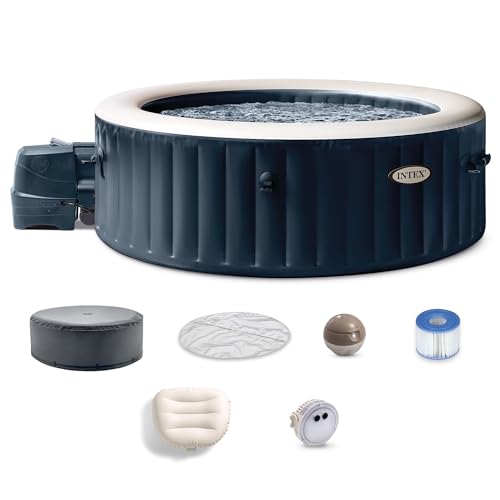
INTEX PureSpa Bubble Massage 4 Person 77×28 28429EP
Stretch the INTEX formula to seventy-seven inches and the character of the tub changes. This Bubble Massage model keeps the twenty-eight inch wall of its smaller sibling, keeps the hard water treatment and the efficient cover, and spends its extra diameter on elbow room. In a round inflatable, diameter is comfort: it is the difference between knees negotiating with a partner’s knees and everyone settling into their own arc of the wall.
From its title
- Footprint: 77 inches across
- Wall height: 28 inches
- Capacity: 4 person, per the listing title
- Massage style: Bubble massage, per the listing title
- Water care: Built-in hard water treatment
- Extras: Energy-efficient cover, 2 headrests, LED light; cobalt blue
Strengths
- Generous diameter paired with the 28 inch wall
- Bubble massage across the whole water volume
- Hard water treatment and efficient cover retained
Trade-offs
- Larger fill means slower heating and more weight
- Air massage cools long soaks gradually
- Cobalt blue will not blend into every garden
Bubble massage, as the title phrases it, means air-driven effervescence rather than directed water jets, and the distinction shapes the soak. Air bubbles rise through the water in a lively curtain that feels invigorating against the skin and keeps the whole tub gently moving, though it does not knead a specific muscle the way a aimed jet can. Air induction also cools water gradually, a quirk worth knowing for long winter sessions, where the massage may run in shorter bursts to protect temperature. The cobalt blue finish is the boldest colour statement among the inflatables here, and gardens divide into those where that reads as cheerful and those where it reads as intrusive; decide with your own planting and fencing in mind. The taller wall again does the depth work, letting bathers sit down into the water column rather than perching in it, and the included headrests support the slumped, half-floating posture that a deep evening soak tends to become.
Setup scale grows with diameter in ways first-time buyers underestimate. A seventy-seven inch tub holds meaningfully more water than the sixty-nine, so filling takes longer, heating takes longer, and the ground beneath carries more weight. None of that is hidden cost so much as physics, and it argues for placing this model where it will stay for the season rather than treating it as a weekend pop-up. Given a settled spot, a maintained cover routine and realistic numbers of bathers, it delivers the roomiest INTEX soak in this line-up.
Best for: pairs or families who felt cramped in compact inflatables and want diameter as much as depth. / Not suited for: a small balcony or deck with limited load capacity, or bathers specifically seeking targeted water jets.
Check price on Amazon — look at the diameter figures closely if elbow room is your complaint with smaller spas.

Coleman SaluSpa Sicily AirJet 5-7 Person 85×28
Sicily is the extrovert of this collection: eighty-five inches across, rated by its title for five to seven people, carrying a hundred and eighty massage jets and a reinforced cover, with smart control mentioned in the listing. The twenty-eight inch wall keeps it in the deeper-feeling camp, but the honest headline is scale. This is the tub for households whose hot tub is a social fixture — teenagers and friends in summer, adults crowding in on cold nights — rather than a private retreat for one or two.
Listing facts
- Footprint: 85 inches across
- Wall height: 28 inches
- Capacity: 5-7 person, per the listing title
- Jets: 180 massage jets, per the listing title
- Cover: Reinforced cover
- Control: Smart inflatable hot tub, per the listing title
Strengths
- Largest footprint and capacity in the set
- 180 jets spread action across a big volume
- Reinforced cover suits the large span
Trade-offs
- Filled weight demands verified ground or deck strength
- Too much tub for solo or couple-only soaking
- Heating a large volume takes time and energy
Capacity ratings deserve the usual translation. Seven people can occupy eighty-five inches of round tub in the way seven people can occupy a small sauna: legally, cheerfully, and with knees everywhere. The sweet spot is four or five adults with room to shift, which still makes Sicily the only genuine gathering option here. A hundred and eighty AirJets, as Coleman styles them, distribute bubbling action around a large water volume, and in a tub this size distribution matters, because a single cluster of jets would leave far corners feeling like plain hot water. The reinforced cover is not a minor detail at this diameter either; a big cover flexes, collects rainwater and suffers at its seams, so reinforcement speaks to the ownership experience in year two, not just week one. Smart control, named in the title without elaboration, suggests adjusting the tub without standing over it in the cold, a convenience that grows on owners quickly.
Running a tub of this size is a commitment of water, heat and garden territory. It will dominate a modest patio, and the ground preparation must be taken seriously, since a filled eighty-five inch spa is among the heaviest objects a household casually places on decking. Check the structure beneath before the tub goes down, not after the first creak. For the right household — sociable, spacious, happy to maintain a bigger body of water — those demands buy the most generous soak in this entire guide.
Best for: social households with a big, strong patio who entertain in the water. / Not suited for: compact gardens, cautious decking, or anyone whose typical soak involves exactly one person.
Check price on Amazon — measure your patio and check the deck structure before falling for the capacity figures.

Coleman Palm Springs EnergySense AirJet 77×28
Palm Springs approaches the deep-soak question from the wallet’s direction. It stands twenty-eight inches tall like its Coleman sibling, spans seventy-seven inches, seats a claimed four to six, and then does something none of the others do: it arrives with two covers, an energy-efficient thermal cover and a standard one. Heat retention is what makes a tall-walled tub practical, because depth you cannot afford to keep warm is depth you will rarely use.
What is published about it
- Footprint: 77 inches across
- Wall height: 28 inches
- Capacity: Up to 4-6 persons, per the listing title
- Covers: 2 covers: 1 energy-efficient thermal cover and 1 standard cover
- Range: EnergySense AirJet
- Colour: Green
Strengths
- Thermal and standard covers included together
- 28 inch wall at a mid-large diameter
- Efficiency theme suits year-round, cold-climate use
Trade-offs
- Jet count is not given in the title
- Green finish will not match every scheme
- Two covers need storage space when one is off duty
Two covers sound like duplication until you think in seasons. The thermal cover does the heavy insulation work through the cold months, when every degree retained overnight is a degree the heater does not buy back, while the lighter standard cover serves in milder weather when insulation matters less and handling ease matters more. That pairing also extends cover life, since the hardworking thermal cover is not being dragged on and off through summer. The EnergySense branding in the title signals that this efficiency theme is the model’s identity rather than an accessory afterthought. Green as a finish divides opinion less in a garden than cobalt blue does, sitting more quietly against planting and timber. Capacity of four to six follows the familiar pattern — six is a squeeze, four is a pleasure — and the seventy-seven inch diameter gives those four a civilised amount of personal arc along the wall.
Owners who soak year-round will extract the most from this arrangement, because winter is exactly when a taller wall tempts you to sink lower and when heat loss punishes you for it. A thermal cover narrows that punishment. The routine still asks for discipline: cover back on promptly, surface skimmed, water care kept steady. But among the inflatables here, this is the listing that most plainly acknowledges running costs as part of the product, and buyers in colder regions should weigh that acknowledgement heavily.
Best for: regular soakers in cooler climates who think about heating bills as part of the purchase. / Not suited for: fair-weather-only users who would never swap covers, or anyone short on storage for the spare.
Check price on Amazon — compare its cover arrangement against single-cover rivals if winter soaking is your plan.

Bestway SaluSpa Hawaii AirJet 4-6 Person 71×28 EnergySense
Hawaii splits the difference in this range: seventy-one inches across, twenty-eight tall, rated for four to six people, wrapped in an EnergySense cover and — the detail that will actually decide some purchases — controllable through an app, with a drink holder and tray bundled in ivory. It is the connected, convenience-leaning entry in a line-up where most listings still expect you to walk outside and press buttons in your dressing gown.
Title details
- Footprint: 71 inches across
- Wall height: 28 inches
- Capacity: 4-6 person, per the listing title
- Cover: EnergySense cover
- Control: App control, per the listing title
- Bundle: SaluSpa drink holder with tray included; ivory finish
Strengths
- App control for heating without trips outside
- EnergySense cover included at a mid-size footprint
- Drink holder and tray bundled for immediate use
Trade-offs
- Ivory finish shows garden staining more than dark colours
- Jet count is not stated in the title
- App convenience depends on your home network reaching the garden
App control changes the rhythm of ownership more than its novelty suggests. Heating can be started from indoors so the tub is ready when you are, temperature can be checked without lifting the cover and dumping heat, and the whole ritual becomes something arranged from the sofa. For a taller-walled tub, that matters, because the deeper soak is usually an evening plan, and evening plans survive better when preparation takes seconds. The EnergySense cover keeps the efficiency story present, holding the heat the app told the heater to make. The drink holder with tray is easy to dismiss as a gimmick and easy to love by the third soak; hot water, cold drinks and nowhere sensible to put a glass is a problem every spa owner meets, and a tray that belongs to the tub solves it without a side table crowding the patio edge.
Ivory is the gentlest finish here, pale against decking and less prone to showing water spots than black or deep blue, though pale surfaces show leaf stains and garden grime instead, so a cover kept on between uses does double duty. Seventy-one inches suits the middle of the market: big enough for a family soak with children, small enough not to annex the garden. If your household’s pattern is spontaneous evening use by two to four people, Hawaii’s combination of size, wall height and remote control is arguably the most modern-feeling package in this guide.
Best for: households who will genuinely use remote control and soak in twos and fours. / Not suited for: gardens with poor outdoor connectivity, or buyers who prefer the darkest, lowest-maintenance finish.
Check price on Amazon — worth shortlisting if starting the heat from indoors sounds like your routine.
The six at a glance, measured only on stated facts
| Model | Size | People (per title) | Distinguishing feature |
|---|---|---|---|
| WHALEKING Slipper | 55 inches long | 1 bather by design | Deep in the title; acrylic slipper shape |
| INTEX Greystone Deluxe | 69 x 28 inches | 4 | Hard water treatment, headrests |
| INTEX Bubble Massage | 77 x 28 inches | 4 | Bubble massage, cobalt blue |
| Coleman Sicily | 85 x 28 inches | 5-7 | 180 jets, reinforced cover |
| Coleman Palm Springs | 77 x 28 inches | 4-6 | Thermal plus standard covers |
| Bestway Hawaii | 71 x 28 inches | 4-6 | App control, drink holder bundle |
Two patterns stand out from the table. First, every inflatable here shares the same wall height, so depth between them is a tie; what actually separates them is diameter, covers and controls. Shoppers who arrive expecting to rank the inflatables by depth should redirect that energy toward the size and running-cost questions, where real differences live. Second, capacity ratings climb with diameter but comfort does not climb at the same rate — the jump from four people in sixty-nine inches to four in seventy-seven is worth more, per person, than any headline number suggests.
How to choose a hot tub that will actually feel deep?
Start with your own seated height, not the brochure
Sit on the floor against a wall, as you would in a tub, and have someone measure from the floor to your shoulder. That rough figure, compared against a tub’s internal arrangement and wall height, tells you more about your soak than any photograph of strangers smiling in foam. Taller bathers feel the benefit of the twenty-eight inch wall most, because they are the ones a shorter wall leaves exposed from the chest up. Shorter bathers may find any of these tubs generous and can prioritise diameter or covers instead. If several adults of different heights share the tub, choose for the tallest regular user; everyone else can sit on the floor of the tub or perch slightly higher, but the tall person cannot make a shallow wall deeper.
Decide whether depth means solitude or company
The deepest-feeling soak in this guide is a solitary one, inside the WHALEKING, and the most sociable is the shallowest-feeling per person, inside a crowded Sicily. Neither is the wrong answer; they are different pleasures. Be honest about your real pattern over the last year of baths, showers and garden evenings. Households that imagine weekly gatherings but actually soak alone after long days should buy the tub for the life they live, because a big inflatable heated for one person wastes money every single session, while a slipper tub bought by a family that entertains will sit admired and unused. If both patterns genuinely occur, the mid-size inflatables — seventy-one to seventy-seven inches — are the compromise that serves a couple nightly and a foursome occasionally.
Count the cost of keeping deep water hot
A taller wall holds more water over the bather, and more water costs more to heat and to keep hot. Covers are therefore not accessories in this category; they are the mechanism that makes depth affordable, which is why the Palm Springs two-cover arrangement and the various energy-efficient covers named in these titles deserve as much attention as any jet figure. Think, too, about where the tub sits: a sheltered corner out of the wind loses far less heat than an exposed terrace, and a tub used daily stays cheaper per soak than one reheated from cold every weekend. If your pattern is the occasional long Saturday soak, a smaller volume you can heat without wincing will be used more than a vast one you ration.
Why two inches of wall changes an evening soak
It is worth dwelling on the physiology for a moment, because it explains the whole category. Immersion works through water pressure and warmth together: the deeper the body sits, the more evenly warmth reaches the torso, and the more the water itself supports muscles that otherwise hold you upright. A bather whose shoulders sit above the surface is really taking two baths at once — a warm one below the waterline and a cold-air one above it — and in winter that contrast is what drives people indoors early. Raise the waterline to the collarbone and the session lengthens almost without the bather deciding anything. That is the honest promise of the twenty-eight inch wall, stated without a single invented depth figure: not a deeper tub in the abstract, but more of you under the water at once.
The same logic explains why the slipper shape works indoors. By lifting the back and deepening the sitting well, the WHALEKING puts the bather’s torso low relative to the rim, achieving with geometry what the inflatables achieve with height. Two different engineering answers, one shared goal. When you read any hot tub listing after this guide, translate its claims into that single question — how much of a seated adult ends up below the waterline — and you will cut through most of the category’s fog in seconds. Listings that cannot answer it with a dimension are asking you to buy a mood.
Getting in and out of a taller-walled tub
A twenty-eight inch wall asks a question the shorter mainstream never raises: how does everyone get over it? Inflatable walls are soft and forgiving to climb across, which is part of their accessibility charm, but a wet, air-filled rim is also an unstable handhold, and older bathers or anyone with a knee that complains should plan the entry rather than improvise it. A sturdy step outside the tub, a clear route that does not cross hosepipes, and a rule that nobody climbs in carrying drinks or phones all sound fussy until the first slippery evening. Inside, the floor of an inflatable gives underfoot in a way a rigid tub never does, and most people settle by sitting down in stages — perch, swing, slide — rather than stepping down as they would into a bath.
The WHALEKING presents the opposite problem in a more elegant material. A free-standing slipper tub has a fixed rim at a fixed height, no give anywhere, and a smooth acrylic interior that offers no grip to wet hands. Bathroom planning should treat entry as part of the design: the tub’s position relative to a wall or a sturdy fitting you can steady yourself on, the floor finish where wet feet land, and enough clear space beside the tub for an unhurried exit. None of this is a reason to avoid a deep tub. It is a reminder that depth is a relationship between water and body, and the body has to arrive and leave safely for the relationship to work.
Water care in a taller, larger body of water
More water dilutes mistakes and hides them longer, which makes inflatable spa care a discipline of small regular checks rather than dramatic rescues. A tall-walled tub that gets used at full depth holds its chemistry in a narrower comfort band than owners expect, because bathers introduce the same load of skin oils, cosmetics and warmth into a volume whose temperature stays high for long, cover-closed hours. Test strips or whatever routine the manufacturer directs should happen on a rhythm — after heavy use, and weekly regardless — rather than when the water starts to look tired. By the time water looks tired, the fix is usually a drain and refill, which in an eighty-five inch tub is a genuine afternoon’s decision.
The hard water treatment built into both INTEX listings speaks to the other slow enemy, mineral scale. In hard-water regions, scale roughens surfaces, stresses heaters and leaves a tide line that makes even a clean tub look neglected. A treatment system does not abolish water care, but it changes the failure mode from crust to routine. Owners of the Coleman and Bestway models should simply expect to carry that mineral management themselves through their normal water-care products and habits. Either way, the cover is part of water care too: a covered tub collects less debris, loses less heat and holds its chemistry steadier, which is why every listing here makes a point of its cover in the title.
How seating position changes the depth you feel
Two bathers in the same tub can honestly report different depths, because posture is a dimension too. Sitting upright on the floor of an inflatable, back against the wall, puts the waterline where the wall height promises. Slumping — the natural drift of a long soak — slides the hips forward and drops the shoulders several inches lower, which is exactly the posture headrests exist to support, and why both INTEX listings bundle them. Children experience these tubs as genuinely deep water and should be supervised with that in mind; a twenty-eight inch wall is chest height on a small child seated inside. Adults supervising from within the tub, rather than from a chair beside it, is the arrangement that matches the physics.
In the slipper tub, posture is designed rather than improvised. The raised end sets the recline angle, and the bather’s job reduces to settling into the shape. That is a real ergonomic difference from a round inflatable, where the wall offers the same support at every point of the compass and the bather chooses their own angle, for better and worse. People with a bad lower back often prefer the slipper’s decision made for them; people who like to shift, turn and chat across a tub prefer the inflatable’s freedom. Depth, once again, turns out to be partly geometry and partly behaviour.
Seasonal rhythms: when depth earns its keep
Ask owners when their tub justifies itself and most describe the same scene: a cold evening, breath visible, shoulders below the waterline, and no hurry to get out. That scene is the twenty-eight inch wall’s whole argument, and it peaks in the months when a shallower tub would drive bathers indoors within minutes. Summer reverses the logic. In hot weather, very warm deep water can feel oppressive, temperatures get dialled down, and the tub becomes a cool plunge as much as a soak — a role inflatables play happily at lower temperatures, especially the larger models where several people can lounge. Planning a purchase around your climate’s dominant season, rather than the week you happen to be shopping, is the simplest way to land on the right size and cover combination.
Storage season deserves a mention for the inflatables. A tub that comes down for winter needs cleaning, thorough drying and a storage spot where the material will not be crushed or gnawed; a tub that stays up needs its cover discipline and water care maintained through the cold. The listings here do not dictate either path, but the choice interacts with depth in one practical way: the household that keeps a tall tub running all winter is buying the deep-soak season in full, while the household that stores it is buying a spring-to-autumn amenity. Both are legitimate. Confusing one plan for the other is how tubs end up neglected.
Heat, time and the first week of ownership
Every new tub teaches the same lesson in its first week: hot water runs on a schedule, not on impulse. A freshly filled inflatable needs hours to reach soaking temperature, and the bigger the diameter, the longer the wait, so the households who love their tubs are the ones who fold heating into the day’s rhythm — switched on in the morning for the evening, or held at temperature under a good cover for regular users. The app control on the Hawaii and the smart framing of the Sicily exist precisely to soften that discipline, letting the heating start from wherever the owner happens to be. First-week disappointment usually traces back to expecting a kettle and discovering a slow cooker, and it fades as soon as the routine forms.
Depth interacts with heating in one more subtle way. A taller wall loses more surface heat from the exposed ring of water near the rim on a windy night, and bathers feel the top layer cool first, which can make a deep tub seem to be losing its temperature even when the bulk of the water is fine. Stirring the water with the bubbles running redistributes that warmth, and replacing the cover the moment the last bather climbs out protects the next session. These are small crafts, learned in a fortnight, and they separate owners who describe their tub as effortless from owners who describe the identical model as disappointing.
Give any of these six a month of honest use before judging it. The first soak is a novelty, the fifth is a routine, and the twentieth is when a household discovers whether it bought the right size, the right wall and the right cover for the life it actually leads. Depth chosen on real dimensions, rather than on adjectives, survives that month comfortably — which is the entire reason this guide insisted on the numbers the listings were willing to state, and refused the ones they were not.
What depth does for sore muscles — and what it does not
Warm immersion has a long folk reputation for easing the day out of tired legs and shoulders, and a deeper soak plainly gives that warmth more body to work on at once. It is still worth keeping the claim modest: a hot tub is a comfort, not a treatment, and none of these listings is presented here as a medical device. What can be said without stretching is that people use these tubs after physical work, after sport and at the end of long standing days because the combination of heat, buoyancy and enforced stillness feels restorative, and the deeper the water, the more complete that stillness becomes, since the body is supported rather than braced. Anyone managing an actual condition should take their guidance from their clinician and treat the tub as the pleasant environment it is, not as a prescription.
Buoyancy deserves its own sentence in a depth guide, because it scales with immersion. The more of the body the water carries, the less the joints carry, and a bather floating at collarbone depth in a twenty-eight inch tub is experiencing meaningfully more unloading than the same person perched in a shallow one. That is simple physics, available to anyone, and it explains why taller bathers in particular describe the taller wall as a different category of soak rather than a marginal improvement. It also explains the appeal of the slipper tub’s well, where the shape gathers water around the seated body instead of spreading it thinly across a rectangle.
Reading inflatable dimensions like an owner, not a shopper
Diameter figures in inflatable listings describe the tub at its broadest, which is the outside of a soft wall, not the clear water space inside. The usable circle is smaller, by the thickness of the wall on both sides, and that is the space bathers actually share. This is why the seventy-seven inch models feel disproportionately roomier than the sixty-nine: a modest gain in stated diameter becomes a larger gain in the inner circle where people sit. Shoppers comparing across brands should therefore compare like with like — stated diameter against stated diameter, wall against wall — and resist converting any of it into imagined internal depths that the manufacturers have not published.
Height figures carry a similar caution in reverse. Twenty-eight inches is the wall, not the water; nobody fills an inflatable to its brim, because bathers displace water and movement spills it. The working waterline sits below the rim, which is precisely why the taller wall matters: starting higher leaves the working line higher after the sensible margin is subtracted. A twenty-six inch tub run at a safe fill and a twenty-eight inch tub run the same way preserve their two-inch difference where it counts, at the bather’s shoulders, on a cold night, twenty minutes into the soak.
One more comparison belongs in this guide, because shoppers meet it constantly: the rigid, plumbed outdoor spa. None appears among these six picks, and the omission is deliberate rather than an oversight. A rigid spa is a garden building project with a tub inside it — craned or manhandled into place, wired by an electrician, and effectively permanent. The inflatables here ask for a level surface and a season’s commitment, and the WHALEKING asks for a bathroom renovation. Between those levels of commitment sits most of the real buying public, and this guide serves it by refusing to pretend an inflatable and a rigid spa are interchangeable answers to the same question. If your project is genuinely permanent and outdoors, shop that category on its own terms; if it is a bathroom, the slipper tub is your candidate; if it is a patio and a season, the five inflatables are the honest field.
Within that field, let the last deciding factor be the soak you pictured when you first searched. If the picture held one person and a book, the WHALEKING or the Greystone will serve it best. If it held a partner and a long conversation, the mid-size tubs were drawn for exactly that frame. If it held a crowd, only the Sicily was. Pictures are not specifications, but they are evidence about desire, and desire — checked against wall height, diameter and cover — is what remains satisfied a year after the novelty has worn off.
Before ordering, walk the intended site once more with the chosen model’s diameter in mind and a hose laid in a circle on the ground; living with that circle for a day, walking around it and sitting inside its line with a chair, teaches more about fit than any amount of specification reading, and it costs nothing but ten minutes of a weekend afternoon.
Households with dogs should also expect the tub to become a spectator event, since a warm, steaming circle of water at garden level fascinates most animals, and a covered tub between sessions is as much about keeping paws and curiosity out as it is about keeping heat in.
It is also worth deciding, before the first fill, who in the household owns the weekly water checks and the cover routine, because shared-but-unowned jobs in a garden have a way of becoming nobody’s job by the third week, and a tall tub’s water rewards the household that settles that question early and writes the answer on the inside of a kitchen cupboard door.
Guests need one briefing and one only: where to step, where towels live, and how long the water takes to forgive a cannonball entry in a tub that was filled close to its sensible line.
Finally, keep the packaging question in mind until the tub has survived its first fortnight of use, because inflatables occasionally arrive with a slow seam leak that only shows itself across several days of holding water, and a household that has kept its receipts, its box and its temper during that window will find any remedy far easier to arrange than one that declared the installation finished on day one and threw every scrap of evidence into the recycling.
A garden tap within hose reach, a drain that can accept a full emptying without flooding a border, and a dry, clean spot for the cover while people are in the water during each long evening session complete the practical trio of site requirements every buyer should confirm that separates an easy installation from an awkward one.
Common mistakes when shopping for depth
Believing a depth figure nobody published. If a number for soaking depth does not appear in the listing, it does not exist for buying purposes. Work from wall height and diameter, which manufacturers do state, and distrust any secondary source that fills the silence with precision.
Buying diameter and calling it depth. A wide, short-walled tub feels spacious and still leaves shoulders in the cold. Shoppers regularly spend on the dimension that photographs well rather than the one that warms them.
Crowding a tall tub. Filling a four-person rating with four large adults lowers everyone’s comfort and sloshes water over the rim, effectively shallowing the soak. The tall wall pays off best with a little room per bather.
Ignoring the cover until the first bill. Depth without insulation is a subscription to disappointment. Check what cover the listing includes before comparing anything else, especially for winter use.
Siting the tub where the wind lives. An exposed corner steals heat from bathers’ shoulders — precisely the area a deep soak is meant to protect — and quietly cancels the benefit the extra wall height bought.
Final recommendation
Choose the WHALEKING if depth, honestly defined, is the purchase, and your bathroom project can take a plumbed slipper tub. Among the inflatables, let size and season decide: Greystone for small patios, the seventy-seven inch INTEX for room with bubbles, Sicily for gatherings, Palm Springs for cold-climate running costs, Hawaii for app-driven convenience. Anyone weighing the running-cost side further should read our companion guide to Best Eco Friendly Hot Tubs, where insulation approaches are compared in their own right rather than as a footnote to depth.
Frequently asked questions
Is a 28 inch inflatable really deeper than a 26 inch one?
Its wall stands two inches taller, and for a seated adult that typically means the waterline sits noticeably higher on the body. The titles do not publish internal soaking depths, so this guide compares wall heights only — but wall height is the dimension that decides how much of you the water can cover.
Can an inflatable ever match a plumbed soaking tub?
They solve different problems. The WHALEKING offers a shaped, permanent, single-person soak with the water held close around one body. An inflatable offers several people, portability and a far simpler installation. Depth per bather favours the slipper tub; depth shared among friends favours the inflatables. Flooring under a plumbed bathroom project is a bigger decision than most buyers expect, and the patterns in Best Braided Rugs Online at least make the bath-mat end of that project more cheerful.
How many adults comfortably fit a four-person inflatable?
Two, luxuriously; three, comfortably; four, in the spirit of a friendly squeeze. Ratings describe capacity, not comfort, and the deeper soak this guide is about is best experienced at the comfortable end of that scale rather than the maximum.
Does the cover really change how deep a soak feels?
Indirectly, yes. A good cover keeps the full volume hot between sessions, so the tub is filled and used at its proper level instead of being run low or left cold. The Palm Springs listing, with its separate thermal cover, treats that relationship most seriously of the six.
What should I check before placing an 85 inch tub on decking?
The structure’s load rating, in writing if you can get it, and the state of the boards and joists beneath the chosen spot. A filled tub of that diameter is a multi-tonne object once bathers climb in. Afterward, the walk back indoors in winter is its own small project, and the absorbent options in Best Towels for Surfers handle the dripping dash better than a bath towel does.
Depth, in the end, is simply more of you resting in warm water at once, together, on a cold evening — buy the tub that delivers that to the people who will actually climb in.


