What's inside
- Where to buy, by efficiency approach
- Quick Picks
- How these picks were chosen
- Comparing the tiers without flattening them
- How to choose an eco friendly hot tub for your climate?
- The habit layer: efficiency no manufacturer can sell you
- Where the heat actually goes: a short physics tour
- Electricity supply and the shape of a heating bill
- Water: the other half of the footprint
- Covers deserve their own maintenance routine
- Second-hand tubs and the reuse question
- Common mistakes in eco hot tub shopping
- Final recommendation
- Frequently asked questions
As an Amazon Associate I earn from qualifying purchases. This post may contain affiliate links at no extra cost to you.
As an Amazon Associate, cottageverdict.com earns from qualifying purchases.
Eco friendly hot tubs are not one thing, and pretending otherwise would make this guide useless. Among these six listings, the evidence for efficiency arrives in tiers that differ in kind, not just in degree. Some tubs build insulation into their structure. One leans on an efficient cover alone. One rigid spa fills its cabinet with foam and adds a thermal cover. One inflatable insulates the ground beneath it with foam mats. No title here claims an energy certification, so none is reported. Read the tiers, decide which matches your climate and habits, and the right eco friendly choice usually becomes obvious.
Why does the tier matter so much? Because heat leaves a hot tub through every surface it touches, all the time, and each approach blocks different exits. A cover seals the top. Wall insulation slows the sides. Foam fill surrounds everything. Mats interrupt the floor. A tub with one exit blocked still leaks through the others, which is why this guide refuses to flatten six different designs into a single green badge — and why the most efficient real-world setup often combines a good product with a sheltered site and a disciplined cover routine.
Where to buy, by efficiency approach
The reviews below link to each listing directly. Choose the Bestway Miami for built-in insulation at couple size. Choose its Cancun sibling when winters bite and freeze protection joins insulation on your list. Choose the Coleman EnergySense when the insulated formula must stretch to family size. Choose the INTEX when a serious cover and a taller, larger tub fit your habits better than wall insulation fits your walls. Choose the Lifesmart for full foam insulation in a rigid, plug-in spa. Choose the drop-stitch six-person tub when floor mats and family capacity are the priorities and you accept the lightest evidence tier.
Quick Picks
| Pick | Best for | Efficiency evidence in the title |
|---|---|---|
| Bestway SaluSpa Miami Energy-Efficient 2-4 Person 71×26 | Built-in insulation, compact size | Built-in insulation and 120 massage jets at 71 x 26 inches |
| Bestway SaluSpa Cancun Energy-Efficient 2-4 Person 71×26 | Insulation plus cold-weather protection | Built-in insulation, Freeze Shield technology, 120 bubble jets |
| INTEX PureSpa Bubble Massage 4 Person Energy Efficient Cover 28425EG | Cover-led efficiency, saltwater ready | Energy efficient cover included; saltwater system ready; 77 x 28 inches |
| Coleman SaluSpa Energy-Efficient AirJet 4-6 Person Insulation | EnergySense insulation for 4-6 people | Built-in EnergySense insulation, Freeze Shield, 140 jets, smart portable spa |
| Lifesmart 4-Person Plug and Play Hot Tub Thermal Cover 13-Jet | Rigid plug-and-play with full foam insulation | Thermal cover, full foam insulation, 200 gallon, 110V plug and play |
| Inflatable Hot Tub 6 Person Drop Stitch Insulated Foam Mats | Floor-up insulation for six people | Full drop stitch build, insulated foam mats to retain heat, wood grain finish |
How these picks were chosen
Every pick had to show its working in its own title. A listing that merely draped itself in green language without naming a mechanism — insulation, an efficient cover, foam, mats — did not qualify, because a buyer cannot verify a vibe. That single rule produced the tier structure this guide is built on, and it also produced the guide’s silences: where a title names no jets, no dimensions or no cover, the review records the gap rather than borrowing a sibling’s numbers.
The six were then arranged to span the realistic shapes of demand. Two compact insulated inflatables differ on freeze protection. One insulated inflatable grows to family size. One large inflatable bets on its cover. One rigid spa bets on foam and permanence. One large inflatable bets on the floor. Between them they cover the honest meanings the phrase eco friendly can carry in this category today, without a single invented certification to dress the set up. Prices and ratings are absent throughout, as they should be in a guide meant to be read next season as well as this one.

Bestway SaluSpa Miami Energy-Efficient 2-4 Person 71×26
Miami makes the strongest structural claim in this guide, and it makes it in plain words: built-in insulation. Rather than asking a cover to do all the thermal work after the fact, this Bestway builds heat retention into the tub itself, at a modest seventy-one by twenty-six inches for two to four people, with a hundred and twenty massage jets providing the bubbles. For a buyer whose idea of eco friendly starts with wasting less heat in the first place, that ordering of priorities is exactly right.
Evidence from the title
- Footprint: 71 inches across
- Wall height: 26 inches
- Capacity: 2-4 person, per the listing title
- Insulation: Built-in insulation, per the listing title
- Jets: 120 massage jets
- Efficiency evidence tier: Insulation in the tub structure itself
Strengths
- Insulation built into the structure, per the title
- Compact volume reduces heating demand
- 120 jets at a manageable 71 inch size
Trade-offs
- 26 inch wall, shallower than some rivals
- Freeze Shield wording belongs to the Cancun, not this model
- No certification is claimed in the title
Think of a hot tub’s heat as money in a purse with several holes. The cover plugs the biggest hole, at the surface. The walls and floor are the quieter holes, leaking steadily into cold ground and night air, and built-in insulation is the only approach among these six that addresses them in the product’s own construction. A smaller volume helps the arithmetic further: two to four people need less water heated, less heat maintained, and less time to reach temperature than the big social tubs, so the Miami’s modesty is itself an efficiency feature, even though no listing would print it that way. The hundred and twenty jets give the soak its lively character without turning the tub into a giant’s bath. What the title does not do is claim any certification, rating or standard, and this guide will not invent one; the efficiency case here rests on the stated insulation and the sensible size, which is evidence enough when it is read carefully.
Daily ownership of a smaller insulated tub has a rhythm larger models cannot match. It reaches temperature sooner after a refill, the cover is light enough that replacing it never feels like a chore worth postponering, and a couple can justify heating it for an ordinary Tuesday. Freeze protection is not mentioned for this model — its Cancun sibling carries that wording — so owners in genuinely cold regions should read the Miami as a three-season proposition unless their own checks say otherwise. Within those seasons, it is the most self-consistent efficiency package in the set.
Best for: couples who want efficiency engineered into the tub rather than added on top of it. / Not suited for: mid-winter soaking in a cold climate without checking its freeze provisions, or groups larger than four.
Check price on Amazon — start here if structural insulation matters more to you than maximum diameter.

Bestway SaluSpa Cancun Energy-Efficient 2-4 Person 71×26
Cancun takes the Miami’s formula — same seventy-one by twenty-six inch footprint, same two-to-four person rating, same hundred and twenty jets, built-in insulation included — and adds the phrase that changes its season: Freeze Shield technology. Where the Miami reads as a three-season tub, the Cancun’s title explicitly contemplates freezing conditions, which makes it the Bestway in this guide aimed at owners who keep water in the tub when the garden frosts.
Its stated mechanism
- Footprint: 71 inches across
- Wall height: 26 inches
- Capacity: 2-4 person, per the listing title
- Insulation: Built-in insulation, per the listing title
- Cold protection: Freeze Shield technology, per the listing title
- Jets: 120 bubble jets
Strengths
- Built-in insulation paired with named freeze protection
- Same compact, heat-friendly footprint as the Miami
- 120 bubble jets for the soak itself
Trade-offs
- Still a 26 inch wall and a four-person ceiling
- No efficiency certification stated in the title
- Freeze wording is a technology name, not a guarantee — conditions apply on the listing
Freeze protection and insulation are cousins, not twins, and a careful buyer should separate them. Insulation slows heat loss every hour of every day, trimming the energy needed to hold temperature. Freeze Shield, as the listing names it, addresses the catastrophic scenario: water in pipes and components dropping to freezing during a cold snap, with the damage that follows. A tub can be well insulated and still vulnerable in a hard frost if water sits unheated in the wrong place, and it can be freeze-protected while still leaking heat through thin walls. The Cancun claims both lines of defence in its title, which is why it, rather than its sibling, is the recommendation for northern gardens and unheated outbuildings. The bubble jets — the title’s wording here, where the Miami says massage jets — deliver the same airy effervescence either way, and the shared footprint means the two models compete purely on this cold-weather question and on styling.
Choosing between the siblings is therefore unusually simple. Price the pair, look at your winter, and be truthful about whether the tub will hold water through it. Owners who drain and store before the frosts gain little from freeze technology; owners who soak under cold stars in January gain a great deal. Everything else — the insulation story, the size, the jet count — is common ground, and common ground this solid is rare in a category addicted to trivial differentiation.
Best for: year-round soakers in frost-prone regions who want insulation and freeze defence in one compact tub. / Not suited for: buyers in mild climates paying for cold protection they will never call on, when the Miami covers the same ground.
Check price on Amazon — choose this sibling if your tub will still be full when the first frost arrives.

INTEX PureSpa Bubble Massage 4 Person Energy Efficient Cover 28425EG
INTEX takes a different road to the same destination, and this guide will describe it as exactly what it is: a seventy-seven by twenty-eight inch, four-person bubble massage spa whose efficiency claim rests on its included energy efficient cover, with a saltwater system readiness as a second, separate virtue. There is no claim of insulation in the walls. That honesty makes the comparison more useful, not less, because covers genuinely are where most heat escapes — through the surface — and a good one is not a token gesture.
Title evidence
- Footprint: 77 inches across
- Wall height: 28 inches
- Capacity: 4 person, per the listing title
- Efficiency feature: Energy efficient spa cover included
- Water system: Saltwater system ready, per the listing title
- Structural insulation: None stated in the listing title
Strengths
- Efficient cover targets the biggest heat-loss channel
- Taller 28 inch wall at a roomy 77 inches
- Saltwater readiness widens water-care options
Trade-offs
- No structural insulation is claimed
- Efficiency depends heavily on cover discipline
- Saltwater system itself is not stated as included
Heat rises, and in a hot tub it rises into the air through the water’s surface all night long. A well-fitting, efficient cover attacks the largest single loss channel a spa has, which is why cover-led efficiency is a legitimate tier of evidence rather than a marketing fig leaf. What it cannot do is slow the slower seep through walls and floor, so the INTEX approach asks slightly more of the heater across a long cold week than a structurally insulated tub does, while asking nothing extra of the buyer in complexity. The twenty-eight inch wall, taller than the Bestway pair, also plays a quiet part: more water depth per soak means the tub is used as intended rather than topped up and reheated around partial fills. Saltwater readiness belongs in a different column of the ledger — it concerns water care chemistry rather than energy — but households drawn to gentler water treatment will count it as part of an eco-minded package, provided they remember it is readiness, not an included system.
The practical buyer should weigh this model on total behaviour: a big, tall tub with a serious cover, kept covered religiously, can out-perform a smaller insulated tub whose cover lives leaning against a fence. Efficiency in the real world is product multiplied by habit, and INTEX has built the half of that equation it controls. If your household is disciplined about covers — on within minutes of the last bather leaving — this listing’s approach will serve you better than its modest wording suggests.
Best for: cover-disciplined households wanting a larger, taller tub whose efficiency comes from its lid. / Not suited for: owners who leave covers off for hours, since this model’s whole thermal case rests on that habit.
Check price on Amazon — a strong pick if you know the cover will go straight back on after every soak.

Coleman SaluSpa Energy-Efficient AirJet 4-6 Person Insulation
Coleman scales the insulated formula up. This SaluSpa carries built-in EnergySense insulation and Freeze Shield technology like the Bestway pair, but stretches to seventy-seven by twenty-eight inches for four to six people, raises the jet count to a hundred and forty, and describes itself as a smart portable outdoor spa. If the Bestway twins are the efficiency argument at couple size, this is the same argument made for a family.
What the listing claims
- Footprint: 77 inches across
- Wall height: 28 inches
- Capacity: 4-6 person, per the listing title
- Insulation: Built-in EnergySense insulation, per the listing title
- Cold protection: Freeze Shield technology, per the listing title
- Jets: 140 soothing jets; smart portable outdoor spa
Strengths
- EnergySense insulation at a family-sized 77 inches
- Freeze Shield included for winter operation
- 140 jets, the highest count among the insulated picks
Trade-offs
- Larger volume still costs more to heat than the 71 inch pair
- Smart features are named but not detailed in the title
- No certification is stated in the listing
Scale is the enemy of efficiency in hot tubs, because volume grows faster than the number of happy bathers, so an insulated construction matters more, not less, as a tub grows. The Coleman applies its insulation claim at exactly the size where wall losses start to dominate the heating bill, and pairs it with freeze protection for the households who will keep those seventy-seven inches full through winter. A hundred and forty jets across that diameter should distribute the bubbling action evenly, avoiding the dead corners that large tubs can suffer. The smart description in the title hints at connected control without detailing it, and connected control has a genuine efficiency angle — heating scheduled precisely for the soak, rather than held at temperature all day in case of one — though the listing leaves the specifics to be checked there. Four to six people follows the usual translation: four in comfort, six in friendship.
This is the listing for the household that refused to choose between the insulated camp and the bigger tub. It asks for the largest commitment among the insulated models — more water, more ground, more cover to handle — and returns the most complete feature set in this guide in exchange. Cold-climate families who soak together weekly will feel the insulation working every single week, in the only currency that finally matters in this category, which is heat not bought twice.
Best for: families in cold regions who want structural insulation without shrinking to a two-person tub. / Not suited for: couples who would heat six-person volume for two bathers, or minimalists wary of connected features.
Check price on Amazon — the family-size answer if the Bestway pair reads as too small for your household.

Lifesmart 4-Person Plug and Play Hot Tub Thermal Cover 13-Jet
Lifesmart breaks the inflatable pattern entirely. This is a rigid plug-and-play spa for four people, with bucket seats, thirteen jets, a thermal cover and — the phrase that earns its place in an eco guide — full foam insulation, running from an ordinary hundred and ten volt supply. Two hundred gallons, a one horsepower pump and a multi-colour light complete a title that reads like a small permanent spa rather than a seasonal blow-up.
Facts as published
- Type: Plug and play hot tub spa, per the listing title
- Capacity: 4-person; 200 gallon capacity
- Insulation: Full foam insulation, per the listing title
- Cover: Thermal cover; sold as a 2-pack in the title
- Jets and pump: 13 jets; 1.0 HP pump; 4 bucket seats with jets
- Power: 110V 15 amp; multi-color LED light
Strengths
- Full foam insulation in a rigid shell
- Thermal cover included to close the surface
- Plug-and-play 110V avoids a dedicated circuit
Trade-offs
- 13 water jets feel different from air-bubble massage
- Heating on 110V rewards patient scheduling
- Rigid body is far less portable than any inflatable here
Full foam insulation is the rigid-spa world’s classic answer to heat loss: the cabinet’s void filled so that heat leaving the water meets resistance in every direction, and the plumbing sits inside that warm envelope rather than in cold air. It is a different technology from the inflatables’ insulated walls, proven over decades of rigid spas, and it pairs here with a thermal cover to close the surface as well. Plug-and-play power matters to the eco calculation in an indirect way: a hundred and ten volt installation avoids an electrician’s visit and dedicated circuit, lowering the total project footprint, though heating and recovery on such a supply are gentler than on a hardwired spa, and patient owners suit it best. Thirteen jets sounds sparse beside the inflatables’ hundreds, but the comparison misleads — these are thirteen water jets in four defined bucket seats, each aimed at a seated body, against the inflatables’ clouds of air bubbles. Different sensations, honestly labelled in both cases.
The two-pack wording in the title refers to the offering as listed and should be read on the listing itself before ordering, since it is the kind of detail that decides what arrives. What is unambiguous is the proposition: a seat-shaped, foam-insulated, covered spa that plugs in and stays put. For an owner who wants a permanent fixture without a building project, and who counts insulation as the core eco feature, this older-school design may be the most convincing entry in the whole guide.
Best for: owners wanting a permanent, seated spa whose insulation is structural and proven. / Not suited for: anyone who needs to store the tub away seasonally, or who expects inflatable-style bubble clouds from its jets.
Check price on Amazon — consider it seriously if your eco priority is insulation and your plan is permanent.
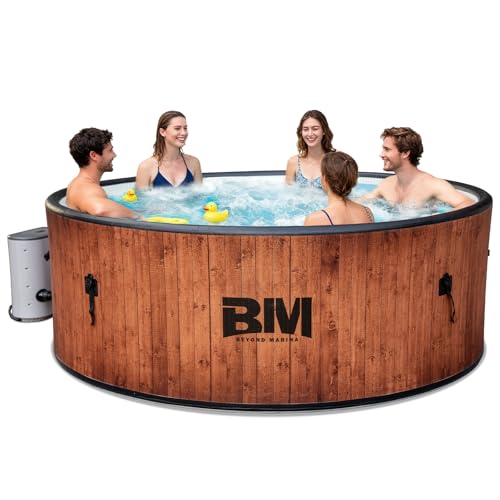
Inflatable Hot Tub 6 Person Drop Stitch Insulated Foam Mats
The final pick insulates from the ground up, literally. This unbranded six-person inflatable is built with full drop-stitch construction and comes with insulated foam mats whose stated job is to help retain heat, all wrapped in a wood grain finish aimed at family home relaxation. Its efficiency evidence is the most modest tier in this guide — mats beneath the tub rather than insulation within its walls — and the review will keep it in that tier, while noting that the floor is a genuinely important place to insulate.
The stated case
- Capacity: 6 person, per the listing title
- Construction: Full drop stitch, per the listing title
- Insulation: Insulated foam mats that help retain heat, per the title
- Finish: Wood grain
- Intended use: Family home relaxation, per the listing title
- Dimensions: Not stated in the listing title
Strengths
- Insulated mats tackle downward heat loss directly
- Drop-stitch build for a firmer large tub
- Six-person size suits family soaking
Trade-offs
- No wall insulation or cover claim in the title
- Dimensions and jet count are not stated
- Unbranded listing means details need checking there
Cold ground is a patient thief. A tub sitting directly on a patio slab loses heat downward around the clock, into a heat sink that never warms up, and a mat layer interrupts that path with the simplest technology in this entire guide: a barrier. Drop-stitch construction, borrowed from paddle boards, lets inflatable walls hold a firmer, more defined shape at pressure, which can make a large tub feel sturdier under bathers’ backs. Six-person capacity puts this at the social end of the market, where per-person efficiency can actually be respectable — one heating bill shared by a family — provided the tub is genuinely used by groups rather than heated for one. The wood grain finish helps a big inflatable sit more quietly in a garden of timber and planting. Against all that, the title gives no dimensions, no jet count and no cover claim, and those silences must be checked on the listing rather than filled in by optimism.
Buy this one with your eyes open and it can serve a family well: the mats are a real feature, the construction method is a real feature, and the capacity is real. Simply do not credit it with the wall insulation of the Bestway or Coleman models, or the full foam of the Lifesmart, because its title does not claim either. In a guide organised by tiers of evidence, it stands as the entry tier — and as a reminder that the floor is the one loss channel even the premium models expect you to think about yourself.
Best for: families wanting a large tub whose floor insulation is included and whose finish suits a timber garden. / Not suited for: buyers seeking the strongest insulation evidence, or anyone uncomfortable verifying unstated details on a listing.
Check price on Amazon — check the listing’s dimensions carefully, since its title leaves them open.
Comparing the tiers without flattening them
| Model | Where the efficiency lives | Also in the title |
|---|---|---|
| Bestway Miami | Built-in insulation | 120 jets, 71 x 26 |
| Bestway Cancun | Built-in insulation | Freeze Shield, 120 bubble jets |
| INTEX 28425EG | Energy efficient cover | Saltwater ready, 77 x 28 |
| Coleman EnergySense | Built-in EnergySense insulation | Freeze Shield, 140 jets |
| Lifesmart | Full foam insulation plus thermal cover | Plug and play 110V, bucket seats |
| Drop-stitch 6 person | Insulated foam mats | Wood grain, family use |
Laid side by side, the tiers stop looking like a league table and start looking like a map. Structural insulation — Bestway, Coleman, and in foam form Lifesmart — works while you soak, while you sleep and while you are on holiday, asking nothing of your habits. Cover-led efficiency works exactly as well as your discipline, which for tidy households is very well indeed. Floor mats work on the one channel the others mostly leave to the buyer. None of these is a certification, and a shopper who meets any seller translating them into one should walk away from that seller, not from the tub.
How to choose an eco friendly hot tub for your climate?
Let your winter make the first decision
Climate sorts this field faster than any feature list. In a mild region where the tub runs from spring to autumn, the differences between tiers shrink, because the temperature gap between water and air — the engine of all heat loss — stays modest, and a cover-led model like the INTEX can be a perfectly rational buy. In a cold region, or in any household determined to soak through January, the gap widens brutally and structural insulation plus freeze protection stop being premiums and become the product itself. That is the Cancun and Coleman territory, with the Lifesmart’s foam cabinet as the rigid alternative. Decide your season honestly before you decide your model, because retrofitting winter capability onto a summer tub is not really possible.
Size the tub to the bathers you actually have
The greenest litre of hot water is the one you never heated. A couple who buys a six-person tub heats a family’s worth of water for two bodies, every session, for years, and no insulation tier fully rescues that arithmetic. Conversely, a family of five in a two-to-four person tub will run it constantly and crowd it miserably, which is its own kind of waste — of money and of the whole idea. Match capacity to your real, recurring group, using the comfortable interpretation of the ratings rather than the maximum, and let that decision precede the insulation debate. The tiers then refine a purchase that is already the right size.
Plan the site as part of the insulation
Where the tub sits can be worth as much as what it is made of. A sheltered corner, out of the prevailing wind, loses dramatically less heat than an exposed terrace, because moving air strips warmth from the surface and the walls continuously. A base that is not a cold slab — or mats where the product does not include them — cuts the downward loss. Proximity to the house shortens the dash in winter, which sounds like comfort rather than efficiency until you realise it also shortens the time the cover spends off and the door spends open. Treat the garden itself as the outermost layer of insulation and several models in this guide become better buys than their titles alone suggest.
The habit layer: efficiency no manufacturer can sell you
Two identical tubs in two gardens can post wildly different running costs, and the difference lives in routine. Covers replaced promptly, rather than after a phone scroll. Temperatures held sensibly rather than at maximum all week for a Saturday soak. Filters and water care kept steady, because a tub that must be drained and refilled through neglect wastes both water and the heat invested in it. Heating scheduled around use — the promise hinted at by the smart wording in the Coleman title — rather than maintained blindly. None of this is purchasable, and all of it is available to the owner of any model here, which is oddly encouraging: the cheapest efficiency upgrade in the category is behaviour, and it stacks with whichever tier you buy.
There is a water side to the ledger as well as an energy side. A well-maintained tub keeps its water longer between changes, and the saltwater readiness in the INTEX title speaks to households thinking about gentler water care routines. Covers reduce evaporation as well as heat loss. Even the act of choosing a tub you will keep for many seasons, rather than a flimsy one replaced twice, is an environmental decision, and it is one more reason the rigid Lifesmart, for all its different character, belongs in this conversation.
Where the heat actually goes: a short physics tour
A hot tub in a cold garden is a warm object surrounded by things that want its heat, and each route out has its own character. The surface loses heat by evaporation first of all — every wisp of steam is water leaving with energy in it — and by convection into the air above. The walls lose by conduction into whatever air or material touches them, which is why wind matters so much: moving air carries conducted heat away before the wall’s outer skin can warm its surroundings into a truce. The floor loses into the ground, slowly and endlessly, because soil a metre down sits at a stable cool temperature all year and accepts heat like a savings account that never fills.
Now the tiers in this guide snap into focus. A cover suppresses evaporation and surface convection, the two fastest routes, which is why even a modest cover transforms a tub’s appetite and why the INTEX’s cover-led approach deserves respect. Wall insulation slows conduction, the steady route, which dominates the bill across the long covered hours between soaks — and most hours in a tub’s life are covered hours, a fact that quietly favours the Bestway, Coleman and Lifesmart constructions. Mats throttle the floor route, small per hour and enormous per month. A buyer who understands the three routes stops asking which product is green and starts asking which routes their garden, climate and habits leave open. That is a question with an answer, and the answer is usually two routes, not one.
Electricity supply and the shape of a heating bill
The Lifesmart’s hundred and ten volt plug-and-play design raises a topic the inflatables share but rarely discuss: all of these tubs heat with electricity at the point of use, and the cost of a soak is the cost of replacing the heat the garden took. Supply type changes the tempo rather than the physics. A plug-in supply typically heats more slowly, which rewards owners who plan — tub kept ready under insulation, or heating started well ahead — and punishes the spontaneous filler who wants a soak within the hour. That is not a defect; it is a rhythm, and households differ in which rhythm they live by. The deeper point for an eco buyer is that heating slowly under good insulation and heating quickly under poor insulation can arrive at similar bills by opposite roads, which is why this guide keeps returning to retention: retained heat is the only heat that is free.
Time-of-use thinking helps some households further. Where a tariff rewards off-peak consumption, a well-insulated tub can be warmed when electricity is cheaper or cleaner and coast on its retention into the evening, while a leaky tub must be heated at whatever moment the soak happens. Smart scheduling, hinted at in the Coleman title, is the tool that connects those two ideas. None of this requires spreadsheets. It requires noticing that a hot tub is a thermal battery, and that insulation is what makes the battery hold its charge.
Water: the other half of the footprint
Energy dominates eco discussions of hot tubs, but water has its own ledger. Every refill is hundreds of litres drawn, heated and eventually drained, so the habits that extend water life — steady care, covers that keep debris out, bathers who rinse off garden dirt before climbing in — are environmental habits as much as maintenance ones. The saltwater readiness in the INTEX title interests some buyers for this reason, since gentler water routines can suit longer water life, though the readiness itself guarantees nothing without the system and the routine to match. Drainage destination matters too: spa water should be left to cool and dechlorinate as directed before it meets planting, and a household that plans its emptying days around the garden’s needs treats the tub as part of the household’s water cycle rather than an exception to it.
Longevity closes the water argument. A tub repaired and kept in service for many seasons spreads its manufacturing footprint across thousands of soaks; a tub abandoned after two summers because its cover split and its site was miserable concentrates that footprint into a few dozen. Buying the tier you will actually maintain, at the size you will actually fill, in the corner you will actually enjoy, is therefore not just consumer advice. It is the main environmental decision in the whole purchase, and it is entirely within the buyer’s control.
Covers deserve their own maintenance routine
Since every tier in this guide leans on a cover for the surface route, cover care is efficiency care. A cover that sags collects rainwater, and pooled water stretches and stresses the material until the fit — the very thing that seals the surface — begins to fail at the edges. Lifting technique matters too: dragging a large cover across paving abrades its underside, while folding or rolling it onto a clean, dry stand keeps the sealing surface intact. The Palm Springs approach seen elsewhere in this site’s hot tub coverage, supplying two covers for different seasons, underlines the point from the manufacturer’s side: covers are consumable equipment with a service life, and budgeting for their eventual replacement is part of honest ownership. An owner who treats the cover as a lid will replace it often and lose heat in between; an owner who treats it as the tub’s roof will get years from it.
Storage of the off-duty cover, where a model supplies or invites a second, should be dry, shaded and off the ground. Ultraviolet light ages cover materials steadily, and a spare left in full sun behind the tub may be older, in material terms, than the one doing the work. These are humble details, and that is precisely their significance in an eco guide: the category’s real-world efficiency is decided less by the insulation technology printed in a title than by the accumulation of humble details attended to, week after week, by the person who owns the tub.
Second-hand tubs and the reuse question
Eco-minded shoppers often ask about buying used, and hot tubs give a complicated answer. A sound rigid spa like the Lifesmart pattern — foam-insulated, seated, built for years — can be an excellent second-hand purchase if its shell, pump and cover are verified working, because the product’s whole design assumes a long life and reuse honours it. Inflatables are harder to judge: their materials age invisibly, a slow leak may only declare itself across a week of use, and a missing or perished cover quietly destroys the efficiency case that justified the model when new. Anyone buying used should price a replacement cover into the decision from the start and test the tub filled, heated and running, not folded in a driveway. Reuse is a genuine virtue in this category, but only when the reused tub still performs the thermal job its tier promises.
End of life runs the other way. An inflatable that finally gives up should have its electrical components separated for appropriate disposal rather than going whole into general waste, and a rigid spa’s shell and foam are a bulk problem best handled through local schemes. Planning that exit at purchase time sounds morbid; in practice it is simply the last page of the same ledger this guide has kept throughout, in which a tub’s footprint is counted across its whole life rather than at the moment of its most flattering photograph.
A word belongs here to households splitting the difference: running an inflatable through the main season and a smaller, well-insulated option — or no tub at all — through the coldest months. There is no rule that one product must serve twelve months, and the environmental arithmetic often favours the household that stores the big tub honestly rather than heating it through a winter it was not built for. The Bestway and Coleman freeze wording exists for owners who choose otherwise, but choosing otherwise is a decision, not a default, and it should be made with the heating pattern of your own garden in mind rather than from a photograph of somebody else’s snowy soak on a listing page.
Renters and movers face a version of the same calculation. An inflatable’s portability is an eco feature in disguise for a household likely to move, because a tub that travels with its owners keeps serving instead of being abandoned to a house sale or a skip. The rigid Lifesmart, magnificent in a settled garden, becomes a liability in a transient one. Permanence is green only when life is permanent enough to match it, and the honest buyer weighs their own next five years as carefully as any insulation claim in any title in this guide.
Finally, teach the household the one-minute version of this guide: heat escapes upward, sideways and downward; the cover handles upward; the walls or foam handle sideways; the base handles downward; and the bather handles the rest by putting the cover back. A family that can recite that sentence will run any of these six tubs more efficiently than a gadget enthusiast running the best of them carelessly, and that, more than any single product choice, is the finding this comparison keeps returning to from every angle it examines.
One more scenario deserves untangling before the recommendations, because it arrives in almost every buyer’s mind: the tub bought partly for children. Family use changes the efficiency sums in a kinder direction than expected, since a tub filled for four bathers at once extracts more soak per litre and per unit of heat than the same tub filled four times for one. It also changes the safety sums, and supervision, temperature moderation for younger bodies and strict cover discipline between sessions become part of the eco routine rather than separate from it — a cover replaced promptly is simultaneously the safety habit and the energy habit, which is a convenient overlap for any parent negotiating new rules with excited children.
Grandparents sit at the other end of the same family picture, and for them the rigid, seated Lifesmart pattern often reads as the most dignified option in this guide: defined seats, a stable shell, no climbing over an air-filled wall. Its insulation story then becomes almost a bonus on top of an accessibility decision. Eco choices in real households are rarely made on thermal grounds alone, and a guide that pretended otherwise would fail the families it claims to serve; the tiers matter, and so does everything else about the life the tub is joining.
It is also fair to ask what this guide deliberately left out, and the answer is any product whose efficiency story existed only in adjectives. The six survivors span a wide range of prices of effort — from mats under a family inflatable to a foam-filled rigid spa — yet each one can point to a named mechanism and say: there, that is where the heat is kept. A seventh tier exists in the wider market, made of tubs with no mechanism at all and a leaf in the logo, and the most useful sentence in this entire article may be the advice to let those pass without regret, however prettily they photograph against a sunset.
Shoppers comparing across seasons should also remember that a tub bought in a summer sale for winter use will be judged by January’s standards, and one bought in a winter promotion for summer parties will spend its life in July’s. Write down, before ordering, the month in which this tub must perform at its best, and grade every claim in every title against that month. The Miami graded against April and the Cancun graded against January are both excellent; graded against each other’s month, each looks like a compromise — which is exactly why the grading has to be done by your calendar, not by the category’s marketing.
Keep the delivery packaging question in mind as well, because a large inflatable arrives with a surprising volume of protective material, and a household that plans its recycling and its storage space for the pump, cover spares and repair kit on the same day the tub arrives will start ownership organised rather than spending the first month stepping over the evidence of the purchase.
And if the tub is a gift — a surprisingly common route into this category — the giver’s kindest addition is not an accessory but a conversation, about where it will sit, who will run its water checks, and which of the tiers in this guide its insulation story honestly belongs to.
Neighbours, it should be said, form part of a tub’s real footprint too: a pump humming through a fence at midnight and a cover flapping in a gale are small sounds with long reaches, and the sheltered siting this guide recommends for heat loss turns out, conveniently, to be the same siting that keeps a household popular on its own street through many seasons of soaking.
One last habit separates contented owners from the rest: a brief monthly glance at the whole installation — cover fit, mat position, wall firmness, the ground beneath for damp — taken slowly with a cup of tea in hand on a dry morning before the garden wakes, which catches the small, easily corrected drifts that, left alone for a whole season, quietly tax every single tier of insulation that this guide has described in such very careful detail above.
Common mistakes in eco hot tub shopping
Treating eco as a badge instead of a mechanism. If a listing cannot say where its efficiency lives — walls, cover, foam, floor — it is selling a colour palette. Every pick here names its mechanism in its title; hold all others to the same standard.
Assuming a cover and insulation are interchangeable. They guard different surfaces. A cover-only tub in a cold, windy site will work its heater hard no matter how good the cover is, and an insulated tub with its cover left off bleeds heat from the top.
Buying freeze protection for a tub that gets stored. If your winter plan is drain, dry and garage, the Cancun’s headline talent sits unused while its sibling does the same job. Match the technology to the plan you will actually follow.
Over-sizing for hypothetical guests. Guests come twice a year; the heating bill arrives every week. Capacity bought for imaginary crowds is the commonest eco error in the category, and the least discussed.
Placing the tub in the wind for the view. The prettiest corner of the garden is often the draughtiest, and a season of heat loss is a high price for a sunset. Shelter first, view second, and many gardens offer a corner with both.
Final recommendation
For most buyers, the insulated inflatables are the centre of gravity: the Miami for couples in kind climates, the Cancun where frost is real, the Coleman where a family needs the same construction at scale. The Lifesmart is the permanence play, foam-insulated and seated, for owners done with inflating anything. The INTEX suits the disciplined cover user who wants size and a taller wall, and the drop-stitch tub serves families content with floor-level insulation and a larger, softer footprint. Whichever tier you land in, pair it with the site and habits described above — and if your project extends to a permanent bathing space, the compact fixtures in Best Selling Bathtubs for Mobile Homes show how much function can fit a modest footprint.
Frequently asked questions
Does built-in insulation really beat a good cover?
They do different jobs, so the honest answer is that a tub wants both. Insulation guards the walls and floor continuously; a cover guards the surface, which is the largest single loss. The insulated models here still rely on their covers, and the cover-led INTEX still loses some heat through its walls. The tiers describe emphasis, not magic.
Are any of these tubs certified energy efficient?
No title in this set claims a certification, so this guide claims none for them. What the titles do claim are mechanisms — insulation, efficient covers, foam, mats — and those mechanisms are what the reviews compare. A buyer who needs a certified product for a rebate or a regulation should verify that status on the listing and with the manufacturer directly. Younger bathers, incidentally, care nothing for tiers, and the play surfaces in Best Kids Road Rugs are a better use of a family budget than a second spa accessory.
What does Freeze Shield actually protect against?
As named in the Bestway Cancun and Coleman titles, it is a technology aimed at freezing conditions — the scenario where standing water in a tub’s system drops to freezing and damages components. It is not a promise that a tub can be ignored all winter; it is a layer of defence for tubs that stay filled in cold regions, and its exact operation is a listing detail to confirm there.
Is a rigid plug-and-play spa greener than an inflatable?
The Lifesmart’s full foam insulation and permanent nature make a strong case: structural insulation, a thermal cover, and a product built to stay in service for years. Set against that, an inflatable that is stored half the year heats nothing at all during those months. The greener answer depends on your pattern of use more than on the product category.
Do insulated foam mats under a tub make a real difference?
They address a real loss channel, since cold ground draws heat downward without pause, and the drop-stitch model’s title claims its mats help retain heat. They are the lightest tier here because they leave walls and surface to other means, but as an addition to any tub — including under models that lack them — the logic is sound. For the post-soak dash indoors, the dedicated pads in Best Bowling Ball Towels are, admittedly, the wrong product entirely; a big bath towel by the door is the unglamorous correct answer.
Pick the tier that honestly matches your winter, size it carefully to your real bathers at home together, and let the cover go back on — that is the whole secret, and it was never really a secret.


