What's inside
- Where to buy, split by the two worlds
- Quick Picks
- How these picks were chosen
- One table, two worlds
- How to choose a tub for a manufactured-home bathroom?
- The replacement job, step by honest step
- Hot water: the constraint nobody mentions in the showroom
- Winter, storage and the vehicle tub’s second life
- The surround, the curtain and the rest of the wet room
- Getting in and out: the small bathroom’s safety question
- What a good installation day looks like
- Common mistakes in mobile-home tub shopping
- Final recommendation
- Frequently asked questions
As an Amazon Associate I earn from qualifying purchases. This post may contain affiliate links at no extra cost to you.
As an Amazon Associate, cottageverdict.com earns from qualifying purchases.
Shopping for bathtubs for mobile homes means shopping in two different worlds at once, and this guide keeps them separate because confusing them wastes money. The first world is the compact RV-style tub: thirty-six to forty inches of lightweight plastic, built to replace the small bathing slot in vehicles and the tiniest manufactured bathrooms, with titles that say RV outright. The second world is the standard fifty-four by thirty inch alcove, the size a great many mobile-home bathrooms were genuinely built around, served by ordinary acrylic soaking tubs whose titles do not mention mobile homes at all. Both worlds are legitimate. They are just not interchangeable.
A word about the phrase best selling in this guide’s title: no sales figures appear in any listing here, and none are invented. What can be examined honestly is fit, and fit is what decides every purchase in this category. A mobile-home bathroom forgives very little — the alcove is the alcove, the drain is where it is, the floor carries what it carries — so each review below concentrates on dimensions, drain side, material and the exact wording of its title, including where a title is silent.
Where to buy, split by the two worlds
The six listings split cleanly. Buy the thirty-six inch RecPro for the smallest RV and compact slots with a left drain. Buy the forty inch RecPro for a durable replacement at the next size up. Buy the Lippert when the compact slot drains on the right and the tub doubles as a shower floor. Then cross to the alcove world: the WOODBRIDGE for a fifty-four inch soaker with its pop-up drain included, the Kingston Brass Aqua Eden for a fittings-house take on the same slot, and the Swiss Madison Ivy for the skirted, armrest-equipped version with both dimensions stated in its title.
Quick Picks
| Pick | Best for | Headline from the title |
|---|---|---|
| RecPro 36×24 RV Bathtub Left Drain White | Smallest RV and compact installs | 36 x 24 inches, left drain, lightweight, leak-resistant wording |
| RecPro RV Bathtub 40×24 Camper Trailer Made in USA White | 40 inch RV replacement tubs | 40 x 24 inches, durable replacement framing, made in USA per title |
| Lippert Replacement 24×40 RV Bathtub Right Drain White | Right-drain RV replacements | 24 x 40 inches, right drain, scratch-resistant ABS acrylic |
| WOODBRIDGE 54in Acrylic Alcove Soaking Bathtub Left Drain | A real soaking alcove at 54 inches | 54 inch acrylic alcove soaker, left drain, chrome pop-up drain included |
| Kingston Brass Aqua Eden 54in Acrylic Alcove Tub Left Drain | 54 inch alcove from a fittings house | Aqua Eden 54 inch acrylic alcove tub, left hand drain, white |
| Swiss Madison Ivy 54×30 Skirted Alcove Bathtub Left Drain | Skirted style with an armrest | 54 x 30 inches stated in full, skirted, integrated armrest, glossy white |
How these picks were chosen
The pool was built from the two measurements that dominate this search in real life. Thirty-six to forty inch compact tubs serve the RV and smallest-bathroom replacements, and all three compact picks here carry RV wording in their titles, so their intended world is stated by their makers rather than inferred. Fifty-four inch alcove tubs serve the standard manufactured-home bathroom, and the three picks there were chosen because their dimensions match that alcove — with the guide stating openly, in each review, that their titles do not carry a mobile-home label.
Within each world, picks were spread across the decisions a buyer actually faces: left drain against right drain, thirty-six against forty inches, included drain hardware against a bare listing, skirted against unskirted fronts. Materials are reported exactly as titles give them — ABS acrylic named for the Lippert, acrylic for the alcove three, and no material claim at all where a RecPro title does not make one. Nothing in this guide relies on a star rating, a sales rank or a price, because none of those helps a tub fit an alcove.

RecPro 36×24 RV Bathtub Left Drain White
The RecPro thirty-six by twenty-four is the tiniest tub in this guide and unapologetically an RV product, with a left drain, a white easy-to-clean surface, and two words in its title that matter enormously in a vehicle or a compact manufactured bathroom: lightweight and leak-resistant. At three feet long, nobody will stretch out in it. That was never the assignment. The assignment is a real, plumbed bath-or-shower base in a space where a conventional tub simply cannot go.
Title facts
- Footprint: 36 x 24 inches
- Drain: Left drain
- Colour: White, easy-to-clean surface per the title
- Weight character: Lightweight, per the listing title
- Sealing: Leak-resistant, per the listing title
- Setting in title: RV bathtub
Strengths
- Compact 36 inch footprint fits RV and tiny bathrooms
- Lightweight construction suits sensitive floors
- Leak-resistant wording speaks to the big compact-home fear
Trade-offs
- Far too short for an adult to stretch out
- Left drain only — layout must match
- White working finish, no design statement intended
Small tubs live a double life. In an RV or a tiny mobile-home bathroom, a thirty-six inch tub is often the bathing facility entire — used with a shower over it, sat in by children, stood in by adults, and relied on daily rather than luxuriated in weekly. Judged by that standard, the details in this title are the right ones. Light weight matters because floors in vehicles and older manufactured homes were not built for cast iron, and every kilo saved in the bathroom is a kilo the structure does not carry. Leak resistance matters even more, because a slow drip that a concrete house shrugs off can rot a lightweight floor quietly and expensively. The left drain fixes the plumbing layout before you order, so check it against the waste position under your floor; in compact installs there is rarely room to improvise a crossover. The easy-to-clean white surface is the sensible finish for a working tub, showing water spots honestly and matching the plain fixtures these bathrooms usually carry.
Buyers should be clear-eyed about comfort. A thirty-six inch well serves a seated soak for a smaller person, a bath for a child, and a shower base for everyone else. If your household’s dream is a long evening soak, this is the wrong end of the guide — look at the fifty-four inch alcove models below. If your reality is a cracked RV tub that needs replacing before the season, or a compact bathroom where bathing currently means a strip wash, this little RecPro is not a compromise at all. It is the product the space was asking for.
Best for: RV owners and very compact mobile-home bathrooms replacing a small tub like for like. / Not suited for: anyone whose priority is a full-length adult soak, or whose waste pipe sits on the right.
Check price on Amazon — confirm your drain side and floor opening first, then this is the straightforward replacement.

RecPro RV Bathtub 40×24 Camper Trailer Made in USA White
The second RecPro grows the formula to forty by twenty-four inches and calls itself, in its title, a durable replacement for camper trailer RVs, made in the USA. That word replacement is the key to the whole listing. Most of these tubs are not bought for new builds; they are bought at the moment an old tub cracks, usually discovered with a trip already booked, and the buyer’s questions are brutally practical: will it fit the hole, will it last, and can it be fitted without rebuilding the bathroom around it.
As its listing states
- Footprint: 40 x 24 inches
- Role: Durable replacement tub, per the listing title
- Setting in title: Camper trailer RV tub
- Origin: Made in USA, per the listing title
- Colour: White
- Drain side: Not stated in the listing title
Strengths
- 40 inch length eases the compact squeeze
- Replacement framing matches how these are really bought
- Made in USA stated in the title
Trade-offs
- Drain side is not given in the title
- Still a seated-or-shower tub for adults
- Width stays at the compact 24 inch standard
Forty inches is still firmly compact territory, but the extra four inches over its smaller sibling are not nothing — they are the difference between a child sitting cross-legged and a child sitting folded, and between an adult’s seated shower feeling cramped and feeling merely compact. The twenty-four inch width is shared with the smaller RecPro and with the Lippert below, which tells you something about the standard these RV bathrooms were built around: a two-foot-wide bathing slot is the industry’s compact language, and replacement tubs speak it fluently. Durability, in an RV tub, mostly means resisting the flex and vibration of a vehicle that moves, plus the point loads of adults standing in it to shower. A tub that feels adequate in a static showroom can crack at a drain corner after a season of road miles, so the replacement framing in the title addresses the failure these buyers have usually just lived through. The drain side, notably, is not stated in this title, so it must be confirmed on the listing before ordering — in a forty inch hole, there is no spare room for a wrong guess.
The made-in-USA line will matter to some buyers for its own sake and to others as a proxy for reachable support and consistent sizing. Either way, the sensible order of operations is unchanged: photograph and measure the existing tub from above and below, note the drain position to the inch, check the floor around it for the soft spots that betray old leaks, and only then choose between this and the thirty-six inch model on the basis of the hole you actually have, not the hole you wish you had.
Best for: camper and trailer owners replacing a failed forty inch tub who value the durability pitch. / Not suited for: a first-time install where drain position is still flexible, until that detail is confirmed on the listing.
Check price on Amazon — measure your existing tub’s drain position before ordering, since the title leaves it open.

Lippert Replacement 24×40 RV Bathtub Right Drain White
Lippert’s entry is the right-drain mirror of the compact replacement story: twenty-four by forty inches, white, built from scratch-resistant ABS acrylic, and named for the whole family of recreational vehicles — RVs, travel trailers, fifth wheels and motorhomes. Where the second RecPro leaves its drain side unstated, this title states it plainly, and for a replacement buyer that single word, right, can be the entire decision.
Published details
- Footprint: 24 x 40 inches
- Drain: Right drain
- Material: Scratch-resistant ABS acrylic, per the listing title
- Setting in title: RVs, travel trailers, 5th wheels, motorhomes
- Colour: White
- Model reference: W2440RHSPK, per the listing title
Strengths
- Right drain stated clearly for replacement matching
- Scratch-resistant ABS acrylic suits shower-over use
- Named for the full range of RV types
Trade-offs
- Compact 40 inch length, as with all the RV picks
- No lightweight claim is made in its title
- White only, in keeping with the replacement market
Material is this listing’s second argument. ABS acrylic, described as scratch-resistant in the title, suits a tub that doubles as a shower floor, because shower use grinds grit underfoot in a way that occasional soaking never does. In a vehicle bathroom, the tub base is also often the shower tray, stood in daily, sometimes in outdoor shoes at a muddy site entrance, and surface resilience stops being cosmetic and becomes structural hygiene. The breadth of vehicle types in the title reflects how standardised these compact bathrooms are across the RV world; a forty by twenty-four slot appears in a motorhome much as in a trailer, and a replacement that speaks to all of them is drawing on that shared standard. The model reference in the title is worth using when cross-checking your existing unit, since Lippert supplies a great deal of original equipment in this world and a matching reference can confirm a like-for-like swap faster than any measurement.
Right-drain buyers should still verify the second dimension of drain position — how far from the end wall the outlet sits — because side alone does not guarantee the waste lines up under a fixed floor. With that confirmed, this is the compact pick for the large minority of RV bathrooms plumbed from the right, and its scratch-resistant surface makes it the natural choice where the tub will be stood in daily as a shower base through a long season.
Best for: RV and trailer owners whose existing tub drains on the right and whose tub doubles as the shower floor. / Not suited for: left-drain layouts, or anyone shopping for a soaking tub rather than a working replacement.
Check price on Amazon — match the model reference and drain position against your current tub for a clean swap.
WOODBRIDGE 54in Acrylic Alcove Soaking Bathtub Left Drain
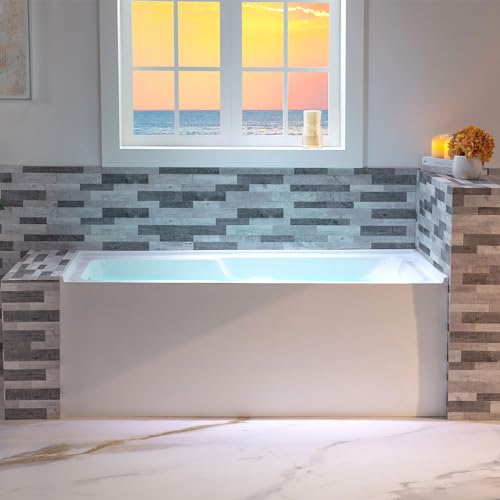
At fifty-four inches the guide changes species. The WOODBRIDGE is an acrylic rectangular alcove soaking tub with a left drain and a chrome pop-up drain included — a proper bathroom fixture of the kind fitted in houses everywhere, offered here because fifty-four by thirty inches is the alcove size that a great many mobile-home bathrooms were actually built with. One honesty note belongs at the top: its title never says mobile home, and this guide does not claim the maker labels it for that use. It is here on dimensions and fit, which is how most successful mobile-home bathroom renovations actually proceed.
From the title
- Length: 54 inches
- Type: Acrylic rectangular alcove soaking bathtub
- Drain: Left drain; chrome pop-up drain included
- Colour: White
- Width: Not stated in the listing title
- Mobile home label in title: None — the title does not use those words
Strengths
- True soaking design at the common 54 inch alcove size
- Pop-up drain included in chrome
- Acrylic keeps handling weight manageable
Trade-offs
- Title does not label it for mobile homes — fit is dimensional
- Left drain only in this configuration
- Width is not stated in the title and should be confirmed
An alcove tub installs between three walls, which is why the type suits manufactured housing so well: the bathroom’s bathing slot is defined, the tub drops into it, and the surrounding walls take the splash. Acrylic keeps the fixture light enough for two people to manoeuvre through a mobile home’s doors and corridor — a practical consideration that rules out heavier materials before style is even discussed — and it feels warm on contact, which matters in a soaking tub whose entire purpose is lingering. The included chrome pop-up drain removes a small but classic renovation friction, the new tub meeting an old waste fitting and neither matching, though the left-drain layout still has to agree with your plumbing. As a soaker, fifty-four inches serves most adults in a seated recline; taller bathers will bend their knees, as they do in most standard tubs, and should judge this as the standard-size soak it is rather than a stretched luxury version.
Renovators should think about the alcove as a system. The tub is the centrepiece, but the surround, the floor beneath and the waste run decide whether the job lasts, and a mobile-home floor that has survived one tub may carry soft patches from decades of small leaks. Budget the inspection, not just the fixture. Chosen with that care, the WOODBRIDGE is the point in this guide where a mobile-home bathroom stops apologising and simply becomes a good bathroom with a real tub in it.
Best for: mobile-home renovators whose alcove measures fifty-four inches and who want a genuine soaking tub. / Not suited for: buyers needing a manufacturer-labelled mobile-home product, or a right-drain layout.
Check price on Amazon — verify your alcove width and drain side, then this is the full-size upgrade path.

Kingston Brass Aqua Eden 54in Acrylic Alcove Tub Left Drain
Kingston Brass brings its Aqua Eden alcove tub to the same fifty-four inch slot, in acrylic, white, with a left hand drain and a model reference that encodes the size for anyone cross-checking. Like the WOODBRIDGE, it carries no mobile-home wording in its title, and it earns its place the same way: fifty-four inch alcove tubs are the standard answer to a standard mobile-home bathroom, whoever manufactures them and whatever they call them.
Stated specifications
- Length: 54 inches
- Type: Acrylic alcove tub, Aqua Eden range
- Drain: Left hand drain
- Colour: White
- Model reference: VTAP543022L, per the listing title
- Mobile home label in title: None — the title does not use those words
Strengths
- Same renovation-friendly 54 inch alcove format
- Published model reference aids exact matching
- Acrylic build suits manufactured-home handling
Trade-offs
- Drain hardware is not mentioned in the title
- No mobile-home labelling in the title
- Left hand drain is the only configuration listed
What distinguishes this entry is mostly emphasis. Kingston Brass is a fittings-led name, and the Aqua Eden title is spare to the point of austerity — size, material, drain side, colour, reference — which a certain kind of buyer will read as confidence. The stated facts match the WOODBRIDGE closely, so the decision between them comes down to the details their titles treat differently: the WOODBRIDGE names an included chrome pop-up drain, while this listing leaves drain hardware unmentioned, and a renovator pricing the whole job should count any separately bought waste fitting into this side of the comparison. Fifty-four inch acrylic alcove tubs share the same installation virtues in a manufactured home — manageable weight, three-wall fit, warm-touch surface — and the same caveat about checking the floor and the waste position before the old tub comes out, because a bathroom mid-renovation with the wrong tub on the drive is a household emergency, not a project.
The model reference deserves a practical word. References like the one in this title let a buyer, a plumber or a parts desk confirm they are discussing the same object, and in replacement work that precision prevents the commonest ordering error in the category: the right length in the wrong drain configuration. Quote it when you ask questions. Mobile-home owners are often told their bathrooms are non-standard and difficult; a fifty-four inch alcove with a published reference is a useful reminder that much of the room is, in fact, standard hardware all the way down.
Best for: renovators who prefer a fittings-house name and a precise model reference for their fifty-four inch alcove. / Not suited for: buyers wanting the drain included in the box, or whose alcove drains on the right.
Check price on Amazon — use the model reference when confirming compatibility with your installer.

Swiss Madison Ivy 54×30 Skirted Alcove Bathtub Left Drain
Swiss Madison’s Ivy completes the alcove trio and is the only one of the three whose title states both dimensions outright: fifty-four by thirty inches, skirted, with an integrated armrest, in glossy white, draining on the left. That full fifty-four by thirty statement is exactly the standard mobile-home alcove measurement, which makes this listing the easiest of the three to match against a tape measure — while, once again, its title itself makes no mobile-home claim, and neither does this review on its behalf.
Its listing in short
- Footprint: 54 x 30 inches
- Type: Skirted left drain soaking alcove bathtub
- Finish: Glossy white
- Comfort feature: Integrated armrest, per the listing title
- Drain: Left drain
- Mobile home label in title: None — the title does not use those words
Strengths
- Full 54 x 30 dimensions stated in the title
- Skirted front simplifies the finished look
- Integrated armrest supports longer soaks
Trade-offs
- No mobile-home wording in its title
- Glossy finish shows every water mark between cleans
- Left drain only, like its alcove siblings
The skirt is the design decision here. A skirted alcove tub presents a finished front face of its own, rather than relying on a built apron or tiled front, and in a manufactured-home bathroom that can simplify the whole installation: the tub arrives looking complete along its visible side, and the finish work concentrates on the surround and seals. Glossy white is the classic partner to that look, bright in a small room and forgiving of the plain fixtures around it. The integrated armrest is a small moulded kindness that soaking tubs often omit; an armrest shapes the recline, giving the bather somewhere for arms to rest out of the water with a book or a phone, and it signals that this tub was designed for staying in, not just for standing in under a shower. That said, a fifty-four inch soak with an armrest still serves a seated recline rather than a full stretch, and taller bathers should keep the same expectations they would bring to any standard-length tub.
Of the three alcove models, this is the one that most visibly tries to make a small bathroom feel designed rather than assembled, and in mobile homes — where bathrooms are so often the last room anyone renovates — that ambition has real value. The checks remain the familiar ones: left drain against your waste, thirty inch width against your alcove, floor condition underneath, and surround plans around it. Pass those, and the Ivy turns the standard slot into the best-looking room corner in the home.
Best for: renovators whose fifty-four by thirty alcove is confirmed and who want the most finished-looking front. / Not suited for: right-drain bathrooms, or buyers who require a product explicitly labelled for mobile homes.
Check price on Amazon — the style-led choice once your alcove measurements match its stated footprint.
One table, two worlds
| Model | Size | Drain | World it belongs to |
|---|---|---|---|
| RecPro 36×24 | 36 x 24 inches | Left | RV / compact, per its title |
| RecPro 40×24 | 40 x 24 inches | Not stated in the title | Camper trailer RV, per its title |
| Lippert 24×40 | 24 x 40 inches | Right | RV range, per its title |
| WOODBRIDGE 54in | 54 inches | Left | Standard alcove dimensions |
| Kingston Brass Aqua Eden | 54 inches | Left hand | Standard alcove dimensions |
| Swiss Madison Ivy | 54 x 30 inches | Left | Standard alcove dimensions |
The table makes the guide’s central point visible at a glance: three tubs are labelled by their makers for vehicles, and three are standard alcove fixtures whose relevance to mobile homes is dimensional. A buyer who keeps that distinction straight will shop each world on its own terms — replacement logic in the compact world, renovation logic in the alcove world — and will not waste a return on a tub that was never going to fit the room’s intention, however well it might have fitted its measurements.
How to choose a tub for a manufactured-home bathroom?
Measure the alcove like a surveyor, not an optimist
Measure wall to wall at several heights, because manufactured-home walls are not always perfectly parallel, and measure the width at the floor and at rim height separately. Record the drain position in two dimensions — which side, and how far from the end wall — and photograph everything before you order anything. Then measure the route in: door widths, the corridor turn, any step up into the home. A fifty-four inch acrylic tub is light, but it is rigid, and a bathroom it cannot physically reach might as well be on another continent. Compact RV tubs forgive more on the route and less in the slot, where a thirty-six or forty inch hole either matches the replacement or does not. In both worlds, the tape measure is the entire ballgame, and ten careful minutes with one outperforms any amount of hopeful reading.
Respect the floor beneath
Manufactured and mobile homes carry their bathrooms on floors that reward respect. Decades of small drips around an old tub can soften the board beneath it invisibly, and a new tub installed over a soft floor will flex, crack its seals and begin the cycle again. When the old tub comes out, press, probe and inspect; repair the floor as part of the same job, and consider that the lightweight compact tubs exist partly because these floors were never asked to carry house-scale fixtures. Even the acrylic alcove models, though light for their class, concentrate a full bath of water and a bather into the alcove footprint, so sound support under the tub’s base — level, continuous, and in good condition — is not a refinement. It is the installation.
Decide which world your bathroom lives in
Some mobile homes genuinely have compact, RV-scale bathrooms, especially older and smaller models, and for them the thirty-six and forty inch tubs are not a compromise but the correct catalogue. Others have full alcove bathrooms indistinguishable in layout from a site-built house, and their owners should shop the fifty-four inch world without hesitation — while remembering that the alcove tubs’ titles do not promise mobile-home certification, so the responsibility for confirming fit, support and plumbing compatibility sits with the buyer and their installer. Neither world is the budget version of the other. They are answers to different rooms, and the most expensive mistake in this category is ordering from the wrong one.
The replacement job, step by honest step
Replacing a tub in a mobile home follows a rhythm worth knowing before you begin. The old tub’s removal is the moment of truth, revealing the floor, the waste position and the true alcove dimensions all at once, which is why experienced renovators keep the household’s alternative bathing arrangements ready for a few days rather than a few hours. With the space open, repairs happen: floor sections renewed, waste adjusted if the new drain demands it, surround prepared. The new tub is then dry-fitted before any sealant appears, because a compact slot or an alcove either welcomes it squarely or reveals the last surprise while surprises are still cheap. Only then does fixing and sealing proceed, followed by the least glamorous and most important stage — a filled tub left to sit, every joint watched, before the surround is closed and the room declared finished. Rushing that final check is how small leaks earn their decades.
Hot water: the constraint nobody mentions in the showroom
A tub is only as good as the hot water behind it, and mobile homes and RVs test that supply in ways a site-built house rarely does. Smaller water heaters and, in vehicles, genuinely tiny ones mean that filling even a fifty-four inch alcove tub can consume most of a tank, leaving the bather in a bath that began lukewarm or the rest of the household without hot water for the evening. This is not an argument against the alcove models; it is an argument for honesty in planning. A household that loves a long soak and owns a modest heater may find the fifty-four inch tub delightful twice a month and impractical twice a week, while the compact tubs ask so little of the supply that they can be filled generously at any hour. Match the tub to the heater as carefully as to the alcove, and consider that a slightly less full, properly hot bath beats a brimful tepid one every single time.
Shower-over use softens the constraint considerably, which is one reason so many of these bathrooms are arranged that way. A shower draws hot water at the pace of use rather than in one enormous advance payment, and a bather can be thoroughly warm in a compact tub used as a shower base while a full soak in the same room would have emptied the tank. Households deciding between the two worlds in this guide should therefore ask a lifestyle question alongside the dimensional ones: in this home, is bathing mostly showering with an occasional soak, or soaking with an occasional shower? The first pattern forgives compact tubs completely. The second justifies the alcove, provided the heater can keep the promise the tub makes.
Winter, storage and the vehicle tub’s second life
RV tubs live a seasonal existence that house tubs never meet. A vehicle winterised and stored asks its bathroom to survive freezing with empty pipes, and the tub itself — plastic, light, drained — usually weathers that well provided the drain and trap were properly emptied, since standing water in a low corner is the one thing that can crack even a forgiving plastic fixture. Spring recommissioning is the compact tub’s annual examination: fill it, watch the drain, check the seals with a dry hand underneath, and look for the hairline cracks that a winter of frost and road vibration can start at stress points. Owners who build that five-minute inspection into the season’s opening ritual rarely meet the mid-trip leak that ruins a holiday.
Permanently sited mobile homes face a gentler version of the same duty. A home left empty through a cold spell, or a bathroom on an exposed end wall, can see temperatures around the plumbing fall further than the living spaces suggest, and the tub’s waste run is usually the most exposed pipe in the room. Keeping a trace of warmth in an empty home, or draining down properly when that is not possible, protects the new installation exactly as it protected the old one. None of this is specialised knowledge; it is the ordinary respect that lightweight construction asks in exchange for its affordability, and it is cheap at the price.
The surround, the curtain and the rest of the wet room
An alcove tub is a promise that three walls will behave like part of the bath, and in manufactured homes those walls deserve as much scrutiny as the fixture. Panels must meet the tub’s edge in a continuous, sealed line, because the alcove design assumes water running down the wall lands on the tub’s rim and returns to the bath, not that it vanishes into the wall cavity at a failed joint. Where a shower runs over the tub, that assumption is tested daily and at pressure. Renewing tired sealant while the tub is out is nearly free; renewing it after the new surround is finished is a fiddly afternoon; repairing the rot behind a surround that leaked for a year is a project. The order of operations in the renovation section of this guide exists to keep households in the first of those three situations.
Curtains and screens complete the system in a homelier way. In a compact RV bathroom the curtain often is the waterproofing strategy for everything beyond the tub, drawn around a space the size of a wardrobe, and a curtain that is long enough, weighted enough and replaced before it mildews is genuine equipment, not decoration. In an alcove bathroom, a well-hung curtain or a screen decides whether the floor outside the tub stays dry through a family’s morning showers, which in turn decides how long that floor — the one this guide keeps asking you to respect — remains sound. Small rooms are systems, and the tub is only their largest single part.
Getting in and out: the small bathroom’s safety question
Compact bathrooms concentrate every bathing risk into a few square feet, and a new tub is the moment to think about them calmly. A high step-over into a small tub, in a room with no spare floor to fall safely onto, is how minor slips become real injuries, especially for older residents and for children being lifted in and out. The alcove models ask for the standard step-over of any house bath, no worse and no better, and their rims at least offer a wide, predictable edge to hold. The compact tubs sit lower in absolute terms but live in rooms where the walls themselves are close enough to steady a hand — one of the few genuine safety gifts of a tiny bathroom. Grab points, a non-slip surface in the base where people stand to shower, and lighting that does not leave the tub in shadow are all decisions made once, during installation, that pay out quietly for years.
Children change the picture in the opposite direction, turning the compact tub into the hero of the room. A thirty-six or forty inch tub is a manageable, containable bath for a small child in a way a deep alcove soaker is not, with less water, less reach and less anxiety for the adult kneeling — in a tiny room, often sitting on the closed toilet — alongside. Families in compact homes rarely need persuading on this point, but it is worth stating for buyers cross-shopping the two worlds: the right tub depends on who is being bathed this year, not only on what the alcove allows.
What a good installation day looks like
On a good installation day, nothing surprising happens, and that is by design. The old tub came out the day before, the floor was inspected and repaired, the new tub was dry-fitted and photographed in place, and the waste connection was proven to line up before any sealant was opened. The new fixture goes in level — checked along its rim in both directions, because a tub that is nearly level still ponds water in one corner and leaves a tide mark to prove it — and it is bedded so its base does not drum or flex underfoot. The surround is sealed in the right order, the tub is filled to the overflow and left, and somebody checks underneath with a torch and a dry hand before a single panel is closed. Then the room is left alone for the sealant’s full curing time, however impatient the household is for a first bath, because a seal broken in its first day is a leak with a head start.
Households hiring the job out should hear that sequence in the installer’s own words before agreeing a price. An installer who describes dry-fitting, bedding and a filled test without prompting is describing the job this guide has been circling throughout; one who promises the whole swap in two hours, sight unseen, is describing the other kind. In mobile homes especially, where access under the floor can be its own adventure, the calm installer with a torch and a plan is worth more than any single feature printed in any tub’s title in this article.
Budget honesty belongs in this guide too, stated without a single figure, since prices are deliberately absent from these pages. In compact replacements, the tub is often the smallest line in the whole job once floor repair, waste adjustment and surround work are counted, which is liberating news disguised as a warning: choosing between the thirty-six and forty inch RecPro, or stepping to the Lippert for its surface, should be decided on fit and use, because the price gap between the fixtures themselves will be dwarfed by the labour around them either way. In the alcove world the same logic holds at a larger scale. The WOODBRIDGE’s included drain, the Kingston’s separate hardware, the Swiss Madison’s skirted finish — these differences matter to the final account, but the floor, the surround and the installer matter more, and a budget that reserves something for surprises under the old tub is a budget that finishes the bathroom.
Time deserves the same honesty. A compact like-for-like swap in a sound room can be a day’s work; an alcove renovation with floor repair is a small project with drying and curing times that cannot be hurried by enthusiasm. Households with one bathroom — most mobile homes — should plan the sequence around that reality, whether that means a weekend at a relative’s house, a campsite shower block, or simply starting on the day that gives the work its clearest run. The tub will serve for decades; the disruption lasts days, and it is remembered kindly only when it was planned rather than endured by accident.
And when the work is done, do the smallest and most satisfying check in this whole article: run a full bath or a long shower, dry the floor completely, and then walk the room in bare feet an hour later. Dry boards underfoot, warm water in the tub, and no mysterious damp at the skirting — that is the entire promise of the category, delivered, in whichever of the two worlds your home turned out to inhabit.
A note on resale and inspection, for owners who think ahead: a sound, well-fitted bathroom is one of the rooms an inspector or a buyer reads as a proxy for the whole home’s care, and a mobile home with a dry floor, a modern alcove tub and clean seals tells that story fluently. Conversely, the soft floor and stained surround of a neglected bathroom raise questions far beyond their repair cost. The tubs in this guide, fitted with the care described above, are therefore not only bathing equipment; they are part of the home’s evidence about itself, and that is one more reason the unglamorous stages — bedding, sealing, the filled test — deserve their full share of the budget and the day.
Equally, owners planning to age in their home should read the alcove three with the future in mind. A standard alcove accepts the ordinary ecosystem of bathing aids — seats, rails fitted by professionals, hand-held showers — far more readily than a compact vehicle tub does, because the standard world manufactures for the standard slot. Choosing the fifty-four inch world, where the room allows it, is partly a decision to stay inside that ecosystem, with all the options it will offer in ten or twenty years. The compact world has its own dignity and its own correct applications, but future adaptability is not among them, and the buyer choosing between worlds deserves to weigh that alongside the tape measure’s verdict.
Before the old tub leaves the house, one small favour to your future self: photograph its labels, its drain from below, and the alcove with a tape measure stretched across it, and keep those pictures with the home’s paperwork, because the next person to renovate that bathroom — possibly you, possibly a buyer in twenty years — will bless the evidence exactly as this guide has blessed careful measuring throughout.
And spare a thought for where the old tub goes, since a compact plastic unit can serve a second life in a workshop, a garden or an animal-care corner long after its bathroom service ends, while a cracked one belongs in proper disposal rather than in a hedge — the small courtesies of renovation add up across a street of homes just as the small leaks do.
Neighbours in a park of manufactured homes are an underused resource in all of this, because somebody on every street has already replaced the very tub you are contemplating, in the very alcove you own, and ten minutes of their hindsight — which installer, which surprise under the floor, which drain position the homes on this row actually have — is worth a week of solitary research and may be the most accurate specification sheet available anywhere for your particular model of home.
That local knowledge cuts both ways, of course, and the same conversation will usually reveal which bathrooms on the street have already suffered the soft-floor lesson this guide keeps returning to, which tends to concentrate a new buyer’s mind wonderfully on the inspection stage of their own project.
Finally, remember that the bathroom door itself is part of the specification in a compact home: a tub that fits the alcove but cannot pass the doorway exists only as a photograph, which is why this guide asked you to measure the route in with the same care as the room, and why acrylic’s manageable weight earns its mention in review after review above.
Delivery day nerves are normal, the crate will look enormous in the drive, and the tape measure you trusted at the start is the right counsellor to trust again at the door.
Keep the packaging until the filled test has passed, keep the paperwork after that, and let the first proper bath in the finished room be unhurried — the household has earned it, and a tub chosen by measurement tends to reward its owners quietly and reliably for a very long time indeed, through season after season of ordinary, unremarkable, entirely dependable daily use at home, year after year, without drama, fuss, leaks or any complaint whatsoever.
Common mistakes in mobile-home tub shopping
Assuming mobile home means one standard size. This guide exists in two sizes precisely because the assumption fails. Compact slots and fifty-four inch alcoves both live under the same search term, and only your tape measure knows which one lives in your home.
Ordering by length and forgetting the drain. A left-drain tub over a right-side waste is not a near miss; it is a different tub. Two of the compact picks state their side, one does not, and all three alcove picks drain left — check before the crate arrives.
Believing a standard alcove tub is labelled for mobile homes. The three fifty-four inch models here make no such claim in their titles. They fit by dimension and by installation logic, and a buyer who needs a manufacturer’s explicit label should look for that wording rather than assume it.
Installing over a tired floor. The new tub inherits every sin of the surface beneath it. Inspect and repair while the space is open; it is the cheapest moment in the tub’s whole life to do so.
Treating the surround as an afterthought. In an alcove, the walls and seals do half the waterproofing work. A fine tub in a failing surround is a leaking bathroom with a nicer centrepiece.
Final recommendation
Let the room decide. If your bathroom is a compact slot, the RecPro pair and the Lippert cover the realistic replacements, divided by size and drain side. If your bathroom holds a fifty-four inch alcove, the WOODBRIDGE, Kingston Brass and Swiss Madison Ivy offer the same standard footprint with different emphases — included drain hardware, a fittings-house reference, and a skirted front with an armrest. Measure twice, respect the floor, and the result will outlast the renovation nerves. Readers finishing a whole small bathroom may find the open-toe comfort of Best Womens Open Toe House Slippers a fair reward for the person who spent the weekend on their knees with a sealant gun.
Frequently asked questions
Are the 54 inch tubs in this guide made for mobile homes?
Their titles do not say so, and this guide does not pretend otherwise. They are standard acrylic alcove tubs whose fifty-four inch size — fifty-four by thirty in the Swiss Madison’s case, as its title states — matches the alcove fitted in a great many mobile homes. Fit is dimensional and structural, confirmed by measuring, not by a label.
Why are the RV tubs so much smaller?
Because the rooms are. A thirty-six or forty inch tub serves a bathroom where every inch is contested, doubles as a shower base, and must stay light for the structure beneath it. In that world, compact is not a downgrade; it is the specification. The textile side of small-space living is covered in our guide to Best Mysore Yoga Rugs, whose compact woven rugs suit exactly the floors these homes have.
What if my drain is on the opposite side?
In the compact world, the Lippert covers the right-drain case among these picks. In the alcove world, all three listed models drain on the left, so a right-drain alcove needs either a plumbing adjustment by your installer or a different configuration from the same makers’ ranges — a question to settle before ordering, not after.
Can I put a shower over an alcove soaking tub?
Alcove tubs commonly serve that double duty in ordinary houses, with the surround and seals doing the waterproof work, and the same logic applies in a manufactured home provided the surround is sound. The compact RV tubs are designed with shower-over use in their bones, which is why surface resilience features in the Lippert’s title.
How do I check the floor before the new tub goes in?
With the old tub removed, walk the area in socks, press around the waste and the edges, and look for dark staining, softness or a springy feel underfoot. Any of those means repair before installation. After a day of that work, the drying-off corner of the bathroom deserves a decent towel, and the rugged options in Best Boat Towels handle building-site levels of dust and damp surprisingly well.
Measure the room you have, choose from the world it belongs to, and a mobile-home bathroom will give you a proper bath for decades.


