What's inside
- Where to buy
- Quick Picks
- How these picks were chosen
- Six towel sets, weighed for life afloat
- The numbers that matter, tabulated
- What makes a towel earn its locker space?
- Life afloat with quick-dry cloth: the daily rhythm
- Beyond the swim: the towel as general boat equipment
- Different boats, different towel fleets
- Children, dogs and guests: the towel diplomacy section
- Washing on the move: marina laundries and bucket reality
- The drying line: rigging the boat’s hardest-working system
- Retiring a boat towel: second careers and honest endings
- Cold water, thin towels: managing the comfort equation
- Fresh water is precious: towel habits that respect the tank
- Common mistakes
- Final recommendation
- FAQ
As an Amazon Associate I earn from qualifying purchases. This post may contain affiliate links at no extra cost to you.
As an Amazon Associate, cottageverdict.com earns from qualifying purchases.
Storage on a boat is measured in lockers, not cupboards, and that single fact explains what makes good boat towels: they must dry fast in moving air, pack down to almost nothing, absorb properly when swimmers and spray arrive, and come in enough numbers that the whole crew is not negotiating over one damp square of cotton by day two. It is worth saying plainly at the start that none of the six listings below uses the words boat or marine in its title. These are travel, camping and beach towels whose stated properties (quick dry, compact, lightweight, multi-pack, generously sized where it counts) happen to map precisely onto life afloat, and this guide recommends them on exactly that honest basis, with no invented salt-proofing or ultraviolet wizardry anywhere in the reviews.
The six divide by a simple trade. At one end sit the oversized beach formats (Utopia’s 32×71 microfiber, Genovega’s 74×38 Turkish towels, Lane Linen’s 39×71) which wrap an adult fully after a swim and double as cockpit cushions, picnic grounds and sunshade ballast. At the other end sit the compact travellers (Dofilachy’s 24×48 camping towels in a six-pack, Rainleaf’s 48×24 microfiber, and the 4Monster four-pack with its water-resistant carry bag) which treat locker space as sacred and drying speed as king. Most boats, sensibly, end up carrying one from each family: big towels for swimming stops, small ones for the galley, the heads and the endless small mopping that boating involves.
Counts matter as much as cloth. Four of the six listings are multi-packs of four or six towels, and that is not upselling; it is the arithmetic of a wet weekend. A towel used at an anchorage swim is damp for hours, and the crew that owns one towel per person per day owns a laundry problem with a view. The reviews below therefore weigh pack count and drying behaviour as heavily as absorbency, because aboard a boat those are the properties that decide whether a towel is an asset or a mildew farm with stripes.
Where to buy
All six sets are listed on Amazon, and each review below carries its own direct link. The 4Monster four-pack opens the list as the organised traveller, microfiber towels with a water-resistant bag for the set. Utopia’s four-pack goes biggest in microfiber, four thin 32×71 beach towels with a travel bag. Genovega answers with six oversized Turkish beach towels at 74×38, pitched by its listing at cruises and vacations as much as at beaches. Lane Linen’s four-pack offers pre-washed oversized towels at 39×71 in a multicolour set. Dofilachy supplies six compact microfiber camping towels at 24×48, and Rainleaf closes with its long-standing quick-dry travel towel in navy at 48×24.
Quick Picks
| Pick | Best for | Điểm nổi bật theo title |
|---|---|---|
| 4Monster 4-Pack Quick Dry Microfiber Travel Towels | Crews who pack by the bag, not the pile | Quick dry microfiber set with water-resistant bag |
| Utopia Towels Microfiber Beach Towel 4 Pack 32×71 | Full-size wrap in a compact microfiber roll | Thin lightweight 32×71, sand free claim, travel bag |
| Genovega Turkish Beach Towels 6 Pack Oversized 74×38 | Charter groups and big crews | Six oversized 74×38 towels, quick dry, sand free claim |
| Lane Linen Beach Towels 4 Pack Oversized 39×71 Multi | The widest coverage here, pre-washed | 39×71 oversized, pre-washed, machine washable, multicolour |
| Dofilachy 6 Pack Camping Towel Quick Dry Microfiber 24×48 | Small lockers and many hands | Six microfiber towels at 24×48, quick dry |
| Rainleaf Microfiber Towel Quick Dry Camping Travel Gym | The single-towel minimalist | 48×24 microfiber, compact, super absorbent per listing |
How these picks were chosen
The selection began with the properties a boat actually tests, taken only from what listings state. Quick drying is claimed by nearly every pick here, and it is the property that matters most in a marine routine where towels dry on a rail, a line or a guardwire rather than in a tumble dryer. Compactness and light weight came next, because a towel’s locker footprint is a real cost on a small boat, and absorbency third, because a towel that cannot dry a swimmer is decoration regardless of how small it rolls.
Pack arithmetic was treated as a specification in its own right. Sets of four and six dominate the list because crewing is plural: swimmers rotate, guests arrive, and a galley towel should never be the same object as a swim towel. Single-format listings were admitted only where the product’s whole identity is the individual travel towel, as with Rainleaf, whose listing speaks to campers, hikers and gym users as much as to swimmers.
Size honesty shaped the final pass. The big beach formats state their inches proudly (32×71, 74×38, 39×71) and are reviewed as full-body towels; the compact formats state theirs too (24×48, 48×24) and are reviewed as working towels for bodies at a pinch and for every smaller job aboard. The 4Monster listing does not state dimensions in its title, so its review says so and judges it on its stated system (four quick-dry microfiber towels, water-resistant bag) rather than on invented measurements.
No pick was credited with properties its listing does not claim. Readers will find no promises in this guide about resisting salt, blocking sun or surviving marine conditions specifically, because no listing here makes those claims and a towel’s fitness for a boat rests on the drier, simpler virtues of speed, size and count.
Six towel sets, weighed for life afloat
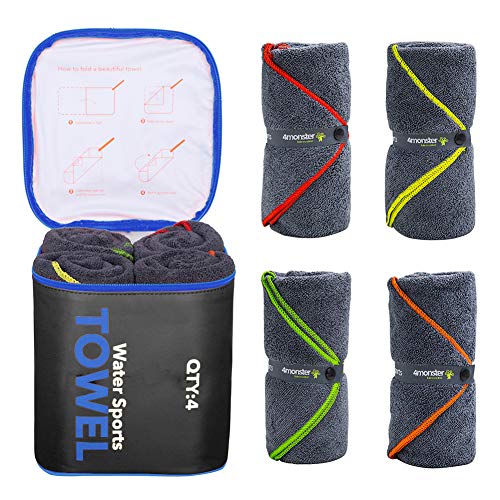
4Monster 4-Pack Quick Dry Microfiber Travel Towels
4Monster sells a system rather than a stack: four quick-dry microfiber travel towels, described as super absorbent and ultra-soft, arriving with a water-resistant bag, and aimed by the listing at RV, gym, beach, pool, swimming and family trips. Aboard a boat, that water-resistant bag is the detail that keeps giving. Wet towels and dry kit cannot share a locker politely, and a dedicated bag that contains the damp set on the trip home (or isolates the dry set from a wet cockpit on the way out) solves the oldest packing argument in boating without a single extra purchase.
- Pack as listed: 4-pack
- Material as listed: microfiber
- Behaviour as listed: quick dry, super absorbent, ultra-soft
- Carry as listed: water-resistant bag included
- Uses named in the listing: RV, gym, beach, pool, swimming, family trips
- Dimensions: absent from the title text
Strengths
- The water-resistant bag turns four loose towels into one grab-and-go unit for marina showers and swim stops.
- Microfiber’s drying speed suits rail-drying between anchorages.
- Four towels cover a small crew’s swim rotation without immediate laundry.
Trade-offs
- With no dimensions in the title, buyers must confirm towel sizes on the product page against their crew’s needs.
- A shared bag means a shared laundry rhythm; one forgotten wet set compromises the whole unit.
- Microfiber’s smooth hand-feel divides opinion among cotton loyalists.
The family-trips framing in the listing translates directly to crewed boats, where the towel problem is never one swimmer but four people surfacing at once. Four matched towels also impose a gentle order: everyone can identify the boat’s towels at a crowded anchorage or a marina facility, and the set comes home complete instead of donating one towel per harbour to the lost-property of the coastline.
For RV and camper travellers (the listing’s other named tribe) the same bag logic applies, and many owners will run one set across both vehicles and vessel. Microfiber tolerates that itinerant life well, washing in marina laundries and drying on any line a campsite or cockpit offers.
Best for: a small crew or family wanting an organised, bagged set of quick-dry towels for boat and road alike. Not suited for: anyone who must see confirmed oversized dimensions in the title alone before ordering — they are not stated there. Check price on Amazon and verify the set’s towel sizes on the listing first.

Utopia Towels Microfiber Beach Towel 4 Pack 32×71
Utopia’s proposition is a paradox that microfiber makes possible: a genuinely large towel, 32×71 inches, that still packs like a travel towel. Four of them come in the pack, thin and lightweight per the listing, with a sand free claim, a travel bag, and quick-dry behaviour aimed at beach, pool, camping, picnic and travel. Aboard, that combination answers the swim-stop problem in full: a towel long enough to wrap a tall adult completely, light enough to dry on a guardwire without sagging it, and numerous enough that the second swim of the day does not begin with a cold, damp embrace.
- Size as listed: 32 x 71 inches
- Pack as listed: 4 pack
- Material as listed: microfiber
- Build as listed: thin, lightweight, extra large, compact
- Claims as listed: sand free, absorbent, quick dry
- Carry as listed: travel bag included
Strengths
- 71 inches of length wraps adults fully, which compact towels simply cannot do.
- Thin microfiber dries fast even in a light breeze, the normal condition on open water.
- Four large towels double as cockpit sun pads, picnic cloths and spare bunk covers.
Trade-offs
- Thin microfiber lacks the plush, warming feel of a thick cotton beach towel after a cold swim.
- Large towels catch wind on a rail; they want clipping or folding over the line, not draping loose.
- Sand free is a maker’s claim about microfiber’s smooth surface; rinsing still improves any towel’s life.
The secondary careers of a big towel deserve emphasis, because boats reward multi-use kit. A 32×71 across a cockpit bench is a seat cover that keeps vinyl bearable in sun; across a foredeck it is a sunbathing mat; over a sleeping guest it is an emergency blanket layer. Four of them aboard is not four towels, it is a small textile department, and that versatility is the true argument for carrying size where a boat can dry it.
Drying discipline stays simple: shake, clip to the rail or line by two corners, and let the breeze do in an hour what a bathroom rail at home does in a day. Microfiber forgives the occasional forgotten evening, but a set aired after every swim will smell of nothing but the sea air it dried in.
Best for: boats that swim often and want full-size coverage without cotton’s bulk or drying time. Not suited for: swimmers who want a heavy, warming wrap after cold water, because thin microfiber dries the skin without cossetting it. Check price on Amazon for the four-pack of full-length microfiber towels.

Genovega Turkish Beach Towels 6 Pack Oversized 74×38
Genovega brings the biggest count and the biggest single dimension in the guide: six oversized Turkish beach towels at 74×38 inches, described as quick dry and sand free, light, and pitched at swim, bath, camping, pool, travel and cruise use, with the listing going so far as to name cruise accessories and vacation essentials. Six towels is charter-party arithmetic (a full cockpit of guests, each with a towel that reaches) and 74×38 is a genuinely enveloping size, wider than the Utopia as well as longer, which taller and broader swimmers will notice immediately.
- Size as listed: 74 x 38 inches
- Pack as listed: 6 packs
- Style as listed: Turkish beach towels
- Claims as listed: quick dry, sand free, light
- Uses named in the listing: swim, bath, camping, pool, cruise, vacation
Strengths
- Six towels end the guest-towel negotiation for crewed boats and charter groups.
- The 38-inch width wraps where narrower towels merely cover.
- Bulk buying in one set keeps colours and quality uniform across the boat.
Trade-offs
- Six oversized towels are a serious locker commitment even in a quick-dry fabric.
- The listing does not state a fibre in its title, so hand-feel expectations should be set on the product page.
- More towels aboard means more towels to launder after a big weekend.
The cruise framing in the listing is more relevant to boat owners than it first appears. Towels that serve as bath, beach and travel blanket in a cruise cabin serve identically in a yacht cabin, and a matched set of six gives a boat the faintly hotel-like order that guests remember. For owners who charter or host often, uniformity is not vanity; it is how a boat signals that its kit is maintained, and a ragged assortment of borrowed beach towels signals the opposite before the anchor is even down.
Rotation is the management system: two in use, two drying, two in reserve covers a long weekend for a couple with guests, and the full six covers a crowd. Wash them as a fleet, dry them as a fleet, and the set ages evenly instead of producing one hero towel and five ghosts.
Best for: larger crews, charter and guest-heavy boats wanting six matched oversized towels in one purchase. Not suited for: a minimalist two-hander with tiny lockers, where six big towels would crowd out everything else. Check price on Amazon for the six-towel Genovega set.

Lane Linen Beach Towels 4 Pack Oversized 39×71 Multi
Lane Linen’s four-pack takes the width crown in this guide at 39×71 inches, pre-washed and machine washable per the listing, lightweight, super absorbent in the maker’s words, and sold as a multicolour set for vacation, travel and camping. Width is the dimension swimmers actually feel: a 39-inch towel wraps a torso with overlap to spare, stays put while its owner walks a pontoon, and spreads into a credible lying surface on a beach or a foredeck. The pre-washed detail signals a towel that arrives soft and at its true size, with the first wash’s surprises already taken at the factory.
- Size as listed: 39 x 71 inches
- Pack as listed: 4 pack
- Finish as listed: pre-washed
- Care as listed: machine washable
- Build as listed: lightweight, oversized
- Claim as listed: super absorbent
- Colours as listed: multi
Strengths
- The widest towel here wraps adults securely and doubles as a full-length lying mat.
- Pre-washed fabric starts soft and dimensionally honest.
- Multicolour sets let each crew member claim a colour, ending towel mix-ups at a stroke.
Trade-offs
- The listing title does not name a fibre, so drying speed expectations belong to the product page, not to assumption.
- Four oversized towels still occupy real locker volume despite the lightweight claim.
- Machine washable is not the same as quick to dry; plan rail time after every swim.
Colour-coding deserves its moment, because aboard a boat it is hygiene as much as tidiness. When each person’s towel is recognisably theirs by colour, towels stop migrating between swimmers, the galley and the engine-check rag pile, three populations that should never merge. The multicolour set builds that system in from the first unpacking, which is a quiet operational advantage no single-colour pack can match.
As a lying surface the 39-inch width earns its locker space twice over: one towel is a beach mat for one adult or a picnic ground for two people’s lunch, and two towels overlapped make a foredeck sun pad that stays put better than narrower strips. Boats live by such improvisations, and width is the raw material of most of them.
Best for: crews wanting the widest wrap and a colour-per-person system in a pre-washed, machine-washable set. Not suited for: a purchase decision that depends on fibre content stated in the title — it is absent there, so verify it on the listing first. Check price on Amazon for Lane Linen’s multicolour four-pack.

Dofilachy 6 Pack Camping Towel Quick Dry Microfiber 24×48
Dofilachy occupies the compact end with intent: six microfiber towels at 24×48 inches, quick dry, described for camp, bath, beach and swim. A 24×48 is a working towel rather than a wrap (enough to dry a body briskly, ideal for hair, faces, hands and every smaller task) and six of them constitute a boat’s utility department. This is the set that lives everywhere at once: one in the galley, one in the heads, one by the helm for spray, one in each swim bag, and the arithmetic still leaves a spare.
- Size as listed: 24 x 48 inches
- Pack as listed: 6 pack
- Material as listed: microfiber
- Behaviour as listed: quick dry
- Uses named in the listing: camp, bath, beach, swim
Strengths
- Six compact towels distribute across a whole boat’s stations in a way no single big towel can.
- The 24×48 size dries fastest of all here, being mostly surface and very little bulk.
- Microfiber at this size washes and dries in marina facilities without drama.
Trade-offs
- Nobody wraps up in a 24×48 after a cold swim; it dries, it does not envelop.
- Six small towels are six things to count, clip and retrieve from the rail.
- As a beach lying surface it serves a child, not an adult.
The galley and heads argument deserves expansion, because those are the towels a boat actually wears out. Hands are dried twenty times a day, spills arrive on their own schedule, and a compact quick-dry towel at each station, rotated daily, keeps the boat civilised in a way one heroic beach towel never can. Dofilachy’s six-pack is the only listing here that can staff every station from a single purchase, and that completeness is its real specification.
Campers will recognise the format from their own kit, and the listing’s camping framing is honest: this is the towel of people who move, rinse and move again. Boats are simply campsites that float, and the towel logic transfers without translation.
Best for: smaller boats and busy crews wanting many fast, compact towels stationed all over the vessel. Not suited for: swimmers whose first priority is a full post-swim wrap, who should take the oversized sets above. Check price on Amazon for the six-pack of compact microfiber towels.

Rainleaf Microfiber Towel Quick Dry Camping Travel Gym
Rainleaf is the veteran traveller of the list, a microfiber towel in navy blue at 48×24 inches whose listing strings together camping, travel, gym, beach, bath, backpacking, hiking and swim, and claims compactness, super absorbency, light weight and fast drying. As the only single-towel proposition in the guide, it speaks to the solo sailor, the crew member packing a personal kit bag, and the dinghy sailor whose entire vessel has less storage than a wardrobe. Navy, as with so much marine kit, is chosen because it hides the evidence of travel and matches everything a boat already owns.
- Size as listed: 48 x 24 inches
- Material as listed: microfiber
- Colour as listed: navy blue
- Build as listed: compact, lightweight
- Claims as listed: super absorbent, fast drying
- Uses named in the listing: beach, bath, backpacking, hiking, swim, gym
Strengths
- A proven travel format that packs to a fraction of a cotton towel’s volume.
- One towel, one owner, one rhythm: the simplest possible system for solo sailors and crew.
- Fast drying on any line, rail or rigging a boat can offer.
Trade-offs
- A single towel means no rotation; a forgotten drying session is felt at the next swim.
- At 48×24 it dries an adult efficiently but does not wrap one.
- Microfiber needs its no-softener wash discipline to keep its absorbency honest.
The backpacking and hiking language in the listing is a clue to this towel’s real character: it was designed for people who carry their lives, and sailors are that tribe in wetter clothes. In a crew bag it takes the space of a paperback; in a dinghy’s bow compartment it takes almost none; and its drying speed means the morning swim’s towel is a dry towel again by the afternoon’s.
Pairs well with commitment: owners who rinse it, air it and wash it on schedule will find it outlasts bulkier kit, while owners who ball it up wet in a locker will blame the towel for a mildew that was authored by the balling. The Rainleaf rewards the tidy, which is perhaps the most marine virtue of all.
Best for: solo sailors, travelling crew and dinghy sailors wanting one compact, fast, navy towel per person. Not suited for: a family boat needing a fleet, where the multi-packs above solve the count problem in one order. Check price on Amazon for the Rainleaf travel towel in navy.
The numbers that matter, tabulated
| Set | Towels inside | Each towel measures | Carry system per listing |
|---|---|---|---|
| 4Monster | 4 | Not stated in title | Water-resistant bag |
| Utopia | 4 | 32×71 in | Travel bag |
| Genovega | 6 | 74×38 in | Bulk set |
| Lane Linen | 4 | 39×71 in | Multicolour set |
| Dofilachy | 6 | 24×48 in | Six-pack |
| Rainleaf | 1 | 48×24 in | Compact travel format |
What makes a towel earn its locker space?
How fast will it dry where you actually sail?
Drying is a local phenomenon. A towel that resets in an hour on a breezy rail may sulk all day in a still, humid marina, and the difference decides how many towels a boat must carry. Quick-dry microfiber (4Monster, Utopia, Dofilachy, Rainleaf) holds the advantage in poor drying weather because the fabric itself releases water readily; the oversized sets compensate with sheer count, rotating damp towels out of service before their slowness matters. Judge your own anchorage habits honestly: boats that move daily, generating breeze over the rail, can run leaner than boats that sit in marinas between weekends.
Wrap, dry, or mop: which job is this towel hired for?
Three different jobs share one noun aboard a boat. The wrap job (post-swim warmth and modesty) needs the big formats, full stop. The dry job (bodies, hair, hands, faces, repeated all day) is served by any size and best by several. The mop job (spills, spray, condensation, the galley’s permanent small emergencies) wants compact, expendable and quick, which is Dofilachy territory. A boat that hires one towel for all three jobs gets a compromise that swims badly, dries slowly and mops reluctantly; the sets in this guide exist so that each job can have its own cloth.
How many people, how many swims, how many days?
Multiply crew by swims per day by days between laundries, and the required towel count appears with embarrassing clarity. A couple swimming twice daily on a three-day weekend consumes twelve towel-uses; a six-pack of quick-dry towels, each reusable after a few hours on the rail, covers it, while a pair of slow cotton towels collapses by Saturday noon. Charter and guest days multiply the crew term without warning, which is the practical soul of the Genovega six-pack’s existence.
What will you wash it in, and where will it dry ashore?
Marina laundries, campsite sinks and home machines all feature in a boat towel’s life, and microfiber’s tolerance of cool, quick washes suits that circuit best. Back home, the same no-softener discipline that protects every microfiber in this guide applies, and a towel that has been softener-coated will announce it by pushing water around a swimmer’s back instead of drinking it. Buy for the laundry you actually have, not the one in the brochure.
Life afloat with quick-dry cloth: the daily rhythm
A boat’s towel day has a choreography. Morning swims put the first set on the rail; breakfast moves the galley towel through its first six jobs; the midday swim rotates the rail set; and by evening a well-run boat has dry towels staged for showers and damp ones earning their air. The rail or line is the engine of the whole system, and the small disciplines matter: towels clipped by corners rather than folded double over a line dry in half the time, towels shaken before hanging shed the water that would otherwise ride along, and towels brought in before the evening dew keep the day’s drying work from being undone overnight.
Guests read a boat through its towels faster than through its varnish, a truth charter crews learn early. A dry, generous towel handed over at the bathing platform says the boat is run by people who anticipated your comfort; a thin, damp one says the opposite in a language no brochure can correct. Owners who host should therefore hold the swim fleet to a guest standard permanently, rotating the tired pieces down to utility duty before a visitor ever meets them, and should treat the towel drawer with the same seriousness as the safety briefing, because both are forms of care made visible.
Below deck, segregation is civilisation. Swim towels, galley towels and the rag that lives near the engine should be as visually distinct as a crew can arrange (colour sets like Lane Linen’s multicolour pack exist for this) because the cost of confusion is a galley towel that smells of suncream or a swim towel that has met the bilge. Boats that run this separation find their towels last longer and their crews complain less, two metrics that tend to travel together.
Storage of the dry reserve wants air too. A locker stuffed airtight with towels in a warm hull grows the marine perfume no owner admits to recognising, while a mesh bag or a ventilated locker keeps the reserve sweet. The 4Monster’s water-resistant bag is for transport and wet containment, not for long-term storage of damp towels, a distinction its owners should honour by airing the set whenever the boat is opened up.
Beyond the swim: the towel as general boat equipment
Experienced crews rate towels alongside tools, because a towel aboard is never only a towel. It is the padding between a winch handle and a varnished rail, the cushion on a hard cockpit coaming during a long watch, the improvised sunshade over a sleeping child, the wrap that keeps a caught fish or a cold bottle from rattling, and the first response to every spill, drip and condensation trail the hull produces. Oversized towels multiply these careers (a 39-inch Lane Linen is a picnic cloth, a bunk blanket and a beach mat in rotation), while compact towels win the small jobs by being everywhere at once.
That versatility argues for carrying one more towel than the swim arithmetic demands, a lesson usually learned the day a towel is promoted to engine duty and the swim rotation collapses. The multi-pack structure of this guide’s picks builds that spare in from the start, which is precisely why sets, not singles, dominate the list, and why the single Rainleaf is recommended per person rather than per boat.
Home textiles teach the same lesson in a different room: the kitchen’s hardest-working cloths are also bought in packs and judged on absorbency and wash survival, a comparison drawn out in Best Cotton Dish Towels, where cotton weaves are separated by their drying and lint behaviour. Readers outfitting a whole life rather than a single boat may also enjoy the natural-fibre end of home comfort in Best Wool Slippers, where real wool felt and European sizing are the honest complications. And for the shore-based days between voyages, the all-day indoor footwear gathered in Best Work from Home Slippers covers slippers chosen for long hours on home floors.
Different boats, different towel fleets
A sailing dinghy has no lockers worth the name, and its towel strategy is a personal one: one compact towel per sailor, carried in the same dry bag as the spare clothes, expected to handle a capsize’s aftermath and the drive home. That is Rainleaf territory exactly, with perhaps a Dofilachy towel as the boat’s shared utility cloth, living in the bow compartment and accepting every unglamorous job the day invents. Weight and volume are the whole specification at this scale, and any towel that cannot justify its grams stays ashore.
A day sailer or small weekender adds a cabin the size of a wardrobe and a crew of family, and its fleet grows by system rather than by size: a bagged set like the 4Monster’s for swims, a couple of compact towels for the galley corner, and the discipline of drying everything on the rail before the drive home, because a small cabin sealed for a week with damp cloth inside announces itself the moment the hatch opens next Saturday. The water-resistant bag earns its keep hardest here, containing the damp set through the car journey that ends every day-sailor’s weekend.
A cruising yacht with guests aboard graduates to the oversized sets. Cockpit cushions, bunk rooms and a bathing platform multiply both swimmers and expectations, and the Genovega six or the Lane Linen four become the swim department while compact towels staff the interior. Cruisers also gain the luxury of a fixed drying line rigged for the purpose, which changes the arithmetic in favour of larger towels: with reliable air, even the biggest formats reset between swims, and the wrap they offer after a dawn dip in cold water is a genuine comfort rather than a logistics problem.
Charter and hire boats invert the ownership question. Guests arrive with airline luggage and beach towels of heroic thickness, and the boat’s own kit must absorb the difference without complaint. A uniform, quick-dry ship’s set, laundered between charters as a fleet, is the professional answer, and the multi-pack listings here are sized almost suspiciously well for that duty. Owners who charter will also appreciate that a matched set photographs as care, which in the charter market is a currency of its own.
Children, dogs and guests: the towel diplomacy section
Children aboard consume towels at a rate no adult arithmetic predicts, because a child’s towel is also a cape, a blanket, a sail for a toy boat and a mop for a spilled drink, sometimes within one hour. The defence is depth: enough compact towels that a child’s current creative project never bankrupts the swim rotation. Colour ownership helps here too (a colour per child ends most towel litigation before it reaches the cockpit court) which is another quiet vote for multicolour sets and for giving the Dofilachy six-pack’s stations one towel of slack each.
Dogs, where they sail, need a towel of their own with the same inevitability as children, and theirs should be the oldest compact towel in the fleet, promoted sideways into paw and wet-coat duty. A dog dried with the galley towel teaches the whole crew a lesson about systems; a dog with a dedicated towel, kept by the boarding ladder, becomes part of the boat’s routine and even, in time, a small ceremony of arrival that the dog itself learns to wait for.
Guests deserve the boat’s best towels and its clearest instructions. The best, because hospitality is measured in such details and a guest handed a thin, tired towel reads the whole boat through it. The instructions, because guests do not know the rail system, the colour code or the rule about towels below deck, and thirty seconds of cheerful briefing at the first swim saves three days of damp improvisation. The oversized sets exist for this audience most of all: a guest wrapped to the ankles in a dry 74-inch towel forgives a boat almost any other economy.
Washing on the move: marina laundries and bucket reality
Boat laundry is a discipline of small machines and shared facilities, and quick-dry towels are its easiest citizens. A microfiber set washes in a short cool cycle, spins nearly dry, and finishes on the rail, which means a crew can reset its entire towel fleet in one marina visit without monopolising machines or returning to a boat draped like a laundry ship for two days. Etiquette matters in those shared rooms: towels that have been shaken out and rinsed of sand before they meet a communal machine keep both the machine and the crew’s reputation intact.
Between ports, the bucket method rules. A rinse in fresh water at the day’s end, a thorough wring, and a night on the line prevents the salt-and-damp accumulation that turns a week’s towels sour, and it costs nothing but the habit. Salt left in fabric holds moisture against the cloth and stiffens it; the rinse is not cleanliness theatre, it is what keeps a quick-dry towel quick. Crews who rinse nightly can stretch a full wash across a whole cruise; crews who do not will be doing laundry maths in every port.
Detergent choice follows the fabric rules already laid out: mild, sparing, and never softener on microfiber. A final freshwater rinse matters more afloat than ashore, because detergent residue in a towel that will be used on salt-stung skin is an irritation delivered precisely where it is least welcome. None of this is burdensome once it is rhythm, and rhythm, aboard any boat, is simply what seamanship looks like when applied to small things.
The drying line: rigging the boat’s hardest-working system
Every boat already owns a drying machine; it is called the rigging, the rail and the breeze, and it outperforms any tumble dryer ever installed ashore when it is used deliberately. A line rigged along the sunny, breezy side of the boat, towels clipped by their corners so air reaches both faces, will reset a microfiber set between a morning swim and an afternoon one, a turnaround no bathroom rail in a house can match. The technique is in the details: single thickness over the line, never folded double; corners clipped so the towel bellies in the wind like a small sail; the heaviest towels given the windward end where the air moves fastest.
Clips are equipment, not afterthoughts. A towel lost overboard from a rail is a small financial event and a genuine environmental discourtesy, and the oversized towels in this guide, with their generous windage, are the most likely emigrants. Two clips per towel, three for the big formats in a blow, and a rule that towels come in before sailing rather than after the first heel, keeps the fleet intact. Crews develop their own liturgy here within a weekend, and it is one of the small competencies that separate boats that smell of the sea from boats that smell of laundry.
Rain and dew are the system’s two saboteurs. A shower resets the drying clock to zero and adds weight besides, while overnight dew quietly re-wets a fleet that was dry at dusk. The countermeasures are habits, not hardware: towels below or under cover when weather threatens, everything in before the evening meal, and a morning shake that throws off dew before the sun is asked to finish the job. Boats that run these habits find their towel count can be modest; boats that do not will always feel short of towels, whatever they buy.
Retiring a boat towel: second careers and honest endings
A towel’s first career ends when its absorbency fades (water starts skating across microfiber that softener or age has coated) or when its fabric thins past dignity. Aboard a boat, that is a promotion rather than a funeral: retired swim towels become the utility fleet, standing duty at the engine check, the fuel dock and the fish-cleaning board, where their remaining life is spent honourably and their replacements take over the swimmers. The colour or station system should record the demotion visibly, because a retired towel that wanders back into swim service teaches the crew why systems exist.
The final career, when a towel is truly done, is the rag bag, and even there the quick-dry sets earn their passage, since a microfiber rag is the best glass-and-instrument cloth a boat can own. Nothing in this guide needs to leave the vessel until it has served in three departments, and that longevity, multiplied across a six-pack, is the quiet economics underneath the whole quick-dry proposition.
Cold water, thin towels: managing the comfort equation
The one honest weakness of the quick-dry fleet must be faced squarely: thin microfiber dries a swimmer without warming one, and after genuinely cold water that distinction is felt in the teeth. The boat’s answer is layering rather than substitution. The microfiber towel does the drying, fast and completely, and then a fleece, a robe or the boat’s blankets do the warming, each textile at the job it is built for. Crews in cold climates who try to make one heroic towel do both jobs end up with a towel that dries slowly and a swimmer who warms slowly, the worst trade on the water.
Warmth can also be staged. A towel left in the sun on the cabin top while the crew swims is a heated towel by the time it is needed, and a towel kept below in the cabin’s warmth beats one that has hung in a sea wind for an hour. These are small seamanship details, but cold-water swimming is a sport of small details, and the towel’s place in the rewarming sequence (dry fast, then insulate) should be briefed to guests with the same care as the swim itself.
None of this displaces the oversized sets from cold-water boats; it assigns them their correct partner. The 74-inch Genovega or the 39-inch-wide Lane Linen, wrapped fully around a dried swimmer, traps a layer of still air that a compact towel cannot, and that trapped air is the beginning of warmth even before the fleece arrives. Size, in cold water, is insulation’s first instalment.
Fresh water is precious: towel habits that respect the tank
On a cruising boat, every rinse comes out of a tank that somebody must refill, and towel habits are quietly water policy. Quick-dry towels earn their passage here twice: they need less rinsing than salt-logged cotton to stay sweet, and their small bulk means a full fleet wash uses a fraction of the water a cotton fleet demands. Crews that rinse towels in the last of the dishwater’s fresh allocation, or catch the rinse from a deck shower’s warm-up, are not being eccentric; they are extending the boat’s range by the oldest method there is, which is wasting nothing.
The same logic governs the swim itself. A towel that dries a swimmer properly at the platform reduces the freshwater shower that follows it, because most of that shower was only ever about removing what a good towel and a brisk rub leave behind. Multiply that saving by a crew, by a season, by the distance between water points on a long coast, and the humble towel takes its place in the boat’s passage planning. No listing in this guide claims such a virtue, and none needs to: it is arithmetic, available to any crew willing to do it.
Common mistakes
Bringing thick cotton bath towels from home. They drink a swim’s worth of water and hold it for a day and a half, occupying the rail and the locker like wet livestock. Boats run on quick-dry cloth for reasons that become obvious by the second anchorage.
Counting towels per person instead of per swim. One towel each is a hotel rule. Aboard, the unit is the swim, and rotation through drying time is what the count must satisfy.
Letting swim towels and utility towels merge. The day the galley towel is used on an oily hand is the day the system needs colours, stations and rules. Separation is cheaper than replacement.
Storing towels damp in a sealed bag or locker. Mildew is a storage decision, not a fabric fate. Air everything at every opportunity and bring towels in before dewfall.
Judging a towel by softness in the shop. Aboard, drying speed and pack size decide happiness; softness is a pleasant third. The plush towel that never dries is the worst towel on the boat.
Final recommendation
Build the boat’s towel kit in two layers. The swim layer wants size and count: Utopia’s 32×71 four-pack for most crews, Genovega’s six oversized towels for guest-heavy boats, Lane Linen’s 39-inch width where wrapping and colour-coding matter most. The working layer wants numbers and speed: Dofilachy’s six compact towels stationed around the boat, or the 4Monster bagged set where transport order is the priority. Solo sailors and personal kit bags take the Rainleaf and are done. None of these towels claims to be marine equipment, and none needs to be: quick drying, compact packing, honest absorbency and enough count for the crew are the whole specification, and each set here meets it in its own proportions.
FAQ
Are any of these towels actually made for boats? None of the six listings claims a boat or marine purpose in its title; they are travel, beach and camping towels whose stated quick-dry, compact and multi-pack properties suit boats exceptionally well. This guide recommends them on those stated properties only.
How many towels does a weekend for four require? With quick-dry sets rotated on a rail, a four-pack of large towels plus a compact set for stations covers most weekends; guest-heavy boats should start from a six-pack of large towels instead.
Why does microfiber dominate this list? Because its stated combination (quick dry, lightweight, compact, absorbent) matches the constraints of locker storage and rail drying better than any other common towel fabric, and four of the six listings are microfiber for exactly those reasons.
Can these towels handle daily washing? The Lane Linen set is explicitly machine washable per its listing, and microfiber sets generally tolerate frequent cool washing; skip fabric softener, which coats microfiber and dulls absorbency.
What size counts as a real swim wrap? Around 70 inches of length with at least 32 inches of width wraps most adults fully, which is why the Utopia, Genovega and Lane Linen formats anchor the swim layer of this guide.
Should boat towels be a different colour from home towels? It helps more than expected. A distinct colour or set that lives permanently on the boat stops the weekly migration of household towels into lockers and marina lost-property, and lets the boat’s fleet be washed, counted and retired as a unit.
What is the best towel for a marina shower run? A large quick-dry towel that wraps fully and packs into its own bag: the Utopia set’s format, or the 4Monster system whose water-resistant bag keeps the wet towel off dry clothes on the walk back to the boat.
How should towels be stored over winter lay-up? Washed, dried completely, and stored with air around them ashore if possible. A towel wintered dry and aired returns in spring ready; one wintered in a sealed, damp locker returns as a cautionary tale.
A closing observation from every marina laundry ever shared: the crews with the fewest towel complaints are never the ones with the most expensive towels, but the ones whose towels match their boat’s storage, their waters’ temperature and their own drying habits, chosen once with those three facts in view and then simply maintained. That match, rather than any single product, is what this guide has been fitting all along, and each of the six sets above will deliver it for the boat whose facts it fits.
One more piece of fleet discipline: count the towels off the rail and into their locker at every departure and every return, the way a crew counts lines and fenders, because a towel fleet audited weekly never suffers the mysterious shrinkage that afflicts boats whose kit is assumed rather than counted, and the audit takes less time than the argument it prevents.
And when the season ends, the fleet that was rinsed, aired and counted all summer will store without a murmur and greet the spring fitting-out as an asset rather than an excavation, which is the final, quiet dividend of choosing cloth that dries fast and treating it as if it mattered.
Tie the fleet into the boat’s checklist alongside lines, fenders and the anchor light, and towels stop being an afterthought that somebody’s cousin was supposed to bring.
The test of the whole system arrives on the third consecutive day afloat, when every towel aboard has been swum in, rained on or pressed into service at least twice, and the boat that chose well still produces a dry one on demand.
Pack light, dry fast, carry spares, and the wettest day aboard stays a pleasure instead of a laundry negotiation.


