What's inside
- Where to buy the working pair
- Quick Picks
- How these picks were chosen
- The working six, compared
- How to choose slippers for a full working day at home?
- The camera test and the doorbell test
- Feet are part of the desk setup, even though no setup guide says so
- Breaks, movement and the thousand small journeys
- Hybrid weeks and the pair that travels between two lives
- Two workers, one house: the shared-floor problem
- Seasons of the working year
- Common mistakes in work-from-home slipper buying
- Final recommendation
- Frequently asked questions
As an Amazon Associate I earn from qualifying purchases. This post may contain affiliate links at no extra cost to you.
As an Amazon Associate, cottageverdict.com earns from qualifying purchases.
No listing in this guide actually says work from home in its title, so let this introduction build the category honestly from what the six pairs are: slippers made for whole days at home — cushioned enough for hard floors, grippy enough for the dash to the door or the garden, warm or breathable enough for a full shift, and presentable enough that standing up on a video call holds no terrors. Work from home slippers are simply house slippers held to a working day’s standard, and that standard is stricter than the bedroom’s: eight or more hours, every room in the house, and no colleague to blame for the state of them by Friday.
The working day at home has a shape that ordinary slipper shopping ignores. It begins at a desk, migrates to a kitchen, stands through calls, sits through documents, answers doors, lets animals in and out, and ends — if the rituals hold — with a change of footwear that tells the brain the shift is over. A pair that serves that whole arc needs a sole with stated grip, a footbed that survives standing, warmth matched to the house’s coldest room, and a care routine that can reset it weekly. Those are the tests applied to each of the six pairs below.
Where to buy the working pair
Each review links to its own listing. The ULTRAIDEAS is the fleece-lined, washable winter staple in black. The KUBUA is the loafer-shaped pair that passes for a shoe at the door. The VeraCosy brings two-tone red and gift-ready polish to a washable daily build. The Evshine is the closed-back knit for workers who move around the house. The Fires slipper socks serve the barefoot-minded with a rubber sole underneath. The ERGOfoot clog serves the standing day, with its maker’s support language handled carefully inside its review.
Quick Picks
| Pick | Best for | Title highlight |
|---|---|---|
| ULTRAIDEAS Women’s Indoor Outdoor Slipper Memory Foam Black 8.5 | Fleece-lined desk-day staple | Warm fleece lining, durable non-slip sole, machine washable, multi-layer cushion |
| KUBUA Slippers Men Women Slip On House Shoes Loafers | Loafer shape for men and women | Slip-on loafer styling, non-slip outdoor-garden sole, lightweight and warm |
| VeraCosy Men’s Two-Tone Cozy House Slippers Red 9-10 | Two-tone red pair, gift-ready | Men’s 9-10 in red, supportive wording, non-slip, machine washable, gift-ready |
| Evshine Fuzzy Memory Foam Slippers Women Closed Back Knit Grey | Closed back for secure all-day wear | Closed back knit, faux lamb wool lining, textured rubber sole, grey 38-39 |
| Fires Womens Mens Slippers Rubber Sole Slipper Socks Pinkstripe | Slipper socks with a rubber sole | Slipper-sock format, soft and lightweight, rubber sole, pink stripe, dual sizing |
| ERGOfoot Orthopedic Slippers Arch Support Cotton Terry Clog | Clog shape with terry lining | Clog form, arch support in the listing’s words, cotton terry lining, anti-slip rubber sole |
How these picks were chosen
The selection began from the working day’s demands rather than from slipper styles. Every pair here had to show, in its own title, at least the beginnings of an all-day case: a described sole on five of the six, washability or easy care where a full-time pair needs it, warmth or breathability stated plainly, and a shape that survives movement around a house. The six survivors then spread across the genuine variety of home working — seated and still, standing and moving, cold house and warm, shoe-like and sock-like — because a guide that chose six identical plush slides would have answered a question nobody’s calendar asks.
Language discipline matters in this category more than most. Titles in the wider market reach readily for medical vocabulary, and one title here does so too. Wherever such wording appears, this guide attributes it to the listing and discusses comfort only, because a slipper can be a pleasure to stand in without being a treatment for anything. Facts are otherwise confined to titles: sizes, materials, soles and care claims appear only where a title states them, and the gaps are labelled as gaps rather than filled with the reviewer’s optimism.

ULTRAIDEAS Women’s Indoor Outdoor Slipper Memory Foam Black 8.5
Black, fleece-lined, washable and built on memory foam with what its title calls multi-layer cushion support — the ULTRAIDEAS pair reads like a specification written by someone who has actually worked a winter from a spare room. The durable non-slip sole in the title matters as much as the warmth, because a work-from-home day is not spent at a desk. It is spent crossing kitchens, answering doors and standing at counters between calls, and a slipper that only performs while seated is half a product.
What its title states
- Size in title: Size 8.5
- Colour: Black
- Lining: Warm fleece lining, per the listing title
- Footbed: Memory foam; multi-layer cushion support, per the title
- Sole: Durable non-slip sole
- Care: Machine washable
Strengths
- Fleece lining answers the cold home office
- Machine washable for a full-time working pair
- Durable non-slip sole for the whole house, not just the desk
Trade-offs
- Black fleece will feel heavy in a warm house by spring
- A stated single size demands accurate ordering
- Lined warmth can overheat feet under a desk heater
Fleece lining is the headline for anyone whose home office runs cold, which is a great many home offices, since spare rooms and converted corners are rarely the warmest square metres in a house. Warm feet change posture more than people expect: cold feet get tucked, crossed and sat on, and by mid-afternoon the whole sitting position has quietly collapsed around them. A lined slipper breaks that chain at its first link. The washable claim deserves equal billing in a work context, because a pair worn forty-plus hours a week accumulates the week, and being able to launder the working pair over the weekend is the difference between a fresh Monday and a faintly defeated one. Black is the right colour for the job in a second way: it passes on camera, in the brief full-length moment when you stand to fetch something mid-call, as intentional footwear rather than as a confession.
The stated single size, eight and a half, sharpens the purchase in a useful way. Desk slippers are worn longer per day than any other footwear you own, so a half-size honesty in the title is worth more than a forgiving band worn eight hours daily. If your feet swell across a working day — many do, seated — the fleece’s give will accommodate some of that, but start from the correct size rather than relying on it.
Best for: full-time home workers in cooler houses who want one washable, lined, camera-safe pair. / Not suited for: warm-climate desks, or anyone whose feet run hot even in winter.
Check price on Amazon — the winter desk default, if your size matches the stated eight and a half.
KUBUA Slippers Men Women Slip On House Shoes Loafers
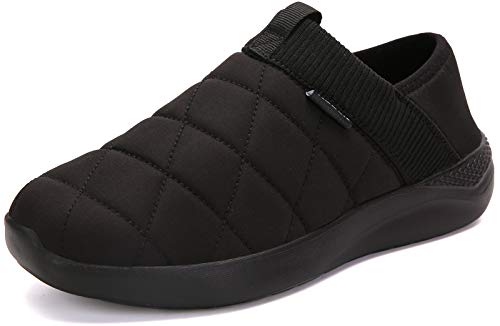
The KUBUA entry is shaped like a loafer, and that silhouette is its whole argument. A slip-on house shoe that borrows the outline of a casual shoe — for men and women alike, per its title — with a non-slip sole the listing explicitly extends to outdoor and garden use, in a lightweight, warm build. For the home worker whose day includes the school run gate, the garden path and the neighbour’s doorstep, a loafer-shaped slipper erases the boundary between house footwear and leaving footwear.
Listing details
- Audience: Men and women, per the listing title
- Style: Slip-on house shoes in a loafer shape
- Sole: Non-slip; outdoor and garden use named in the title
- Entry: Easy to put on and take off, per the title
- Weight character: Lightweight
- Warmth: Warm indoor slipper, per the title
Strengths
- Loafer outline passes as a shoe at the door
- Sole explicitly rated for garden and outdoor steps
- Lightweight and easy to slip on and off
Trade-offs
- No lining or footbed material is named in the title
- Shoe-like fit is less cosy than plush designs
- Warmth level cannot be judged from the title alone
Shape carries social information. On a video call nobody sees your feet, but at the front door, in the garden, and in the corner shop at lunchtime, people do, and a loafer reads as a shoe in all of those places while a plush moccasin reads as a slipper in all of them. Households differ in how much that distinction matters, yet for anyone whose work day leaks into the street — deliveries signed for, bins moved, a dog let out between meetings — the loafer form removes a dozen small shoe changes a day. The easy on-and-off wording in the title serves the same rhythm: these are built for a life of thresholds. Lightweight construction keeps them from feeling like boots at the desk, and the warmth claim places them in the cooler half of the year, though the title gives no lining detail, so the exact warmth mechanism is a listing question rather than a fact to invent here.
Unisex framing also makes this the natural household pair — the one bought in two sizes for two people, or kept as the good spare by the door. Its weakness is the mirror of its strength: a loafer’s open back and shoe-like fit will never feel like a cocoon, and the worker who wants to curl up in a chair with a blanket over her feet at four o’clock will find this pair correct rather than comforting. Know which of those afternoons is yours.
Best for: home workers whose day keeps crossing the doorstep and who want one pair for both sides of it. / Not suited for: anyone seeking a plush, lined cocoon for purely indoor, seated hours.
Check price on Amazon — choose it if your working day includes the garden path as often as the desk.

VeraCosy Men’s Two-Tone Cozy House Slippers Red 9-10
Red two-tone is a confident choice in a sea of grey, and the VeraCosy pair wears it openly: a men’s slipper in the nine-to-ten band, non-slip, machine washable, lightweight, gift-ready by its title’s account, with supportive and comfy as the maker’s own comfort words. In a guide about the working day at home, this is the pair with a personality — the one visible under a desk in a photograph and unmistakably chosen rather than inherited.
From the title itself
- Audience and size: Men’s, 9-10 US
- Colour: Red, two-tone
- Feel words in title: Supportive, comfy — the listing’s own wording
- Sole: Non-slip
- Care: Machine washable; lightweight
- Presentation: Gift-ready, per the listing title
Strengths
- Distinctive two-tone red in a grey category
- Washable and non-slip for daily working wear
- Gift-ready presentation for a new home worker
Trade-offs
- Men’s sizing only, in the 9-10 band
- Bold colour will not suit every household’s taste
- Support language is the maker’s comfort wording, nothing more
Colour in work-from-home clothing does a quiet psychological job. The rituals that separate working hours from home hours have thinned to almost nothing for many people, and small deliberate signals — real clothes, a cleared desk, footwear with some intent in it — carry more weight than they used to. A red slipper is a trivially small version of that signal, and trivially small signals are the kind that survive daily life. The practical inventory underneath the colour is solid for the category: a non-slip sole for hard floors, washability for a pair in daily service, and a light build for feet that will cover surprising distances between desk, kitchen and door across a working week. Supportive is the maker’s word and this guide repeats it as exactly that — a comfort claim in the listing’s language — rather than as any promise about what the slipper will do for a foot condition.
Gift-ready wording and a bold colour make this the obvious present in the set for a man newly working from home, a small upgrade to a daily ritual he performs forty hours a week. The two-tone design also hides wear cleverly, since a darker toe and heel forgive the scuffs that a single pale shade would advertise. Buyers who want their slippers to disappear should look at the black and grey pairs; buyers who want theirs to be noticed, at least by themselves, have found their listing.
Best for: men working from home who want a washable daily pair with some character. / Not suited for: anyone shopping for women’s sizing, or a pair meant to vanish under a desk.
Check price on Amazon — the characterful pick for a full-time desk week.

Evshine Fuzzy Memory Foam Slippers Women Closed Back Knit Grey
A closed back is a small structural decision with an outsized effect on a working day, and the Evshine pair is the only entry here built around it: a grey knit house shoe for women, lined in soft faux lamb wool, on a textured rubber sole, sized thirty-eight to thirty-nine. Every other pair in this guide can be kicked off in a second. This one stays on — through stairs, through standing desk hours, through the whole geography of a home that is also an office.
Stated facts
- Back design: Closed back, per the listing title
- Upper: Knit house shoe styling
- Lining: Soft faux lamb wool lining, per the title
- Sole: Textured rubber sole
- Size and colour: Grey, 38-39 (size 8)
- Use range: Indoor outdoor comfort, per the title
Strengths
- Closed back stays on through stairs and standing hours
- Textured rubber sole gives stated grip
- Faux lamb wool lining warms a draughty office
Trade-offs
- Slower to step into than any slide here
- Warm build is wrong for summer working
- European-American size pairing needs chart-checking
The case for a heel is security at speed. A backless slide asks the foot to participate in keeping it aboard; a closed back simply remains, which matters when the day includes carrying coffee up stairs, hurrying to a doorbell between calls, or standing for long stretches at a raised desk where a loose slipper becomes a thing to trip over in slow motion. The knit upper keeps the shoe-like structure from feeling like a shoe, flexing over the foot rather than armouring it, and the faux lamb wool lining supplies the warmth layer that pure knit would lack. A textured rubber sole is the most explicit grip language in this guide, and rubber on tile and wood is the combination home workers actually need at the sink and the bathroom door. Grey keeps the whole thing visually quiet, which suits a pair designed to be worn in every room and, per the title’s indoor-outdoor wording, occasionally beyond them.
This is also the pair for the worker whose feet get cold from the ankle’s direction — the draught that slides under doors and across floors finds the gap at the back of a slide first. If your home office has a cold floor and a draughty door, the closed back plus lining is not a styling preference but the thermal answer. The trade is entry speed and a warmer summer profile; in a hot house, this pair will be the first one retired to the cupboard in May.
Best for: women whose work day moves around the house and who want their slippers to keep up securely. / Not suited for: hot houses, or anyone who kicks slippers off and on constantly through the day.
Check price on Amazon — the secure choice if your desk day involves stairs and standing.

Fires Womens Mens Slippers Rubber Sole Slipper Socks Pinkstripe
Slipper socks occupy the borderland between footwear and clothing, and the Fires pair plants its flag there deliberately: a soft, lightweight sock construction in a pink stripe, finished — crucially — with a rubber sole and non-slip wording, sized across both women’s and men’s ranges in its title. Without that sole, a slipper sock is a lovely thing that slides on kitchen tile. With it, the format becomes a legitimate all-day house shoe for people who dislike the feeling of shoes altogether.
As the maker lists it
- Format: House slipper socks, per the listing title
- Sole: Rubber sole; non-slip wording in the title
- Audience and size: Women 8-9 / men 6.5-7.5, per the title
- Colour: Pink stripe
- Weight character: Soft and lightweight, per the title
- Use range: Indoor and outdoor, per the title
Strengths
- Sock freedom with a real rubber sole beneath
- Ideal for cross-legged, floor-based working styles
- Packs flat; dual sizing suits shared households
Trade-offs
- No cushioning system for long standing on hard floors
- Soft uppers offer little structure or warmth depth
- Wash care is not stated in the title
The appeal is proprioceptive, if a humble product may borrow a grand word: a slipper sock lets the foot feel the floor, spread, grip and move almost as it does barefoot, while adding warmth and a sole’s protection. Workers who sit cross-legged, perch on footstools, tuck feet under themselves on a sofa with a laptop, or practise the general floor-based sprawl of a creative working day will find every structured pair in this guide fighting them, and this pair simply joining in. The rubber sole then covers the standing, walking and doorstep parts of the day with more authority than the sock format usually manages, and the indoor-outdoor wording in the title supports brief sorties. What the format cannot offer is cushioning architecture: there is no foam story here, so a worker standing on hard floors for long cooking or workshop stretches will feel the day in their heels by evening, honestly and directly.
Pink stripe is the most playful finish in this guide, and it suits a product that is itself a small rebellion against footwear formality. Dual sizing in the title — women’s eight to nine, men’s six and a half to seven and a half — makes it a flexible household purchase, and the soft construction packs flat for travel or for the drawer of a desk that doubles as a guest room. Wash care is not stated in the title, so treat that as a listing check; a sock-format product usually has a laundry answer, but this guide does not guess at one.
Best for: workers who hate wearing shoes and work in sprawled, seated postures all day. / Not suited for: anyone needing cushioned support for hours of standing on tile or stone.
Check price on Amazon — the barefoot-feeling option, with a sole where it counts.

ERGOfoot Orthopedic Slippers Arch Support Cotton Terry Clog
The ERGOfoot clog closes this guide with the most assertive title of the six, and this review will handle that assertiveness carefully. The listing calls its slippers orthopedic, speaks of arch support, and mentions heel pain on long standing days. Those are the maker’s words, quoted here as listing language; what this guide can assess in comfort terms is the tangible design underneath them — a roomy clog shape for women and men, a soft cotton terry lining, and an anti-slip rubber sole — aimed plainly at people who spend long days on their feet at home.
Title inventory
- Style: Clog, for women and men per the title
- Support wording: Arch support — the listing’s own term
- Lining: Soft cotton terry lining
- Sole: Anti-slip rubber sole
- Listing language note: The title uses orthopedic and heel-pain wording — presented here as the maker’s language
- Shape benefit: Clog entry: roomy, quick to step into
Strengths
- Clog shape suits long, standing-heavy home days
- Cotton terry lining manages warm feet kindly
- Anti-slip rubber sole stated in the title
Trade-offs
- Support claims are the maker’s language, not a treatment promise
- Clog structure feels firm beside plush pairs
- Least cosy option for curled-up desk work
Strip the vocabulary back to the object and the object still makes sense for its audience. A clog gives toes room to spread, steps in and out without hands, and presents a defined sole under the whole foot, which is why clog shapes have served standing workers in kitchens and workshops for generations. Cotton terry as a lining absorbs moisture and feels familiar against the skin in the way a towel does, suiting feet that run warm and workers who are in and out of the pair all day. The rubber sole’s anti-slip wording covers the wet-floor moments of a home that is also a workplace. Where this review must be precise is the support story: an arch shape you can feel is a comfort feature, and many wearers genuinely prefer it for long standing days, but no slipper in a shopping guide should be presented as treating heel pain or any other condition, and anyone with persistent foot pain deserves a clinician’s assessment rather than a checkout page. Bought as a comfortable, structured clog for long home days, this pair stands on its merits. Bought as medicine, it would be misunderstood.
The unisex clog also suits the standing-desk convert, the home baker, the parent working in fragments around a newborn — anyone whose work-from-home day is secretly a work-on-your-feet day wearing a laptop as a disguise. Its shape is the least slipper-like here after the loafer, which on camera and at the door reads as deliberate footwear. If your day is seated and still, the softer pairs above will feel kinder; if your day is upright and moving, this clog was drawn for it.
Best for: home workers who spend the day standing and want a structured, roomy clog for comfort. / Not suited for: anyone seeking treatment for foot pain — that conversation belongs with a clinician — or devotees of soft plush.
Check price on Amazon — a sensible standing-day clog, bought for comfort rather than for claims.
The working six, compared
| Pair | Shape | Sole in the title | Day it suits |
|---|---|---|---|
| ULTRAIDEAS | Lined slipper, black | Durable non-slip | Cold, seated, full-time |
| KUBUA | Loafer slip-on | Non-slip, outdoor-garden | Door-crossing days |
| VeraCosy | Two-tone slipper, red | Non-slip | Daily wear with character |
| Evshine | Closed-back knit shoe | Textured rubber | Moving, stair-using days |
| Fires | Slipper socks, pink stripe | Rubber, non-slip | Floor-based, sprawled work |
| ERGOfoot | Clog, terry lined | Anti-slip rubber | Standing-heavy days |
Read the table by your calendar rather than by your taste. A seated worker in a cold house and a standing worker in a warm one are shopping in the same guide for opposite products, and both are right. The sole column is the safety column — it decides where in the house, and how far beyond it, the pair can be trusted. The day column is the honesty column, and matching it to your real routine, rather than to the routine of a tidier imaginary worker, is the single most reliable predictor of a pair still loved in six months.
How to choose slippers for a full working day at home?
Audit your day in rooms, not in hours
List the rooms your working day actually visits and the floors in each. A day that is ninety percent one carpeted room forgives almost anything; a day spread across tile, wood, stairs and a garden path is a footwear specification waiting to be written down. Count the standing, too — the calls taken walking, the lunch cooked, the printer besieged — because standing time is what separates the pairs in this guide most sharply. Foam and structure serve the stander; softness and freedom serve the sitter; the clog and the slipper sock are both correct answers, addressed to opposite days. Write the audit before opening a single listing and the six reviews above will sort themselves with unusual speed.
Warmth belongs to the coldest room you work in
Home offices colonise cold corners: the spare room over the garage, the converted loft, the end of the house the heating reaches last. Choose warmth for that room, not for the cosy living room where the evening happens, because the working pair’s job is the working hours. Fleece and faux lamb wool linings exist for those corners, and their cost — overheating in a warm house — is paid by a different household than the one shivering at a north-facing desk. If your work migrates between a cold office and a warm kitchen, the mid-weight unlined pairs split the difference, and a pair of socks becomes the adjustable layer that turns one slipper into a small system.
Plan the Friday wash and the evening change
A working pair accumulates a working week, and the households that stay fond of their slippers are the ones with a reset ritual: the washable pairs laundered on a rhythm, the others aired and rested, ideally with a second pair rotating through. Build that ritual into the purchase — if your life has no laundry rhythm, do not buy the pair that needs one most. Then keep the oldest home ritual of all: change out of the working pair when the work ends. It costs nothing, it rests the footwear, and it returns to the evening a boundary that remote work dissolved, one small, soft signal at a time.
The camera test and the doorbell test
Two moments judge a work-from-home pair in public, and both arrive without warning. The camera test is the stand-up moment in a video call — the reach for a charger, the book fetched from a shelf — when the lower half of the outfit joins the meeting for three seconds. Black, loafer-shaped, closed-back and clog pairs pass it as footwear; novelty plush and socks pass it as personality, which some workplaces welcome and some merely survive. The doorbell test is faster and wetter: a parcel, a neighbour, a dog making decisions, all on a doorstep that may be damp. A stated non-slip sole and a shape that stays on at a jog are the whole exam. A pair that passes both tests can be forgotten for the rest of the day, and forgettability, in working footwear, is the highest praise available.
Feet are part of the desk setup, even though no setup guide says so
Every ergonomic checklist ever written stops at the ankles, as if the working body ended where the chair’s castors begin. Feet, meanwhile, spend the seated day doing unlisted work: bracing against the floor when you lean, wrapping around chair legs, perching on rungs, going quietly numb in a tucked position that felt clever at nine and punitive by noon. A slipper with a defined sole changes that underground life more than its softness does, because it gives the foot a stable platform to press against and a reason to stay flat on the floor where circulation prefers it. A footbed with some body to it also spreads the small pressures of a footrest or a rung, instead of letting a bar of wood announce itself through a thin sock sole by mid-afternoon.
None of this requires medical language, and this guide avoids it on purpose. It is the ordinary mechanics of sitting, observable by anyone who spends one meeting noticing what their feet are doing. The pairs in this guide divide, under that observation, into those that encourage a settled, flat, warm foot — the lined and closed and clog shapes — and those that encourage a free, mobile, floor-feeling foot, which is the slipper sock’s whole philosophy. Workers who fidget their way through calls will recognise themselves in the second camp and should not be argued into the first by anyone’s idea of correctness. The best desk footwear is the pair whose philosophy matches the feet it is given.
Breaks, movement and the thousand small journeys
Remote work quietly abolished the incidental walk — to the printer, to the meeting room, to the sandwich shop — and then wondered why its practitioners felt welded to their chairs. The replacement ritual is the micro-journey: tea made between calls, a lap of the garden on a long document call, post collected, plants watered, a window opened in another room. Slippers are the enabling technology of every one of those journeys, because a pair that must be wrestled into, or that cannot be trusted on the garden path, raises the price of moving until the worker stops paying it. This is the deepest sense in which the sole and entry columns of this guide’s table matter: they are not really about footwear at all, but about whether a working day at home contains movement or only posture.
Households that take this seriously end up with infrastructure — a pair that lives at the desk, sound on every floor in the house, and a culture of standing up that the footwear never obstructs. The KUBUA’s garden-rated sole and the Evshine’s staying-on back are, read this way, health equipment of the most modest and honest kind: they remove friction from motion. Nobody needs a lecture about sitting less from a slipper guide. But a pair that makes the kettle trip effortless has done more for the working day than a pair that merely cushions the chair-bound hours, and buyers choosing between the six here might weigh that invisible contribution alongside every visible feature.
Hybrid weeks and the pair that travels between two lives
Many readers no longer work from home full-time; they split the week, and the split creates a footwear problem nobody had in 2019. The home pair now works two or three days instead of five, rests in between, and competes with an office wardrobe for the title of most-worn. Rest days actually extend a pair’s life and freshness, which is one quiet dividend of the hybrid pattern. The other consideration runs the opposite way: a pair bought for two days a week should be chosen even more strictly for pleasure, since it no longer needs to justify itself as infrastructure. The characterful VeraCosy and the indulgent end of this guide make their strongest case to the hybrid worker, whose slipper is closer to a treat than a tool.
Travel folds into the same question. The worker who decamps to a cottage, a parent’s house or a long rental with a laptop needs a pair that packs, and the soft constructions here — above all the slipper socks — travel in a washbag’s corner while the structured clog defends its suitcase space like a second pair of shoes. There is no universal answer, only the honest inventory of where your working days actually happen, which is the same inventory this guide has been asking for since its first section, applied now to geography instead of rooms.
Two workers, one house: the shared-floor problem
Households with two home workers discover frictions no single-worker guide anticipates. Slipper noise becomes a shared resource — a hard sole on a wooden floor above a partner’s call is a small act of war — and the soft-soled and sock entries in this guide earn a diplomatic value that never appears in their titles. Sizes and colours stop being private choices and become a system for not wearing each other’s footwear at dawn, which is where the bold VeraCosy red and the pink stripe suddenly look less like decoration and more like labelling. Even the laundry rhythm doubles in importance, because a shared machine and two working pairs need a schedule that a single worker can leave to instinct.
The same household logic governs the spare pair by the door, the one offered to the visiting grandparent or the friend who came for lunch and stayed for the evening. A washable, forgivingly sized pair — the loafer shape travels best between different feet — turns that offer into a genuine comfort rather than a faint embarrassment, and in a house that is also two offices, the guest pair is sometimes the only footwear present that is not somebody’s livelihood. Small systems, again: the working house runs on them, and slippers, being worn more hours than any other item in it, are where the systems show first.
Seasons of the working year
The working year has weather inside it. January’s home office is a cold room with a short day outside the window, and the lined pairs rule it without argument. July’s is a warm room where the same linings feel like a punishment and the unlined, the knit and the sock come into their own — the ERGOfoot’s cotton terry, notably, was built for exactly that half of the calendar, absorbing where fleece would insulate. Between those poles sits the long shoulder season in which most working actually happens, and for which the mid-weight pairs in this guide were effectively designed. A reader choosing in October should be suspicious of her own certainty, because she is shopping inside one season’s propaganda; the calendar test from the choosing section — buy for the coldest room and the longest day — is the corrective.
Annual rhythm also governs replacement. A pair bought at the start of autumn and worn through the working winter will be ready for honest assessment by spring, and the household that replaces on that rhythm, rather than waiting for a sole to part company mid-call, treats its footwear the way it treats its software: maintained on a schedule, not rescued from failures. None of this is extravagant. It is the arithmetic of forty-hour weeks applied to the cheapest tool in the office.
A final consideration belongs to the end of the working pair’s life, which arrives sooner under a forty-hour load than most owners expect and should arrive without drama. A sole worn smooth is a fall waiting for a wet kitchen floor, and a footbed compressed to cardboard is a day of small discomforts that never quite announce their cause. The dignified pattern is retirement to lighter duties — the old pair demoted to gardening, to the garage, to the holiday cottage — and eventual disposal without ceremony. Keeping three generations in service at once, as many households do, is not thrift but clutter with a safety profile, and the working house, of all houses, should know the difference between a tool kept past its life and a tool kept for its memories.
Buy the replacement before the emergency, in the season before the season, and the whole question of work-from-home footwear settles into what it should always have been: a solved problem, quietly supporting the working day from underneath, noticed only on the rare morning when the right pair is in the wash and its absence explains, better than any review could, exactly what it had been doing all along.
Children and animals, the unofficial colleagues of every home office, cast their own votes in this category. A pair that survives being borrowed by a teenager, slept on by a cat and tripped over by a dog — washable, robust-soled, dark enough to forgive the evidence — will outlast a delicate pair in such a house regardless of what either title promises, and the worker whose office has a door that closes is in a different market from the worker whose office is the kitchen table, however similar their laptops look.
That kitchen-table worker, incidentally, may be this guide’s most important reader, because every demand in it — grip for the sink, warmth for the draught, presentability for the call taken where the family eats — is doubled at that table, and the pairs that answer all three at once are the ones this article has been quietly pointing toward since its opening paragraphs.
One more honest note on price, in a guide that prints none: the working pair is the wrong place in the house to economise by reflex, because its cost divides by hundreds of wearing days until it is effectively measured in fractions of a cent per hour of comfort, while a false saving at this level is repaid in the small, daily currency of cold feet, slippery doorsteps and a pair replaced twice in the span one good pair would have covered without complaint.
The reverse error exists too — the trophy pair, bought for specifications its owner will never use, as if a home office were an expedition — and the cure for both errors is the same unglamorous inventory this guide keeps prescribing: rooms, floors, postures, seasons, and the truth about how the day is actually spent.
Deliveries of a different kind deserve a mention before the recommendations: the groceries, the parcels, the takeaway at the end of a long Thursday. Each one is a small expedition to a possibly wet doorstep in whatever is on your feet, and across a year those expeditions outnumber every other outing the working pair will make, which is why this guide has treated the doorstep, rather than the desk, as the working slipper’s proving ground from its very first page.
Keep the receipt, keep the packaging until the pair has survived a full working week including its first wash where one is claimed, and judge it on Friday afternoon rather than Monday morning — Friday feet are the honest electorate of this entire category, and their verdict, tired or content, is the one that predicts the year.
It is also worth saying, in a week when every surface of the home has become a workplace, that the working pair marks territory in a way that helps some people think. Shoes on for the office was the old signal; for the home worker, the working slipper is its softened descendant — on at the desk, off at the sofa, and changed at the day’s end — and households that keep that small ceremony report, with a consistency that surprised even them, that the work feels more finished when the footwear says so.
None of that requires buying anything new, of course; it requires only that the pair you already chose, using the rooms-and-seasons method above, be allowed to mean something — and a guide that ends by telling you the meaning matters more than the purchase has at least kept its priorities in the order the evidence supports.
So, before the final recommendations, run the Friday test in imagination one last time: it is the end of a long week, the house is cold at the edges, a delivery is at the door, a call is in twenty minutes, and the floor between you and all of it is the floor you actually own. The pair you picture reaching for, without a second thought and without a flinch, is the pair this guide has been trying to hand you — and if none of the six quite matches that picture, the inventory method matters more than any single listing, so take the method and shop on with it.
And if the picture includes a second person reaching for their own pair at the same moment, in a different colour and a different size, then the household system described earlier in this article has already begun, and the only remaining decision is whose wash day comes first in the diary.
That is a good place for any household to arrive: two workers, two pairs, one laundry rhythm, and a front door that nobody in the house dreads answering on a wet, dark evening in the middle of February.
Common mistakes in work-from-home slipper buying
Buying bedroom slippers for an office day. A soft pair made for twenty carpeted steps will be destroyed — in comfort long before in structure — by eight hours across a whole house. Match the pair to the day’s geography, not to the room where the day begins.
Reading support language as a medical promise. One title in this guide uses orthopedic and heel-pain wording. That is the maker’s marketing language, repeated here as such; comfort is a fair reason to buy a clog, and treatment is a conversation for a clinician, not a checkout.
Ignoring the sole because the upper looked cosy. The working day’s accidents happen at sinks, doorsteps and stairs. If a title describes its sole, believe that the maker thought about the floor; if it does not, ask the question on the listing before the floor asks it for you.
Wearing one pair every day without rest or washing. Foam tires, linings stale, and affection dies. Rotation and a laundry rhythm are not indulgences at forty hours a week; they are the maintenance schedule of a tool you stand in.
Choosing for the photograph instead of the calendar. The boldest colour and the plushest pile both fade into the background of a working week, while fit, grip and warmth report for duty every hour. Buy the calendar’s pair and let the photograph look after itself.
Final recommendation
For the classic cold, seated, full-time desk week, the ULTRAIDEAS is this guide’s centre of gravity: lined, washable, black and grippy. For the threshold-crossing day, take the KUBUA’s loafer. For character with the same daily discipline, the VeraCosy. For the moving, stair-climbing day, the Evshine’s closed back. For the floor-sprawling creative day, the Fires slipper socks. For the standing day, the ERGOfoot clog, bought for comfort and shape rather than for its title’s bolder words. Readers outfitting the rest of the home-working house might start with the woven colour in Best Paisley Rugs for the office floor itself.
Frequently asked questions
How long should a pair worn forty hours a week last?
Shorter than a bedroom pair, and planning for that is wisdom rather than pessimism. Foam compresses, soles smooth and linings tire under a working load, so a household that rotates two pairs and washes the washable ones will get more total service — and better daily comfort — than one that wears a single pair into the ground. Retire by sole smoothness and footbed feel, not by appearance.
Are any of these suitable for a standing desk?
The closed-back Evshine and the ERGOfoot clog are the natural candidates, for opposite reasons: the Evshine stays securely on a moving foot, and the clog’s structured shape suits upright hours. The slipper socks, by contrast, are at their best everywhere except standing still on hard floors. Match the pair to the posture, as the choosing section argues, and consider a mat under any standing station. The floor beneath that mat is its own project, and Best Traditional Rugs covers the classic end of that decision.
Can I really wear slippers to answer the door to clients?
In most home-working lives the door is parcels and neighbours rather than clients, and the loafer, black and clog shapes here pass those encounters as ordinary footwear. A client-facing household should simply weight the camera and doorbell tests more heavily and choose from the shoe-like end of this guide.
What should I do about foot pain that starts during the work day?
Take it seriously and take it elsewhere: persistent pain deserves a clinician, and no product in this guide is presented as a treatment for it. Comfort changes — a different shape, a break from standing, a chair adjusted properly — are reasonable first steps for ordinary end-of-day tiredness, and the ERGOfoot review explains exactly where the line between comfort language and medical claims sits, and why this guide stays on its own side of it.
Is it worth owning a separate pair just for evenings?
Many home workers find the change of footwear is the cheapest boundary ritual available, and it rests the working pair into the bargain. The open-toed styles in Best Body Wash Towels are, strictly, towels — but the post-work shower they belong to is where the evening change usually begins, slippers and all.
Pick the pair your own calendar honestly describes, keep it clean, and change out of it at six each evening — and the humble slipper becomes the most reliable colleague in the house.