What's inside
- Where to buy
- Quick Picks
- How these picks were chosen
- The six rugs, reviewed one at a time
- Side-by-side: the six at a glance
- How do you choose a traditional rug that fits your room?
- Reading a traditional pattern like a decorator
- Keeping a low-pile traditional rug looking its age (in a good way)
- Room by room: where each format earns its keep
- What power-loomed polypropylene actually means for ownership
- Colour stories: pairing the four palettes with real rooms
- Unrolling day: setting a big rug up properly
- Common mistakes
- Final recommendation
- FAQ
As an Amazon Associate I earn from qualifying purchases. This post may contain affiliate links at no extra cost to you.
As an Amazon Associate, cottageverdict.com earns from qualifying purchases.
A room furnished with plain, modern pieces can feel finished yet oddly anonymous, and that is usually the moment people start hunting for traditional rugs: a patterned floor covering with a medallion, a border and enough colour depth to give the furniture something to answer to. The difficulty is that the word traditional covers a wide spread of goods on Amazon, from power-loomed polypropylene made in Turkey to washable low-pile prints with a vintage wash, and the listings rarely explain themselves in the same vocabulary. This guide reads all six listings on their own stated terms, separates the genuinely large area rugs from the one small accent piece, and keeps the conversation honest about what machine production means for pattern, pile and price of effort in daily care.
Four of the six picks below come from a single maker, SAFAVIEH, and that concentration is worth stating plainly at the outset rather than discovering halfway through. Traditional-pattern rugs on Amazon lean heavily on that brand’s Lyndhurst and Mahal lines, so much of this article is really an exercise in telling four SAFAVIEH models apart from one another: two 8×10 area rugs in different colour stories, one 9×12 floral, and one 4×6 accent rug that plays a completely different role in a house. The remaining two picks, from Hazo Haus and Unique Loom, break the pattern in useful ways, one by being washable and non-slip, the other by offering a smaller 5×8 footprint for rooms where an 8×10 would swallow the floorboards whole.
Nothing here is hand-knotted, and nothing pretends to be an antique. Every pick is a manufactured rug whose design borrows the visual grammar of Persian and Oriental weaving: central medallions or all-over floral repeats, guard stripes, main borders, and colour pairings such as red with black or red with navy that have anchored formal rooms for generations. Judged on those terms, as hard-wearing patterned flooring rather than as collectible textiles, several of them are genuinely good answers. The sections below work through size first, then construction, then colour, because that is the order in which a purchase usually succeeds or fails.
Where to buy
All six rugs are sold through Amazon, and each review further down carries a direct link to its own listing. The Lyndhurst LNH331B in red and black is the boldest of the SAFAVIEH group, an 8×10 whose deep ground colour hides a multitude of everyday sins. Its stablemate the LNH212D spreads a softer Persian floral across a full 9×12 in beige and ivory, aimed at rooms that want pattern without darkness. The little LNH555 accent rug, just 4×6 in black and ivory, works at an entryway or beside a bed where a full area rug would be absurd. SAFAVIEH’s Mahal MAH693F returns to 8×10 but swaps the palette to red and navy, a cooler and more formal combination. Hazo Haus offers the practical outlier, a washable 8×10 in taupe and brown with a non-slip backing, while the Unique Loom Voyage closes the list at 5×8 in red and tan for dining nooks and smaller sitting rooms.
Quick Picks
| Pick | Best for | Điểm nổi bật theo title |
|---|---|---|
| SAFAVIEH Lyndhurst Rug 8×10 Traditional Persian Red Black LNH331B | Formal living rooms wanting a deep, dramatic ground | Power-loomed polypropylene, 3/8 in low pile, made in Turkey |
| SAFAVIEH Lyndhurst Rug 9×12 Persian Floral Beige Ivory LNH212D | Large pale rooms that need pattern at scale | 9×12 footprint with a beige and ivory floral design |
| SAFAVIEH Lyndhurst Accent Rug 4×6 Black Ivory LNH555 | Entryways and bedside spots in busy homes | Non-shedding, easy care, pitched at high traffic areas |
| SAFAVIEH Mahal Rug 8×10 Red Navy MAH693F | Traditional schemes built around navy upholstery | Traditional Oriental design in red and navy at 8×10 |
| Hazo Haus Boho Traditional Oriental Rug 8×10 Taupe Brown | Homes that need to machine-wash their rug | Washable low pile with non-slip backing, vintage styling |
| Unique Loom Voyage Traditional Oriental Rug 5×8 Red Tan | Smaller rooms and under-table placements | Intricate classic design in a 5×8 rectangle, red and tan |
How these picks were chosen
The shortlist began with a simple filter: the listing had to present itself as a traditional, Persian or Oriental design rather than a generic vintage print, and it had to state a concrete size a buyer could measure a room against. That filter is why the sizes here are so specific, running from the 4×6 accent format up to a full 9×12, and why every entry names its colours in the title instead of hiding them behind a variant selector. A rug whose pattern and palette cannot be identified from its own listing is a rug a reader cannot shortlist with any confidence, so those fell away early.
Construction came next. Where a title states how the rug is made, that fact is reported exactly as given: the two larger Lyndhurst models declare power-loomed polypropylene with a 3/8 inch low pile and Turkish manufacture, while the Hazo Haus title declares washable low pile with a non-slip backing. Where a title stays quiet about fibre or loom type, this guide says so in the spec box rather than filling the gap with a guess, because fibre content drives everything from vacuuming behaviour to how a spill should be handled in the first five minutes.
Colour range mattered as a third pass. Traditional patterns fail in two opposite directions: grounds so dark they turn a north-facing room into a cave, and grounds so pale they show every muddy paw within a week. The six picks deliberately span that spectrum, from the near-black drama of the LNH555 through mid-tone reds to the beige and ivory calm of the LNH212D, so a reader can place their own room’s light and traffic on the scale and pick accordingly.
Finally, each rug had to earn its place against the others rather than duplicate one. Two 8×10 SAFAVIEH rugs survive in the list only because their palettes pull a room in genuinely different directions; the 4×6 survives because no other pick serves an entryway; the washable Hazo Haus survives because no other pick can go in a machine. If a candidate merely repeated a size, palette and construction already covered, it was cut, however handsome its thumbnail looked.
The six rugs, reviewed one at a time

SAFAVIEH Lyndhurst Rug 8×10 Traditional Persian Red Black LNH331B
Red and black is the most assertive pairing in this entire guide, and the LNH331B wears it across a full 8×10, so the first question is whether your room can absorb that much saturated colour at floor level. In a living room with pale walls, a light sofa and wooden furniture, the answer is usually yes: the rug becomes the one committed gesture in the space, and everything else reads calmer by contrast. In a room already carrying dark leather, heavy curtains and low natural light, the same rug can tip the balance toward gloom, and one of the paler picks below will serve you better.
- Size as listed: 8′ x 10′
- Construction as listed: power-loomed polypropylene
- Pile as listed: 3/8 in low pile
- Origin as listed: made in Turkey
- Rooms named in the listing: bedroom, kitchen, living room
Strengths
- The 3/8 inch low pile sits flat under dining chairs and lets doors swing clear without shaving or planing.
- Polypropylene shrugs off the blot-and-lift spill routine that would panic a wool owner.
- A red ground with black patterning conceals tracked-in grit between vacuum passes far better than any pale rug here.
Trade-offs
- That same dark ground shows pale lint, pet hair from light-coloured animals and dust with embarrassing clarity.
- Power-loomed patterning is crisp but flat; anyone hoping for the irregular charm of hand-knotted work will not find it here.
- At 8×10 it demands a genuinely large room, and in a small one it leaves almost no border of bare floor.
Underfoot, a low polypropylene pile feels smooth and slightly cool rather than plush, which suits a living room where people cross constantly and sit on furniture rather than on the floor. Children playing at board-game height will want a cushion; adults reading in armchairs will never notice. The listing names the kitchen among its rooms, and while an 8×10 rarely fits a kitchen, the fibre logic holds: a synthetic low pile tolerates splashes and chair-leg traffic in a way that a deep natural pile simply does not.
Pattern scale deserves a thought before ordering. Traditional Persian layouts at this size usually centre a medallion, which means a coffee table will cover the middle of the design and the border will do the visual work around the edges. That is not a flaw, but buyers who fall for the full symmetrical layout in the product photo should picture their own furniture footprint honestly, because the border is what they will actually live with day to day.
Best for: a formal-leaning living room with light walls that needs one deep, forgiving anchor of colour. Not suited for: a dim room already furnished in dark tones, where the black patterning would swallow what little light the space has. Check price on Amazon — the red and black colourway is the one to confirm on the listing before you commit.

SAFAVIEH Lyndhurst Rug 9×12 Persian Floral Beige Ivory LNH212D
Scale changes everything about a floral pattern. Spread across 9×12, the beige and ivory Persian floral of the LNH212D stops reading as busy and starts reading as texture, the way a large garden looks calmer than a single crowded flowerbed. This is the biggest rug in the guide and the palest, a combination aimed squarely at generous rooms (open-plan living spaces, large primary bedrooms) where a smaller rug would float like a postage stamp in the middle of the floor and a darker one would fight the daylight.
- Size as listed: 9′ x 12′
- Construction as listed: power-loomed polypropylene
- Pile as listed: 3/8 in low pile
- Origin as listed: made in Turkey
- Rooms named in the listing: bedroom, kitchen, living room
Strengths
- The 9×12 footprint lets all four legs of a sofa and both front chair legs rest on the rug, the layout rule designers repeat endlessly.
- Beige and ivory lift a room’s light instead of absorbing it, suiting north-facing spaces.
- Shared Lyndhurst construction means the same easy synthetic care as its red sibling, at a larger scale.
Trade-offs
- Pale grounds confess everything: coffee drips, muddy shoes and pet accidents all announce themselves immediately.
- A rug this size is heavy to shift for deep cleaning and awkward to carry up stairs on delivery day.
- The floral repeat may feel too gentle for anyone wanting a strong medallion centrepiece.
The floral design also changes how the rug pairs with upholstery. Plain linen, leather and solid velvet all sit comfortably on it; a floral sofa or heavily patterned curtains would set up a negotiation nobody wins. In a bedroom, the 9×12 extends generously on both sides of a large bed, giving bare feet a soft landing zone that a runner on each side only approximates, and the low pile keeps the bed frame’s casters from digging ruts.
Because the pile matches the LNH331B at 3/8 inch, day-to-day upkeep is identical: regular vacuuming without a beater bar set aggressively, prompt blotting, and a full unroll-and-air session when it first arrives to let the fold lines relax. The difference is purely visual and spatial, which is precisely why both rugs earn their place here rather than one cancelling the other out.
Best for: a big, bright living room or primary bedroom that needs pattern at full scale without losing light. Not suited for: a household with muddy-pawed dogs and a pale-carpet tolerance of zero, because ivory floral forgives nothing. Check price on Amazon and measure your room’s door swing before this one ships.
SAFAVIEH Lyndhurst Accent Rug 4×6 Black Ivory LNH555
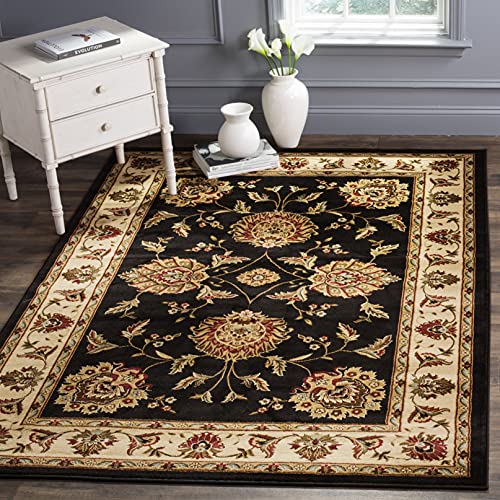
Every other pick in this guide is furniture-scale; the LNH555 is not, and pretending otherwise would do it a disservice. At 4×6 in black and ivory, it is an accent rug in the true sense, sized for the patch of floor inside a front door, the landing strip beside a bed, or the working space in front of a kitchen sink run. The listing itself aims it at high traffic areas (entryway, living room, bedroom are named), and calls out a non-shedding, easy care character, which is exactly the brief a small hard-working rug has to meet.
- Size as listed: 4′ x 6′
- Design as listed: traditional Oriental, black and ivory
- Shedding as listed: non-shedding
- Care as listed: easy care
- Fibre: the listing title does not name one
Strengths
- The 4×6 format fits entryways and bedside gaps that no 8×10 could serve.
- Black patterning on ivory hides the grey scuff film that entrance floors collect.
- Non-shedding behaviour, as the listing claims, suits a spot vacuumed briefly and often.
Trade-offs
- It cannot anchor a seating arrangement; buyers wanting that effect need a full area rug.
- With no fibre named in the title, spill behaviour is harder to predict from the listing alone.
- Small rugs wander on hard floors unless a pad goes underneath, an extra purchase to plan for.
In an entryway the black and ivory scheme performs a quiet trick: it looks formal enough to greet guests, yet the high-contrast pattern breaks up the visual evidence of grit, leaf fragments and umbrella drips until the weekend clean. Beside a bed, the same rug gives a defined, handsome rectangle for slippers and morning feet, and its modest size means it can be lifted, shaken outside and replaced in under a minute, a chore rhythm no large rug permits.
One caution belongs to scale again. A 4×6 under a coffee table in a big room reads as lost, and the traditional design will look like a sample swatch of a grander idea. Keep this rug in genuinely small territories (hall, doorway, bedside, a child’s reading corner) and it reads as intentional rather than undersized.
Best for: an entryway or bedside that needs traditional pattern in a small, non-shedding, easy-care format. Not suited for: anyone furnishing a main seating area, because 4×6 cannot carry a sofa-and-chairs layout. Check price on Amazon — and budget for a rug pad in the same order if your floors are hard.

SAFAVIEH Mahal Rug 8×10 Red Navy MAH693F
Swap black for navy and a traditional rug changes its whole social register. The Mahal MAH693F keeps the 8×10 footprint and the red ground of the first pick, but the navy partner colour cools the scheme down, pulling it toward libraries, studies and living rooms furnished with blue upholstery, brass and dark wood. The listing describes a traditional Oriental design, non-shedding and easy care, and names the living room and bedroom as its territory.
- Size as listed: 8′ x 10′
- Design as listed: traditional Oriental, red and navy
- Shedding as listed: non-shedding
- Care as listed: easy care
- Pile depth: none stated in the listing title
Strengths
- Navy is the easiest traditional partner colour to furnish around, matching denim, chambray and most blue-grey paints.
- The red ground still does the heavy lifting on hiding everyday dirt between cleans.
- Non-shedding and easy care claims suit a room that gets vacuumed on a schedule rather than fussed over.
Trade-offs
- The title gives no fibre or pile figure, so underfoot feel cannot be judged from the listing text.
- Red and navy together can read formal to the point of stiffness in a casual family room.
- Like its red and black sibling, it needs a large room to breathe.
Where the Mahal earns separate attention from the Lyndhurst LNH331B is in decorating arithmetic. Navy recurs in far more homes than black does (sofa fabrics, cushion stripes, painted bookcases, even the spines of books), so the rug’s secondary colour finds echoes around the room without any effort. The result is a scheme that looks collected rather than matched, which is the quality most people are actually chasing when they type traditional into a search box.
In a bedroom, red and navy at 8×10 gives a grounded, hotel-like formality, especially under a bed with white or cream bedding that throws the pattern into relief. Keep the rest of the textiles quiet and let the floor carry the ornament; competing patterns on the bed will flatten both. If the room faces north, test the idea against your light first, since navy deepens in cool daylight.
Best for: a study-leaning living room or formal bedroom already using navy somewhere in its scheme. Not suited for: a sun-drenched casual family room dressed in warm neutrals, where red and navy would sit like visiting dignitaries. Check price on Amazon and compare its palette against the LNH331B before choosing between the two 8×10 SAFAVIEH options.

Hazo Haus Boho Traditional Oriental Rug 8×10 Taupe Brown
The Hazo Haus entry is where this guide’s priorities flip. Instead of asking how formal a room it can make, it asks how a traditional-look rug survives a house with children, pets and a dining table in constant use. The listing’s own words are washable, low pile and non-slip, wrapped in a modern vintage traditional eclectic Oriental design in taupe and brown, sized 8×10 and suggested for dining under a table, bedroom and lounge. A rug that can be machine-washed changes the ownership equation completely, because the worst day of a rug’s life (a full glass of something red, a pet accident) becomes a laundry event instead of a professional-cleaning invoice.
- Size as listed: 8×10
- Washing as listed: washable
- Pile as listed: low pile
- Backing as listed: non-slip
- Colours as listed: taupe and brown, neutral
Strengths
- Machine washability, per the listing, is the single most practical feature anywhere in this guide.
- A non-slip backing removes the separate rug-pad purchase that the other five picks quietly assume.
- Taupe and brown neutrals sit under almost any dining set without negotiating with the curtains.
Trade-offs
- Washable low-pile rugs feel flatter and thinner underfoot than a 3/8 inch piled rug; there is no plushness to sink into.
- An 8×10 in a domestic washing machine is a serious load, so check your machine’s capacity honestly.
- The faded vintage treatment will disappoint anyone wanting the saturated, formal colour of the SAFAVIEH reds.
Under a dining table is this rug’s natural home, and the listing says so itself. Chairs slide across low pile without catching, crumbs vacuum up in seconds, and the non-slip base keeps the whole arrangement from creeping toward the wall over a month of family dinners, which is the slow-motion failure mode of unbacked rugs in dining rooms everywhere. The eclectic, washed-out patterning also forgives the visual chaos of a lived-in eating space better than a crisp medallion would.
The boho framing matters for expectations. This is a relaxed, distressed-look interpretation of traditional motifs, closer in spirit to a faded heirloom than to a formal Persian layout, and it suits rattan, linen and light woods far better than mahogany and brass. Buy it for the life it enables rather than the formality it imitates.
Best for: a dining room or family living space where washability and grip outrank plushness and ceremony. Not suited for: a formal sitting room chasing saturated traditional colour, because the taupe vintage wash deliberately mutes it. Check price on Amazon — and confirm your washing machine can swallow an 8×10 before this becomes your plan A.

Unique Loom Voyage Traditional Oriental Rug 5×8 Red Tan
The Voyage from Unique Loom is the diplomat of the list: traditional Oriental design with intricate detailing, in red and tan, at a 5×8 size that fits the rooms the 8x10s cannot enter. Think of a modest sitting room in an older house, a dining area for four, a home office that needs warming up, or the floor space at the foot of a bed in a smaller primary suite. Red brings the traditional warmth; tan, being lighter and drier than the Mahal’s navy or the Lyndhurst’s black, keeps the overall effect friendly rather than ceremonial.
- Size as listed: 5′ 0 x 8′ 0 rectangular
- Design as listed: traditional Oriental, classic, intricate
- Colours as listed: red and tan
- Collection as listed: Voyage
- Fibre: no fibre is named in the title
Strengths
- The 5×8 footprint suits smaller rooms where an 8×10 would run wall to wall and look like carpet.
- Red and tan is the most forgiving palette here for warm-toned, lived-in rooms.
- Intricate patterning at a smaller scale reads rich rather than overwhelming.
Trade-offs
- Seating for six will not fit on it; this is a four-chair, one-sofa scale.
- The title names no fibre and no pile height, limiting what the listing alone can tell you.
- Intricate small-scale pattern shows vacuum tracks and footprints in changing light more than a bold design does.
Placement is where the Voyage repays thought. Under a four-person dining table, 5×8 leaves enough margin for chairs to pull back without dropping off the edge onto hard floor, the detail that separates a rug that works from a rug that merely looks nice in a photograph. In an office, it defines the desk zone and warms the acoustic of a room full of hard surfaces, and its traditional pattern flatters bookcases and leather chairs without demanding a full formal scheme.
Readers torn between this and a larger rug should measure the gap they want between rug edge and wall. A consistent border of visible floor (roughly a hand’s span to a foot and a half) is what makes an area rug read as a deliberate island; the Voyage achieves that in rooms where the SAFAVIEH 8x10s would leave only a skirting-board sliver.
Best for: a smaller sitting room, dining four or home office wanting traditional warmth at a manageable scale. Not suited for: a large open-plan space, where 5×8 would look marooned in the middle of the floor. Check price on Amazon and tape the 5×8 outline on your floor first if you are between sizes.
Side-by-side: the six at a glance
| Rug | Footprint | Palette | Defining trait |
|---|---|---|---|
| Lyndhurst LNH331B | 8×10 | Red, black | Power-loomed polypropylene, 3/8 in pile, made in Turkey |
| Lyndhurst LNH212D | 9×12 | Beige, ivory | Largest here; pale floral at full-room scale |
| Lyndhurst LNH555 | 4×6 | Black, ivory | Accent size, non-shedding, aimed at high traffic |
| Mahal MAH693F | 8×10 | Red, navy | Cool formal pairing for blue-toned rooms |
| Hazo Haus | 8×10 | Taupe, brown | Washable with non-slip backing |
| Unique Loom Voyage | 5×8 | Red, tan | Intricate design in the smallest area-rug size here |
How do you choose a traditional rug that fits your room?
Start with the tape measure, not the pattern
Every disappointment in rug buying begins with size guessed from a photograph. Measure the room, then decide how much bare floor you want showing around the rug’s edge, then subtract. In living rooms the widely used arrangement puts at least the front legs of every seat on the rug, which is why the 9×12 and 8×10 formats dominate this guide. Dining rooms add a harder constraint: the rug must extend beyond the table far enough that a pulled-out chair stays on it, usually about two feet on every side, which pushes most six-seat tables toward 8×10 as a minimum.
Which pile height suits your doors and chairs?
The two Lyndhurst area rugs state a 3/8 inch low pile, and that number quietly governs daily life: interior doors clear it, dining chairs glide on it, vacuum heads pass over it without drama, and crumbs sit on top of it rather than vanishing into depth. Deeper piles feel luxurious in a bedroom corner but fight every chair leg and door swing they meet. The Hazo Haus washable is lower still, trading cushioning for washability. If your household includes a robot vacuum, low pile across the board is the pragmatic answer, since modest pile heights are what those machines climb and clean most reliably.
Do you need the rug to survive a washing machine?
Only one pick here, the Hazo Haus, claims washability in its listing, and for some households that single fact outweighs every aesthetic argument in this article. Dining rooms under toddlers, homes with elderly pets, and rental properties where the rug is a consumable rather than an heirloom all tilt toward washable. Everyone else can prioritise pattern and pile, accepting that a serious spill means spot treatment and patience. Households that prefer natural fibre altogether sometimes step sideways into a different construction entirely; our guide to Best Reversible Cotton Rugs looks at flat woven cotton options whose two-sided designs suit exactly that lighter, washable-leaning brief.
How much darkness can your light afford?
Hold the palette up against your windows. South-facing rooms with all-day sun can carry the red and black Lyndhurst or the red and navy Mahal without flinching. North-facing rooms, basement conversions and spaces shaded by trees will thank you for the beige and ivory LNH212D or the taupe Hazo Haus. The test that never lies: lay a garment in the rug’s dominant colour on the floor for a day and watch it at breakfast, noon and dusk. Floors occupy more of your visual field than any wall, and a ground colour that sulks at 4 p.m. will sulk every day you own it.
Reading a traditional pattern like a decorator
Traditional rug layouts follow a grammar worth learning before you buy, because the listing photographs show the whole composition while your furniture will hide most of it. The border (usually a wide main stripe flanked by narrow guard stripes) is the part that survives contact with sofas and tables, so judge a rug by its border first: does it frame a room gracefully on its own? The field inside it may carry a central medallion, which suits a room where the middle of the rug stays visible, such as a bedroom with the rug spread below the bed, or an all-over floral repeat like the LNH212D’s, which tolerates furniture anywhere because no single motif needs to be centred.
Symmetry deserves a word of caution for perfectionists. A centred medallion layout assumes the rug itself will be centred in the room, yet fireplaces, doorways and radiators routinely push real placements a few inches off the architectural axis. When that happens, an all-over floral or a small-scale intricate repeat forgives the offset completely, while a strict medallion keeps quietly announcing it. Buyers with an off-centre hearth or an L-shaped room should weight that practical geometry as heavily as the palette, and the floral LNH212D and intricate Voyage both gain ground in exactly those awkward, characterful spaces.
Colour placement inside the pattern matters too. In the strongest traditional designs, the darkest tone appears in the border and outlines, anchoring the composition, while mid tones fill the field and a light tone lifts the motifs. That is the structure behind both Lyndhurst colourways here, and it is why they read as formal even at a glance. Distressed or vintage-washed treatments, like the Hazo Haus finish, deliberately blur that structure, softening contrast until the pattern behaves more like texture. Neither approach is better; they simply belong to different rooms, one ceremonial and one relaxed.
Layering textiles over a traditional rug follows the same logic of contrast. Plain cushions in one of the rug’s minor colours will always look intentional, and a throw that repeats the border tone ties a sofa to the floor without matching anything exactly. If you enjoy handmade texture in those layers, the throws gathered in Best Crochet Blankets are reviewed there stitch by stitch, with sizes and yarns compared for exactly this kind of pairing.
Keeping a low-pile traditional rug looking its age (in a good way)
Machine-made low-pile rugs ask for rhythm rather than effort. Vacuum weekly in slow overlapping passes, turning the rug a half-turn every few months so traffic lanes and sunlight distribute evenly instead of engraving one path from door to sofa. Blot spills from the outside of the stain inward, with plain water first; aggressive scrubbing on a printed or power-loomed pattern can fuzz the surface and lighten the very motifs you bought. A pad underneath (felt or rubber-backed) stops creep, softens footfall, and extends the rug’s life by absorbing the grinding friction between rug and floor.
New rugs also benefit from a patient first week. Fold lines from shipping relax faster with heavy books parked on the creases overnight and a day of foot traffic than with any steaming experiment, and corners that curl usually settle once the pad goes under. Shedding, where it happens with synthetic low pile, is minimal and front-loaded; the two SAFAVIEH listings that address it claim non-shedding behaviour outright, and the rest should be judged after a fortnight of normal vacuuming rather than on day one.
Rotation has a seasonal dimension as well. A rug turned 180 degrees in spring presents its less-faded half to the window for summer, evening out the light exposure that slowly bleaches reds toward rust. Households that take relaxation as seriously as their floors sometimes extend that same seasonal reset outdoors; the soaking options compared in Best Deep Hot Tubs cover the deeper models for readers planning a garden corner to unwind in after the indoor chores are done.
Room by room: where each format earns its keep
Bedrooms reward the largest rug you can fit, because the whole point of the exercise is that no bare foot ever meets cold floor between bed and bathroom door. A 9×12 under a king or queen bed, pulled forward so it stops short of the nightstands, leaves a generous patterned apron on three sides; that is the LNH212D’s finest hour, and its pale floral is particularly kind to rooms where morning light arrives slowly. An 8×10 performs the same trick in a smaller suite, though the apron narrows to the point where the LNH555’s bedside format starts to look like the smarter spend for the remaining gap beside a guest bed.
Dining rooms are governed by chair geometry rather than taste. When a chair slides back, its rear legs must remain on the rug, or the sitter feels the little cliff-edge drop onto hard floor and the rug’s edge begins to curl from repeated catching. That single rule explains why the washable Hazo Haus, expressly suggested by its listing for dining under a table, pairs its 8×10 size with low pile and grip: the dimensions satisfy the chair rule for most six-seat tables, the pile lets chairs glide, and the backing stops the whole arrangement migrating. Formal dining rooms that host twice a year can indulge the red Lyndhurst instead; family dining rooms that host twice a day should not.
Living rooms split by conversation layout. A sofa-and-two-chairs grouping around a fireplace wants the rug to unify the seats, which means 8×10 as a floor and 9×12 as a luxury, with front legs on and back legs wherever they land. A media room, where seating lines up in rows facing a screen, can run a smaller rug without the layout falling apart, and that is where the Voyage at 5×8 sneaks into a role its size would never win in a conversational plan. Hallways and landings, finally, belong to the accent format: a 4×6 traditional pattern at a junction of doors reads as a deliberate pause in the architecture, especially in the black and ivory of the LNH555, which tolerates the cross-traffic of an entire household passing over it daily.
Home offices deserve a sentence of their own because castor chairs are rug enemies. A wheeled chair on pile behaves like a slow plough, so the office pick from this list should be the lowest, firmest surface available (the washable Hazo Haus or a Lyndhurst at its stated 3/8 inch), ideally with a chair mat on top in the immediate desk zone. The Voyage’s red and tan warmth suits the bookcase-and-desk aesthetic, but put the mat down and let the pattern show around it.
What power-loomed polypropylene actually means for ownership
Two of the listings state their construction outright, and the phrase deserves unpacking because it predicts years of behaviour. Power-loomed means the rug was woven on mechanised looms at industrial speed, which is how a detailed Persian-style pattern reaches this segment of the market at all. The pattern is consistent from one end to the other, the edges are finished evenly, and two rugs of the same model genuinely match, something no hand process promises. The honest cost of that consistency is the absence of tiny irregularities (the slight wobble in a motif, the colour shift where one dye lot met another) that give handmade pieces their living quality. At floor distance, under furniture, most households never miss them.
Polypropylene is a synthetic fibre chosen for stubborn practicality. It does not absorb water the way wool does, so spills sit on the surface long enough to be blotted rather than soaking straight through to the backing. It resists fading in sunny rooms better than most natural fibres, which matters for the red grounds in this guide, since red is historically the first colour to surrender to sunlight. It also has no nutritional value for moths, closing off an entire category of storage worry that wool owners in older houses know well. Against that ledger, polypropylene feels smoother and less springy than wool, carries a faint sheen in raking light that wool never shows, and should be kept away from high heat sources, which is worth remembering before placing any synthetic rug tight against a working fireplace hearth.
The 3/8 inch pile figure stated for both large Lyndhurst models sits in the practical middle of the low-pile family: tall enough to show pattern depth and soften a footstep, short enough that a dropped earring can be found and a dining chair does not feel moored. Pile height also decides how the pattern reads from standing height. Lower piles render motifs crisply, almost like print; deeper piles blur them slightly as the fibres lean. Traditional designs, with their fine guard stripes and small floral sprigs, generally flatter the crisper end, which is another quiet argument for the constructions gathered here.
None of this makes a manufactured rug a lesser purchase; it makes it a legible one. You know exactly what the fibre will do with a spilled drink, exactly how the pattern will repeat, and exactly how the edges will behave under a vacuum, and for a floor covering that must serve a family every day, that predictability is a feature in its own right.
Colour stories: pairing the four palettes with real rooms
Red and black, the LNH331B’s pairing, is the extrovert. Against honey-toned oak floors it glows; against very dark walnut it can disappear into the floor’s own shadows, leaving only the pattern’s movement visible. White or cream upholstery gives it a stage, charcoal upholstery gives it a rival, and the room is better with the stage. Metal accents in brass or aged gold warm it further, while chrome and glass push the scheme toward a harder, more urban register that some traditional patterns struggle to follow. If your curtains carry any red at all, let it be a whisper (a stripe, a tieback) rather than a repeat of the rug’s ground, because two large red fields in one room shout each other down.
Beige and ivory, the LNH212D’s territory, behaves almost as a neutral with manners. It accepts coloured furniture graciously: a green velvet chair, a cognac leather ottoman, navy cushions all sit on it without argument. Its risk is the opposite of the dark rug’s risk (blandness rather than gloom) and the cure is texture elsewhere: a chunky knit throw, a rough timber beam, a woven shade at the window. Pale rugs also benefit from deliberate darkness at the room’s edges (a blackened picture frame, an iron floor lamp) which gives the eye a frame and stops the whole space floating away into cream.
Red and navy, the Mahal’s combination, is the palette of rooms with books. It was practically designed for shelves, leather club chairs and the deep greens of a study wall, and it holds its dignity under lamplight in the evening better than any other pairing here, when the navy sinks toward black and the red warms toward ember. In daylight it asks for one light element to keep it honest (pale curtains, a cream ceiling, a light-toned chair) and rewards the effort with a room that feels established, as if it had been furnished over decades rather than delivered in a month.
Taupe and brown, the Hazo Haus wash, is the chameleon: it leans warm beside terracotta and linen, cooler beside grey stone and pale ash floors, and it never once demands that the rest of the room reorganise itself around the floor. Red and tan, the Voyage’s pairing, sits between the Mahal’s formality and the Hazo Haus’s ease, a country-house palette that suits scrubbed pine, painted furniture and the slightly faded textiles of a room that is used hard and loved anyway. Between them, these two lighter-hearted options cover the households that want traditional pattern as background music rather than as the headline act.
One last colour discipline applies to every palette in the guide: photograph your room’s floor, walls and largest piece of furniture together in daylight, and look at the photograph rather than the room when comparing it with listing images. Screens flatter saturation, memory edits it, and the photograph is the only witness that does neither.
Unrolling day: setting a big rug up properly
Large rugs arrive rolled tight, and the first hour decides how the next month looks. Unroll the rug in the room where it will live, not in a hallway, and let it rest flat with furniture parked on the corners if they insist on curling. Reverse-rolling the stubborn end (bending it gently back against its curl and holding it for a minute) persuades most edges without any heat or steam. Give the whole thing a slow vacuum in both directions; manufacturing fluff and packaging dust come off in that first pass, and the pattern’s colours read truer once the surface is clean.
Position the pad before the final placement, trimming it an inch inside the rug’s outline on every side so no pale border of pad peeks out. Then walk the rug into its exact position with two people lifting rather than dragging, because dragging a large rug across a pad bunches the pad into ridges that telegraph through the pile for weeks. Check door clearance with an actual swing of every door that crosses the rug, and check the furniture layout with the front-legs rule before the heavy pieces come back in; moving a bookcase twice because the rug sat three inches off-centre is a rite of passage nobody needs.
Finally, live with the rug for a full day of changing light before judging the colour. Morning sun, afternoon shade and evening lamplight will each present a different version of the same red or ivory, and the version that matters is the one your household actually inhabits, which is usually the evening one. Photographs taken at those three moments make an honest record if you are deciding between keeping this rug and exchanging it for its sibling colourway.
Common mistakes
Buying the pattern before the dimensions. A medallion you adore at 5×8 becomes a different object at 9×12, and a rug two feet too short in a dining room will annoy you at every single meal, long after the pattern has stopped registering.
Expecting hand-knotted character from a power loom. These are manufactured rugs with manufactured virtues: consistency, easy care, accessible sizes. Judging them against antique textiles guarantees disappointment that has nothing to do with quality.
Skipping the pad to save a little money. An unpadded rug creeps, wrinkles and wears at the folds, and on hard floors it can slide underfoot. The pad is not an accessory; it is half the product.
Matching the rug to the sofa exactly. Floors and furniture in identical tones merge into one visual slab. Traditional patterns work because they contrast gently with plain upholstery, giving each element its own outline.
Cleaning a printed design like a plain carpet. Harsh chemicals and rotary scrubbing can lift or blur pattern definition. Gentle blotting and prompt attention preserve the contrast that makes these designs worth owning.
Final recommendation
For most readers, the decision narrows quickly once size and light are honest. A large, bright room earns the LNH212D, whose pale floral fills space without darkening it. A formal room with light walls and a taste for drama belongs to the LNH331B in red and black, while rooms already speaking navy should take the Mahal MAH693F instead and enjoy how easily it furnishes around itself. Practical households (dining tables, pets, children, rentals) should skip straight to the washable Hazo Haus and never apologise for it. Smaller rooms get the Voyage at 5×8, and the LNH555 accent rug is the finishing touch for the doorway or bedside that the big rugs cannot reach. None of these is an heirloom, and none needs to be: they are well-chosen manufactured rugs whose patterns carry centuries of design logic into rooms that have to be lived in daily.
FAQ
Are any of these rugs genuinely Persian or hand-knotted? No. The listings describe manufactured rugs in Persian and Oriental styles; the two larger Lyndhurst models state power-loomed polypropylene made in Turkey, and none of the six claims hand-knotting. Buy them as durable patterned flooring, not as collectible textiles.
Which pick handles a busy hallway best? The LNH555 accent rug is the one whose listing explicitly targets high traffic areas and claims non-shedding, easy care behaviour, and its 4×6 size actually fits a hallway or entryway.
Can the Hazo Haus rug really go in a washing machine? Its listing describes it as washable, and that is the claim to rely on; an 8×10 is a large load, so confirm your machine’s drum capacity and follow the maker’s care instructions on the listing before the first wash.
What size should go under a six-seat dining table? Work outward from the table: chairs pulled back need roughly two feet of rug beyond the table edge on all sides, which lands most six-seat arrangements on an 8×10 or the 9×12 LNH212D.
Do low-pile rugs feel cold or thin underfoot? A 3/8 inch synthetic pile feels smooth and firm rather than plush; a felt pad underneath adds noticeable softness and warmth, and is recommended on hard floors for that reason as much as for grip.
How long do fold lines from shipping take to disappear? On low-pile manufactured rugs, most creases relax within a few days of foot traffic, faster if heavy furniture or books rest on the stubborn lines overnight and a pad underneath holds the rug flat and still.
Should a traditional rug sit on top of wall-to-wall carpet? It can, though the combination works best when the area rug is low pile and the carpet beneath is short and dense; deep carpet under any area rug invites rippling, and a firm pad designed for rug-on-carpet use helps the top layer stay put.
Is one large rug better than two smaller ones in an open-plan space? Usually yes for a single seating zone, because one continuous pattern field unifies the furniture; two smaller rugs earn their place when the space genuinely holds two separate activities, such as a reading corner divided from a play area, where each zone deserves its own boundary.
One practical footnote: photograph the empty room from its doorway before ordering, because that single viewpoint, the one guests will share, reveals whether a bold border or a quiet field will serve the space better.
Choose the rug whose palette your daylight already loves, and the pattern will take care of the room.


