What's inside
- Key Takeaways
- Quick Picks
- How We Chose These Picks
- Which of the Best 500 Sq Ft Air Purifiers Fits Your Room?
- How Do the Six Compare Side by Side?
- How Much Clean Air Does a 500 Square Foot Room Actually Need?
- Where Should the Purifier Stand in a Room This Size?
- What Does Owning One of These Cost in Effort Over a Year?
- What Mistakes Do People Make When Buying for 500 Square Feet?
- How Does a 500 Square Foot Room Behave Differently From a Bedroom?
- What Should You Check During the First Week of Ownership?
- How Do Seasons Change What This Room Needs?
- When Is a Second, Smaller Unit Better Than One Big One?
- How Should Pet Owners Judge These Six Differently?
- What About Renters, Landlords, and Rooms You Cannot Modify?
- How Do You Keep the Room Feeling Clean Between Filter Changes?
- Final Recommendation
- Frequently Asked Questions
- Related Guides
As an Amazon Associate I earn from qualifying purchases. This post may contain affiliate links at no extra cost to you.
cottageverdict.com is reader-supported. When you buy through links on our site, we may earn an affiliate commission.
Where to buy: each model below is sold through Amazon, and the product names in the Quick Picks table and the detailed reviews link straight to its listing, where you can check price on Amazon and confirm the current filter bundle before ordering. This guide compares the best 500 sq ft air purifiers against the rooms they will actually serve. A 500 square foot room sounds like a simple shopping problem, yet it is exactly the size where people most often buy the wrong machine. It is bigger than a bedroom, smaller than an open-plan floor, and it usually does several jobs at once: a living room with a kitchenette, a primary suite with a sitting corner, a finished basement den, a studio apartment where cooking, sleeping, and working all share one volume of air. Shoppers hunting for the best 500 sq ft air purifiers quickly discover that headline coverage figures are slippery, because a purifier rated for a space that large on its gentlest setting may only truly keep up when the fan runs harder than anyone wants to listen to during a film or a night of sleep.
So this guide works from the room outward rather than from the marketing inward. Picture the actual 500 square feet: ceiling height, how many doors stay open, whether a dog claims the rug, whether someone fries onions three nights a week, whether the room sits above a damp crawl space or beside a busy road. Those details decide how much clean air delivery you need, how much carbon matters for odors, and whether smart controls are a genuine convenience or a novelty that fades after the first month. The six machines below were chosen because each one answers a different version of that room honestly, from a verified 480 square foot specialist that treats the target almost exactly, to larger, stronger units that loaf along quietly at medium speed in a space this size, which is often the smarter way to buy.
One more thing before the picks: a purifier cleans the air that passes through it, nothing more. It will not dry a wet wall, fix a leaking pipe, or vacuum the rug. What it can do, run consistently and sized correctly, is steadily pull down the floating dust, pollen, dander, and smoke particles that make a mid-size room feel stale, and that steady background work is what the rest of this article is about.
Key Takeaways
- For a true 500 square foot room, favor a machine whose verified rating lands near or above that figure, then run it on a middle speed rather than trusting the largest number printed on the box.
- The Winix D480 is the closest thing here to a made-to-measure answer, while the Winix 9800 covers the same footprint with Wi-Fi and a darker, living-room-friendly finish.
- Bigger machines such as the Levoit Core 400S and Medify MA-40 earn their place by moving the required air at lower, quieter settings.
- The Coway Airmega 150 suits the suite-style version of this room, where a washable pre-filter and calm auto mode matter more than raw reach.
- The Blueair Blue Pure 511i Max is the light sleeper’s option, built around very low night noise and all-direction intake.
- Placement and door habits change results as much as model choice, so leave breathing room around the intake and keep the unit inside the space you actually occupy.
Quick Picks
| Pick | Badge | Why it earns its spot |
|---|---|---|
| Winix D480 | Closest Verified Fit | Its verified rating sits almost exactly on this room size, so its speeds map honestly onto the space instead of relying on a stretched ceiling figure. |
| Coway Airmega 150 | Best for Suite Layouts | A washable pre-filter, a real auto mode, and a calm demeanor make it the easiest machine to live with in a bedroom-plus-sitting-room arrangement. |
| Levoit Core 400S | Best Smart Oversizing | Deliberately stronger than the room demands, it cruises at gentler settings while its sensor and app keep track of what the air is doing. |
| Blueair Blue Pure 511i Max | Quietest Night Shift | Built for bedrooms first, it pairs all-around intake with a hushed night mode, which suits studios where the purifier shares your sleep space. |
| Winix 9800 | Best Connected Classic | A four-stage tower rated right at this footprint, with app control and PlasmaWave for households that like adjusting things from the sofa. |
| Medify MA-40 | Best for Smoke and Odors | The heavy lifter of the group, happiest in a den or workshop-adjacent room where cooking smells and drifting smoke are part of daily life. |
How We Chose These Picks
The first filter was arithmetic, done skeptically. Coverage claims in this category are usually quoted for a full hour of operation at top speed, sometimes for several air changes, sometimes for one, and the fine print decides whether a number means anything in a lived-in room. For a 500 square foot target, we gave the most credit to machines with independent verification for a room near that size, and we treated unverified headline numbers as headroom rather than proof. That is why the D480, verified for 480 square feet, ranks as a closer honest fit than several rivals advertising four-digit coverage: its rating describes roughly the room you have, at settings you might plausibly use, rather than a laboratory sprint.
Next came the speed question, which is really a noise question wearing a disguise. A purifier only delivers its promised air changes at the speed those changes were measured, and in a room where people watch television, take calls, and sleep a few steps away, the usable speed is usually the middle one. We therefore favored machines whose middle settings still move a serious amount of air, and we were honest about the trade: oversizing, as with the Core 400S and MA-40, buys quiet by letting a larger fan and filter do the same work with less effort. Undersizing buys nothing except a machine that must shout to keep up, so no genuinely small desktop unit appears here despite how often they are marketed toward rooms this size.
Filtration stages were weighed by what a mixed-use room actually generates. Fine particles are the baseline job, and every pick uses a high-efficiency particulate filter as its core. Beyond that, the differences matter: activated carbon depth for cooking and fireplace odors, a washable or vacuumable pre-filter where pet hair is a daily fact, and in the Winix models an optional PlasmaWave stage that some households love and others prefer to switch off, which is exactly why a physical control for it counts in its favor. We did not reward stage-count marketing on its own; a well-sealed three-stage machine beats a leaky five-stage one, because air that sneaks around the filter is air that never got cleaned.
Daily friction decided the final ordering. Filter access that requires tools, a control panel that lights up a dark studio at night, an app that demands an account before the fan will spin, a handle positioned where it tempts you to carry the unit by its cord: small irritations compound over years of ownership. We favored straightforward filter swaps, legible indicators that tell you when a filter is genuinely spent, and footprints that fit the leftover floor corners a 500 square foot room actually offers, which are rarely the wide-open spaces shown in product photography. Warranty length and the maker’s track record for stocking replacement filters years later also counted, because a purifier is a subscription to its own filters whether brands say so or not.
Finally, we deliberately spread the six across philosophies rather than crowning near-duplicates. There is a verified-fit purist’s choice, a suite-friendly all-rounder, a smart oversized cruiser, a bedroom-quiet specialist, a connected tower, and a smoke-and-odor bruiser. If your 500 square feet is really two connected rooms, a hallway away from a wood stove, or a rental where you cannot modify anything, one of those philosophies will match your constraints better than a single supposed winner would, and the detailed reviews below are written to help you recognize which one is yours.
Which of the Best 500 Sq Ft Air Purifiers Fits Your Room?

Winix D480 — Closest Verified Fit
Most purifiers ask you to trust a coverage figure the brand calculated for itself. The D480 instead carries independent verification for 480 square feet, which for this particular shopping problem is close to gold: your room is 500 square feet, the rating says 480, and the small gap is easily absorbed by the fact that verified coverage figures assume a standard ceiling and a closed door rather than the marketing department’s optimism. In practice it means the speed dial behaves predictably. Medium handles ordinary days, high clears the room after vacuuming or a dusty DIY afternoon, and you are never forced to live on turbo just to reach the performance you paid for.
The three-stage arrangement is conventional in the best sense: a pre-filter catches the coarse material that would otherwise clog the main filter early, the true HEPA element does the fine work, and a carbon stage takes the edge off cooking and household odors. Winix adds its PlasmaWave feature, which can be switched off entirely if you prefer filtration and nothing else, and having that choice on the panel rather than buried in an app respects how people actually feel about air treatment extras. In a studio or den the D480 reads as an appliance rather than furniture, upright and unapologetic, but its behavior is easy to forget about once the novelty fades, which is the real compliment for anything that runs all day.
- Filtration: three stages with true HEPA and carbon
- Coverage anchor: independently verified for 480 square feet
- Controls: onboard panel with optional PlasmaWave stage
- Character: upright unit suited to corners and wall-adjacent spots
Strengths
- Rating matches this room size with unusual honesty
- Predictable speeds, with no need to camp on the loudest setting
- PlasmaWave can be disabled for purist filtration-only running
Trade-offs
- Styling is functional rather than decorative
- Carbon stage is moderate, so heavy smoke needs the MA-40 instead
- No app, which connected-home households may miss
Best for: buyers who want the rating on the box to describe their actual room. Not suited for: anyone determined to control everything from a phone.

Coway Airmega 150 — Best for Suite Layouts
A 500 square foot primary suite is a peculiar space: half sleeping quarters, half sitting room, often with a dressing area leaking air through an open doorway. The Airmega 150 feels designed by people who understand that arrangement. Its coverage headroom, quoted up to 1,035 square feet, means that in your suite it spends its life loafing at low and medium speeds, and its auto mode is genuinely set-and-forget, reading the room’s particle levels and adjusting without the hunting and surging that make some sensor-driven machines annoying at bedtime. You set it near the sitting area, let it watch the air, and weeks pass without you thinking about it.
The washable pre-filter is the detail owners mention most, because in a suite with an en-suite bathroom and a wardrobe shedding fibers, coarse dust accumulates fast, and rinsing a pre-filter under a tap every few weeks beats buying replacements. Behind it sit the HEPA and carbon stages in a combined pack, so the annual filter change is one part, one motion, no puzzle. Coway also backs this model with a longer warranty than most rivals offer, which matters for a machine expected to run ten thousand hours in a room where you sleep. If your 500 square feet includes your bed, this is the pick whose manners were considered first.
- Filtration: washable pre-filter plus combined HEPA and carbon pack
- Coverage anchor: headroom quoted up to 1,035 square feet
- Controls: sensor-driven auto mode and air quality display
- Ownership: single-pack filter changes, longer warranty cover
Strengths
- Calm auto behavior suits rooms where people sleep
- Washable pre-filter trims running costs and waste
- Headroom keeps everyday speeds low and quiet
Trade-offs
- Combined filter pack costs more at replacement time
- Less raw punch for smoke events than the Medify
- Design is compact, so it covers a suite better than a hall-like space
Best for: primary suites and calm, always-on background cleaning. Not suited for: rooms regularly filled with cooking or fireplace smoke.

Levoit Core 400S — Best Smart Oversizing
Deliberately buying too much purifier is a legitimate strategy, and the Core 400S is the cleanest example of it in this group. Marketed for rooms far larger than yours, up to 1,718 square feet in the brand’s framing, it treats a 500 square foot living space as light duty. The practical dividend is noise: the air changes you need arrive at speeds where conversation and television dialogue stay effortless, and the sleep mode dims and hushes the unit for studio apartments where the sofa converts to a bed a few feet away. Oversizing also stretches filter life in real terms, because the element is never being flogged at its limit.
The smart layer is more useful than most. A laser particle sensor feeds an air quality readout you can check at a glance, the app allows schedules that match a working household, fan down during the empty midday hours if you prefer, up before you come home, and voice control exists for those who use it. A child lock on the panel sounds trivial until a toddler discovers buttons. The cylindrical format draws air from every side, which forgives imperfect placement against a wall or beside a bookcase, a real advantage in furnished rooms where the ideal free-standing spot is already occupied by a plant, a lamp, or the dog’s bed.
- Filtration: three-in-one cylindrical filter with pre-filter, HEPA, and carbon
- Coverage anchor: brand-rated for rooms well beyond this size
- Controls: app, voice, schedules, sensor auto mode, child lock
- Placement: all-direction intake forgives wall-adjacent positioning
Strengths
- Oversized capacity delivers quiet at useful speeds
- Scheduling suits predictable working households
- Glanceable air quality display builds good habits
Trade-offs
- Full smart value requires using the app
- Cylindrical filters are a proprietary replacement path
- More machine than a mild-dust room strictly needs
Best for: living rooms and studios where quiet plus scheduling matter. Not suited for: buyers who avoid apps on principle.
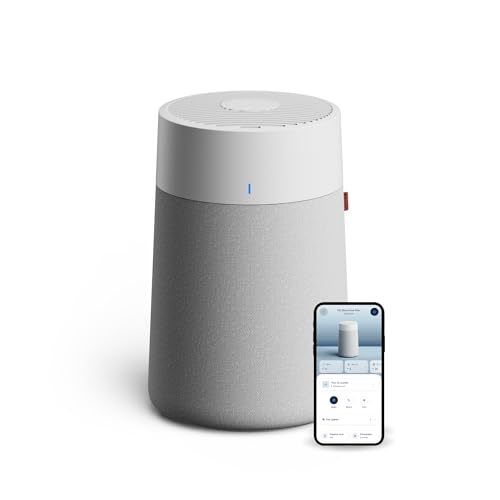
Blueair Blue Pure 511i Max — Quietest Night Shift
Studios collapse the distance between purifier and pillow to almost nothing, and that is the room this Blueair was born for. Its party trick is hush: the night mode is engineered to run at a whisper, and the brand’s HEPASilent approach blends electrostatic and mechanical capture so the fan does not need to work as frantically to move cleaned air. Quoted coverage reaches 1,138 square feet, which in a 500 square foot studio means the machine can hold the room on gentle settings through the night and still have a higher gear in reserve for the evening you burn toast or the afternoon pollen pours through a cracked window.
Intake wraps the body, so air arrives from every direction and placement becomes forgiving in the way small-space dwellers need: tucked beside a dresser, angled in the corner by the door, it still breathes. The fabric pre-filter doubles as the machine’s face, catching the lint and hair that studios generate from bedding and clothing in one shared space, and it can be cleaned rather than immediately replaced. App control and auto mode round out a package aimed squarely at renters who want the purifier to disappear into the background of a room that already contains their whole life, only noticing it on the mornings the air feels plainly fresher.
- Filtration: HEPASilent particle capture with fabric pre-filter
- Coverage anchor: brand figures reach 1,138 square feet
- Controls: auto mode, app connection, dedicated night setting
- Placement: intake from all sides for tight corners
Strengths
- Night running is calm enough for light sleepers
- Fabric pre-filter handles studio lint gracefully
- Compact footprint respects scarce floor space
Trade-offs
- Odor handling is lighter than deep-carbon rivals
- Fabric cover needs regular cleaning to stay effective
- Premium positioning within this group
Best for: studios and bedrooms where the purifier sleeps beside you. Not suited for: odor-heavy rooms near busy kitchens.
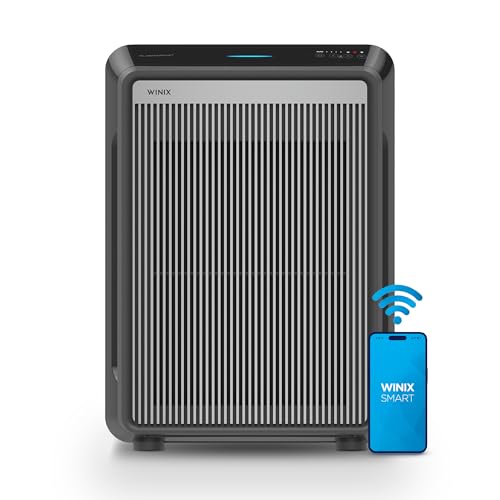
Winix 9800 — Best Connected Classic
If the D480 is the purist’s answer, the 9800 is the same family thinking dressed for a connected living room. It is a four-stage tower rated for 500 square feet, which places it squarely on target without the oversizing argument, and the black finish disappears against media consoles and dark shelving in a way white boxes never quite manage. Four stages here means the usual progression done thoroughly: pre-filter for the coarse load, carbon for household smells, true HEPA for the fine fraction, and PlasmaWave as the switchable finishing stage for households that want it.
Wi-Fi is the real differentiator from its sibling. Schedules, remote speed changes, and filter-life awareness live in the app, so the tower can be told to work hard during the hour before everyone gets home and idle politely during film night. In a den or family room that doubles as a guest space, that remote flexibility earns its keep weekly. Tower proportions also matter in this room size: the footprint stays narrow while the outlet throws cleaned air upward and outward, circulating a long room better than a squat box parked at one end. Choose it over the D480 when the room is social, dark-finished, and run from the sofa.
- Filtration: four stages including true HEPA and carbon
- Coverage anchor: rated for 500 square feet
- Controls: Wi-Fi app control plus onboard panel
- Form: slim black tower for living room placement
Strengths
- On-target rating with full smart control
- Finish blends with entertainment furniture
- Tower airflow suits long, narrow rooms
Trade-offs
- App setup is one more account in your life
- Dark finish shows pale dust between cleanings
- Carbon depth still trails the Medify for smoke
Best for: connected living rooms and dens with dark furniture. Not suited for: anyone who wants zero apps involved.

Medify MA-40 — Best for Smoke and Odors
Every group needs a heavy lifter, and the MA-40 lifts with both hands. Medify quotes coverage of 1,793 square feet in an hour, figures that translate in your 500 square foot room to rapid recovery: the evening a neighbor’s bonfire drifts through the screens, the afternoon a cast-iron pan smokes out the kitchenette, the week wildfire haze settles over the neighborhood. Where gentler machines need an hour to restore the room, this one treats the same job as a short assignment, then settles back to a maintenance speed with capacity to spare.
The build favors function over furniture-blending, with a substantial filter and a control scheme meant to be used rather than admired. Touch controls, a timer, and a child lock cover the household basics, and the unit’s confidence with smoke and odor work comes from moving a lot of air through a lot of filter media rather than from any exotic stage. In a basement den with a wood stove nearby, a workshop-adjacent hobby room, or a rental where previous tenants smoked, that blunt capability is worth more than elegance. It is the pick for rooms whose air problems arrive in events rather than as a gentle constant background.
- Filtration: high-volume HEPA filtration aimed at smoke and odor events
- Coverage anchor: brand quotes 1,793 square feet in one hour
- Controls: touch panel, timer, child lock
- Character: substantial unit prioritizing throughput
Strengths
- Fastest recovery after smoke or cooking events
- Generous headroom keeps maintenance speeds moderate
- Straightforward controls, nothing precious
Trade-offs
- Larger presence than suite-oriented rivals
- Top speeds are purposeful rather than quiet
- Fewer smart features than the Levoit or Winix 9800
Best for: dens, smoky neighborhoods, and event-driven air problems. Not suited for: minimalist rooms where the appliance must vanish visually.
How Do the Six Compare Side by Side?
| Model | Coverage anchor | Standout trait | Watch out for |
|---|---|---|---|
| Winix D480 | Verified 480 sq ft | Honest on-target rating | No app control |
| Coway Airmega 150 | Up to 1,035 sq ft | Washable pre-filter, calm auto | Combined pack replacement cost |
| Levoit Core 400S | Beyond this room size | Smart oversizing, schedules | App needed for full value |
| Blueair Blue Pure 511i Max | Up to 1,138 sq ft | Hushed night running | Lighter odor capacity |
| Winix 9800 | Rated 500 sq ft | Connected black tower | Shows dust on dark finish |
| Medify MA-40 | 1,793 sq ft per hour claim | Smoke event recovery | Biggest visual presence |
How Much Clean Air Does a 500 Square Foot Room Actually Need?
Think in air changes rather than square feet alone. A useful target for a lived-in room is cycling the full volume through the filter several times each hour, which steadily dilutes whatever cooking, breathing, pets, and the outdoors contribute. Ceiling height quietly rewrites the math: a loft-style 500 square feet under tall ceilings holds far more air than the same footprint under a standard eight-foot lid, so loft owners should lean toward the oversized picks or accept higher everyday speeds. Open doorways do something similar, effectively annexing the hallway and the next room into your purifier’s workload whether you planned that or not.
This is also where the verified-versus-advertised distinction stops being academic. A machine verified for a room near yours has demonstrated delivery under a recognized method, while a machine merely advertised for a huge area may reach that figure only at a speed you will refuse to use during dinner. Read every coverage claim by asking at what setting, over what period, and by whose measurement. When those answers are missing, treat the number as a ceiling on possibility rather than a promise, and lean on the headroom strategy: buy capacity above the room, run it below its limit, and enjoy the quiet that arithmetic buys you.
Where Should the Purifier Stand in a Room This Size?
Placement is free performance. Give the intake clearance on every side the design expects, keep the outlet unobstructed, and resist the urge to shove the unit into the dead corner behind the sofa where air barely circulates. A spot along the room’s natural traffic path, near the door or between the seating and the kitchenette, intercepts particles while they are still airborne and traveling. In a suite, favor the sleeping zone over the sitting zone if you must choose, because the hours you spend breathing in one place are longest in bed. In a studio, a position roughly central along the longest wall usually beats either end of the room.
Height and habits matter too. Most of these machines are designed for the floor and perform best there, pulling from the zone where dust resettles and dander drifts. Keep the purifier running when the room is empty as well as occupied; particles do not schedule themselves around your presence, and a machine that only works during waking hours spends every morning catching up on yesterday’s accumulation. Finally, close the door when you can during high-pollen or smoky days. A purifier defending a sealed 500 square feet will always beat the same machine heroically defending the entire floor of a house through an open doorway.
What Does Owning One of These Cost in Effort Over a Year?
The purchase is the easy part; ownership is filters, minutes, and habits. Budget for the main filter replacement on the maker’s schedule, which for most of this group means roughly annual under ordinary conditions and sooner in smoky or very dusty homes. Pre-filters ask for a vacuum or a rinse every few weeks, a five-minute job that protects the expensive element behind it. Wipe the sensor lens if your model has one, keep the exterior vents dusted, and check that the intake has not slowly been colonized by curtains, throws, or a creeping pile of magazines, which happens in real rooms more often than anyone admits.
Energy use at the middle speeds these machines will actually live on is modest, comparable to a lamp or a small fan rather than to anything with a heating element, and running continuously at a gentle setting generally serves the room better than blasting intermittently. The habit worth building is a seasonal review: at each filter check, ask whether the room’s life has changed. A new dog, a home office that moved in, a smoker who quit, a baby on the way: each shifts what you need from the machine, and the right answer may be a speed change, a relocation, or eventually a different pick from this very list rather than a second unit bought in a panic.
What Mistakes Do People Make When Buying for 500 Square Feet?
The classic error is trusting the largest coverage number on the page and ending up with a machine that must run loudly to do its job, then turning it down, then concluding that purifiers do not work. The second error is the opposite romance: buying a tiny desktop unit because it is cute and cheap, and asking it to defend a family room. Both failures come from shopping by headline instead of by delivered air at a livable speed. A third mistake is sealing the purifier’s fate with placement, wedging it between furniture where its intake starves, or parking it in the hallway to serve two rooms and watching it serve neither properly.
Filter neglect ruins more ownership stories than any defect. A clogged pre-filter strangles airflow, a spent main filter passes its best work behind it, and the machine keeps humming reassuringly while doing less each month. Mark replacement dates somewhere you will actually see them. People also forget the sources: a purifier cannot outrun a constantly open window on a high-pollen day, a litter box that needs changing, or a damp corner quietly feeding mustiness into the room. Treat the machine as one part of how the room is kept, alongside ventilation judgment and ordinary housekeeping, and it will reward you. Expect it to compensate for everything, and no model on this page can save the experiment.
How Does a 500 Square Foot Room Behave Differently From a Bedroom?
Bedrooms forgive weak purifiers because the sleeper stays in one place, the door closes, and the air volume is modest. A 500 square foot multipurpose room offers none of that mercy. People cross it constantly, stirring settled dust back into the breathing zone with every trip to the kitchenette. Exterior doors open onto porches and garages. A sofa, rug, curtains, and upholstered chairs form a reservoir of fabric that collects particles all day and releases them whenever someone sits down hard or a child launches onto the cushions. The purifier in such a room is not polishing still air; it is working against continuous resuspension, which is why delivered volume at a tolerable speed matters more here than any laboratory capture percentage.
The room also changes personality across the day. Morning might mean exercise on a mat in the corner, midday a laptop call at the table, evening cooking steam and a dog shedding through its post-walk shake. Each activity injects a different mix into the air, and a machine with a responsive auto mode, like the Coway or the Levoit in this group, effectively changes jobs with the room. A fixed-speed purifier can still succeed, but its owner becomes the sensor, raising the fan before guests arrive and lowering it when the film starts. Neither approach is wrong; they simply suit different temperaments, and recognizing your own temperament before buying prevents the common regret of owning a capable machine whose controls annoy you daily.
Furniture layout quietly decides circulation quality as well. Long rooms develop dead zones at the far end from a purifier parked by the door, and tall bookcases split one space into two informal air districts. In those layouts the tower format of the Winix 9800, throwing cleaned air upward where it can travel and mix, often evens things out better than a low box. Compact square rooms are kinder: almost any pick here, placed along a wall with clearance, will establish a gentle circuit that eventually brings most of the room’s air through the filter. Walk your room’s shape honestly before ordering, because the best placement is the one your furniture actually permits.
What Should You Check During the First Week of Ownership?
Treat the first week as a commissioning period rather than a verdict. Start by running the machine harder than you expect to need, a day or two at a strong setting while you are out or able to tolerate the sound, to pull down the backlog of dust that has been circulating and settling long before the purifier arrived. Then step down to the speed you plan to live with and notice the room at the times it usually bothers you: waking, cooking, returning from work. Dust behavior on dark surfaces is a surprisingly honest progress report, as is how often you reach for a tissue during a long evening on the sofa.
Check the sensor’s story against your own senses if your model displays air quality. Readings that spike when you vacuum, shake a rug, or open the door on a breezy day are behaving sensibly; a display that never changes at all deserves suspicion, and the manual’s cleaning instructions for the sensor window deserve a look. Listen at night from where you actually sleep, not from beside the machine at noon, because a household’s background noise collapses after dark and a hum that seemed trivial in daylight can become the room’s loudest citizen at two in the morning. Studios especially should run this test before the return window closes.
Also confirm the practical geography: the cord reaches without crossing a walkway, the filter door opens fully where the unit stands, and nobody in the household has started switching it off because it is in their way. A purifier that gets unplugged for vacuuming and forgotten is a common silent failure. If the first week reveals the machine is slightly undersized for your ceiling height or your open doorway, the fix is usually behavioral before it is financial: close the door during the hours that matter, move the unit toward the occupied zone, and reserve high speed for event recovery. Only when those adjustments still leave the room stale should a stronger model enter the conversation.
How Do Seasons Change What This Room Needs?
Spring loads a mid-size room with pollen every time a window opens for the first mild evening, and households in tree-heavy neighborhoods feel the difference within days. During those weeks the purifier earns its keep by running steadily with windows managed deliberately: air the room briefly if you must, then close up and let the machine restore the interior while the outdoor count stays high. The Blueair and Coway picks, calm at continuous low speeds, are particularly well suited to this season-long background duty.
Summer brings humidity, closed windows, and air conditioning competing for the same air. A purifier does not dry the room, so a musty note that persists despite diligent filtering points at moisture, and moisture points at a source worth finding: a slow leak, a bathroom fan that vents poorly, a basement wall wicking groundwater. Autumn reverses the problem toward dust and the first heating days, when ducts and radiators wake up carrying a summer’s accumulation and the initial week of furnace or baseboard use smells faintly of warm dust no matter how clean the house is. Winter adds wood smoke in many neighborhoods, sealed windows, and long indoor hours, which is when the Medify’s event recovery and the Winix models’ carbon stages justify their existence. Reading your room seasonally turns one purchase into four smaller strategies, each already covered by the same machine.
When Is a Second, Smaller Unit Better Than One Big One?
Sometimes the honest answer for 500 square feet is not a stronger single machine but a division of labor. If your space is really a bedroom joined to a study by a wide opening, and the two halves keep different hours, one purifier will always be compromising: close enough to the bed to serve sleep, too far from the desk to help during work. A mid-size main unit for the sleeping half paired with a compact desktop machine at the desk can serve both zones at their moments of need for less total noise than one giant running hard enough to reach everywhere. The picks in this guide were selected as single-unit answers, yet several households will recognize their floor plan in this exception.
The reverse trap also exists: two weak units bought cheaply, each unable to establish real circulation in its half, humming away in permanent inadequacy. Division only works when each zone’s machine is honestly sized for that zone at a livable speed. Do the same skeptical arithmetic per half that this guide applied to the whole room, respect verified figures over headline numbers, and keep each unit inside the zone it serves with its door or opening managed sensibly. Done that way, splitting the problem is not a compromise at all; it is simply admitting that air, like light, is local, and the rooms we live in rarely behave as one perfect box.
How Should Pet Owners Judge These Six Differently?
A dog or cat rewrites the particle budget of a mid-size room completely. Hair itself is coarse and mostly settles, but dander rides the air for hours, and the constant small disturbances of animals moving, scratching, and claiming furniture keep material aloft far longer than in a pet-free home. For pet households the pre-filter stops being a minor accessory and becomes the hardest-working component in the machine: it intercepts the visible load before the fine filter has to, and a washable or easily vacuumed pre-filter, like the Coway’s, turns a weekly two-minute rinse into real money saved across years of ownership. Placement also shifts; put the purifier near the animal’s favorite territory rather than near your own chair, because capturing material close to its source beats chasing it after it has toured the whole room.
Odor is the second pet tax, and carbon depth decides how gracefully a machine pays it. Litter areas, feeding corners, and the warm smell of a dog after rain all respond to steady air exchange through a carbon stage, though none of these machines will rescue a litter box that is overdue for attention. Pet owners should also plan filter intervals pessimistically: whatever the standard schedule says, a two-pet household in a carpeted room should inspect early the first year and learn its own rhythm, since a filter loaded with hair and dander loses efficiency in ways a calendar cannot predict. Among this six, the Coway’s washable front end, the Levoit’s pet-aware positioning, and the Medify’s sheer throughput give animal households three distinct but credible answers.
What About Renters, Landlords, and Rooms You Cannot Modify?
Rental living imposes its own specification sheet: nothing wall-mounted, nothing that risks a deposit, nothing so loud that a downstairs neighbor complains through the floor, and ideally nothing that will be awkward to move when the lease ends. Every pick here is a freestanding appliance, which is precisely why this category suits renters better than any installed solution. The practical rental checks happen before purchase: measure the floor corner you truly have, confirm an outlet exists within cord reach without an extension lead snaking across the room, and think about the move in twelve or twenty-four months, when a mid-size unit that one person can carry downstairs will be a blessing you gave your future self.
Renters also inherit other people’s air history: previous cooking habits soaked into a kitchenette, a prior tenant’s smoking in defiance of the lease, carpeting of unknown age. A purifier cannot rewrite any of that, but a strong carbon stage and a few weeks of determined running can make a surprising dent in the lived-in smell of a new place, especially combined with the deep clean every tenancy change deserves. Keep the original box if storage allows; it protects the machine in transit and keeps filters and manuals together. And because rental rooms often double as everything, prioritize the picks whose night behavior you can sleep beside, since in a studio there is no spare room to exile a droning appliance to.
How Do You Keep the Room Feeling Clean Between Filter Changes?
A purifier works on what floats, and the household controls how much material gets the chance to float. Hard floors swept or vacuumed with a well-sealed machine surrender far less dust to the air than carpet beaten by an old vacuum with a leaking body, so the purifier’s job quietly depends on its cleaning companions. Soft furnishings deserve a rhythm too: throws and cushion covers washed on a cycle, curtains vacuumed with an upholstery tool when the seasons turn, the rug taken outside for a proper shake on a dry day if its size allows. None of this is purifier advice exactly, yet owners who do these things consistently report the machine’s sensor calmer and its filters aging more gracefully, because less material ever reaches the intake.
Ventilation judgment is the other half of the partnership. Fresh air is genuinely good, and a room sealed forever against the outdoors trades one problem for stuffiness of another kind. The skill is timing: open windows when outdoor air is at its best, early on a still morning after rain, and keep them closed during the smoky, high-pollen, or traffic-heavy hours when the street is exporting its worst into your living space. On those closed days the purifier carries the whole load, which is another argument for the headroom strategy running quietly through this entire guide. Cook with a lid and the hood when you have one, shake bedding near an open window rather than beside the bed, and let the machine finish each job you start. Household habits and hardware multiply each other; neither reaches its best alone.
Finally, pay attention to the small signals the room sends across months. A windowsill that stays cleaner between dustings, a guest who no longer sneezes through board-game night, the dog’s corner smelling like dog only faintly instead of announcing itself at the door: these are the unglamorous metrics by which a purifier actually proves itself. Photograph the pre-filter at each cleaning for a season if you want evidence; the declining load surprises most owners. The goal was never a laboratory reading. It was a room that stops asking to be thought about, and that is achievable in 500 square feet with any of these six, run patiently and kept honestly.
One last calibration before you decide: measure your room rather than trusting the listing description or the landlord’s brochure, because advertised square footage often includes closets, bathrooms, or a hallway nook your purifier will never meaningfully serve. Length times width for the space you actually sit and sleep in gives the working figure, and if that number lands nearer four hundred than five, the on-target picks gain breathing room while the oversized models become quieter still. If it lands nearer six hundred because the kitchenette truly shares the air, lean the other way and let capacity win the argument. Honest measurement takes two minutes with a tape and settles arguments that weeks of review-reading cannot.
And if two households read this same guide and choose differently, both can be right, because the room on paper is identical while the lives inside it are not: one cooks nightly and keeps a shepherd dog, the other orders in and travels for work. Match the machine to the life first and the floor plan second, and the purchase tends to age well.
Final Recommendation
Start with the Winix D480 if your room is a straightforward 500 square feet and you value a rating that tells the plain truth about fit. Choose the Coway Airmega 150 when that space includes your bed and you want calm, washable-pre-filter ownership, and take the Levoit Core 400S when you would rather oversize deliberately and let schedules and sensors run the show quietly. The Blueair Blue Pure 511i Max belongs beside light sleepers and studio dwellers, the Winix 9800 in connected living rooms with long layouts, and the Medify MA-40 wherever smoke and odor arrive in waves that need answering quickly.
Whichever you pick, commit to the unglamorous half of ownership: sensible placement, doors managed on bad-air days, pre-filters cleaned, and main filters replaced on time. Do that, and a room this size becomes the easiest kind to keep feeling fresh, because it is large enough to matter and small enough for one good machine to genuinely master. In a 500 square foot room, the right purifier does not announce itself; it simply makes the air stop being something you notice at all.
Frequently Asked Questions
Can one purifier really handle a 500 square foot room alone?
Yes, provided the machine’s honest delivery matches the space and the door stays mostly closed. Every pick here was chosen with that single-unit job in mind. Rooms with tall ceilings, wide-open connections to other spaces, or heavy smoke loads may still justify oversizing, which is why the stronger Levoit and Medify models appear alongside the on-target Winix units.
Should I run the purifier all day or only when I am home?
Continuous gentle running usually wins. Particles accumulate around the clock from fabrics, pets, and outdoor air leaking in, and a machine that never stops never falls behind. Use auto mode if your model has a trustworthy one, or hold a middle speed during occupied hours and a lower setting overnight in rooms where people sleep.
Does a higher coverage rating always mean cleaner air?
No. A rating describes capacity under particular test conditions, often at maximum speed. What reaches your lungs is delivered air at the speed you tolerate, filtered well and circulated sensibly. A verified mid-size rating used fully will outperform an inflated large rating throttled down to a whisper for the sake of quiet.
How often will I replace filters in a room this size?
Expect the main filter to last roughly a year in typical conditions for most picks here, with pre-filters cleaned every few weeks along the way. Smoky neighborhoods, shedding pets, and renovation dust all shorten that interval. Indicators help, but a calendar note at purchase time is the backup that never fails.
Will a purifier help with cooking smells in a studio?
It will reduce them noticeably, especially models with meaningful carbon capacity, though no purifier erases a strong cooking session instantly. Ventilate with a window or hood while cooking when conditions allow, then let the purifier finish the job. The Medify and the two Winix models are the strongest odor hands in this particular six.
Related Guides
Still narrowing things down? Readers comparing rooms and budgets also work through Best Affordable Air Purifiers for Mold and Dust, weigh combined cooling and cleaning in Best Air Purifiers and Fans, and tackle a tougher odor problem in Best Air Purifiers for Cigarette Smoke.


