What's inside
- Where to buy these picks
- Quick Picks
- How these picks were chosen
- Rustic vanities compared at a glance
- Which rustic vanity belongs in your bathroom?
- Living with barn doors in a damp room
- Lighting, mirrors and the vanity as a system
- Planning the swap: a weekend vanity replacement without tears
- Rustic brown among other finishes: pairing the room
- Taps, wastes and the plumbing questions to ask before delivery
- Small bathrooms: making thirty inches work like forty
- The morning after installation: living with the choice
- What rustic is not: keeping the style honest
- Budgeting the whole job, not just the cabinet
- Drawers versus doors: an honest storage argument
- Ventilation: the invisible fitting every rustic cabinet needs
- Common mistakes
- Final recommendation
- Frequently asked questions
As an Amazon Associate I earn from qualifying purchases. This post may contain affiliate links at no extra cost to you.
As an Amazon Associate, cottageverdict.com earns from qualifying purchases.
A rustic bathroom succeeds or fails at the vanity, because that one cabinet carries the room’s storage, its sink and most of its visual weight in a single footprint. The best rustic bathroom vanities gathered here all speak the farmhouse dialect fluently: sliding barn doors, rustic brown finishes, vessel and deep-basin sinks, drawers that promise order for towels and bottles. Yet beneath the shared vocabulary their sizes run from 30 inches to a full 48, their mounting splits between freestanding cabinets and one wall-mounted floating design, and their extras range from LED lighting and side hooks to soft-closing doors and an included faucet and drain.
That spread is the point of this guide. A 30-inch vanity is a small-bathroom instrument where every drawer must justify itself, while a 48-inch unit is a family-bathroom workhorse whose sliding doors and deep basin serve several people in rotation. Buyers should therefore start with the tape measure, continue with the plumbing position, and only then fall for a finish, because rustic brown looks equally handsome on a cabinet that fits and a cabinet that blocks the bathroom door’s swing.
Every fact below comes from the maker’s own listing: sizes, door styles, drawer counts, shelf arrangements, countertop materials where named, and fittings where included. Where a listing stays silent about a faucet, a material or a mounting detail, the review says so, because a vanity is plumbed into a home for years and deserves more honesty at purchase than a kettle does.
Read the six with a tape measure in one hand and your bathroom’s storage sins in mind, and the ordering will start to feel less like a ranking and more like a diagnosis.
Bring the room’s measurements to the reviews rather than the other way round, because a cabinet chosen for a real wall will always outperform a cabinet chosen for an imagined one, however beautiful the imagined one may be in photographs online today entirely now.
Where to buy these picks
The six rustic cabinets, in review order, run as follows.
Concho’s 30-inch farmhouse model leads with theatre: a tempered vessel sink, LED light, sliding barn door, three drawers and side hooks for organisation.
LUXOAK’s 30-inch barn door cabinet in brown keeps things grounded, freestanding with drawers, metal handles and a reclaimed barnwood character.
AMERLIFE stretches to 48 inches, the group’s family size, with sliding barn doors, drawers and a deep basin in rustic brown.
DELUXE LIVING’s 30-inch entry specifies a durable SMC resin countertop, three full-extension drawers and an open storage shelf.
YOURLITE’s 36-inch farmhouse cabinet adds soft-closing doors, four drawers, an adjustable shelf and a faucet and drain in the box.
DWVO’s 36-inch LED model breaks the pattern as a wall-mounted floating cabinet with a sliding barn door. Renovators who prefer to choose their own finish entirely should also read Best Unfinished Bathroom Vanities before committing.
Widths, doors and inclusions are compared in a table further down for readers who prefer their shortlist in columns rather than paragraphs.
Quick Picks
| Pick | Best for | Highlight from the listing |
|---|---|---|
| Concho 30 Farmhouse Vessel Sink | Small bathrooms wanting drama | Vessel sink, LED light, barn door, 3 drawers, side hooks |
| LUXOAK 30 Barn Door Brown | Purists of the barnwood look | Freestanding, reclaimed barnwood character, metal handles |
| AMERLIFE 48 Farmhouse Rustic Brown | Family bathrooms needing width | 48 inches, sliding barn doors, deep basin, drawers |
| DELUXE LIVING 30 Rustic Brown | Order lovers wanting full-extension drawers | SMC resin countertop, 3 full-extension drawers, open shelf |
| YOURLITE 36 Farmhouse Rustic Brown | Buyers wanting fittings included | Soft-closing doors, 4 drawers, faucet and drain included |
| DWVO 36 LED Farmhouse Barn Door | Fans of floating cabinets | Wall mounted, LED, sliding barn door, 36 inches |
How these picks were chosen
Size came first, because vanity shopping without a width is interior decoration fan fiction. The set deliberately spans 30, 36 and 48 inches so that small, medium and family bathrooms each find a native candidate, and the reviews judge storage and presence relative to footprint rather than crowning the largest cabinet by default.
The rustic brief had to be explicit in each title: farmhouse naming, barn doors, reclaimed barnwood character or a rustic brown finish stated outright. Cabinets that merely wore a brown colour while speaking a modern design language were set aside, because a buyer searching this category wants the farmhouse grammar of doors, hardware and texture, not a tint.
Storage architecture was mapped from the listings: drawer counts of three and four, adjustable shelves, open shelving, side hooks and soft-closing doors all appear in different combinations, and each combination suits a different household’s clutter. A vanity is a storage machine wearing a sink, so those details earned as much weight as the finishes that dominate the photographs.
Finally, completeness of the package was recorded without assumption. A vessel sink is named on the Concho, a countertop material on the DELUXE LIVING, a faucet and drain on the YOURLITE, LED lighting on Concho and DWVO, and mounting style on all six, freestanding five times and wall-mounted once. Anything not named was treated as not included, the only safe way to budget a bathroom.
One further filter deserves stating: each cabinet had to make sense as the only vanity in its bathroom. Features that only shine in a showroom photograph, without storage, mounting or completeness logic behind them, were treated as decoration and given no weight in the ordering.

Concho 30 Farmhouse Vessel Sink
Concho packs more incident into 30 inches than any rival here, and the result is a small-bathroom vanity with genuine theatre. A tempered vessel sink sits proudly on top rather than hiding in the counter, an LED light is built into the proposition, and the sliding barn door below keeps the farmhouse story unmistakable. Three drawers, an adjustable shelf and side hooks for organisation complete a specification that reads like a designer squeezed a boutique hotel’s checklist into a cottage footprint.
The vessel sink is the decision point. Vessel bowls look sculptural and keep the counter’s wood-look surfaces visible, yet their raised rim means water lands from a greater height and splashes more willingly, a behaviour households with small children or enthusiastic face-washers should weigh honestly. Adults in a guest bathroom or an ensuite will mostly enjoy the drama; a family bathroom at school-run pace may prefer the deep basin of the AMERLIFE.
- Width: 30 inches
- Sink: tempered vessel sink included
- Lighting: LED light included
- Storage: 3 drawers, adjustable shelf, side hooks
- Door: sliding barn door, rustic brown
Strengths
- Vessel sink and LED light give a small room a boutique moment
- Side hooks put towels and tools on the cabinet, not the floor
- Three drawers plus a shelf organise a compact footprint properly
Trade-offs
- Vessel sinks splash more readily than inset basins for children
- LED adds wiring considerations a plain cabinet avoids
- Barn door needs clear side travel space to slide fully
Side hooks are the detail owners will praise in month six. Towels, a hairdryer on its cord, a wash bag: the hooks give the bathroom’s wandering objects a legal home on the cabinet itself, which keeps a 30-inch footprint from exporting clutter onto every other surface in a small room. Combined with three drawers, the storage plan here is the most inventive in the group relative to size.
LED lighting introduces the practical footnote of power. A lit vanity needs an electrical plan, whether that is an existing socket in the right place or an electrician’s visit folded into the renovation budget, and renters should register that before falling for the glow. The barn door, meanwhile, needs lateral clearance to travel, so measure the wall beside the cabinet as carefully as the cabinet itself.
Concho is the small-bathroom showpiece of this set: the pick for a guest bathroom that should impress, an ensuite that deserves a moment, or a compact cottage bathroom where one beautiful object must carry the whole room. It asks for splash tolerance and a power plan, and it returns more character per inch than anything else here.
Best for: guest bathrooms and ensuites where a vessel sink and LED glow should carry a compact room.
Not suited for: a high-speed family bathroom with small children, because a raised vessel bowl invites splashing and the LED wiring adds a project a plain cabinet avoids.
See the Concho vessel sink arrangement

LUXOAK 30 Barn Door Brown
LUXOAK’s 30-inch cabinet is the rustic purist’s entry, built around a phrase the other listings circle but never quite say: reclaimed barnwood. The maker presents that character directly, and in a category where rustic can mean a printed texture, the promise of barnwood personality, knots, grain variation and all, is the reason this cabinet exists. It stands freestanding in brown, with a single sink, drawers and metal handles, asking for no wiring, no wall fixing and no assembly of extras.
Freestanding matters more than its familiarity suggests. A floor-standing cabinet can be positioned, levelled and plumbed with the fewest surprises, moved if the bathroom is ever remodelled, and replaced without repairing a wall. For cottages with uneven floors and older plumbing, that forgiving format is often worth more than a floating silhouette, and it suits the barn-door aesthetic’s own honest, movable-furniture roots.
- Width: 30 inches, freestanding
- Sink: single sink included
- Storage: drawers with metal handles
- Character: reclaimed barnwood, per the maker
- Mounting: floor-standing cabinet
Strengths
- Reclaimed barnwood character gives the most authentic rustic story here
- Freestanding format simplifies placement and plumbing access
- Metal handles promise a sturdy grip for daily drawer work
Trade-offs
- Drawer count is not numbered in the title
- No shelf or lighting extras are named
- Single 30-inch width serves small rooms only
Storage is described in general terms: drawers, with metal handles whose material at least promises a confident pull across years of damp-handed mornings. The title does not number the drawers or name a shelf, so households with elaborate storage plans should study the full listing’s interior photographs rather than assume a layout. What is promised is a small bath storage vanity, and its brief is compact order rather than maximal capacity.
Brown as a finish is the safest rustic choice in the group, warm against white sanitaryware and forgiving of water marks between cleans. The barn door slides across the front in the farmhouse manner, so the same lateral clearance advice applies as with the Concho: picture the door’s travel before the cabinet is fixed in place, especially in a bathroom where a towel rail or a door swing shares the wall.
LUXOAK suits the buyer who wants the rustic story told straight: real barn character, a freestanding body, a sink included and no electronic garnish. It is the least theatrical and arguably the most timeless cabinet here, the one least likely to date as bathroom fashions turn.
Best for: rustic purists wanting reclaimed barnwood character in a freestanding 30-inch cabinet with a sink included.
Not suited for: a storage-maximising household that needs a numbered drawer plan confirmed, since this title describes drawers without counting them or naming shelves.
View the LUXOAK barnwood finish
AMERLIFE 48 Farmhouse Rustic Brown
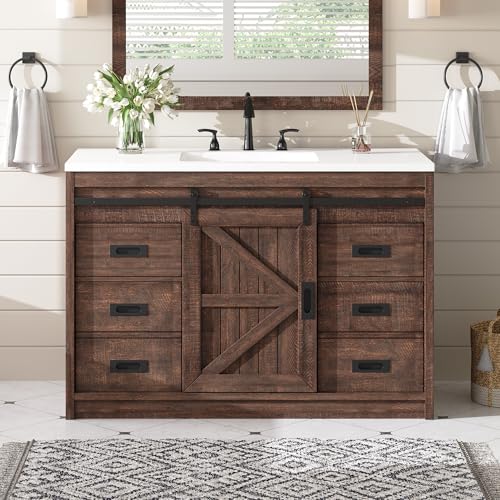
AMERLIFE builds the group’s family instrument, a 48-inch freestanding vanity in rustic brown whose sliding barn doors and deep basin are scaled for households rather than individuals. Width changes everything in a bathroom: two people can stand at a 48-inch cabinet without negotiation, toiletries stop competing for a single shelf edge, and the room gains a piece of furniture with the presence to anchor a larger space rather than apologise in its corner.
The deep basin is the quietly heroic feature. Family washing is splashy washing, children, shaving, hair rinsing and all, and depth is what keeps that water in the sink rather than on the cabinet front and the floor. Paired with drawers and the maker’s claim of spacious storage, the AMERLIFE reads as a cabinet designed by someone who has watched a household actually use a bathroom across a school morning.
- Width: 48 inches, freestanding
- Sink: deep basin included
- Doors: sliding barn doors, plural
- Storage: drawers plus spacious storage claim
- Finish: rustic brown
Strengths
- 48-inch width serves family bathrooms and shared mornings
- Deep basin contains the splashes of busy washing
- Barn doors plural suit a wide cabinet’s symmetry
Trade-offs
- 48 inches will overwhelm a small bathroom’s proportions
- Basin count and faucet inclusion are not detailed in the title
- Wide freestanding cabinets need two people to position safely
Sliding barn doors on a wide cabinet carry a practical advantage beyond style: they never swing into the room, so a person standing at the basin is never dodging a door, and a laundry basket parked in front does not block access to the cabinet’s interior. On a 48-inch unit with doors in the plural, that access pattern shapes daily life more than any finish could.
Scale brings duties. A 48-inch freestanding cabinet is a two-person lift and a careful journey through doorways, and its width must be checked against the room’s door swing, bath length and the walkway that remains once it stands in place. The title does not detail basin count or faucet inclusion, so planners should confirm both on the full listing before the plumbing is roughed in around assumptions.
For the main family bathroom of a farmhouse-style home, this is the natural centrepiece of the six, and the only one whose width changes what the room can do. Households planning a full renovation around it might also size up Best Thirty Inch Electric Cooktops for the kitchen end of the project.
Best for: family bathrooms with the width to use 48 inches and the traffic to need a deep, splash-containing basin.
Not suited for: a compact ensuite, where 48 inches would consume the walkway and turn a rustic statement into a daily obstruction.
Check the AMERLIFE 48-inch dimensions

DELUXE LIVING 30 Rustic Brown
DELUXE LIVING’s 30-inch cabinet makes its argument in the drawers. Three full-extension drawers are specified, and that phrase matters: a drawer that pulls out its entire depth ends the archaeological era of bathroom storage, where bottles migrate to a dark rear zone and are bought twice because nobody can see them. Add an open storage shelf for towels and a countertop whose material is actually named, durable SMC resin in the maker’s words, and this becomes the engineer’s favourite in a style-led category.
The open shelf divides households neatly. Towel-stacking families who like their linens visible, aired and reachable will call it the best feature on the page; families whose bathroom reality includes tangled cables and half-used bottles will see a display shelf for their disorder. Neither is wrong, and the honest buyer should picture their own objects on that shelf before ordering, not the listing’s styled ones.
- Width: 30 inches
- Countertop: durable SMC resin, per the maker
- Drawers: 3 full-extension drawers
- Storage: open storage shelf
- Assembly: described as easy by the maker
Strengths
- Full-extension drawers expose their whole depth, ending lost bottles
- Named countertop material gives a durability claim to judge
- Open shelf keeps towels visible, aired and grabbable
Trade-offs
- Open shelving displays clutter as faithfully as it displays towels
- Sink style is not characterised beyond inclusion
- No doors means no hidden zone for medicines or chemicals
An SMC resin countertop brings a practical promise to a rustic cabinet: a hard, wipeable, water-tolerant surface that shrugs off the toothpaste and soap assault a wooden top would absorb. In a farmhouse scheme it keeps the rustic story in the cabinet body while the working surface stays modern and maintainable, a division of labour many renovators actively seek.
Easy assembly is the maker’s claim, welcome in a category where flat-pack dread is real, though buyers should still budget an unhurried afternoon and a second pair of hands for the sink stage. The listing names a sink’s inclusion without characterising its style, so vessel-versus-inset preferences should be confirmed on the full listing before this cabinet is matched against the Concho’s stated vessel drama.
DELUXE LIVING suits the organised mind in a rustic room: full-depth drawers, an honest countertop and towels on open display. It trades the barn-door theatre of its rivals for storage mechanics, and households who open drawers more often than they admire doors will rank it first.
Best for: organised households wanting full-extension drawers and a named resin countertop in a 30-inch rustic cabinet.
Not suited for: a household needing lockable or hidden storage for medicines, because an open shelf and doorless design put everything on view.
Inspect the DELUXE LIVING drawer layout

YOURLITE 36 Farmhouse Rustic Brown
YOURLITE’s 36-inch farmhouse cabinet is the completeness champion of this group, the one listing that names a faucet and drain among its contents. That inclusion changes the buying experience entirely: no separate tap hunt, no thread-matching anxiety, no second delivery to wait for while the bathroom sits unfinished. Two soft-closing doors, four drawers, an adjustable shelf and a metal handle complete a specification that reads like a checklist written by a renovator who has been burned before.
Soft-closing doors deserve their headline. In a shared house, the bathroom cabinet is opened at hours when half the occupants are asleep, and a door that glides shut in silence is a daily kindness disguised as a hinge specification. Four drawers, the most in this group, let a couple divide territory drawer by drawer, while the adjustable shelf behind those quiet doors adapts to tall bottles that defeat fixed shelving.
- Width: 36 inches, freestanding
- Doors: 2 soft-closing doors
- Drawers: 4 drawers
- Shelf: adjustable shelf, metal handle
- Included: faucet and drain named in the title
Strengths
- Faucet and drain included, the most complete package here
- Soft-closing doors end the dawn slam in shared homes
- Four drawers is the highest drawer count in the group
Trade-offs
- 36 inches is a middle size that must be measured carefully
- Barn door styling is absent for farmhouse purists
- Faucet style is fixed by the package, limiting design choice
Thirty-six inches is the diplomatic size: wide enough for a main bathroom in a modest home, narrow enough for a generous ensuite, and the size most likely to match an existing vanity’s plumbing position in a like-for-like replacement. Freestanding format keeps that replacement simple, since the cabinet can be offered up, levelled and connected without wall surgery.
The trade-offs are taste and freedom. No barn door slides across this front, so farmhouse purists chasing that specific theatre should look to Concho, LUXOAK or AMERLIFE, and the included faucet fixes a design decision that some renovators prefer to make separately across a longer hunt. Buyers who value a finished room over a curated tap will accept both trades without blinking.
YOURLITE is the renovator’s shortcut that does not feel like one: complete, quiet and generously drawered. Anyone mid-project, with a plumber booked and a deadline looming, should read its inclusion list twice, and anyone planning the wider house can browse Best Blenders for Making Nut Butters while the bathroom cures.
Best for: renovators wanting a complete 36-inch package with faucet, drain, soft-close doors and four drawers.
Not suited for: a barn-door devotee, because this farmhouse front uses conventional soft-closing doors and the sliding theatre is simply not part of its design.
See what YOURLITE includes in the box
DWVO 36 LED Farmhouse Barn Door
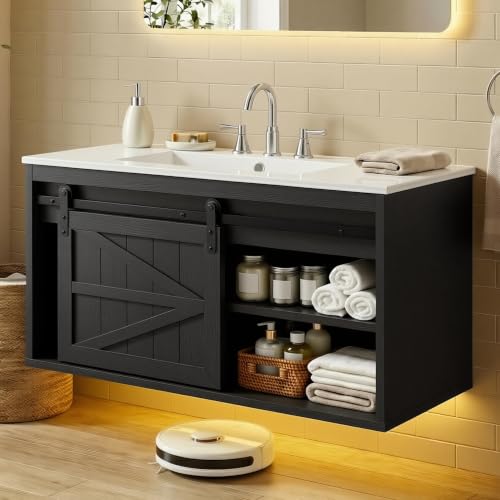
DWVO breaks this group’s pattern in the most interesting way: a 36-inch farmhouse cabinet with a sliding barn door and LED lighting that does not stand on the floor at all. It floats, wall mounted, and that single decision changes the bathroom’s whole feeling, because visible floor beneath a cabinet makes a small room read larger and lets a mop or a robot cleaner pass where cabinet plinths once trapped dust. Rustic warmth with a floating silhouette is an unusual marriage, and here it works as a deliberate design statement.
The barn door keeps the farmhouse grammar intact on the front, sliding rather than swinging, while the LED element repeats the Concho’s lesson about power: a lit cabinet needs an electrical plan, whether existing or newly installed. Buyers should treat that as part of the design rather than an afterthought, because a floating, glowing vanity installed without its lighting connected is a promise half kept.
- Width: 36 inches
- Mounting: wall mounted, floating cabinet
- Lighting: LED included
- Door: sliding barn door
- Sink: included with the vanity
Strengths
- Floating mount frees floor space and eases floor cleaning
- LED and barn door combine modern and farmhouse signals
- 36-inch width suits mid-size bathrooms and ensuites
Trade-offs
- Wall mounting demands solid fixings and accurate levelling
- Storage volume is not detailed in the title
- Floating cabinets expose the floor gap to dust and lost items
Mounting is the serious consideration. A wall-hung cabinet carrying a sink and a household’s stored bottles must be fixed into a wall that can hold it, with fixings matched to the wall’s construction and levels checked with patience. Stud walls, masonry and tiled surfaces each tell a different fixing story, and a buyer unsure of theirs should consult the full listing’s requirements or a tradesperson before the drill comes out.
Storage volume goes unspecified in the title, so the interior should be studied in the listing’s photographs by anyone whose bathroom depends on the vanity alone for storage. Floating cabinets also create a low shadow gap that collects the dropped and the dusty, a minor housekeeping tax most owners happily pay for the airy look and the easy floor clean.
DWVO suits the renovator designing a room rather than replacing a cabinet: a mid-size bathroom where floor visibility, LED ambience and barn-door character can be planned together from the start. It is the most architectural choice here, and the one whose success depends most on installation care.
Best for: design-led renovators wanting a floating 36-inch cabinet with LED light and barn-door character.
Not suited for: a quick-swap replacer with uncertain wall construction, because wall mounting a loaded cabinet demands verified fixings a freestanding unit never asks for.
View the DWVO floating installation style
Rustic vanities compared at a glance
Place the six side by side and the rustic category reveals itself as a set of storage philosophies wearing similar finishes.
| Vanity | Width | Mounting | Defining extra |
|---|---|---|---|
| Concho 30 Farmhouse Vessel Sink | 30 in | Freestanding | Vessel sink, LED, side hooks |
| LUXOAK 30 Barn Door Brown | 30 in | Freestanding | Reclaimed barnwood character |
| AMERLIFE 48 Farmhouse Rustic Brown | 48 in | Freestanding | Deep basin, barn doors |
| DELUXE LIVING 30 Rustic Brown | 30 in | Freestanding | Full-extension drawers, SMC top |
| YOURLITE 36 Farmhouse Rustic Brown | 36 in | Freestanding | Faucet and drain included |
| DWVO 36 LED Farmhouse Barn Door | 36 in | Wall mounted | LED, floating barn door |
Widths run 30 to 48 inches, mounting splits five-to-one in favour of freestanding, and completeness ranges from cabinet-and-sink to YOURLITE’s faucet-included package. Start from your room’s width, then read across.
Notice, reading down the mounting column, how completely the freestanding format dominates this category: five of six makers judged that a rustic buyer wants furniture that stands on its own feet, and the single floating exception had to bring LED light and a barn door to justify its difference.
Which rustic vanity belongs in your bathroom?
How wide is the wall, really?
Measure the available wall, then subtract the room’s realities: door swing, bath or shower clearance, and the walkway a person needs while someone else is at the basin. Thirty inches serves small rooms with dignity, 36 is the flexible middle, and 48 transforms a family bathroom only where the floor plan can absorb it. A vanity that fits on paper but crowds the door will be cursed daily, so let the tape measure overrule the heart at this first step.
Check the plumbing position against the cabinet’s interior while measuring. A drawer bank colliding with a waste pipe is a classic renovation surprise, and listings’ interior photographs deserve study before the cabinet is ordered around fixed pipework.
Freestanding or floating?
Five of these six stand on the floor, and that format forgives uneven cottages, simplifies plumbing and allows future rearrangement. The DWVO floats, buying floor visibility and easy cleaning at the cost of serious wall fixing. Choose floating only when the wall’s construction is known and the installation will be done properly, because a floating cabinet is a promise the wall must keep for years.
What will actually be stored inside?
Inventory your bathroom honestly. Towels favour shelves and hooks, as on the Concho and DELUXE LIVING; bottles and small clutter favour drawers, led by DELUXE LIVING’s full-extension set and YOURLITE’s four; shared family chaos favours the AMERLIFE’s sheer volume. A vanity chosen for the storage you wish you had will be defeated by the storage you actually have within a month.
How complete should the box be?
Decide whether you are buying furniture or a finished station. YOURLITE includes a faucet and drain, Concho and DWVO include LED lighting, DELUXE LIVING names its countertop material, and every model here includes a sink in some form. The more complete the package, the fewer compatibility surprises, and the less freedom to curate each fitting separately, a trade renovators should make consciously rather than discover.
What about guests, children and the vanity’s hardest users?
Design for the hardest user, not the tidiest. Children splash, lean and open drawers with wet hands, so deep basins, wipeable countertops and soft-closing hardware earn their keep in family rooms, while a guest bathroom can safely indulge the Concho’s vessel drama. A vanity bought for a fantasy household will be defeated by the real one within a season.
Guests introduce a different test: can a stranger find a towel, a spare roll and the light without asking? Hooks, open shelves and obvious storage pass that test kindly, which is why the guest-bathroom recommendations in this guide lean toward the Concho’s visible organisation.
Living with barn doors in a damp room
Sliding barn doors are the farmhouse signature, and in a bathroom they carry practical consequences worth planning around. A sliding door never swings into a person or a towel rail, which is why the style suits tight rooms, yet it needs an unobstructed stretch of cabinet front or wall to travel across, and its track appreciates a wipe in a room where steam and dust combine into grime.
Humidity is the background condition of every bathroom decision. Finishes described as rustic brown across these listings are designed for that life, but owners help them by ventilating the room, wiping standing splashes off cabinet fronts and keeping the gap behind a freestanding vanity dry and aired. A rustic cabinet ages beautifully when its owner treats water as a guest to be shown out, rather than a resident.
Children and barn doors get along famously, perhaps too famously, since a sliding door invites sliding. Households with toddlers should expect the door to become a toy for a season and choose hardware that tolerates enthusiasm, one more reason the soft-closing doors on the YOURLITE exist as an alternative philosophy in the same category.
Lighting, mirrors and the vanity as a system
Two models here build LED light into the vanity itself, and that choice ripples outward into mirror and wiring decisions. A lit cabinet can soften the need for aggressive overhead lighting, flattering faces at the hour they least flatter themselves, but it should be planned with the mirror’s position and the room’s existing circuits as one system rather than three purchases that meet for the first time on installation day.
Unlit models leave the lighting story entirely to the room, which suits bathrooms where wall lights already exist and work well. In those rooms, spending on drawers, basins or width returns more than a glowing cabinet would, and the rustic mood can be carried by a wooden mirror frame echoing the vanity’s finish instead.
Planning the swap: a weekend vanity replacement without tears
Replacing a vanity goes smoothly when the order of operations is respected. Photograph the existing plumbing before anything is disconnected, confirm the new cabinet’s waste and supply positions against those photographs, and dry-fit the cabinet in place before any sealant appears. Freestanding models forgive small mismatches with shims and patience; the floating DWVO rewards exact preparation and punishes improvisation, so its weekend should be planned with a spirit level and a second person.
Keep the old cabinet until the new one is plumbed and level. Bathrooms have a way of revealing a cracked tile, a short pipe or a wall that is not where the drawings promised, and a household with one bathroom cannot afford a vanity gap that stretches into a second weekend. Stage the new cabinet in another room, protect its finish during the work, and let the rustic reveal happen only when the water runs clear and the drawers glide.
Finish the job with the unglamorous details that make it feel professional: a clean bead of sealant where cabinet meets wall, drawers adjusted so their fronts sit in one plane, and a first stocking of the storage with the discipline the new layout deserves. The discipline fades, as all discipline does, but a good first month sets the pattern the cabinet will mostly keep.
Rustic brown among other finishes: pairing the room
Rustic brown is a forgiving anchor because it sits comfortably between white sanitaryware and almost any wall colour a cottage accumulates, from sage paint to bare plaster tones. It hides water marks better than pale finishes and warms a tiled room that might otherwise feel clinical, which is why all six makers here converge on it while differing on everything else.
Metal choices should echo rather than compete. The metal handles named on LUXOAK and YOURLITE suggest the direction: let taps, rails and mirror frames speak in one metal family, and the room reads as designed even when its pieces arrived years apart. A rustic vanity is a large enough object to set that family’s tone, so choose the cabinet early in a renovation and let smaller fittings follow its lead.
Taps, wastes and the plumbing questions to ask before delivery
A vanity arrives as furniture and becomes plumbing the moment it is connected, so the questions worth asking are plumbing questions. Where exactly do the supply lines and the waste sit in your wall or floor, and how does that position meet the cabinet’s interior, its drawers and its shelf? Drawer banks and waste pipes are natural enemies, and the time to discover a collision is on paper, with the listing’s interior dimensions in hand, not with the cabinet standing in a half-tiled room.
Faucet decisions branch from the package. YOURLITE settles the question by including a faucet and drain, while the other five leave the tap as a separate purchase whose mounting style must match the sink and countertop it will serve. Vessel sinks, like the Concho’s, generally pair with taller or wall-mounted taps, a detail that catches renovators out when a standard tap arrives and cannot clear the bowl’s rim.
Isolation valves and flexible connectors are the unphotogenic heroes of installation day. Budget for them, confirm their condition on an older property, and the swap becomes a controlled afternoon instead of a hunt for parts with the water off. A rustic cabinet deserves a calm installation, because rushed plumbing is how beautiful furniture gets water-stained in its first week.
Small bathrooms: making thirty inches work like forty
A 30-inch vanity succeeds when the rest of the room conspires with it. A large mirror above a small cabinet multiplies light and the sense of width, while wall-mounted taps, where the sink allows, return counter depth that a compact top cannot spare. The Concho exploits this logic with side hooks that move storage onto the cabinet’s flanks, and the DELUXE LIVING with an open shelf that keeps towels in the room’s air rather than in a drawer.
Colour discipline helps a small rustic bathroom feel intentional. Let the cabinet’s brown be the room’s one deep note, keep walls and towels pale around it, and the space reads as layered rather than crowded. Two competing dark features in a tiny room, a dark vanity against a dark floor, for instance, shrink the walls faster than any measurement can explain.
Finally, guard the floor. Small bathrooms feel larger when more floor is visible, which is the DWVO’s floating argument at 36 inches and a reminder that even a freestanding 30-inch cabinet should sit as close to the wall as plumbing allows, reclaiming every centimetre of the walkway for the humans who will cross it half awake.
The morning after installation: living with the choice
The first morning with a new vanity is a small ceremony, and it teaches the household where the design’s promises hold. Drawers glide or they do not, the basin contains the family’s splashiest washer or it does not, and the barn door’s travel either clears the towel rail or announces the miscalculation made on paper. Most of those lessons are pleasant confirmations, because a buyer who measured honestly has usually chosen well.
Stock the storage with restraint on day one. The temptation to fill every drawer immediately, simply because it exists, recreates the old clutter in a new cabinet within a week. Assign each drawer a category, leave one shelf deliberately half empty for the objects bathrooms generate over time, and the organisation chosen on installation day has a chance of surviving the year.
Photograph the finished room for the household’s own satisfaction and for future reference. When a tap washer needs replacing or a matching fitting is wanted years later, that photograph, with the model name kept in a note, saves the archaeology that bathroom maintenance so often becomes. Rustic cabinets are long-lived furniture; treat their records with the same respect.
What rustic is not: keeping the style honest
Rustic, done well, is a texture and a warmth, not a theme park. One barn door in a calm room reads as character; a bathroom where every surface performs farmhouse at full volume reads as a set. The six cabinets here are strong enough to be the room’s single rustic statement, supported by plain towels, simple sanitaryware and honest materials elsewhere, and they look more expensive for that restraint.
The style also has to survive cleaning day. Finishes that invite a wipe rather than a ritual, basins that accept a cloth in every corner and hardware without dust-trapping filigree are the difference between rustic as a living style and rustic as a maintenance burden. Judge the listings’ photographs with a cloth in your hand, mentally, and the right cabinet usually identifies itself.
Above all, rustic should serve the room’s people. A farmhouse cabinet that stores a family’s chaos gracefully is more truly rustic than a museum piece nobody dares splash, because the farmhouses that inspired the style were working rooms first and pictures second. Every recommendation in this guide was filtered through that working test.
Budgeting the whole job, not just the cabinet
The cabinet’s ticket is the largest line in a vanity project and rarely the only one. Faucets where not included, connectors, valves, sealant, a possible electrician for LED models, and the disposal or rehoming of the old unit all belong in the budget from the start. A buyer who totals those honestly can choose a cabinet class with confidence, while a buyer who budgets for the cabinet alone will meet each extra as a small betrayal during installation week.
Sequencing saves money as surely as shopping does. Plumbing adjustments are cheapest while the old cabinet is out and the wall is open, electrical points for a lit vanity are cheapest before tiling, and neither trade enjoys being recalled for the small job that could have ridden along with the big one. Plan the vanity as the centre of a small project, not as a parcel arriving into an unprepared room.
Keep a contingency for the wall’s secrets. Older bathrooms conceal soft plaster, tired pipework and floors that slope with conviction, and a modest reserve turns those discoveries into anecdotes rather than crises. The rustic cabinet will outlast the memory of the contingency entirely, which is the correct proportion for renovation spending.
Drawers versus doors: an honest storage argument
Drawers are the modern answer and doors are the traditional one, and this group contains both philosophies in strength. A drawer brings its contents to you, fully visible, which is why the full-extension sets on the DELUXE LIVING feel so civilised; a door conceals a larger, more flexible void where tall bottles, cleaning supplies and the bathroom’s awkward shapes live without negotiation. Neither wins universally, because bathrooms store both kinds of object.
The hybrid cabinets here, drawers beside shelved door space, reflect how households actually behave: daily smalls in drawers where they can be seen, bulk and bottles behind doors where they can be forgotten safely. When choosing, inventory by shape rather than by count. Ten small items argue for drawers; four tall ones argue for an adjustable shelf, and most bathrooms, audited honestly, argue for the hybrid.
Soft closure belongs in this argument too, because it changes how storage feels at the margins of the day. A drawer or door that closes itself quietly will be closed properly every time, while one that must be pushed home will be left ajar by tired people, and ajar doors in a steamy room invite the damp inside. Small mechanisms, daily consequences.
Ventilation: the invisible fitting every rustic cabinet needs
Wood-look cabinets and steam are lifelong neighbours, and ventilation is the diplomacy between them. A bathroom that clears its steam quickly, through a window habit or a working extractor, will keep any of these six finishes looking fresh for years, while a sealed, steamy room will test the best finish eventually. Renovators choosing a vanity should therefore glance upward at the fan with the same seriousness they give the cabinet’s drawers.
Habits matter where hardware is lacking. A door left open after a shower, a window cracked for ten minutes, splashes wiped from the cabinet front while they are still splashes: these small behaviours cost nothing and repay themselves in finish life. Rustic furniture rewards a household that treats air as part of the plumbing.
Common mistakes
Ordering by photograph before measuring the wall. A 48-inch statement in a 36-inch gap is a return shipment, not a renovation. Measure width, depth, door swing and walkway, in that order, before any finish is admired.
Forgetting the barn door’s travel. Sliding doors need lateral room. A towel rail, a wall cabinet or the bathroom door itself can block the slide and turn a signature feature into a daily annoyance.
Assuming a faucet is included. Only the YOURLITE names one in its title among these six. Every other buyer should budget and choose a faucet deliberately rather than discovering the gap on installation day.
Ignoring the wall behind a floating cabinet. The DWVO’s elegance depends on fixings the wall must support. Verify construction and fixing points before ordering a wall-mounted vanity for an unknown wall.
Storing chemicals against an unventilated cabinet back. Bathrooms are damp, and cleaning products leak quietly. Line the cabinet base, ventilate the room and wipe splashes, so a rustic finish ages as character rather than damage.
Letting the new cabinet sit in its packaging in a damp room. Acclimatise and inspect the vanity in a dry space before installation day, because packaging hides transit damage and a damp garage is no kinder to a cabinet than a steamy bathroom is.
Final recommendation
YOURLITE takes the all-round recommendation on completeness and daily manners: 36 flexible inches, a faucet and drain in the box, soft-closing doors and the group’s deepest drawer count. For a renovator who wants the bathroom finished rather than merely furnished, it removes more decisions, and more risks, than any rival here.
The specialists each own a room: Concho the dramatic small bathroom, LUXOAK the barnwood purist’s cottage, AMERLIFE the family headquarters, DELUXE LIVING the organiser’s 30 inches, and DWVO the design-led floating renovation. Rustic vanities reward buyers who measure first and romanticise second, and this set covers every width a real bathroom is likely to offer.
One last check belongs to the household rather than the room: stand at the current vanity tomorrow, open its doors and drawers, and look at what is actually inside. That unedited inventory, more than any photograph in any listing, is the specification your next cabinet must satisfy.
And if the tape measure vetoes your favourite, believe it the first time: bathrooms forgive many compromises, but a cabinet that crowds the door is the one compromise rehearsed twice a day, every day, for years.
Frequently asked questions
Do all six vanities include a sink?
Each listing presents its vanity with a sink in some form: a tempered vessel sink on the Concho, a deep basin on the AMERLIFE, and sink-inclusive descriptions across the rest. Styles differ, so buyers with a strong vessel-versus-inset preference should confirm the exact form on the full listing of their finalist.
Which vanity suits a family bathroom best?
The AMERLIFE at 48 inches, because width and a deep basin are the two features family traffic consumes fastest. Where 48 inches will not fit, the YOURLITE’s four drawers and included faucet make it the most family-practical of the smaller cabinets.
What does wall mounted actually demand?
On the DWVO, it demands a wall able to carry a loaded cabinet and sink, fixings matched to that wall’s construction, and careful levelling during installation. The reward is visible floor, easier cleaning and a lighter feeling room, which is why design-led renovators accept the extra installation care.
Are barn doors practical in a bathroom?
Yes, with planning. They never swing into the room, which helps tight layouts, but they need clear lateral travel and a track kept wiped in a steamy room. Households with toddlers may prefer YOURLITE’s soft-closing conventional doors until the sliding-as-entertainment phase passes.
Which pick needs the least extra shopping?
YOURLITE, by a clear margin. Its title names a faucet and drain alongside the cabinet and sink, while the other five leave the faucet as a separate decision. LED models add an electrical consideration rather than a purchase, and every buyer should still budget for sealant, connectors and the small plumbing consumables no vanity includes.
How long should a vanity swap take a competent DIYer?
Plan a full unhurried day for a like-for-like freestanding swap, including disconnecting, dry-fitting, levelling and sealing, and keep the old unit until the new one runs. A wall-mounted floating cabinet deserves a second day of patience for fixing and levelling, because its precision cannot be hurried without showing.
Can a rustic vanity work in a modern bathroom?
Yes, as the room’s warmth. A rustic brown cabinet against otherwise clean, modern lines reads as a deliberate contrast, especially when one metal family ties its handles to the taps and rails. The style clash to avoid is half-measures: a barn door surrounded by timid hints of five other styles pleases nobody.
What should be checked on delivery day?
Open the packaging in a dry room, confirm the cabinet’s width against your measurement, slide every drawer and door through its travel, and inspect corners and the sink for transit damage before the old vanity is touched. A problem found on delivery day is a replacement; the same problem found after demolition is a crisis.
Measure honestly, store realistically and let the rustic finish do the romancing, and the right one of these six cabinets will serve the room long after the renovation dust is forgotten.


