What's inside
- Where to buy one of these electric percolators
- Quick picks for the percolator shelf
- How these picks were chosen
- The six pots, perk by perk
- Feature ledger across the six pots
- How to choose an electric percolator?
- Percolating well: the method behind the machines
- Where a percolator sits among modern brewers
- What a cup means, and other percolator arithmetic
- Stainless steel, and the honest limits of a title
- Hosting with a percolator: the social case
- Keeping a steel percolator bright for decades
- Common mistakes with a new percolator
- Final recommendation
- Frequently asked questions
As an Amazon Associate I earn from qualifying purchases. This post may contain affiliate links at no extra cost to you.
As an Amazon Associate, cottageverdict.com earns from qualifying purchases.
There is a particular kind of coffee drinker who has tried drip machines, pods, and pour-over, and quietly returned to the percolator. The best stainless steel electric percolators serve that drinker: coffee brewed by cycling water up through a stem and over the grounds, producing a cup with a weight and clarity of flavour that many people associate with grandparents’ kitchens, diners, and campsite mornings — except the electric versions here need no stove and mind themselves once plugged in. Stainless steel is the material brief for good reason. It shrugs off the staining that clouds glass, tolerates decades of daily use, and does not carry the flavour memory that can haunt plastic reservoirs.
Electric percolation also deserves a defence against its stovetop ancestor’s reputation. The old stovetop pots depended on a cook’s judgement of flame and timing, and a moment’s distraction boiled the brew into bitterness. An electric base regulates the cycle far more calmly, which is why the modern versions produce a consistency their grandparents’ pots achieved only in skilled hands. The six below are all electric, all countertop, and all built around that regulated cycle — the method’s flavour with the guesswork engineered down to choosing grounds and watching the colour.
The six machines below span 6-cup to 12-cup capacities, and five of the six state stainless steel in their titles outright. The sixth, Cuisinart’s Classic, keeps its title to name and capacity alone, so its material is flagged as unstated wherever it matters in this review — an honesty point, not a disqualification, since the Classic line is a long-running percolator design. Beyond capacity, the titles divide on keep-warm behaviour, spouts, cords, and viewing knobs. A percolator is a simple machine, which means its small details — how it pours, how it signals readiness, how its basket handles grounds — are the whole buying decision.
Where to buy one of these electric percolators
All six are listed on Amazon; each review further down carries its own link.
- Presto’s 02811 leads with the cleanest proposition in the category: stainless steel, twelve cups, electric, nothing else to explain.
- Presto’s smaller 02822 answers the two-person household that found the big pot wasteful.
- West Bend’s classic-styled entry adds a heat resistant handle base and a detachable cord to the twelve-cup format.
- Farberware’s eight-cup model is the only pick whose title promises automatic keep warm and a no-drip spout together.
- Cuisinart’s Classic PRC-12N brings a familiar kitchen brand to the twelve-cup size with the plainest title here.
- Elite Gourmet’s EC812 closes the set with a clear brew knob, a cordless base, and cool-touch handling.
Quick picks for the percolator shelf
| Pick | Best for | Title highlight |
|---|---|---|
| Presto 02811 12-Cup Electric Percolator | Straightforward family brewing | Stainless steel stated, 12-cup, electric |
| Presto 02822 6-Cup Electric Percolator | Couples and small kitchens | Stainless steel stated, 6-cup, electric |
| West Bend 12-Cup Electric Percolator | Table service away from the counter | Detachable cord, stainless stem and basket, heat resistant handle base |
| Farberware 8-Cup Electric Percolator | Slow mornings with coffee held warm | Automatic keep warm, no-drip spout, stainless steel basket |
| Cuisinart Classic 12-Cup Percolator PRC-12N | Brand-loyal buyers at full family size | Classic line, 12 cup, model PRC-12N; material not stated in title |
| Elite Gourmet EC812 12-Cup Electric Percolator | Watching the perk through a clear knob | Clear brew knob, cordless base, keep warm, stainless steel stated |
How these picks were chosen
Three rules shaped the list. The machine had to be a true electric percolator — a self-contained pot that perks on its own base or cord, not a stovetop vessel and not a drip machine wearing retro styling. Capacity had to be printed in the title, because percolators brew best near their intended volume and a buyer needs that number to match the household. And stainless steel had to be stated, with one deliberate exception: the Cuisinart Classic earned its place on the strength of its long-running Classic percolator line, with its title’s silence on material recorded openly in its review and spec box rather than papered over.
Longevity of the designs themselves was a soft fourth consideration. Percolators are heritage appliances, and a model that has remained in production signals that its maker still supports it with parts and that its quirks are known quantities. The Presto pair, the Farberware, and the Cuisinart Classic all carry that heritage signal in their naming; the West Bend leans on classic styling and service features; the Elite Gourmet is the moderniser, adding the viewing knob and cordless base. A reader valuing the newest conveniences and a reader valuing the longest track record can both find their preference honoured here, which is how a six-pot list should behave.
Within those rules, the six divide into three sizes and several philosophies. The Presto pair offers the same idea at two scales. West Bend and Elite Gourmet compete at twelve cups with service features — detachable cord, cordless base, viewing knob. Farberware alone occupies the eight-cup middle with keep-warm automation. That spread lets a buyer decide by household arithmetic first and feature preference second, which is the correct order for an appliance bought to be used daily for years. Readers whose kitchens are also being fitted for winter should note the companion heating guide, Best Furnace Filters 20x25x1, which handles the largest of the three furnace sizes covered across this batch.
The six pots, perk by perk

Presto 02811 12-Cup Electric Percolator
Presto’s 02811 is the reference design against which the rest of this list quietly measures itself. The title offers exactly four facts — brand, stainless steel, twelve cups, electric percolator — and that economy reflects the machine’s character. A percolator’s job is to cycle water through grounds until the brew reaches strength, then hold it ready; the 02811 has been doing that job in American kitchens for a very long time, and its continued presence in the catalogue is itself a form of evidence. Twelve cups suits the household that brews once for a family breakfast, a thermos for work, and a second round for whoever wanders into the kitchen mid-morning. Stainless construction means the pot can live on the counter permanently without becoming an eyesore of stained plastic.
Spec mini box — Capacity: 12-cup, stated. Material: stainless steel, stated. Type: electric percolator. Keep warm behaviour: the title says nothing. Cord arrangement: undescribed in the title. Spout design: no claim printed.
Strengths
- The plainest, most proven proposition here: full family capacity in stainless steel.
- A twelve-cup brew covers breakfast plus a travel mug without a second cycle.
- Stainless steel resists the permanent coffee staining that ages other materials.
Trade-offs
- The title promises no keep-warm specifics, so holding behaviour needs the full listing.
- Twelve cups is a lot of coffee for a solo drinker to brew well, since percolators prefer fuller loads.
- No viewing or signalling feature is named, leaving readiness cues to the full product description.
Percolator brewing rewards a particular patience. The perk cycle starts gentle, strengthens as the water darkens in its rhythm, and punishes the cook who lets it boil violently for too long — over-perked coffee turns bitter, which is the origin of the percolator’s unfair reputation in some circles. Used with a measured hand, the 02811 produces the rounded, hot, assertive cup its loyalists defend. The stainless body helps here in a subtle way: it holds heat steadily through the cycle rather than shedding it, keeping the perk rhythm even. For a household replacing a drip machine out of flavour boredom, this is the lowest-risk doorway into the method — a known design, a family size, a material that forgives. Everything fancier in this list adds a feature to this baseline; decide whether you need the feature before paying for the deviation.
Longevity is the 02811’s quiet argument. Percolators have few moving parts — a heating element, a stem, a basket, a lid — and a stainless body removes corrosion from the list of eventual failures. Owners measure these pots in decades, handing them between households, taking them to holiday cabins, pressing them into service when a fancier machine fails on a holiday morning. That service record also means replacement baskets and lids circulate widely, a practical mercy when a small part is lost in a move. A family buying its first percolator is therefore not really buying an appliance so much as adopting a piece of kitchen infrastructure, and the 02811’s unadorned title reflects that status: it does not need to promise features, because its promise is continuity.
Best for: a family kitchen wanting the classic twelve-cup stainless percolator experience without embellishment. Not suited for: a one-person household brewing two mugs at dawn, where twelve cups wastes grounds. Check price on Amazon — the baseline twelve-cup pot.

Presto 02822 6-Cup Electric Percolator
The 02822 is the 02811’s idea at half scale, and the halving changes more than the arithmetic. Six cups is the percolator for two people who drink coffee together — a pot that brews near its designed volume every morning, which is precisely the condition under which percolators taste best. Small households that buy twelve-cup pots and brew four cups in them get a thinner, less even extraction, because the perk cycle was engineered around a fuller basket and a taller column of water. The 02822 removes that mismatch. Its title mirrors its sibling’s economy: stainless steel, six cups, electric. On a small counter or in a caravan kitchen, the reduced footprint is a second, quieter benefit.
Spec mini box — Capacity: 6-cup, stated. Material: stainless steel, stated. Type: electric percolator. Keep warm behaviour: unaddressed by the title. Dimensions: absent from the title. Spout design: left undescribed.
Strengths
- Right-sized brewing for couples, the load a percolator handles most happily.
- Stainless steel construction at a footprint small kitchens can actually spare.
- The same proven Presto design language as the twelve-cup reference model.
Trade-offs
- Guests for brunch will require two cycles or a second pot standing by.
- The title names no keep-warm or signalling features to lean on.
- Households that grow will outgrow it, though it retires gracefully to office duty.
There is a ritual economy to a six-cup pot. It heats its smaller volume quickly, perks to strength without a long wait, and rinses clean in a minute at the sink — a daily driver rather than an occasion appliance. Couples who drink at different times should think carefully, though: percolated coffee is best fresh from the cycle, and a pot brewed for two at 7 a.m. is not the same pleasure reheated for one at 9. In that pattern, the Farberware’s stated keep warm becomes relevant competition despite its larger size. But for the synchronised household — two mugs, one breakfast, a shared newspaper — the 02822 is the most honestly sized pot in this list, and its stainless build means it can serve that ritual for a very long time without complaint.
The six-cup format also travels through life stages gracefully. It suits a first apartment, a downsized kitchen after the children leave, a desk-side office setup, or the counter of a small rental where a twelve-cup pot would dominate the workspace. Because it brews its full load happily, it avoids the sad compromise of the big pot run at half mast, and because it is stainless it can be scrubbed back to brightness after months of daily service. Couples who entertain occasionally can simply run two cycles for guests — the second perks while the first is being enjoyed — rather than storing a large pot for rare weekends. Right-sizing is a form of honesty in appliance buying, and this little Presto embodies it.
Best for: two coffee drinkers brewing together each morning at the pot’s natural volume. Not suited for: a brunch-hosting household that regularly serves six people at once. Check price on Amazon and view the compact six-cup model.

West Bend 12-Cup Electric Percolator
West Bend’s entry is the percolator designed to leave the counter. Its title spends its words on service: a classic style body, a heat resistant handle base, a detachable cord, and a stainless steel stem and basket, at twelve cups in silver. The detachable cord is the headline for hosts who have ever carried a full percolator to a dining table while trailing a cable across the kitchen — unplug, carry, pour, return. The heat resistant handle base addresses the other half of that journey, the grip. Note the precision of the stainless claim: the title assigns stainless steel to the stem and basket, the internal parts that meet the coffee, rather than blanketing the whole appliance in the claim, and this review respects that wording.
Spec mini box — Capacity: 12-cup, stated. Stainless parts named: stem and basket. Cord: detachable, stated. Handle: heat resistant handle base, stated. Colour: silver. Keep warm behaviour: no promise in the title.
Strengths
- A detachable cord turns a counter appliance into a table-ready serving pot.
- Stainless steel is specified exactly where coffee contact happens: stem and basket.
- Classic styling suits kitchens that reject black-plastic appliance aesthetics.
Trade-offs
- The title does not extend the stainless claim to the body itself, so material expectations should follow the wording.
- No keep-warm promise appears, which matters for long, slow breakfasts.
- A detachable cord is one more small part for a busy drawer to swallow.
Think of the gatherings this pot serves: a holiday breakfast where coffee belongs on the table beside the food, a porch morning where the pot travels outside, a church hall or club room where the percolator circulates. In each setting the cordless carry is the feature that earns its keep, and the heat resistant base lets the pot be set down and lifted without a mitt hunt. The classic styling is functional in these settings too — the pot reads as serveware rather than machinery, so it sits comfortably among dishes. Households that drink coffee where they brew it, at a kitchen counter with stools, will use the detachable cord less, though it still simplifies cleaning, since the pot can go to the sink untethered for a proper rinse of the stem and basket after each use.
Cleaning deserves a word in West Bend’s favour. The stem and basket are where coffee oils concentrate, and a pot that detaches from its cord can be carried to the sink, filled with hot soapy water, and given a proper soak without an electrical tether dictating where it may go. That freedom quietly raises the standard of care the pot receives, because chores that are easy get done. The classic styling also ages without embarrassment: silver-toned serveware does not date the way coloured plastic appliances do, so the West Bend can sit on a sideboard during a dinner party without apologising for itself. For households whose coffee ritual is social — brewed in the kitchen, consumed everywhere else — these small logistics are the product.
Best for: households that carry coffee to a table, porch, or gathering, where the detachable cord earns its place daily. Not suited for: a counter-only routine that values stated keep-warm automation above serving freedom. Check price on Amazon for the West Bend server.
Farberware 8-Cup Electric Percolator
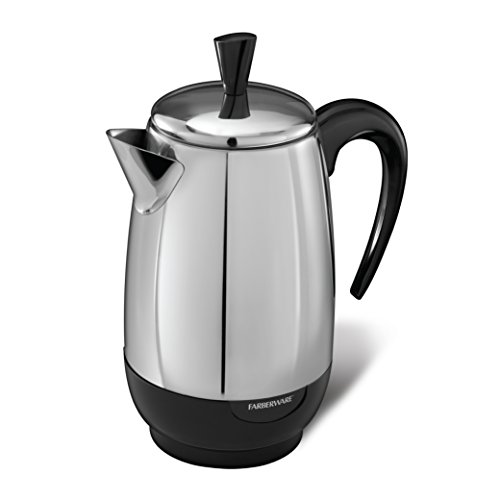
Farberware occupies the sensible middle. Eight cups fits the household that found six tight and twelve excessive, and its title is the most service-minded of the six: a stainless steel basket, automatic keep warm, and a no-drip spout. Each phrase answers a known percolator grievance. Automatic keep warm addresses the second-cup problem, holding the brew ready without a re-perk. A no-drip spout addresses the dribble down the pot’s side that stains counters and tablecloths — a small indignity that owners of lesser spouts know intimately. The stainless claim attaches to the basket, the grounds-contact component, and this review keeps it there.
Spec mini box — Capacity: 8 cup, stated. Stainless part named: basket. Keep warm: automatic, stated. Spout: no-drip, stated. Body material: the title keeps it unstated. Cord arrangement: a full-listing question.
Strengths
- Automatic keep warm is unique in this list as a title promise, serving staggered risers.
- The no-drip spout targets the percolator’s most common table manners failure.
- Eight cups is the Goldilocks capacity for many three-to-four-person households.
Trade-offs
- Stainless steel is claimed for the basket, not the whole pot, per the title’s own wording.
- Keep-warm holding will slowly change any coffee; purists still brew fresh per round.
- Eight cups can run short when a full house of guests wants coffee at once.
The staggered household is this pot’s natural habitat: one person leaves for an early shift, another rises at eight, a teenager surfaces at ten, and the coffee needs to be ready and decent across that whole span. Automatic keep warm is built for exactly that pattern, trading the peak flavour of the just-perked moment for availability across a morning. The no-drip spout supports the same household’s reality — coffee poured half-awake, over a counter that does not need scrubbing before work. Farberware’s long presence in American kitchens lends the design a familiarity that helps here; this is the percolator shape many buyers grew up watching. If your household drinks together, the Prestos argue their case; if your household drinks in shifts, this Farberware is the list’s most considerate answer.
The eight-cup middle size has one more virtue: thermal honesty. A twelve-cup pot brewed for a four-person household spends its morning half empty, and each pouring exposes more of the remaining coffee to air and cooling. An eight-cup pot brewed for the same household runs closer to its design, empties sooner, and keeps the average cup closer to fresh. Farberware’s keep warm then covers the tail of the morning rather than propping up a whole oversized batch. The no-drip spout, meanwhile, protects light-coloured counters and the pot’s own exterior from the baked-on dribble stains that make older percolators look tired before their time. Small mercies, compounded daily, are what separate an appliance people like from an appliance people merely use.
Best for: a household whose members rise at different hours and want coffee held ready with a tidy pour. Not suited for: a purist routine that re-perks fresh for every single cup regardless of convenience. Check price on Amazon and compare the eight-cup’s keep warm.
Cuisinart Classic 12-Cup Percolator PRC-12N
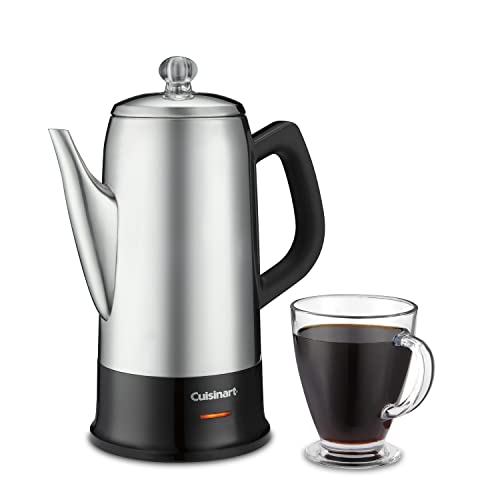
Cuisinart’s title is the shortest in the list: Classic 12 Cup Percolator, PRC-12N. It does not state the body material, and this article will not state it either — the listing title leaves material unaddressed, so buyers for whom certified stainless construction is the entire point should weigh the five picks whose titles say so. What the Cuisinart offers instead is a name and a line. The Classic designation signals a long-running design rather than a seasonal model, and Cuisinart’s kitchen-appliance presence means many buyers already trust the brand’s fit and finish from other counters in their homes. Twelve cups matches the family format of the Presto 02811 and the West Bend directly.
Spec mini box — Capacity: 12 cup, stated. Model: PRC-12N. Line: Classic. Material: not stated in the listing title — verify with the manufacturer’s documentation. Keep warm behaviour: unmentioned. Cord arrangement: equally quiet in the title.
Strengths
- A long-running Classic line suggests a stable design with an established owner base.
- Full twelve-cup capacity matches the largest pots here for family service.
- Cuisinart’s appliance ecosystem suits buyers standardising on one kitchen brand.
Trade-offs
- Material is unverified by the title, the central caveat of this entire review.
- No service features — keep warm, cord style, spout design — are promised in the title.
- Buyers must do the most extra reading of any pick here before ordering confidently.
Why include a pick whose title withholds the category’s headline material? Because shopping by title alone has limits, and this article’s job is to mark those limits visibly rather than exclude a widely sold percolator in silence. The honest framing is conditional: if the full listing or the manufacturer’s documentation confirms the construction you want, the PRC-12N competes on brand and capacity with the best here. If that confirmation does not materialise, the Presto 02811 offers the same capacity with stainless steel stated in plain words. That conditional path respects both the reader’s intelligence and the evidence available. Brand-loyal households furnishing an entire Cuisinart counter will find the homework worthwhile; evidence-first shoppers can treat this entry as a verify-then-decide placeholder in an otherwise fully stated list.
There is also a gifting dimension to the brand question. A percolator given to parents or grandparents often succeeds or fails on familiarity, and Cuisinart’s name is one many recipients already trust from blenders and food processors on their own counters. If the giver does the material homework the title skips, the PRC-12N can be a confident present at a generous capacity. The same logic applies to wedding registries and housewarmings, where a recognisable brand reduces the recipient’s hesitation to unbox and use the thing. None of that softens the recorded caveat — it simply explains why a verify-first pick can still be the right pick for a particular buyer who values the badge and is willing to read one page of specifications.
Best for: a Cuisinart-loyal kitchen at twelve-cup scale, after confirming construction in the full listing. Not suited for: a purchase that must be justified by the title alone, since material goes unstated there. Check price on Amazon and read the PRC-12N specifications closely.

Elite Gourmet EC812 12-Cup Electric Percolator
The EC812 is the percolator for people who like to watch. Its title leads with a clear brew knob — the glass or transparent dome on the lid through which the perk’s colour deepens as the brew strengthens — and backs it with keep warm, a cool-touch exterior, a cordless base, and stainless steel construction, at twelve cups. The clear knob is not a gimmick: judging percolation by colour is the traditional way to stop the cycle at the strength your household prefers, and a visible perk turns an abstract wait into a small kitchen pleasure. The cordless base echoes the West Bend’s serving freedom by a different mechanism — lift the pot off its powered base and pour anywhere, then set it back to stay warm.
Spec mini box — Capacity: 12-cup, stated. Material: stainless steel, stated. Brew visibility: clear brew knob, stated. Base: cordless, with cool-touch handling, stated. Keep warm: stated. Model: EC812.
Strengths
- The clear brew knob lets the brewer judge strength by colour, the classic percolator skill.
- A cordless base combines serving freedom with a home station that keeps coffee warm.
- Cool-touch handling suits households where the pot gets passed and poured by many hands.
Trade-offs
- More features mean more parts — base, knob, seals — in the cleaning routine.
- Twelve cups still overshoots a solo drinker’s daily need by a wide margin.
- The knob’s clarity depends on keeping it descaled and wiped, a small recurring chore.
There is an educational streak in this machine. A new percolator drinker learns the method faster with a window into it: the first pale perks, the deepening amber, the moment the colour matches last week’s best pot. That feedback loop builds the judgement that the opaque pots demand you develop blind, by time and taste alone. The cordless base then modernises the serving half of the ritual, and keep warm covers the second round. Households with children or elderly relatives will appreciate cool-touch handling more than they expect — a pot that gets carried gets touched in the wrong places, and designing for that reality is kindness in appliance form. Of the six, the EC812 asks the most involvement and returns the most feedback, which is precisely the exchange its buyer is looking for.
The clear knob has a social life as well. Children watching coffee perk through the dome treat it as a tiny kitchen theatre, and guests at a brunch table comment on it in a way nobody comments on a drip machine’s carafe. Appliances that spark a sentence of conversation earn their counter space in social households. The cool-touch exterior supports that social role by making the pot approachable — a guest can be handed the EC812 to pour a round without a warning lecture about hot surfaces. Taken together, the EC812’s features describe a percolator designed for the room where coffee is consumed, not only the corner where it is made, and that orientation distinguishes it from every other pot in this six.
Best for: an engaged brewer who wants to watch the perk, serve cordlessly, and keep twelve cups warm. Not suited for: a minimalist counter that counts every extra base and seal as clutter. Check price on Amazon and watch the perk through its clear knob.
Feature ledger across the six pots
| Percolator | Cups | What the title states about steel | Service note |
|---|---|---|---|
| Presto 02811 12-Cup Electric Percolator | 12 | Stainless steel, whole pot | Baseline design, no service extras named |
| Presto 02822 6-Cup Electric Percolator | 6 | Stainless steel, whole pot | Compact sibling of the 02811 |
| West Bend 12-Cup Electric Percolator | 12 | Stainless stem and basket | Detachable cord, heat resistant handle base |
| Farberware 8-Cup Electric Percolator | 8 | Stainless steel basket | Automatic keep warm, no-drip spout |
| Cuisinart Classic 12-Cup Percolator PRC-12N | 12 | Material not stated in title | Classic line; verify construction in full listing |
| Elite Gourmet EC812 12-Cup Electric Percolator | 12 | Stainless steel stated | Clear brew knob, cordless base, keep warm |
How to choose an electric percolator?
How many cups does your household honestly drink per brew?
Percolators reward honest arithmetic because they brew best near capacity. Count the mugs filled in a normal morning, add one for the person who always wants a second, and buy that size: six for couples, eight for small families with staggered hours, twelve for households and hosts. Oversizing a percolator is not like oversizing a drip machine; a half-empty perk cycle extracts unevenly and teaches you to dislike a method that would have pleased you at the right scale. If your household straddles two sizes on weekdays and weekends, choose the weekday size and let guests trigger a second cycle.
What about sediment in the cup?
A little fine sediment is the percolator’s signature, settling quietly at the bottom of the mug as the coffee rests. Coarse grounds minimise it, letting the pot rest a minute before pouring reduces it further, and most drinkers of the method accept the last sip’s texture as part of the tradition. If a completely clear cup is non-negotiable for you, be honest about that now: no pot in this list will satisfy that preference, and a filtered method belongs on your counter instead.
Where does the coffee get poured?
At the counter, any of the six serves. At a table or porch, the West Bend’s detachable cord and the Elite Gourmet’s cordless base earn their complexity, while the Farberware’s no-drip spout protects the tablecloth wherever the pouring happens. Think about the last ten breakfasts you hosted and where the coffee actually travelled; that memory is a better spec sheet than any feature list. Households deep in a mashing-and-pureeing phase of family cooking may also enjoy Best Hand Held Blenders for Mashed Potatoes, which covers stick blenders with potato mashers for the other end of the comfort-food menu.
Does the pot need to match your other appliances?
Only your eye can answer that, but note the material spread: the Prestos and EC812 present as stainless pots, the West Bend leans classic silver serveware, and the Farberware and Cuisinart titles leave the body’s appearance to their photographs. In open-plan kitchens where the coffee pot lives in view all day, that visual question is legitimate and worth settling from the listing images rather than from assumptions — another case where the title tells you less than you need and the honest response is to look.
How long must brewed coffee wait before drinking?
If the pot is drained within twenty minutes of perking, keep-warm features are decoration. If your mornings stretch across hours, the Farberware’s automatic keep warm and the EC812’s stated keep warm protect the second and third cups from going cold or needing a microwave rescue. Be honest about the flavour trade: held coffee drifts from its fresh peak, so households that prize the first-cup experience above convenience should brew smaller and more often — the little Presto’s entire argument.
Percolating well: the method behind the machines
Grounds choice completes the technique picture. A medium roast shows the percolator’s character most forgivingly, because very dark roasts can tip into harshness under repeated cycling while very light roasts may taste underdeveloped. Freshness matters more than origin here: grounds bought in modest quantities and stored airtight will outperform an expensive bag left open beside the pot for a month. Measure by habit rather than by scale if you prefer — two consistent scoops beat a precise dose used inconsistently — but keep the habit fixed once the household agrees the cup is right. The percolator’s whole appeal is repeatability earned through ritual, and ritual is simply technique that has become comfortable.
Every pot in this list obeys the same physics, so technique matters as much as hardware. Start with cold, fresh water filled to the level your household actually drinks. Add coarser grounds than drip machines prefer — fine grounds slip through baskets and cloud the cup with sediment. Let the perk establish a gentle, regular rhythm rather than a violent boil; the moment the cycling water reaches the colour your household likes, the brew is done, and the machine should move to holding rather than continued hard perking. Remove the basket after brewing if your pot’s design allows it, so the finished coffee stops extracting while it waits. These habits, applied to any of the six, close most of the gap between percolator nostalgia and percolator disappointment. The machines differ in how they help you — a clear knob to judge colour, keep warm to hold the result, a clean spout to serve it — but the judgement itself remains the brewer’s craft.
Where a percolator sits among modern brewers
It helps to place the percolator honestly in the modern kitchen’s crowded coffee bench. Against drip machines, it trades automation for character: no paper filters, no programmable timers in these titles, but a hotter, weightier cup and a pot that doubles as serveware. Against pod systems, it trades single-serving convenience for economy and ritual — grounds cost what grounds cost, and nothing proprietary stands between you and a second pot. Against espresso, it is not a rival at all but a different drink entirely, closer to a strong filter coffee with a roasted edge. The households that keep a percolator for decades are rarely claiming it beats every alternative at everything; they are claiming it makes the specific cup they want, in the quantity their mornings require, in a pot that will outlast the trend cycle. Judged by that standard, the six here divide cleanly: pick the size that matches your mornings, then the service features that match your rooms, and the method will do the rest.
What a cup means, and other percolator arithmetic
Newcomers are routinely surprised by percolator capacity, because the cup in appliance language is a modest measure rather than the brimming mug most people drink from. A twelve-cup pot therefore serves perhaps six generous mugs, and a six-cup pot serves three. Recalculate your household in mugs before choosing a size, or the family pot will feel smaller than its number promised and the couple’s pot will feel like a toy. The same arithmetic explains why percolator loyalists speak warmly of the eight-cup middle: in mug terms it is a four-mug pot, which matches a family breakfast with one refill each more honestly than the headline number suggests. None of the titles here clarifies the cup measure, so treat the relative ladder — 6, 8, 12 — as the reliable information and your own mug count as the conversion key.
Water level discipline follows from the same numbers. Every percolator has a fill band it prefers, marked inside the pot, and brewing far below it weakens the perk’s hydraulics while filling above it risks a sputtering lid. The practical habit is simple: decide the household’s standard brew, mark the routine mentally, and let the machine repeat it. Consistency is the percolator’s flavour secret — the same water, the same grounds, the same perk duration produces the cup people fall in love with, and variation in any of the three produces the inconsistency that sends pots back to the cupboard.
Stainless steel, and the honest limits of a title
This list contains a small lesson in reading appliance titles. Five of the six state stainless steel somewhere, but not in the same place: the Prestos and the Elite Gourmet claim it broadly, West Bend assigns it to the stem and basket, and Farberware assigns it to the basket alone. Those are different promises. The basket and stem are the parts in constant contact with hot coffee, so a basket-only claim still covers the surfaces that matter most for flavour and corrosion, while a whole-pot claim adds the body’s durability and appearance to the bargain. The Cuisinart’s silence sits at the far end of the same spectrum — no promise at all in the title, leaving the question to the full listing. A careful buyer reads the preposition as carefully as the material: stainless steel where, exactly? That single habit, applied across appliance shopping generally, prevents more disappointment than any brand loyalty ever will.
Steel also explains the percolator’s survival as a category. Glass can shatter on a cold counter, plastic absorbs the ghosts of a thousand brews, but a steel pot can be dented, scrubbed, descaled, and returned to service with its dignity intact. In a throwaway appliance era, a coffee maker whose body is the least likely part to fail has an obvious appeal, and it is why so many of these designs have remained in production across decades with only detail changes. When you buy one of the broadly stated steel pots here, you are buying into that continuity — spare baskets exist, knowledge exists, and the pot on your counter has ancestors still perking in other people’s kitchens.
Hosting with a percolator: the social case
There is a reason the twelve-cup format refuses to die, and it is standing in every church basement and holiday kitchen in the country: a percolator is a social appliance. It brews a crowd’s worth of coffee in one vessel, carries to the table as its own server, and keeps the host out of the kitchen during the part of the gathering that matters. The West Bend’s detachable cord and the EC812’s cordless base were plainly designed by people who understood that journey from counter to company. Even the Farberware’s no-drip spout is a hosting feature in disguise, sparing the good tablecloth. When you choose among the large pots, imagine the last gathering you hosted and the exact moment coffee was needed: if it was mid-conversation at the table, serving design outranks everything else on the spec sheet; if it was a quiet family breakfast, the Presto baseline’s simplicity reasserts itself. Appliances live where rituals put them, and the percolator’s ritual has always been communal.
Keeping a steel percolator bright for decades
Care for these pots divides into a daily thirty seconds and a monthly ten minutes. Daily: empty the basket promptly, rinse the stem and basket under hot water, and leave the lid ajar so the interior dries without trapping yesterday’s aroma. The coffee oils that flavour a fresh brew turn rancid on metal within a day, and most complaints about a percolator’s taste trace back to a basket that was rinsed tomorrow instead of today. Monthly, or whenever the perk slows and the interior shows scale freckles, run a descaling cycle appropriate to your water hardness and polish the exterior while it is already at the sink. Stainless rewards this rhythm by staying bright without coatings or special products — a soft cloth and ordinary washing-up liquid handle the outside, and abrasives are unnecessary unless a scorched spot from an empty boil demands them. Never boil the pot dry; an electric percolator’s element and a steel base both suffer from it, and the smell announces the mistake to the whole house.
Common mistakes with a new percolator
- Grinding too fine. Powdery grounds pass through the basket, muddy the cup, and get blamed on the machine within a week.
- Letting the perk rage. A rolling, violent cycle extracts bitterness; the gentle rhythm is not a flaw to fix but the method working correctly.
- Brewing a half pot in a twelve-cup body. The cycle was designed around a fuller column of water, and chronic under-filling teaches a false lesson about the pot’s quality.
- Leaving grounds sitting in the finished coffee. Extraction continues while the basket stays in, so the last cup tastes harsher than the first through no fault of the beans.
- Skipping the stem and basket rinse. Old coffee oils coat the stem invisibly and flavour tomorrow’s brew; a daily rinse is the cheapest flavour upgrade available.
- Storing the pot with its lid sealed. A closed, damp interior grows stale odours that the next brew inherits; store it dry with the lid ajar and the basket clean.
Final recommendation
A note on buying two sizes: some households genuinely run a weekday pot and a weekend pot, and the Presto pair makes that strategy unusually painless because the 02822 and 02811 share a design language, a cleaning routine, and a learning curve. The small pot handles the couple’s dawn brew at full efficiency; the large one emerges for guests, holidays, and baking days when coffee demand triples. If counter and cupboard space allow the pair, it is a more satisfying arrangement than one compromise size straining at both ends of the week. Single-pot households should simply choose for the majority of their mornings and accept a second cycle on the exceptional days.
Start from household size, then pick your service style. Couples should take the little Presto 02822 and enjoy brewing at natural volume every morning. Family kitchens wanting the definitive version of the classic pot belong with the 02811. The West Bend serves households whose coffee travels to tables and porches, the Farberware serves households whose drinkers arrive in shifts and value a clean pour, and the Elite Gourmet EC812 serves the brewer who wants to watch strength develop and pour from a cordless base. The Cuisinart PRC-12N remains the conditional choice: a respected name at full capacity, pending a material confirmation its title does not provide. Whichever pot lands on your counter, pair it with coarse grounds and a gentle perk, and consider the room it brews in as well — Best Window Fans to Cool a Room rounds up window fans for kitchens that run warm through the summer brewing season.
Frequently asked questions
Does percolated coffee taste different from drip?
Yes, in character. Because the water cycles through the grounds repeatedly and brews good and hot, the cup tends toward a fuller, rounder, more assertive profile that stands up to breakfast. Drinkers raised on diner coffee often prefer it; drinkers chasing delicate floral notes usually stay with pour-over. Milk and sugar flatter percolated coffee particularly well, which is why the method pairs naturally with breakfast food — eggs, toast, and anything fried seem to call for a coffee with enough body to stand beside them rather than a delicate cup that disappears behind the plate.
Why does one pick not state stainless steel?
The Cuisinart Classic’s title lists only its line, capacity, and model code. That silence is recorded in its review rather than filled in by assumption, and the full listing or manufacturer documentation is the place to confirm construction before buying. The same discipline applies to any figure a title omits — dimensions, cord length, warming behaviour — because a percolator bought for a decade deserves ten minutes of verification at the start.
What grind works in a percolator basket?
A coarse grind. It stays inside the basket instead of sifting into the brew, keeps the cup clear, and extracts at a pace matched to the perk cycle’s repeated passes.
Are percolators economical to run?
By the standards of coffee equipment, yes. There are no proprietary pods and no paper filters in any of these titles — the steel basket is the filter, washed and reused indefinitely. Ground coffee bought in ordinary bags keeps the per-pot cost low, and the appliance itself, with few moving parts and a steel body in the broadly stated picks, is built for a long service life rather than a replacement cycle. The main running cost is the electricity of the perk and any keep-warm holding, which staggered households should weigh against the cost of brewing multiple small batches instead.
Is keep warm worth prioritising?
Only if your household drinks across a long morning. The Farberware states automatic keep warm and the EC812 states keep warm; households that drain the pot quickly gain nothing from the feature and can choose purely on size and serving style. A useful test: if your current coffee maker regularly sits with coffee in it past the one-hour mark, keep warm will earn its place on your counter every single day.
Do electric percolators need paper filters?
None of these titles mentions paper filters, because the metal basket is the filtration system: it holds the grounds while the water cycles, and it is rinsed and reused for the life of the pot. Some owners add optional paper discs to catch finer sediment, but that is an accessory choice rather than a requirement of any machine here. The absence of consumables is a large part of the category’s running-cost appeal, and it also means a percolator never strands you on a Sunday morning with an empty filter packet and a full house.
How long does a percolator take to brew?
Expect a slower, more visible ritual than a drip machine’s hidden cycle: the water must heat, the perk must establish, and the brew strengthens over minutes of cycling. The clear knob on the EC812 exists precisely because this timing is judged by eye and colour rather than by a beep. Households in a rush to leave should start the pot before dressing; households that savour mornings will find the pace is part of the pleasure.
What water works best in a percolator?
Fresh, cold, and neither distilled nor heavily mineralised. Very hard water scales the stem and element and dulls flavour over time, while completely mineral-free water can taste flat in any brewing method. If your tap water is hard, the monthly descaling rhythm described in the care section keeps the perk brisk and the cup clean.
Can a percolator replace a drip machine entirely?
For many households it already has. The trade is attention: a percolator rewards a brewer who watches the cycle and removes the basket, while a drip machine forgives total neglect. Choose according to the ritual you will actually keep. Plenty of kitchens run both — the drip machine for weekday autopilot, the percolator for weekends when coffee is an event rather than a fuel stop — and the pots here are priced and sized to make that dual arrangement easy to justify.
Pick the pot sized to your mornings, perk it gently, rinse its basket like you mean it, and stainless steel will return the favour for years of breakfasts, brunches, holiday gatherings, and slow Sunday refills alike.


