What's inside
- Where to buy the six commercial stick blenders
- Quick Picks
- How these picks were chosen
- Each machine, taken on its own title’s terms
- Numbers across the range
- What should a kitchen match first: shaft, capacity or speed?
- Technique: working a big stick in a big pot
- Common mistakes when specifying a commercial stick blender
- Final recommendation
- Cleaning and storing long shafts without drama
- Duty cycles and the working life of a commercial motor
- Ergonomics: the arm is part of the specification
- From soup to sauce: matching the machine to the mixture
- Buying for a kitchen that will grow
- The second stick: why serious kitchens own two
- What the plug tells you: a note on the electrical lines
- A service, hour by hour, with the right stick
- Warranty, parts and the long view
- Safety around steam, blades and big volumes
- A closing word on brands and loyalty
- Frequently asked questions
As an Amazon Associate I earn from qualifying purchases. This post may contain affiliate links at no extra cost to you.
As an Amazon Associate, cottageverdict.com earns from qualifying purchases.
There is a moment in every busy kitchen when the stockpot is too full to move, the soup is too hot to pour, and the blender jar on the counter is simply too small for the job. The best commercial stick blenders exist for that moment: they go directly to the food instead of bringing the food to them, working directly in pots measured in gallons rather than cups. Shaft length, batch capacity and speed control are the three numbers that separate these six machines, and every one of those numbers below comes straight from the listing titles.
Commercial is the operative word in every title gathered here, and it changes what the numbers mean. Home immersion blenders are built for a smoothie and a rest; these are built for a service. Titles here talk in gallons — ten, twenty-six, fifty, sixty-four — and in shaft lengths from twelve inches to twenty-two. They talk about interchangeable shafts, hands-free locks, variable speed and, in one case, NSF and ETL marks aimed at restaurant inspection regimes. The domestic jobs (a baby food purée, a smoothie) appear in exactly one title, and even there they ride along on a 750W heavy-duty frame.
Read the capacities exactly as the listings state them, neither rounded nor reinterpreted. A title that says up to 64 gallons is describing the batch class the machine is built for, under the manufacturer’s own framing. This guide reports those figures faithfully and compares machines on the numbers printed, because in professional equipment the printed numbers are how kitchens shortlist before they ever hold a handle.
Where to buy the six commercial stick blenders
All six are Amazon listings; one line each here, with the full examination in the individual reviews below, where every figure is traced back to the words its own listing actually prints.
- VEVOR opens the list with a 750W machine on a 20-inch shaft and a 304 stainless steel blade.
- The Waring WSB250 is the compact professional, twelve inches of shaft rated by its title for ten-gallon batches.
- Waring’s Big Stix stretches to twenty-one inches, one horsepower and a fifty-gallon capacity claim.
- Robot Coupe’s MP 450 Turbo carries an eighteen-inch shaft and one of the most recognised names in professional blending.
- TK’s Tartle Kitchen entry is the lightest on power at 500W, and the only title here printing NSF and ETL marks.
- VONCI closes with the longest shaft of all, twenty-two inches, plus a lock for hands-free running.
Quick Picks
| Pick | Best for | Headline figure from the title |
|---|---|---|
| VEVOR Commercial 750W 20in | Long-shaft blending with variable speed | 750W; 20-inch shaft; 304 stainless steel blade |
| Waring WSB250 12in Heavy-Duty | Smaller commercial batches and tight pots | 12-inch shaft; 10-gallon; 750W; 2-speed |
| Waring Big Stix 21in 1 HP | Restaurant-grade volume in deep vessels | 21-inch removable shaft; 1 HP; 50 gal capacity |
| Robot Coupe MP 450 Turbo 18in | Professional kitchens loyal to the marque | 18-inch; heavy-duty commercial; 120-volts |
| TK Tartle Kitchen Commercial 500W 16in NSF | Certification-conscious restaurant buying | 500W; 16-inch shaft; up to 26 gal; NSF and ETL |
| VONCI 750W Commercial 22in | The deepest pots and hands-free stretches | 22-inch detachable shaft; up to 64 gal; lock for hands-free |
How these picks were chosen
Commercial status had to be printed, not presumed. Each surviving title calls itself commercial or heavy-duty in so many words, which excluded the entire domestic category no matter how powerful individual home models claim to be. Within that gate, the spread was built around shaft length, because shaft length is the dimension that decides which pots a kitchen can actually work: twelve inches for stockpots of modest depth, twenty-two for the tallest vessels on the range.
Capacity claims were mapped next, and they climb steeply across the list — ten gallons, twenty-six, fifty, sixty-four — giving kitchens of very different scales a rung to stand on. Where a title prints no capacity, as the VEVOR and Robot Coupe listings do not, the review records the fact rather than estimating one from wattage. Power figures run 500W to 750W with one horsepower rating in the mix, and speed arrangements split between two-speed simplicity and full variable control.
Shaft construction rounded out the criteria. Interchangeable, removable and detachable shafts all appear in these titles, each word describing a machine whose working end separates from its motor — for cleaning, for storage, for swapping lengths. Stainless steel is named for the VEVOR blade and the TK shaft. Certifications appear exactly once, on the TK listing, and that uniqueness is itself information for restaurant purchasers whose inspectors ask questions at renewal time.
Each machine, taken on its own title’s terms

VEVOR Commercial 750W 20in
VEVOR’s commercial entry pairs the joint-highest wattage here with the second-longest shaft: 750W driving a 20-inch stick with a 304 stainless steel blade and variable speed. Its title lists soup, smoothie, purée and baby food as its arenas, calling the machine multi-purpose and portable — the generalist of the six, aimed at kitchens that blend everything.
Listing details
- Power in the title: 750W
- Shaft length printed: 20 inches
- Blade material named: 304 stainless steel
- Speed control: variable speed
- Stated uses: soup, smoothie, puree, baby food
- Batch capacity: not given in the listing title
Strengths
- Variable speed suits the range from delicate purées to stubborn soup bases
- A 20-inch shaft reaches deep into tall stockpots without knuckles meeting the rim
- The blade’s stainless grade is specified numerically, a detail many titles skip
Trade-offs
- No batch capacity is printed, so volume planning leans on shaft and wattage alone
- Portability is claimed in a machine whose 20-inch shaft still needs a home
- No certification marks appear in the title
Variable speed is the feature that justifies this machine’s generalist billing. A soup base wants full power and patience; a purée wants a gentler start that does not throw hot liquid up the pot walls; a smoothie wants short aggressive bursts. One dial serving all three rhythms is what separates a stick blender that lives in a drawer of attachments from one that simply lives in the hand, ready. The VEVOR title puts variable speed in writing, and kitchens blending across the menu will feel that decision daily.
The 304 stainless blade specification deserves notice because it is the kind of detail commercial buyers are trained to look for. The 304 grade is the food industry’s workhorse stainless, chosen for corrosion resistance in wet, acidic environments — tomato soups, fruit purées, brined vegetables. A title that prints the grade is speaking the language of spec sheets, and it lets a buyer compare materials rather than adjectives.
What the title withholds is capacity. Every rival below except the Robot Coupe prints a gallon figure; VEVOR does not. A 20-inch shaft implies deep vessels, and 750W implies muscle, but implication is not a rating. Kitchens blending to a fixed batch size should treat that silence as the question to resolve in the manufacturer’s documentation before slotting this machine into a production routine.
Best for: kitchens blending soups, purées and smoothies in deep pots who want variable speed on a long shaft
Not suited for: batch planning by printed gallon capacity, since the title publishes no capacity figure
Check price on Amazon — the VEVOR 20-inch, for variable-speed work deep in the pot.

Waring WSB250 12in Heavy-Duty
The WSB250 is Waring’s compact professional: a 12-inch heavy-duty immersion blender, two speeds, 750W, and a title that rates it for ten-gallon batches. Where the giants below chase volume, this one chases agility — a shorter shaft that manoeuvres in ordinary stockpots, with an interchangeable shaft design for the working end.
Listing details
- Power in the title: 750W
- Shaft length printed: 12 inches
- Capacity stated: 10-gallon
- Speed control: 2-speed
- Shaft design: interchangeable shaft
- Batch ceiling beyond 10 gallons: not stated in the listing
Strengths
- Ten gallons is a honest commercial batch for cafés, bistros and prep kitchens
- Two speeds keep operation simple under service pressure
- An interchangeable shaft eases cleaning and replacement of the working end
Trade-offs
- The 12-inch shaft cannot reach the bottom of the deepest commercial pots
- Two speeds offer less finesse than the variable controls elsewhere here
- No hands-free lock is mentioned, so long blends are held blends
Ten gallons is a revealing number. It describes the real batch size of a huge share of professional cooking: the soup of the day in a bistro, the sauce base in a café, the purée in a school kitchen. Machines rated far beyond that are built for commissaries and production kitchens. The WSB250’s title sizes itself for the middle of the trade, and there is an honesty in a manufacturer printing a modest capacity on a heavy-duty machine rather than inflating toward the biggest number in the catalogue.
Two-speed control reads as a limitation until you watch a service kitchen work. During a rush, a cook does not modulate a dial through nine settings; the choice is low to start without splashing, high to finish smooth. A two-speed machine answers that reality with a switch that can be operated by feel, with wet hands, without looking. Variable speed wins for finesse work; two speeds win for speed of decision, and both philosophies have their kitchens.
The interchangeable shaft completes the professional picture. Shafts are the part that lives in the food, takes the knocks and needs the deepest cleaning. A shaft that separates for washing — and can be replaced without retiring the motor — extends the machine’s working life and simplifies the end-of-night scrub. Waring prints that design choice in the title, where it belongs.
Best for: bistros and prep kitchens blending ten-gallon batches with no time for dial-fiddling
Not suited for: the tallest stockpots, which a 12-inch shaft physically cannot bottom out in
Check price on Amazon — the Waring WSB250, for compact professional batches at service speed.

Waring Big Stix 21in 1 HP
Big Stix is Waring’s heavy artillery. The title stacks its credentials without embarrassment: 21-inch removable shaft, submersible, 1 HP and 700 watts, variable speed, professional restaurant grade, fifty-gallon capacity, 120V with a 5-15P plug. This is the machine for kettles and tilt skillets, for production kitchens where blending is measured in drum-like volumes.
Listing details
- Power in the title: 1 HP, 700 Watt
- Shaft length printed: 21 inches, removable
- Capacity stated: 50 gal
- Speed control: variable speed
- Electrical printed: 120V, 5-15P
- Design notes: submersible; professional restaurant grade
Strengths
- Fifty gallons is production scale, five times the WSB250’s stated batch
- A removable 21-inch shaft reaches into kettles few sticks can serve
- Horsepower and wattage are both printed, speaking to commercial buyers in their own units
Trade-offs
- Its scale is wasted on kitchens whose largest pot holds eight gallons
- No hands-free lock is claimed, so long runs occupy a cook’s arm
- Certification marks are not printed in this title
Horsepower is the dialect of commercial equipment, and its presence here signals the intended reader. Home blenders speak watts; motors in production kitchens are discussed in horsepower because torque under load is the working question. A stick blender in fifty gallons of soup is not spinning freely — it is dragging a vortex through a dense, hot medium, and the 1 HP figure is Waring’s printed answer to that drag. The parallel 700-watt figure translates for buyers crossing over from domestic spec sheets.
Submersible, printed plainly, matters at this scale. In a kettle, the shaft and part of the housing’s lower reach may sit in liquid; a machine designed and described as submersible can be worked at the angles a deep vessel demands without the cook nursing the waterline. Combined with the removable shaft — essential, because a 21-inch shaft cannot be cleaned gracefully while attached — the design reads as genuinely production-minded rather than a home unit stretched.
Variable speed at this volume is a safety feature as much as a culinary one. Starting a vortex slowly in fifty gallons prevents the surge that throws hot soup over a kettle’s rim; ramping up once the mass is moving keeps the blend controlled. Kitchens considering this machine should picture their largest vessel honestly: if nothing on the range exceeds fifteen gallons, the Big Stix is magnificent overkill, and the WSB250 above will serve with less weight in the hand.
Best for: production kitchens blending in kettles and fifty-gallon batches
Not suited for: café-scale pots, where its 21-inch shaft and horsepower are surplus weight
Check price on Amazon — the Waring Big Stix, for restaurant-grade volume in the deepest vessels.

Robot Coupe MP 450 Turbo 18in
Robot Coupe’s MP 450 Turbo is the minimalist title of the six: eighteen inches, heavy-duty commercial, power mixer, 120 volts — and very little else. The brand’s professional reputation does the talking that other listings do with figures. What is printed describes a long-shaft commercial machine; what is absent — wattage, capacity, speed arrangement — is absent completely.
Listing details
- Shaft length in the title: 18-inch
- Class printed: heavy-duty commercial immersion blender
- Electrical printed: 120-volts
- Power figure: not stated in the listing title
- Batch capacity: not given in the listing
- Speed arrangement: not stated in the listing title
Strengths
- An 18-inch shaft covers the great majority of commercial stockpots
- The title’s restraint reflects a brand sold on professional reputation
- Commercial and heavy-duty are both claimed in so many words
Trade-offs
- No wattage is printed, blocking the most basic power comparison
- No capacity figure appears anywhere in the title
- Speed control goes undescribed, leaving a core working question open
There are two ways to read a sparse title on professional equipment. The charitable reading: Robot Coupe sells through dealers and catalogues where full spec sheets accompany the model number, and the Amazon title is a label rather than the specification. The strict reading — the one this guide applies to every pick equally — is that a buyer comparing listings learns the shaft length and the voltage, and must go to the manufacturer’s documentation for everything else, including the wattage every rival except this one prints.
The MP 450 Turbo name itself carries information for those who know the range: MP denotes the power mixer line, and Turbo denotes a fixed high-speed configuration in the manufacturer’s lineup — but note carefully that the title does not say that, and this guide does not grade on knowledge the listing withholds. It is mentioned only to explain why professional buyers may feel they know this machine already, and why a first-time commercial buyer should not rely on that feeling.
Eighteen inches, at least, is a well-chosen length printed in plain sight. It bottoms out in most stockpots, reaches deep into tall sauce vessels, and stops short of the unwieldy extreme the 22-inch VONCI occupies. For a kitchen that wants the marque and works in conventional pots, the printed facts support the purchase; the unprinted facts are a documentation errand, and this review declines to run it on the listing’s behalf.
Best for: professional kitchens set on the Robot Coupe line and working in conventional-depth pots
Not suited for: spec-sheet comparison shopping, since the title withholds wattage, capacity and speed details
Check price on Amazon — the Robot Coupe MP 450 Turbo, for the eighteen-inch professional standard.

TK Tartle Kitchen Commercial 500W 16in NSF
TK’s Tartle Kitchen listing is the certification carrier: a 500W heavy-duty commercial machine for restaurants, 16-inch shaft, variable speed, interchangeable stainless steel shaft, rated by its title up to 26 gallons or 100 litres — and marked NSF and ETL. For purchasers whose health inspector reads equipment marks, those five letters may outweigh every watt in this article.
Listing details
- Power in the title: 500W
- Shaft length printed: 16 inches
- Capacity stated: up to 26 gal / 100 L
- Speed control: variable speed
- Shaft: interchangeable stainless steel shaft
- Marks printed: NSF and ETL
Strengths
- NSF and ETL appear in this title and no other here — decisive for inspected kitchens
- Capacity is printed in gallons and litres both, a courtesy to metric kitchens
- An interchangeable stainless shaft supports hygiene routines and replacement
Trade-offs
- At 500W it carries the lowest power figure of the six
- A 16-inch shaft stops short of the deepest kettles the Big Stix serves
- No horsepower figure is printed for comparison in those units
Certifications deserve plain explanation. NSF marks on food equipment speak to sanitation design — materials and construction that can be cleaned to standard. ETL marks speak to electrical safety testing. A restaurant operating under inspection does not buy these marks as decoration; they are part of the paperwork of a compliant kitchen. That TK prints both in its title, while famous names here print neither, is a genuine competitive fact of this list, whatever one assumes about the unlisted documentation of the others.
Five hundred watts invites a sceptical glance that the rest of the title answers reasonably well. The stated batch ceiling, 26 gallons, sits between the WSB250’s ten and the Big Stix’s fifty, and the machine’s stated arenas — soups, sauces, purées — are the medium-density work where technique and shaft design matter alongside raw power. Variable speed, again, is the cook’s tool for starting thick mixtures gently. The package coheres: moderate power, moderate capacity, strong credentials.
The interchangeable stainless shaft reinforces the hygiene story. A shaft that detaches can be washed thoroughly, inspected, and replaced if damaged, all of which inspectors and head chefs both appreciate. In a list where several titles mention shaft removal, TK is the one that wraps the feature in a full compliance narrative — restaurant framing, certifications, dual-unit capacity. Buyers in regulated kitchens will recognise their own checklist in this title faster than in any other here.
Best for: restaurants and inspected kitchens that need NSF and ETL marks printed on the listing
Not suited for: fifty-gallon production work, which exceeds both its stated capacity and its shaft reach
Check price on Amazon — the TK 500W, for certification-led restaurant buying at mid-scale.
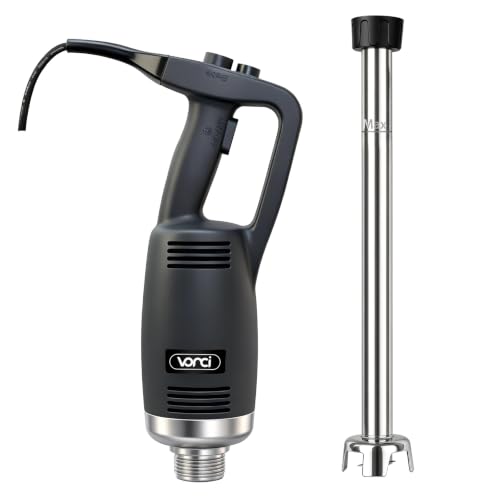
VONCI 750W Commercial 22in
VONCI finishes the list at the extremes: the longest shaft at 22 inches, detachable; the largest stated capacity at up to 64 gallons or 240 litres; 750W; variable speed; and a feature none of the others claim — a lock for hands-free operation. Its stated territory runs to thick sauces, mashed potatoes and pastes, the heavy end of the blending world.
Listing details
- Power in the title: 750W
- Shaft length printed: 22 inches, detachable
- Capacity stated: up to 64 gal / 240 L
- Speed control: variable speed
- Distinctive feature: lock for hands-free
- Stated territory: large-batch processing; thick sauces, mashed potatoes and pastes
Strengths
- Hands-free locking answers the real fatigue of long blends in huge batches
- Sixty-four gallons is the largest capacity printed in this group
- Thick mixtures are named as home territory, not treated as an edge case
Trade-offs
- A 22-inch shaft is cumbersome in shallow or small vessels
- No certification marks are printed in the title
- No horsepower figure accompanies the wattage
The hands-free lock is the most operationally interesting sentence in any of these six titles. Blending fifty or sixty gallons is not a thirty-second task; a vortex must be established, ingredients incorporated, texture checked. Holding a trigger through all of that, in steam, with one arm committed, is how technique degrades and accidents happen. A lock that keeps the machine running frees the cook to steady the vessel, feed ingredients, or simply rest the arm — a feature aimed squarely at production reality rather than showroom appeal.
Thick sauces, mashed potatoes and pastes, named in the title, are the loads that stall weak sticks. They resist the vortex, climb the shaft, and demand torque at low speed before they surrender. VONCI’s title walks toward that work deliberately, pairing the claim with variable speed — the control that lets a cook start a paste slowly and build. Whether the machine’s real-world torque matches its title’s confidence is a question only use can answer, but as a statement of intended work, this is the boldest positioning in the six.
Sixty-four gallons, like all capacities here, is the listing’s own figure. It places the VONCI beyond even the Big Stix in stated batch class, with two inches more shaft to reach the bottom of the vessels that implies. Kitchens should match that ambition to their actual largest pot; a machine specified for 240 litres, used daily in 20, is not a bargain but a burden, however good its lock feels.
Best for: production kitchens blending thick, huge batches who need hands-free running
Not suited for: shallow pans and small pots, where a 22-inch detachable shaft cannot work comfortably
Check price on Amazon — the VONCI 22-inch, for the deepest vessels and the thickest mixtures.
Numbers across the range
| Machine | Shaft | Power printed | Capacity printed |
|---|---|---|---|
| VEVOR | 20 in | 750W | Not printed |
| Waring WSB250 | 12 in | 750W | 10-gallon |
| Waring Big Stix | 21 in | 1 HP / 700 Watt | 50 gal |
| Robot Coupe MP 450 Turbo | 18 in | Not printed | Not printed |
| TK Tartle Kitchen | 16 in | 500W | 26 gal / 100 L |
| VONCI | 22 in | 750W | 64 gal / 240 L |
The grid exposes the category’s shape: shaft and capacity climb together, power stays in a narrow band, and two listings leave cells empty where their rivals print figures. A buyer who fills the empty cells from imagination is not comparing anymore — they are hoping, and commercial kitchens cannot run on hope.
What should a kitchen match first: shaft, capacity or speed?
Measure the deepest pot before anything else
Shaft length is a hard physical gate. A 12-inch shaft in a 16-inch-deep pot leaves the bottom unblended and the cook leaning into steam; a 22-inch shaft in a shallow pan cannot be angled to work at all. Measure the vessels you actually own, allow for the blade housing, and let that measurement strike machines from the list before any other comparison begins.
Size capacity to the batch you cook weekly
Capacity claims here span ten to sixty-four gallons, and the right figure is the batch you cook most often, not the largest you can imagine. A machine loafing far below its class is heavy and awkward; a machine at its ceiling every day works hot and hard. The weekly soup, sauce or mash batch is the number to shop against.
Decide how your cooks actually control speed
Two-speed and variable-speed machines suit different hands. Under service pressure, a two-position switch is operated by feel; for delicate emulsions and pastes, a dial’s gradations protect texture. Watch your own kitchen for a week: if nobody ever uses the middle settings on any appliance, the simpler control is not a compromise but a match.
Check the compliance paperwork your kitchen answers to
Inspected kitchens should start from marks, not motors. In this list only the TK title prints NSF and ETL, which makes it the default starting point for restaurants whose documentation matters — others may hold marks their titles omit, but a buyer can only shortlist from what is printed and then verify.
Technique: working a big stick in a big pot
Start submerged and start slow. The blade housing should be under the surface before the motor spins, or the first second of blending redecorates the range. With variable speed, begin low, let the vortex form, then climb. With a two-speed machine, the low setting exists precisely for those opening seconds. Hot liquids expand the rule’s importance: a surge in a near-full pot of soup is a burn looking for a victim.
Move in a pattern rather than parking in one spot. A slow figure-of-eight or a deliberate circuit of the pot’s floor, tilting the shaft gently, prevents the two classic failures: a blended centre surrounded by an untouched ring, and a vortex so stable it merely spins the same liquid past the blades. Thick mixtures need the shaft walked through them section by section, which is where the VONCI’s stated territory and its hands-free lock meet real technique.
Rest the machine as the work allows. Commercial sticks are built for duty cycles home units cannot match, but heat is still heat, and a motor worked continuously through a 64-gallon batch appreciates the pauses that ingredient additions naturally create. Build those pauses into the workflow — add, blend, rest, check — and texture improves along with the machine’s lifespan.
Kitchens equipping a whole prep line often shop the neighbouring categories in the same breath; the sets gathered in Best Nonstick Cookware Sets Removable Handle Covers are the usual companions to a new blending station.
Common mistakes when specifying a commercial stick blender
Buying shaft length by ambition instead of by tape measure. The deepest pot in the kitchen sets the requirement. A shaft bought for a kettle the kitchen does not own will spend its life being awkward in the pots it does own.
Treating the largest capacity claim as the best machine. Sixty-four gallons is a class, not a medal. Kitchens cooking ten-gallon batches gain nothing from it and pay in weight, storage and manoeuvrability.
Ignoring the shaft’s removal design until cleaning night. Interchangeable, removable and detachable are printed in these titles because professionals asked for them. A fixed long shaft turns the nightly wash into a wrestling match beside a sink it barely fits.
Assuming famous names print their full specifications in the title. The Robot Coupe listing proves otherwise: no wattage, no capacity, no speed description. Professional buyers must read documentation, not reputations, before committing a kitchen’s money.
Overlooking certifications until the inspector arrives. If your kitchen answers to NSF-minded inspection, the marks are a purchasing gate, not a bonus. Only one title in this list prints them; verify the rest individually rather than assuming.
Starting at full speed in a full pot. Every cook learns this once, usually wearing the evidence. Low first, vortex, then power — the sequence is the difference between blending and splashing, especially with the long shafts here.
Final recommendation
Match the machine to the pot and the paperwork, in that order. For the broad middle of professional cooking — ten-gallon batches, ordinary stockpots, service-speed decisions — the Waring WSB250 is the most honestly sized tool in this list, its interchangeable shaft and two speeds aimed at kitchens that cook rather than catalogue-shop. Kitchens blending across a varied menu in deep pots, with purées and smoothies beside the soups, will lean toward the VEVOR’s variable speed and specified stainless blade.
At production scale the choice narrows to temperament. The Big Stix brings Waring’s restaurant-grade framing, horsepower and a fifty-gallon claim; the VONCI answers with more shaft, more stated capacity and the hands-free lock that long, thick blends genuinely benefit from. Between them, kitchens that value the established marque and kettle work pick the former; kitchens whose signature work is mashed potatoes and pastes by the drum pick the latter.
The TK stands apart on paperwork: where NSF and ETL marks are a gate, it is the starting point and possibly the whole conversation. The Robot Coupe remains the connoisseur’s option — an 18-inch professional standard whose title asks you to verify everything else in documentation. And prep kitchens planning the drinks-and-desserts station alongside might note that Best Radiant Cooktops 36inch covers the range these blenders’ pots will sit on.
Cleaning and storing long shafts without drama
The working end of a stick blender lives in food, so its cleaning decides the machine’s hygiene reputation. Detachable designs — claimed in various words by the Waring pair, the TK and the VONCI — let the shaft go to the sink or the wash area while the motor stays dry and safe on a shelf. Blend a pot of hot soapy water for a few seconds immediately after use and most residue surrenders before it sets; the deep clean then becomes a rinse and inspection rather than an excavation.
Storage is the long shaft’s quiet problem. A 22-inch shaft does not fit drawers; kitchens typically hang these machines or rest them in a dedicated tall container near the range. However it is stored, the blade guard should be protected from knocks and the cord kept loose. Machines that live within arm’s reach of the pots get used; machines exiled to a distant cupboard get substituted by inferior tools, and the kitchen quietly stops blending in the pot at all.
Home-based food businesses working from domestic kitchens face a smaller version of the same logistics, and the baby-food makers among them often pair a commercial stick with gentler tools — Best Hand Blenders for Baby Food covers that domestic end of the family.
Duty cycles and the working life of a commercial motor
Commercial in these titles is a promise about endurance as much as power. A domestic stick blender asked to work a ten-gallon soup will overheat, rest, and eventually fail; the machines here are framed for repeated, lengthy runs across a service. That framing shows in the details the titles choose to print: horsepower alongside watts, submersible construction, shafts built to detach for the washing that heavy use demands. None of the titles prints a duty-cycle figure, so endurance comparisons beyond those signals belong to manufacturer documentation — another honest blank this guide leaves blank.
What a kitchen controls is how the machine is treated within its class. Blending in sensible bursts, keeping the blade submerged so the motor is not racing unloaded, and cleaning the shaft before residue bakes on all extend working life more reliably than any specification. The cooks who get a decade from a commercial stick are the ones who treat it as the kitchen’s engine rather than its disposable gadget.
Ergonomics: the arm is part of the specification
No title here prints a weight, yet every cook who has blended twenty gallons knows the arm is where commercial blending is truly specified. A long shaft acts as a lever: the further the blade sits from the hand, the more every wobble at the pot’s floor is amplified at the grip, and the more the cook’s shoulder pays for the vortex. This is the practical context for the VONCI’s hands-free lock — it is not a convenience feature but an ergonomic intervention, transferring endurance from the cook’s arm to the machine’s mount and motor.
Grip and switch placement decide the rest. A switch that must be held continuously is a safety philosophy: release and the blades stop, which protects fingers and pot linings alike, at the cost of fatigue on long runs. A lockable switch reverses the trade. Kitchens should choose consciously, matching the control philosophy to the work — short, varied blends favour the dead-man’s switch; long, uniform production runs favour the lock, with the discipline to stay present while it runs.
Two-handed technique helps on the biggest machines regardless of switch type: one hand steering the shaft, the other steadying the vessel or resting ready at the control. The Big Stix class of machine, working in fifty gallons, rewards a cook who treats blending as a physical station task — stance, reach, cord routed behind — rather than as an afterthought performed one-handed while the other hand seasons something else.
From soup to sauce: matching the machine to the mixture
Thin mixtures — broths, light soups, drinks — are the easy class. Any machine here will move them; the skill is avoiding the aeration that a too-fast start whips into them. Variable speed earns its keep by letting the cook keep the vortex below the foaming threshold, and the two-speed WSB250’s low setting exists for exactly this opening phase.
Medium mixtures — most soups at serving texture, sauces, fruit purées — are the category’s centre of gravity. Here the shaft must be walked through the pot, because a stationary stick polishes one cylinder of liquid and leaves the corners coarse. The VEVOR’s stated menu lives in this class, and its variable speed plus 20-inch reach describe a machine built to tour a deep pot thoroughly.
Thick mixtures — mashed potatoes, pastes, dense sauces — are where titles make their boldest claims and motors earn their money. The VONCI names them outright. Thick loads climb shafts, resist vortices and punish impatience; the technique is low speed, small movements, and time. A kitchen whose reputation rides on a smooth mash or a glossy paste should weight this class heavily, because a machine that is merely adequate here will be found out every single service.
Frozen and fibrous ingredients sit at the edge of the category. None of these titles claims ice-crushing or heavy fibrous work, and this guide does not volunteer the claim on their behalf. Sticks in this class are liquid-and-soft-solid machines; asking them to mill raw fibrous matter is how shafts bend and motors cook. Keep the category boundary where the titles draw it.
Buying for a kitchen that will grow
New kitchens habitually underbuy blending capacity, because the opening menu is small and the opening pots are smaller. Within a year, the soup batch doubles, a catering enquiry arrives, and the stick that was adequate is suddenly the bottleneck standing in steam. The titles here offer a natural growth ladder: the WSB250’s ten gallons for the opening act, the TK’s twenty-six for the established restaurant, the fifty and sixty-four gallon machines for the production chapter. Buying one rung above today’s need is the classic compromise — present-day handling stays sane, and the growth year does not begin with an equipment emergency.
The counter-argument deserves its due: overshot machines are heavier, longer and more awkward every single day, not only on the day the big batch arrives. A kitchen that will plausibly never cook beyond fifteen gallons should not volunteer for a 22-inch shaft out of optimism. Growth planning means reading your own trajectory honestly — covers per service, batch history, the size of the largest vessel on the range today — and letting those facts, rather than the catalogue’s biggest number, set the rung.
The second stick: why serious kitchens own two
Watch a mature kitchen long enough and a pattern emerges: the big machine has a smaller partner. The production stick handles kettles and drums; a compact stick handles the two-gallon sauce, the quick emulsion, the tasting-batch purée. The pairing mirrors this list’s own shape — a WSB250-class machine beside a Big Stix or VONCI — and it exists because using a 21-inch shaft in a small pot is not merely awkward but genuinely worse at the job, splashing, under-submerging and tiring the arm for nothing.
There is also a continuity argument. When the only stick in a kitchen fails mid-service, the menu fails with it; soups cannot be finished, sauces cannot be smoothed. A second, smaller machine is insurance that also earns its keep daily, which is the best kind. Kitchens equipping from zero might sequence the purchases the other way from intuition: the mid-size machine first, since it covers the most services, then the giant when batch sizes prove the need, then — if the giant becomes the workhorse — the compact partner for the small work the giant does badly.
Allergen and flavour separation supply a third reason in some operations. A stick reserved for nut-free or allergen-controlled production, cleaned and stored apart, simplifies a kitchen’s safety story. The interchangeable-shaft machines speak to this too: shafts can be swapped and washed between tasks more rigorously than a fixed unit can be cleaned in place, which is one more reason the titles’ shaft language earned its prominence in the choosing criteria.
What the plug tells you: a note on the electrical lines
Two titles print electrical details and they are worth reading closely. The Big Stix specifies 120V with a 5-15P plug — the standard North American commercial receptacle — which tells a buyer the machine runs from ordinary kitchen circuits without rewiring. The Robot Coupe prints 120-volts and stops there. The other titles omit electrical information entirely, and for equipment of this class the omission simply returns the buyer to documentation, where voltage, plug and circuit expectations should always be confirmed before a machine is scheduled into a kitchen’s power plan.
The deeper point is that commercial kitchens run many hungry devices at once, and a stick blender joins a circuit shared with kettles, mixers and refrigeration. Knowing a machine’s draw — derivable from its printed wattage where given — is part of placing it sensibly. The titles that print power figures are, perhaps unintentionally, also printing circuit-planning information, and kitchens that read them that way will have fewer tripped breakers interrupting a service at the exact moment the soup reaches texture.
A service, hour by hour, with the right stick
Morning prep is where the mid-size machines justify themselves. The soup of the day comes together in a ten-to-twenty-gallon pot, vegetables softened, stock added, and the stick tours the pot until the texture turns. A variable-speed machine starts the blend gently under a lid of steam; a two-speed machine does the same work with a low-then-high rhythm that experienced cooks perform without thinking. Either way, the alternative — ladling hot soup into a countertop jar in batches — costs twenty minutes and a scalded wrist’s worth of risk, which is the entire reason this category exists.
Midday service asks different things: a sauce refreshed, a purée finished to order, an emulsion rescued. These are small, urgent jobs, and they favour the compact end of the range — the machine that can be grabbed, used for forty seconds, rinsed and re-holstered. Kitchens that own only a giant learn to dread these moments; kitchens with a compact partner barely notice them.
Evening production, in the operations that run it, belongs to the big shafts. Tomorrow’s mash, the week’s sauce base, the banquet soup — batches at the fifty-gallon scale where the hands-free lock stops being a feature and becomes the shift’s quiet hero. The cook sets the vortex, monitors, adjusts, and the machine holds its note. When the batch is done, the detachable shaft goes to the wash, the motor to its hook, and the kitchen’s most versatile tool is ready to begin again at dawn.
Warranty, parts and the long view
Commercial equipment is bought as a working asset, and the titles here hint at the parts story without telling it. Interchangeable and removable shafts imply replaceable shafts — the component most exposed to damage is the component designed to be renewed. That design philosophy, printed in four of these six titles in one wording or another, is the strongest available signal about how each manufacturer expects the machine to age: not as a sealed unit discarded whole, but as a motor with a renewable working end.
Buyers should still verify parts availability and warranty terms in documentation before purchase, because no title here prints them and this guide will not invent them. The questions are standard: are shafts sold separately, in which lengths, and does the warranty contemplate commercial use — a real distinction, since some warranties quietly exclude the very kitchens these machines are marketed to. A machine whose title says commercial and whose warranty agrees is the complete package; the title alone is only the first half of that sentence.
Kept clean, stored dry, worked within its batch class and fitted with a fresh shaft when the old one tires, a commercial stick should outlast several domestic equivalents bought in sequence. That longevity, more than any single blend, is what the commercial premium purchases — and it is why the kitchens that buy these machines tend to describe them by name and years of service rather than by model year.
Safety around steam, blades and big volumes
The hazards of this category are plain and manageable. Hot liquid is the first: always blend with the blade housing fully submerged, start at the gentlest setting the machine offers, and keep free hands and loose clothing clear of the pot’s rim. The second hazard is the blade itself, exposed in a way jar-blender blades are not; shafts should be treated as live until unplugged, and the wash routine should begin with the machine disconnected, every time, without exception for haste.
Volume adds a third consideration — stability. A cook leaning over a kettle with a long shaft is working at height and over heat; the station should be arranged so the stance is balanced, the cord routed away from burners, and the pot beyond any risk of being pulled. Kitchens that brief these basics once, and post them where the machine hangs, rarely meet the accidents that give the category its occasional scary stories. The machines are powerful servants; the rituals around them are what keep them servants.
A closing word on brands and loyalty
Professional kitchens are loyal creatures, and this list contains the names that inspire the loyalty — Waring twice, Robot Coupe once — alongside challengers competing on specifications and certifications. Loyalty earned over years of services is real evidence, but it is evidence about the past range as much as the present listing. The disciplined buyer honours it by shortlisting the trusted names first, then subjects them to exactly the same printed-fact comparison as the challengers. When the trusted name wins on the facts, the purchase is doubly sound. When a challenger wins — on marks, on capacity, on a hands-free lock — loyalty has done its proper job, which is to be the tiebreaker, not the verdict.
Frequently asked questions
What shaft length does a typical stockpot need?
Match the shaft to the pot’s depth with the blade housing submerged and your hand clear of the rim. Twelve inches serves modest stockpots; sixteen to eighteen covers most commercial vessels; twenty and beyond is kettle territory. Measure the deepest pot you own rather than guessing from its labelled volume.
Why do capacities in these titles vary so wildly?
Because commercial kitchens vary wildly. Ten gallons is a bistro’s soup batch; sixty-four is a production run. Each figure is the manufacturer’s stated batch class for that machine. Shop against the batch you cook weekly, and treat a far larger claim as surplus weight rather than superiority.
Is variable speed worth having in a commercial kitchen?
For soups alone, two speeds often suffice and decide faster under pressure. For purées, pastes, emulsions and thick sauces, variable control protects texture and prevents the opening surge that splashes hot liquid. Kitchens blending across that range benefit most, which is why four of these six titles print it.
Do I need NSF or ETL marks on a stick blender?
If your kitchen is inspected, quite possibly — those marks speak to sanitation design and electrical safety testing respectively. Only the TK title in this list prints them. Others may hold marks their titles omit, but that must be verified in documentation rather than assumed from brand reputation.
Can a commercial stick blender replace a countertop blender?
For soups, sauces and purées in the pot, largely yes, and it handles volumes no jar can. For ice crushing, small quantities and the finest nut butters, a jar blender keeps advantages. Most professional kitchens run both, reaching for the stick whenever the batch outgrows the jar.
Measure the pot with a tape rather than an estimate, size the batch by the week you actually cook rather than the feast you imagine, read the marks your kitchen answers to before you read the wattage — and the right stick blender stops being a gamble and becomes what it should be: the tool that turns the biggest pot on the range into the easiest, calmest blend of the working day.


