What's inside
- Where to buy the six blenders
- Quick picks
- How these picks were chosen
- Each blender, reviewed on its title’s evidence
- All six blenders, one comparison
- What should you look for in a hand blender for baby food?
- Batch cooking and freezing, the workflow these tools serve
- Produce by produce: where each style of blender earns its keep
- Reading wattage and speed counts without being misled
- Mistakes that make purées harder than they need to be
- Final recommendation
- Questions from the purée trenches
As an Amazon Associate I earn from qualifying purchases. This post may contain affiliate links at no extra cost to you.
As an Amazon Associate, cottageverdict.com earns from qualifying purchases.
Making baby food at home starts with good intentions and a steamer basket, and it succeeds or fails on the texture of the result. A purée that looks smooth in the pot can still hide fibrous threads and stubborn lumps, and the tool that decides the difference is the blender doing the work. The best hand blenders for baby food earn that description in the listing titles themselves in most cases here: four of the six picks below name baby food outright, while two stay silent on the subject and are reviewed honestly on that basis. An immersion blender suits this job for a practical reason beyond power. It works inside the cooking pot, so a batch of steamed carrots moves from stove to smooth without a transfer to a countertop jug, without the jug’s washing-up, and without the yield loss that clings to every extra vessel.
The six models gathered here span a wide field: a 1000W five-in-one kit at one end, a simple two-speed 300W stick at the other, and between them a 20-speed set with a chopper bowl, a Braun with a masher attachment, a variable-speed trigger model guarding pan coatings, and a cordless blender that runs on a rechargeable battery. That spread is deliberate. Baby food preparation looks like one task from the outside and is actually a sequence of tasks across a year, and the sections below keep returning to that sequence, because a blender that is perfect for month one of weaning can be merely adequate by month nine, and the reverse is also true. Wattage, speed counts, and accessory lists all come from the listing titles, quoted as the manufacturers state them. Where a title does not give a figure, the spec box records the silence. One framing note before the detail: this roundup discusses texture, batch handling, cleaning, and ordinary food-preparation hygiene. It makes no claims about infant nutrition or health, because a blender listing is not a source for either, and parents should take feeding guidance from their own clinician and current official guidance rather than from kitchenware copy.
Where to buy the six blenders
Each model below is sold on Amazon, and every full review carries its own link. A brief orientation to the six names first.
The KOIOS five-in-one kit leads on paper strength: 1000W, twelve speeds, a food processor attachment, a beaker, an egg whisk, and a milk frother around a 304 stainless steel blade, with Non-BPA wording in the title. OVENTE’s HS560R strips the idea back to a corded 300W stick with two speeds and stainless blades, finished in red. Bonsenkitchen’s four-in-one answers with twenty speeds plus a turbo mode, a 24 oz beaker, and a chopper bowl. Braun’s MultiQuick Vario 5 brings twenty-one speeds, a 500W motor, and the only masher in the group. FRESKO’s entry is built around a variable-speed trigger and an anti-scratch stainless shaft. DASH closes the list as the cordless option, rechargeable, in French Grey.
Quick picks
| Pick | Best for | Standout detail from the title |
|---|---|---|
| KOIOS 1000W 12-Speed 5-in-1 | One kit covering purée, whisking and frothing | 1000W, 12 speeds, food processor and beaker included, Non-BPA stated |
| OVENTE HS560R Red 300W | Small daily batches with minimal kit | 300W, 2 mixing speeds, stainless steel blades, corded |
| Bonsenkitchen 4-in-1 20-Speed with Processor | Chopping alongside blending | 20 speeds and turbo, 24 oz beaker, chopper bowl, egg whisk |
| Braun MultiQuick Vario 5 with Masher | Texture variety from one handle | 21 speeds, 500W, masher, chopper and whisk on EasyClick |
| FRESKO Immersion Blender Variable Speed | Coated pans and gentle starts | Variable speed trigger, anti-scratch stainless steel shaft |
| DASH Cordless Immersion Blender Grey | Blending at the stove with no cord | Rechargeable battery, stainless steel blades, blends in the pot |
How these picks were chosen
The first pass sorted listings by relevance to the actual task: turning cooked vegetables, fruits, and grains into smooth purées in household batch sizes. Four titles say baby food in so many words, and those four anchor the list. The remaining two slots went to models whose titles support purée work generally, and the roundup flags their silence on baby food rather than papering over it. The Braun earned its place through its masher attachment, a tool whose whole purpose is controlled, lump-managed mashing of soft cooked food. The DASH earned its place through the word purees in its own title and a cordless format that changes how the tool moves around a stove.
Accessory spread formed the second criterion, because baby food preparation is rarely blending alone. Steamed vegetables need chopping before or after, egg whisk and frother attachments serve the rest of the household, and a beaker sized to a small batch keeps the blender head submerged, which is what makes a stick blender produce a smooth result instead of a splashed one. Speed range formed the third: puréeing fibrous produce asks for both a gentle start, so the pot’s contents do not leap, and a strong finish, so skins and fibres break down. Wattage was recorded where printed, with the caveat that wattage figures across brands are not measured on one shared standard, so the number informs rather than decides.
Hygiene documentation formed a quieter criterion. Titles that address food-contact materials, the KOIOS Non-BPA wording being the clear example, were credited for answering a question every parent asks, while titles silent on materials were not penalised beyond noting the silence, since the manufacturer’s full documentation often covers what a title cannot fit. The same restraint applied to dishwasher claims: none of the six titles settles which parts are dishwasher safe, so this roundup gives no dishwasher verdicts and directs readers to each maker’s documentation for the parts list.
Excluded along the way: dedicated baby food maker appliances, which are a different product class built around steaming cycles, and manual food mills, which involve no motor at all. Also excluded were models already used in earlier rounds of this research programme, even where a colour variant existed, so that this list adds new information rather than repeating it. What remains is six genuinely different answers to one small daily job.
Each blender, reviewed on its title’s evidence

KOIOS 1000W 12-Speed 5-in-1
KOIOS presents the most complete kit in this roundup. The title lists a 1000W motor, twelve speeds, a 304 stainless steel blade, and a five-in-one accessory set comprising a food processor, a beaker, an egg whisk, and a milk frother around the main stick. Baby food is named directly in the title, alongside smoothies and purée work generally, and the title also carries Non-BPA wording for the plastic parts. For a household equipping itself for a full season of batch cooking, this is the pick that arrives with the fewest gaps to fill later.
Power stated: 1000W
Speeds: 12
Attachments named: food processor, beaker, egg whisk, milk frother
Blade material: 304 stainless steel
Baby food in title: yes, named directly
Strengths
- The food processor attachment handles the pre-chop of firm steamed vegetables before the stick finishes them smooth.
- Twelve speeds give a genuinely low starting gear, which keeps a shallow beaker of purée inside the beaker.
- Non-BPA wording is printed in the title for the plastic components, a detail many rival titles skip.
Trade-offs
- Five-in-one kits multiply washing-up; every attachment used in a session needs cleaning and storage.
- The title gives no beaker capacity, so batch sizing against your freezer trays needs the manufacturer’s documentation.
- 1000W in a small beaker is easy to over-run; short bursts protect both texture and motor.
Power is this blender’s headline and its main handling lesson. A 1000W stick in a deep pot of steamed sweet potato is a pleasure, pulling the mixture down and finishing it silky quickly. The same motor in a half-full beaker can empty the beaker onto the counter if started at full speed, which is why the twelve-speed dial matters more than the wattage figure: begin at the bottom, let the vortex form, then climb. The processor attachment earns its shelf space during the Sunday batch session, when carrots, parsnips, and chicken all need reducing at different textures, and the whisk and frother carry the tool into ordinary family cooking between baby batches, so it does not sit idle once the purée stage of life passes.
The 304 stainless blade designation is worth decoding, since it is the only grade specified anywhere in this roundup. 304 is the food-industry workhorse grade, chosen for corrosion resistance against exactly the acidic loads a baby food kitchen produces daily: tomato, apple, citrus in family cooking. A blade in that grade tolerates being left wet on the draining board better than lesser steels, though prompt drying remains the habit to keep. The designation also signals that KOIOS expects the blade to be judged as a food-contact component, which aligns with the Non-BPA wording elsewhere in the same title: the listing is consciously addressing the materials question that parents ask first.
Cleaning deserves its own sentence in any baby food context, because the routine is daily. A stick blender’s advantage is that the shaft can be rinsed and washed immediately after use, before residue dries into the blade housing. The KOIOS adds attachments to that routine, and each one is a surface that needs the same prompt attention. Where blending happens in the pot and the shaft is rinsed in the same motion, this kit may be more than the routine needs; a weekly batch-cooking routine will use every piece.
Best for: a weekly batch-cooking routine where the processor attachment pre-chops and the stick finishes, all from one 1000W handle. Not suited for: a single small beaker of purée blended at full speed, where this motor’s strength works against a shallow load.
Check price on Amazon to see the full five-in-one kit contents.
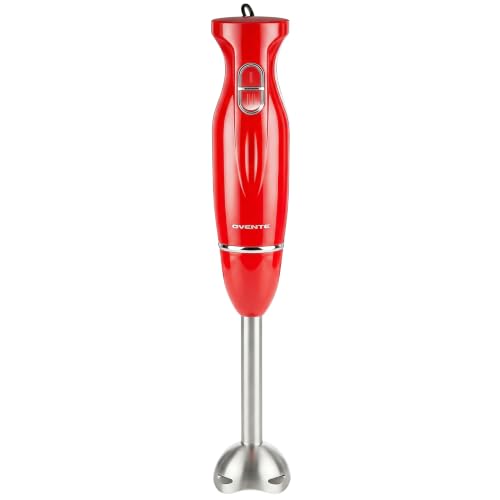
OVENTE HS560R Red 300W
OVENTE’s HS560R is the minimalist of the group: a corded electric hand blender rated at 300W, two mixing speeds, stainless steel blades, and a red finish, with baby food named in the title among smoothies and purees. There is no attachment ecosystem here, no beaker listed, no whisk. What the title describes is a single-purpose stick that plugs in, blends, rinses, and goes back in the drawer, and for the specific rhythm of making small fresh batches daily, that simplicity is a coherent design rather than a missing feature.
Power stated: 300W
Speeds: 2 mixing speeds
Attachments named: none in the listing title
Blade material: stainless steel
Baby food in title: yes, named directly
Strengths
- Two speeds are genuinely enough for soft steamed produce, the core of early purées.
- A single stick with no attachments is the fastest cleanup in this roundup.
- Corded power means no battery state to manage before a hungry baby’s meal.
Trade-offs
- 300W is the lowest figure here; dense mixtures like thick bean purée will work it harder.
- No beaker is listed, so blending happens in the cooking pot or a jug already owned.
- Fibrous produce may need longer blending and a stir midway to reach a smooth finish.
The case for this blender rests on matching tool to material. The foods that dominate the first months of home preparation, steamed carrot, squash, pear, apple, sweet potato, are soft by design, and a 300W stick with sharp stainless blades reduces them without drama. Struggle begins at the edges of the repertoire: chickpeas, lentils cooked firm, or mixtures thickened with grains ask more of the motor, and the honest technique there is adding cooking liquid gradually and blending longer rather than forcing the head through a stiff mass. Two speeds support that technique adequately, low to incorporate, high to finish.
Grandparents’ houses and childminders form a quiet second market for a tool like this, and the OVENTE suits it well. A simple two-speed stick can be bought for a second kitchen without duplicating a whole kit, explained to another caregiver in one sentence, and used for the midday batch wherever the child spends the day. Consistency of texture across two homes helps a baby accept food in both places, and the cheapest route to that consistency is the same simple tool in both kitchens rather than a flagship in one and improvisation in the other.
There is also a storage argument. Kitchens in the baby stage accumulate equipment at an alarming rate, and a lone stick that lives in the cutlery drawer earns its keep differently from a boxed kit that needs a cupboard. The red finish, trivial as it sounds, makes the tool easy to spot in a crowded drawer at the exact tired moment when spotting matters. Nothing in the title promises more than the tool delivers, and that alignment between claim and object is worth something in a category full of inflated kits.
Best for: daily small batches of soft steamed produce, blended in the pot and rinsed in under a minute. Not suited for: thick chickpea or firm lentil mixtures at full pot depth, where 300W and two speeds run out of headroom.
The OVENTE stick’s current listing is at Check price on Amazon.

Bonsenkitchen 4-in-1 20-Speed with Processor
Bonsenkitchen’s entry counters the OVENTE’s restraint with range: twenty speeds plus a turbo mode, in a four-in-one emulsion blender set carrying an egg whisk, a 24 oz beaker, and a chopper bowl. Baby food is named in the title, as are smoothie and soup duty. The title does not print a wattage figure, and the spec box records that absence rather than estimating one. Twenty speeds on a stick blender is a granularity most cooks will use as three broad zones, gentle, working, and turbo, but the fine dial does allow a slower, more controlled start in a full beaker than a two-speed tool can offer.
Power stated: not given in the listing title
Speeds: 20 speeds and turbo mode
Attachments named: egg whisk, 24 oz beaker, chopper bowl
Beaker capacity: 24 oz
Baby food in title: yes, named directly
Strengths
- The 24 oz beaker is sized in the title, letting a cook match batch volume to freezer portions without guessing.
- A chopper bowl covers the fine dice of cooked vegetables before blending, useful for stage-two textures.
- Turbo mode gives a short finishing burst for the last fibrous threads in a purée.
Trade-offs
- With no wattage printed, power comparisons against the KOIOS or Braun rest on the manufacturer’s documentation.
- Twenty speed settings invite fiddling; most purée work will live at three points on the dial.
- The chopper bowl adds a lidded vessel to the wash pile on batch days.
The chopper bowl quietly changes what this tool can do across a child’s first year of eating. Early purées want total smoothness, which the stick in the beaker delivers. Later, the goal shifts to soft lumps and minced textures that encourage chewing, and a chopper bowl produces those evenly in seconds, where a stick blender tends to overshoot into smoothness or leave uneven chunks. Owning both mechanisms on one handle means the texture ladder, smooth, mashed, minced, can be climbed with one appliance. The beaker’s stated 24 oz capacity suits that arc too: generous for a week of first tastes, modest enough that later batches stay fresh.
Portion maths makes the beaker’s stated size concrete. A 24 oz batch divides into roughly twelve small freezer portions of the size a baby eats in the early weeks, or six generous portions for an older infant, which maps neatly onto a week of one meal a day or half a week of two. Knowing the vessel’s capacity from the title lets a parent plan the steamer load to match, instead of blending whatever resulted and discovering the mismatch at the freezer. It is a small example of a general rule in this roundup: the listings that print their figures save their buyers real planning effort.
Turbo mode deserves a practical note. Used as a two-second finish, it polishes a purée. Used continuously, it heats the mixture through friction and strains the motor, and it can whip air into a purée that then oxidises faster in the fridge. The twenty-speed dial rewards the same discipline: the correct speed is the slowest one that keeps the mixture moving, and the title’s wide range simply gives more room to find it across ingredients from steamed pear to cooked lentils.
Best for: a household planning to climb the texture ladder from smooth purée to minced family food on one handle with a sized beaker. Not suited for: a purchase that requires the motor’s wattage confirmed in the title, since this listing leaves the figure out.
Review the Bonsenkitchen set and its beaker sizing via Check price on Amazon.

Braun MultiQuick Vario 5 with Masher
Braun’s MultiQuick Vario 5 arrives with the strongest brand claim in the group, a number-one hand blender brand statement in its own title, and a specification to match: twenty-one speeds, turbo boost, a 500W motor, SplashControl technology, an EasyClick accessory system, and attachments for chopping, whisking, and mashing. One honesty point must lead the review. This title does not mention baby food. Its place here rests on the masher attachment and on general purée capability, and the spec box records the omission plainly: baby food use not stated in the listing title. Judged on what the title does say, this is a texture specialist.
Power stated: 500W
Speeds: 21-speed with turbo boost
Attachments named: chopper, whisk, masher
Named technologies: SplashControl, EasyClick
Baby food in title: not stated in the listing title
Strengths
- The masher attachment produces controlled, even mash textures that a blade alone cannot replicate.
- SplashControl is named in the title, aimed at the mess that defines blending in open pots.
- EasyClick swapping means the chopper, whisk, and masher change over with one hand during a session.
Trade-offs
- Baby food never appears in the title, so suitability rests on the masher’s general purpose rather than a stated one.
- Twenty-one speeds exceed what purée work can distinguish; the dial’s low end matters more than its count.
- The title names no beaker, so small-batch blending needs a vessel already in the kitchen.
Brand heritage cuts both ways and should be weighed coldly. Braun’s hand blender line is long-established, and the title’s number-one claim is the company’s own assertion rather than an independent finding, so it should be read as marketing confidence, not evidence. What can be assessed from the listing is the coherence of the package: the speed count, the named splash-control design, the one-handed operation claim, and an attachment set with no filler pieces. On that evidence the Vario 5 is a thoroughly thought-through tool whose only gap, for this roundup’s purpose, is the absence of the two words baby food.
The masher is the reason to linger on this pick. A blade blender makes food smoother by cutting; a masher makes food softer by pressing, and the difference shows in foods where cutting releases starch and turns gluey, potato being the famous case. For a baby moving from purée to fork-mashed textures, a powered masher produces the even, lump-managed consistency that encourages the transition, without the gummy result a blade can give starchy vegetables. Paired with the chopper for mincing and the blade shaft for true purées, the Braun covers the full texture range with mechanisms matched to each stage rather than one blade asked to do everything.
SplashControl and the ergonomic, single-hand operation claims address the other reality of this cooking: it usually happens with a baby in the other arm or in a sling. A blender that starts gently, resists splashing at the pot’s surface, and swaps attachments one-handed respects the actual conditions of the work. The 500W figure sits mid-list, adequate for the soft and medium mixtures that dominate this repertoire, and the turbo boost covers the finishing seconds. None of that converts the title’s silence on baby food into a claim; it simply makes the masher-led case on the evidence available.
Best for: the mashed and minced texture stages, where the masher attachment and one-handed attachment swaps match how this cooking actually happens. Not suited for: a shortlist that requires baby food to be named in the listing itself, since this title confines itself to mashing, chopping, and whisking.
See the Braun Vario 5 configuration at Check price on Amazon.

FRESKO Immersion Blender Variable Speed
FRESKO builds its pitch around control and care for cookware. The title describes a handheld immersion blender with a variable speed trigger, an anti-scratch stainless steel shaft, and stated suitability for soups, shakes, baby food, and puree. The trigger is the distinguishing mechanism: like a drill’s throttle, it lets the hand holding the blender feather the speed continuously rather than stepping between fixed gears. Baby food is named directly. Wattage, notably, is absent from the title, and the spec box says so.
Power stated: none stated in the listing
Speed control: variable speed trigger
Shaft: anti-scratch stainless steel
Attachments named: none in the listing title
Baby food in title: yes, named directly
Strengths
- A trigger gives continuous speed control, the gentlest possible start in a shallow pot of purée.
- The anti-scratch shaft speaks directly to nonstick and enamelled pots, the vessels baby food is usually cooked in.
- A single stick keeps the routine to blend, rinse, and store, with nothing else to wash.
Trade-offs
- No wattage is printed, so dense mixtures are a leap of faith the documentation must settle.
- No attachments are listed; whisking and chopping stay with other tools.
- Trigger control rewards a steady hand, and tired hands can surge the speed unintentionally.
The anti-scratch shaft deserves more attention than it usually gets, because the pot is half the baby food system. Most small-batch cooking happens in a favourite saucepan, frequently nonstick or enamelled, and a bare metal blender bell dragged around its base during daily use will mark the coating over a season. A shaft designed to be kinder to that surface protects the pan the household already owns. Combined with the trigger, which lets the cook start at a whisper while the head is still settling into the mixture, the FRESKO shows a design aimed at the daily, careful, small-scale end of this work rather than at headline power.
Trigger control also changes how blending sounds, and sound is information. A cook feathering a trigger hears the motor labour as the mixture thickens and eases it back before the strain peaks; a cook on a fixed high gear hears the same labour only after the fact. For fibrous mixtures, that live feedback encourages the pause-and-stir rhythm that produces the smoothest result. It is a subtle advantage, and it costs nothing, but it only materialises with attentive blending rather than holding the tool at full pull and waiting.
Its limits are the mirror of its focus. When the repertoire grows to include family soups in a stockpot or frozen-fruit smoothies, an unstated wattage and a lone stick format may feel thin, and the household will reach for a bigger tool. Within the stated brief, soups, shakes, baby food, and puree, the title’s promises are modest and coherent. The variable trigger also teaches good technique by default: a feathered trigger produces shorter, cooler bursts, which is kinder to both the motor and the food.
Best for: daily purées made in a nonstick saucepan, where the anti-scratch shaft and feathered trigger protect pan and mixture alike. Not suited for: a stockpot of family soup or a frozen smoothie habit, duties this title never claims and its unstated wattage leaves open.
The FRESKO blender’s listing can be found through Check price on Amazon.

DASH Cordless Immersion Blender Grey
DASH removes the cord. Its title describes a cordless immersion blender with stainless steel blades in a French Grey finish, built for soups, sauces, purees, and mayo, blending right in the pot on a rechargeable battery. The honesty flag for this pick: the title says purees generally and never says baby food, and the spec box records that. What the cordless format offers this particular job is freedom of position. A parent can blend at whichever burner is free, at the counter beside the freezer trays, or at a grandparent’s stove, without hunting for a socket within cord’s reach of the pot.
Power source: rechargeable battery, cordless
Power stated: no wattage given in the title
Blade material: stainless steel
Finish: French Grey
Baby food in title: not stated; title says purees generally
Strengths
- No cord means no cord dragging across burners or knocking the pot as the blender circles it.
- Blending right in the pot, as the title puts it, keeps yield in the food rather than on a jug’s walls.
- A rechargeable tool travels between kitchens, useful for childcare split across homes.
Trade-offs
- Battery state becomes a prep step; a flat battery at mealtime has no corded fallback.
- The title gives neither wattage nor speed settings, so strength is unquantified in the listing.
- Baby food is not named, so the case rests on the title’s general purees wording.
Cordless blending changes technique in small ways that suit this work. Without a cord dictating where the cook stands, the pot can stay on a back burner, away from the front edge, while the blender works. The tool also moves to the food rather than the reverse: a tray of steamed vegetables cooling on the counter can be blended where it sits. Against those conveniences stands the discipline of charging. Plugged in beside the kettle after each use, the battery never needs thinking about again; stored away in a drawer, it eventually produces the flat-battery mealtime, and the title offers no runtime figure to plan around, so the manufacturer’s documentation carries that question.
Charging logistics deserve planning rather than complaint. A cordless blender that lives on its charger on the counter is, in practice, always ready, and its footprint there is smaller than a corded stick’s drawer tangle. Cordless kitchen tools only struggle in homes where they are stored away unplugged. Decide the charging spot before the first use, near where the blending happens, and the format’s only real cost disappears. The French Grey finish, incidentally, hides the inevitable turmeric and carrot staining of this work better than a white housing would, a practical mercy well known to every cook with a season of orange vegetables behind them.
Mayo in the title is a small tell about the tool’s intended emulsifying competence, and sauces likewise suggest it handles warm, liquid mixtures confidently. For purées of steamed vegetables, the deciding unknowns are sustained power under load and how the speed is controlled, neither of which the title specifies. This is therefore the pick to choose for its format, with eyes open about its paperwork, rather than for any quantified performance claim.
Best for: blending at a back burner or a second home’s stove, where the missing cord matters more than an unquantified motor. Not suited for: a charging routine likely to be forgotten, or a shortlist that requires baby food named in the listing before the tool is trusted with it.
Look over the DASH cordless model at Check price on Amazon.
All six blenders, one comparison
| Blender | Power as titled | Speed arrangement | Kit included | Baby food named? |
|---|---|---|---|---|
| KOIOS 5-in-1 | 1000W | 12 speeds | Processor, beaker, whisk, frother | Yes |
| OVENTE HS560R | 300W | 2 speeds | Stick only | Yes |
| Bonsenkitchen 4-in-1 | Not printed | 20 speeds + turbo | Whisk, 24 oz beaker, chopper bowl | Yes |
| Braun Vario 5 | 500W | 21 speeds + turbo boost | Chopper, whisk, masher | No |
| FRESKO | Not printed | Variable trigger | Stick only | Yes |
| DASH Cordless | Battery, figure not printed | Not specified | Stick only | No, purees generally |
Kit weight tells its own story in the middle column. Two picks are sticks alone, two carry four or five functions around the handle, and two sit between with three attachments or a bowl-and-beaker pairing. None of those shapes is inherently superior; each maps onto a household pattern described in the reviews, and the table’s purpose is to make the mapping visible before the detail sections argue it.
The named-or-not column is the one to read twice. Four listings promise baby food in their own words; two promise purée capability in general terms, and this roundup treats that difference as information, not as a disqualification.
What should you look for in a hand blender for baby food?
Does the blender head stay submerged in a small batch?
A stick blender only works smoothly when its blade bell sits fully under the mixture’s surface. Above the surface it throws food; half-submerged it pulls air and splashes. Small early batches, a few spoonfuls of pear, are the hardest to blend for exactly this reason. A beaker matched to the tool, like the Bonsenkitchen’s stated 24 oz vessel, or a narrow jug already in the kitchen, concentrates a small batch deep enough for the head to work. When blending in the cooking pot, choose the smallest pot that holds the batch for the same reason.
How will you climb the texture ladder?
First foods are smooth; later foods should not be. Before buying, picture the whole first year: total purée, then soft mash, then minced and chopped family food. A lone stick covers the first stage beautifully and the later stages awkwardly, since a blade overshoots mash into purée. A masher or chopper attachment, the Braun and Bonsenkitchen routes respectively, covers the ladder’s upper rungs. Planning to buy one tool for the whole journey means weighting attachments accordingly.
What does cleaning look like at 7 p.m.?
The honest test of any baby food tool is its tenth consecutive day of use. Shafts that rinse clean under the tap immediately after blending stay pleasant; attachments with lids, seals, and chopper bowls demand a fuller wash. Hot soapy water, prompt washing, and thorough drying are the ordinary routine for everything that touches a baby’s food, and tools with fewer crevices make that routine easier to keep when everyone is tired. Check the manufacturer’s documentation for dishwasher guidance on each part rather than assuming.
Whose hands will do the blending?
Baby food in many homes is made by more than one person, including grandparents and other caregivers whose grip strength and confidence with kitchen motors vary. A tool with a simple two-speed control and an obvious button, like the OVENTE, asks nothing of a first-time user. A twenty-speed dial or a feathered trigger rewards the regular cook and can puzzle the occasional one. If the blender will pass between hands, weight the control scheme’s legibility as heavily as its range, and leave the chosen tool’s one-page routine, speeds, washing, storage, written where the tool lives.
Corded reliability or cordless freedom?
A corded stick is always ready and always tethered; a cordless stick is ready only when charged and free to work anywhere. Kitchens with a socket beside the stove suit either. Kitchens where the only socket sits across the room make the cord a genuine hazard around hot pots, and there the DASH format earns its place despite its paperwork gaps.
Batch cooking and freezing, the workflow these tools serve
Most home baby food settles into a weekly rhythm: steam or roast a few vegetables and fruits, blend them at the textures the child currently eats, portion into small trays or pots, freeze, and defrost portions as the week runs. The rhythm survives because each stage is short and the equipment cooperates. Where the rhythm collapses, it does so at predictable friction points: a blender that is annoying to wash, a freezer with no labelled system, a batch size mismatched to the child’s appetite so that food is wasted or runs out midweek. Choosing the blender with its cleaning routine in mind, as the choosing section argues, removes the first and most common of those friction points before it can form. The blender’s role in that rhythm is concentrated into perhaps twenty minutes, but its quality decides whether the rhythm holds. A tool that splashes, stalls on fibrous skins, or takes ten minutes to wash turns batch day into a chore that gets skipped, and the freezer empties. A tool that starts gently, finishes smoothly, and rinses in a moment keeps the habit alive for months.
Freezing changes texture in ways worth anticipating at the blending stage. Some vegetables, courgette and other watery produce especially, weep liquid as they thaw and arrive thinner than they froze. Blending those slightly thicker than the day’s target compensates without any additive. Others, particularly root vegetables, hold their body well and freeze true to the pot. Learning the household’s own short list of which produce weeps and which holds, usually within the first month of batch days, cuts waste compared with blending every batch to the same consistency and correcting at the high chair.
Portioning interacts with blender choice more than first-time parents expect. Blending directly in the pot, the immersion format’s core advantage, means the whole batch reaches one even texture before portioning, so tray twelve matches tray one. Blending in small beaker loads can drift, the first load thinner, the last thicker as the pot’s ratio of solids to liquid changes. For a child whose acceptance of a food can hinge on texture, that evenness is not fussiness; it is the difference between a food that gets eaten all week and one refused from the third tray onward. Ordinary food-safety practice applies throughout: cool cooked food promptly, refrigerate or freeze in clean covered containers, and follow current official guidance on storage times rather than any rule printed on a blender box.
Produce by produce: where each style of blender earns its keep
Root vegetables reward patience rather than power. Carrot and parsnip carry fibrous cores that survive casual steaming, and the blender meets them best after a full softening, with enough cooking liquid to let the vortex circulate. Any pick here handles them once soft; the difference shows in time, the stronger motors finishing in fewer passes. Sweet potato blends almost eagerly but coats the blade bell in a dense paste that benefits from pulsing and scraping rather than one continuous run.
Green vegetables test a blender’s honesty. Peas carry skins that a weak finish leaves as flecks throughout the purée; the remedy is a longer high-speed finish or, for the smoothest result, pressing the blended peas through a sieve, a step no motor eliminates entirely. Broccoli stalks behave like roots and want thorough cooking, while the florets alone blend easily. Green beans are the sternest test in the basket, stringy even when tender, and they sort the roundup clearly: the kits with chopper bowls can pre-cut the fibres short, while the lone sticks need the beans chopped by knife before the pot if a smooth finish is the goal.
Fruits divide by water content. Pear and apple steam into natural blending condition and need little added liquid, which is why they anchor most first batches. Banana and avocado are never cooked and should be mashed or briefly blended at serving time rather than frozen in bulk, since both discolour; the masher attachment and the gentlest stick settings suit them. Stone fruit skins can survive blending as tiny flecks, acceptable at later texture stages and worth sieving for the earliest ones.
Grains and legumes arrive later in the first year and change the load profile. Cooked lentils blend smoothly when soft and wet, and resist when cooked firm for salads. Rice and oat mixtures thicken as they stand, so a purée blended to perfection in the pot can set almost solid in the tray; blending them slightly loose is experience every batch cook collects. Chickpeas demand the most of any common ingredient here, and households planning them regularly should weight the stronger stated motors and the chopper attachments accordingly.
Reading wattage and speed counts without being misled
The numbers on these six titles invite a league table that the underlying measurements do not support. Wattage describes electrical draw, not blending force delivered at the blade, and manufacturers measure and rate motors under their own conventions, so the KOIOS figure of 1000W and the Braun figure of 500W cannot be read as a promise that one blends twice as powerfully as the other. Gear design, blade shape, and the bell’s ability to pull mixture downward matter as much in the pot. What wattage does usefully indicate is the class of work a motor was built for: the 300W OVENTE announces itself as a light-duty tool, and its title’s modest repertoire agrees; the four-figure KOIOS announces batch ambitions, and its accessory kit agrees.
Speed counts mislead in the opposite direction, by excess. Twenty-one speeds and twenty speeds differ by marketing arithmetic, not by anything a hand can select mid-blend or a purée can register. What matters is the bottom of the range: how slowly the tool can turn while still moving the mixture, because that slow start is what keeps a beaker’s contents inside it and a pot’s surface calm. A trigger, as on the FRESKO, replaces the whole counting game with continuous control, which is why this roundup describes arrangements rather than ranking counts. Judge a blender for this work by its gentlest gear, its blade and bell design as titled, and the vessels it ships with; treat the big numbers as class labels and the league table dissolves into honest categories.
Mistakes that make purées harder than they need to be
Blending before the food is properly soft. A blender cannot fix undercooked carrot; it can only distribute the lumps more evenly. Steam or simmer until a piece crushes between finger and thumb, then blend. The texture ceiling of any purée is set at the steaming stage, not the blending stage.
Starting at full speed. Every pick here offers a gentler way in, a low gear, a trigger, a dial’s bottom end. Starting fast in a shallow mixture redecorates the stove. Form the vortex slowly, then climb.
Blending a batch too small for the vessel. Three spoonfuls of pear in a stockpot will coat the walls and defeat the blade. Match vessel to volume, or double the batch and freeze the surplus in portions.
Letting the shaft sit dirty while the baby is fed. Residue dries into the blade housing within the hour and becomes tomorrow’s scrubbing job, and dried residue is also the unhygienic outcome. Thirty seconds under the tap immediately after blending is the whole secret.
Forcing starchy vegetables through the blade too long. Potato and similar starches turn gluey under extended blade work. Mash them, with the Braun’s attachment or a fork, and reserve the blade for produce that rewards it.
Adding all the cooking liquid at the start. A flooded pot blends thin and hides lumps in the swirl. Begin with the solids and a splash of liquid, blend to a paste, then loosen gradually to the target consistency; a purée can always be thinned at the end and can rarely be thickened.
Trusting the first spoonful as the texture verdict. The top of a pot blends smoother than the bottom layer around the blade’s reach. Stir the batch with a spoon, check for threads and skins against the spoon’s back, and give the base layer its own few seconds before portioning.
Final recommendation
Start the decision with the texture ladder. A household equipping itself once for the whole first year should look hardest at the Bonsenkitchen four-in-one, whose chopper bowl and stick cover the climb from smooth to minced, with the Braun Vario 5 as the alternative where mashing matters most and its title’s silence on baby food is acceptable. The KOIOS kit suits confident batch cooking that will genuinely use a processor, whisk, and frother alongside the stick, and who wants baby food named in the title with the strongest stated wattage behind it. For the simplest daily routine, the OVENTE blends soft produce with the least washing-up in the group, and the FRESKO protects good pans while doing the same work with finer speed control. The DASH cordless is the format pick, for kitchens where a cord near hot pots is the real problem. Kitchens equipping for bigger cooking alongside can cross-check the grill guide at Best Smokeless Grills with Cover for the family’s other end of the menu.
Questions from the purée trenches
Can these blenders handle frozen fruit for smoothies?
Only the KOIOS and Bonsenkitchen titles mention smoothies, and even there, frozen fruit is a heavier duty than the baby food task. Let frozen pieces soften slightly and add liquid; a stick blender worked patiently through a thawing mixture outlasts one forced through ice-hard fruit. The other titles make no smoothie claim, and their documentation should settle the question before an attempt.
How smooth is smooth enough for a first purée?
For first tastes, the practical test is that the purée pours slowly off a spoon and shows no threads, skins, or grains when a little is rubbed between finger and thumb. Blend, then check, then blend again in short bursts; over-blending with added liquid is easier to correct than under-blending discovered at the high chair. Current feeding guidance from health authorities should shape when and what, while the blender’s job is only texture.
Is a beaker necessary, or can everything happen in the pot?
The pot works for most batches and keeps washing-up minimal, which is the immersion format’s founding idea. A beaker earns its place for very small batches, where pot depth defeats the blade bell, and for whisking small quantities. Two of the six kits include one; the stick-only picks assume the kitchen already owns a suitable narrow jug.
When should a household move beyond a stick blender?
Two signals suggest the repertoire has outgrown the format: regular batches larger than a stockpot side dish, where a countertop jug’s capacity wins, and a daily smoothie habit with frozen ingredients, which is a different duty cycle entirely. Neither signal appears during the core purée months for most families. The stick format’s pot-side convenience dominates its natural territory, and the tools in this list were chosen to hold that territory well rather than to chase duties their titles never claimed.
What about the other sizes and tools mentioned in this research?
Filter and blender shopping share one discipline, checking the stated figures rather than the headline, which is why the companion research on Best Furnace Filters 20x20x1 rewards the same careful reading, and anyone furnishing a serious kitchen sink around all this batch cooking will find the material discussion in Best Enameld Cast Iron Kitchen Sinks worth the detour.
A closing observation from the whole comparison: the two picks whose titles stay silent on baby food are not the weakest tools here, and the four that name it are not automatically the strongest. The titles simply answer different questions, and reading them at that level, point by point, chooses better than shopping by headline wattage.
One more small discipline is worth adopting whichever model comes home: blend the first batch of any new food in a small test quantity and check the texture cold as well as warm, because purées firm up as they cool and a mixture that seemed loose at the stove can set spoon-standing firm in the fridge.
Label each freezer portion with the food and the date it was made; memory blurs quickly once several orange purées share a freezer drawer.
Texture, in the end, is a promise a baby learns to trust, and the blender is where that promise is either kept evenly, tray after tray, or broken by the lumps nobody checked for.
Pick the blender whose title promises match the textures ahead, and the Sunday batch session becomes the easiest twenty minutes of the feeding week.


