What's inside
- Where to buy these picks
- Quick Picks
- How these picks were chosen
- The six picks in detail
- Power phrasing and pitchers, compared honestly
- How do you choose a blender that truly crushes ice?
- Technique: the staged crush
- Snow, shards and slush: naming the textures
- Cleaning ice machines before they smell like it
- Ice from the tap: cubes, trays and the freezer’s role
- Frozen drinks as a household ritual
- When the pitcher is the party: batch planning
- Safety around a machine that fractures ice
- Common mistakes
- Final recommendation
- Frequently asked questions
As an Amazon Associate I earn from qualifying purchases. This post may contain affiliate links at no extra cost to you.
As an Amazon Associate, cottageverdict.com earns from qualifying purchases.
Ice is the honesty test of the blender world. Fruit forgives a weak motor and leafy greens merely sulk, but frozen cubes expose everything — blade design, pitcher geometry, power delivery — in about ten loud seconds. Shoppers comparing the best blenders for crushing ice face a shelf of wattage claims, pitcher sizes from 40 to 80 ounces, and blade names that sound like weapons. This guide reads only what the six listing titles actually state: five of them claim ice crushing in so many words, and one, the BLACK+DECKER, carries the promise only in its model name, a distinction its review below handles openly. Everything else — speeds, tampers, timers, jar materials — is on the record in the titles and compared as written.
Where to buy these picks
Ninja’s UltraCrush BP201 leads with a 1000W motor, a 72-ounce pitcher, three speeds plus pulse, and blades whose stated job is powering through ice and fruit.
The second Ninja, the Professional Plus BN701, raises the claim to 1400 peak watts and adds Auto-iQ presets for smoothies, frozen drinks and ice cream in the same 72-ounce format.
Hamilton Beach’s Wave Crusher takes the opposite scale: a 40-ounce glass jar, 700 watts, fourteen functions and stainless steel blades the maker calls Ice Sabre.
CRANDDI’s K96 goes professional — up to 1500W, an 80-ounce pitcher, nine variable speeds, a tamper in the box and ice crushing named outright.
WantJoin posts the biggest number here, a maximum 1800W, with a 70-ounce commercial pitcher, a timer, and crushing ice listed among its stated duties.
BLACK+DECKER’s Crush Master closes the set with ten speeds and stainless steel blades, its ice ambitions carried by its name rather than its description.
Quick Picks
| Pick | Best for | Highlight from the listing title |
|---|---|---|
| Ninja UltraCrush BP201 | Straightforward ice power in a big pitcher | 1000W, 72oz, Total Crushing blades, 3 speeds plus pulse |
| Ninja Professional Plus BN701 | Preset-driven frozen drinks | 1400 peak watts, Auto-iQ presets, 72oz pitcher |
| Hamilton Beach Wave Crusher 54220 | Smaller households and glass-jar loyalists | 40oz glass jar, 14 functions, Ice Sabre blades |
| CRANDDI Professional K96 | The largest pitcher and a tamper | 80oz, up to 1500W, 9 speeds, tamper included |
| WantJoin Professional 1800W | Maximum stated wattage with a timer | Max 1800W, 70oz, timer, ice crushing stated |
| BLACK+DECKER Crush Master BL2010BP | Ten speeds from an established name | Crush Master, 10 speeds, stainless steel blades |
How these picks were chosen
Ice had to be in the title, or — in one disclosed case — in the product’s very name. Five titles say crushing, crushing ice or blades that power through ice in plain words. The sixth, BLACK+DECKER’s Crush Master, never mentions ice in its title text; its model name asserts crushing generally, and the review below treats its ice credentials as a name-level claim to verify rather than a stated fact. That honesty matters more than a tidy list, because a buyer crushing ice daily deserves to know which promises are printed and which are implied.
Wattage was recorded exactly as each maker phrases it, and the phrasings differ in ways worth noticing: a plain 1000W, a 1400 peak-watt figure, a maximum 1500W, a maximum 1800W. Peak and maximum numbers describe a motor’s ceiling, not its cruising speed, so the reviews resist ranking these machines by wattage alone. Blade and pitcher design — the geometry that keeps ice falling into the blades — does as much work as raw power, and the titles that name their blade systems or include a tamper are saying something real about that geometry.
Capacity was the third axis, and the spread is wide: 40 ounces of glass against 80 ounces of commercial pitcher, with the two Ninjas and the WantJoin in the large middle. Ice drinks are usually made for a table, not a person, so pitcher size interacts with household size directly. The reviews keep asking who is drinking, because a blender that is perfect for a couple’s margarita night is a different machine from one feeding a family’s smoothie morning.
Finally, every wattage, pitcher and duty below was taken from the title text alone, in the maker’s own phrasing, including the awkward ones — a lower-case fish in a duty list, a wattage with no unit agreement, a flagship claim carried only by a product name. That fidelity is deliberate: a buyer comparing these machines on any marketplace will meet exactly these words, and a guide that quietly tidies them away would be preparing its readers for a shelf that does not exist.
The six picks in detail

Ninja UltraCrush BP201
The BP201 is Ninja stating its ice case in the plainest terms on this page: 1000W of motor, Total Crushing blades that the title says power through ice and fruit, an extra-large 72-ounce pitcher, three manual speeds plus pulse, and dishwasher-safe parts. No presets, no timer, no programme names — the specification reads like a tool rather than an appliance, and for ice that directness is a genuine philosophy.
- Motor: 1000W, as stated
- Pitcher: 72 oz
- Speeds: 3 manual speeds plus pulse
- Blades: Total Crushing, stated to power through ice and fruit
- Cleaning: dishwasher safe, per the title
Strengths
- Ice is addressed in the title’s own words, not implied
- Three speeds plus pulse give manual control over texture
- 72-ounce pitcher serves a table of frozen drinks in one batch
Trade-offs
- No presets means the cook judges doneness by eye and ear
- No tamper is mentioned for stubborn, dry loads
- Wattage is stated plainly while rivals quote higher peak figures
Manual speeds suit ice better than their simplicity suggests. Crushing is a staged process — a few pulses to fracture the cubes, a climb through speeds as the fragments shrink, a final run once the mixture moves as one mass — and a cook with three speeds and a pulse button conducts that process directly, listening for the moment the rattling changes pitch. Presets can do it too, but the manual machine teaches its owner the sound of crushed ice, a skill that transfers to every frozen drink afterwards.
The 72-ounce pitcher defines the BP201’s social role. That is a pitcher for a round of frozen drinks for several people, or a family’s smoothie batch with ice worked through it, made once rather than in relays. The trade is storage and washing: a pitcher that size needs its cupboard and its sink space, and households blending for one should honestly ask whether they will ever fill it. Dishwasher clearance, stated in the title, softens the washing side of that bargain considerably.
Ninja appears twice in this list, and the BP201 is the one to choose when the cook wants to remain the intelligence in the system. Its sibling below automates the programme; this one hands over three speeds and trusts the hand on the dial. Neither philosophy is superior in the abstract, but they suit different kitchens — the BP201 for the cook who watches the pitcher, the BN701 for the cook who presses a button and lays the table while it works.
A note on noise, because ice sets the volume: crushing is loud in any machine, and a 1000W motor fracturing cubes in a large pitcher will announce itself through a flat. Early-morning smoothie households should treat that as a scheduling fact, not a defect — no title here promises quiet, and none should be believed if it did. Blend the ice portion the night before where the recipe allows, or accept the household’s most honest alarm clock.
Durability questions for the BP201 live below the title’s waterline: pitcher material is not stated, and neither is any warranty language. What the title does give — a model number, a plain wattage, a blade claim aimed squarely at ice — is enough to shortlist it confidently for the job this page is about. Verify the pitcher material on the listing if glass matters to you, because the Hamilton Beach below is the only model here whose jar material is stated at all.
Best for: hands-on cooks making big batches of frozen drinks who want stated ice power without presets
Not suited for: solo blenders who will never fill a 72-ounce pitcher and would wash it resentfully
Check price on Amazon — listen for the pitch change; this machine expects a cook, not a passenger.

Ninja Professional Plus BN701
The BN701 is the BP201’s automated sibling: same brand, same 72-ounce pitcher family, but a 1400 peak-watt motor and Auto-iQ presets that the title ties to smoothies, frozen drinks and ice cream. Total Crushing appears again, dishwasher safety is stated again, and the difference between the two Ninjas is really a difference in who — or what — decides when the ice is done.
- Motor: 1400 peak watts, as stated
- Pitcher: 72 oz
- Programmes: 3 Auto-iQ presets
- Stated duties: smoothies, frozen drinks, ice cream
- Cleaning: dishwasher safe, per the title
Strengths
- Presets run a timed ice programme without supervision
- Higher stated peak wattage than its sibling
- Ice-adjacent duties are named: frozen drinks and ice cream
Trade-offs
- Peak wattage is a ceiling figure, not a sustained one
- Preset timing may not match every ice load’s needs
- No tamper is mentioned for thick, spoonable mixtures
Auto-iQ’s value in ice work is consistency. A preset pulses, pauses and runs in a pattern designed to draw the load down into the blades, and it does so identically on the tenth use as on the first. For a household making the same frozen coffee or the same berry smoothie daily, that repeatability removes the morning’s small negotiations — how long, which speed, is it done — and replaces them with a button. The cook’s attention moves to the rest of breakfast, which is where busy households actually need it.
The peak-watt phrasing deserves its calm reading. Fourteen hundred peak watts describes what the motor can reach, briefly, under load — relevant when a pitcher of cubes first resists — while the work of a two-minute blend happens below that ceiling. Read alongside the BP201’s plain 1000W, the honest conclusion is that both Ninjas are credibly powered for ice, with the BN701 holding a reserve for the hardest first seconds. Anyone ranking them by the bigger number alone is reading advertising grammar, not engineering.
Ice cream among the stated duties is a small tell about texture ambition. Frozen desserts need a machine to keep a thick, barely flowing mass moving without melting it with endless running, and a preset tuned for that duty implies the programme library was built around frozen work generally, not smoothies alone. Households whose ice habit runs to desserts and thick shakes, not just drinks, should weight that line of the title accordingly.
Two Ninjas in one list also raises the household question of sameness. A buyer choosing between them is not choosing quality tiers so much as control philosophies at a similar scale: same pitcher size, same dishwasher relief, same blade branding. The decision can therefore be made purely on temperament — do you trust your ear or the programme — which is a more honest basis than most blender purchases ever get.
As with its sibling, the unstated items are pitcher material and any tamper provision. Thick frozen mixtures are where a tamper earns its keep, and its absence from this title means thick-load cooks should look hard at the CRANDDI below, which includes one and says so. The BN701’s pitch is automation within a drinks-and-desserts repertoire; loads beyond that repertoire are another model’s argument.
Best for: busy households that want frozen drinks and desserts run by preset while they do something else
Not suited for: cooks who like conducting the blend themselves, or who work with very thick loads needing a tamper
Check price on Amazon — press the preset once in the shop of your mind; if that feels like relief, choose it.

Hamilton Beach Wave Crusher 54220
Hamilton Beach’s Wave Crusher is the contrarian of the six: the smallest stated power at 700 watts, the smallest jar at 40 ounces — and the only glass jar in the group, fitted with stainless steel blades the maker names Ice Sabre and a system promising consistently smooth results across fourteen functions. It is a reminder that ice crushing is a system, not a wattage contest, and its title argues the system case in so many words.
- Motor: 700 watts, as stated
- Jar: 40 oz, glass
- Functions: 14
- Blades: stainless steel, named Ice Sabre
- Wave-action system claimed for smooth results
Strengths
- Glass jar resists staining and scratching and feels like kitchenware, not camping gear
- Named ice blades state the crushing intent directly
- Forty ounces suits couples and small batches without waste
Trade-offs
- 700 watts is the lowest figure here and big frozen loads will test it
- Glass is heavier and breakable where plastic pitchers shrug off drops
- Fourteen functions on a modest motor means versatility over brute force
The Wave Crusher name describes a pitcher geometry idea: the jar’s shape keeps the mixture folding back toward the blades in a wave, so the load circulates instead of riding above the cutting zone while the bottom turns to slush. For ice that circulation is the whole game — cubes must keep arriving at the blades — and a maker naming its system for circulation is addressing the real problem. Fourteen functions then parcel that system out across consistencies, from crushing to smooth blending.
Glass deserves its paragraph. A glass jar does not hold the ghost of last week’s garlic soup or the orange stain of turmeric smoothies; it washes to a neutral clarity, feels substantial on the counter, and suits households that keep a blender out as a permanent resident. Its costs are weight and fragility, both manageable in an adult kitchen and both real in a household of small children and stone floors. The title states the material proudly, and it is the only title here that can.
Seven hundred watts with ice is a technique question. Small batches, ice added in stages, liquid present to carry the fragments — a cook working that way gets crushed ice from this machine without heroics. A cook who fills 40 ounces with solid cubes and walks away will meet the motor’s limits and blame the specification. The honest framing is that the Wave Crusher serves the considered end of the ice market: drinks for two or three, made properly, in a jar that belongs on a table.
Its scale also suits the way many households actually use ice: not a party pitcher but a daily pair of smoothies, a sauce, a frozen coffee. The big-pitcher models earn their size on weekends; this one earns its keep on Tuesdays. Counter space follows the same logic — a 40-ounce glass jar system sits where an 80-ounce commercial pitcher simply cannot, and a blender that fits the kitchen gets used by the kitchen.
Model number 54220 is stated, which helps with the unglamorous homework: jar replacements and parts searches begin from that number, and glass-jar owners should confirm a replacement jar’s availability before the first accident rather than after it. That is not pessimism; it is the standard economics of choosing the one breakable component in the category, and the Wave Crusher’s other virtues are worth the small administrative effort.
Best for: small households and couples who want a glass jar and a circulation system tuned for smooth results
Not suited for: party-scale frozen drink makers, because 40 ounces and 700 watts set a deliberate ceiling
Check price on Amazon — if your ice work is daily and small-batch, its system argument beats raw watts.

CRANDDI Professional K96
CRANDDI’s K96 is the professional entry: a commercial-positioned blender with a maximum of 1500W, the largest pitcher here at 80 ounces, nine variable speeds, 110V power, and — the detail experienced blenders look for first — a tamper included, with ice crushing named among its duties. This is the specification of a machine built for cafés and serious home bars, where ice is not an occasional guest but the daily workload.
- Motor: max 1500W, as stated
- Pitcher: 80 oz
- Speeds: variable, 9 speeds
- Included: tamper
- Stated duties: smoothies and ice crushing; 110V
Strengths
- A tamper is included, the professional answer to stubborn frozen loads
- 80-ounce pitcher is the biggest batch capacity in this group
- Nine variable speeds give fine control from fracture to silk
Trade-offs
- Commercial scale is oversized for a solo smoothie habit
- Maximum wattage phrasing describes a ceiling, not a cruise
- No dishwasher claim appears in the title
The tamper changes what ice crushing can mean. In a dry or barely liquid load — frozen fruit for a spoonable bowl, ice being worked toward snow — the mixture bridges above the blades and spins air. A tamper lets the cook press the load down through the lid while the motor runs, safely and continuously, turning a stalled pitcher into a moving one. No other title in this six includes one, and for thick frozen work that single accessory outranks several hundred watts of anyone’s ceiling figure.
Nine variable speeds suit the staged nature of serious ice work: low to fracture, middle to circulate, high to polish. A café-style workflow — drinks queued, textures specified — needs that granularity, and so does a home entertainer making rounds of different drinks from one machine. The 80-ounce pitcher completes the picture: this is throughput equipment, and its natural home is a counter with room to work and a household or small business with a queue to serve.
Commercial positioning brings commercial questions the title leaves open: duty cycle, warranty terms for home versus business use, and pitcher material are all listing-level enquiries. A buyer tempted by the K96 for a juice-bar side project should confirm the commercial terms in writing; a home buyer should confirm the footprint, because 80-ounce systems stand tall and may not fit beneath standard wall cabinets — measure the counter-to-cabinet gap before the machine arrives to dispute it.
There is also a confidence argument for buying the professional tool when ice is a daily, non-negotiable job — the smoothie café in a family’s kitchen, the frozen-drink enthusiast’s home bar. Consumer machines asked to do commercial work age in dog years; a machine built for the workload treats it as a Tuesday. The K96’s title reads like it expects to be worked, and households with genuine volume should take that expectation seriously rather than as marketing posture.
What the K96 does not claim is as telling as what it does: no presets, no dishwasher promise, no glass. Its intelligence is mechanical — power, capacity, speed range, a stick to push the food down. Cooks who want automation should look back at the BN701; cooks who want to command a frozen load personally, at scale, have found the most complete statement of that philosophy on this page.
Best for: high-volume households, home bars and small cafés crushing ice daily with thick loads in the repertoire
Not suited for: small kitchens and solo users, because an 80-ounce commercial system will dominate both
Check price on Amazon — the tamper is the tell; if your loads stall, this is your machine.

WantJoin Professional 1800W
WantJoin posts the largest wattage figure in the group — a maximum of 1800W — inside an ETL-listed, 70-ounce commercial blender for home and kitchen use, with a timer, and a duty list that runs from crushing ice through frozen dessert and soup to an intriguingly lower-case fish. The specification is maximal in the commercial style: big number, big pitcher, a timer for repeatable runs, and a safety listing stated outright.
- Motor: max 1800W, as stated
- Pitcher: 70 oz (2200 ml)
- Certification: ETL listed, per the title
- Controls: timer
- Stated duties: crushing ice, frozen dessert, soup, fish
Strengths
- Highest stated wattage ceiling in this group
- A timer makes repeatable ice programmes hands-free
- ETL listing is a stated safety credential rivals omit
Trade-offs
- Maximum wattage is a peak claim, to be read as a ceiling
- Commercial scale and pitcher size demand counter room
- No dishwasher or preset claims appear in the title
The timer is this machine’s most practical feature for ice, because crushed ice is a texture with a window: too short and the drink is full of shards, too long and it melts toward water. A timer lets a household find its number — the seconds that produce its preferred snow for its preferred drink — and then reproduce it exactly, which is the difference between a recipe and a habit. In a small commercial setting that repeatability is quite literally the product being sold.
ETL listing deserves the attention the other titles do not ask for. A stated electrical safety certification matters in a machine drawing serious power to fracture ice, particularly for buyers equipping a small business where insurers and landlords ask such questions. Home buyers benefit too: the listing signals that the maximal specification has passed through at least one external checkpoint, which is more assurance than a wattage figure alone provides.
The duty list’s breadth — ice, frozen dessert, soup, fish — describes a commercial kitchen’s blender, expected to swing from frozen to hot to savoury without complaint. For ice specifically, soup on the same list is quietly reassuring: a pitcher and seal system built to handle hot liquids is built to tolerances that frozen work also respects. The fish, lower-case and unexplained, presumably refers to processing for pastes or stocks in a commercial context; home buyers can simply note the breadth and move on.
Seventy ounces at 2200 ml is family-and-gathering scale, a step below the CRANDDI’s 80 yet well above the couple-sized end of this list. The WantJoin and the K96 are the two true heavyweights here, and they divide by temperament: the K96 offers the tamper and nine speeds for the hands-on professional, the WantJoin offers the timer and the higher ceiling for the set-and-repeat professional. Households should choose by which of those two working styles resembles their own kitchen on a busy evening.
Maximum wattage, one more time, is a ceiling. The WantJoin’s 1800W maximum and the CRANDDI’s 1500W maximum do not mean either machine cruises hundreds of watts above the Ninjas in ordinary use; they mean the motors are built with headroom for the hardest seconds of a frozen load. Buyers unmoved by that distinction should choose on pitcher, controls and certification, where these titles offer real, checkable differences instead of arithmetic.
Best for: repeatable-texture households and small commercial users who want a timer and a stated safety listing
Not suited for: cooks who work thick, dry loads by hand, because no tamper is mentioned here
Check price on Amazon — find your seconds once, then let the timer keep the faith.
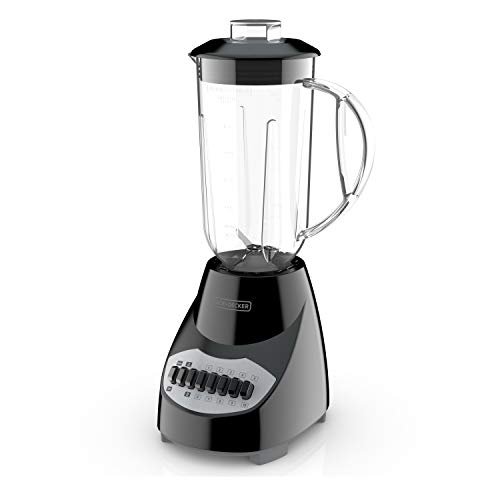
BLACK+DECKER Crush Master BL2010BP
BLACK+DECKER’s Crush Master is where this guide’s honesty rule earns its keep. Its title states ten speeds and stainless steel blades from an established appliance name — and never mentions ice at all. The crushing promise lives in the model name, Crush Master, rather than in any stated duty. That does not make it a poor blender; it makes it the one pick whose ice credentials rest on a name, and the review treats it accordingly.
- Speeds: 10
- Blades: stainless steel
- Model: BL2010BP
- Ice crushing: not stated in the listing title
- Pitcher size and wattage: not stated in the listing title
Strengths
- Ten speeds give the widest stated speed count in this group
- Stainless steel blades from a mainstream appliance maker
- A long-sold model identity makes parts and information easy to find
Trade-offs
- Ice is never mentioned in the title — the name carries the claim
- Neither wattage nor pitcher size is stated, an unusual double silence
- No ice-specific blade branding or system is described
Ten speeds on a blender is a philosophy of small steps. Ice work benefits from gradation — the jump from fracturing to circulating to polishing is smoother across ten settings than across three — and a cook who learns this machine’s ladder can park the blend at exactly the texture a drink wants. The stainless blades are the standard, serviceable choice, without the named blade systems rivals advertise. Everything about the specification says general-purpose competence rather than frozen specialisation.
The silences must be faced squarely, because they are the review. A buyer crushing ice daily should want a wattage figure and a pitcher size before money moves, and this title offers neither; both must be pulled from the full listing, where they certainly exist. Until then, the Crush Master is best understood as a mainstream ten-speed blender whose name promises crushing, bought by households whose ice work is occasional — cubes for drinks, the odd frozen smoothie — rather than a daily frozen programme.
There is no shame in that role, and it is worth saying plainly because roundups rarely do. Most households crush ice a few times a month, and for them a mainstream machine with ten speeds, from a maker whose service network is everywhere, is a rational purchase that leaves budget for the rest of the kitchen. The error would be buying it for a daily snow-cone habit on the strength of its name. Names are marketing; titles are evidence; this guide ranks evidence first and says so.
The BL2010BP model code at least makes verification easy: a long-marketed model accumulates documentation, replacement pitchers and answered questions in a way a brand-new listing cannot. A careful buyer can establish its wattage, capacity and real-world ice behaviour from that record in minutes. Treat this pick, then, as the research-light, expectation-moderate option — the blender for the household that wants ice handled competently among many jobs, not the star of a frozen-drinks programme.
If the Crush Master wins your household, give its ice work the technique cheaper machines reward: ice in stages, liquid in the pitcher, pulse before speed. Worked that way, a ten-speed mainstream blender produces perfectly respectable crushed ice for drinks, and its owner will wonder what the fuss was about. Worked carelessly — a full pitcher of dry cubes at top speed — it will deliver the verdict its unstated specification always implied.
Best for: general-purpose households whose ice crushing is occasional and who value ten speeds and a familiar name
Not suited for: daily ice crushers, because this title states neither ice duty, wattage nor pitcher size
Check price on Amazon — believe the name if you like, but verify the numbers on the listing first.
Power phrasing and pitchers, compared honestly
| Model | Power as stated | Pitcher as stated | Ice claim as stated |
|---|---|---|---|
| Ninja UltraCrush BP201 | 1000W | 72 oz | Blades power through ice and fruit |
| Ninja Professional Plus BN701 | 1400 peak watts | 72 oz | Total Crushing; frozen drinks named |
| Hamilton Beach Wave Crusher 54220 | 700 watts | 40 oz glass | Ice Sabre blades |
| CRANDDI Professional K96 | Max 1500W | 80 oz | Ice crushing named; tamper included |
| WantJoin Professional 1800W | Max 1800W | 70 oz | Crushing ice named; timer included |
| BLACK+DECKER Crush Master BL2010BP | Not stated | Not stated | Carried by the Crush Master name only |
That last row is the most useful line in the table: it shows exactly what a title can leave unsaid while a product name implies plenty. Readers moving from frozen drinks to frozen spreads will find the sibling blender question — nut butters — a stricter test of the same machines. Best Blenders for Making Nut Butters
How do you choose a blender that truly crushes ice?
Peak, maximum or plain — how should wattage be read?
Treat every wattage figure as a dialect. A plain figure states the motor’s rating in the maker’s ordinary terms; peak and maximum figures describe the ceiling the motor can touch under the hardest load. The ceiling matters — the first seconds against solid cubes are the hardest a blender ever works — but a machine does not live at its ceiling, and a 1800W maximum does not crush ice eighty percent better than a plain 1000W. Use wattage to sort machines into credible classes, then choose within the class on design.
Design means the things that keep ice meeting blades: pitcher shape that circulates the load, blade systems named for the job, a tamper for dry loads, presets programmed to pulse before they run. Those features appear in these titles as checkable facts, and they predict crushed-ice quality more reliably than the wattage beauty contest that dominates blender marketing.
How much pitcher do you honestly need?
Frozen drinks expand the arithmetic: ice, liquid and fruit for four people overflow a small pitcher and underfill a huge one, and an underfilled large pitcher blends badly because the load spreads too thin to circulate. Match the pitcher to the usual batch — 40 ounces for couples, the 70s for families and gatherings, 80 for queues — and be honest about the usual, not the annual party. The party can run two batches; the daily smoothie cannot shrink the pitcher.
Storage and washing belong in the same calculation. A pitcher that must be fetched from a high shelf will be fetched less often, and a pitcher too tall for the sink is a daily irritation. The best capacity is the one that lives within arm’s reach of the counter where the drinks are made.
Will you conduct the blend or programme it?
Ice rewards both temperaments differently. Manual speeds and a tamper put texture under the cook’s hand, adjustable mid-blend as the sound changes; presets and timers hand the judgement to the machine, repeatably, while the cook does something else. Households should choose by their real evenings: the entertainer who talks while blending needs programmes, the perfectionist who watches the pitcher needs controls.
There is no wrong answer, but there is a wrong purchase — the manual machine bought by a household that wanted to press a button, resented weekly for a specification its title stated plainly. Read the control descriptions in these titles as descriptions of your future evenings, because that is what they are.
A kitchen being equipped for frozen drinks usually gets its cooking surfaces specified in the same project, and the thirty-inch cooktop question tends to follow the blender question home. Best Thirty Inch Electric Cooktops
Technique: the staged crush
Equipment aside, technique decides most domestic ice. Start with liquid in the pitcher — a little, enough to carry fragments — then ice in two additions rather than one avalanche. Pulse to fracture, rest a breath so pieces settle into the liquid, then run and climb the speeds as the sound smooths from rattle to roar to a steady churn. Stop the moment the texture arrives; every extra ten seconds is meltwater diluting the drink you were making.
Frozen fruit follows the same staging, with one addition: give the load a minute’s head start out of the freezer for the hardest items, because rock-solid fruit at deep-freeze temperatures defeats circulation in any pitcher. Professional smoothie bars work this way by instinct. Home cooks who adopt the staging habit routinely conclude their old blender was better than they thought — and that their new one, chosen from this list, is better still.
Snow, shards and slush: naming the textures
Crushed ice is not one thing. Snow — fine, soft, packable — is for cones and delicate cocktails and needs the longest, most controlled work. Shards — coarse, crunchy, slow-melting — suit drinks that want dilution over time and come from shorter, punchier crushing. Slush is ice already married to liquid, the smoothie and frozen-drink texture, judged by the straw rather than the spoon. A household that names its target texture can shop this list precisely: fine control and tampers for snow, presets for slush, almost anything competent for shards.
The naming also rescues disappointing blends from blame. A drink that wanted shards and got snow is a technique miss, not a machine failure, and it corrects in seconds next round. Keep a small notebook of settings per drink — unfashionable, invaluable — and the blender, whichever of the six it is, becomes an instrument the household actually knows how to play.
Cleaning ice machines before they smell like it
Blenders that crush ice also crush fruit, dairy and greens, and their pitchers remember all of it if washing lags. The dishwasher-safe titles here — both Ninjas — hold a real advantage for daily users, because a pitcher that can go straight into the machine gets washed every time. Hand-wash models reward the immediate rinse: thirty seconds under the tap after pouring, before residues set, is worth ten minutes of soaking later.
Blade assemblies deserve respect in both directions — sharp enough to demand care, hidden enough to collect residue underneath. A bottle brush and hot soapy water, worked around the blade base after frozen-dessert sessions, keep flavours honest. The machine that smells faintly of last month’s smoothie will eventually stop being asked to make this month’s, and that quiet retirement is the commonest end of a home blender’s career.
Ice from the tap: cubes, trays and the freezer’s role
The freezer is a silent partner in every crushed-ice drink. Small cubes fracture faster and circulate sooner than large, dense ones; very cold, dry ice shatters cleanly, while wet, melting ice clumps and stalls circulation in any pitcher. Households that crush often standardise their cubes the way cafés do — one tray size, frozen hard, used straight from the freezer without a rinsing ritual — and their results steady noticeably without any change of machine.
Bagged ice behaves differently again: often wetter on the surface, sometimes fused into clusters that need breaking before they meet the blades. A few seconds of patience at the freezer — choosing loose cubes, breaking clusters by hand — is worth more than several hundred advertised watts. When a blend disappoints, audit the ice before the appliance; the cheapest component in the system is also the most variable.
Frozen drinks as a household ritual
A blender that crushes ice well tends to acquire ceremonies: the Friday frozen drink, the post-match smoothie round, the summer afternoon when the pitcher comes out for the street’s children. Those rituals are worth designing for when choosing from this list — a machine kept on the counter, with a pitcher the household can wash without negotiation, will host them; a machine stored in pieces will not.
Stock the ritual like a small bar: frozen fruit in known bags, the syrups and juices your drinks actually use, ice trays kept full by rule. The appliance decision then completes itself — capacity for your crowd, controls for your temperament — and the six titles above stop being a specification contest and become what they should be, a choice of which machine hosts the household’s coldest, loudest, happiest ten minutes.
When the pitcher is the party: batch planning
Batch mathematics decides whether a gathering feels generous or rationed. A 72 or 80-ounce pitcher of frozen drink serves a table in one pour; a 40-ounce jar serves the same table in two makings, which is fine if the second batch is part of the theatre and awkward if guests hold empty glasses through it. Plan the vessel to the ritual: continuous small batches suit a cook who enjoys the performance, while a single large batch suits a host who wants to sit down.
Leftovers argue the other way — frozen drinks do not keep their texture, so the pitcher that exactly matches the table beats the one that exceeds it. Households that regularly over-make should choose down a size and run a second batch on demand. The titles here give you honest capacities to plan with, except for the one model that withholds its pitcher size entirely, whose absence in your planning is itself information.
Safety around a machine that fractures ice
Ice blenders combine sharp blades, serious motors and lids that must stay seated under load, so their safety habits deserve one plain paragraph. Never reach into a pitcher that is mounted and plugged in; use the tamper through the lid where one is provided, or stop the machine entirely before a spoon goes in. Seat the lid before the first pulse, keep the cord clear of the pitcher’s swing, and let the blades stop fully before pouring — a spinning blade throws slush further than any cook expects.
Children can absolutely join frozen-drink making, from the far side of the counter, with the adult owning the machine’s controls. The spectacle is half the fun for them anyway. Households that build these habits from the first use never think about them again, which is exactly what a safety routine is for.
Common mistakes
Reading peak wattage as everyday power
The largest number on the box describes the motor’s hardest moment, not its working life. Households that buy the biggest ceiling and ignore pitcher design, blade systems and controls end up with a loud machine that still leaves cubes surfing above the blades. Read the whole title — the duties, the pitcher, the tamper, the timer — and let wattage be one witness among several.
Loading all the ice at once, dry
A full pitcher of dry cubes bridges, rattles and spins in place while the motor strains — the classic way to hate a new blender in its first minute. Liquid first, ice in stages, pulse before speed: the sequence costs twenty seconds and transforms the result on every machine in this list, from the 700-watt glass jar to the commercial heavyweights.
Blending past the texture
Ice keeps changing after it looks right, because friction is heat and heat is meltwater. The drink that was perfect at the pitcher’s first smooth roar is thinner by the time a cautious cook adds another half-minute for luck. Stop early, check, and give it three seconds more only if the spoon says so. Restraint is a blending skill, and frozen drinks grade it strictly.
Ignoring the under-cabinet measurement
The large pitchers here stand tall on powerful bases, and standard kitchen cabinets hang lower than memory suggests. Measure the counter-to-cabinet clearance and compare it with the assembled height on the listing before ordering any of the big three. A blender that must live in a cupboard and be assembled for every smoothie is a blender quietly retiring from service.
Assuming a name is a specification
One pick in this very list carries its ice promise in its model name while its title states neither ice duty, wattage nor pitcher size. Names are written by marketers; specifications are written, however reluctantly, by the product. Buy on the stated facts, verify the rest on the listing, and let names be the last thing that persuades you — especially in a category where ice separates claims from machines.
Storing the pitcher assembled in a damp cupboard
A washed pitcher put away still damp, sealed with its lid, develops the stale smell that later flavours innocent smoothies. Dry the pitcher open, store the lid ajar, and let the blade area air before the cupboard door closes. The habit costs nothing and protects every drink the machine will ever make — particularly in the large pitchers, whose depths dry slowest.
Frozen drinks raise the temperature of a kitchen in every sense, and households sensitive to air quality often end up comparing purifiers with ultraviolet stages for the same rooms. Best Air Purifiers With UV Light
Final recommendation
For a defensible default, take the Ninja BP201: ice stated in plain words, a big pitcher, manual control, dishwasher relief. Take its BN701 sibling if presets will get the machine used daily. Take the CRANDDI K96 if thick loads and volume are real, the WantJoin if timers and repeatability rule your kitchen, and the Hamilton Beach if your batches are small, your jar should be glass and your counter is tight.
The Crush Master closes the list as the honest generalist — ten speeds, a familiar name, and an ice claim the buyer must verify beyond its title. That spread is the category in miniature: five machines that state their ice credentials and one that implies them. Buy the statement that matches your workload, stage your ice properly, and every one of these pitchers will earn its noise.
One last discipline for the undecided: write down your last ten uses of ice at home, honestly — drinks, smoothies, desserts, the odd sauce — and count how many needed a full pitcher and how many needed a handful. That small census, not the showroom, should pick between the 40-ounce glass jar and the 80-ounce professional. Machines bought for the household’s real arithmetic get used; machines bought for its fantasies get stored.
Frequently asked questions
Does more wattage always mean better crushed ice?
No. Wattage sets a ceiling on the work available; pitcher circulation, blade design and technique decide how much of that work reaches the ice. A well-designed 1000W machine with staged loading will out-crush a poorly fed machine quoting a much higher peak figure. Read wattage as a class marker, then judge the system around it.
Can these blenders make snow-cone ice?
Snow is the most demanding texture and favours fine speed control, a tamper for dry loads and patience — the CRANDDI’s specification reads most naturally for it, with the Ninjas’ crushing systems close behind. Any of the five ice-stating models can approach snow with staged technique; the coarse end of the texture family, shards for drinks, is comfortably within all of them.
Is a glass jar better for ice?
Glass brings neutrality — no stains, no odours, a pleasant weight — and the Wave Crusher pairs it with named ice blades and a circulation system. Its costs are fragility and a smaller, less powerful format. Households crushing ice daily at volume usually choose the large pitchers; households blending small batches in a calm kitchen may fairly prefer the glass.
Why does my crushed ice come out watery?
Time and load are the usual culprits: blending past the texture melts the earliest fragments, and an overfilled pitcher circulates so slowly that friction wins. Work in smaller batches, stage the ice, stop at the first smooth roar and serve immediately. If the problem persists across technique changes, the machine’s circulation design is the limit, and the tamper-equipped or preset models here address exactly that.
What should I check before buying the Crush Master for ice?
Its wattage, its pitcher size and any ice statement in the full listing, because the title provides none of the three — only ten speeds, stainless blades and a promising name. It may prove perfectly capable for occasional ice; the point is that its capability must be established from the listing, not inherited from its name.
How loud should I expect ice crushing to be?
Loud, briefly, in every model here — fracturing ice is mechanical violence in a pitcher, and no title in this group claims quiet operation. The staged technique shortens the worst of it, and a towel under the base softens the counter’s drum effect. Households blending at dawn should plan the ice work for the night before where the recipe tolerates it.
Should I buy a separate ice crusher instead?
Only if crushed ice alone, in quantity, is the whole job — a shaved-ice or crusher appliance does one texture repeatedly. For households whose ice lives inside drinks, smoothies and desserts, a blender from this list covers the ice and everything around it in one footprint. The deciding question is whether your kitchen needs a specialist or a citizen, and most kitchens vote citizen.
May your ice crack clean, your pitchers circulate, and your frozen drinks reach the table at exactly the texture you named.


