What's inside
- Where to buy these copper sinks
- The six basins in brief
- How the shortlist was built
- Side-by-side: the six basins compared
- How to choose a copper sink when no title promises a tarnish-proof finish?
- The exact questions worth sending before any order
- Living with patina: a realistic care rhythm
- Why the premise fails, and why copper sells anyway
- Installation realities the titles only hint at
- Common mistakes
- The first year with a living finish, season by season
- Water, minerals and the marks they leave
- Faucets, drains and accessories in matching metal
- Final recommendation
- Frequently asked questions
As an Amazon Associate I earn from qualifying purchases. This post may contain affiliate links at no extra cost to you.
As an Amazon Associate, cottageverdict.com earns from qualifying purchases.
Start with the correction, because everything else in this guide depends on it: none of the six copper kitchen sinks below claims to be non-tarnish in its listing title. Not one title mentions lacquer, a clear coat, a sealed finish, or any protective layer that would keep copper bright without polishing. That silence matters. Solid copper is a living finish. Air, water, lemon juice, tomato sauce and plain fingerprints all change its colour over time, pushing bright penny tones toward brown, then toward the mottled patina that antique copper is famous for. Shoppers searching for the best non tarnish copper kitchen sinks usually want the warmth of copper without that colour journey, and the honest answer is that this shortlist cannot promise it. What this shortlist can do is show which models give you an antique finish from day one, which arrive hand-hammered, which gauges and cabinet sizes are actually stated, and how to verify a coating directly with the manufacturer before money changes hands. Treat every bright product photograph as a photograph of a new sink on its first day, not as a guarantee about its third year.
Copper rewards people glad of change and frustrates anyone set on a fixed colour. One household polishing a farmhouse apron every few weeks can hold a fairly bright tone with effort. Another household cooking daily, leaves wet sponges in the bowl and never polishes will watch patina develop unevenly, darker where hands touch and lighter where water runs. Neither outcome is a defect. Both follow from the metal itself. The six picks below were chosen because their titles state verifiable facts — width, gauge where given, mounting style, faucet holes, cabinet fit — rather than shine claims. Read the coating row in every spec box carefully: for all six picks it records that a protective coating is not stated in the listing title, and that gap is the single most important fact in this article.
Where to buy these copper sinks
The Lange 32 inch farmhouse model opens the list because its title states the most: hand-hammered 17-gauge solid copper, an apron front and a 36 inch cabinet fit. Anyone after the widest Sinkology option with a stated gauge starts there.
Next, the Angelico 33 inch drop-in suits kitchens that cannot face apron-front cabinet surgery, and its title adds three faucet holes to the decision.
Third comes the smaller Lange at 25 inches, an apron-front model for a 30 inch cabinet, carrying an antique copper description and an everyday warranty mention.
Fourth, the Monarch Abode Milan at 21 inches works as a bar or prep sink, dual mount, deep and rectangular, sized for a secondary station rather than the main wash-up.
Fifth, the Signature Hardware Fiona stretches to 36 inches, the broadest basin here, for cooks who wash sheet pans daily.
Finally, the Raina at 33 inches gives Signature Hardware shoppers a farmhouse footprint one size down from the Fiona, and its title stays spare about everything beyond basin and style.
The six basins in brief
| Pick | Best for | Standout from the title |
|---|---|---|
| Sinkology Lange 32 in Copper Farmhouse Single Bowl | Main kitchens with a 36 inch cabinet | Hand-hammered 17-gauge solid copper, apron front |
| Sinkology Angelico 33 in Copper Drop-In Sink | Drop-in replacement without apron work | Three faucet holes, antique copper, 17-gauge |
| Sinkology Lange 25 in Copper Farmhouse Sink | Compact farmhouse look in a 30 inch cabinet | Antique copper, apron front undermount |
| Monarch Abode Milan 21 in Copper Sink | Bar and prep stations | Dual mount, deep single rectangular bowl |
| Signature Hardware Fiona 36 in Copper Farmhouse Sink | Oversized pans and batch cooking | 36 inch single basin farmhouse format |
| Signature Hardware Raina 33 in Copper Farmhouse Sink | Farmhouse style at 33 inches | Single basin copper farmhouse design |
How the shortlist was built
Selection began with the premise problem. Because the search phrase promises non-tarnish performance, every candidate title was read first for coating language: lacquer, sealed, clear coat, tarnish resistant, anything. The six finalists state none of it, and rather than discard the whole category, this guide keeps them and labels the gap openly, since these are the copper sinks a shopper will actually meet. Width came second. The list spans 21 to 36 inches so that bar, compact, standard and oversized kitchens each get a candidate. Mounting style came third: apron-front undermount, drop-in and dual mount are all represented, because installation cost often decides a sink purchase more than the basin itself. Gauge was recorded where a title states it — the two larger Sinkology models state 17-gauge — and left unstated where a title omits it, without borrowing numbers from other models in the same brand. Faucet holes were counted from titles, cabinet minimums were taken only where printed, and finish wording was preserved exactly: antique copper means the patina look is part of the product from the start, which is useful honesty for the tarnish-anxious shopper, since a pre-antiqued surface changes less visibly than a bright one.
One more filter shaped the order. Models whose titles describe the bowl, the mount and the cabinet fit give a buyer three separate checks to run at home; models with spare titles demand more questions to the seller. The ranking below roughly follows how much a title lets you verify before purchase, not any claim about shine retention, because no title here supports such a claim.

Sinkology Lange 32 in Copper Farmhouse Single Bowl
The largest Lange in this guide pairs a 32 inch apron-front bowl with the fullest specification Sinkology prints anywhere in the shortlist. Its title calls the metal solid copper, describes hand-hammering, names 17-gauge thickness and matches the sink to a 36 inch cabinet. For a buyer uneasy about the tarnish question, that density of stated fact is the real value: you can verify the cabinet, plan the apron cut and picture the hammered texture without guessing, even though the coating question still needs a direct answer from the maker.
- Width: 32 inches
- Material: solid copper, hand-hammered
- Gauge: 17-gauge
- Mount: apron front, undermount apron install
- Cabinet fit: 36 inch cabinet
- Protective coating: Not stated in the listing title — verify with the manufacturer’s documentation
Strengths
- Gauge is printed in the title, which lets a buyer compare metal thickness without chasing a spec sheet.
- Apron-front format puts the copper face on display, the whole point of choosing this metal.
- Cabinet requirement is explicit, so the carpentry conversation can happen before delivery.
Trade-offs
- Apron installation demands cabinet modification that a drop-in never asks for.
- Hammered texture holds water spots visibly and asks for a wipe after heavy use.
- Nothing in the title promises the bright finish will hold, so patina planning is on the buyer.
Think about how a hammered apron behaves in a working kitchen. Each dimple catches light differently, which disguises early patina better than a flat polished sheet would; blotches that would glare on smooth copper soften into the texture. That makes this model a pragmatic pick for someone who loves copper yet dreads the first tarnish marks, not because the marks are prevented, but because the surface design absorbs them gracefully. The single bowl swallows roasting pans and stockpots without a divider forcing awkward angles. Undermount fitting leaves the counter edge clean for sweeping crumbs straight into the basin. Before ordering, email the manufacturer one precise question: is this sink lacquered, and if so, what maintains the lacquer? Get the reply in writing. A lacquered answer changes your cleaning rules completely, since abrasive pads strip lacquer in patches and patchy lacquer tarnishes faster than bare copper. An unlacquered answer means you are buying a living finish with open eyes. Either answer is workable; an unanswered question is not. Pair the sink with a bottom grid if you plan to rest cast iron in it, because copper dents more readily than stainless steel and the title’s gauge, while respectable, is not armour.
Best for: a 36 inch cabinet run where the apron becomes the kitchen’s centrepiece and the cook accepts patina as part of the deal. Not suited for: a 30 inch cabinet base, since the stated fit is 36 inches and the apron leaves no room to fudge that number. Check price on Amazon to confirm the current listing details for the Lange 32.

Sinkology Angelico 33 in Copper Drop-In Sink
Drop-in mounting changes the whole renovation maths, and the Angelico leans into that advantage at 33 inches wide. The title describes antique copper, which signals a finish that already wears the darker, settled tones many buyers fear arriving uninvited. Starting antique is a legitimate strategy against tarnish anxiety: a surface that begins mottled shows later change far less dramatically than mirror-bright copper. Three faucet holes are drilled per the title, the gauge matches its Lange sibling at 17, and the cabinet fit is again stated as 36 inches.
- Width: 33 inches
- Material: antique copper, hand-hammered
- Gauge: 17-gauge
- Mount: drop-in
- Faucet holes: 3-hole configuration
- Cabinet fit: 36 inch cabinet
- Protective coating: no coating is given in the listing title, so confirm any lacquer directly with the manufacturer
Strengths
- Drop-in fitting can reuse an existing counter cut-out, trimming both cost and downtime.
- Antique finish hides the early stages of patina better than a bright polish does.
- Pre-drilled holes remove the risk of drilling copper at home.
Trade-offs
- The raised rim traps crumbs and water at its edge and needs a deliberate wipe.
- Three holes commit you to a matching faucet layout or visible deck plates.
- Antique colouring varies by batch, so the delivered tone may differ from photographs.
Renovators keeping sound countertops will feel the appeal immediately. A drop-in swap can be a weekend job: old sink out, sealant bead down, new basin seated, clips tightened, plumbing reconnected. Compare that with apron-front carpentry and the Angelico earns its place even before finish talk begins. The rim, though, is a real compromise. It interrupts the sweep of the counter, catches flour dust along its front edge and shows water marks where it meets stone or laminate. Households that wipe counters twenty times a day may find the rim tiresome within a month. The faucet question deserves equal care. Three holes suit widespread or deck-mounted arrangements; a single-hole pull-down faucet leaves two holes to cap, and caps on copper rarely match the antique tone exactly. Photograph your current faucet layout, count its holes, and only then judge this model. On the tarnish front, repeat the same written question posed for the Lange: antique describes colour, not coating, and colour alone tells you nothing about whether a lacquer layer exists. If the maker confirms no lacquer, the antique start still softens the patina transition, which is the closest thing to a low-drama copper ownership experience this list offers.
Best for: a countertop-saving renovation in a 36 inch cabinet kitchen where an antique tone is welcome from day one. Not suited for: a single-hole faucet plan without caps, because the title fixes the deck at three holes. See the Angelico listing on Amazon for its present configuration.

Sinkology Lange 25 in Copper Farmhouse Sink
Small kitchens rarely get farmhouse drama, yet the 25 inch Lange squeezes an apron front into a 30 inch cabinet. The title describes hand-hammered antique copper, an apron front undermount fitting and an everyday warranty, a trio that suits cottages, galley layouts and compact remodels. Gauge goes unmentioned here, unlike the bigger Lange, so thickness comparisons against the 32 inch model cannot be made from the title alone.
- Width: 25 inches
- Material: antique copper, hand-hammered
- Gauge: none stated in the listing for this model
- Mount: apron front, undermount
- Cabinet fit: 30 inch cabinet
- Warranty mention: everyday warranty
- Protective coating: the listing title is silent on any coating, so ask the manufacturer before assuming protection
Strengths
- Apron-front presence in a footprint that fits a 30 inch base cabinet.
- Antique finish softens visible change as patina develops.
- Warranty is at least mentioned in the title, inviting a closer read of its terms.
Trade-offs
- A 25 inch single bowl crowds large sheet pans and wide roasters.
- Gauge silence means the metal thickness must be confirmed elsewhere.
- Apron carpentry still applies, even at this smaller size.
Scale is the honest conversation here. A quarter-sheet pan fits; a half-sheet pan fights. Two cooks working side by side will negotiate elbow room around a bowl this size, and a tall stockpot under a standard faucet can feel boxed in. None of that condemns the sink — plenty of cottages cook beautifully in small basins — but buyers should rehearse their biggest regular wash-up item against 25 inches before committing. The antique finish repeats the Angelico’s advantage in miniature: early water spotting blends into existing tonal variation instead of announcing itself. Because the apron is the visual event in a small kitchen, its face will draw every eye, so decide in advance whether you will polish that apron panel regularly or let it darken ahead of the bowl. Mixed tones, bright apron over dark bowl or the reverse, look accidental; a single deliberate approach looks designed. Ask the manufacturer the coating question in writing, ask the gauge question in the same message, and ask what the everyday warranty actually covers, since the title names it without defining it. Three written answers turn this from a pretty gamble into a specified purchase.
Best for: a 30 inch cabinet cottage kitchen wanting apron character without surrendering the whole run to the sink. Not suited for: half-sheet pans washed daily, because 25 inches of bowl leaves them nowhere flat to rest. View the smaller Lange on Amazon before measuring your cabinet.
Monarch Abode Milan 21 in Copper Sink
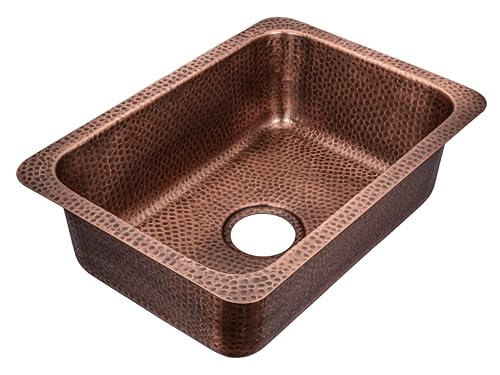
At 21 inches the Milan leaves the main-sink contest entirely and pitches itself at bars, prep corners and butler’s pantries. Monarch Abode’s title calls it hand hammered pure copper, describes a deep single rectangular bowl and offers dual mounting — drop-in or undermount — which gives installers two routes into the same cabinet. A second station changes how a kitchen flows: vegetables rinse here while the main bowl holds soaking pans, or ice and bottles gather here during a party while dinner prep continues undisturbed across the room.
- Width: 21 inches
- Material: pure copper, hand hammered
- Mount: dual mount, drop-in or undermount
- Bowl: deep single rectangular bowl
- Intended stations: kitchen and bar use per the title
- Protective coating: not given in the listing title; written confirmation from the manufacturer is the only safe route
Strengths
- Dual mounting flexibility suits both new stone and retrofit projects.
- Deep bowl contains splashes at a drinks station and holds tall bottles upright.
- Pure copper wording in the title is explicit about the base metal.
Trade-offs
- Far too small to serve as a household’s only sink.
- Rectangular corners need a brush to clean properly, unlike rounded bowls.
- Bar duty means ice melt and citrus contact, both of which mark copper quickly.
Consider the chemistry of a bar sink before falling for the look. Lemon and lime wedges strip patina on contact, leaving bright fingerprints of juice wherever a garnish rests, while standing meltwater darkens the base. Owners who love that lived-in map will be delighted; owners chasing a uniform glow will be polishing after every gathering. Because the bowl is a secondary station, the stakes are lower than at the main sink, making the Milan a sensible place to learn whether copper ownership suits your temperament before committing the primary basin to the same metal. The dual mount deserves a decision early: undermount reads sleeker and wipes cleanly from the counter, drop-in forgives an imperfect cut-out. Rectangular geometry pairs well with modern cabinetry lines, though the corners will collect grit unless a small brush lives nearby. The coating question applies here with the same force as everywhere in this guide — the title says pure copper and hand hammered, and says nothing about lacquer — so the written manufacturer check remains part of the purchase, not an optional extra.
Best for: a drinks or prep station where copper character matters more than main-sink capacity. Not suited for: duty as the sole sink in a family kitchen, since 21 inches cannot absorb a dinner’s worth of pans. Look over the Milan on Amazon for its mounting details.

Signature Hardware Fiona 36 in Copper Farmhouse Sink
The Fiona is the broadest basin in this guide at 36 inches, a farmhouse single basin format from Signature Hardware aimed at cooks whose wash-up includes roasting trays, grill grates and canning pots. Its title is strikingly brief: brand, model number 305572, name, size, farmhouse style, single basin, copper, kitchen sink. No gauge, no hammering description, no cabinet figure, no finish adjective. That brevity cuts both ways — nothing is overpromised, yet almost everything practical must be verified beyond the title.
- Width: 36 inches
- Format: farmhouse single basin
- Material: copper
- Model reference: 305572
- Gauge: not stated in the listing title
- Cabinet fit: not stated in the listing title
- Protective coating: nothing about a coating appears in the title, so the manufacturer must answer that question in writing
Strengths
- The widest working bowl here, kind to sheet pans and oversized cookware.
- Single basin layout avoids the divider collisions that plague divided sinks.
- Farmhouse format gives a large copper apron as a design anchor.
Trade-offs
- Title silence on gauge and cabinet fit forces extra verification steps.
- A 36 inch apron installation is a substantial carpentry commitment.
- Large copper surfaces show patina variation across a wide, very visible area.
Big copper behaves differently from small copper. Across 36 inches, water temperature differences, splash zones and hand contact create a broad landscape of tones, and the apron face becomes practically a wall panel whose colour story the whole room reads. Batch cooks who entertain heavily often accept that landscape happily, because the alternative — wrestling a roasting tray into a divided 30 inch sink — annoys them weekly. Before ordering, build a verification list from everything the title omits: gauge, exact bowl depth, minimum cabinet, drain opening size, and the coating question that anchors this entire guide. Send the list to Signature Hardware support and keep the replies with your renovation records; if a dispute about finish ever arises, those messages are your evidence of what was represented. Also confirm apron height against your cabinet face frame, since farmhouse aprons vary and a mismatch shows as an ugly shadow line. Weight matters too at this size, so plan cabinet reinforcement rather than assuming the base will cope. None of these checks are reasons to avoid the Fiona; they are the purchase price of a title that prefers brevity.
Best for: high-volume home cooking in a kitchen that can give 36 inches to a single basin. Not suited for: a divided-bowl workflow, because the title specifies one basin with no divider. Open the Fiona page on Amazon and note what its fuller description adds.

Signature Hardware Raina 33 in Copper Farmhouse Sink
Sitting one size below the Fiona, the Raina offers a 33 inch single basin farmhouse layout under model reference 305574. The title shares its sibling’s restraint: size, basin count, style and metal, with nothing further about gauge, finish treatment or cabinet requirements. For many kitchens 33 inches is the sweet spot — wide enough for a roasting pan laid flat, narrow enough to leave counter on both sides in a standard run — and that balance is the Raina’s whole argument.
- Width: 33 inches
- Format: farmhouse single basin
- Material: copper
- Model reference: 305574
- Gauge: not stated in the listing title
- Cabinet fit: not stated in the listing title
- Protective coating: no coating information appears in the title; verify with the manufacturer’s documentation before purchase
Strengths
- 33 inches hits the practical middle ground of the farmhouse sizes here.
- Single basin keeps wide cookware manoeuvrable during washing.
- Shares the Fiona’s design language for a coordinated specification.
Trade-offs
- Practical details must be chased down beyond the title, as with the Fiona.
- Apron fitting still requires cabinet alteration at this width.
- Buyers wanting stated gauge figures will find none in the title.
Choosing between the Raina and the Fiona is really a countertop arithmetic exercise. Three inches surrendered at the sink return three inches of landing space beside it, and landing space is where hot pans, draining boards and coffee gear actually live. Kitchens under twelve feet of run usually feel the Raina’s compromise as relief. The verification homework mirrors the Fiona’s list almost exactly — gauge, depth, cabinet minimum, drain size, coating — because the titles share the same omissions. One extra check belongs here: confirm whether the apron on this model is flat or hammered, since the title does not say and the two textures age very differently under patina. A flat apron displays every tonal shift like a canvas; a hammered one breaks shifts into sparkle. Neither is better, but they produce different rooms, and discovering which one arrived after the crate opens is the wrong order of events. If written answers confirm bare copper, decide your polishing rhythm before installation day, while the decision is still abstract and cheap. Households that set a monthly polish keep a brighter apron; households that skip it should choose the mindset of patina appreciation in advance rather than drifting into disappointment.
Best for: a standard kitchen run where 33 inches balances pan capacity against landing space. Not suited for: a 30 inch cabinet base without modification, because a 33 inch farmhouse bowl needs a wider home than that. Review the Raina on Amazon alongside your tape measurements.
Side-by-side: the six basins compared
| Model | Width and mount | What the title confirms | What remains unconfirmed |
|---|---|---|---|
| Sinkology Lange 32 in Copper Farmhouse Single Bowl | 32 in, apron undermount | 17-gauge solid copper, 36 in cabinet | Any protective coating |
| Sinkology Angelico 33 in Copper Drop-In Sink | 33 in, drop-in | 17-gauge, antique copper, 3 holes, 36 in cabinet | Any protective coating |
| Sinkology Lange 25 in Copper Farmhouse Sink | 25 in, apron undermount | Antique copper, 30 in cabinet, warranty mention | Gauge and any protective coating |
| Monarch Abode Milan 21 in Copper Sink | 21 in, dual mount | Pure copper, deep rectangular bowl | Gauge and any protective coating |
| Signature Hardware Fiona 36 in Copper Farmhouse Sink | 36 in, farmhouse | Single basin copper format | Gauge, cabinet fit, coating |
| Signature Hardware Raina 33 in Copper Farmhouse Sink | 33 in, farmhouse | Single basin copper format | Gauge, cabinet fit, coating |
How to choose a copper sink when no title promises a tarnish-proof finish?
What does living finish actually mean day to day?
Living finish is industry language for an unsealed metal surface that keeps reacting with its environment. On copper that reaction shows as gradual darkening, occasional green hints in persistently damp corners over long periods, bright spots where acidic food splashes, and soft sheen where hands and cloths rub daily. Day to day it means the sink you photograph at installation will not be the sink you own in a year, in the same way a leather bag or a wooden table changes with use. People who find that evolution charming describe patina as character. People expecting a fixed showroom colour describe the identical process as tarnish. The metal does not care which word you choose, so choose your word honestly before purchase, because it predicts your satisfaction better than any specification.
How can a coating claim be verified properly?
Ask in writing, through the manufacturer’s own support channel, using the model number from the title. A useful question names the exact thing: is a lacquer or clear coat applied at the factory, what product maintains it, and what happens to the warranty if the coating wears? Vague answers about easy care or lasting beauty are not confirmation. A documented yes, with care instructions attached, is confirmation. A documented no is equally valuable, since it tells you the sink is bare copper and your decision can proceed on patina terms. Silence after two attempts should be read as a no for planning purposes. Keep the exchange; if a sink arrives described differently from the written answer, that record is what resolves the dispute. While asking about coating, add gauge, bowl depth and minimum cabinet size for the models whose titles omit them — the Fiona, the Raina and the smaller Lange all leave at least one of those open.
Which size fits which kitchen?
Work from the cabinet outward. A 30 inch cabinet points to the 25 inch Lange. A 36 inch cabinet opens the door to the Lange 32 and the Angelico 33. The Milan at 21 inches belongs to a secondary station almost regardless of cabinet, since its role is support rather than main duty. The Fiona’s 36 inches and the Raina’s 33 demand a tape measure session, because their titles do not print cabinet minimums: measure the interior width of the base unit, subtract the cabinet walls, and confirm the remainder against the manufacturer’s stated requirement once obtained. Then rehearse the wash-up: lay your largest pan on the counter, measure it diagonally, and compare that figure with the bowl width you are considering. Pans that fit flat wash faster and chip less enamel than pans balanced on a rim.
Does antique finish solve the tarnish worry?
Partly, and the distinction matters. Antique describes a colour treatment that starts the sink at the darker end of copper’s range. Change still happens — water spots, polished patches where the faucet drips, brightening where scouring concentrates — but the contrast between new marks and the base tone is smaller, so the eye reads the surface as consistent for longer. The Angelico and the smaller Lange both carry antique wording in their titles, which is why this guide keeps returning to them for anxious buyers. Antique is not a coating, though. It does not seal the metal, and treating it as protection leads to the same disappointment as treating a photograph as a promise.
The exact questions worth sending before any order
One short message, sent to the manufacturer’s support address and saved, covers every gap these six titles leave open. Ask first about coating: whether any lacquer or clear sealant is applied at the factory, and if the answer is yes, which maintenance product the maker approves and which cleaners void the finish warranty. Ask second about metal: the gauge for the Lange 25, the Milan, the Fiona and the Raina, whose titles omit it, plus confirmation that the copper is solid rather than plated for any model where that wording is absent. Ask third about fitting: minimum cabinet size for the two Signature Hardware basins, bowl depth for all six, and the drain opening diameter so a strainer can be ordered in the same shipment. Ask fourth about finish expectations: whether the photographed tone is the delivered tone or a polished presentation, and whether samples can be supplied for the antique models, since batch variation in hand-finished copper is normal and a sample converts an argument about colour into a comparison against a physical reference. Five working days is a fair window for a reply. A maker who answers all four groups clearly has earned confidence; a maker who answers none has also told you something, and the Angelico or Lange 32 — whose titles already state the most — become the safer destinations for the order.
Sound belongs on the checklist too, even though no title here mentions it. Thin metal basins drum under running water and clatter when pans land; heavier gauge copper sounds duller and feels more substantial, which is part of why the stated 17-gauge on the two larger Sinkology models carries weight beyond dent resistance. If the sink will sit in an open-plan room where the kitchen shares air with the living space, ask whether the underside carries any sound-dampening treatment, and plan a mat or grid to soften contact noise regardless. It is a small quality-of-life detail that showroom visits, with their ambient noise, consistently hide.
Living with patina: a realistic care rhythm
Bare or antique copper asks for small habits rather than heroic effort. Rinse the bowl after washing up so detergent and food acids do not sit overnight. Wipe the basin dry when the kitchen closes, a thirty-second task that prevents most water spotting. Keep a separate soft cloth for copper and banish scouring pads to other jobs, because scratches in copper hold dirt and darken unevenly, drawing lines across the surface that no polish fully erases. When brightness is the goal, a paste made for copper, worked along the bowl in sections and rinsed thoroughly, restores tone; expect the restored brightness to begin softening within weeks, since that is the metal’s nature rather than a product failure. When patina is the goal, do almost nothing beyond rinsing and drying, and resist spot-polishing single marks, because isolated bright patches look like damage while an even, overall deepening looks like intention. Acidic spills deserve prompt rinsing in both regimes: lemon juice and vinegar strip patina instantly and leave pale ghosts that take weeks to blend back. Hot pans should land on trivets, not directly in the bowl, both to protect any finish and to avoid heat marks. A bottom grid earns its keep for households that stack cast iron, spreading weight and preventing the dents that thin copper can suffer. None of this is difficult. All of it must be acceptable before purchase, because a copper sink bought in hope that maintenance will feel different later usually becomes a resentment with a faucet.
Households comparing copper against other metals entirely may find our guide to Best Food Processors with Glass Bowls a useful reminder that every material category carries its own version of this honesty problem, glass included.
Why the premise fails, and why copper sells anyway
The phrase non-tarnish copper survives in search boxes because it names a wish, not a product class. Truly tarnish-resistant copper products do exist in the wider market, and they achieve the effect with factory lacquer — a clear skin that delays contact between metal and air. That skin has its own lifespan, its own cleaning rules and its own failure mode, in which worn patches tarnish in islands while protected areas stay bright. Makers of the six sinks here chose not to claim that route in their titles, and this guide refuses to claim it on their behalf. What remains after the wish is stripped away is still a strong category: warm colour no other sink metal offers, hand-worked texture, sizes from bar scale to banquet scale, and a surface that records the life of the kitchen cooking around it. Plenty of owners, told plainly that patina is guaranteed, buy copper anyway and love it more for having been warned. The warning is the service this article exists to provide; the six verified sets of dimensions, mounts and gauges are the shopping tools that come with it.
Installation realities the titles only hint at
Apron-front models — both Langes, the Fiona and the Raina — require the cabinet face to be cut or built to receive the apron, plus support rails inside the cabinet to carry a filled basin’s weight. That work is routine for a kitchen fitter and intimidating for a first-time DIY installer, so price it into the project honestly. Drop-in fitting for the Angelico is the gentlest route, resting on the counter with sealant and clips, reversible if tastes change. The Milan’s dual mount lets the installer choose per project, undermounting into stone or dropping into laminate. Plumbing rarely moves for a same-size swap, but apron sinks can sit lower than the basin they replace, which sometimes forces a drain adjustment; a tape measure on the existing drain height prevents a Saturday surprise. Faucet planning interacts with mounting too: the Angelico’s three drilled holes fix the faucet style early, while apron models leave the deck or wall choice open. Finally, delivery inspection matters with copper. Photograph the basin on arrival, check corners for transit dents, and confirm the finish tone matches your expectation under your own kitchen light before the installer cuts anything, because returns are simpler before carpentry begins.
Common mistakes
Believing a bright listing photograph is a finish guarantee. Photographs show day one; copper’s story is written over years, and no title in this guide promises otherwise.
Skipping the written coating question. Verbal reassurance at a showroom cannot be quoted later; an email from the manufacturer can.
Polishing only the apron. A gleaming front panel over a darkened bowl looks like two different sinks joined by mistake, so treat the whole surface on one rhythm or none.
Using abrasive pads on a lacquered surface without knowing it is lacquered. Patchy stripped lacquer tarnishes in blotches that are harder to live with than honest bare copper.
Ordering a farmhouse sink before measuring the cabinet interior. Exterior cabinet width and usable interior width are different numbers, and apron models forgive nothing.
Letting acidic food rest in the bowl overnight. A marinade spill left until morning leaves a pale mark that takes weeks of normal use to blend away.
Matching faucet finish from a screen. Antique copper tones vary, and a faucet that clashes with the apron will bother you at eye level every single day.
The first year with a living finish, season by season
Spring cleaning season usually brings the first deliberate polish, and with it the first surprise: the bowl brightens unevenly, because areas protected by the drying rack have darkened less than exposed zones. Working the polish in small circles and rinsing between sections evens the result. By early summer, cold drinks sweat beside the sink and salad dressings splash during prep; each vinaigrette drip left unrinsed writes a pale comma on the surface that fades back over roughly a fortnight of ordinary use. Summer is also when the metal feels most alive, warm to the touch on bright afternoons, changing faster than in any other season because heat and humidity speed every reaction the surface undergoes.
Autumn cooking brings stockpots, roasting and preserving. Tomato-based sauces are the season’s main marking agent, and a canning day can leave the bowl looking stormy by evening. Experienced copper owners schedule a polish after preserving weekends rather than fighting marks mid-season. The apron, meanwhile, collects handprints at its centre where cooks steady themselves, gradually polishing that one patch brighter through contact alone — a phenomenon worth expecting on the wide Fiona and Raina aprons, where the bright hand-zone can sit visibly amid darker surroundings until a full-apron polish resets it.
Winter slows the change. Heating dries indoor air, water spots shrink in importance, and the sink settles into its deepest tones of the year. Holiday gatherings test capacity rather than finish: the Lange 32 and the Fiona earn their width when roasting trays queue for washing, while the little Milan proves its worth holding ice at a drinks station, gathering meltwater marks that nobody at a party notices or minds. By the second spring, most owners have stopped seeing individual marks at all. The surface has become a record of the kitchen’s habits, darker where life happens and calmer at the edges, and the question that opened this guide — how to stop the change — has usually been replaced by a simpler one about whether the change looks good. For the majority of households that reach that point, it does.
Resale and renovation value follow a similar arc. Copper farmhouse sinks photograph beautifully in property listings and signal a considered kitchen to anyone browsing listings. A heavily blotched basin photographed without context can read as neglect, though, so a full polish before listing photographs is a small investment with outsized effect. If the kitchen is ever remodelled again, a solid copper basin retains scrap and resale interest that coated alternatives do not, one more reason the gauge stated in a title matters: heavier metal holds value in every sense.
Water, minerals and the marks they leave
Local water shapes a copper sink’s appearance as surely as cooking habits do. Hard water leaves pale mineral scale along the waterline and around the faucet base, and on copper that scale reads bright against the darkening metal, outlining every splash zone. A quick wipe after the last wash of the evening prevents most of it; neglected scale needs a gentle acidic rinse, which itself strips patina in the cleaned patch, restarting the blending process in that spot. Well water with high iron content can push tones toward muddy brown faster than city water does. None of this argues against copper, but it does argue for looking at your kettle’s interior before ordering: heavy scale in the kettle predicts heavy marking in the basin, and a household already annoyed by kettle fur will likely be annoyed by sink scale too. Water softeners change the equation again, reducing mineral marks while sometimes making the surface feel slicker and slower to dry. Wherever your supply falls, the first month is diagnostic. Watch which zones darken, which stay bright and where spots gather, then set the care rhythm to match the pattern your own water creates rather than a generic schedule copied from elsewhere.
Dishwasher drainage deserves a thought as well. Copper basins are hand-wash stations by nature, yet the dishwasher beside them vents steam across the apron during every cycle, and that repeated warm moisture accelerates tonal change on the apron face nearest the machine. In many kitchens the apron darkens unevenly for exactly this reason, one side ageing faster than the other. Knowing the cause prevents misdiagnosis: the sink is not defective, the layout is simply giving one panel more weather than the rest. Occasional whole-apron polishing evens the difference when it bothers you, and ignoring it is equally legitimate once the explanation is understood.
Faucets, drains and accessories in matching metal
A copper sink rarely sits alone. The faucet, the drain strainer, the soap dispenser and sometimes the cabinet hardware all share the same sightline, and mismatched metals in that cluster are far more noticeable than a mismatched finish across the room. Faucets sold as copper vary widely in tone, from rose-bright to oil-dark, and many are copper-coloured coatings over brass rather than solid copper, which means they age on a completely different schedule from the basin beneath them. A coated faucet can stay frozen at its day-one colour while the sink deepens around it, a contrast some owners love and others find increasingly odd. Drain strainers in matching copper are worth sourcing at purchase time, because a bright stainless strainer dropped into a darkened copper bowl looks like a replacement part forever. Bottom grids, usually stainless or copper-toned, protect the bowl floor and slightly hide the zone where patina darkens fastest. Accessories bought later rarely match accessories bought with the sink, since batches differ; if a coordinated set matters to you, assemble it in one order, photograph it together in daylight, and keep the finish names from every box in the same folder as the manufacturer’s coating answer.
Lighting completes the picture. Under-cabinet lights with a warm colour temperature flatter copper and deepen its glow, while cool daylight bulbs push the same surface toward pink and expose every water mark. If the kitchen lighting is due for replacement anyway, sequence it before judging the sink’s delivered tone, because the Fiona’s broad apron in particular reads like a different product under different bulbs. Showroom photographs, taken under controlled warm light, set expectations that a north-facing kitchen with cool tubes may never meet, and recognising that gap in advance is cheaper than returning a 36 inch basin.
Final recommendation
Begin from temperament, then check dimensions. Cooks who accept patina and run a 36 inch cabinet should look first at the Lange 32, whose title states gauge, material and fit with unusual completeness. Renovators protecting existing countertops will find the Angelico’s drop-in ease and antique start the calmest route into copper. Small kitchens are served honestly by the 25 inch Lange, provided the sheet-pan rehearsal passes. The Milan belongs at a second station, where its deep little bowl adds copper character without carrying the household’s whole wash-up burden. Batch cooks with wide runs can justify the Fiona’s 36 inches after completing the verification list its short title demands. Kitchens wanting farmhouse presence with a little counter handed back should settle on the Raina. Whichever name survives your measuring, send the coating question before the order, not after the delivery.
Frequently asked questions
Will any of these six sinks stay bright without polishing? No title here supports that expectation. Bare copper darkens with use, and none of the six listings states a lacquer or sealant in its title, so brightness without effort should not be the reason for choosing any of them.
How is antique copper different from bright copper? Antique models such as the Angelico and the smaller Lange start with darker, settled tones. Later change still occurs but shows less contrast, which many owners find easier to live with.
What gauge do these sinks use? Only the Lange 32 and the Angelico state 17-gauge in their titles. The other four titles omit gauge, so that figure must come from the manufacturer’s documentation for those models.
Can a copper sink be lacquered after purchase? Aftermarket coatings exist, but applying one changes care requirements and may affect warranty terms. Ask the manufacturer first; factory information beats improvisation on a surface that meets water daily.
Which pick suits a bar area? The Milan, at 21 inches with dual mounting and a deep rectangular bowl, is the only model here designed with bar duty in its title.
Does hammering change how patina looks? Yes, in the buyer’s favour. The dimpled surfaces on the Lange models, the Angelico and the Milan scatter light, so early tonal change reads as texture rather than staining. Flat aprons on the Signature Hardware pair show every shift plainly, which some owners prefer for its honesty and others find relentless. Choose the texture that matches how closely you want to watch the surface age.
What should be ordered alongside the sink? A strainer confirmed against the drain opening, a bottom grid sized to the bowl, a copper care product approved by the maker, and soft cloths reserved for the metal. Ordering the strainer in a matching tone at the same time avoids the permanent replacement-part look of a mismatched drain, and having the approved cleaner in the cupboard from day one prevents improvisation with abrasive products during the first spill emergency.
Shopping for the wider kitchen project alongside the sink? The reading list continues with Best Micro Bath Mats for the bathroom side of a renovation and Best Personal Air Fryers for the countertop plan.
One last rehearsal separates satisfied copper owners from disappointed ones. Take the pan your household washes most, the board you chop on daily and the pot that fills the current sink to its brim, and lay them inside a tape outline of the bowl you favour — 32 inches for the big Lange, 25 for its smaller sibling, 21 for the Milan. Live with that outline on the counter for two days of real cooking. Tape costs nothing, reveals crowding that specifications hide, and turns an abstract width into a felt experience. Do the same with colour: tape a copper-toned card to the cabinet face where an apron would sit, and watch it across a full day of changing light. Kitchens that pass both rehearsals almost never regret copper. Kitchens that fail one usually discover the failure would have been expensive. The six models above cover the realistic spread of sizes and mounts; the rehearsal tells you which corner of that spread is genuinely yours.
Buy the copper for the colour it becomes, verify the coating in writing, and the sink will keep its side of the bargain for decades.


