What's inside
- Key Takeaways
- Quick Picks
- How Did We Choose These Barista Towels?
- Comparison Table
- Why Should the Steam Wand Have Its Own Dedicated Cloth?
- How Many Barista Towels Does a Home Bar Actually Need?
- How Should You Wash Barista Towels Without Ruining Them?
- What Are the Most Common Mistakes With Barista Towels?
- What Does a Café-Grade Cloth Routine Look Like Across One Day?
- How Do Coffee Oils Change a Cloth Over Time?
- Can One Cloth Set Serve Both a Café Machine and a Home Kitchen?
- What Should You Look For When a Barista Towel Listing Stays Vague?
- How Does Cloth Choice Affect the Drinks Themselves?
- Where Do Barista Towels Fit in a Zero-Waste Coffee Routine?
- How Should a Small Café Train New Staff Into the Cloth System?
- What About the Milk Pitcher and the Grinder — Do They Need Cloth Rules Too?
- Final Recommendation
- Frequently Asked Questions
- Related Guides
As an Amazon Associate I earn from qualifying purchases. This post may contain affiliate links at no extra cost to you.
cottageverdict.com is reader-supported. When you buy through links on our site, we may earn an affiliate commission.
Where to buy: Every cloth below is sold on Amazon. Follow a linked pick name to its listing to check price on Amazon, confirm the pack count, size, and colours in the box, and note the washing guidance before the cloths join your bar.
A coffee bar runs on cloths the way a kitchen runs on knives. Every shot pulled leaves evidence behind: milk crusted on the steam wand within seconds of steaming, a portafilter basket filmed with oils, grounds scattered across the drip tray, fingerprints blooming on glassware. The best barista towels are not generic kitchen cloths pressed into service; they are small, deliberate tools, sized for one-handed work, woven to grab milk residue without smearing it, and cheap enough in packs that a clean one is always within reach. Use the wrong cloth and you spend the morning polishing the same wand with a soggy square that stopped absorbing an hour ago.
The cardinal rule of the coffee bar is separation. One cloth lives at the steam wand and touches nothing else, because milk is a food, and a wand cloth that also wipes counters carries yesterday’s surfaces back to tomorrow’s latte. A second cloth serves the portafilter and basket. A third, usually microfiber, handles glass, polished steel, and the machine’s face, where a rough weave would leave the day’s work visible as haze. Cafés that ignore the separation do not notice a problem on day one; they notice it in the taste of the drinks and the state of the wand by day thirty. Every pick below is sold in multi-packs precisely because the system needs numbers: several cloths per station, rotated through the day, laundered every night.
Size is the quiet specification. Most barista cloths land near 12 by 12 inches, a square that folds into a thick pad in the palm — thick enough to shield fingers from a hot wand, small enough to live draped over the drip tray rail without trailing into the tray itself. One pick here breaks the pattern at 12 by 20 inches for counter work, and one shrinks slightly to 11 inches for compact home bars. Microfiber dominates the category for good reason: it splits into fibres fine enough to lift milk fat and coffee oil rather than pushing them around, it wrings nearly dry, and it survives the daily hot wash that café hygiene demands. This guide compares six sets on the jobs they actually perform at the bar.
Key Takeaways
- Keep cloths separated by job: a dedicated steam wand cloth, a portafilter cloth, and a polishing cloth for glass and steel.
- The 12 by 12 inch square is the bar standard because it folds into a heat-safe pad that fits a palm and a drip tray rail.
- Microfiber earns its dominance here by lifting milk fat and coffee oil instead of smearing them, then wringing nearly dry.
- watchget’s 12 by 20 black cloths suit counters and big spill-prone home bars better than the standard square.
- Solyra’s waffle weave adds texture that helps on drip trays and portafilter baskets, with OEKO-TEX certification behind the cloth.
- Normcore’s two-colour set makes cloth separation visual, so the wand cloth never migrates to the counter by mistake.
Quick Picks
| Pick | Badge | Why it earns its place |
|---|---|---|
| watchget Barista Microfiber Cloths | Best Steam Wand Set | Four 12 by 12 microfiber cloths pitched directly at wands, machines, and counters; check price on Amazon. |
| EubooTree Barista Towels | Best Full Rotation | Six cloths let a small bar run wand, portafilter, and counter sets with spares in the wash; check price on Amazon. |
| MHW-3BOMBER Barista Towels | Best Compact Bar | An 11 inch cloth from a specialist espresso accessories maker, sized for tight home setups; check price on Amazon. |
| watchget Barista Towels 12×20 | Best Counter Size | A longer black cloth that covers counter wiping and big milk spills the small squares cannot; check price on Amazon. |
| Solyra Barista Towels | Best Waffle Weave | Waffle texture at 380 GSM in light and dark grey, OEKO-TEX certified, six to a pack; check price on Amazon. |
| Normcore Barista Cleaning Towels | Best Colour-Coded Pair | Two cloths in two colours from a precision accessories brand, built for a separation system; check price on Amazon. |
How Did We Choose These Barista Towels?
We judged these cloths at the machine, in the order a barista touches them. First came the steam wand test in spirit: does the cloth fold into a pad thick enough to wipe a freshly steamed wand without the heat biting through, and does its weave pull milk film off in one pass rather than skating over it? Milk residue is the category’s defining enemy — it bakes onto hot metal quickly and turns unpleasant faster than any other spill in the café — so cloths designed and described for wand work earned priority over general-purpose microfiber wearing a coffee label.
Pack arithmetic came second. A cloth system fails when the count forces reuse, so we favoured sets of four and six that let a bar run dedicated cloths per job with a laundry buffer. The one two-pack on the list, Normcore’s, survives the cut because its two colours encode the separation system itself, and because buyers typically pair it with a bulk set. Third, we weighed weave variety honestly: smooth microfiber polishes glass and steel best, while waffle texture scrubs baskets and trays with more bite, and a good bar arguably needs both textures in the drawer.
Finally, we looked for signs that the maker understands espresso work. Brands whose catalogues revolve around tampers, distributors, and portafilters tend to size and finish their cloths for the bar rather than the car or the kitchen. Where a listing gave a concrete specification — a GSM figure, a certification, exact dimensions — we treated that specificity as a mark in the maker’s favour and repeated it accurately in the review.
We also kept an eye on what happens at the sink, because a bar cloth’s second workplace is the wash. Cloths that release grounds and milk readily under a rinse stay in service longer between laundry cycles, and cloths whose edges are finished tidily survive the daily hot wash without fraying into strings that catch on portafilter baskets. None of the six sets here is a lifetime purchase — bar cloths are honest consumables — but each is built to give a long, predictable service life rather than a bright first fortnight and a slow decline into rag status.

watchget Barista Microfiber Cloths — Best Steam Wand Set
watchget builds its whole catalogue around the espresso bar, and this four-pack of 12 by 12 inch microfiber cloths is the straightforward expression of that focus. The listing names the jobs without decoration: espresso machines, steam wands, and countertops. That plainness is reassuring in a category full of cloths borrowed from car detailing. The square format folds twice into a palm-sized pad with enough layers to stand between your fingers and a wand that has just pushed steam through milk, and the microfiber face lifts the white film in a couple of wipes when the cloth is damp — which is how a wand cloth should always be kept, moist rather than dripping, parked beside the machine.
Four cloths map neatly onto a home bar’s day or a small café station: one at the wand, one for the portafilter, one for the counter and tray, one resting clean as the mid-service replacement when the wand cloth has absorbed all it should. The cloths also behave well in the wash, which matters more than any first-week impression; barista cloths live a daily hot cycle with detergent, and microfiber that pills or stiffens after a month becomes a smearing tool. Nothing in this set pretends to luxury. It is the dependable starter kit, the one to buy when you are setting up a bar and want the cloth question answered in a single order.
There is a technique point worth pairing with this set: purge the wand, wipe immediately, purge again. Milk begins setting on hot steel within moments, and even the best cloth works twice as hard on residue that was allowed to bake while a shot was being poured. Baristas who build the wipe into the steaming motion itself find a four-pack like this lasts the whole day; baristas who batch their cleaning find themselves reaching for the spare by mid-morning. The cloth rewards the habit it was designed around.
- Pack count: 4 cloths
- Size: 12 x 12 inches
- Material: microfiber
- Stated jobs: steam wands, machine surfaces, countertops
- Positioning: the all-round starter set for a new bar
Strengths
- Purpose-named for wand and machine work by a coffee-focused brand.
- Square folds into a thick, heat-comfortable pad for wand wiping.
- Four cloths cover the basic separation system with one spare.
Trade-offs
- A busy café station will want two packs to survive a full day’s rotation.
- Smooth microfiber polishes well but scrubs baked residue less aggressively than waffle weaves.
- One size only, so counter-heavy setups may still want a larger cloth alongside.
One more habit separates tidy bars from sticky ones: the cloth’s parking place. A wand cloth draped over the drip tray rail stays damp, visible, and dedicated; a wand cloth tossed beside the grinder wanders into other jobs within the hour. Give this set fixed homes — rail for the wand cloth, hook for the portafilter cloth, folded stack for counters — and the system maintains itself. The watchget squares are sized for exactly those parking places, which is why they feel so natural in daily use.
Best for: home baristas and small cafés setting up a proper cloth system from scratch. Not suited for: high-volume bars that burn through a dozen cloths before lunch.

EubooTree Barista Towels — Best Full Rotation
Six is a meaningful number at a coffee bar, and the EubooTree pack is built around it. Six microfiber cloths at 12 by 12 inches let a bar run two complete rotations of the three-cloth system — wand, portafilter, counter — or one rotation at the machine and a second set already clean for the afternoon, with the morning’s set in the wash. The listing points the cloths at steam wands, milk frothers, and countertops, which covers the full geography of a small espresso setup including the standalone frother that many home bars and offices use instead of a true wand.
The practical virtue of a six-pack shows up on the messy days. A spilled pitcher, a portafilter knocked across the counter, a grinder that decides to spray — café work generates cloth casualties that have nothing to do with the planned rotation, and depth on the bench is what keeps a spill from tempting anyone to grab the wand cloth for the floor. With six, the answer to every accident is a fresh cloth and the dirty one straight into the laundry pile, which is exactly the behaviour hygiene depends on. For a home bar that hosts guests on weekends, the count also means the system survives entertaining, when shots are pulled back to back and cloths cycle fastest.
EubooTree is a generalist accessories label rather than a coffee specialist, and the cloths are correspondingly plain: no colour coding, no weave novelty, just microfiber squares in quantity. That plainness is the value proposition. Buyers who already know their system and simply need honest cloths in real numbers will find this the most efficient pack in the guide; buyers who want the system designed for them should look at the colour-coded Normcore pair or the waffle-textured Solyra set and then come back here for bulk.
- Pack count: 6 cloths
- Size: 12 x 12 inches
- Material: microfiber
- Stated jobs: steam wands, milk frothers, countertops
- Positioning: rotation depth for small bars and busy home setups
Strengths
- Six cloths support two full three-cloth rotations without laundry anxiety.
- Covers wand, frother, and counter duties in one purchase.
- Spare depth keeps accidents from breaking the separation rule.
Trade-offs
- Uniform cloths mean you must mark or fold-code them yourself to keep jobs separate.
- No texture variety; heavy scrubbing jobs get the same smooth face as polishing jobs.
- Generalist brand, so the coffee-specific detailing is minimal.
There is a quiet economy in buying cloth depth before you feel the shortage. A bar that owns six cloths launders them in proper full loads, which washes better and wears fibres more evenly than desperate daily mini-washes of two. The set also absorbs life’s interruptions — a forgotten wash, a dropped cloth, a surprise crowd — without the system collapsing into improvisation. Depth is not indulgence at a coffee bar; it is the margin that keeps standards intact on the worst morning of the month.
Best for: small cafés and serious home bars that already run a cloth system and need numbers. Not suited for: beginners who want colours or labels to teach them the system.

MHW-3BOMBER Barista Towels — Best Compact Bar
MHW-3BOMBER has built a following among home espresso enthusiasts by treating accessories like instruments, and its barista towel four-pack follows the house style: microfiber cloths at 11 inches, a shade smaller than the café standard, intended for steam wands, countertops, and the machine’s surfaces. That inch matters in a compact home bar where a full-size cloth drapes into the drip tray or swallows the small counter whole. On a crowded kitchen worktop beside a domestic machine, the slightly trimmer square handles with a precision that reads as quality every time you fold it.
The brand context does real work here. A maker whose tampers and distributors are bought for their machining understands that barista cloth is also equipment, and the cloths arrive with that expectation of finish — tidy edges, consistent weave, a feel that survives the wash without going ragged at the corners. Four cloths is the standard system count, and in a home setting, where shots are pulled in twos and fours rather than by the hundred, four is genuinely sufficient: the daily load is light, the laundry is the household’s own, and the cloths rest more than they work.
Choose this set if your bar is a considered corner rather than a commercial station — the espresso corner in a kitchen, the office setup that takes its coffee seriously. Café buyers should note the smaller footprint and modest count and look to the bigger packs; this set’s virtues are precision and pedigree, not depth. It also makes a quietly excellent gift paired with beans for the home barista whose current wand cloth is, as is traditional, a tea towel with regrets.
- Pack count: 4 cloths
- Size: 11 inches
- Material: microfiber
- Stated jobs: steam wand, countertop, machine surfaces
- Positioning: specialist-brand cloths for compact home bars
Strengths
- Slightly smaller format suits tight home bars and small machines precisely.
- Specialist espresso brand with a reputation for finished, durable accessories.
- Four cloths match a home bar’s daily rhythm comfortably.
Trade-offs
- The 11 inch size gives up a little pad thickness for wiping very hot commercial wands.
- Not the economical route to cloth depth for a working café.
- Home-bar focus means bulk buyers are better served elsewhere in this guide.
Compact bars live or die by small frictions, and cloth is one of them. A full-size towel on a small machine’s drip tray bunches under the portafilter, catches on the group head, and generally behaves like a blanket at a desk job. The 11 inch format simply removes that friction, which is why owners of neat little setups speak warmly about this set out of proportion to its simplicity. Sometimes the correct size is the whole review.
Best for: home espresso corners where space is tight and equipment quality is a pleasure in itself. Not suited for: commercial stations needing size and numbers above all.

watchget Barista Towels 12×20 — Best Counter Size
Every bar has one job the little squares do badly: the counter itself. Grounds drift, milk splashes beyond the tray, a rinsed portafilter drips across the worktop, and a 12 inch cloth spends the wipe already saturated. watchget’s second entry answers with length — four black microfiber towels at 12 by 20 inches, sized to cover a counter run in a couple of passes and to live folded over a shoulder or rail as the bar’s general-purpose cloth. The black colourway is chosen for the same reason barbers wear black towels: coffee stains stop being a visual event, and the cloth looks serviceable from the first drink of the day to the last.
The listing still names steam wand duty, and the longer cloth can certainly serve there, folded lengthwise into a thick pad. But its natural role in a thoughtful system is one step removed from the wand: this is the cloth for the counter, the tray surround, the machine’s top where cups warm, and the inevitable full-pitcher spill that a square cloth would merely relocate. Pair it with any 12 by 12 set in this guide and the two sizes divide the bar between them — small cloths for the machine’s intimate work, the long black cloth for the landscape around it.
Home bars benefit disproportionately. A domestic espresso corner shares its counter with breakfast, homework, and everything else a kitchen holds, so the bar cloth doubles as the cleanup cloth for a much wider territory. The 12 by 20 format covers that territory without apology, and black keeps it looking intentional beside the machine rather than like a borrowed dish rag. Four in the pack is enough to rotate daily with laundry in between, the rhythm home use actually follows.
- Pack count: 4 towels
- Size: 12 x 20 inches
- Material: microfiber
- Colour: black
- Positioning: the counter and spill cloth in a two-size system
Strengths
- Extended length covers counters and major spills in a few passes.
- Black hides coffee staining through the whole working day.
- Pairs logically with any square cloth set to complete a bar’s system.
Trade-offs
- Too much cloth for delicate wand work unless folded with care.
- Black microfiber shows pale milk residue clearly, so it still needs disciplined rinsing.
- Buyers wanting one cloth for everything may find the size specialised rather than universal.
Length also changes how a cloth can be carried. The 12 by 20 towel rides over a shoulder without sliding off, hangs from a rail without touching the floor, and folds into thirds for a long pad when both hands need to work a big tray clean. Bar staff develop a relationship with a cloth that stays where it is put, and this format earns that trust. In a home kitchen it becomes the cloth reached for during cooking as often as during coffee, which is a compliment rather than a misuse — as long as it returns to the wash before it returns to the bar.
Best for: counters, spills, and home bars where the coffee corner shares a busy kitchen surface. Not suited for: minimalists wanting a single small cloth to do every job.

Solyra Barista Towels — Best Waffle Weave
Texture is the Solyra set’s argument. These six microfiber towels, 12 by 12 inches, use a waffle weave at a stated 380 GSM, and the waffle’s grid of recessed squares changes how a cloth behaves at the bar: the raised edges bite into the film on a portafilter basket and the grit on a drip tray, while the pockets hold loosened residue instead of skating it across the surface. For the scrubbing third of bar work — baskets, trays, shower screens, the ring inside a milk pitcher — that bite is the difference between two wipes and six. The listing also carries OEKO-TEX certification, a detail worth noting for a cloth that spends its life touching food-contact surfaces.
The colour scheme quietly supports the separation system: the pack mixes light and dark grey, so a bar can assign dark cloths to the dirty jobs and light ones to the wand and glass, reading the assignment at a glance. Six cloths at this texture also wash and dry well; waffle structures release soil readily and the recessed weave dries faster than a flat plush of similar weight, which helps the nightly laundry turn around by morning. Coffee oils are the long-term enemy of any bar cloth, turning it slick and faintly rancid if washing is lazy, and a weave that lets go of its soil fights that decline directly.
Solyra’s set is the connoisseur’s pick in this guide — the one for baristas who have felt the difference between weaves and have opinions about drip trays. Beginners will also get on with it happily, since the light-and-dark split teaches the separation habit without any effort. What it will not do is polish glass to a showroom shine as silkily as a flat microfiber; bars that serve in glass and care about the gleam should keep one smooth cloth from another set in the drawer for that single job.
- Pack count: 6 towels
- Size: 12 x 12 inches
- Material: microfiber, waffle weave, 380 GSM
- Colours: light and dark grey mix
- Certification: OEKO-TEX, per the listing
Strengths
- Waffle texture scrubs baskets, trays, and pitcher rings with real bite.
- Light and dark greys make job separation readable at a glance.
- Stated GSM and OEKO-TEX certification give the listing unusual specificity.
Trade-offs
- Waffle texture is a step behind flat microfiber for final glass polishing.
- The scrubbing strength is wasted if the cloth is only ever used on a wand.
- Texture traps grounds in its pockets, so it needs a proper shake and rinse mid-service.
Waffle cloths also age gracefully, which is rarer than it should be. Flat microfiber tends to go slick as its fibres mat, but the waffle’s structure keeps edges standing proud of the surface, so the scrubbing bite fades more slowly. Baristas who descale and backflush on a schedule will appreciate a cloth that keeps pace with that maintenance rhythm instead of becoming the weakest tool in it. Pair the texture with the pack’s two-tone split and you have the most deliberately engineered set in this line-up.
Best for: baristas who scrub baskets and trays daily and want texture with a colour system built in. Not suited for: glass-polish perfectionists as their only cloth.
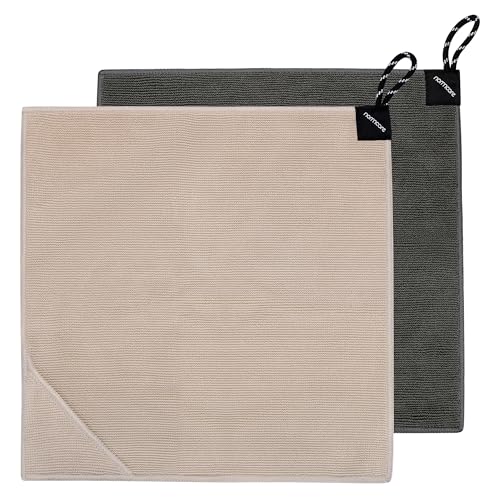
Normcore Barista Cleaning Towels — Best Colour-Coded Pair
Normcore approaches the bar cloth as a system problem, and its answer is colour. This set pairs two microfiber barista cloths in two assorted colours, so the separation rule — one cloth for the steam wand, another for everything else — stops depending on memory, folding habits, or which cloth happens to be damp. The wand cloth is the red one, or the dark one, or whichever your bar decides; the point is that the decision is visible from across the room, to a trainee, a guest barista, or yourself at six in the morning before the first coffee has happened.
Normcore’s wider reputation rests on precision accessories for espresso — distribution tools, tampers, and portafilter gear bought by people who measure their shots. The cloths inherit that positioning: they are the finishing touch of a considered home bar rather than a bulk commodity, priced and packed accordingly at two. In practice most buyers will run them as the designated pair at the machine — wand and portafilter — backed by a cheaper bulk set for counters and accidents, and that hybrid system is arguably the smartest configuration in this entire guide: precision where hygiene matters most, volume where it does not.
Do not buy this set expecting it to stock a café. Two cloths cannot survive a commercial morning, and the listing makes no such promise. Buy it because your home bar’s current system is one cloth doing everything, and you want the upgrade that actually changes behaviour. Colour is the cheapest trainer a bar can hire, and this pair puts it to work from the first shot of the day.
- Pack count: 2 cloths
- Size: barista cloth format (see listing for current dimensions)
- Material: microfiber
- Colours: two assorted colours per set
- Positioning: the designated wand-and-portafilter pair
Strengths
- Two colours encode the separation rule so nobody has to remember it.
- Precision-accessory brand with strong credibility among home espresso enthusiasts.
- Ideal designated pair when combined with a bulk set for counters.
Trade-offs
- Only two cloths; a full rotation requires additional packs or a bulk partner set.
- Premium positioning for what is, in material terms, a simple microfiber cloth.
- Colour assortment may vary, so confirm the current pairing on the listing.
The pair also travels well between roles as a bar grows. Today the two colours separate wand from portafilter; when a bulk set joins the drawer later, the Normcore cloths retire gracefully into being the designated milk cloths only, the two that never leave the machine’s side. Equipment that keeps a clear job as the setup evolves is equipment bought once. That, more than the branding, is the case for spending a little more on two cloths with a plan.
Best for: home baristas formalising a wand-versus-everything-else system. Not suited for: cafés needing cloth depth for a full service day.
Comparison Table
| Cloth set | Pack | Size | Weave | Best role |
|---|---|---|---|---|
| watchget Barista Microfiber Cloths | 4 | 12 x 12 in | Microfiber | Steam wand starter set |
| EubooTree Barista Towels | 6 | 12 x 12 in | Microfiber | Full rotation depth |
| MHW-3BOMBER Barista Towels | 4 | 11 in | Microfiber | Compact home bars |
| watchget Barista Towels 12×20 | 4 | 12 x 20 in | Microfiber, black | Counters and spills |
| Solyra Barista Towels | 6 | 12 x 12 in | Waffle, 380 GSM | Scrubbing baskets and trays |
| Normcore Barista Cleaning Towels | 2 | Barista format | Microfiber, two colours | Colour-coded separation |
Why Should the Steam Wand Have Its Own Dedicated Cloth?
Because milk is perishable and the wand is hot. Every steaming leaves a film of milk on the steel, and that film, warmed repeatedly through the day, becomes exactly the sort of residue no café wants near fresh drinks. A dedicated wand cloth, kept damp and used for nothing else, means the only thing that ever touches the wand is a clean, single-purpose tool. The moment that cloth also wipes a counter, it starts ferrying the counter back to the milk. Separation is not fussiness; it is the entire hygiene architecture of the bar expressed in cloth.
The dedicated cloth also protects the machine. A wand wiped after every use never develops the baked crust that eventually needs soaking and scrubbing, and the steam holes stay clear, which keeps milk texture where it belongs. Baristas in busy cafés treat the wand cloth as part of the machine itself — always in the same place, always damp, replaced the moment it is heavily soiled. Home baristas who adopt the same discipline find their machines cleaner, their milk sweeter, and their morning routine oddly more satisfying.
How Many Barista Towels Does a Home Bar Actually Need?
Count jobs before cloths. A home bar running the full separation system needs three working cloths — wand, portafilter, counter — plus at least one full spare set for laundry days and spill emergencies, which lands most households at four to six cloths. That is precisely the pack range dominating this guide. A single drinker making two flat whites a morning can run happily on a four-pack; a household pulling shots for guests every weekend should start at six and stop rationing.
Cafés should scale by station rather than by shop. Each espresso station deserves its own working set and its own laundry buffer, because cloths borrowed between stations are cloths whose job history nobody knows. However you scale, buy the buffer before you need it: the day the wash is late is the day a thin rotation tempts someone to break the separation rule, and habits broken under pressure tend to stay broken.
How Should You Wash Barista Towels Without Ruining Them?
Launder bar cloths hot and daily, with a plain detergent and no fabric softener — softener coats microfiber’s split fibres and quietly converts an absorbent cloth into a smearing one, the same failure that ruins barber and bath towels. Rinse the wand cloth under the tap through the day whenever it grows heavily loaded, and never leave milk cloths sitting damp overnight; sour milk smell in microfiber is stubborn, and prevention is a thirty-second rinse. Shake grounds out before washing so the load is not grinding grit into every weave.
Dry the cloths fully and store them flat or folded at the bar, not balled in a drawer. Retire cloths when they stop grabbing — when milk film starts skating across the surface instead of lifting, the fibres are spent or coated, and a wash stripped of softener build-up is worth one attempt before replacement. A cloth rotation that is washed honestly and retired on condition will keep a bar hygienic for a long stretch; a rotation washed lazily makes even the best cloth in this guide perform like a rag.
What Are the Most Common Mistakes With Barista Towels?
The first mistake is the single-cloth bar: one heroic square wiping wand, basket, counter, and hands in rotation, spreading each job’s residue into the next. The second is letting the wand cloth dry out — a dry cloth polishes milk film rather than lifting it, and the residue bakes on. Third is reaching for paper towel as a substitute, which shreds on hot steel, leaves fibres behind, and costs more across a month than a washable set.
Home bars add two errors of their own. They press the good tea towels into wand service, where milk and heat retire them from polite company, and they wash bar cloths with fabric softener out of household habit, glazing the microfiber until every wipe smears. Both errors end the same way: a dedicated, properly washed cloth set is not an affectation but the cheapest upgrade in the whole espresso hobby.
What Does a Café-Grade Cloth Routine Look Like Across One Day?
Picture the rhythm at a well-run station. Before the first customer, three fresh cloths take their places: wand cloth dampened and parked on the rail, portafilter cloth folded beside the knock box, counter cloth within reach of the grinder. Through the morning rush the wand cloth is rinsed whenever the pace allows and replaced outright at the first sign of heavy soiling; the counter cloth absorbs the rush’s debris and is swapped at the midday lull. Nothing heroic happens — that is the point. The routine is a set of small, repeatable acts that keep every surface one wipe away from clean.
At close, every cloth goes into the wash regardless of how clean it looks, because milk residue does not announce itself politely. Tomorrow starts with a fresh set from the clean stack, and the rotation rolls on. Home bars can copy this rhythm at quarter scale: fresh cloths on the days you pull shots, everything laundered that night, no cloth carried over to a second day. The routine matters more than the brand of cloth inside it, but the routine only survives if the drawer holds enough cloths to make it easy — which returns, as every bar question does, to buying the pack size that fits the system.
How Do Coffee Oils Change a Cloth Over Time?
Coffee is an oily business, and cloths absorb that truth literally. Espresso oils coat fibres a little with every wipe, and milk adds its own fats to the wand cloth. Fresh from the wash, a good microfiber feels grabby, almost eager; months of lazy laundering leave it slick, faintly sweet-smelling in the wrong way, and prone to smearing a portafilter basket instead of cleaning it. The decline is gradual enough that bars adapt to it without noticing, wiping three times where one wipe used to do, until a new cloth arrives and exposes how far the old set had slipped.
Fighting the decline is mostly washing discipline: hot water, adequate detergent, no softener, and a full dry. Waffle weaves resist a little longer because their structure sheds soil more completely, and dark cloths hide the visual side of ageing without slowing the functional side. When a cloth stays slick after an honest hot wash, retire it to garage duty and promote a fresh one. Cloths are consumables in a way machines are not, and treating them as permanent is how bars end up polishing with oil.
Can One Cloth Set Serve Both a Café Machine and a Home Kitchen?
It can serve both places, but it should not serve both purposes on the same day. A cloth that has wiped a kitchen’s raw-chicken counter has no business at a steam wand an hour later, however hot the wash in between is planned to be — plans slip, washes get delayed, and the separation rule exists precisely for the days when discipline is tired. Keep the bar’s cloths in the bar’s drawer, marked by colour or size, and let the kitchen keep its own. The sets in this guide are inexpensive enough in pack terms that duplication is cheap insurance.
Where sharing genuinely works is across beverage work: the same cloth discipline, and often the same cloths, serve a tea station, a smoothie bar, or a home cocktail corner, anywhere milk, syrups, and glass need constant small cleanups. The barista towel is really the hospitality cloth in its most refined form — small, grabby, washable, and assigned — and any counter that adopts its rules gets tidier, whatever it serves.
What Should You Look For When a Barista Towel Listing Stays Vague?
Plenty of cloths are sold with the word barista attached and very little else — no dimensions, no weave description, no pack logic. Treat vagueness as information. A maker who will not state a cloth’s size probably knows it is an awkward one, and a listing that never mentions steam wands is usually describing a general cleaning cloth in a coffee costume. The listings behind this guide’s picks name their jobs, their sizes, and in Solyra’s case even a fabric weight and certification; that specificity is what separates bar equipment from kitchen cloths wearing a label.
Your own checklist can stay short. Size near 12 inches square for machine work, a pack count that covers your rotation with a buffer, microfiber or a purposeful waffle texture, and colours or counts that let you keep jobs separate. Anything missing from that list should be a deliberate exception — the long watchget towels break the size rule on purpose, the Normcore pair breaks the count rule on purpose — rather than an accident you discover at the machine. Buy the exceptions knowingly and the standard kit by the checklist, and the drawer will organise itself.
How Does Cloth Choice Affect the Drinks Themselves?
It sounds like a stretch until you taste the evidence. A wand wiped with a counter cloth can carry cleaning-spray residue and old milk into fresh milk; a basket wiped with a slick, oily cloth leaves a film that the next shot extracts through, picking up stale flavours on its way. Coffee people chase grams, degrees, and seconds in pursuit of a cleaner cup, then undo the work with a dirty square of fabric. The cloth is the last thing that touches the equipment before the coffee does, which makes it, gram for gram, one of the highest-leverage items on the bar.
The effect is largest in milk drinks, where the wand meets the ingredient directly, and in light-roast espresso, where stale oil flavours have nowhere to hide. None of this requires expensive cloth — it requires dedicated, clean, frequently laundered cloth, which is a habit wearing a product’s clothing. That is the real subject of this guide: the six sets above are simply the easiest ways to buy the habit.
Where Do Barista Towels Fit in a Zero-Waste Coffee Routine?
Home espresso generates quiet waste: paper towels for wipes, disposable cloths for the counter, pods and packaging beyond the bar itself. A washable cloth set is one of the easiest reductions available, because it replaces the most disposable item in the routine — the wipe — with something that lasts through hundreds of washes. A six-pack in daily rotation can stand in for a small mountain of paper across a year, and microfiber’s quick wringing means the cloth, not the bin, handles the spills.
The honest caveat is laundry: cloth only wins if it is washed efficiently, in full loads, and kept in service long enough to justify the water. That circles back to pack depth and retirement discipline — buy enough cloths to wash in real loads, care for them without softener so they keep absorbing, and retire them to rougher duty rather than the bin when their bar days end. A cloth that finishes life cleaning a bicycle chain has been thoroughly used, and a bar that runs its textiles that way can feel good about both the drinks and the drawer.
How Should a Small Café Train New Staff Into the Cloth System?
New baristas learn the cloth system fastest when the system can be seen. Colours assigned to jobs, cloths parked in fixed places, and a clean stack that lives in one obvious spot teach more in a shift than any laminated instruction. The trainer’s job shrinks to three sentences: the wand cloth never leaves the rail, a dropped cloth is a dirty cloth, and when in doubt, take a fresh one. Everything else — rinsing rhythm, folding, laundry timing — is refinement layered onto those rules once they hold.
Managers should also protect the system from its most common saboteur: the busy moment. Rushes tempt everyone to grab the nearest cloth for the nearest spill, and one rush of exceptions can reset a trainee’s habits to zero. Depth is the protection — enough cloths that the nearest one is always a legitimate choice — which is why this guide keeps returning to pack counts. Training, hygiene, and inventory turn out to be the same conversation, held at a coffee bar, about small squares of microfiber.
What About the Milk Pitcher and the Grinder — Do They Need Cloth Rules Too?
They do, and they are the two stations beginners forget. The milk pitcher grows a ring of dried milk at its inner rim that a dedicated rinse-and-wipe after each use prevents entirely; let it accumulate and it flavours the next pitcher and resists later cleaning. Waffle texture earns its keep here, reaching the ring with its edges. The grinder, meanwhile, sheds fine grounds that migrate across every nearby surface, and a dry counter cloth stationed beside it — used dry, never damp, so grounds lift instead of pasting — keeps the drift from becoming the bar’s background texture.
Neither station needs its own exclusive cloth in a home setup; the counter cloth can cover both with a rinse between roles. In a café, volume argues for a pitcher cloth in the rotation as well. The principle scales rather than changes: every recurring mess gets an assigned cloth, every assigned cloth gets washed nightly, and no cloth serves two masters whose residues should never meet.
Final Recommendation
Start with the system, then buy the cloths that serve it. Most readers should take the watchget four-pack as the wand-and-machine foundation or the EubooTree six-pack when rotation depth matters, add the long black watchget towels if counters and spills are your daily reality, and choose Solyra’s waffle set when baskets and trays need scrubbing bite. MHW-3BOMBER suits the compact, considered home bar, and Normcore’s two colours are the smartest small purchase in the guide for anyone whose cloths keep migrating between jobs. Keep the wand cloth sacred, wash hot, skip the softener, and your bar will run cleaner than cafés with machines ten times the price.
Frequently Asked Questions
Can I use regular kitchen towels at an espresso bar?
You can, but they underperform at every bar job: cotton tea towels smear milk fat, dry slowly, and are usually the wrong size for wand work. A dedicated microfiber set costs little, washes daily, and keeps milk cloths separate from food cloths, which kitchen towels cannot promise.
How often should barista cloths be replaced during service?
Replace the wand cloth the moment it is heavily soiled or has dried stiff, and swap the full set at least daily in a café. Home bars pulling a handful of drinks can run one set through the day with mid-service rinses, provided the cloths are laundered that night.
Why do barista towels use microfiber instead of cotton?
Microfiber’s split fibres lift milk fat and coffee oil rather than pushing them around, the cloth wrings nearly dry for the next wipe, and it tolerates daily hot washing without shrinking into a board. Cotton remains pleasant for general kitchen work but loses every one of those comparisons at the machine.
What size barista towel should I buy?
Start with the 12 by 12 inch square, which folds into a safe pad for wand work and stores neatly on the drip tray rail. Add a longer cloth near 12 by 20 inches if counters and spills dominate your cleanup, rather than upsizing every cloth in the system.
Do waffle weave barista towels really clean better?
For scrubbing jobs, yes: the waffle grid’s edges bite into basket film and tray grit, and its pockets hold what it loosens. For polishing glass, a flat microfiber still wins. Most well-equipped bars keep both textures and let each do the work it is shaped for.
Set the drawer up tonight: three cloths out, the rest stacked clean, the wand’s cloth a colour your half-asleep self cannot confuse with any other. Tomorrow’s first shot will taste like the system working, quietly, before the house is even awake.
One last detail for the home bar: keep the bar cloths out of the family laundry basket’s general population. A separate small hamper or a hook by the machine keeps milk cloths from spending a weekend marinating among gym clothes, and it makes the nightly wash a single grab rather than a search. Systems survive on convenience, and the most convenient version of this one is very convenient indeed.
And when a cloth finally retires from the bar, demote it proudly — garage, bicycle, and windows all await — rather than letting a spent cloth linger at the machine out of misplaced thrift and habit.
Related Guides
The discipline of the right cloth for the right job runs through every corner of the home. Our guide to Best Egyptian Cotton Bath Towels trades microfiber for long-staple luxury at the other end of the house, while Best No-Lint Bath Towels tackles the cloth problem of fibres left behind. For the café counter’s closest cousin in the drinks world, see Best Bar Towels, and if your mornings begin with movement rather than espresso, Best Bedroom Slippers for Travel covers the small comforts that pack well.


