What's inside
- Quick picks: best barber slippers
- What Barbers Actually Wear on Their Feet
- Quick Comparison
- How to Choose Footwear for Barbering
- Common Mistakes When Buying Barber Footwear
- Sizing and Fit for Work Footwear
- Caring for Barber Footwear
- Frequently Asked Questions
- Barber Footwear for Different Shop Floors
- Conclusion
As an Amazon Associate I earn from qualifying purchases. This post may contain affiliate links at no extra cost to you.
Quick picks: best barber slippers
| # | Product | Where to buy |
|---|---|---|
| 1 | Crocs Bistro Clog | Check on Amazon |
| 2 | Dansko Professional Clog | Check on Amazon |
| 3 | Birkenstock Boston | Check on Amazon |
| 4 | Alegria Classic Clog | Check on Amazon |
| 5 | UGG Ascot Slipper | Check on Amazon |
What Barbers Actually Wear on Their Feet
A barber spends the working day standing, and the footwear that survives that day has to do three things: slip on easily in the morning, support the feet for eight hours, and survive hair, water and hard floors. The slippers in this guide are the slip-on styles that barbers actually wear, and they are not bedroom slippers: they are work clogs, slip-on shoes and recovery slippers, chosen because they meet the demands of a barbershop rather than the demands of a living room. The keyword says slippers because that is how shoppers search, and the guide answers it with the footwear that does the job.
The first demand is the floor. A barbershop floor is hard, it is covered in cut hair, and it gets wet when hair is washed, so the footwear needs a sole that grips when wet, a closed toe that protects the foot, and an upper that can be wiped clean. An open slipper with a fabric sole would be ruined in a week, while a clog with a rubber sole and a wipe-clean upper will last for years. Every style in this guide has a closed toe, a rubber outsole, and an upper that can be cleaned, which is the minimum for shop wear.
The second demand is the shift. Eight hours of standing is hard on the feet, the knees and the back, and the footwear has to cushion and support rather than just cover. A flat, soft slipper will feel wonderful for an hour and tiring after a full day, while a contoured footbed with arch support will feel firm at first and comfortable after eight hours. The Dansko and the Birkenstock in this guide are the most supportive, and the others all have cushioned, contoured footbeds that are made for standing.
The third demand is the change of shoes. A barber who wears work shoes all day needs something soft to change into afterwards, and the UGG Ascot at the end of this guide is the recovery slipper for that moment: a soft, shearling-lined slipper for the journey home and the evening, when the feet need warmth and softness rather than support. The guide covers the whole day, from the first client to the last, and the footwear for each part of it.
Each style below is described with its strengths, its trade-offs and the wearer it fits, plus a guide to choosing between them, the mistakes that waste money, and answers to the questions shoppers ask most. The descriptions are based on the makers' published specifications and on widely reported owner experience, and no prices are given because prices change with size, colour and retailer.
Quick Comparison
| Footwear | Materials | Standout features | Best for |
|---|---|---|---|
| Crocs Bistro Clog | Resin, slip resistant | Wipe-clean, light, enclosed toe | Best wipe-clean shop clog |
| Skechers Work Sure Track | Leather, memory foam | Slip resistant, cushioned | Best cushioned work shoe |
| Dansko Professional Clog | Leather, contoured footbed | Arch support, durable | Best support for long shifts |
| Birkenstock Boston | Suede, cork footbed | Contoured cork, adjustable strap | Best moulded footbed |
| Alegria Classic Clog | Leather, rocker sole | Rocker outsole, cushioned insole | Best rocker-sole comfort |
| UGG Ascot Slipper | Suede, wool lining | Soft recovery slipper | Best after-shift slipper |

Crocs Bistro Clog
The wipe-clean work clog: light, slip resistant, enclosed, and made to be hosed down at the end of the day.
The Crocs Bistro Clog is the work clog that most barbers know, and it is the one that best meets the demands of a barbershop floor. It is made from a closed-cell resin that does not absorb water or hair, it has an enclosed toe, a slip-resistant outsole, and a cushioned footbed, and it can be wiped clean or rinsed at the end of the day. The Bistro is the clog for a barber who wants footwear that can be cleaned in seconds and that will not be ruined by water, hair or clippers.
The Bistro works because its material is the right one for the job. Resin does not absorb moisture, so the clog does not get heavy or smelly, and it can be washed under a tap, which is more than can be said for leather or suede. The slip-resistant outsole grips on wet floors, the enclosed toe protects the foot from dropped clippers and scissors, and the clog is light enough to wear for a full shift without tiring the legs. Owners report that it is the clog they wear when they want something practical, and that it lasts for years of daily shop wear.
The trade-offs are support and looks. The Bistro has a cushioned footbed but no real arch support, so a barber who needs support should add an insole or choose a contoured clog instead. It is also a resin clog, and it looks like one, which suits a working barbershop and not a formal one, and it is ventilated, which keeps the feet cool but lets hair in. The clog is roomy, so a buyer between sizes should size down.
One practical note: the Bistro is the work version of the Crocs clog, with a thicker, slip-resistant sole and no holes on the top, unlike the classic clog. A buyer should check the style name before ordering, since the classic clog looks alike in photographs and is not made for wet work floors.
Strengths:
- Wipe-clean resin that does not absorb water or hair
- Slip-resistant outsole for wet shop floors
- Enclosed toe that protects the foot
- Light enough for a full shift; rinses clean
Trade-offs:
- Little arch support; add an insole if needed
- Ventilated design lets hair in
- Looks like a work clog, not a smart shoe
Who it fits: Barbers who want a practical, washable clog for the shop floor.
Check price on Amazon: Crocs Bistro Clog
Skechers Work Relaxed Fit Sure Track
A leather work shoe with memory foam: the cushioned, slip-resistant choice for barbers who want a shoe rather than a clog.
The Skechers Work Relaxed Fit Sure Track is the work shoe in this guide, and it is the one for a barber who wants a shoe rather than a clog. It has a leather upper, a memory-foam insole, a slip-resistant outsole and a relaxed fit, and it is made for workers who stand all day on hard floors. The Sure Track is the shoe for a barber who wants cushioning, a smart look, and a sole that grips, all in a style that can be worn in a smarter barbershop.
The Sure Track works because its memory foam does the job that a contoured footbed does in the more expensive clogs, at a lower cost. The foam compresses under the heel and the ball of the foot, which spreads the pressure and reduces the ache of standing on tile or concrete, and the relaxed fit gives the toes room to spread, which matters after hours on the feet. The leather upper can be wiped clean, the slip-resistant outsole grips on wet floors, and the shoe is light enough to wear for a full shift.
The trade-offs are durability and support. The memory foam will compress permanently after a year or so of daily wear, the leather needs care to stay smart, and the footbed is flat, so a barber who needs arch support should add an insole. The shoe is also a lace-up, which takes longer to put on than a clog, and it is not as easy to clean as a resin clog, since hair can catch in the laces.
One practical note: Skechers Work shoes are sold in whole and half sizes, and the relaxed fit is roomy, so most wearers take their usual size. A buyer who wears thick socks should consider a half size up, and the shoe should be aired out after each shift, since the memory foam can hold moisture.
Strengths:
- Memory-foam insole that cushions hard floors
- Slip-resistant outsole for wet shop floors
- Leather upper that looks smart and wipes clean
- Relaxed fit with room for the toes
Trade-offs:
- Memory foam compresses permanently over time
- Flat footbed with little arch support
- Lace-up takes longer to put on than a clog
Who it fits: Barbers who want a smart, cushioned work shoe for long shifts.

Dansko Professional Clog
The contoured clog that barbers, nurses and chefs swear by: real arch support in a leather clog built for standing all day.
The Dansko Professional Clog is the most supportive footwear in this guide, and it is the one that barbers, nurses and chefs have worn for decades. It has a leather upper, a contoured footbed with a raised arch, a rocker outsole and a closed toe, and it is built for people who stand all day. The Professional is the clog for a barber whose feet, knees or back ache at the end of the day, and who needs support rather than softness.
The Dansko works because its footbed is shaped, not flat. The raised arch supports the foot, the heel cup holds the heel in place, and the rocker outsole rolls the foot forward with each step, which reduces the effort of walking and standing. Owners report that it takes a week or two to get used to the firm footbed, and that after that, it is the most comfortable footwear they own, and that their feet hurt less at the end of the day. The leather upper is durable, the clog is easy to clean, and it lasts for years.
The trade-offs are the break-in and the look. The Professional is firm when new, and it needs a week or two before it feels comfortable, which frustrates a wearer who expects instant softness. It is also a heavy, traditional-looking clog, which suits a working barbershop and not a fashion-conscious one, and it is the most expensive work clog in this guide. The clog is sized in European sizes, so a buyer should check the maker's size chart carefully.
One practical note: the Dansko Professional is made in narrow, medium and wide widths, which is unusual for a clog and makes fitting easier. A buyer should measure the foot and choose the width that fits, rather than sizing up in length, since a longer clog that is still narrow will not solve a width problem.
Strengths:
- Contoured footbed with real arch support
- Rocker outsole that eases walking and standing
- Durable leather upper that lasts for years
- The most recommended clog for all-day standing
Trade-offs:
- Firm when new; needs a week or two to break in
- Heavy, traditional look
- European sizing needs a careful check
Who it fits: Barbers whose feet, knees or back ache after long shifts.
Check price on Amazon: Dansko Professional Clog

Birkenstock Boston
A suede clog with a moulded cork footbed: the slip-on that shapes itself to the foot over weeks of wear.
The Birkenstock Boston is the moulded clog in this guide, and it is the one for a barber who wants footwear that shapes itself to the foot. It has a suede upper, a cork and latex footbed that moulds to the shape of the foot over weeks of wear, an adjustable strap, and a rubber outsole. The Boston is the clog for a barber who likes a slip-on, who wants arch support, and who is willing to wait for the footbed to break in.
The Boston works because the cork footbed is the most personal in this guide. It starts firm and it moulds to the foot, so after a few weeks it fits the wearer and no one else, with an arch that matches the wearer's own. Owners report that it is the most comfortable clog they own once broken in, and that it is the one they wear for years, since the footbed can be replaced when it wears out. The suede upper is durable, the strap adjusts the fit, and the rubber outsole grips well on shop floors.
The trade-offs are the break-in and the care. The Boston needs several weeks before the footbed moulds, and it feels hard and uncomfortable at first, which puts off a wearer who wants instant comfort. The suede upper needs a protector spray, and the cork footbed should not get wet, since water can damage the cork. The clog is also expensive, and it is sized in European sizes, so a buyer should check the size chart carefully.
One practical note: the Boston is sold in narrow and regular widths, and most wearers take the regular width. A buyer should take his usual size, and should expect the clog to feel snug at first, since the cork will compress slightly and the suede will stretch a little with wear.
Strengths:
- Moulded cork footbed that shapes to the foot
- Adjustable strap for a custom fit
- Durable suede upper with a rubber outsole
- Footbed can be replaced; the clog lasts for years
Trade-offs:
- Needs weeks to break in; hard at first
- Cork footbed must not get wet
- Suede needs protector spray
Who it fits: Barbers who want a moulded, supportive slip-on and will wait for the break-in.
Check price on Amazon: Birkenstock Boston
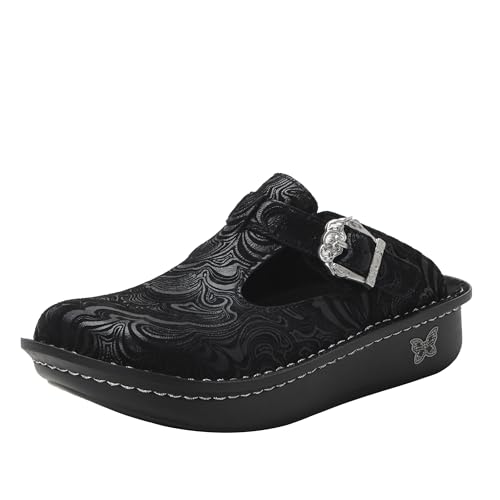
Alegria Classic Clog
A leather clog with a rocker sole and a cushioned insole: the comfortable, colourful choice for long days on the feet.
The Alegria Classic Clog is the comfortable, colourful clog in this guide, and it is the one for a barber who wants cushioning and a rocker sole in a leather clog. It has a leather upper, a cushioned, removable insole, a rocker outsole that rolls the foot forward, and a closed toe, and it is made for workers who stand all day. The Classic is the clog for a barber who wants comfort, who likes a leather clog, and who wants a style with a little more personality than a plain work clog.
The Alegria works because its rocker sole does the work that the Dansko's rocker does, while its insole is softer and more cushioned. The rocker rolls the foot forward with each step, which reduces the effort of walking, and the cushioned insole spreads pressure across the foot, which reduces the ache of standing. Owners report that it is the most comfortable clog they have worn, and that it is the one they reach for on the longest days. The leather upper is durable and easy to clean, and the insole can be removed and replaced with a custom orthotic.
The trade-offs are weight and price. The Classic is heavier than the Crocs and the Skechers in this guide, and it is more expensive than both, though less than the Dansko. The rocker sole takes a day or two to get used to, and the clog is sized in European sizes, so a buyer should check the size chart. The leather needs care to stay smart, and the clog is not as easy to clean as a resin clog.
One practical note: the Alegria Classic is sold in many colours and patterns, and the fit is roomy, so most wearers take their usual size. A buyer who wears orthotics should check that the insole is removable, which it is, and should try the clog with the orthotic in place before committing.
Strengths:
- Rocker outsole that eases walking and standing
- Cushioned, removable insole that fits orthotics
- Durable leather upper in many colours
- Comfortable from the first wear; no long break-in
Trade-offs:
- Heavier than lighter clogs in this guide
- Rocker sole takes a day or two to get used to
- More expensive than resin or canvas clogs
Who it fits: Barbers who want a cushioned, leather, rocker-sole clog for long days.
Check price on Amazon: Alegria Classic Clog

UGG Ascot Slipper
The after-shift slipper: suede, wool lining and a rubber sole, for the journey home and the evening after a long day.
The UGG Ascot Slipper is the recovery slipper in this guide, and it is the one for the end of the barber's day. It has a suede upper, a wool lining and a moulded rubber outsole, in a low profile that slips on easily and looks like a shoe. The Ascot is the slipper to change into after the shift, for the journey home and the evening, when the feet need warmth and softness rather than support, and it is the softest footwear in this guide.
The Ascot works as a recovery slipper because its wool lining breathes and its footbed is cushioned, so the feet can recover from a day in work shoes. Owners report that it is the slipper they wear when they get home, that it is the most comfortable footwear they own for relaxed hours, and that it holds its shape well over time. The rubber outsole means it can be worn to the car and around the house, and the low profile means it slips on in a second, which is what tired feet want at the end of the day.
The trade-offs are that the Ascot is not a work shoe. It has a flat footbed with little arch support, it is not made for standing all day, and the suede upper needs a protector spray before it meets rain. It is a slipper for after the shift, not for the shift itself, and a barber who wears it to work will find his feet aching by midday. It is also sold in whole sizes, and it fits snugly at first, loosening slightly as the lining compresses.
One practical note: UGG slippers are widely copied, and the copies use synthetic linings that do not breathe. A buyer should buy from a known retailer and check that the upper is suede, the lining is wool, and the sole is rubber, since those three things are what make the Ascot worth its place in this guide.
Strengths:
- Suede upper with a breathable wool lining
- Cushioned footbed for tired feet
- Moulded rubber outsole for the house and the car
- The softest footwear in this guide; ideal after a shift
Trade-offs:
- Not a work shoe; no real arch support
- Suede needs protector spray in wet weather
- Not for standing all day
Who it fits: Barbers who want a soft recovery slipper for after the shift.
Check price on Amazon: UGG Ascot Slipper
How to Choose Footwear for Barbering
Start with the floor, because it decides the sole. A barbershop floor is hard and it gets wet, so the footwear needs a slip-resistant rubber outsole and a closed toe. A fabric sole will slip and wear through, an open toe will let hair and water in, and a smooth sole will slide on a wet floor. Every style in this guide has a rubber outsole and a closed toe, and the Crocs Bistro has the most slip-resistant sole here, which is worth knowing for a shop with a tiled floor.
Next, decide on support. Eight hours of standing needs a contoured footbed, and a flat, soft slipper will feel wonderful for an hour and tiring after a full day. The Dansko Professional and the Birkenstock Boston have the most support in this guide, and they are the right choice for a barber whose feet, knees or back ache. The Skechers and the Alegria have cushioned footbeds that suit a barber who wants comfort without a firm arch, and the Crocs suits a barber who wants something light and washable.
Then check the upper. A barbershop upper must survive hair, water and clippers, and it must be easy to clean. Resin can be rinsed, leather can be wiped, and suede needs a protector spray and more care. A barber who wants the easiest care should choose resin or leather, and a barber who chooses suede should accept that it will need more attention. The upper is the part of the footwear that shows, so it should also suit the style of the shop, whether that is a traditional barbershop or a modern one.
Fit is the fourth decision, and it matters more in work footwear than in a house slipper, because the footwear will be worn for eight hours. Most styles in this guide are sold in whole sizes or European sizes, so a buyer should measure the foot and check the maker's size chart rather than guessing. The footwear should feel snug at first, since linings and footbeds settle with wear, but it should not press on the toes or pinch the heel. Work footwear that fits well will feel comfortable at the end of the day, and work footwear that does not will hurt from the first hour.
Finally, think about the change of shoes. A barber who wears work shoes all day needs something soft to change into afterwards, and the UGG Ascot in this guide is the recovery slipper for that moment. Buying a work pair and a recovery pair together is the best way to look after the feet, since the feet need support during the day and softness afterwards, and no single pair of footwear does both well.
Common Mistakes When Buying Barber Footwear
The most common mistake is wearing a house slipper to work. A soft, open slipper with a fabric sole will be ruined by a barbershop floor in a week, and it will not support the feet for a shift. The footwear in this guide is made for work, with closed toes, rubber soles and wipe-clean uppers, and a barber who buys house slippers for the shop will be buying replacements within a month.
The second mistake is choosing softness over support. A soft, flat slipper feels wonderful for an hour and tiring after eight, while a firm, contoured clog feels hard at first and comfortable after a full day. A barber who chooses by the first minute will end up with aching feet, and a barber who chooses by the eighth hour will end up with footwear that lasts. The break-in period is worth enduring, and the Dansko and the Birkenstock in this guide are the proof of it.
The third mistake is ignoring the floor. A sole that grips on carpet will slip on wet tile, and a sole that is fine in a dry shop will slide when hair is washed. The fix is to choose a slip-resistant sole, and to check that the sole is described as slip resistant rather than just rubber, since not all rubber grips when wet.
The fourth mistake is buying the wrong size because work sizing is confusing. European sizes, whole sizes, and makers who size small or large all make online ordering a gamble, and the fix is to measure the foot and to read the maker's size chart. Work footwear that fits will feel comfortable at the end of the day, and work footwear that does not will hurt from the first hour.
Sizing and Fit for Work Footwear
Work footwear should be fitted in the late afternoon, when the feet are at their largest. Feet swell slightly with standing and with heat, so footwear tried on in the morning may pinch by dinner time, and footwear that feels snug in the evening will feel roomy in the morning. A barber who tries shoes on before work will buy a pair that is too tight, and a barber who tries them on after work will buy a pair that fits for the whole day.
Width matters as much as length in work footwear, because the feet spread under load. A narrow shoe will pinch across the toes after hours of standing, while a wide shoe will let the foot spread naturally. The Dansko Professional is sold in narrow, medium and wide widths, and the Birkenstock Boston in narrow and regular, which makes fitting easier, and a buyer should choose the width that fits rather than sizing up in length.
Socks change the fit, and work footwear should be fitted with the socks it will be worn with. A thick work sock adds bulk, and footwear fitted barefoot will feel tight with socks on. The simplest approach is to decide how the footwear will be worn most often and fit it that way, and to remember that a contoured footbed will feel firm at first and comfortable after a week, while a soft footbed will feel comfortable at first and tired after a month.
Caring for Barber Footwear
Work footwear lasts longer when it is aired out after each shift. The footbed holds moisture, and footwear that is shut away damp will develop odour and the lining will break down sooner. Leave the shoes in a ventilated spot, and they will dry, the foam will recover, and the footwear will stay fresh for months longer than a pair that is stored damp.
Resin clogs can be rinsed under a tap and left to dry, which is the easiest care in this guide. Leather clogs and shoes should be wiped clean with a damp cloth and treated with a conditioner occasionally, to keep the leather supple and prevent cracking. Suede should be protected with a spray before the first wear, and cork footbeds should be kept dry, since water can damage the cork.
Frequently Asked Questions
What footwear do barbers actually wear at work?
Most barbers wear a closed-toe clog or a slip-on work shoe: Crocs Bistro, Dansko Professional, Birkenstock Boston, Alegria Classic and Skechers Work are the styles that appear most often in barbershops. The common features are a closed toe, a slip-resistant rubber sole, an upper that can be wiped clean, and a footbed made for standing all day. A house slipper with a fabric sole will not survive a barbershop floor.
Are clogs or lace-up shoes better for barbering?
Clogs are easier to slip on and off, and they are the choice for a barber who wants speed and simplicity. Lace-up shoes, like the Skechers Sure Track, give a more secure fit and a smarter look, and they suit a smarter barbershop. The right choice is the one that fits the shop's style and the barber's feet, and many barbers keep one of each.
Do barbers need arch support in their footwear?
Yes, if they stand all day. A flat, soft slipper feels wonderful for an hour and tiring after eight, while a contoured footbed with arch support feels firm at first and comfortable after a full day. The Dansko Professional and the Birkenstock Boston have the most support in this guide, and they are the right choice for a barber whose feet, knees or back ache.
Can barber footwear be washed?
Resin clogs like the Crocs Bistro can be rinsed under a tap. Leather clogs and shoes should be wiped clean with a damp cloth and treated with conditioner, not soaked. Suede needs a protector spray, and cork footbeds must be kept dry. A barber who wants the easiest care should choose resin or leather rather than suede.
What should a barber wear after the shift?
A soft recovery slipper, like the UGG Ascot in this guide: suede, wool lining, cushioned footbed, and a rubber sole for the journey home. The feet need warmth and softness after a day in work shoes, and a recovery slipper lets them rest. Buying a work pair and a recovery pair together is the best way to look after the feet.
Barber Footwear for Different Shop Floors
The floor a barbershop has decides which sole the footwear needs, and it is the part of the choice that barbers think about least. A tiled floor is hard and it gets wet, so the footwear needs a slip-resistant sole with deep tread, and a closed toe that keeps water out. A wooden floor is softer but it can be slippery when hair is on it, and a rubber sole with a good grip is worth having. A concrete floor is the hardest of all, and it needs a cushioned footbed as well as a grippy sole, since the hardness will tire the feet faster than any other floor.
For tiled floors, the Crocs Bistro has the most slip-resistant sole in this guide, and it is the right choice for a shop with tiles that get wet when hair is washed. The resin upper does not absorb water, so the clog does not get heavy, and it can be rinsed at the end of the day. A leather shoe on a wet tiled floor will slip more easily, and it will need more care to stay smart, so a barber with a tiled floor should lean toward resin or a work shoe with a sole described as slip resistant rather than just rubber.
For concrete floors, cushioning matters more than grip. Concrete does not give, and eight hours of standing on it will tire the feet, the knees and the back, so the footwear needs a contoured footbed or a thick memory-foam insole. The Dansko Professional and the Skechers Sure Track are the best choices here, since their footbeds spread pressure and support the arch, and the Alegria Classic is the cushioned alternative. A barber on concrete should also consider a floor mat, since no footwear can fully replace a cushioned floor, and the combination of a good mat and a good clog is what keeps feet comfortable for a full shift.
Conclusion
The best barber slippers are the ones that survive the shop floor and support the feet for a full shift, and the Dansko Professional leads this guide for support while the Crocs Bistro leads for practical, wipe-clean wear. The Skechers Sure Track is the cushioned work shoe, the Birkenstock Boston is the moulded clog, the Alegria Classic is the cushioned rocker clog, and the UGG Ascot is the recovery slipper for after the shift. Any of the six will serve well, and the right one is the one whose sole, support and upper match the barber's shop and feet.
Choose a closed toe and a slip-resistant sole, pick support over softness for the working day, get fitted in the late afternoon, and keep a soft pair for after the shift. Footwear bought with those rules in mind will last for years and will keep the feet comfortable from the first client to the last.


