What's inside
- Where to buy these picks
- The six pairs summarised
- What got each pair onto the list
- Six warm pairs, reviewed with their labels kept straight
- Warmth mechanisms, compared without mixing labels
- How do you choose warm slippers without guesswork?
- Linings, quilting and shells: three ways to be warm
- Keeping warm slippers pleasant all winter
- Marginal notes on warm feet
- A winter of warm feet, planned properly
- Common mistakes worth avoiding
- Final recommendation
- Frequently asked questions
As an Amazon Associate I earn from qualifying purchases. This post may contain affiliate links at no extra cost to you.
As an Amazon Associate, cottageverdict.com earns from qualifying purchases.
Cold floors turn slippers from a comfort into a heating strategy, and the best insulated slippers are the pairs that keep feet warm without turning every trip to the kitchen into a shuffle in ski boots. This guide reviews six cold-weather house shoes, and it begins with a labelling discipline the category often skips. Three of the six listing titles use the word insulated outright: the Baffin CUSH BOOTY, the ArcticShield Slippaz, and The North Face ThermoBall bootie. Those three carry the label because their sellers printed it.
The other three earn their place by construction rather than by label. RockDove’s Campground model is a puffer slipper — a quilted, padded design whose warmth comes from its puffy build, memory foam and cosy description, with no insulated claim in its title. Hsyooes offers fur-lined clogs, fleece inside a slip-on mule shape, again described here by its lining rather than by a label its title does not apply to the product name. The second Baffin, the CUSH hybrid, is a lightweight water-resistant slip-on rated by its maker for elemental conditions, and its title likewise leaves the insulated word to its Booty sibling.
One product also needs its shape named correctly. The North Face entry is a bootie — a low winter boot with a grippy rubber sole, sold in the title as insulated winter shoes — not a slipper in the backless, shuffle-to-the-kettle sense. It is reviewed as the outdoor-leaning end of this line-up, useful for readers whose cold-floor problem extends across a yard or a school run. Every warmth description below traces to words in the corresponding title, and claims such as ArcticShield’s heat-reflection language are reported as the seller’s claims, not as measurements made here.
Where to buy these picks
Six warm house shoes follow, three carrying the insulated label in their titles and three relying on linings, quilting and shells.
- Baffin CUSH BOOTY Insulated Hybrid Slippers Navy Large — Baffin’s CUSH BOOTY in navy, size large: a mid-height insulated hybrid slipper with a reinforced nylon upper and a wool blend footbed.
- ArcticShield Insulated EZ Slip-On Indoor Outdoor Slippaz — ArcticShield’s EZ Slip-On Slippaz, insulated per the title, with plush fleece lining, waterproof bottoms and an adjustable elastic fit across sizes M to 3XL.
- Hsyooes Fur Lined Clogs Insulated House Slipper Black — Hsyooes fur-lined clogs in black, a unisex fleece-lined mule for indoor and outdoor wear, sized here at 11 women / 10 men.
- RockDove Mens Campground Puffer Slippers Oriole 11-12 — RockDove’s Campground puffer slippers in oriole, sizes 11-12, with memory foam, a machine-washable build and an indoor/outdoor sole.
- BAFFIN Cush Hybrid Insulated Slippers — Baffin’s CUSH hybrid in navy, size large: the lightweight, water-resistant slip-on sibling with ripstop nylon and a non-slip bottom.
- The North Face ThermoBall Traction Bootie Insulated — The North Face ThermoBall Traction bootie in black and white, size 11: insulated winter shoes with a water-repellent finish and a grippy rubber sole.
The six pairs summarised
| Pair | Warmest for | Warmth evidence in its title |
|---|---|---|
| Baffin CUSH BOOTY Insulated Hybrid Slippers Navy Large | Deep-winter floors and draughty ankles | Insulated booty with wool blend footbed |
| ArcticShield Insulated EZ Slip-On Indoor Outdoor Slippaz | Wet doorstep rounds and larger feet | Waterproof bottoms, elastic fit, M-3XL |
| Hsyooes Fur Lined Clogs Insulated House Slipper Black | Constant short trips through the back door | Fleece-lined clog, fastest on-and-off |
| RockDove Mens Campground Puffer Slippers Oriole 11-12 | Campers, gifts and washable warmth | Puffer build, memory foam, machine washable |
| BAFFIN Cush Hybrid Insulated Slippers | Cool floors, damp thresholds and travel | Lightweight water-resistant ripstop |
| The North Face ThermoBall Traction Bootie Insulated | Cold routes that continue outdoors | A true insulated bootie with rubber sole |
What got each pair onto the list
The shortlist was built to span the three ways a house shoe can be warm. First, labelled insulation in a slipper body — the CUSH BOOTY and the ArcticShield. Second, warmth by architecture — RockDove’s quilting, Hsyooes’ fleece lining, the CUSH hybrid’s water-resistant shell. Third, the bootie that leaves the house — the ThermoBall. A reader who finishes the guide should know which mechanism they are buying, because the mechanisms behave differently across a winter: linings compress, quilting lofts, shells shrug off wet steps to the bin, and a bootie simply goes where slippers should not.
Sizing honesty shaped the selection too. Several titles name a specific size — large for both Baffins, 11-12 for the RockDove, a women’s 11 for the North Face, a dual-gender 11/10 for the Hsyooes — because slippers are sold in size variants and listings often headline one of them. Those figures are reported as the listed variants, and every review reminds its reader to select their own size in the complete slipper listing rather than assuming the headline size is the only one made.
Claims discipline ran throughout. ArcticShield’s title says its material features retain heat reflection; that is printed here as the manufacturer’s description of its technology. The North Face’s water repellent wording is a finish claim, distinct from ArcticShield’s waterproof bottoms, and the two are never merged. Readers outfitting a whole cold-house routine might pair this guide with Best Slippers That Look Like Shoes, the neighbouring roundup of house shoes built to pass as footwear outdoors.
Six warm pairs, reviewed with their labels kept straight

Baffin CUSH BOOTY Insulated Hybrid Slippers Navy Large
The CUSH BOOTY is Baffin’s fuller answer to cold floors: an insulated hybrid slipper — the word insulated is in its title — built to mid height with a reinforced nylon upper, a warm breathable wool blend footbed and a slip-resistant bottom, listed here in navy and size large. Mid height is the design’s argument. A low slipper warms the foot; a booty wraps the ankle, and anyone who has felt a draught find the gap between sock and trouser leg understands why that extra coverage changes the experience of a cold room.
Hybrid is the other word doing work in this title, signalling a slipper built with outdoor manners: a reinforced upper and a real bottom rather than a fabric sole. The honest scope of that claim is the doorstep, the porch and the cold garage, not the hiking trail — this remains a slipper, with a slipper’s softness around the foot. Within that scope, the wool blend footbed is a thoughtful detail, since the surface directly underfoot decides more of a slipper’s warmth than the upper most shoppers inspect.
Listing facts at a glance
- Label in title: Insulated
- Height: Mid-height booty
- Upper: Reinforced nylon
- Footbed: Wool blend, described as warm and breathable
- Bottom: Slip-resistant
- Listed variant: Navy blue, large
Strengths
- Insulated label stated outright in the title
- Mid-height cut covers the ankle against draughts
- Wool blend footbed warms from below
Trade-offs
- A booty takes longer to pull on than a backless mule
- Reinforced nylon upper is practical rather than plush
- The listed variant is one size; others must be selected on the page
Baffin is a cold-weather footwear name, and the CUSH BOOTY reads like a winter boot distilled to its indoor essence: insulation, a breathable warm footbed, grip underneath. For houses with stone or tile floors that stay cold for months, that distillation is exactly the product category that generic fluffy slippers fail to serve. The trade is aesthetic — this is equipment-styled footwear, and a reader furnishing a soft, textile-led home may find its look brisk. A reader whose feet are cold by October will not care.
Breathability, which the title claims for the footbed, matters more in insulated footwear than shoppers expect. Warmth without airflow produces clammy feet within the hour, and a slipper worn all day needs the wool blend’s described breathability to stay pleasant past the first coffee. Wool blends are also traditionally kind about odour across a long season of daily wear, a practical virtue in a product that lives on its owner’s feet for a third of the year.
Sizing deserves a direct note: the headline variant is large, unisex in the title’s wording. Households buying for two people should expect to order two sizes deliberately rather than sharing a pair, because an insulated booty worn a size loose loses the close fit its warmth depends on. Check the maker’s size guidance in the complete slipper listing, particularly if the wearer plans to add thick winter socks inside.
Size range and the maker’s full description are in the complete slipper listing: Check price on Amazon.
Best for: Cold-floor households wanting a labelled-insulated slipper with ankle coverage and a proper grip bottom.
Not suited for: Anyone who wants a backless mule to kick off in seconds, or a soft decorative look.

ArcticShield Insulated EZ Slip-On Indoor Outdoor Slippaz
ArcticShield’s Slippaz take the slip-on route to the same destination: the title labels them insulated and then lists a small armoury of features — retain heat reflection technology, plush fleece lining, waterproof bottoms, non-slip outsoles and an adjustable elastic fit — across a wide size span of M to 3XL. The heat-reflection phrase is the manufacturer’s name for its material approach, and it is reported here as exactly that: a claim by the seller about how the slipper keeps warmth in, not a laboratory finding of this guide.
The adjustable elastic fit is the quietly democratic feature. Slipper sizing is notoriously coarse, feet swell across a day, and winter socks vary in thickness; an elasticated fit absorbs all three variables. Combined with waterproof bottoms — the title’s words — the Slippaz are pitched at the slipper wearer whose duties include the doorstep, the bins and a dog’s short garden visit, in weather that wets an ordinary fabric sole through in one trip.
Listing facts at a glance
- Label in title: Insulated
- Lining: Plush fleece
- Bottoms: Waterproof, with non-slip outsoles
- Fit: Adjustable elastic
- Listed sizes: M to 3XL
- Maker’s claim noted: Retain heat reflection technology
Strengths
- Insulated label plus a fleece lining, two warmth systems in one title
- Waterproof bottoms suit wet doorstep duties
- Elastic fit and a wide M-3XL span forgive sizing guesswork
Trade-offs
- Heat-reflection performance is a maker’s claim, not independently measured here
- An elastic slip-on will not hug the heel like a booty
- The utilitarian styling puts function visibly first
Two warmth mechanisms in one slipper — insulation by the title’s label and a plush fleece lining by its description — give the Slippaz a belt-and-braces character. Linings warm by trapping air against the foot and by feeling warm at first touch, which matters psychologically on a cold morning more than any specification admits. A slipper that feels warm in the first ten seconds is the one that gets worn; the technically warmer pair that starts cold often stays by the bed.
Waterproof bottoms redraw the map of where a slipper can go. The classic fabric sole limits its owner to dry indoor floors; a waterproof, non-slip bottom extends the territory to the porch, the garage and the garden path in ordinary damp conditions. That extension is the difference between changing shoes four times a day and not changing them at all, which for many households is the real product being bought.
The size span deserves its sentence: M to 3XL is unusually broad for a slipper listing, and larger-footed shoppers — routinely an afterthought in house footwear — are explicitly served here. The elastic fit should still be checked against the maker’s chart, since letter sizing in slippers maps imperfectly onto shoe sizes, and a warm slipper in the wrong size is a warm disappointment.
The maker’s size chart and technology description are in the full footwear listing: Check price on Amazon.
Best for: Slipper wearers whose rounds include wet doorsteps, and larger-footed shoppers needing a broad size span.
Not suited for: Purists who want a natural-fibre slipper, and anyone who dislikes an elasticated fit.

Hsyooes Fur Lined Clogs Insulated House Slipper Black
Hsyooes answers cold floors with a lining rather than a label: fur-lined clogs — fleece inside, in the title’s fuller wording — shaped as a unisex slip-on mule for indoor and outdoor wear, listed in black at 11 women / 10 men. This guide describes the product by that construction, a lined clog, and does not hang the insulated label on it. The clog shape carries its own logic: the fastest on-and-off in this entire line-up, a covered toe for warmth and protection, and an open heel that keeps the feel of a house shoe rather than a boot.
Garden shoes appear in the title’s list of roles, and that phrase sketches the intended territory honestly — the clog as the household’s universal threshold footwear, worn for the kettle, the doorstep and the herb patch alike. A fleece lining inside that shape warms the top and sides of the foot while the open back vents a little heat, a balance many wearers prefer for all-day indoor use over the full enclosure of a booty.
Listing facts at a glance
- Construction: Fur-lined clog; fleece lining
- Shape: Slip-on mule / clog
- Wear: Indoor and outdoor, per the title
- Listed variant: Black, 11 women / 10 men
- Grip wording in title: Non-slip
- Label note: Described here by its lining, not as an insulated model
Strengths
- Fastest on-and-off of the six, with a covered toe
- Fleece lining warms without fully enclosing the heel
- Unisex clog shape suits shared household duty
Trade-offs
- An open heel lets draughts reach the back of the foot
- No insulated label in the product’s name or headline description
- A single listed size variant headlines the title
The clog’s case rests on frequency of use. Footwear that takes two seconds to enter gets worn for the thirty-second jobs — the bin, the letterbox, the quick check of a noise outside — where a booty wearer might gamble on bare feet or socks. Across a winter, those small exposures are where cold feet actually happen, and the lined clog quietly prevents them. Convenience is a warmth feature, even though no specification table will ever list it as one.
Shared-household duty is the second case. A unisex clog in a common size range, left by the back door, serves whoever passes — the household’s threshold shoe. The fleece lining makes that shared role pleasant rather than merely practical, and black is the forgiving colour for a shoe that will meet garden soil. Households with a strict shoes-off culture will keep it by the door it serves; others will let it roam the ground floor.
Expectations should stay calibrated to the construction. A lined mule will not match a labelled insulated booty’s warmth in a genuinely cold room, because the open heel and the uninsulated description set its ceiling. What it offers instead is the warmest version of the easiest shape — and for a large share of households, that trade is the right one. Readers heating whole rooms rather than feet might cross-check Best Rugs for Radiant Heat for the floor-warming side of the same winter problem.
Colour and size options beyond the headline variant are in the brand’s own notes: Check price on Amazon.
Best for: Households wanting a warm lined clog by the door for constant short trips, indoors and out.
Not suited for: Anyone needing maximum enclosure against draughts, or shopping specifically for a labelled insulated model.

RockDove Mens Campground Puffer Slippers Oriole 11-12
RockDove’s Campground slipper is the puffer entry: a men’s campground-style design in oriole, sizes 11-12, whose title lists an indoor/outdoor sole, a lightweight build, memory foam, machine washability, a non-slip character and the words cosy and puffy. Its warmth story is architectural — a quilted puffer upper traps air in its padded chambers the way a puffer jacket does — and this guide credits that construction without upgrading it to an insulated label the title does not use. The jacket-for-feet comparison is the seller’s evident design intent, and it is a proven cold-weather idea transplanted sensibly.
Machine washability is the feature that separates this pair from every other pick here. Slippers absorb a season of indoor life, and most warm models — wool footbeds, fleece linings, nylon shells — come with cautious care instructions. A slipper that can simply be washed answers the hygiene question that quietly retires many pairs by February. For a gift-ready product, as the title also claims, washability is the practical half of the present.
Listing facts at a glance
- Construction: Puffer slipper, quilted padded upper
- Footbed: Memory foam
- Care: Machine washable, per the title
- Sole: Indoor/outdoor, non-slip
- Listed variant: Oriole, sizes 11-12
- Label note: Puffer construction; no insulated label in the title
Strengths
- Machine washable, unique among these six
- Puffer quilting traps air for warmth by design
- Memory foam footbed and a sole rated for outdoors
Trade-offs
- No insulated label, so warmth rests on the puffer build
- Memory foam divides opinion — some feet find it too soft
- Oriole is a bold colour that will not suit every hallway
The campground framing in the product’s name points at its intended second life: the slipper as camp footwear, for the tent door and the cabin deck. That context explains the sole, the washability and the packable lightness better than any house-shoe comparison does. Households that camp, caravan or keep a cabin will read this pair differently from pure indoor shoppers — for them, one product covering the cold kitchen floor and the October campsite is a genuinely economical idea.
Memory foam deserves its balanced paragraph. It cushions by moulding, which many wearers experience as immediate comfort, and it is the footbed most likely to please a gift recipient on first wear. Its critics note that foam can feel warm in itself and can compress across a long season. In a winter slipper the warmth is arguably a feature, and the compression question is answered by the wash-and-replace economics of a sensibly priced slipper rather than by engineering debate.
Gift-readiness, claimed in the title, is plausible here for a structural reason: sizing in slippers is forgiving, the 11-12 band covers a common range, and the product asks nothing of the recipient — no charging, no assembly, no care ritual beyond a wash. Buyers choosing between this and the labelled-insulated pairs for a present should decide whether the recipient’s home is cold enough to need the label, or merely chilly enough to enjoy the puffer.
Colourways and the full size run are listed in the complete slipper listing: Check price on Amazon.
Best for: Campers and cabin households, gift buyers, and anyone who wants a warm slipper they can simply wash.
Not suited for: Shoppers who want the insulated word in the title, or who dislike memory foam underfoot.

BAFFIN Cush Hybrid Insulated Slippers
The second Baffin is the CUSH in its original hybrid form: a unisex slip-on in navy, size large, described as lightweight and water-resistant, with ripstop nylon in its construction, a non-slip bottom, and the maker’s elemental rating language in the title. Notably, this title does not use the word insulated — that label belongs to the CUSH BOOTY above — so this review treats the CUSH as the lighter, weather-shedding sibling: the slipper for cool floors and damp thresholds rather than for the deepest cold of January.
Ripstop nylon is a telling material choice. It is the fabric of lightweight outdoor gear — resistant to tearing, quick to dry, indifferent to scuffs — and in a slipper it signals a design meant to be used rather than admired. Paired with water resistance, it makes the CUSH the pair most likely to survive a season of doorstep duties, school-gate dashes in fine rain, and the general abrasion of a busy hallway without looking tired.
Listing facts at a glance
- Construction: Hybrid slip-on, ripstop nylon
- Character per title: Lightweight, water-resistant
- Bottom: Non-slip
- Maker’s rating language: Elemental rated footwear
- Listed variant: Navy, large
- Label note: No insulated wording in this title
Strengths
- Lightweight build for all-day, on-off wear
- Water-resistant ripstop shrugs off damp thresholds
- Non-slip bottom and an outdoor maker’s pedigree
Trade-offs
- Not the labelled insulated model — deep-cold shoppers should take the Booty
- Styling is outdoor-technical rather than homely
- One headline size; the range lives in the complete slipper listing
Two Baffins in one guide invite a direct comparison, and it resolves cleanly. The BOOTY is the warmer, taller, insulated specialist; the CUSH is the lighter, lower, everyday hybrid. Households in genuinely cold houses should buy the Booty and accept its pull-on effort. Households in merely cool houses — underfloor-heated kitchens, draughty hallways, mild winters — will wear the CUSH more, because a slipper’s warmth only counts on the days it is actually on a foot.
Water resistance, carefully distinguished from the ArcticShield’s waterproof bottoms, describes an upper that sheds splashes and light damp rather than a sole sealed for puddles. The distinction matters at the doorstep: the CUSH handles the wet porch and the dewy grass edge; standing in a puddle is beyond its brief. Reading those two words precisely — resistant against proof — is the same discipline this guide applies to the insulated label, and it prevents the only disappointments this category produces.
There is a travel case for this pair as well. Lightweight, packable, quick-drying house shoes earn their suitcase space on winter trips to rentals and relatives, where the floors are unknown and the heating is someone else’s choice. The CUSH’s outdoor manners mean it doubles as the trip’s doorstep shoe too. Few slippers justify luggage room; a hybrid like this is the exception that tests the rule.
The maker’s sizing and full material notes are in the full footwear listing: Check price on Amazon.
Best for: Cool-but-not-arctic homes, travellers, and anyone wanting one light hybrid for floors and thresholds alike.
Not suited for: Deep-winter households that need labelled insulation and ankle coverage.
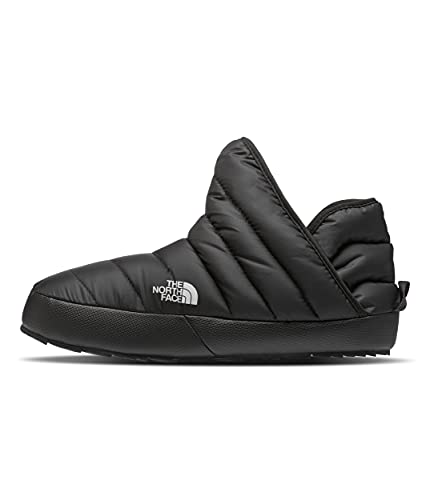
The North Face ThermoBall Traction Bootie Insulated
The North Face entry must be introduced by its true shape: it is a bootie — the ThermoBall Traction Bootie — a low insulated winter boot with a water-repellent finish, an easy slip-on fit and a grippy rubber sole, listed in black and white at women’s size 11. Its title calls the product insulated winter shoes, and that is the honest frame: this is the pair for readers whose cold-weather route runs from the kitchen across a frosty yard, down a path, or along a pavement, where every true slipper in this guide would be out of its depth.
ThermoBall is the maker’s name for its synthetic insulation, and the title’s pairing of warm and insulated is the strongest warmth language in the line-up. Traction in the product name, backed by the grippy rubber sole of the title, completes the winter-shoe picture: grip for icy patches, repellency for slush, and a slip-on fit that keeps the bootie honest to its house-shoe cousins. It is the most capable product here and the least slipper-like, and the review scores it on exactly those terms.
Listing facts at a glance
- Product type: Bootie — insulated winter shoes
- Insulation: ThermoBall, the maker’s insulation, per the title
- Finish: Water repellent
- Sole: Grippy rubber
- Fit: Easy slip-on
- Listed variant: Black/white, women’s 11
Strengths
- True winter-shoe capability with labelled insulation
- Grippy rubber sole for frost and slush
- Water-repellent finish extends the territory beyond the doorstep
Trade-offs
- A bootie, not a slipper — heavier and more structured than house shoes
- Overkill for purely indoor cold floors
- The listed variant is a single women’s size
Including a bootie in a slipper guide is a deliberate provocation with a practical core: a share of cold-feet misery happens outdoors in inadequate footwear chosen because it was by the door. The ThermoBall bootie is the by-the-door shoe that ends that compromise, warm enough and grippy enough for the school run or the dog’s circuit, yet slip-on easy like its slipper cousins. Households that recognise that pattern will find this the most-used product in the guide; households whose problem is strictly indoor will find it machinery without a mission.
The rubber sole is the dividing line. Every other pick here has a slipper bottom — some non-slip, one waterproof — but a grippy rubber outsole belongs to outdoor footwear’s world, with tread that bites on frost rather than merely resisting a slide on laminate. That capability carries weight and stiffness with it, which is why the bootie will never feel like the RockDove’s foam-cushioned softness across a lazy Sunday indoors. Choose by territory, not by spec-sheet envy.
Sizing and audience need one clear sentence: the headline variant is a women’s 11 in black and white, and the product line’s other sizes and colours live in the brand’s own notes. Buyers shopping for a household should also note the bootie’s unisex-adjacent styling — black and white athletic colouring that reads as a trainer-boot — which suits some hallways and wardrobes far better than a slipper’s soft palette would. Readers who enjoy that trainer direction indoors may enjoy Best Fishing Towels for the outdoor errands kit that pairs with it.
The full size run and the maker’s insulation notes are in the full footwear listing: Check price on Amazon.
Best for: Households whose cold problem extends outdoors — yards, paths, school runs — and who want one slip-on winter shoe.
Not suited for: Purely indoor slipper shoppers, who will find it heavier and warmer than the job requires.
Warmth mechanisms, compared without mixing labels
The label column is the discipline of this guide in one view: three titles say insulated, three describe a warm construction instead, and the rows keep those claims separate.
| Pick | Insulated in the title? | Warmth mechanism described | Shape |
|---|---|---|---|
| Baffin CUSH BOOTY Insulated Hybrid Slippers Navy Large | Yes | Insulation plus wool blend footbed | Mid-height booty |
| ArcticShield Insulated EZ Slip-On Indoor Outdoor Slippaz | Yes | Insulation, heat-reflection claim, fleece lining | Slip-on |
| Hsyooes Fur Lined Clogs Insulated House Slipper Black | Not applied here | Fur / fleece lining | Clog mule |
| RockDove Mens Campground Puffer Slippers Oriole 11-12 | No | Puffer quilting, memory foam | Puffer slipper |
| BAFFIN Cush Hybrid Insulated Slippers | No | Water-resistant ripstop shell | Hybrid slip-on |
| The North Face ThermoBall Traction Bootie Insulated | Yes — as winter shoes | ThermoBall insulation | Bootie |
Read across the rows and a pattern emerges: the labelled products cluster at the enclosed end of the design spectrum — booty, lined slip-on, winter bootie — while the unlabelled three win their places on convenience, washability and lightness. That is a fair map of the market. Insulation as a printed claim tends to arrive with structure; warmth as a construction tends to arrive with ease. Neither column is the guide’s favourite; the household’s floor temperature and daily routes should pick the row.
Shape is the second sort. The clog enters and exits fastest, the booties protect furthest, and the slip-ons split the difference. A household can also rationally own two rows — the clog by the door and the booty by the bed is a combination this guide would endorse for a cold house — since the products overlap far less in daily use than a single-winner ranking implies.
How do you choose warm slippers without guesswork?
How cold is the floor, really?
Answer with the house, not the season’s worst night. A stone-floored farmhouse in a cold valley needs the labelled end of this guide — the CUSH BOOTY or the ThermoBall bootie — because its floors stay cold for months. A modern flat with one chilly hallway needs the clog or the CUSH hybrid, and will suffocate in booties by mid-morning. Slippers bought for the coldest imaginable day spend the ordinary days unworn, which makes them the most expensive kind of slipper there is.
Consider also who is cold. Circulation, age and habit vary within one household, and the warmest pair in this guide may be a personal purchase rather than a household one. Buying one serious insulated pair for the coldest person and lighter pairs for everyone else beats uniform issue in both comfort and cost.
Where will the slippers actually walk?
Map the routes: bed to bathroom, kitchen to doorstep, door to bins, house to car. Purely indoor routes forgive any sole in this guide. Routes with wet thresholds argue for the ArcticShield’s waterproof bottoms or the CUSH’s water-resistant shell. Routes that leave the garden argue for the bootie’s rubber sole alone. The map takes a minute to draw and eliminates half the shortlist more reliably than any warmth comparison.
Frequency bends the answer too. A pair worn sixteen hours a day should be chosen for breathability and fit; a pair worn for twenty doorstep minutes should be chosen for speed. The Hsyooes clog is the twenty-minute champion of this guide, and no amount of insulation in a rival changes that.
What should you check in the manufacturer’s own description?
Size mapping first: letter sizes, dual-gender sizes and wide spans all appear in these titles, and each maker’s chart converts them differently. Then the care instructions — only the RockDove claims machine washability in its title — and the exact composition of linings and footbeds. Finally, for the labelled products, the maker’s own description of its insulation, so the claim you are buying is the claim as the manufacturer states it.
Linings, quilting and shells: three ways to be warm
A lining warms by contact: fleece or fur against the skin feels warm instantly and insulates by the air it traps, which is why the Hsyooes clog and the ArcticShield feel welcoming in the first seconds. A puffer warms by loft: quilted chambers hold still air above the foot, the same principle as the jacket it imitates, and the RockDove’s warmth builds over the first minutes of wear. A shell warms by defence: the CUSH hybrid’s water-resistant ripstop keeps wind and damp from stripping heat away, a quieter mechanism that shows its value at thresholds and in draughty halls.
Labelled insulation, as in the two Baffin-adjacent cases and the ThermoBall bootie, is the manufacturer’s engineered answer layered into the product’s construction. The practical shopper need not rank these mechanisms in the abstract; they should match mechanism to moment — instant warmth for short wears, loft for long evenings, defence for draughty routes, and the labelled specialists for houses where cold is a season-long condition.
Keeping warm slippers pleasant all winter
Warm footwear lives a hard life: worn daily, rarely rested, and kept in the warmest spot in the house. Rotating two pairs, even cheaply, extends both lives and solves the damp-footbed problem that builds by midwinter. Airing pairs overnight away from direct heat preserves linings and foams alike, and the RockDove’s washability offers its owners a reset the other five cannot match — one more reason care instructions belong in the purchase decision.
Socks are the adjustable layer of the whole system. A mid-weight sock inside a hybrid slipper closes much of the gap to an insulated booty on a cold snap, and a bare foot inside the same slipper suits a mild evening. Households that treat socks as the thermostat and slippers as the constant get more range from one pair than households that buy three pairs for three temperatures.
Marginal notes on warm feet
The word slipper covers everything in this guide from a backless clog to a winter bootie, which is why shape words — mule, booty, slip-on, clog — carry more information than the category name. Reading for shape first and warmth second prevents the classic error of ordering a bootie for a shuffle-to-the-kettle job.
Gift buyers should note how forgiving this category is: no plugs, no setup, broad size bands, and in the RockDove’s case an explicitly gift-ready pitch. The labelled-insulated pairs make the most thoughtful present for a known cold house; the clog makes the safest present where the house is unknown.
Finally, a word for the floor itself. Slippers treat the symptom at the foot; rugs, draught-proofing and heating treat the room. This guide’s products are the cheapest layer of the solution and the one worn closest, which is why they are bought first — but a household fighting a genuinely cold floor all winter should let the slippers buy time while the room gets its own attention.
A winter of warm feet, planned properly
The coldest floor in most houses is not the one people expect. Hallways and bathrooms, with their hard surfaces and exterior doors, routinely out-chill the stone-flagged kitchen that gets the blame, because traffic and cooking warm the kitchen for half the day. Households choosing from this guide should aim their warmest pair at the route they walk barefoot at 6 a.m., not at the room with the coldest reputation. That single observation redirects more slipper purchases than any insulation claim.
Draughts attack the ankle gap, which is why this line-up’s shapes matter as much as its warmth mechanisms. A booty closes the gap entirely; a slip-on narrows it; a clog leaves it open in exchange for speed. Wearers who feel cold first at the ankle should read the CUSH BOOTY’s mid-height cut as the headline feature it is, while wearers whose feet themselves run cold underfoot should look instead at footbeds — the wool blend, the memory foam — where their cold actually lives.
Layering works indoors exactly as it does on a mountain, only quieter. A thin sock inside a hybrid slipper is the base layer; the slipper is the insulation; the room’s rugs and draught-proofing are the shell. Households that think in layers stop asking one pair of slippers to perform miracles in a cold house, and start getting full value from mid-weight products like the Baffin CUSH, which were designed as part of a system rather than as a substitute for one.
Night-time is the slipper’s proving hour. The trip from a warm bed across a cold floor is the coldest journey in domestic life, measured by contrast rather than by temperature, and it is the journey by which wearers actually judge their slippers. A pair kept at the bedside that can be entered half-asleep — the clog, the easy slip-ons — beats a theoretically warmer pair that lives downstairs. Placement is a feature; buy the pair you will keep where the cold finds you.
Work-from-home winters changed what a slipper must endure. Eight hours of wear exposes every weakness that an evening’s use forgives: footbeds that flatten by noon, linings that turn clammy by three, fits that loosen as the day swells the foot. The adjustable elastic of the ArcticShield and the breathable claims scattered through these titles read differently to a full-time wearer. Households buying for a desk worker should weight all-day virtues — breathability, rebound, fit retention — above the first-minute warmth that sells slippers in shops.
Two pairs in rotation is the professional’s arrangement, and it deserves repeating in this longer section because it solves three problems at once: the damp pair rests while the dry pair works, each pair’s materials recover their loft between wears, and the household is never slipperless when a sole finally surrenders. Rotation also lets a household own range — a clog for the door, a booty for the evening — without pretending one product should do both jobs.
Guests in winter expose a household’s slipper poverty instantly. Visitors pad around in socks on cold floors while the owners’ feet are armoured, and the kind households keep a spare warm pair by the door for exactly this moment. The broad-banded, forgiving fits in this guide — the elastic Slippaz above all — make the best guest pairs, because a spare slipper must fit whoever arrives. It is a small hospitality with an outsized warmth-to-cost ratio.
Care through the season is mostly a matter of dryness. Warm slippers worn daily accumulate moisture from the foot itself, and a night aired in a dry room — not on a radiator, which punishes glues and foams — restores most pairs by morning. The RockDove’s machine washability remains the category’s reset button, but even un-washable pairs stay pleasant far longer with airing and rotation than with any spray or powder. Neglect, not cold, is what retires warm slippers early.
There is an economics of warmth worth one paragraph. Heating a whole house to slipperless comfort costs orders of magnitude more than heating two feet inside a labelled insulated booty, and households watching energy bills have quietly rediscovered the slipper as infrastructure. That framing flatters every product in this guide, but it flatters the durable, repairable-feeling constructions most — the pairs built like footwear, which is to say the Baffins and the bootie, built by makers who also build for the outdoors.
The guide ends where it began: with labels. Insulated is a word three of these titles print and three do not, and the winter will not check the vocabulary before it tests the footwear. Buy the mechanism your house needs — lining, loft, shell or labelled insulation — in the shape your routes demand, and the word on the box becomes what it should always have been: a starting point for the decision, never the decision itself.
Price in this category tracks construction more honestly than in most footwear. The labelled, engineered pairs cost what winter boots cost because they share winter boots’ materials and makers; the lined clog and the puffer cost what slippers cost because they are slippers, honestly built. A shopper who understands that map stops asking why one pair costs three times another — they are not the same product wearing different labels, and the winter will grade them accordingly.
Odour management is the unspoken trial of the warm slipper, worn daily for months against a foot that works all day inside it. Wool blends and breathable claims earn their keep here in ways a specification cannot photograph, and the washable RockDove sidesteps the entire problem by submitting to the machine. Households sensitive to the issue should weight those three facts — wool, breathability, washability — above an extra increment of warmth they may never need.
The hallway test sorts this guide faster than any table: stand in the hall, in the pair, for the length of a delivery conversation. The clog and the hybrids pass without thought; the booties pass with presence; the puffer passes with a smile. A pair that cannot survive a hallway conversation will not survive the doorstep duties that fill a winter’s day, whatever its warmth rating claims. Buy for the hallway and the bedroom will take care of itself.
Children, again, change the arithmetic without changing the physics. A child’s cold feet are a household emergency out of all proportion to their size, and the broad, forgiving fits in this line-up — the elastic span above all — serve as the household’s emergency pair for small visitors and growing feet alike. No pick here is a child’s product, and none should be bought as one; but a spare adult pair that a cold child can shuffle in beats a lecture about socks.
What the outdoor makers bring to this category, finally, is a standard of construction the slipper world rarely meets: sealed seams of thought, soles with intentions, materials chosen against weather rather than against a carpet. The Baffin pair and the North Face bootie carry that standard visibly. A household that buys footwear hard and keeps it long will recognise the value immediately — these are the pairs still in service when three softer pairs have been replaced.
Common mistakes worth avoiding
Calling every warm slipper insulated
The label belongs to the titles that print it — here, the CUSH BOOTY, the ArcticShield and the North Face bootie. Puffer quilting and fleece linings are real warmth, described honestly as construction. Shoppers who blur the terms end up comparing a maker’s engineered claim against a lining’s comfort as if they were the same measurement, and the disappointment that follows is a vocabulary failure, not a product failure.
Buying a bootie for a mule’s job
A mid-height insulated booty is wonderful footwear that takes both hands and a moment to put on. For a household whose slipper use is forty short trips a day, that effort quietly converts into bare feet and cold floors. Match the closure to the trip count: the clog exists because most household journeys are under a minute.
Ignoring the sole’s weather rating
Fabric and foam soles fail at the first wet doorstep, and the failure is total — a soaked slipper is out of service for a day. Routes that cross damp ground need the waterproof bottoms, water-resistant shell or rubber sole that three of these titles describe. Reading the sole’s line in the title is as important as reading the warmth line.
Trusting the headline size
Large, 11-12, M-3XL and a dual-gender 11/10 all headline these listings, and none of them maps onto another maker’s chart. Slipper sizes are variants of a product, not promises about the range. Confirm your size in the maker’s own chart in this model’s full listing, especially when buying the labelled pairs whose close fit their warmth depends on.
Expecting one pair to serve every temperature
A ThermoBall bootie in a mild October kitchen is as wrong as a lined clog in a January farmhouse. Households with real seasons usually end with two pairs at different weights, worn in rotation — which also happens to be the arrangement that makes each pair last longest. The single-pair expectation is the mistake; the two-pair wardrobe is the fix.
Final recommendation
For labelled insulation in a slipper body, the shortlist is two names long. The Baffin CUSH BOOTY is the deep-winter house choice — mid-height, wool blend underfoot, grip below — while the ArcticShield Slippaz add fleece, waterproof bottoms and an elastic fit for the wearer whose slippers work outdoors at the doorstep. Both print their claim in their titles, and both reviews above hold them to exactly that claim.
For warmth without the label, choose by mechanism: RockDove’s puffer for washable, cushioned evenings and camp trips; the Hsyooes clog for lined speed at the back door; the lighter Baffin CUSH for cool floors and damp thresholds. And where the cold problem honestly extends down the path and along the pavement, the North Face bootie stops pretending to be a slipper and simply solves it as a winter shoe.
Frequently asked questions
Which of these are actually labelled insulated?
Three titles use the word: the Baffin CUSH BOOTY, the ArcticShield Slippaz, and The North Face ThermoBall bootie, whose title calls it insulated winter shoes. The RockDove is a puffer slipper, the Hsyooes a fur-lined clog and the Baffin CUSH a water-resistant hybrid; all three are warm by construction and are described that way here.
Is the North Face pick really a slipper?
No — it is a bootie, a low insulated winter boot with a grippy rubber sole and a water-repellent finish. It belongs in this guide because it solves the extended version of the cold-floor problem, the part that continues across the yard, but it should be bought as outdoor footwear, not as a house slipper.
What does ArcticShield’s heat reflection claim mean?
Retain heat reflection is the manufacturer’s name for its material technology, printed in the title and reported here as the seller’s claim. It describes the slipper’s intended approach — reflecting warmth back toward the foot — alongside its fleece lining and insulation label. This guide does not independently measure the effect.
Which pair can I wash?
Only the RockDove’s title claims machine washability. The other five should be cared for by their makers’ instructions in the retail listing for this pairs — another reason the puffer pair suits campers and households where slippers live hard lives.
Waterproof or water-resistant — does the wording matter?
Yes, and the titles use both precisely. ArcticShield claims waterproof bottoms; the Baffin CUSH claims a water-resistant build and The North Face a water-repellent finish. Proof outranks resistant at a wet doorstep, while resistant finishes suit splashes and damp. Buy the word that matches your wettest regular route.
Buy the label where the title prints it, the lining where it does not, and the bootie where the path runs cold — and every floor in the house loses its sting.


