What's inside
- Where to Buy Serious Smoke Filtration
- Key Takeaways
- Quick Picks
- How Did We Choose These Picks for Smoke?
- Comparison Table
- Why Does Cigarette Smoke Defeat Ordinary Purifiers?
- What Should You Look for in a Purifier for a Smoking Room?
- How Should You Run a Purifier Where Someone Smokes?
- Can a Purifier Protect Nonsmokers Sharing the Home?
- What Mistakes Do People Make Buying Purifiers for Smoke?
- How Do Cigars, Vaping, and Incense Change the Calculation?
- What About a Garage, Basement, or Dedicated Smoking Room?
- How Do You Deep-Clean a Room Before the Purifier Takes Over?
- How Long Does Smoke Linger, and What Does That Mean for Sizing?
- What Should Landlords, Hosts, and Sellers Know About Smoke and Air?
- Why Do Some Rooms Still Smell After Weeks of Purification?
- How Should You Maintain a Purifier That Eats Smoke for a Living?
- Final Recommendation
- Frequently Asked Questions
- Related Guides
As an Amazon Associate I earn from qualifying purchases. This post may contain affiliate links at no extra cost to you.
cottageverdict.com is reader-supported. When you buy through links on our site, we may earn an affiliate commission.
Where to Buy Serious Smoke Filtration
Every pick in this guide is sold through Amazon, where you can check price on Amazon and, just as importantly, price the replacement filters before you commit, because smoke duty eats filters faster than any other household job. If you are shopping for the best air purifiers for cigarette smoke, forget the desktop gadgets and the perfume-adjacent ion sticks. Cigarette smoke is a two-front problem: a cloud of very fine particles and a cocktail of gases that soak into walls, curtains, and upholstery. Beating it takes pounds of activated carbon, not ounces, plus a true HEPA stage for the particles, and the six machines below are the ones built with that kind of media weight behind them.
Key Takeaways
- Smoke is particles plus gases; a purifier needs a HEPA stage for the first and a heavy carbon bed for the second, or it is only doing half the job.
- Carbon quantity is the specification that matters most here, and it is the one budget models skimp on hardest.
- Placement in the smoking room, running continuously, beats a stronger machine switched on after the fact.
- No purifier extracts smoke that has already soaked into fabrics; it manages the air while cleaning and ventilation handle the residue.
- Filter replacement on smoke duty runs faster and costs more than the same machine would on dust duty, so budget for it honestly.
- Source habits, like smoking near an open window or outdoors, multiply whatever the machine achieves indoors.
Quick Picks
| Pick | Badge | Why it is here |
|---|---|---|
| Austin Air HealthMate Plus B450 | Best Overall for Smoke | A steel box built around a deep bed of activated carbon and zeolite, with a filter rated to serve for years rather than months. |
| IQAir GC MultiGas XE | Best for Chemical Sensitivity to Smoke | Granular gas-phase cartridges from a Swiss filtration specialist, aimed at the gases and odors other machines wave at. |
| Medify MA-40 | Best Value Smoke Fighter | A tall, slim HEPA machine with a carbon stage and big-room coverage at a mainstream price point. |
| Winix 5510 | Best Smart Pick for a Smoking Lounge | True HEPA plus a high-deodorization carbon filter and app control, so it can work hard while the room is empty. |
| Levoit Core 600S | Best for Large Open-Plan Rooms | Levoit’s biggest Core model, sized for extra-large spaces where smoke drifts far from its source. |
| Rabbit Air A3 SPA-1000N | Best Wall-Mounted Design | A slim, quiet panel that mounts on the wall or stands on the floor, with a customizable filter set including an odor-focused option. |
Notice what is absent: no mini units, no USB novelties, nothing that plugs into a lighter socket. Smoke is the heavyweight division of home air cleaning, and everything on this list was chosen because its filter media has the mass to stay in the fight for months rather than days.
How Did We Choose These Picks for Smoke?
We started from the chemistry. Tobacco smoke contains thousands of compounds, and the ones that make a room smell stale for days are gases and vapors that sail straight through a particle filter. So the first question for every candidate was how much adsorbent media it carries and in what form. Granular activated carbon, especially blended with zeolite or impregnated for specific gases, outperforms the thin carbon sheets glued behind many budget filters, and the top two picks in this guide are built around exactly that kind of bed.
The second question was particle capture, because smoke particles are small and stay airborne for hours. A true HEPA stage is the baseline expectation, and every pick here meets it. The third question was stamina: smoke duty saturates carbon faster than dust duty saturates anything, so we favored machines whose filters are either very large, very long-lived, or reasonably priced to replace. A purifier that wins in week one and surrenders by month two is a poor answer to a daily habit.
Finally, we considered the rooms smoke actually lives in: dens, lounges, garages converted to hangouts, and apartments where one smoker shares air with nonsmokers. Coverage, noise at working speeds, and the option to run the machine hard while the room is empty all shaped the final six. One boundary we hold throughout: a purifier manages air quality and comfort. It does not make smoking safe, it does not undo exposure, and anyone with health concerns about smoke should talk to a medical professional rather than rely on any appliance, including the excellent ones below.

Austin Air HealthMate Plus B450 — Best Overall for Smoke
Austin Air builds purifiers the way appliance companies used to build everything: a powder-coated steel cabinet, a motor meant to run for years, and a filter philosophy based on sheer media weight. The HealthMate Plus carries a deep bed of activated carbon blended with zeolite, wrapped in a multi-stage system that also includes particle filtration for the solid fraction of smoke. The Plus formulation exists specifically for environments heavy with chemicals and odors, which makes it the natural flagship for a guide about cigarette smoke. Where most purifiers treat odor as a secondary feature, this machine treats it as the main event.
The ownership story is where the Austin pulls away from the field. Its combined filter is rated for years of service under normal conditions rather than the six-to-twelve-month cycle typical of plastic rivals, and in smoke duty that longevity translates directly into money saved and performance that does not fall off a cliff each quarter. The trade is immediacy: the machine is heavy, resolutely plain in appearance, and its controls are a simple speed dial rather than an app. It cleans like a workhorse and presents like one too.
In a smoking den or a living room shared with a smoker, the sensible pattern is to let it run continuously at a moderate speed and turn it up during and after smoking sessions. Owners who do that report the difference in how the room greets them the next morning, which is the real test of smoke filtration: not the air during the cigarette, but the air at breakfast the day after. For that test, nothing in this guide is better prepared.
- Filtration: four-stage system with deep activated carbon and zeolite bed
- Coverage: rooms up to about 1,500 sq ft
- Format: floor-standing steel cabinet, manual speed control
- Ownership note: long-life filter softens the higher purchase price
Strengths
- Carbon and zeolite mass that genuinely addresses smoke gases instead of merely perfuming over them.
- Filter longevity measured in years, which transforms the running-cost calculation.
- Steel construction and simple controls suit a machine expected to run around the clock.
Trade-offs
- Heavy, utilitarian cabinet will not win any interior design awards.
- No app, no air-quality display, and no smart features of any kind.
- Purchase price sits well above the mainstream plastic competition.
Best for: homes with a regular smoker and anyone who wants the strongest odor defense with minimal filter churn. Not suited for: buyers who want smart-home integration or a decorative appliance.
Check price on Amazon.
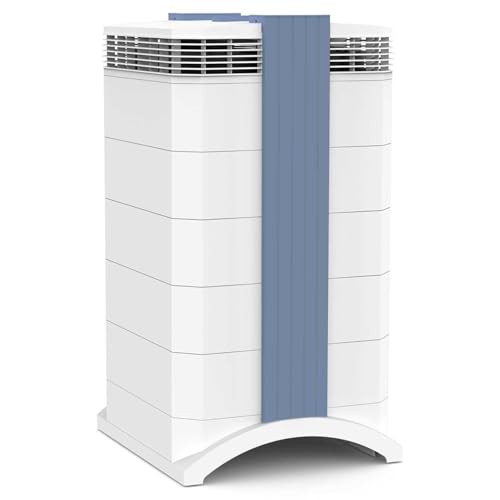
IQAir GC MultiGas XE — Best for Chemical Sensitivity to Smoke
The GC MultiGas is IQAir’s specialist instrument for the gaseous half of air pollution, and cigarette smoke is one of the most chemically complex gases a home produces. Instead of a particle-first design with a carbon afterthought, this machine arranges granular media cartridges around gas and odor removal, with particle filtration handling the solid fraction. It is Swiss-made, built on wheels despite its size, and unapologetically expensive, because granular gas filtration at this scale simply costs what it costs.
Where the Austin Air pick is a bunker, the IQAir is a laboratory instrument that happens to live in your lounge. The XE generation adds connectivity and refined controls, but the core proposition is unchanged: a large quantity of adsorbent media, arranged so air spends real time in contact with it. For households where smoke arrives from a neighbor’s balcony, a downstairs tenant, or a family member who smokes by an open window, that gas-phase depth is the difference between a room that smells managed and a room that smells clean.
Be clear-eyed about the particle side: this is a gas specialist, and while it handles smoke particles competently, buyers whose problem is mostly dust should look at particle-first machines instead. But for the reader whose complaint is specifically the smell and chemical presence of tobacco smoke, the GC MultiGas XE is the most serious tool in this guide, and its price reflects a filter architecture nobody else here attempts.
- Filtration: granular gas-phase cartridges plus particle stage
- Coverage: rooms up to about 1,125 sq ft
- Format: wheeled floor unit, connected XE generation
- Ownership note: cartridge refills are a premium-priced consumable
Strengths
- Gas and VOC removal depth that particle-first purifiers cannot match.
- Build quality and filtration engineering from a specialist manufacturer.
- Effective against smoke drifting in from neighbors, not just smoke made in the room.
Trade-offs
- The most expensive route in this guide by a wide margin.
- Large footprint and industrial styling dominate a small room.
- Particle performance, while good, is not the reason to buy it.
Best for: chemically sensitive households and anyone battling smoke odor as the primary enemy. Not suited for: budget shoppers or dust-first problems in small rooms.
Check price on Amazon.

Medify MA-40 — Best Value Smoke Fighter
The MA-40 is the pick for readers who need real smoke capability without entering the premium tier, and it earns that place with a straightforward formula: a tall tower, a substantial HEPA filter, and a carbon stage, sized to cycle the air of a large room. Medify quotes coverage around 1,793 square feet in an hour, and while hourly coverage figures flatter every machine, the underlying hardware is honestly proportioned for the living rooms and dens where most indoor smoking happens.
Its manners help its case. The MA-40 runs quietly at the speeds you would use overnight, offers a child lock and a timer, and its slim footprint tucks against a wall in rooms where the Austin’s cabinet would loom. For an apartment where a smoker shares space with a partner who does not smoke, that combination of discretion and capacity is often the deciding factor. The machine also handles the wider household load, pollen, dust, cooking smells, without complaint, so it does not sit idle on the days nobody smokes.
The honest caveat is carbon depth. The MA-40’s carbon stage is respectable for its class but it is not a granular bed, and in a room smoked in heavily every day, its odor performance will fade sooner than the top two picks and demand a filter change to recover. Buy it knowing that rhythm, keep a spare filter budget in mind, and it delivers the best smoke defense per dollar in this guide.
- Filtration: HEPA filter with activated carbon stage
- Coverage: up to about 1,793 sq ft in one hour
- Format: slim tower, touch controls, timer and child lock
- Ownership note: plan on timely filter changes under heavy smoke duty
Strengths
- Strong coverage and quiet manners at a mainstream price.
- Slim tower shape fits apartments and shared living rooms gracefully.
- Capable all-rounder for dust and pollen when smoke is not the day’s problem.
Trade-offs
- Carbon stage is thinner than the granular beds of the premium picks.
- Heavy daily smoking will shorten its effective odor-fighting intervals.
- Plastic construction feels ordinary beside the steel Austin cabinet.
Best for: apartments and family living rooms needing credible smoke help on a sensible budget. Not suited for: very heavy daily smoking in a dedicated lounge.
Check price on Amazon.

Winix 5510 — Best Smart Pick for a Smoking Lounge
The Winix 5510 descends from one of the most recommended purifier lines of the last decade, and this generation adds app support to a formula that already suited smoky rooms: true HEPA filtration paired with a high-deodorization carbon filter. That carbon filter is the detail to underline. Winix specced it for odor-heavy work rather than treating it as a token sheet, and in a lounge or den it shows, particularly in the hours after a smoking session when lesser machines have given up.
Connectivity changes how a smoke purifier gets used. With app control and auto mode driven by an air-quality sensor, the 5510 can be scheduled to run hard while the room is empty, the single most effective usage pattern for smoke, and ease back before people return. A driver of that pattern does not need to remember anything; the machine simply does the overnight shift. PlasmaWave, Winix’s additional air treatment technology, can be switched off by those who prefer filtration alone, which is a flexibility we appreciate and mention so readers know the choice exists.
Against the Austin, the Winix trades media mass for intelligence and price. Its filters are consumables on a normal cycle, and heavy smoke will move that cycle forward. But for a lounge that doubles as a media room, where a steel cabinet would look like a filing cabinet crashed the party, the 5510’s blend of deodorizing carbon, sensors, and scheduling makes it the easiest serious smoke machine to live with.
- Filtration: true HEPA plus high-deodorization carbon filter, PlasmaWave option
- Coverage: large rooms up to about 1,881 sq ft in one hour
- Format: floor unit with app control and auto mode
- Ownership note: filter set is a recurring, moderately priced consumable
Strengths
- Deodorization-focused carbon filter suits post-session odor clearing.
- Scheduling and auto mode enable the powerful run-it-while-empty pattern.
- Refined, furniture-friendly design for rooms that are lived in, not just smoked in.
Trade-offs
- Carbon quantity still trails the granular-bed specialists.
- App and sensor features add complexity some buyers will never use.
- Heavy smoke duty shortens the comfortable filter interval.
Best for: dens, lounges, and media rooms where scheduling and appearance matter alongside odor control. Not suited for: buyers wanting maximum carbon mass above all else.
Check price on Amazon.

Levoit Core 600S — Best for Large Open-Plan Rooms
Open-plan living defeats small purifiers quietly: the smoke from one end of a combined kitchen-living space has forty feet to travel and thousands of cubic feet to dilute into, and a compact machine simply never catches up. The Core 600S is Levoit’s answer at scale, the largest of the Core line, rated for extra-large rooms up to roughly 2,933 square feet and verified under the AHAM program. Its 3-in-1 filter combines particle and carbon stages in a drum with far more media than its smaller siblings carry.
Smart features here serve the smoke mission directly. App and voice control let you start a hard cycle from the sofa the moment smoking begins rather than after it ends, and auto mode responds to the particle spikes a cigarette produces within moments. The machine is also notably energy-conscious for its size, which matters for a device whose correct usage is nearly continuous. In a big room, continuous moderate running beats heroic bursts, and the 600S is built for exactly that rhythm.
Its limits are the familiar ones for combination filters. The carbon portion of a 3-in-1 drum is a compromise by design, effective for everyday odor loads and moderate smoking, but it will saturate faster than a dedicated bed in a home where smoking is heavy and constant. Position it between the smoking spot and the rest of the plan, keep its intake clear of furniture, and it is the most practical way to defend a large open space without buying two machines.
- Filtration: 3-in-1 drum filter with particle and carbon stages
- Coverage: extra-large rooms up to about 2,933 sq ft
- Format: floor unit, app and voice control, auto mode
- Ownership note: drum filters are a mid-priced recurring replacement
Strengths
- Scale that matches open-plan rooms where smoke travels far from its source.
- Responsive auto mode reacts to smoke events as they happen.
- Energy-efficient running suits the continuous operation smoke demands.
Trade-offs
- Combination drum carbon saturates faster than dedicated granular beds.
- Large unit needs a deliberate spot; it will not disappear into a corner.
- Heavy daily smoking may still call for a second unit or a carbon specialist.
Best for: open-plan homes and large living spaces with light-to-moderate indoor smoking. Not suited for: small rooms or the heaviest smoking households.
Check price on Amazon.

Rabbit Air A3 SPA-1000N — Best Wall-Mounted Design
The A3 solves a placement problem that quietly undermines smoke purification in real rooms: floor units get pushed into corners, behind sofas, anywhere their airflow goes to die. Rabbit Air’s flat panel design mounts on a wall like a picture frame or stands slim against it, keeping the machine in the room’s air circulation instead of exiled from it. For a smoking lounge, a studio, or a rental where floor space is precious, that form factor is not a styling flourish; it is a functional advantage.
Inside, the A3 runs a multi-stage system with a HEPA stage and a customizable filter slot, and Rabbit Air offers an odor-focused filter option that suits this guide’s mission precisely. Operation is famously quiet, which matters in the rooms where people sit for hours, and Wi-Fi control lets you run a hard cycle before guests arrive or after they leave. The washable pre-filter catches the coarse load and stretches the life of the expensive stages behind it, a small economy that compounds over years of smoke duty.
Price is the barrier, as with most design-led machines, and its carbon capacity, even with the odor filter fitted, sits below the granular specialists. What you are buying is placement discipline, silence, and an appliance that looks intentional in a finished room. In homes where the alternative is a stronger machine hidden behind furniture doing nothing, the A3’s honest positioning makes it the more effective purifier in practice.
- Filtration: multi-stage with HEPA and customizable filter, odor option available
- Coverage: large rooms, wall-mount or floor-stand placement
- Format: slim panel, Wi-Fi enabled, very quiet operation
- Ownership note: washable pre-filter reduces consumable costs
Strengths
- Wall mounting guarantees the good placement floor units rarely keep.
- Odor-focused filter option tailors the machine to smoke duty.
- Exceptionally quiet for rooms where people linger and talk.
Trade-offs
- Premium pricing for the design and mounting system.
- Carbon depth still trails the Austin and IQAir specialists.
- Wall mounting asks for a small installation effort and commitment to a spot.
Best for: design-conscious lounges, studios, and rentals where floor space and placement discipline matter. Not suited for: maximum-carbon seekers on a budget.
Check price on Amazon.
Comparison Table
| Pick | Carbon approach | Coverage | Strongest suit |
|---|---|---|---|
| Austin Air HealthMate Plus B450 | Deep carbon and zeolite bed | Up to ~1,500 sq ft | Long-term smoke odor defense |
| IQAir GC MultiGas XE | Granular gas cartridges | Up to ~1,125 sq ft | Gases and chemical odors |
| Medify MA-40 | Carbon stage with HEPA | Up to ~1,793 sq ft/hr | Value for apartments |
| Winix 5510 | High-deodorization carbon filter | Up to ~1,881 sq ft/hr | Scheduled lounge clearing |
| Levoit Core 600S | 3-in-1 drum carbon stage | Up to ~2,933 sq ft | Open-plan spaces |
| Rabbit Air A3 SPA-1000N | Customizable, odor option | Large rooms | Placement and quiet |
The pattern in the table is a trade between media mass and convenience. The first two rows win on chemistry, the middle rows win on price and intelligence, and the last rows win on scale and placement. Your smoking pattern, not the spec sheet, decides which trade is yours.
Why Does Cigarette Smoke Defeat Ordinary Purifiers?
Light a cigarette and you release two pollutants wearing one name. The visible cloud is particulate matter, fine enough to remain suspended for hours and small enough to drift through a home on the faintest air currents. The invisible remainder is a mixture of gases and vapors, including the compounds responsible for the stale, sweet-sour smell that defines a smoker’s room long after the last cigarette. A purifier built only with a particle filter removes the cloud and leaves the smell, which is why so many buyers conclude that purifiers do not work on smoke. Their purifier worked perfectly, on the half of the problem it was built for.
Adsorption is the countermeasure, and it is a physical process with physical limits. Activated carbon is riddled with microscopic pores that trap gas molecules on contact, but every gram of carbon has a finite capacity, and once saturated it stops helping and can even release odors back. This is why the weight of carbon in a machine predicts its smoke career better than any other figure, and why thin carbon sheets in budget filters exhaust themselves in weeks of smoke duty while deep beds keep working for seasons.
The third actor is the room itself. Smoke compounds adsorb into paint, fabric, carpet, and paper, then slowly re-emit, which is the phenomenon behind thirdhand residue and the reason a freshly painted smoker’s flat can smell again by summer. A purifier cannot reach into a sofa. What it can do is keep the airborne concentration low enough that rooms stop accumulating new residue and existing residue fades without being topped up. That is a management victory, honestly framed, and it is the victory these six machines are built to deliver.
What Should You Look for in a Purifier for a Smoking Room?
Begin with the carbon, and be specific about it. Look for weight, depth, and composition: granular beds, zeolite blends, and deodorization filters designed for odor work all signal serious intent. Be wary of listings that say carbon filter without any indication of quantity, because in this category the absence of a number is usually the number. Then confirm a true HEPA stage for the particle fraction, since smoke particles are exactly the size range HEPA media exists to catch.
Room sizing deserves skepticism and arithmetic. Use the verified coverage figures where they exist, and remember that smoke is a continuous source, not a one-time spill. A machine rated exactly at your room’s size will spend its life at full speed and full volume; stepping up a size buys quieter running at the same cleaning rate, which in a lounge is worth real money. Noise at the speed you will actually use, not the whisper of the lowest setting, is the figure your evenings depend on.
Finally, price the second year before buying the first. Add the cost of replacement filters on a smoke-duty schedule, which is faster than the manufacturer’s gentle household estimate, and compare totals rather than stickers. The Austin’s expensive box with a years-long filter often beats a cheap tower with quarterly consumables by the second winter, and the Winix and Medify sit at honest points along that same curve. Smoke is a subscription problem; buy the subscription you can sustain.
How Should You Run a Purifier Where Someone Smokes?
Continuous beats heroic. A purifier left running at a moderate speed all day maintains a low baseline, so each new cigarette starts from clean air rather than from yesterday’s residue. Bursts after the fact fight a room that has already absorbed its load into the curtains. If running costs or noise argue against all-day operation, the compromise with the best evidence behind it is scheduling: hard cycles during smoking hours and for an hour after, using a timer or app, which is where the Winix 5510’s connectivity stops being a toy and becomes the strategy itself.
Placement follows the smoke, not the furniture plan. Put the machine in the room where smoking happens, on the same side of the house, ideally between the smoking chair and the door the smoke would escape through. Keep its intake and outlet clear by a comfortable margin, and resist the tidiness instinct that pushes purifiers behind sofas. A machine breathing freely at medium speed outperforms a muffled machine at maximum every time.
Pair the machine with the two free technologies: ventilation and source discipline. Cracking a window near the smoking spot and running a small exhaust path outward during a session removes smoke before the purifier ever meets it, and soft furnishings washed or aired regularly stop re-emitting what they have absorbed. The purifier is the anchor of this system, but a system is what a smoking household actually needs.
One more habit separates satisfied owners from disappointed ones: give the machine the room’s worst hour, not its best. If smoking clusters in the evening, the purifier should already be running before the first cigarette, at a speed that keeps pace, rather than being summoned afterward to perform a rescue. Air cleaning is a rate contest between source and filter, and starting early is the only way the filter ever gets ahead of a source that renews itself hourly.
Can a Purifier Protect Nonsmokers Sharing the Home?
This question deserves a careful answer rather than a sales pitch. A good purifier measurably reduces the concentration of smoke particles and odors in the air of the rooms where it runs, and that reduction is real comfort for everyone sharing the space: clothes smell less, visitors notice less, and the home stops announcing the habit at the front door. Families buy these machines for exactly those gains and are usually satisfied with them.
What a purifier cannot do is make indoor smoking safe for the people around it, and no honest guide should imply otherwise. Secondhand smoke is a health hazard with no appliance-shaped exemption, and children, pregnant people, and anyone with respiratory conditions deserve the stronger protections of a smoke-free indoor environment. If health is the concern driving your purchase, the most effective step is moving the smoking outside entirely, and any reader weighing that decision should discuss it with a medical professional who knows their situation.
Within those boundaries, strategy matters. Confining smoking to one room with the door closed, running a carbon-heavy purifier there continuously, and ventilating that room outward does more for the rest of the household than any single machine placed in a hallway. Think of the purifier as the last line of a layered defense whose first lines are location and ventilation, and it will serve the nonsmokers in the home as well as a machine honestly can.
What Mistakes Do People Make Buying Purifiers for Smoke?
The classic error is buying a particle machine for a gas problem: a handsome HEPA tower with a carbon sheet the thickness of a credit card, praised in reviews by dust sufferers, installed in a smoking den to general disappointment. The second error is the opposite romance, trusting an ionizer or ozone-adjacent gadget to neutralize a daily pack. Whatever their other merits, such devices do not adsorb gases in meaningful quantity, and ozone-generating products bring their own air-quality questions into a room that already has enough.
Sizing optimism runs third. Buyers measure the room, buy the machine rated for exactly that area, and then run it on its quiet setting to preserve the evening, delivering perhaps a third of the cleaning the room needs. Smoke rewards oversizing. Fourth is filter amnesia: carbon saturates invisibly, the machine keeps humming, and the household concludes the purifier stopped working when in truth its carbon finished months ago. Mark replacement dates on the calendar the day the filter goes in.
The final mistake is expecting the machine to forgive the room. Purifiers manage air; they do not launder curtains, repaint walls, or extract a decade of residue from a sofa. Households that pair the machine with a genuine deep clean at the start get results that feel disproportionate to the hardware, because the purifier is finally maintaining a clean room instead of besieging a dirty one.
How Do Cigars, Vaping, and Incense Change the Calculation?
Not all indoor smoke is cigarette smoke, and the differences matter when you are matching a machine to a habit. Cigar smoke is denser, oilier, and produced in larger volumes per session, and its odor compounds cling with unusual determination. A cigar lounge at home is the strongest argument in this entire guide for the granular-bed end of the list, because a combination filter that handles cigarettes gracefully can be overwhelmed by a single celebratory evening of cigars. Ventilation earns an even larger share of the credit there: many home cigar smokers do better with a dedicated exhaust arrangement first and a purifier second.
Vaping sits at the opposite pole. The aerosol is largely vapor droplets rather than combustion products, it disperses faster, and its lingering smell is usually a fraction of tobacco’s. The purifiers in this guide handle it easily, arguably excessively; a household whose only concern is a vaper’s cloud can step down the list toward the value picks without regret. What vaping does leave behind is a faint residue film on windows and screens over time, which is a cleaning matter rather than a filtration one.
Incense and candles occupy the middle ground. Both produce genuine combustion particles, and incense in particular generates a fine, fragrant smoke that a HEPA stage captures well while a modest carbon stage handles the scent. The trap is that fragrance is the point of incense, so aggressive purification during a session defeats the purpose; run the machine afterward instead. Wood stoves and fireplaces, finally, produce episodic heavy smoke when doors open or drafts reverse, and there the purifier’s role is recovery: clearing the room over the following hour rather than preventing the event.
What About a Garage, Basement, or Dedicated Smoking Room?
Moving the smoking to a semi-detached space is the strategy many households land on, and it changes the purifier brief in useful ways. A garage or basement tolerates a louder, more industrial machine, which means the Austin’s steel cabinet and straightforward power feel entirely at home there, and its noise at working speed stops mattering. Temperature swings in unheated spaces argue for simple machines without delicate electronics or batteries, another point in favor of the mechanical end of this list.
The dedicated smoking room, a den with a door that closes, is where purification performs at its best, because containment does half the work. A closed door, a purifier sized generously for the room, and a slight outward airflow path, even a window cracked with a small fan on bad days, create a system in which smoke genuinely stays where it was made. Weatherstripping the door is the cheapest upgrade in this entire guide and the one most often skipped.
Renters face a different version of the problem, because smoke residue is a deposit issue as much as a comfort one. Landlords can and do charge for remediation when a tenancy leaves walls and carpets carrying tobacco odor. A purifier run faithfully in the smoking room reduces new accumulation measurably, but it does not erase the record of smoking that happened before it arrived, and no renter should rely on a machine as a substitute for checking what their lease actually says about smoking indoors.
How Do You Deep-Clean a Room Before the Purifier Takes Over?
The sequence matters. Start by removing the reservoirs: launder curtains, cushion covers, and throws; shampoo or steam carpets and upholstered furniture; and empty and wash ashtrays, bins, and any soft item that has lived beside the smoking chair. Hard surfaces come next, walls and ceilings included, because the film on them re-emits odor on warm days. A solution made for smoke remediation or a simple detergent wash both work; what matters is contact and patience rather than any particular bottle.
Only after that cleaning should the purifier be installed and its filter clock started, because a new carbon bed spent fighting a room’s accumulated residue is a bed wasted on history instead of the future. Run the machine hard for the first days in the cleaned room, ventilate whenever weather allows, and then settle into the continuous moderate rhythm described earlier. Households that follow this order consistently report the dramatic before-and-after that purifier advertising promises and dirty rooms never deliver.
Some items will not come back. Heavily saturated foam, old carpet padding, and paper goods like books stored for years in a smoking room can hold odor beyond practical cleaning, and replacing them is sometimes the honest end of the project. The purifier’s role in that judgment is diagnostic as much as practical: if a cleaned, ventilated room with a good machine running still smells, the smell has an address, and it is usually soft, porous, and replaceable.
How Long Does Smoke Linger, and What Does That Mean for Sizing?
A single cigarette smoked indoors does not clear when the smoker stubs it out. The fine particles from it can remain suspended for hours, drifting on currents so slight that a opening door rearranges the whole room’s air. Meanwhile the gaseous fraction begins its slower work of adsorbing into every porous surface within reach. This is why the morning-after test is the honest measure of a smoke purifier: the machine has had all night to work, and the room either greets you neutrally or it does not.
That timeline is the argument for sizing up. A purifier must not merely match the room; it must process the room’s air repeatedly across the hours when nobody is actively smoking, because that is when recovery happens. Machines in this guide rated well above a typical den’s area are not overkill; they are recovery engines with the headroom to run that recovery at a civilized volume. When you compare two candidates, ask not which one can handle the cigarette, but which one can finish the night shift afterward at a speed you can sleep through in the next room.
Humidity plays a quiet supporting role. Moist air seems to hold smoke odor more stubbornly, and rooms that run damp, basements especially, keep smells longer than dry ones. A purifier does not dehumidify, and households fighting both damp and smoke should know the two problems amplify each other. Solve the damp at its source and the purifier’s smoke work gets easier by the week.
What Should Landlords, Hosts, and Sellers Know About Smoke and Air?
Anyone preparing a home for guests, tenants, or buyers inherits the smoke question in a commercial form. A guest room that smells of tobacco reads as neglect even when it is clean, and short-term rental hosts learn quickly that odor complaints outnumber every other kind. A carbon-heavy purifier running in the room between stays, paired with laundered soft furnishings, is the practical core of the fix, and the machines at the top of this list are the ones hosts graduate to after lighter units disappoint them during a busy season of back-to-back bookings and hurried turnovers between one set of guests and the next.
Sellers face the arithmetic in its starkest form, because smoke odor is one of the few smells that measurably moves offers. The remediation sequence, deep clean, paint where needed, purifier running through the listing period, is unglamorous and effective, and it costs a fraction of the discount buyers apply to a house that smells smoked-in. Agents who walk a listing at different times of day can tell you the purifier’s contribution peaks in the morning, when a closed house has concentrated whatever the surfaces are giving off.
None of this requires pretending the machine performs miracles. It requires treating odor as a physical inventory that cleaning removes and filtration stops replenishing. Hosts and sellers who think in inventory terms stop asking whether a purifier works on smoke and start asking the better question: whether theirs carries enough carbon to keep up with the rate at which their rooms produce it.
Why Do Some Rooms Still Smell After Weeks of Purification?
When a good machine has run faithfully and a room still carries the smell, the cause is almost never the machine. The usual suspects are reservoirs the cleaning missed: the inside of a closet where coats absorbed years of smoke, carpet padding beneath a shampooed carpet, a bookshelf of paperbacks that drank in a decade of evenings, or the ventilation system itself, quietly redistributing what it collected. Work through the room like a detective, nose first, on a warm afternoon when surfaces speak loudest, and test each suspect by sealing it away or cleaning it separately.
HVAC systems deserve special suspicion in homes where smoking happened in several rooms. Ducts and filters collect residue and then share it democratically with every room on the system, which is why a purified den can be re-contaminated by the furnace’s first autumn run. Changing the system filter and, in stubborn cases, having ducts cleaned closes that loop. Until it is closed, a purifier in one room is bailing a boat with the seacock open.
The encouraging news is that this process converges. Residue is finite; once the sources are cleaned or removed and no new smoke is being added indoors, the smell declines week by week and the purifier’s job shrinks to maintenance. Households quitting indoor smoking altogether often find the third month is when the house finally smells like nobody’s habit, and the machine that seemed barely adequate in month one turns out to have been winning slowly all along.
How Should You Maintain a Purifier That Eats Smoke for a Living?
Smoke duty is dirty work, and the maintenance rhythm differs from a dust-only household’s. The pre-filter, where fitted, loads with tar-tinted lint faster than its calendar suggests, and a clogged pre-filter strangles airflow so quietly that owners blame the motor. Vacuum or wash it monthly in a smoking home, and treat that chore as the machine’s oil change: small, regular, and the difference between a long life and a short one.
Carbon stages announce their exhaustion through your nose rather than any indicator, because most sensors read particles, not gases. Keep a simple log: the date each filter went in, and a note when the morning-after smell first creeps back. Two or three cycles of that log teach you your household’s true replacement interval, which no manual can know, because it depends on how much smoking the room actually hosts. Order the next filter when the current one is halfway through its expected life, so a saturated bed never sits waiting on a delivery.
Disposal deserves a sentence of its own. A spent smoke filter is a concentrated souvenir of everything it captured, so bag it carefully before carrying it through the rest of the house and wash your hands after handling it. Store spares somewhere dry, sealed, and well away from the smoking room itself, because fresh carbon begins adsorbing the moment it meets air, and a spare kept beside the ashtray is spending its life before it ever reaches the machine.
Final Recommendation
For most smoking households, the Austin Air HealthMate Plus B450 is the answer we would give a friend: the deepest affordable carbon bed, a filter that lasts for years, and a cabinet built for continuous duty. Readers whose enemy is specifically the chemical smell of smoke, including smoke arriving from neighbors, should stretch to the IQAir GC MultiGas XE and accept its price as the cost of the only granular gas architecture here. Everyone else can choose by room and lifestyle: the Medify MA-40 for value, the Winix 5510 for scheduled lounge clearing, the Levoit Core 600S for open-plan scale, and the Rabbit Air A3 when placement and quiet decide the matter.
Whichever machine you bring home, run it continuously, feed it filters on schedule, and give it a deep-cleaned room to defend. Do that, and the morning after a smoky evening stops smelling like evidence. A smoking room will never be a mountain meadow after rain, but with the right carbon working the night shift, it can at least stop confessing yesterday’s habits to everyone who walks in.
Keep the receipt and the filter model number together somewhere findable, because the day the carbon gives out is never the day you want to start detective work about which cartridge your machine takes.
Frequently Asked Questions
How much activated carbon does a smoke purifier actually need?
More than most listings admit. Thin carbon sheets handle light odors, but daily cigarette smoke calls for carbon measured in pounds, ideally granular or blended with zeolite. If a manufacturer will not say how much carbon a machine carries, assume the answer is not much and weigh the deodorization-focused models in this guide accordingly.
Will a purifier remove the smoke smell from furniture and curtains?
No. Odor compounds absorbed into fabrics and foam are beyond a purifier’s reach, because it can only treat air that passes through it. Washing, airing, and deep cleaning handle the furnishings; the purifier’s job is to keep cleaned rooms from re-absorbing fresh smoke at the old rate.
How often will smoke duty wear out my filters?
Faster than the box suggests. Manufacturers rate filters for average households, and daily smoking can halve comfortable intervals for carbon stages. Deep-bed machines stretch this to years; combination-filter models may need attention within months under heavy use. A returning smell is the signal that carbon, not the motor, has finished.
Should I run the purifier only while someone is smoking?
Continuous moderate running works better than session-only bursts, because smoke lingers and off-gasses for hours after a cigarette ends. If you must economize, use a timer or app schedule covering smoking hours plus at least an hour afterward, and let auto mode respond to spikes in between.
Is it better to buy one large purifier or two smaller ones?
For smoke, one carbon-heavy machine in the smoking room beats two light machines elsewhere, because the gases concentrate where the smoking happens. Two units make sense only when smoking genuinely occurs in two separate rooms. Spend the combined budget on media depth first, coverage second.
Does smoking by an open window make a purifier unnecessary?
It reduces the load considerably, and it is one of the most effective habits a smoker can adopt indoors, but wind is an unreliable employee: it reverses, it stills, and it pushes smoke along the wall into the room as often as out of it. A purifier covers the window’s failures. The two together, source discipline plus carbon filtration, outperform either one working alone.
Can a purifier help with smoke drifting in from a neighbor?
Yes, within limits. A gas-capable machine placed in the affected room reduces both the particles and the smell that seep through shared walls and windows. Sealing gaps and ventilating strategically help as much as filtration. Persistent neighbor smoke is also a building and tenancy issue worth raising through those channels.
Related Guides
Readers who want to understand the testing language behind these recommendations should continue to Best Air Purifiers by Verified Lab Ratings, which explains what independent verification does and does not prove. For households where smoke shares the stage with seasonal reactions, Best Air Purifiers for Allergies covers the particle side in depth. And anyone outfitting a smaller space on a budget will find Best Affordable Air Purifiers for a Single Room a useful companion before spending up.


