What's inside
- Quick Picks
- How We Chose These Picks
- Key Takeaways
- Detailed Reviews
- Comparison Table
- How to Choose the Right Light Wood Vanity for Your Bathroom
- Keeping Pale Timber Looking Good in a Steamy Room
- Common Mistakes When Buying a Light Wood Vanity
- Oak, Walnut and Grain: Reading Finish Names Like a Buyer
- Pairing Light Wood With Mirrors, Metals and Flooring
- What Installation Day Actually Involves
- Three Rooms, Three Different Right Answers
- Final Recommendation
- Frequently Asked Questions
- Related Guides
As an Amazon Associate I earn from qualifying purchases. This post may contain affiliate links at no extra cost to you.
As an Amazon Associate, cottageverdict.com earns from qualifying purchases made through links in this guide — at no extra cost to you.
Where to buy: all six vanities below are listed on Amazon, and you will find each name linked in the Quick Picks table, again in its review heading, and once more in the comparison table further down. Follow any of those links to check price on Amazon, and before you order, measure your wall run twice and confirm the sink configuration, the finish shown in the photos, and whether a faucet is included, because the best bathroom vanities light wood shoppers bring home are the ones whose width was checked against the room rather than guessed from a thumbnail.
Light wood changes a bathroom in a way paint colours rarely manage. A pale oak or walnut cabinet pulls warmth into a room that is otherwise all hard, cool surfaces — porcelain, tile, glass, chrome — and it does so without darkening a small space the way espresso or black cabinetry can. Morning light bouncing off a fluted oak front feels different from the same light hitting a flat white door, and that difference is most of the reason this finish family keeps showing up in renovated cottages, Scandinavian-leaning flats, and guest bathrooms that hosts want to feel calm rather than clinical.
Yet “light wood” on a listing page covers several distinct things, and confusing them leads to returns. Some of these six cabinets are described by their makers as solid wood. One is explicitly a wood grain finish, which is a surface treatment rather than a statement about what sits underneath. Two lean on fluted fronts, where narrow vertical grooves catch shadow and give a plain box a crafted texture. Colours range from natural oak through light walnut, and those two tones behave differently under warm bathroom lighting: oak tends to read golden, walnut cooler and slightly grey. Reading the titles closely, as this guide does, keeps those distinctions honest.
Size spreads widely here too. At the compact end sit two 30-inch single-sink cabinets suited to a cottage ensuite or a narrow guest bath. A 36-inch model bridges the gap for a family bathroom that cannot stretch to four feet. Two 48-inch cabinets offer the classic single-sink width with far more drawer storage, and the group closes with a 60-inch double-sink piece in light walnut for a shared primary bathroom. Every pick arrives with a sink included according to its listing, though the basin materials differ — stone on one, ceramic on several — and that detail matters for weight, cleaning, and how the top feels under your hands each morning.
Storage philosophy divides the group just as sharply. Drawer-led designs suit people who organise by category: brushes in one shallow drawer, bottles standing in a deeper one. Door-led cabinets with adjustable shelves swallow bulkier items such as spare towels and cleaning supplies. A couple of picks mix both, adding tip-out trays at the false front beneath the basin. As you read the reviews, keep your own morning routine in mind, because the right internal layout saves more daily irritation than any finish choice.
Quick Picks
| Pick | Badge | Why it earns its place |
|---|---|---|
| Fluted Oak Vanity 48 Inch | Best for Drawer Storage | Six drawers plus adjustable shelves behind a fluted oak front, topped with an integrated stone sink. |
| DELUXE LIVING Light Walnut 48 | Best Classic Build | A solid wood frame, dovetail drawers and a ceramic sink with countertop and backsplash in light walnut. |
| IFBUY Natural Oak 30 | Best Small Arched Design | An arched, fluted natural oak front on a freestanding 30-inch cabinet with a ceramic basin. |
| Virubi Wood Grain 36 | Best Mid-Size Grain Finish | A 36-inch wood grain cabinet with two tip-out drawers, soft-closing doors and an adjustable shelf. |
| Marsail Wood Fluted 30 | Best Compact Fluted | Fluted natural oak styling and a drawer in a freestanding 30-inch footprint for tight rooms. |
| LUVISONA Light Walnut 60 Double Sink | Best for Two People | A 60-inch double-sink vanity in light walnut with two LED defog mirrors and a curved sintered stone top. |
How We Chose These Picks
Selection began with the finish, because a guide about light wood loses its point if half the cabinets are merely white boxes photographed warmly. Each candidate had to present as oak, light walnut, natural wood, or an honestly labelled wood grain in its own listing title. Models whose titles described dark stains, painted colours, or grey washes were set aside even when their shapes were attractive, since a shopper searching this phrase wants the pale timber look first and everything else second.
Next came spread. A useful shortlist should not offer six versions of the same 48-inch cabinet, so the final six were arranged across the widths bathrooms actually come in: 30 inches twice, for genuinely small rooms; 36 inches once, for the awkward middle; 48 inches twice, the most common renovation width; and 60 inches once, for a double-sink primary bath. Within the two 48-inch slots, one pick is drawer-heavy and fluted while the other is a classic door-and-dovetail build, so the overlap is in footprint rather than in character.
Listing evidence carried the rest of the weight. Preference went to titles that state concrete construction details — soft-close hardware, dovetail joinery, adjustable shelves, a named sink material — over titles padded with adjectives. Where a title says solid wood, the review below says so too. Where a title says only wood grain, the review treats it strictly as a finish. That discipline means some spec boxes contain gaps, and those gaps are labelled rather than filled with guesses, because a vanity is a heavy, plumbed, semi-permanent purchase and invented specifications help nobody.
Finally, each pick had to suit the cottage-leaning reader this site serves: warm materials, furniture-like freestanding forms where offered, and storage that copes with real households rather than showroom minimalism. Wall-hung minimalism and glossy lacquer did not fit that brief, however well made they might be.
Key Takeaways
- Oak and light walnut are not interchangeable: oak reads warm and golden under bathroom lighting, while light walnut sits cooler and calmer.
- Fluted fronts on two of these picks are a surface design of vertical grooves, valued for texture and shadow rather than for any structural claim.
- Only some titles here state solid wood construction; the wood grain pick is a finish, and its review treats it that way throughout.
- Widths run from 30 to 60 inches, with the single 60-inch model being the group’s only double-sink cabinet.
- Drawer-led storage suits organised small items, while door cabinets with adjustable shelves handle towels and bulk far better.
- Every pick includes a sink per its listing, but basin material varies between stone, sintered stone and ceramic.
Detailed Reviews

Fluted Oak Vanity 48 Inch
Forty-eight inches is the width where a single-sink vanity stops feeling like a compromise, and this fluted oak cabinet uses that width for storage first and decoration second. The listing describes adjustable shelves alongside six drawers, which is an unusual amount of drawer capacity at this size, and it pairs them with an integrated stone sink and soft-close drawer hardware. The fluting — those close vertical grooves across the front — is the visual signature, turning morning light into thin stripes of shadow that shift as you move around the room.
Consider who benefits most. A household sharing one bathroom but using it in sequence, rather than side by side, gets a single generous basin plus somewhere distinct for each person’s kit. Drawers enforce that separation naturally: one for hair tools, one for skincare, a deep one for the dryer and straighteners that never fit anywhere sensible. The adjustable shelves behind the remaining cabinet space take the tall bottles that drawers reject. If your current vanity is a cavernous cupboard where everything hides behind everything else, this layout is the correction.
The stone sink deserves a sentence of its own. An integrated top means no rim seam collecting grime between basin and counter, and stone brings a cool, weighty feel that ceramic does not quite replicate. The listing also mentions a stable wood base, which matters at 48 inches because a wide cabinet that racks or wobbles on uneven cottage floors will telegraph every movement through the plumbing. None of that makes the piece light to move, so plan the route from door to bathroom before delivery day.
Strengths
- Six drawers give this 48-inch cabinet the most subdivided storage in the group, ending the single-cavern cupboard problem.
- Soft-close drawer hardware is stated in the listing, sparing early-morning sleepers the slam of a rushed routine.
- The integrated stone sink removes the basin-to-counter seam where toothpaste residue usually gathers.
Trade-offs
- The listing does not name a faucet as included, so most buyers should budget attention, if not a separate purchase, for tapware.
- Fluted grooves collect dust more readily than a flat door front and need a soft brush rather than a quick wipe.
- Oak’s golden cast can clash with cool grey floor tiles, so check the finish against your flooring in daylight.
Mini spec box
- Width: 48 inches, per the listing title
- Finish: oak, with a fluted cabinet front
- Storage: 6 drawers plus adjustable shelves
- Sink: integrated stone sink
- Hardware behaviour: soft-close drawers
- Base: described as a stable wood base
- Faucet inclusion: not stated in the listing
Best for: a shared single-sink bathroom where drawer organisation matters more than countertop sprawl. Not suited for: anyone needing two basins, or a buyer who wants a completely flat, wipe-and-done door front.
Check price on Amazon for the Fluted Oak Vanity 48 Inch.
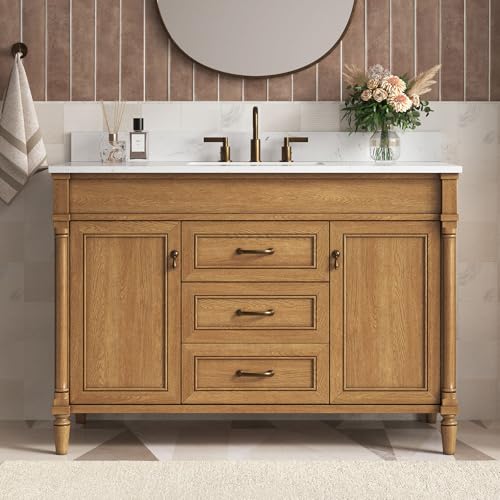
DELUXE LIVING Light Walnut 48
Where the fluted oak pick chases texture, this DELUXE LIVING cabinet chases joinery. Its listing states a solid wood frame, three dovetail drawers, soft closing doors, and a ceramic sink set into a countertop with a backsplash, all in light walnut. Dovetailing is a furniture-maker’s detail: the interlocking joint resists the pulling force a drawer front endures thousands of times, and its presence in a title signals a maker willing to be specific about construction rather than vague about quality.
Light walnut suits bathrooms that already lean cool. If your tiles are white, your grout is grey, and your mirror is chrome, an oak cabinet can look oddly yellow by comparison; walnut’s muted brown-grey threads through those tones without fighting them. The backsplash earns its keep in a family bathroom too, catching the spray that a enthusiastic tooth-brusher or a child at the tap sends up the wall, and the countertop gives the ceramic sink a settled, built-in look rather than a vessel perched on top.
The storage split here is traditional: doors for the open cabinet volume, three drawers for the smaller strata of bathroom life. That arrangement favours households whose storage problem is bulk — spare loo rolls, a hairdryer case, cleaning bottles — with a modest layer of small-item organisation on top. Soft closing doors close the day quietly, a detail you appreciate most when someone is washing up after everyone else has gone to bed. As a classic cabinet with a countertop, it also reads as furniture, which suits a cottage bathroom styled with a wooden mirror frame or woven baskets.
Strengths
- The solid wood frame is stated plainly in the listing, giving this pick the clearest construction claim among the 48-inch pair.
- Three dovetail drawers promise drawer boxes built to resist years of tugging, not just to look tidy on arrival.
- A backsplash is included in the described combo, protecting the wall line behind the ceramic sink from daily spray.
Trade-offs
- Door-led storage means deep items can still hide at the back of the cabinet, unlike the all-drawer alternative above.
- The title does not mention adjustable shelving, so shelf flexibility is not given for this model.
- Three drawers is generous but fewer than the six offered by the fluted oak pick at the same width.
Mini spec box
- Width: 48 inches, per the listing title
- Finish: light walnut
- Frame: solid wood frame, as titled
- Storage: 3 dovetail drawers plus cabinet doors
- Sink: ceramic sink with countertop and backsplash
- Hardware behaviour: soft closing doors
- Mirror inclusion: none stated in the listing
Best for: a traditionally styled family bathroom that values joinery and a backsplash. Not suited for: a buyer who wants maximum drawer subdivision or a strongly golden oak tone.
Check price on Amazon for the DELUXE LIVING Light Walnut 48.

IFBUY Natural Oak 30
Small vanities often look like shrunken versions of big ones, with the design interest scaled away. This IFBUY cabinet goes the other route: at 30 inches it adds an arched profile and a fluted design in natural oak, so a compact ensuite gains a focal point instead of an apology. The listing calls it freestanding and space-saving, pairs it with a ceramic basin, and includes an adjustable storage shelf inside — a sensible trio for a room where every inch is argued over.
The arch is doing quiet work. Bathroom design is dominated by rectangles — tiles, mirrors, shower screens — and a curved line at the vanity softens the whole grid without adding ornament that dates quickly. Fluting reinforces that crafted feel at small scale, where a plain slab door might read as stark. In a cottage guest bath with a round mirror above it, the combination looks deliberate rather than squeezed in.
Practically, a single adjustable shelf is the right amount of storage ambition at this width. It will hold a stack of hand towels, a wash bag for guests, and the cleaning spray, especially if you use a small basket to corral bottles. What it will not do is serve as the sole storage for a family of four, and the review would be dishonest to pretend otherwise. Pair it with a mirrored cabinet or a wall shelf and the room works; expect the vanity alone to swallow a household’s worth of products and it will disappoint by Friday.
Strengths
- The arched, fluted front gives a 30-inch footprint a designed presence that plain compact cabinets rarely achieve.
- An adjustable shelf lets the single cabinet space adapt between tall bottles and folded towels.
- Freestanding form avoids wall-mounting hardware and suits older walls that dislike heavy fixings.
Trade-offs
- One shelf of storage is modest, so most rooms will need supplementary storage elsewhere.
- The title lists no drawers, meaning small items need a tray or basket to stay orderly inside.
- Natural oak’s tone varies with lighting, so the warm look in photos may read paler in a north-facing room.
Mini spec box
- Width: 30 inches, per the listing title
- Finish: natural oak, fluted design with arched profile
- Storage: adjustable storage shelf; drawer count not given
- Sink: ceramic basin
- Installation style: freestanding single vanity
- Soft-close hardware: not stated in the listing
Best for: a small ensuite or guest bath that deserves a decorative focal point. Not suited for: a main family bathroom needing drawer storage for several people’s daily kit.
Check price on Amazon for the IFBUY Natural Oak 30.

Virubi Wood Grain 36
Honesty first: this Virubi cabinet is a wood grain vanity, and the listing says so in those words. Grain here names the finish — the natural wood look across its surfaces — not a claim that the carcass is solid timber. Shoppers who understand that distinction can judge the piece fairly, because at 36 inches it fills the most underserved gap in bathroom sizing: wider than the cramped 30-inch class, narrower than the 48-inch standard that many older bathrooms simply cannot fit between door swing and bath panel.
Its cleverest titled feature is the pair of tip-out drawers. The shallow tray that tips out from the false front beneath a sink is exactly the right size for toothbrushes, toothpaste, and the small tubes that otherwise colonise the countertop edge. Add soft-closing doors and an adjustable shelf in the cabinet below, and the storage story is balanced: a home for the daily small things up top, flexible volume for towels and bottles underneath. For a household bathroom used by two people in sequence, that division maps neatly onto real behaviour.
The 36-inch width also buys countertop landing space on either side of the sink, which 30-inch owners will tell you is the luxury they miss most. A soap dish, a glass, a phone playing the morning news — all need somewhere to sit that is not the basin rim. If your room measures out at roughly three feet of usable run, this is the pick shaped for it, and the grain finish keeps the light wood look consistent with the rest of the guide while being straightforward about what it is.
Strengths
- Two tip-out drawers rescue the dead space beneath the basin for brushes and tubes.
- Soft-closing doors are stated, keeping the shared-bathroom slam out of early mornings.
- The 36-inch width fits rooms stranded between the common 30 and 48-inch sizes.
Trade-offs
- The wood grain is a finish, so buyers specifically wanting solid timber construction should choose elsewhere in this guide.
- Basin material is not given in the title beyond the sink itself, so check the listing photos and details before ordering.
- Tip-out trays are shallow by design and will not take bottles or a hairdryer.
Mini spec box
- Width: 36 inches, per the listing title
- Finish: wood grain, described as natural wood in the title
- Storage: 2 tip-out drawers, doors, adjustable shelf
- Hardware behaviour: soft-closing doors
- Sink material: not given
- Solid wood claim: none stated in the listing
Best for: a mid-size bathroom needing countertop landing space and tidy small-item storage. Not suited for: a buyer whose priority is verified solid wood construction above all else.
Check price on Amazon for the Virubi Wood Grain 36.

Marsail Wood Fluted 30
Marsail’s 30-inch entry takes the fluted treatment that headlines the big oak pick and compresses it into a freestanding cabinet for bathrooms where the vanity shares floor space with a bath, a loo, and optimism. The listing describes a wood vanity in natural oak with a drawer and a ceramic sink, calling the style modern fluted. That drawer is the detail to notice: many compact cabinets offer only a door and a hope, whereas a drawer at the top of a small vanity keeps the everyday handful of items reachable without kneeling.
Picture a narrow cottage bathroom, the kind with a sloped ceiling and a window over the bath. A 30-inch freestanding piece slides into the plumbing run without demanding wall reinforcement, and its fluted face gives the room one crafted object among the sanitaryware. The ceramic sink keeps the top easy to wipe and familiar to maintain. Guests read the room as considered; the owner reads it as finally finished. Both readings are correct, and both trace back to choosing texture at small scale rather than settling for a plain box.
Storage expectations need the usual compact-room calibration. A drawer plus cabinet volume handles one person’s routine or a guest room’s light duties gracefully. It will not absorb bulk buying or a teenager’s expanding shelf of products. The listing does not describe soft-close hardware or adjustable shelving for this model, so treat those as unknowns to confirm on the listing page rather than features to assume. What is stated — size, fluting, drawer, ceramic top, freestanding form — is a coherent package for the rooms it targets.
Strengths
- A drawer in a 30-inch cabinet is genuinely useful and far from universal at this size.
- The fluted natural oak front brings the group’s signature texture to the smallest rooms.
- Ceramic sink tops are simple to clean and forgiving of everyday bathroom products.
Trade-offs
- Total storage is compact-room sized, so heavy stockpiling belongs in a linen cupboard instead.
- Soft-close behaviour is not stated in the listing for this model.
- Shelf adjustability is not given, limiting how precisely the cabinet interior can be tuned.
Mini spec box
- Width: 30 inches, per the listing title
- Finish: natural oak, modern fluted design
- Storage: cabinet with drawer; shelf details not given
- Sink: ceramic vanity sink
- Installation style: freestanding
- Mirror inclusion: not stated in the listing
Best for: a small main bathroom or ensuite wanting fluted style plus a real drawer. Not suited for: households expecting one compact vanity to store bulk supplies for several people.
Check price on Amazon for the Marsail Wood Fluted 30.

LUVISONA Light Walnut 60 Double Sink
Everything else in this guide serves one person at a time. The LUVISONA is built for the couple who discovered that sharing a bathroom is easy and sharing a single basin at 7 a.m. is not. Sixty inches wide in light walnut, it carries a double sink beneath a curved sintered stone top, and the listing adds two oval LED defog mirrors, three drawers, four doors, gold hardware, and a solid wood description. It is the group’s statement piece, and it knows it.
The mirrors deserve attention because they solve a mundane misery: stepping from a shower to a fogged glass and wiping it with a towel that leaves streaks. Defogging mirrors clear themselves, and having one oval mirror per basin preserves the symmetry that makes a double vanity feel designed rather than merely wide. Gold hardware against light walnut warms the palette further, a pairing that suits a primary bathroom styled as a retreat — the room where the day starts with coffee waiting downstairs and ends with the house finally quiet.
Storage splits logically for two: three drawers for the shared middle ground of small items, four doors opening onto cabinet volume for each side’s larger bottles and towels. Sintered stone as a top material brings a dense, hard surface to the busiest counter in the house. Practical cautions scale with the piece: at 60 inches it needs a genuinely large room, a doorway it can actually pass through, and plumbing arranged for two basins. Measure the route from street to bathroom, not just the wall, before falling for it.
Strengths
- Two basins end the morning queue, the single clearest quality-of-life upgrade a shared bathroom can get.
- Two LED defog mirrors are included per the listing, one aligned to each sink.
- The curved sintered stone top gives the wide counter a hard-wearing, unified surface.
Trade-offs
- At 60 inches it simply will not fit standard or small bathrooms, however appealing the mirrors sound.
- Double plumbing means a more involved installation than any single-sink pick here.
- Gold hardware is a strong style commitment that may not sit happily beside chrome fittings elsewhere.
Mini spec box
- Width: 60 inches, per the listing title
- Finish: light walnut, with gold hardware
- Sinks: double sink, oval basins referenced by the mirror pairing
- Top: curved sintered stone top
- Storage: 3 drawers and 4 doors
- Mirrors: 2 oval LED defog mirrors included
- Construction note: solid wood stated in the listing
Best for: a spacious primary bathroom shared by two people on similar schedules. Not suited for: any room under a generous width, or a solo user who would trade the second basin for counter space.
Check price on Amazon for the LUVISONA Light Walnut 60 Double Sink.
Comparison Table
| Pick | Width | Finish | Storage headline | Sink / top |
|---|---|---|---|---|
| Fluted Oak Vanity 48 Inch | 48 in | Oak, fluted front | 6 drawers, adjustable shelves | Integrated stone sink |
| DELUXE LIVING Light Walnut 48 | 48 in | Light walnut | 3 dovetail drawers, doors | Ceramic sink, countertop with backsplash |
| IFBUY Natural Oak 30 | 30 in | Natural oak, fluted, arched | Adjustable shelf | Ceramic basin |
| Virubi Wood Grain 36 | 36 in | Wood grain finish | 2 tip-out drawers, adjustable shelf | Sink material not in listing title |
| Marsail Wood Fluted 30 | 30 in | Natural oak, fluted | Cabinet with drawer | Ceramic sink |
| LUVISONA Light Walnut 60 Double Sink | 60 in | Light walnut, gold hardware | 3 drawers, 4 doors | Double sink, curved sintered stone top |
How to Choose the Right Light Wood Vanity for Your Bathroom
Start with the tape measure, not the mood board. Record the full width available between walls or obstructions, then subtract breathing room for skirting boards and door swing, because a vanity that technically fits but traps the bathroom door is a daily annoyance wearing a pretty face. Check depth as well: the titles here state widths, and a cabinet that projects further than your old one can crowd the space in front of the bath. Finally, locate your existing waste and supply lines, since a drawer-heavy cabinet may need its drawers to clear pipework that a door cabinet would have swallowed without complaint.
Then interrogate the finish honestly. Decide whether you want solid wood where a title states it, or whether a well-executed grain finish at a convenient size serves you better; neither answer is wrong, but confusing the two leads to resentment later. Order your thinking by light as well. Stand in the bathroom at the time you use it most and note the colour temperature of your bulbs and window. Oak flatters warm light and can turn brassy under very warm bulbs, while light walnut stays composed under cooler light and can look flat in a dim, north-facing room.
Match storage to behaviour, not aspiration. If your countertop currently accumulates small tubes and brushes, drawers and tip-out trays will change your life more than any finish. If your problem is towels, spare rolls, and cleaning stock, prioritise door cabinets with adjustable shelves. Households between those poles should look at the mixed layouts. Be honest about who uses the room: a guest bath needs little more than a shelf and good looks, while a family bathroom earns every drawer it can get.
Think about the top as a working surface. Integrated stone and sintered stone tops present one continuous plane that wipes down quickly and resists the ring marks of daily use. Ceramic basins are familiar, repairable in look and feel, and pair naturally with a separate countertop and backsplash arrangement. Consider who cleans the bathroom and how they feel about seams, because the seam between basin and counter is where grime prefers to live.
Budget your attention across the whole ensemble rather than spending it all on the cabinet. A vanity is seen together with its mirror, its faucet, and its lighting, and a modest cabinet beneath a well-chosen mirror routinely outshines an expensive cabinet beneath a leftover one. If funds force a sequence, install the vanity first, live with it for a fortnight, and then choose the mirror and lighting with the cabinet’s actual tone in front of you rather than a memory of a screen image. Renovations done in that order rarely need anything redone, and the household keeps one working basin throughout, which anyone who has brushed their teeth over a kitchen sink for a week will tell you is a mercy worth planning for deliberately.
Last, plan the unglamorous logistics. Freestanding cabinets are kinder to old walls and uneven floors. A 60-inch double vanity may need two people, a wide doorway, and a plumber booked for a longer visit. Confirm what the listing includes — mirrors on the largest pick here, backsplash on one other — and what it does not mention, such as faucets, so the project budget and the installation day both stay calm.
Keeping Pale Timber Looking Good in a Steamy Room
Bathrooms are hostile to wood finishes: steam, splashes, and spilled products all conspire against pale surfaces that show every mark. The defence is routine rather than elaborate. Wipe standing water off the top and the cabinet front after baths and showers, because droplets left to sit will find any weakness in a finish far faster than humidity alone. Keep a soft cloth in a drawer for exactly this purpose; a ritual that lives within arm’s reach actually happens.
Fluted fronts ask for one adaptation. Dust and soap film settle into the grooves, and a flat cloth bridges over them. A soft brush — the kind sold for keyboards or shaving — swept vertically along the grooves once a week keeps the texture crisp. Avoid soaking the brush; damp, not wet, is the rule for anything touching a wood finish. For door and drawer fronts generally, mild soapy water on a wrung-out cloth, followed by a dry pass, handles nearly everything a bathroom produces.
Inside the cabinet, protect the base from the slow leak that every bathroom eventually threatens. A washable liner or a shallow tray under bottles catches drips from pump dispensers and gives you early warning of plumbing weeps before they stain. Check the trap and supply connections twice a year by hand and eye. Light finishes advertise water damage early, which is a hidden advantage: you will see a problem on pale oak long before you would notice it on a dark stain, provided you look.
Common Mistakes When Buying a Light Wood Vanity
The classic error is ordering by photograph colour alone. Listing photos are lit generously, and the same oak that glows on screen can read washed out under your ceiling light or orange under warm bulbs. Where possible, compare the finish name across several photos on the listing, and plan your lighting to flatter the tone you chose rather than hoping the cabinet will adapt to the room.
Second, buyers routinely confuse finish language with construction language. Wood grain, wood look, and wood effect describe appearance. Solid wood, where a title states it, describes material. This guide flags the distinction per pick because the confusion is so common, and because a shopper who pays attention to it tends to stay satisfied: expectations set by the title match the object that arrives.
Third, storage gets imagined instead of inventoried. Before ordering, empty your current vanity onto the bath mat and group what you find. Count the tall bottles, the small tubes, the appliances with cords. Then reread the storage description of your chosen pick and check each group has a home. Five minutes of inventory prevents the most common form of buyer’s remorse in this category, which is not about looks at all.
Fourth, the plumbing gets forgotten until installation day. Drawer boxes and waste pipes compete for the same space, and while many designs accommodate standard layouts, an unusual trap position can defeat a drawer. Note where your waste exits — wall or floor — and compare it against the listing’s diagrams. A tape measure and a phone torch under the old cabinet will tell you more than any amount of hopeful guessing.
Oak, Walnut and Grain: Reading Finish Names Like a Buyer
Finish vocabulary rewards a slow read. Oak, in these titles, names both a tone family and, in ordinary furniture language, a timber with a visible open grain. The fluted 48-inch pick and the two 30-inch cabinets present themselves as oak, and their photographs should show that characteristic grain running through the fluting. When you examine listing images, zoom into a drawer front: real grain varies, repeats imperfectly, and changes direction at joints, while printed grain can repeat with suspicious regularity. Neither observation condemns a piece, but knowing which you are looking at calibrates what you expect to unpack.
Light walnut carries a different visual rhythm. Walnut grain tends to flow in longer, calmer waves, and the light version keeps the colour in a muted mid-brown rather than the deep chocolate of traditional walnut furniture. In a bathroom, that restraint is the appeal. It warms white sanitaryware without the golden push of oak, and it sits comfortably beside brushed nickel, chrome, and the black fittings so many renovators already own. The two walnut picks here use that calm differently: the 48-inch DELUXE LIVING pairs it with classic cabinetry and a backsplash, while the 60-inch LUVISONA sets it against gold hardware and curved stone, proving the same tone can read traditional or glamorous depending on company.
Grain, as a standalone phrase, is the honest middle category, and the Virubi title uses it plainly. A grain finish aims to reproduce the look of timber across the cabinet’s surfaces. For many households that is a perfectly rational trade: the room gains the pale wood appearance, the budget keeps room for a better faucet or mirror, and nobody has pretended the carcass is something it is not. The mistake is only ever in the reading, not in the product. If a listing says grain, believe it, judge the piece on layout and hardware, and enjoy the look for what it delivers.
One more term deserves decoding, because it appears in the largest pick: sintered stone. This is a manufactured surface, compressed and fired into dense slabs, used here as the curved top of the double vanity. It belongs in the same practical family as the integrated stone sink on the fluted oak model — hard, continuous surfaces that shrug off the daily chemistry of toothpaste, soap, and hair products. Ceramic, the third top material in this group, is the familiar glazed basin material of a century of bathrooms. All three clean easily; they differ in feel, weight, and how a chip or stain would be handled years from now.
Pairing Light Wood With Mirrors, Metals and Flooring
A vanity never stands alone visually, and light wood is unusually sensitive to its neighbours. Start with the mirror. A round mirror above a fluted or arched front echoes the softness of the cabinet’s lines, which is why the IFBUY’s arch looks so natural in styled photographs. A rectangular mirror with a thin frame suits the classic walnut cabinet, reinforcing its furniture proportions. The LUVISONA removes this decision by including its two oval defog mirrors, and that inclusion is worth real money and real measuring time when you compare total project cost rather than cabinet cost alone.
Metals come next. Gold hardware, as fitted to the LUVISONA, pulls light walnut toward warmth and ceremony; the same cabinet in chrome would read cooler and more contemporary. If your existing taps and shower fittings are chrome or brushed nickel, a cabinet without strong hardware colour — the oak picks, for instance — lets those metals continue undisturbed. Mixing one warm metal accent is stylish; accidentally mixing three competing finishes is visual noise. Decide which metal leads in the room and let everything else defer to it.
Flooring settles the argument underneath. Pale wood cabinets over pale wood-effect flooring can blur into one continuous wash unless a rug, a bath mat, or a tonal step separates them. Over grey stone tiles, oak supplies the warmth the floor withholds, and the combination is reliably pleasant. Over busy patterned tiles, the calmest cabinet wins: a flat-fronted walnut or a quietly grained piece will coexist with pattern, while strong fluting plus strong pattern can compete. Take a floor tile or a clear photograph of your floor to the screen when you compare listing photos, and judge the pairing, not the cabinet in isolation.
Wall colour is the cheapest variable in the whole project, so let it be the flexible one. If the cabinet arrives slightly warmer or cooler than expected, a repaint of the wall behind it — soft white for warmth, pale sage or stone for calm — reconciles the room for the cost of a single tin. Renovators who fix the wall colour first and demand the cabinet match it exactly are fighting the wrong battle in the wrong order.
What Installation Day Actually Involves
Even a freestanding vanity rewards preparation. The old unit must come out first, which means water off at the isolation valves, supply lines drained into a bucket, and the trap disconnected with a bowl beneath it. Silicone seals around the old top need cutting before the cabinet will move, and the wall behind often reveals why a backsplash or a fresh coat of paint belongs in the plan. None of this is difficult, but all of it is messier than the photograph stage of the project, and scheduling the swap for a morning rather than an evening keeps options open if a valve misbehaves.
Levelling matters more than speed. Cottage floors in particular slope in ways that only reveal themselves when a wide cabinet rocks on two diagonal feet. Shims or adjustable feet correct this, and the cabinet must sit level before the top and basin are sealed, because a tilted counter sends water wandering toward one edge every single day. Once level, the cabinet is fixed, the basin waste connected, supplies opened one at a time, and every joint checked with a dry hand and a torch before the doors close on the plumbing. A slow drip discovered now costs a towel; discovered in a month, it costs the cabinet base.
Double-sink installation doubles several of those steps. The LUVISONA needs two supply tees, two traps or a shared arrangement your plumber approves, and careful alignment of both basins with their mirrors. Book professional help for that piece unless your plumbing experience is genuine, and remember the mirrors are electrical items as well as glass: defogging and LED functions need a supply, which may mean an electrician’s visit joins the plumber’s. Single-sink picks stay firmly in confident DIY territory by comparison, provided the waste position cooperates with the drawer layout you chose.
Aftercare begins on day one. Run a bead of attention, not silicone, along the top’s back edge weekly: look for water sitting where it should not, wipe it, and move on. Keep the cabinet doors open for an hour after a very steamy bath if the room lacks an extractor, letting the interior share the room’s drier air. These small habits, repeated, are what separate a vanity that looks new in five years from one that merely survives.
Three Rooms, Three Different Right Answers
Consider a Victorian terrace ensuite, barely wider than the shower it contains. The owners wanted the pale timber look without surrendering the room to a cabinet that touched both walls. A 30-inch fluted piece — the Marsail’s territory — leaves a hand’s breadth on either side, enough for the eye to read the cabinet as furniture and for a mop to pass during cleaning. The drawer takes the electric toothbrush and its charger, the cabinet below holds two rolled towels and the spare soap, and the room’s smallness becomes a design choice rather than an apology. Adding a mirrored cabinet above doubles the useful storage without touching the floor plan.
Now picture a family bathroom in a suburban semi, used by two adults and a rotating cast of children. The brief here is survival with dignity: surfaces that wipe clean, storage that separates one child’s toothbrush chaos from another’s, and doors that close softly at midnight. The 48-inch fluted oak pick answers with drawers, because drawers let a parent assign territory — this drawer is yours, that one is shared, the deep one holds the hairdryer nobody may relocate. The integrated stone top removes the grimy seam, and the oak’s warmth keeps a hard-working room from feeling institutional.
Finally, imagine a converted barn’s primary bathroom, long and calm, with a window at one end and room to breathe. Anything small looks lost in such a space, and a single basin wastes the width the architecture offers. The 60-inch walnut double belongs here, its two mirrors catching the window light, its gold hardware answering brass details elsewhere in the conversion. The point of the exercise is that none of these choices is the best vanity in the abstract. Each is the best answer to a particular room, a particular household rhythm, and a particular set of frustrations with the cabinet it replaces. Shop for your room, not for a ranking.
Final Recommendation
For most renovators, the DELUXE LIVING Light Walnut 48 is the balanced choice: stated solid wood framing, dovetail drawers, a backsplash, and a tone that behaves under cool bathroom light. If drawer organisation is your priority, step sideways to the Fluted Oak Vanity 48 Inch and its six soft-close drawers. Couples with the room to spare should look seriously at the LUVISONA Light Walnut 60 Double Sink, whose twin defog mirrors and double basins remove the morning bottleneck entirely. Smaller rooms are well served by the two 30-inch picks and the 36-inch bridge between sizes. Whichever width you land on, let the tape measure speak first, the finish second, and the storage layout third — and may your new vanity be the last thing in the bathroom that anyone has to apologise for.
Frequently Asked Questions
Is a wood grain vanity the same as a solid wood vanity?
No, and the listings here keep the two ideas separate. A grain description names the surface appearance, while a solid wood statement names the construction material. The Virubi pick is presented as a grain finish; the DELUXE LIVING and LUVISONA titles state solid wood. Judge each on what its own title claims.
Which width suits a typical family bathroom?
Forty-eight inches is the most forgiving single-sink width, giving counter space on both sides of the basin plus meaningful storage. Rooms that cannot spare four feet usually land at 36 inches comfortably, while 30 inches is best reserved for ensuites and guest baths.
Do these vanities include faucets?
The titles in this guide do not list faucets among the included items for these six picks. Treat tapware as a separate decision, and read the full listing details for the model you choose so there are no surprises on installation day.
What does fluted mean on a vanity front?
Fluting is a series of narrow vertical grooves worked into the front surface. It is a design treatment that adds texture and shadow lines. On the picks here it appears on oak-fronted cabinets, and it needs a soft brush rather than a flat cloth when you clean it.
Are the sinks included with every pick?
Each of the six titles describes a vanity with a sink, though the materials differ: integrated stone on the fluted oak 48, ceramic on several others, and a sintered stone top on the 60-inch double. The Virubi title does not name its sink material, so confirm that detail on its listing.
Should a light wood vanity match my floor or contrast with it?
Contrast is the safer default. An exact match between cabinet and floor is almost impossible to achieve across different materials and makers, and a near-miss looks like a mistake, while a deliberate step in tone looks like design. If your floor is pale, choose the warmer oak or the deeper walnut to separate the planes; if the floor is dark, any of these light cabinets will lift the room. A bath mat in a bridging colour can soften the junction while you live with the pairing.
How do I stop a light finish showing water marks?
Wipe splashes the same day they happen, keep a dry cloth within reach, and check under-sink plumbing twice a year for slow drips. Pale finishes reveal problems early, which works in your favour if you act on what you see.
Related Guides
If you are furnishing the rest of the room, these companion guides cover neighbouring decisions.
Best Inexpensive Bathroom Vanities


