What's inside
- Quick picks: best closed heel slippers athritis dsw
- What Arthritic Feet Need From a Slipper
- Quick Comparison
- How to Choose a Closed-Heel Slipper for Arthritis
- Common Mistakes When Buying Slippers for Arthritis
- Sizing and Fit for Arthritic Feet
- Caring for Slippers for Arthritic Feet
- Frequently Asked Questions
- Buying Slippers for Arthritis at DSW
- Conclusion
As an Amazon Associate I earn from qualifying purchases. This post may contain affiliate links at no extra cost to you.
Quick picks: best closed heel slippers athritis dsw
| # | Product | Where to buy |
|---|---|---|
| 1 | Orthofeet Charlotte Slipper | Check on Amazon |
| 2 | Vionic Relax Slipper | Check on Amazon |
| 3 | Drew Bloom II Slipper | Check on Amazon |
| 4 | Acorn Moc Slipper | Check on Amazon |
| 5 | UGG Ascot Slipper | Check on Amazon |
What Arthritic Feet Need From a Slipper
Feet affected by arthritis need a slipper that is gentle, roomy and supportive, and that is easy to put on and take off. The joints may be sore, swollen or stiff, the toes may not bend easily, and the feet may change size during the day, so a slipper that is tight, hard to put on, or flat and unsupportive will hurt rather than help. The slippers in this guide are chosen because they meet those needs: a roomy toe box, a cushioned insole, arch support, a closed heel that stays on, and a closure or a stretchy upper that makes the slipper easy to put on.
The closed heel matters more for arthritic feet than for most, because a slipper that slips off the heel forces the wearer to grip with the toes to keep it on, and gripping with sore toes is painful. A closed-back slipper stays on the foot, it supports the heel, and it lets the wearer walk normally, which is safer on stairs and on hard floors. Every slipper in this guide is closed-back, and that is the first thing to check when comparing slippers for arthritic feet.
The toe box is the second thing to check. A narrow toe box squeezes the toes together, which is painful for feet with bunions, hammer toes or swollen joints, while a roomy toe box lets the toes spread naturally. The Orthofeet and Propet slippers in this guide are sold in wide widths with roomy toe boxes, and they are the best choice for a wearer whose toes need room. A slipper with a stretchy upper will also give where the foot needs it, which is why the Orthofeet Charlotte is the most recommended slipper here for hard-to-fit feet.
The third thing is the insole. A flat, hard insole will hurt a sore foot, while a cushioned insole will spread pressure and reduce the ache of standing on hard floors. An orthotic insole with arch support will do more, by supporting the arch and aligning the foot, and the Orthofeet and Vionic slippers in this guide have orthotic insoles that can be removed and replaced with a custom orthotic. A wearer who already has orthotics should choose a slipper with a removable insole, and should try it with the orthotic in place.
Each slipper below is described with its strengths, its trade-offs and the wearer it fits, plus a guide to choosing between them, the mistakes that waste money, and answers to the questions shoppers ask most. The descriptions are based on the makers' published specifications and on widely reported owner experience, and no prices are given because prices change with size, colour and retailer. Nothing here is medical advice: a wearer with arthritis should talk to a doctor or a podiatrist about footwear, and should use this guide to compare slippers, not to diagnose or treat a condition.
Quick Comparison
| Slipper | Materials | Standout features | Best for |
|---|---|---|---|
| Orthofeet Charlotte | Stretch, orthotic insole | Roomy toe box, strap, arch support | Best for hard-to-fit arthritic feet |
| Vionic Relax Slipper | Plush, contoured footbed | Arch support, adjustable strap | Best supportive slipper |
| Propet Cush 'N Foot | Suede, cushioned insole | Wide widths, strap, roomy | Best wide-width slipper |
| Drew Bloom II | Leather, removable insole | Firm support, wide widths | Best firm leather slipper |
| Acorn Moc Slipper | Suede, memory foam | Soft, cushioned, light | Best soft cushioned slipper |
| UGG Ascot Slipper | Suede, wool lining | Soft, warm, rubber sole | Best soft recovery slipper |

Orthofeet Charlotte Slipper
The most recommended slipper for arthritic feet: stretchy, roomy, with an orthotic insole and an adjustable strap.
The Orthofeet Charlotte Slipper is the slipper most often recommended for arthritic feet, and it is the one that best meets the needs described above. It has a stretchy upper, a roomy toe box, an orthotic insole with arch support, and a hook-and-loop strap that adjusts the fit, and it is made for feet that are hard to fit: wide feet, swollen feet, bunions, hammer toes, and feet that need an orthotic. The Charlotte is the slipper for a wearer who has struggled to find a slipper that fits, and who needs one that can be adjusted.
The Charlotte works because it is built around the foot rather than around a fashion. The stretchy upper gives where the foot needs room, the toe box is wide enough for toes to spread, the orthotic insole supports the arch, and the strap lets the wearer tighten or loosen the fit during the day as the foot changes. Owners report that it is the first slipper that has fitted their feet properly, and that it is the one they wear when other slippers pinch or slip. The rubber outsole grips on smooth floors, and the slipper is light enough to wear all day.
The trade-offs are the look and the price. The Charlotte is a practical slipper, not a pretty one, and it looks like a comfort shoe rather than a fashion slipper, which suits some wearers and not others. It is also more expensive than a plain slipper, though the orthotic insole and the adjustability are the reason for the cost. The stretchy upper will loosen with wear, and the strap will need tightening as it does.
One practical note: the Charlotte is sold in wide widths, and a buyer should measure the foot and choose the width that fits rather than sizing up in length. The orthotic insole can be removed and replaced with a custom orthotic, which makes the Charlotte the best choice in this guide for a wearer who already has orthotics. DSW carries Orthofeet styles in many stores and online, though availability varies, so a buyer should check the DSW website or a local store for the current range.
Strengths:
- Stretchy upper with a roomy toe box
- Orthotic insole with arch support, removable
- Adjustable strap for swollen or changing feet
- Made for hard-to-fit feet: wide, swollen, bunions
Trade-offs:
- Practical look, not a fashion slipper
- More expensive than a plain slipper
- Stretchy upper loosens with wear
Who it fits: Wearers with arthritic feet who need room, support and adjustability.
Check price on Amazon: Orthofeet Charlotte Slipper
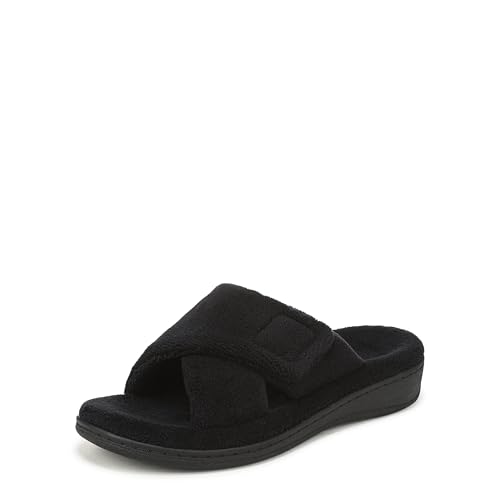
Vionic Relax Slipper
The supportive slipper: plush, contoured, with a hook-and-loop strap and a footbed designed for sore feet.
The Vionic Relax Slipper is the supportive choice in this guide, and it is the one for a wearer who likes a soft slipper but needs arch support. It has a plush upper, a contoured footbed with built-in arch support, and an adjustable hook-and-loop strap that holds the slipper on the foot, which is unusual in a soft slipper and very useful. The Relax is the slipper for a wearer with sore feet, or who stands for long hours, and who does not want to give up a soft slipper to get support.
The Relax's strength is its footbed. Vionic builds its slippers around a contoured insole that supports the arch and aligns the foot, and the Relax carries that design into a plush slipper. The strap holds the heel in place, which keeps the foot over the arch support instead of sliding forward, and the rubber outsole grips on smooth floors. Owners report that it is the slipper they wear when other slippers hurt, and that it is the one their feet feel best in at the end of the day.
The trade-offs are that the Relax is heavier and less delicate than the plain slippers in other guides, and the strap, while useful, changes the look from a simple slipper to a more practical one. The plush upper will flatten with wear, and the slipper is an indoor-outdoor slipper rather than a rugged outdoor one, so it should not be worn for long walks. It is also the most expensive slipper in this guide, though the support is the reason for the cost.
One practical note: the Relax is sold in whole and half sizes, which is unusual for a slipper and makes fitting easier. A buyer should take her usual shoe size, and should expect the strap to need adjusting over the first week as the plush lining compresses slightly. DSW carries Vionic styles, and the Relax is often available online, though a buyer should check the current range.
Strengths:
- Contoured footbed with real arch support
- Adjustable hook-and-loop strap that holds the heel
- Plush upper with a rubber outsole
- The best support available in a soft slipper
Trade-offs:
- Heavier and less delicate than plain slippers
- Strap changes the look to a more practical style
- Most expensive slipper in this guide
Who it fits: Wearers who want a soft slipper with genuine arch support.
Check price on Amazon: Vionic Relax Slipper
Propet Cush 'N Foot Slipper
The wide-width slipper: roomy, cushioned, and made for feet that need extra width and a secure strap.
The Propet Cush 'N Foot Slipper is the wide-width choice in this guide, and it is the one for a wearer who needs extra width and a strap that holds the foot securely. It has a suede upper, a cushioned insole, a hook-and-loop strap, and a rubber outsole, and it is sold in wide and extra-wide widths, which is unusual for a slipper and makes it the best choice for a wide foot. The Cush 'N Foot is the slipper for a wearer who has been told that no slipper fits, and who needs width rather than length.
The Cush 'N Foot works because it is built wide. The toe box is roomy, the strap adjusts across the instep, and the cushioned insole spreads pressure across the foot, which reduces the ache of standing on hard floors. Owners report that it is the first slipper that has fitted their wide feet properly, and that it is the one they wear all day, at home and to the door. The suede upper is durable, the rubber outsole grips well, and the slipper is light enough to wear for hours.
The trade-offs are the look and the support. The Cush 'N Foot is a practical slipper, not a pretty one, and it looks like a comfort shoe rather than a fashion slipper. It has a cushioned insole but no contoured arch support, so a wearer who needs support should add an insole or choose the Vionic or the Orthofeet above. The suede upper needs a protector spray, and the slipper is sold in wide widths only, so a narrow foot will swim in it.
One practical note: Propet slippers are sized in wide widths, and a buyer should measure the foot and choose the width that fits rather than sizing up in length. The strap should be adjusted so that the heel is held without the strap digging in, and the slipper should be aired out after wear, since the cushioned insole can hold moisture. DSW carries Propet styles in many stores, and the Cush 'N Foot is often available there.
Strengths:
- Sold in wide and extra-wide widths
- Adjustable strap across the instep
- Cushioned insole for hard floors
- Roomy toe box that lets toes spread
Trade-offs:
- Practical look, not a fashion slipper
- No contoured arch support
- Wide widths only; too roomy for narrow feet
Who it fits: Wearers with wide, arthritic feet who need width and a secure strap.

Drew Bloom II Slipper
The firm leather slipper: durable, supportive, with a removable insole and wide widths for arthritic feet.
The Drew Bloom II Slipper is the firm leather choice in this guide, and it is the one for a wearer who wants a structured slipper that will last. It has a leather upper, a removable insole, a closed back, and a durable rubber outsole, and it is sold in wide widths, which makes it the best choice for a wearer who wants leather, support, and room. The Bloom II is the slipper for a wearer who likes a shoe-like slipper, and who needs a firm fit rather than a soft one.
The Bloom II works because leather is durable and the removable insole is versatile. The leather upper holds its shape, the insole can be removed and replaced with a custom orthotic, and the closed back holds the heel in place, which keeps the foot over the insole. Owners report that it is the most durable slipper they have owned, and that it is the one they wear when they want a slipper that feels like a shoe rather than a sock. The rubber outsole grips well, and the slipper can be worn to the door and around the house without worry.
The trade-offs are the break-in and the weight. The Bloom II is firm when new, and it needs a week or two before the leather softens and the insole settles. It is also heavier than the softer slippers in this guide, and the leather needs care to stay supple. The slipper is more expensive than a plain slipper, though the durability is the reason for the cost.
One practical note: the Bloom II is sold in wide widths, and the insole can be removed and replaced with a custom orthotic. A buyer should measure the foot and choose the width that fits, and should expect the leather to soften over the first weeks, so a snug fit at first is normal. DSW carries Drew styles, and the Bloom II is often available online.
Strengths:
- Durable leather upper that holds its shape
- Removable insole that fits custom orthotics
- Closed back that holds the heel securely
- Sold in wide widths for arthritic feet
Trade-offs:
- Firm when new; needs a week or two to break in
- Heavier than softer slippers
- Leather needs care to stay supple
Who it fits: Wearers who want a firm, durable, leather slipper with room.
Check price on Amazon: Drew Bloom II Slipper

Acorn Moc Slipper
The soft cushioned slipper: memory foam in a suede moccasin, for arthritic feet that need gentleness above all.
The Acorn Moc Slipper is the soft cushioned choice in this guide, and it is the one for a wearer whose feet need gentleness above all else. It has a suede upper, a soft lining and a memory-foam footbed that moulds to the shape of the foot, which gives it a feeling that owners describe as walking on something soft rather than on a floor. The rubber outsole is flexible and non-slip, so the slipper works on wood floors and tiles as well as on carpet, and it is light enough to wear all day.
The Acorn works because its memory foam does the job that a contoured footbed does in the more expensive slippers, at a lower cost. The foam compresses under the heel and the ball of the foot, which spreads the pressure and reduces the ache of standing on hard floors, and it recovers when the slipper is taken off. The lining is soft without being hot, so the Acorn works in mild weather as well as in winter, and the moccasin style suits both men and women.
The trade-offs are that memory foam wears out. After a year or so of daily wear the foam compresses permanently and the slipper loses some of its cushioning, which is the normal life of a foam footbed and not a defect. The suede upper also needs care in wet weather, and the slipper is a moccasin rather than a structured shoe, so it offers little arch support. A wearer who needs firm support should choose a slipper with a contoured footbed instead.
One practical note: Acorn sells the Moc in many colours and patterns, and the fit is roomy, so most wearers take their usual size. A buyer who wears thick socks should consider sizing up, and the slipper should be aired out regularly, since the foam can hold moisture if it is worn for long hours without a break. DSW carries Acorn styles, and the Moc is often available there.
Strengths:
- Memory-foam footbed that cushions sore feet
- Soft suede upper with a warm lining
- Flexible non-slip rubber outsole
- Light enough to wear all day around the house
Trade-offs:
- Memory foam compresses permanently over time
- Little arch support; not a structured slipper
- Suede upper needs care in wet weather
Who it fits: Wearers whose arthritic feet need softness and cushioning.
Check price on Amazon: Acorn Moc Slipper

UGG Ascot Slipper
The soft recovery slipper: suede, wool lining and a rubber sole, for gentle comfort after a long day.
The UGG Ascot Slipper is the soft recovery slipper in this guide, and it is the one for a wearer who wants gentleness and warmth. It has a suede upper, a wool lining and a moulded rubber outsole, in a low profile that slips on easily and looks like a shoe. The Ascot is the slipper for relaxed hours at home, for the evening, and for a wearer whose feet need softness rather than structure, and it is the softest slipper in this guide.
The Ascot works because its wool lining breathes and its footbed is cushioned, so the feet can rest. Owners report that it is the slipper they wear when they get home, that it is the most comfortable footwear they own for relaxed hours, and that it holds its shape well over time. The rubber outsole means it can be worn to the car and around the house, and the low profile means it slips on in a second, which is what sore feet want at the end of the day.
The trade-offs are that the Ascot is not a supportive slipper. It has a flat footbed with little arch support, it is not made for standing all day, and the suede upper needs a protector spray before it meets rain. It is a slipper for relaxed hours, not for a full day on the feet, and a wearer who needs support should choose the Vionic or the Orthofeet above. It is also sold in whole sizes, and it fits snugly at first, loosening slightly as the lining compresses.
One practical note: UGG slippers are widely copied, and the copies use synthetic linings that do not breathe. A buyer should buy from a known retailer, such as DSW, and check that the upper is suede, the lining is wool, and the sole is rubber, since those three things are what make the Ascot worth its place in this guide.
Strengths:
- Suede upper with a breathable wool lining
- Cushioned footbed for sore feet
- Moulded rubber outsole for the house and the car
- The softest slipper in this guide; ideal for rest
Trade-offs:
- Not a supportive slipper; no real arch support
- Suede needs protector spray in wet weather
- Not for standing all day
Who it fits: Wearers who want a soft, warm slipper for relaxed hours.
Check price on Amazon: UGG Ascot Slipper
How to Choose a Closed-Heel Slipper for Arthritis
Start with the heel, because it decides whether the slipper stays on. A closed-back slipper stays on the foot, supports the heel, and lets the wearer walk normally, while an open-back scuff slips off and forces the wearer to grip with the toes, which is painful for arthritic feet. Every slipper in this guide is closed-back, and a buyer should check that the heel is genuinely closed, not just a low lip, since a low lip will not hold the foot.
Next, check the toe box. A narrow toe box squeezes the toes together, which is painful for feet with bunions, hammer toes or swollen joints, while a roomy toe box lets the toes spread naturally. The Orthofeet and Propet slippers in this guide are sold in wide widths with roomy toe boxes, and they are the best choice for a wearer whose toes need room. A slipper with a stretchy upper will also give where the foot needs it, which is why the Orthofeet Charlotte is the most recommended slipper here.
Then check the insole. A flat, hard insole will hurt a sore foot, while a cushioned insole will spread pressure and reduce the ache of standing on hard floors. An orthotic insole with arch support will do more, by supporting the arch and aligning the foot, and the Orthofeet and Vionic slippers in this guide have orthotic insoles that can be removed and replaced with a custom orthotic. A wearer who already has orthotics should choose a slipper with a removable insole.
Fit is the fourth decision, and it matters more for arthritic feet than for most, because the feet change size during the day. A slipper should be fitted in the late afternoon, when the feet are at their largest, and the strap should be adjusted then, not in the morning. A slipper with a strap can be loosened when the foot swells and tightened when it goes down, which a fixed slipper cannot do, and that adjustability is worth paying for.
Finally, think about where to buy. DSW carries several of the brands in this guide, including Orthofeet, Vionic, Propet, Drew, Acorn and UGG, in stores and online, though availability varies by store and by size. A buyer who wants to try slippers on should visit a DSW store, since fitting matters more for arthritic feet than for most, and a buyer who orders online should check the return policy, since a slipper that does not fit should be returned rather than endured.
Common Mistakes When Buying Slippers for Arthritis
The most common mistake is buying a slipper that is too tight. A tight slipper squeezes sore joints, presses on bunions, and makes the feet hurt more, not less, and a buyer who chooses a snug fit for a normal foot will regret it for an arthritic one. The fix is to choose a roomy toe box and a wide width, and to fit the slipper in the late afternoon, when the feet are at their largest.
The second mistake is buying an open-back scuff. A scuff slips off the heel and forces the wearer to grip with the toes, which is painful for arthritic feet, and it is unsafe on stairs. A closed-back slipper stays on, supports the heel, and lets the wearer walk normally, and it is the right choice for arthritic feet in almost every case.
The third mistake is choosing softness over support. A soft, flat slipper feels wonderful for an hour and tiring after a full day, while a firm, contoured slipper feels hard at first and comfortable after eight hours. A wearer who chooses by the first minute will end up with aching feet, and a wearer who chooses by the eighth hour will end up with a slipper that lasts. The break-in period is worth enduring.
The fourth mistake is ignoring the return policy. A slipper for arthritic feet must be tried at home, on the wearer's own floors, for a few hours, and a buyer who cannot return a slipper that does not fit will be stuck with it. DSW has a return policy that allows worn slippers to be returned in many cases, and a buyer should check it before ordering, since a slipper that hurts should be returned, not endured.
Sizing and Fit for Arthritic Feet
Slippers for arthritic feet should be fitted in the late afternoon, when the feet are at their largest. Feet swell during the day, and a slipper fitted in the morning may feel tight by dinner time, while a slipper fitted in the evening will feel roomy in the morning. Fitting in the afternoon gives a fit that works for the whole day, not just for the morning, and it is the single most useful habit in buying slippers for arthritic feet.
Width should be chosen before length, because a wide foot needs a wide slipper, and sizing up in length will not fix a width problem. The Orthofeet and Propet slippers in this guide are sold in wide and extra-wide widths, and a buyer with a wide foot should choose one of them. A narrow foot will swim in a wide slipper, so the width should be measured, not guessed, and the maker's size chart should be checked.
The strap should be adjusted with the foot in the slipper, and it should hold the heel without digging in. A strap that is too tight will cut off circulation and cause discomfort, while a strap that is too loose will let the heel slip. The strap should be adjusted in the late afternoon, and re-adjusted as the lining settles over the first week, since the fit will change as the slipper breaks in.
Caring for Slippers for Arthritic Feet
Slippers for arthritic feet last longer when they are aired out after each wear. The insole holds moisture, and a slipper that is shut away damp will develop odour and the lining will break down sooner. Leave the slippers in a ventilated spot, and the lining will dry, the foam will recover, and the slipper will stay fresh for months longer than one that is stored damp.
Leather and suede uppers need protection before they are worn. A suede protector spray keeps water and stains out of the fibres, and a leather conditioner keeps the upper supple and prevents cracking. Both should be applied before the first wear and reapplied every few months. A hook-and-loop strap should be brushed out regularly, to remove the hair and fluff that stop it gripping.
Frequently Asked Questions
What should I look for in a slipper for arthritis?
A closed heel that stays on, a roomy toe box that lets the toes spread, a cushioned or orthotic insole that supports the arch, and a strap or a stretchy upper that makes the slipper easy to put on and adjust. The Orthofeet Charlotte in this guide has all four, and it is the most recommended slipper here. A wearer with arthritis should also talk to a doctor or a podiatrist about footwear, since this guide compares slippers and does not give medical advice.
Are closed-heel slippers better than open-back slippers for arthritis?
Yes, in almost every case. A closed-back slipper stays on the foot, supports the heel, and lets the wearer walk normally, while an open-back scuff slips off and forces the wearer to grip with the toes, which is painful for arthritic feet and unsafe on stairs. Every slipper in this guide is closed-back for that reason.
Can I wear my orthotics in these slippers?
Yes, if the insole is removable. The Orthofeet Charlotte and the Drew Bloom II in this guide have removable insoles that can be replaced with a custom orthotic, and the strap lets the wearer adjust the fit around it. A buyer should try the slipper with the orthotic in place before committing, since the fit will be different with it than without it.
Does DSW sell slippers for arthritis?
DSW carries several of the brands in this guide, including Orthofeet, Vionic, Propet, Drew, Acorn and UGG, in stores and online, though availability varies by store and by size. A buyer who wants to try slippers on should visit a DSW store, since fitting matters more for arthritic feet than for most, and a buyer who orders online should check the return policy first.
How should slippers for arthritis fit?
Roomy in the toe box, secure at the heel, and adjustable across the top of the foot. The toes should be able to spread, the heel should not slip, and the strap should hold without digging in. Slippers should be fitted in the late afternoon, when the feet are at their largest, and the width should be chosen before the length, since a wide foot needs a wide slipper.
Buying Slippers for Arthritis at DSW
DSW is a useful place to buy slippers for arthritic feet, because it carries several of the brands in this guide and it allows slippers to be tried on in the store. Trying on matters more for arthritic feet than for most, since the fit must be checked with the foot as it is, not as it is imagined, and a store fitting lets the buyer walk, stand and sit in the slippers before deciding. A buyer who visits a DSW store should bring the socks that will be worn with the slippers, and should try them on in the late afternoon, when the feet are at their largest, since that is the fit that will matter at home.
DSW’s online range is wider than any single store, and it is the best place to find sizes and widths that a local store does not carry. A buyer who orders online should check the size chart, the width options, and the return policy, since a slipper for arthritic feet must be tried at home, on the wearer’s own floors, for a few hours, and a slipper that does not fit should be returned rather than endured. DSW allows returns of worn shoes in many cases, though the policy should be checked before ordering, since it can change.
The brands to look for at DSW are the ones in this guide: Orthofeet, Vionic, Propet, Drew, Acorn and UGG. Availability varies by store and by size, and a buyer who wants a specific style should check the DSW website first, then visit a store to try it on, or order online if the store does not carry it. A buyer who cannot find the exact style should ask a store associate, since DSW can often order a style that is not on the shelf, and a buyer who is flexible about colour will have more choice than one who wants a specific shade.
Conclusion
The best closed-heel slippers for arthritis are the ones that are roomy, cushioned, supportive and easy to put on, and the Orthofeet Charlotte leads this guide as the most recommended while the Vionic Relax leads for supportive comfort. The Propet Cush 'N Foot is the wide-width choice, the Drew Bloom II is the firm leather choice, the Acorn Moc is the soft cushioned choice, and the UGG Ascot is the soft recovery choice. Any of the six will serve well, and the right one is the one whose toe box, insole and closure match the wearer's feet.
Choose a closed heel, pick the width before the length, fit the slipper in the late afternoon, and buy from a store with a good return policy, like DSW. A slipper bought with those rules in mind will be comfortable, safe, and worn every day.
Related guides
- Best Bulky Yarn for Slippers: Thick, Warm Yarns That Knit Up Fast and Last
- Best Breathable Slippers for Men: Cool, Airy House Slippers That Do Not Make Feet Sweat
- Best Barber Slippers: Slip-On Comfort Footwear for Long Shifts Behind the Chair
- Best Soft Button Slippers for Year-Round Wear: Cozy Moccasins That Work in Every Season


