What's inside
As an Amazon Associate I earn from qualifying purchases. This post may contain affiliate links at no extra cost to you.
Quick picks: best dibetic slippers
| # | Product | Where to buy |
|---|---|---|
| 1 | Orthofeet Charlotte Slipper | Check on Amazon |
| 2 | Drew Bloom II Slipper | Check on Amazon |
| 3 | Vionic Relax Slipper | Check on Amazon |
| 4 | Acorn Moc Slipper | Check on Amazon |
| 5 | UGG Ascot Slipper | Check on Amazon |
What Sensitive Feet Need From a Slipper
Feet affected by diabetes need a slipper that is gentle, roomy and soft, and that is easy to put on and take off. The skin may be sensitive, the circulation may be poor, and the feet may not feel pressure or injury the way they should, so a slipper that rubs, squeezes or has a hard seam can cause a problem that goes unnoticed. The slippers in this guide are chosen because they are soft inside, roomy, and easy to wear, and because they avoid the features that cause trouble: hard seams, tight toe boxes, and flat, unsupportive insoles.
The first thing to check is the inside of the slipper. A slipper with a hard seam, a rough lining, or a label that rubs can irritate sensitive skin, and a wearer who cannot feel the irritation will not know until it becomes a sore. The slippers in this guide have soft, smooth linings, and the Orthofeet and Propet slippers are made with minimal seams, which is why they are the most recommended here. A buyer should run a hand inside the slipper before buying, and should choose the softest, smoothest lining available.
The second thing is room. A narrow toe box squeezes the toes together, which is painful for feet that are swollen or sensitive, while a roomy toe box lets the toes spread naturally. The Orthofeet and Propet slippers in this guide are sold in wide widths with roomy toe boxes, and they are the best choice for a wearer whose feet need room. A slipper with a stretchy upper will also give where the foot needs it, which is why the Orthofeet Charlotte is the most recommended slipper here for hard-to-fit feet.
The third thing is the insole. A flat, hard insole will hurt a sensitive foot, while a cushioned insole will spread pressure and reduce the ache of standing on hard floors. An orthotic insole with arch support will do more, by supporting the arch and aligning the foot, and the Orthofeet and Vionic slippers in this guide have orthotic insoles that can be removed and replaced with a custom orthotic. A wearer who already has orthotics should choose a slipper with a removable insole, and should try it with the orthotic in place.
Each slipper below is described with its strengths, its trade-offs and the wearer it fits, plus a guide to choosing between them, the mistakes that waste money, and answers to the questions shoppers ask most. The descriptions are based on the makers' published specifications and on widely reported owner experience, and no prices are given because prices change with size, colour and retailer. Nothing here is medical advice: a wearer with diabetes should talk to a doctor or a podiatrist about footwear, and should use this guide to compare slippers, not to diagnose or treat a condition.
Quick Comparison
| Slipper | Materials | Standout features | Best for |
|---|---|---|---|
| Orthofeet Charlotte | Stretch, orthotic insole | Roomy, seamless, strap | Best for sensitive diabetic feet |
| Propet Cush 'N Foot | Suede, cushioned insole | Wide widths, strap, roomy | Best wide-width slipper |
| Drew Bloom II | Leather, removable insole | Firm support, wide widths | Best firm leather slipper |
| Vionic Relax Slipper | Plush, contoured footbed | Arch support, strap | Best supportive slipper |
| Acorn Moc Slipper | Suede, memory foam | Soft, cushioned, light | Best soft cushioned slipper |
| UGG Ascot Slipper | Suede, wool lining | Soft, warm, rubber sole | Best soft recovery slipper |

Orthofeet Charlotte Slipper
The most recommended slipper for diabetic feet: stretchy, roomy, seamless, with an orthotic insole.
The Orthofeet Charlotte Slipper is the slipper most often recommended for diabetic feet, and it is the one that best meets the needs described above. It has a stretchy upper, a roomy toe box, an orthotic insole with arch support, and a hook-and-loop strap that adjusts the fit, and it is made for feet that are hard to fit: wide feet, swollen feet, bunions, hammer toes, and feet that need an orthotic. The Charlotte is the slipper for a wearer who has struggled to find a slipper that fits, and who needs one that is soft inside and easy to adjust.
The Charlotte works because it is built around the foot rather than around a fashion. The stretchy upper gives where the foot needs room, the toe box is wide enough for toes to spread, the orthotic insole supports the arch, and the strap lets the wearer tighten or loosen the fit during the day as the foot changes. Owners report that it is the first slipper that has fitted their feet properly, and that it is the one they wear when other slippers pinch or rub. The rubber outsole grips on smooth floors, and the slipper is light enough to wear all day.
The trade-offs are the look and the price. The Charlotte is a practical slipper, not a pretty one, and it looks like a comfort shoe rather than a fashion slipper, which suits some wearers and not others. It is also more expensive than a plain slipper, though the orthotic insole and the adjustability are the reason for the cost. The stretchy upper will loosen with wear, and the strap will need tightening as it does.
One practical note: the Charlotte is sold in wide widths, and a buyer should measure the foot and choose the width that fits rather than sizing up in length. The orthotic insole can be removed and replaced with a custom orthotic, which makes the Charlotte the best choice in this guide for a wearer who already has orthotics.
Strengths:
- Stretchy upper with a roomy toe box
- Orthotic insole with arch support, removable
- Adjustable strap for swollen or changing feet
- Soft, smooth lining with minimal seams
Trade-offs:
- Practical look, not a fashion slipper
- More expensive than a plain slipper
- Stretchy upper loosens with wear
Who it fits: Wearers with diabetic feet who need room, softness and adjustability.
Check price on Amazon: Orthofeet Charlotte Slipper
Propet Cush 'N Foot Slipper
The wide-width slipper: roomy, cushioned, and made for feet that need extra width and a secure strap.
The Propet Cush 'N Foot Slipper is the wide-width choice in this guide, and it is the one for a wearer who needs extra width and a strap that holds the foot securely. It has a suede upper, a cushioned insole, a hook-and-loop strap, and a rubber outsole, and it is sold in wide and extra-wide widths, which is unusual for a slipper and makes it the best choice for a wide foot. The Cush 'N Foot is the slipper for a wearer who has been told that no slipper fits, and who needs width rather than length.
The Cush 'N Foot works because it is built wide. The toe box is roomy, the strap adjusts across the instep, and the cushioned insole spreads pressure across the foot, which reduces the ache of standing on hard floors. Owners report that it is the first slipper that has fitted their wide feet properly, and that it is the one they wear all day, at home and to the door. The suede upper is durable, the rubber outsole grips well, and the slipper is light enough to wear for hours.
The trade-offs are the look and the support. The Cush 'N Foot is a practical slipper, not a pretty one, and it looks like a comfort shoe rather than a fashion slipper. It has a cushioned insole but no contoured arch support, so a wearer who needs support should add an insole or choose the Vionic or the Orthofeet above. The suede upper needs a protector spray, and the slipper is sold in wide widths only, so a narrow foot will swim in it.
One practical note: Propet slippers are sized in wide widths, and a buyer should measure the foot and choose the width that fits rather than sizing up in length. The strap should be adjusted so that the heel is held without the strap digging in, and the slipper should be aired out after wear, since the cushioned insole can hold moisture.
Strengths:
- Sold in wide and extra-wide widths
- Adjustable strap across the instep
- Cushioned insole for hard floors
- Roomy toe box that lets toes spread
Trade-offs:
- Practical look, not a fashion slipper
- No contoured arch support
- Wide widths only; too roomy for narrow feet
Who it fits: Wearers with wide, sensitive feet who need width and a secure strap.

Drew Bloom II Slipper
The firm leather slipper: durable, supportive, with a removable insole and wide widths.
The Drew Bloom II Slipper is the firm leather choice in this guide, and it is the one for a wearer who wants a structured slipper that will last. It has a leather upper, a removable insole, a closed back, and a durable rubber outsole, and it is sold in wide widths, which makes it the best choice for a wearer who wants leather, support, and room. The Bloom II is the slipper for a wearer who likes a shoe-like slipper, and who needs a firm fit rather than a soft one.
The Bloom II works because leather is durable and the removable insole is versatile. The leather upper holds its shape, the insole can be removed and replaced with a custom orthotic, and the closed back holds the heel in place, which keeps the foot over the insole. Owners report that it is the most durable slipper they have owned, and that it is the one they wear when they want a slipper that feels like a shoe rather than a sock. The rubber outsole grips well, and the slipper can be worn to the door and around the house without worry.
The trade-offs are the break-in and the weight. The Bloom II is firm when new, and it needs a week or two before the leather softens and the insole settles. It is also heavier than the softer slippers in this guide, and the leather needs care to stay supple. The slipper is more expensive than a plain slipper, though the durability is the reason for the cost.
One practical note: the Bloom II is sold in wide widths, and the insole can be removed and replaced with a custom orthotic. A buyer should measure the foot and choose the width that fits, and should expect the leather to soften over the first weeks, so a snug fit at first is normal.
Strengths:
- Durable leather upper that holds its shape
- Removable insole that fits custom orthotics
- Closed back that holds the heel securely
- Sold in wide widths for sensitive feet
Trade-offs:
- Firm when new; needs a week or two to break in
- Heavier than softer slippers
- Leather needs care to stay supple
Who it fits: Wearers who want a firm, durable, leather slipper with room.
Check price on Amazon: Drew Bloom II Slipper
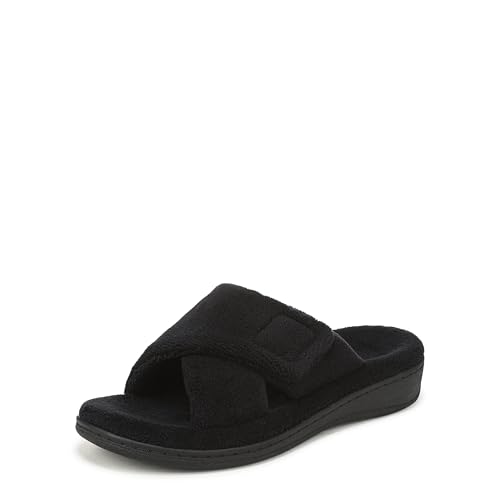
Vionic Relax Slipper
The supportive slipper: plush, contoured, with a hook-and-loop strap and a footbed designed for sore feet.
The Vionic Relax Slipper is the supportive choice in this guide, and it is the one for a wearer who likes a soft slipper but needs arch support. It has a plush upper, a contoured footbed with built-in arch support, and an adjustable hook-and-loop strap that holds the slipper on the foot, which is unusual in a soft slipper and very useful. The Relax is the slipper for a wearer with sore feet, or who stands for long hours, and who does not want to give up a soft slipper to get support.
The Relax's strength is its footbed. Vionic builds its slippers around a contoured insole that supports the arch and aligns the foot, and the Relax carries that design into a plush slipper. The strap holds the heel in place, which keeps the foot over the arch support instead of sliding forward, and the rubber outsole grips on smooth floors. Owners report that it is the slipper they wear when other slippers hurt, and that it is the one their feet feel best in at the end of the day.
The trade-offs are that the Relax is heavier and less delicate than the plain slippers in other guides, and the strap, while useful, changes the look from a simple slipper to a more practical one. The plush upper will flatten with wear, and the slipper is an indoor-outdoor slipper rather than a rugged outdoor one, so it should not be worn for long walks. It is also the most expensive slipper in this guide, though the support is the reason for the cost.
One practical note: the Relax is sold in whole and half sizes, which is unusual for a slipper and makes fitting easier. A buyer should take her usual shoe size, and should expect the strap to need adjusting over the first week as the plush lining compresses slightly.
Strengths:
- Contoured footbed with real arch support
- Adjustable hook-and-loop strap that holds the heel
- Plush upper with a rubber outsole
- The best support available in a soft slipper
Trade-offs:
- Heavier and less delicate than plain slippers
- Strap changes the look to a more practical style
- Most expensive slipper in this guide
Who it fits: Wearers who want a soft slipper with genuine arch support.
Check price on Amazon: Vionic Relax Slipper

Acorn Moc Slipper
The soft cushioned slipper: memory foam in a suede moccasin, for feet that need gentleness above all.
The Acorn Moc Slipper is the soft cushioned choice in this guide, and it is the one for a wearer whose feet need gentleness above all else. It has a suede upper, a soft lining and a memory-foam footbed that moulds to the shape of the foot, which gives it a feeling that owners describe as walking on something soft rather than on a floor. The rubber outsole is flexible and non-slip, so the slipper works on wood floors and tiles as well as on carpet, and it is light enough to wear all day.
The Acorn works because its memory foam does the job that a contoured footbed does in the more expensive slippers, at a lower cost. The foam compresses under the heel and the ball of the foot, which spreads the pressure and reduces the ache of standing on hard floors, and it recovers when the slipper is taken off. The lining is soft without being hot, so the Acorn works in mild weather as well as in winter, and the moccasin style suits both men and women.
The trade-offs are that memory foam wears out. After a year or so of daily wear the foam compresses permanently and the slipper loses some of its cushioning, which is the normal life of a foam footbed and not a defect. The suede upper also needs care in wet weather, and the slipper is a moccasin rather than a structured shoe, so it offers little arch support. A wearer who needs firm support should choose a slipper with a contoured footbed instead.
One practical note: Acorn sells the Moc in many colours and patterns, and the fit is roomy, so most wearers take their usual size. A buyer who wears thick socks should consider sizing up, and the slipper should be aired out regularly, since the foam can hold moisture if it is worn for long hours without a break.
Strengths:
- Memory-foam footbed that cushions sensitive feet
- Soft suede upper with a warm lining
- Flexible non-slip rubber outsole
- Light enough to wear all day around the house
Trade-offs:
- Memory foam compresses permanently over time
- Little arch support; not a structured slipper
- Suede upper needs care in wet weather
Who it fits: Wearers whose feet need softness and cushioning.
Check price on Amazon: Acorn Moc Slipper

UGG Ascot Slipper
The soft recovery slipper: suede, wool lining and a rubber sole, for gentle comfort.
The UGG Ascot Slipper is the soft recovery slipper in this guide, and it is the one for a wearer who wants gentleness and warmth. It has a suede upper, a wool lining and a moulded rubber outsole, in a low profile that slips on easily and looks like a shoe. The Ascot is the slipper for relaxed hours at home, for the evening, and for a wearer whose feet need softness rather than structure, and it is the softest slipper in this guide.
The Ascot works because its wool lining breathes and its footbed is cushioned, so the feet can rest. Owners report that it is the slipper they wear when they get home, that it is the most comfortable footwear they own for relaxed hours, and that it holds its shape well over time. The rubber outsole means it can be worn to the car and around the house, and the low profile means it slips on in a second, which is what sore feet want at the end of the day.
The trade-offs are that the Ascot is not a supportive slipper. It has a flat footbed with little arch support, it is not made for standing all day, and the suede upper needs a protector spray before it meets rain. It is a slipper for relaxed hours, not for a full day on the feet, and a wearer who needs support should choose the Vionic or the Orthofeet above. It is also sold in whole sizes, and it fits snugly at first, loosening slightly as the lining compresses.
One practical note: UGG slippers are widely copied, and the copies use synthetic linings that do not breathe. A buyer should buy from a known retailer and check that the upper is suede, the lining is wool, and the sole is rubber, since those three things are what make the Ascot worth its place in this guide.
Strengths:
- Suede upper with a breathable wool lining
- Cushioned footbed for sensitive feet
- Moulded rubber outsole for the house and the car
- The softest slipper in this guide; ideal for rest
Trade-offs:
- Not a supportive slipper; no real arch support
- Suede needs protector spray in wet weather
- Not for standing all day
Who it fits: Wearers who want a soft, warm slipper for relaxed hours.
Check price on Amazon: UGG Ascot Slipper
How to Choose a Diabetic Slipper
Start with the inside, because it is what touches the foot. A slipper with a hard seam, a rough lining, or a label that rubs can irritate sensitive skin, and a wearer who cannot feel the irritation will not know until it becomes a sore. The slippers in this guide have soft, smooth linings, and the Orthofeet and Propet slippers are made with minimal seams. A buyer should run a hand inside the slipper before buying, and should choose the softest, smoothest lining available.
Next, check the toe box. A narrow toe box squeezes the toes together, which is painful for feet that are swollen or sensitive, while a roomy toe box lets the toes spread naturally. The Orthofeet and Propet slippers in this guide are sold in wide widths with roomy toe boxes, and they are the best choice for a wearer whose toes need room. A slipper with a stretchy upper will also give where the foot needs it.
Then check the insole. A flat, hard insole will hurt a sensitive foot, while a cushioned insole will spread pressure and reduce the ache of standing on hard floors. An orthotic insole with arch support will do more, by supporting the arch and aligning the foot, and the Orthofeet and Vionic slippers in this guide have orthotic insoles that can be removed and replaced with a custom orthotic. A wearer who already has orthotics should choose a slipper with a removable insole.
Fit is the fourth decision, and it matters more for sensitive feet than for most, because the feet change size during the day. A slipper should be fitted in the late afternoon, when the feet are at their largest, and the strap should be adjusted then, not in the morning. A slipper with a strap can be loosened when the foot swells and tightened when it goes down, which a fixed slipper cannot do, and that adjustability is worth paying for.
Finally, think about checking the feet. A wearer with diabetes should check the feet daily, and should look inside the slippers before putting them on, to make sure nothing has fallen in that could rub. A slipper with a light-coloured lining makes it easier to see if there is anything inside, and a slipper that is easy to put on and take off makes the daily check simpler. This is not medical advice, and a wearer should talk to a doctor or a podiatrist about foot care.
Common Mistakes When Buying Diabetic Slippers
The most common mistake is buying a slipper that is too tight. A tight slipper squeezes sensitive feet, presses on sore joints, and rubs the skin, and a buyer who chooses a snug fit for a normal foot will regret it for a sensitive one. The fix is to choose a roomy toe box and a wide width, and to fit the slipper in the late afternoon, when the feet are at their largest.
The second mistake is buying a slipper with hard seams inside. A seam that rubs can irritate skin that cannot feel the irritation, and the wearer will not know until it becomes a sore. The fix is to run a hand inside the slipper before buying, and to choose a slipper with a soft, smooth lining and minimal seams, like the Orthofeet and Propet slippers in this guide.
The third mistake is choosing a flat, hard insole. A flat insole concentrates pressure on the heel and the ball of the foot, which is painful for sensitive feet, while a cushioned or orthotic insole spreads it. A buyer who needs support should choose a contoured footbed, and a buyer who wants softness should choose memory foam, but neither should choose a flat, hard slipper.
The fourth mistake is wearing slippers that are worn out. A slipper with a flattened insole, a torn lining, or a sole that has worn through will not protect the foot, and it should be replaced. A wearer should check the slippers regularly, and should replace them when the cushioning is gone, the lining is torn, or the sole is worn, rather than wearing them until they fall apart.
Sizing and Fit for Diabetic Slippers
Slippers for diabetic feet should be fitted in the late afternoon, when the feet are at their largest. Feet swell during the day, and a slipper fitted in the morning may feel tight by dinner time, while a slipper fitted in the evening will feel roomy in the morning. Fitting in the afternoon gives a fit that works for the whole day, not just for the morning, and it is the single most useful habit in buying slippers for sensitive feet.
Width should be chosen before length, because a wide foot needs a wide slipper, and sizing up in length will not fix a width problem. The Orthofeet and Propet slippers in this guide are sold in wide and extra-wide widths, and a buyer with a wide foot should choose one of them. A narrow foot will swim in a wide slipper, so the width should be measured, not guessed, and the maker's size chart should be checked.
The strap should be adjusted with the foot in the slipper, and it should hold the heel without digging in. A strap that is too tight will cut off circulation and cause discomfort, while a strap that is too loose will let the heel slip. The strap should be adjusted in the late afternoon, and re-adjusted as the lining settles over the first week, since the fit will change as the slipper breaks in.
Caring for Diabetic Slippers
Slippers for sensitive feet last longer when they are aired out after each wear. The insole holds moisture, and a slipper that is shut away damp will develop odour and the lining will break down sooner. Leave the slippers in a ventilated spot, and the lining will dry, the foam will recover, and the slipper will stay fresh for months longer than one that is stored damp.
Leather and suede uppers need protection before they are worn. A suede protector spray keeps water and stains out of the fibres, and a leather conditioner keeps the upper supple and prevents cracking. Both should be applied before the first wear and reapplied every few months. A hook-and-loop strap should be brushed out regularly, to remove the hair and fluff that stop it gripping.
Frequently Asked Questions
What should I look for in a diabetic slipper?
A soft, smooth lining with minimal seams, a roomy toe box that lets the toes spread, a cushioned or orthotic insole that supports the arch, and a strap or a stretchy upper that makes the slipper easy to put on and adjust. The Orthofeet Charlotte in this guide has all four, and it is the most recommended slipper here. This guide compares slippers and does not give medical advice; a wearer with diabetes should talk to a doctor or a podiatrist about footwear.
Are seamless slippers better for diabetic feet?
Yes, in general. A seam inside a slipper can rub sensitive skin, and a wearer who cannot feel the irritation will not know until it becomes a sore. A slipper with a soft, smooth lining and minimal seams is gentler, and a buyer should run a hand inside the slipper before buying to check for hard seams, rough spots or labels that rub.
Can I wear my orthotics in diabetic slippers?
Yes, if the insole is removable. The Orthofeet Charlotte and the Drew Bloom II in this guide have removable insoles that can be replaced with a custom orthotic, and the strap lets the wearer adjust the fit around it. A buyer should try the slipper with the orthotic in place before committing, since the fit will be different with it than without it.
Should diabetic slippers be tight or loose?
Neither: they should be roomy in the toe box and secure at the heel. The toes should be able to spread, the heel should not slip, and the strap should hold without digging in. Slippers should be fitted in the late afternoon, when the feet are at their largest, and the width should be chosen before the length, since a wide foot needs a wide slipper.
How often should diabetic slippers be replaced?
When the cushioning is gone, the lining is torn, or the sole is worn through. A slipper that no longer cushions or protects the foot should be replaced, not worn until it falls apart. A wearer should check the slippers regularly, and should replace them at the first sign of wear inside, since a torn lining can rub sensitive skin.
A Daily Foot Check Routine
A daily foot check is the single most useful habit for a wearer with diabetic feet, and it takes less than a minute. The check is simple: look at the top of each foot, look at the sole with a mirror or a phone, and look between the toes, checking for redness, blisters, cuts, swelling, or any change from the day before. A wearer who does this every day will catch a problem while it is small, and a wearer who does not may not notice a blister until it has become a wound. The slippers in this guide help, since they protect the feet, but they do not replace the check.
The best time for the check is in the evening, when the slippers come off, since the feet have been in them all day and any pressure point will show as redness. A wearer should check the areas where the slipper rubs, especially the heel and the toes, and should look for any redness that does not fade within a few minutes. Redness that stays is a sign that the slipper is pressing, and the slipper should be adjusted, or a different pair chosen, before the redness becomes a blister.
The slippers themselves should be checked too, since a worn lining can rub, and a hard spot in the sole can press. A wearer should feel inside each slipper with a hand, checking for seams that have come loose, for a lining that has bunched up, and for any hard object that has fallen in. A pebble in a slipper can cut a foot that cannot feel it, and a wearer who checks the inside of the slippers before putting them on will avoid that. The habit takes seconds, and it is worth forming.
A wearer who finds a problem should not try to treat it alone, but should talk to a doctor or a podiatrist, especially if the problem is a wound, a blister that does not heal, or redness that spreads. A doctor can advise on the right footwear, on the right care, and on whether the slippers in this guide are suitable, and a wearer who asks will get better advice than one who guesses. The slippers in this guide are a starting point, not a prescription, and the right choice for any wearer is the one a clinician agrees with.
Conclusion
The best diabetic slippers are the ones that are soft inside, roomy, cushioned and easy to put on, and the Orthofeet Charlotte leads this guide as the most recommended while the Vionic Relax leads for supportive comfort. The Propet Cush 'N Foot is the wide-width choice, the Drew Bloom II is the firm leather choice, the Acorn Moc is the soft cushioned choice, and the UGG Ascot is the soft recovery choice. Any of the six will serve well, and the right one is the one whose lining, toe box, insole and closure match the wearer's feet.
Choose a soft, smooth lining, pick the width before the length, fit the slipper in the late afternoon, and check the feet and the slippers daily. A slipper bought with those rules in mind will be gentle, comfortable, and worn every day.


