What's inside
- Key Takeaways
- Quick Picks
- How Did We Choose These Six Disposals?
- What Does Horsepower Actually Change at the Sink?
- How Do the Six Disposals Compare Side by Side?
- Should You Install It Yourself or Call a Plumber?
- What Should Never Go Down a Disposal?
- Are Disposals Safe for Septic Systems?
- What Mistakes Do Buyers Make When Replacing a Disposal?
- How Do You Keep a Disposal Smelling Fresh?
- What Actually Happens Inside When a Disposal Jams?
- How Does a Disposal Interact With the Dishwasher and the Drain Line?
- When Is a Repair Worth It, and When Is Replacement the Honest Answer?
- Which Kitchen Habits Decide How Big a Disposal You Need?
- What Should You Check in the Cabinet Before Ordering?
- How Does Water Temperature Change the Grinding?
- What Does the First Week With a New Disposal Teach You?
- How Do You Choose Between Two Good Disposals That Both Fit?
- Final Recommendation
- Frequently Asked Questions
- Related Guides
As an Amazon Associate I earn from qualifying purchases. This post may contain affiliate links at no extra cost to you.
cottageverdict.com is reader-supported. When you buy through links on our site, we may earn an affiliate commission.
Where to buy: every disposal below links to its Amazon listing, where you can check price on Amazon and confirm whether a power cord is included and which mounting system the unit uses — the two details that decide how your Saturday installation actually goes.
The best garbage disposals are bought in a hurry and lived with for a decade, which is a poor combination. The old unit fails on a Tuesday, water is pooling under the sink, and the replacement gets chosen by whichever box is on the shelf. This guide exists to slow that decision down just enough to make it well, because the differences that matter — motor size, noise, mounting, and how the unit treats a septic system — are invisible in a product photograph and completely obvious by the second week of ownership.
Start with the honest framing: all six disposals here are continuous feed models from established makers, and all six will grind ordinary kitchen scraps. Nobody’s dinner depends on the badge. What separates them is how much grinding headroom the motor carries, how much of the racket reaches the cook, how the unit mounts to the sink flange, and whether it arrives with a cord or expects an electrician’s hardwired connection waiting for it.
Horsepower is the headline number, so let us be precise about what it buys. A 1/2 HP motor handles the daily traffic of most kitchens — vegetable peelings, plate scrapings, coffee grounds in sane quantities — without complaint. A 3/4 HP motor adds torque for denser loads and tougher scraps, and tends to jam less often under the kind of enthusiastic overloading that happens after big family meals. Neither figure makes a disposal invincible; bones, grease and fibrous husks defeat motors of any size when fed carelessly, and the how-to sections below deal with that honestly.
Noise is the second axis, and the one owners mention most after a month. A basic disposal is an appliance you hear through the house. The insulated, multi-stage designs at the top of this list — represented here by InSinkErator’s Evolution line, which the manufacturer rates as dramatically quieter than its own Badger 5 — turn the same job into a muffled hum. Whether that quiet is worth paying for depends on your kitchen’s layout and your household’s patience, and this guide treats it as a legitimate quality-of-life feature rather than a luxury.
Key Takeaways
- Every pick here is continuous feed; you run cold water, switch on, and feed scraps steadily.
- Half-horsepower motors suit most kitchens; three-quarter horsepower adds jam resistance for heavy use.
- The Evolution model is the quiet pick — its maker rates it about 75% quieter than the Badger 5.
- Several picks are listed as septic safe when the system is properly sized and maintained.
- Cord-included models suit DIY replacement; check your existing wiring before assuming.
- Mounting systems differ between brands, and matching your old mount can shorten the swap.
Quick Picks
| Pick | Badge | Why it earns its place |
|---|---|---|
| InSinkErator Badger 5 with Cord 1/2 HP | Default Replacement Pick | The long-running 1/2 HP workhorse with a cord included and Lift and Latch mounting. |
| InSinkErator Badger 5XP 3/4 HP | More Torque Pick | The same Badger formula with a 3/4 HP motor for heavier, denser kitchen loads. |
| InSinkErator Evolution .75HP Advanced | Quiet Pick | Advanced Series grinding and insulation, rated by its maker as far quieter than the Badger line. |
| Waste King L-1001 1/2 HP | Value Brand Pick | A stainless-steel-interior 1/2 HP alternative with its power cord in the box. |
| Moen Prep Series GXP50C 1/2 HP | Compact Kitchen Pick | Moen’s compact Prep Series unit for tighter under-sink cabinets, cord included. |
| Waste Maid 1/2 HP Economy Anti-Jam | Anti-Jam Pick | An economy 1/2 HP unit built around anti-jam design and a fast-swap 3-bolt mount. |
How Did We Choose These Six Disposals?
We limited the field to continuous feed models from makers with long track records in the category, because a disposal is plumbed into the house and should be chosen like infrastructure, not like a gadget. Within that field we spread the list deliberately: two motor sizes, one explicitly quiet flagship, three brands’ mounting philosophies, and both the big-name default and the value alternatives that owner communities have recommended for years.
Specifications were taken only from the listings themselves and widely published maker information — motor size, feed type, cord inclusion, mounting system, septic suitability as stated by the manufacturer. Where a maker publishes a comparative claim, such as the Evolution’s noise reduction against the Badger 5, it is reported here as the maker’s figure, in the maker’s terms, rather than as an independent measurement of our own.
We also favoured models a homeowner can realistically install as a like-for-like replacement. A disposal that demands new wiring, a different flange and a plumber’s visit may still be excellent, but it is a different purchase from the Saturday-morning swap most readers are actually making, and the picks below are honest about which is which.
What Does Horsepower Actually Change at the Sink?
A disposal motor does two jobs: it spins the turntable that slings food against the grind ring, and it keeps spinning when a dense load tries to slow it down. Horsepower is the measure of that second job. In a 1/2 HP unit, a handful of melon rind or a dense wad of pasta can bog the motor toward a stall; in a 3/4 HP unit, the same load is more likely to be powered through and ground down. The difference shows up as jam frequency, not as speed — both sizes clear a normal plate scraping in seconds.
Household size is the practical guide. A couple cooking most nights will rarely trouble a good 1/2 HP motor. A family of five that cooks from scratch, juices, peels in bulk and hosts regularly feeds a disposal the way a motorway feeds a car, and the 3/4 HP picks exist for them. Batch size matters too: any disposal prefers scraps fed gradually with cold water running, and no motor size repeals that rule.
There is also a longevity argument, stated carefully. A motor that rarely works near its limit is a motor under less strain, and owners who overload small disposals are the ones who meet the reset button and the jam-wrench most often. Buying one size up from your strict need is the cheapest reliability upgrade in this category — provided the larger unit still fits your cabinet, which the compact picks below address from the other direction.

InSinkErator Badger 5 with Cord 1/2 HP — Default Replacement Pick
If a plumber had to name the disposal that lives under the most American sinks, the Badger 5 would be the answer given without hesitation. It is a 1/2 HP unit, built for continuous feed use, from the category’s defining brand, sold here in the version with a power cord included, and built around the brand’s Lift and Latch mounting technology, which is designed to make the twist-on connection to the sink flange less of a wrestle for the person lying on their back in a cabinet.
The listing also states the unit is septic safe, which in manufacturer terms means it is suitable for use with properly sized and maintained septic systems — a point the septic section below unpacks, because the disposal is rarely the whole story in a septic household. The Badger’s compact body is the other quiet virtue: under-sink space is contested territory in most kitchens, shared with bins, bottles and the trap, and a disposer that does not sprawl is easier to live with than its specification sheet suggests.
What the Badger 5 does not promise is quiet. It is an honest, uninsulated workhorse and it sounds like one, in short bursts, while it works. For most households the noise lasts seconds at a time and bothers nobody; for open-plan kitchens and light sleepers in small homes, that is the trade that pushes buyers toward the Evolution further down this list. As the default like-for-like replacement for an existing basic disposal, though, nothing here is easier to justify.
- Motor: 1/2 HP, continuous feed
- Mounting: Lift and Latch technology, per the listing
- Power: cord included in this version
- Septic: listed as septic safe
- Character: compact, uninsulated, workhorse
Strengths
- The category’s default for a reason: proven design, enormous installed base, easy like-for-like swaps.
- Cord included, so it plugs into an existing under-sink outlet without wiring work.
- Compact body leaves room for the bin and bottles that share the cabinet.
Trade-offs
- Uninsulated grinding is audible through the house in short, honest bursts.
- Half-horsepower torque asks you to feed dense loads gradually rather than all at once.
- Basic construction is built to a price; it is a workhorse, not a flagship.
Best for: replacing a failed basic disposal with the least drama and the most precedent.
Not suited for: open-plan kitchens where grinding noise carries into living space and conversation.

InSinkErator Badger 5XP 3/4 HP — More Torque Pick
The 5XP takes the Badger formula and answers its one mechanical criticism: the motor grows to 3/4 HP while the compact disposer body, the continuous feed operation and the Lift and Latch mounting stay in the family. It is the pick for the kitchen that found the limits of a half-horsepower unit — the household that cooks in bulk, entertains in earnest, and has met the reset button before.
That extra torque expresses itself as composure. Dense loads that would bog a smaller motor are kept spinning and ground through, which means fewer stalls, fewer jams, and fewer evenings spent with a hex wrench under the sink. The listing again states septic safe, and the unit remains a compact disposer rather than a cabinet-filling flagship, so the upgrade does not demand a bigger kitchen to house it.
Set expectations correctly, though: the 5XP is a stronger Badger, not a quieter one. The sound of work remains part of the experience, and buyers whose real complaint about their old disposal was noise should read the Evolution’s section before choosing torque instead. Buy the 5XP when your complaint was jamming, stalling or a motor that felt outmatched by your cooking, and it answers precisely.
- Motor: 3/4 HP, continuous feed
- Mounting: Lift and Latch technology, per the listing
- Septic: listed as septic safe
- Body: compact disposer format
- Character: the Badger formula with more torque
Strengths
- Three-quarter horsepower keeps dense loads moving, cutting stalls and jam-clearing sessions.
- Same compact footprint and mounting family as the standard Badger it likely replaces.
- Suits large households and serious home cooking without flagship pricing logic.
Trade-offs
- Noise remains at honest workhorse level; the upgrade buys power, not hush.
- More motor than a light-use kitchen will ever call upon.
- Still a basic-line unit in finish and insulation compared with the Advanced Series.
Best for: busy family kitchens whose old half-horsepower disposal jammed or stalled under real loads.
Not suited for: buyers whose main grievance with the old unit was how loud it was.

InSinkErator Evolution .75HP Advanced — Quiet Pick
The Evolution is what the category looks like when it grows up: a 3/4 HP continuous feed disposal from InSinkErator’s Advanced Series, with multi-stage grinding — the listing calls it Advanced Grind — and sound insulation serious enough that the manufacturer rates the unit as 75% quieter than the Badger 5. That figure is the maker’s own comparison, published in their terms, and it is quoted here as exactly that; but even treated with a buyer’s scepticism, the design intent is unmistakable and the difference in character is the reason this model anchors the premium end of the list.
Quieter grinding changes how a kitchen feels. Conversation does not pause for the disposal. A sleeping baby in the next room is not a scheduling constraint on washing up. In open-plan homes, where the sink is effectively in the living room, the Evolution converts an apologetic appliance into a background one, and owners consistently describe that as the upgrade they actually notice daily — more than the extra grinding stages, more than the torque.
The listing adds the practical notes: EZ Connect features aimed at simplifying installation, and septic safe status in the manufacturer’s terms. The costs of the flagship life are the predictable ones — a larger, heavier unit that asks more of the cabinet, and a position at the top of this list’s price tiers. For the right kitchen both are worth it; for a small flat with a forgiving layout, the Badgers below remain the rational buy.
- Motor: 3/4 HP (.75HP), continuous feed
- Series: Advanced Series, with Advanced Grind per the listing
- Noise: manufacturer rates it 75% quieter than the Badger 5
- Installation: EZ Connect features per the listing
- Septic: listed as septic safe
Strengths
- Insulation and multi-stage grinding make it the civilised choice for open-plan living.
- Full 3/4 HP torque, so quiet does not come at the cost of jam resistance.
- Advanced Series build is the flagship end of a mainstream brand’s range.
Trade-offs
- The largest appetite for under-sink space among these picks.
- Sits at the premium tier; light-use kitchens may never hear the value back.
- More unit to manoeuvre during installation than the compact Badgers.
Best for: open-plan kitchens, light sleepers, and households that run the disposal during conversation and television alike.
Not suited for: cramped cabinets or buyers who simply do not care about appliance noise.

Waste King L-1001 1/2 HP — Value Brand Pick
Waste King has spent decades as the alternative answer in this category, and the L-1001 shows why the brand keeps its following: a 1/2 HP disposal, continuous feed in operation, with stainless steel grinding components, a power cord in the box, and a value-first proposition that has made it a standing recommendation in owner communities for years. The listing notes a 2-year limited warranty in its own terms.
Stainless internals are the substantive point here. The grind components live in a wet, abrasive environment, and corrosion resistance in that chamber is a longevity feature rather than a cosmetic one. Combined with the cord-included format — plug into the under-sink outlet and the electrical side of the job is done — the L-1001 is shaped for the confident DIY replacement: old unit out, new unit on, dinner cooked the same evening.
The brand trade-off is ecosystem. InSinkErator’s mounting and parts world is the industry’s default, and switching brands can mean changing the sink flange assembly as part of the job rather than reusing what is already there. That is a one-time cost measured in minutes, but it should be planned rather than discovered, and the installation section below returns to it.
- Motor: 1/2 HP, continuous feed
- Grind components: stainless steel, per the listing
- Power: cord included
- Warranty: 2-year limited, per the listing
- Character: value alternative to the default brand
Strengths
- Stainless grinding components resist the corrosion that ages cheaper chambers.
- Cord in the box suits a straightforward plug-in DIY swap.
- A long-running value model with a deep base of owner experience behind it.
Trade-offs
- Changing brands can mean changing the flange and mount assembly too.
- Half-horsepower manners: feed dense loads gradually, with cold water running.
- Not an insulated design; working noise is part of the bargain.
Best for: value-minded DIYers replacing an old unit and happy to fit a fresh mount as part of the job.
Not suited for: anyone determined to reuse an existing InSinkErator flange untouched.

Moen Prep Series GXP50C 1/2 HP — Compact Kitchen Pick
Moen comes to disposals from the faucet side of the sink, and its Prep Series GXP50C is pitched at the kitchens the big units forget: compact. It is a 1/2 HP unit with continuous feed, shaped into a compact body, sold with a power cord, from Moen’s Prep Series PRO line — a range aimed at everyday food preparation waste rather than at grinding heroics.
The compact body is the argument. Galley kitchens, small flats, in-law suites and rental units often have cabinets where a full-size disposal crowds out the cleaning supplies entirely, and a shorter unit restores the cabinet’s usefulness while still clearing plate scrapings and prep waste as a disposal should. Moen’s presence in the category also suits households already running Moen fixtures, where one brand’s support line covers the whole sink.
Judge it as a compact, though. Half-horsepower torque in a small body is a prep-waste tool, happiest with peelings, trimmings and plate waste fed steadily, and it is not the pick for a household grinding its way through preserving season. Within its intended brief — ordinary waste in a tight cabinet — it is a tidy, well-mannered answer.
- Motor: 1/2 HP, continuous feed
- Series: Moen Prep Series PRO
- Body: compact format for tighter cabinets
- Power: cord included, per the listing
- Character: fixture-brand polish, prep-waste brief
Strengths
- Compact body returns under-sink storage that full-size units consume.
- Cord included keeps the swap in plug-in territory.
- A natural match for kitchens already fitted with Moen fixtures.
Trade-offs
- Sized and powered for prep waste, not for heavy bulk grinding sessions.
- Not an insulated quiet design.
- Compact units leave less margin when a household’s cooking outgrows them.
Best for: small kitchens, flats and suites where cabinet space is as scarce as counter space.
Not suited for: large households whose cooking produces disposal loads in bulk.
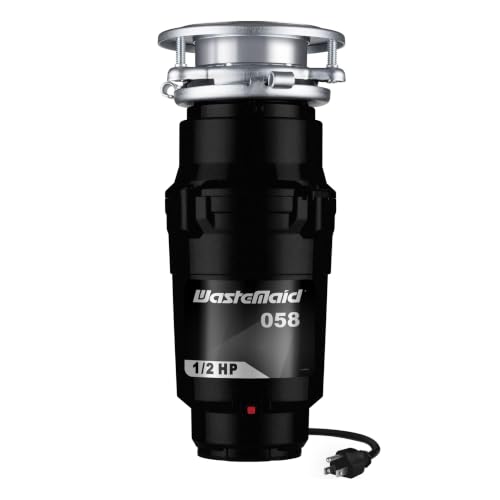
Waste Maid 1/2 HP Economy Anti-Jam — Anti-Jam Pick
The Waste Maid entry makes its pitch in its name: an economy 1/2 HP continuous feed disposal built around an anti-jam grinding system, with stainless steel grinding components, a power cord, and a fast-swap 3-bolt mount that the listing highlights for quick replacement of an existing 3-bolt installation. The listing also states an 8-year warranty in its own terms — the longest figure quoted among these picks, offered here as the maker’s published term.
Anti-jam design addresses the disposal owner’s most familiar annoyance directly. Jams happen when a load stalls the turntable; systems designed against them work to keep the mechanism clearing rather than locking, which in daily life means fewer dates with the reset button. Paired with the 3-bolt mount — the traditional mounting pattern shared by many older installations — the Waste Maid is shaped for the oldest kitchens in this guide’s audience, where the swap should reuse the house’s existing hardware logic.
Economy is in the name too, and it should be read plainly: this is the budget tier’s representative, built to do the standard job at the standard loads. It will not out-grind the 3/4 HP picks or out-hush the Evolution, and it does not claim to. Its case rests on anti-jam manners, mounting convenience and that published warranty term, which together make it a considered buy rather than merely a cheap one.
- Motor: 1/2 HP, with continuous feed
- Design focus: anti-jam grinding system
- Mounting: fast-swap 3-bolt mount, per the listing
- Power: cord included
- Warranty: 8-year, per the listing
Strengths
- Anti-jam design targets the commonest disposal frustration head-on.
- The 3-bolt fast-swap mount suits older installations being replaced like for like.
- The longest warranty term published among these six picks.
Trade-offs
- Economy tier build; heavy households will find its limits sooner.
- Working noise is uninsulated and unapologetic.
- Half-horsepower torque still rewards gradual feeding on dense loads.
Best for: budget-conscious replacements in older kitchens with 3-bolt mounts and jam-prone histories.
Not suited for: buyers shopping for quiet, or for maximum grinding headroom.
How Do the Six Disposals Compare Side by Side?
| Pick | Motor | Mount / notes | Defining trait |
|---|---|---|---|
| InSinkErator Badger 5 with Cord 1/2 HP | 1/2 HP | Lift and Latch; cord included | The default replacement |
| InSinkErator Badger 5XP 3/4 HP | 3/4 HP | Lift and Latch | Badger torque upgrade |
| InSinkErator Evolution .75HP Advanced | 3/4 HP | EZ Connect; insulated | Quiet flagship grinding |
| Waste King L-1001 1/2 HP | 1/2 HP | Cord included; stainless internals | Value brand alternative |
| Moen Prep Series GXP50C 1/2 HP | 1/2 HP | Compact body; cord included | Small-cabinet fit |
| Waste Maid 1/2 HP Economy Anti-Jam | 1/2 HP | 3-bolt fast swap; cord included | Anti-jam economy pick |
Read the table by your actual complaint about the old unit. If it jammed, buy torque or anti-jam design. If it was loud, buy insulation. If it crowded the cabinet, buy compact. If it simply died after honest service, the default replacement is the rational act, and the value brands make that act cheaper without making it foolish. A disposal purchase goes wrong when it answers a complaint you never had.
Should You Install It Yourself or Call a Plumber?
A like-for-like replacement is one of the more achievable plumbing jobs in a house: the old unit twists off its mount, the new one twists on, and the connections are a discharge tube, a dishwasher inlet where fitted, and power. If your replacement matches the old unit’s mounting family and your existing setup has an under-sink outlet for a corded model, a careful homeowner with a bucket, a torch and a free morning is the target installer for most of these picks.
Call a plumber when the job stops being a swap. Hardwired installations with no outlet, a corroded flange that will not seal, a dishwasher connection that has never existed and must be created, or any sign that the trap and drain line need work of their own — each converts the morning project into a professional one, and none of them is a failure of DIY spirit. Electricity and standing water share the cabinet under a sink; respect for that combination is the line between confidence and luck.
Either way, prepare the cabinet. Everything comes out, the base gets wiped dry so leaks can be seen honestly afterwards, and the new unit gets a leak test with a plugged sink full of water before the cleaning bottles go back. The ten driest minutes of the whole job are the ones spent watching for the first drip.
What Should Never Go Down a Disposal?
Grease is the first prohibition, and it is about the drain rather than the disposal. Poured in warm, it coats the pipes as it cools and builds the clog that no disposal can grind its way out of. Wipe greasy pans into the bin and let the disposal handle the residue, not the reservoir. Coffee grounds divide opinion but accumulate in traps in quantity; compost them where you can.
Fibrous and starchy foods are the mechanical prohibitions. Celery strings, corn husks, onion skins and artichoke leaves wrap and mat rather than grind; potato peelings and pasta form a starchy paste that can set in the chamber and the line. Bones are a matter of degree — small, soft fragments in passing are one thing, a carcass is another — and the honest rule is that a disposal is a scraps tool, not a bin replacement. The bin and the compost take the bulk; the disposal takes what washing up leaves behind.
Chemicals deserve a sentence too. Caustic drain cleaners and a disposal chamber are poor company, hard on seals and splash-prone. A sluggish disposal usually wants cleaning, not chemistry: grind ice cubes to scour the chamber, follow with cold water, and use a brush made for the purpose with the power off — never a hand, under any circumstances, in a disposal throat.
Are Disposals Safe for Septic Systems?
Several picks here are listed by their makers as septic safe, and the phrase deserves its proper meaning: the disposal itself is suitable for use with a septic system that is correctly sized for the household and maintained on schedule. A disposal adds ground food solids to the tank’s load, which means the tank fills toward its pumping interval a little faster. In a properly sized system that is a maintenance adjustment, not a hazard.
The households that should pause are those with small, old or already-stretched systems, where the margin is thin before a disposal arrives. In those homes the honest answer comes from the septic professional who services the tank, not from a product listing. Everyone else can read “septic safe” on the Badger and Evolution listings as it is intended: permission, with the maintenance note attached.
What Mistakes Do Buyers Make When Replacing a Disposal?
The first is buying by motor size alone. Horsepower matters, but the household that buys torque when its real problem was noise — or insulation when its real problem was jamming — has spent money on the wrong axis. Name your complaint about the old unit before you shop, and let the table above answer that complaint.
The second is ignoring the mount. A replacement that shares the old unit’s mounting family can be a twenty-minute twist; a brand change can mean a flange replacement, new putty, and a longer morning. Neither is wrong, but only one of them should be a surprise, and surprises under a sink are measured in drips.
Third, buyers forget the electrical question until the cabinet is open. Corded models need an outlet; hardwired homes need either a hardwired model or an outlet fitted by an electrician. Check what your current unit uses before the new one is on the doorstep.
Finally, there is the dishwasher knock-out plug — the small plastic plug inside the disposal’s dishwasher inlet that must be removed if, and only if, a dishwasher connects there. Forget it with a dishwasher attached and the first wash cycle floods the cabinet; remove it without one and the inlet leaks. It is a thirty-second step that decides whether installation day ends in triumph or mopping.
How Do You Keep a Disposal Smelling Fresh?
Disposal odour is rarely the disposal’s fault; it is the biography of everything that has splashed onto the underside of the rubber splash guard and stayed there. That guard is the most neglected surface in the kitchen. Lift its flaps during a proper clean — power off, always — and scrub with an old brush and washing-up liquid, and most mystery smells retire on the spot. The chamber itself benefits from the ice routine: a tray of ice cubes ground with cold water scours the walls, and citrus peel run through afterwards leaves the sink smelling like a grove rather than a bin.
Prevention is mostly water discipline. Run cold water before, during and for a short while after grinding, so ground particles are carried fully into the drain line instead of settling in the trap to be remembered later. A disposal used daily stays fresher than one used weekly, because regular flushing is built into its life; holiday homes and rarely used second kitchens are where smells breed, and a monthly ice-and-water run is their whole prescription.
Avoid the chemical shortcut. Bleach soaks and caustic cleaners are hard on seals, splash guards and the person leaning over the sink, and they treat a symptom that a brush treats better. If a smell survives a genuine clean of the guard and chamber, the problem usually lives further down — in the trap — and that is a plumbing conversation rather than a disposal one.
What Actually Happens Inside When a Disposal Jams?
A disposal does not chop; it flings. The motor spins a turntable, food is thrown outward against a stationary grind ring, and centrifugal force plus the ring’s teeth reduce scraps until the particles wash through. A jam is what happens when something wedges between the turntable and the ring firmly enough to stop the spin — a bottle cap that should never have been there, a dense wad fed too fast, a small bone at an unlucky angle.
The unit protects itself in stages. First the motor hums against the stall; then, if the load is not cleared, a thermal overload trips and the reset button on the underside pops, cutting power before the motor cooks itself. That sequence is why the correct response to a hum is patience rather than panic: switch off, let things cool, free the turntable through the hex socket beneath the unit — most makers include or specify the wrench — work it back and forth until it spins freely, then press reset and test with water running.
Anti-jam designs, like the Waste Maid’s, try to prevent the wedge from setting in the first place, and higher-torque motors power through borderline loads that would stall a smaller unit. Neither repeals physics. The feed discipline in this guide — cold water, gradual loads, no fibrous mats — remains the cheapest anti-jam system ever fitted to a kitchen, and it is installed in the cook rather than the cabinet.
How Does a Disposal Interact With the Dishwasher and the Drain Line?
In most kitchens the dishwasher drains through the disposal, which is why the two appliances share a fate. The disposal’s side inlet receives the dishwasher’s discharge, letting the disposal catch any food solids the dishwasher sends it. This is sensible plumbing, and it is also why the knock-out plug matters so much at installation: the inlet ships sealed, and the plug must be knocked out for a dishwasher connection or the dishwasher has nowhere to drain.
The drain line downstream sets the disposal’s real working conditions. A disposal can reduce scraps to a fine slurry, but a tired, narrow or poorly sloped drain will still carry that slurry reluctantly, and the finest grind in the world will not fix a line that was struggling before the disposal arrived. Homes with old, slow drains should treat persistent sluggishness as a drain diagnosis, not a reason to buy a bigger motor.
Air gaps and high loops — the dishwasher drain routing required in many areas — belong in the same conversation. They exist to keep dirty water from siphoning back toward the dishwasher, and a replacement disposal is the moment to confirm yours is present and correct. A plumber doing the swap will check automatically; a DIY installer should add it to the list deliberately, because it is the step nobody photographs and everybody needs.
When Is a Repair Worth It, and When Is Replacement the Honest Answer?
Some failures are errands, not obituaries. A tripped reset, a jam freed with a wrench, a leaking discharge connection that needs its bolts snugged or its gasket renewed — these cost minutes and restore a sound unit. A disposal that grinds well, runs dry underneath and merely had a bad evening should be repaired by its owner and returned to service without ceremony.
Other failures are the unit telling you its age. Water leaking from the body itself — from a cracked housing or a failed internal seal — has no gasket fix, because the water is escaping the machine rather than a joint. A motor that trips its reset repeatedly under ordinary loads is describing worn internals. Grinding that has grown coarse and slow despite clean, correct use suggests a chamber at the end of its working life. In each case the replacement picks in this guide are the answer, and the swap is usually easier than the diagnosis was.
Age arbitrates the borderline calls. A young unit with a single fault deserves its repair; an old unit with a second fault arriving close behind the first is beginning a sequence, and paying for the sequence costs more than the replacement. Count honestly, and remember that a new unit also resets the clock on seals, mounts and motor alike — which is worth something in a cabinet you would rather not open again for years.
Which Kitchen Habits Decide How Big a Disposal You Need?
Walk your own cooking through the disposal’s day before you shop. A household that cooks from raw ingredients generates peelings, trimmings, cores and rinds in a steady stream, and during preserving or holiday seasons that stream becomes a river. A household that assembles and reheats generates packaging, which the disposal never sees, and a modest load of plate waste. The first household should shop the 3/4 HP end of this list without apology; the second is honestly served by any 1/2 HP pick here.
Juicing, blending and coffee rituals each add their signature loads. Pulp is fibrous and should be fed in small handfuls with generous water, whatever the motor size. Coffee grounds in small daily amounts pass without incident in most homes, though the compost bin remains their better home. Eggshells divide households and plumbers alike; the membrane inside them is the contested part, and moderation is the only position this guide will defend.
Entertaining multiplies everything at once, and it does so at the exact moment the cook has least attention to spare. The disposal that jams during a dinner party is rarely underpowered in absolute terms; it is a modest motor meeting an immodest evening. If your calendar is full of such evenings, buy for the party, not for the Tuesday — the 5XP and the Evolution were chosen for this list with precisely that arithmetic in mind.
What Should You Check in the Cabinet Before Ordering?
Five minutes under the sink now saves a returned parcel later. Measure the vertical space from the sink’s underside to the cabinet floor and compare it with the new unit’s height, remembering that the discharge must still meet the trap at a workable angle. Compact picks like the Moen exist because this measurement fails in real kitchens more often than catalogues admit.
Identify your current mounting family while you are down there. If the old unit is an InSinkErator on its familiar three-bolt style mount, a Badger replacement can be a genuinely quick twist-off, twist-on. A Waste Maid’s 3-bolt fast-swap speaks to the same installed base. Changing to a different brand’s system means the flange comes off the sink too — plumber’s putty, a helper to hold the assembly, and a longer job, all perfectly doable when planned.
Finally, look at the power. Is there an outlet in the cabinet, and is it the switched kind a disposal needs? Is the old unit hardwired into a junction box instead? Corded versions of the Badger 5, Waste King, Moen and Waste Maid all assume the outlet exists. Knowing which world you live in, before the box arrives, is the difference between an installation and an interruption.
How Does Water Temperature Change the Grinding?
Cold water is the disposal’s working fluid, and the instruction is not folklore. Cold keeps fats and grease in solid form, so the grind ring can shatter them into particles small enough to be carried away, instead of melting them into a coating that re-solidifies further down the pipe as a future clog. Cold also keeps the motor’s environment cooler during a long grinding session. The rule costs nothing and prevents the single most common drain problem associated with disposals.
Hot water has its place — in the washing up, after the grinding is done. Running the hot tap to rinse a greasy pan into an empty, switched-off sink is ordinary kitchen life; running hot water as the grinding medium for a fatty load is what the rule warns against. Sequence is the whole trick: grind cold, rinse warm, and the drain line stays out of the story.
Flow matters alongside temperature. A timid trickle cannot carry ground particles through the trap and away, so the tap should run at a proper stream before the switch is touched and continue briefly after the grinding sound clears. That trailing run of water is the step impatience skips, and the trap keeps the receipts.
What Does the First Week With a New Disposal Teach You?
A new disposal is quieter, tighter and more eager than the dying unit it replaced, and the first week is when habits recalibrate. Owners routinely discover that loads they had learned to baby through the old machine now clear without ceremony, and that the soundscape has changed — a new unit’s grind has a pitch and rhythm of its own, and learning it is genuinely useful, because a change in that sound is the earliest leak-free warning the appliance will ever give you.
Use the week to check the installation like an inspector rather than an owner. After the first heavy session, open the cabinet and look with a torch: the flange seam, the discharge joint, the dishwasher inlet and the trap should all be dry, and a sheet of kitchen paper laid beneath the unit will confess any slow weep that eyes miss. Check again at week’s end. Drips found in week one are installation adjustments; drips found in month six have had time to become cabinet damage.
Register the warranty, keep the manual with the wrench it describes, and note the model where a future you will find it. Disposals are bought so rarely that every household forgets its own unit’s details between purchases, and the small folder of paper from installation day is the cheapest memory the kitchen owns. Then forget about the appliance entirely — which, as this guide has argued from the start, is the whole point of choosing it well.
How Do You Choose Between Two Good Disposals That Both Fit?
Tie-breaks in this category should be settled by the house, not by the brochure. Look at the sink itself: a deep farmhouse basin with a thick underside, a thin stainless sink that drums when a basic unit runs, an old cast-iron sink that swallows vibration without comment. The thin stainless sink argues for the insulated Evolution more eloquently than any decibel figure, because a lively sink amplifies whatever the disposal produces, while the cast-iron sink forgives the Badger its honest working voice.
Look next at the household’s hours. Kitchens that run early — bakers, shift workers, parents of infants — place a premium on quiet that evening households never feel. Kitchens that host constantly place their premium on torque and jam resistance, because the disposal’s busiest moments coincide with the cook’s busiest moments. The same six units arrange themselves into different orders depending on which of those households is reading, and that is as it should be: the guide’s job is to make the trade visible, not to pretend one ranking fits every sink in the country.
And look, finally, at who will install and maintain the thing. A confident DIY household can take full advantage of the value brands and their mounting adventures. A household that will call a plumber for every hiccup benefits from the default brand’s ubiquity, because every plumber alive knows the Badger’s ways and carries its common parts. Total cost of ownership includes the humans, and pretending otherwise is how good appliances get blamed for bad matches.
Final Recommendation
Most readers should buy the Badger 5 with cord and be done: it is the proven default, the swap is simple, and the money saved against flagships is real. Step up to the 5XP when your kitchen’s loads, not its layout, were the problem, and to the Evolution when noise was — its manufacturer’s quiet claim is the one premium feature in this category that owners feel every single day. The Waste King and Waste Maid serve value hunters with stainless internals and anti-jam design respectively, and the Moen is the tidy answer for cabinets that cannot spare the room.
Whichever unit you choose, feed it cold water, small loads and respect, and it will repay you the way good infrastructure always does — by being forgotten about for years at a time.
Frequently Asked Questions
Is 1/2 HP enough, or should I buy 3/4 HP?
For most households, 1/2 HP is genuinely enough: it clears peelings, trimmings and plate waste all day without drama. Choose 3/4 HP if you cook in bulk for a large household, entertain heavily, or your old half-horsepower unit stalled and jammed under your normal loads. The upgrade buys jam resistance, not speed.
What does continuous feed mean?
The disposal runs while you feed it: cold water on, switch on, scraps added gradually until the chamber clears. All six picks here work this way. The alternative, batch feed, grinds a loaded chamber at a time behind a stopper switch, and suits different habits; continuous feed is the common household standard.
How loud is a normal garbage disposal?
A basic uninsulated unit is plainly audible through the house while it runs, in bursts of seconds. Insulated designs like the Evolution exist precisely to change that; its manufacturer rates it about 75% quieter than the Badger 5, which is the maker’s own published comparison rather than an independent test.
Can I install a disposal where none existed before?
Yes, but it is a bigger job than a replacement: the sink needs the flange fitted, the drain reconfigured, and power provided — an outlet or hardwired connection — which usually means an electrician alongside the plumbing work. Most first-time installations are sensibly given to a plumber.
Why does my disposal hum but not spin?
That is the classic jam: power is reaching the motor but the turntable cannot move. Switch off, never reach inside, and free the plate with the hex wrench socket underneath the unit or a wooden spoon handle from above, per the maker’s instructions. If it hums with nothing jammed, the reset button and then a professional are the next steps.
Does a disposal need a special electrical circuit?
Requirements vary by home and local code, but the practical question is simpler: is there a switched outlet in the cabinet, or is the old unit hardwired? Most replacement disposals are modest electrical loads, yet the work belongs to an electrician whenever wiring must be added or altered. If an outlet already serves the old unit, a corded model from this list is the straightforward path.
Can a disposal handle ice and citrus?
Yes, and both are useful. Ice cubes ground with cold water scour the chamber walls as they shatter, and a handful of citrus peel afterwards freshens the sink noticeably. Neither replaces the brush-clean of the splash guard, where most odour actually lives, but as weekly maintenance they cost nothing and work.
Is a corded or hardwired disposal better?
Neither is better in the abstract; they answer different houses. A corded unit plugs into a switched under-sink outlet, which makes replacement and servicing simpler, and most picks in this list are sold that way. A hardwired unit connects directly into the home’s wiring, common in older installations, and any change to that wiring belongs to an electrician. Match the new unit to the infrastructure you actually have.
Why does my new disposal vibrate more than expected?
Usually because something in the installation is slightly out of true: a mount not fully seated, a discharge tube under tension, or a unit resting against the cabinet wall or a stored bottle, which turns the whole cabinet into a sounding board. Recheck the mount’s seating, give the discharge a relaxed alignment, and clear anything touching the body before suspecting the machine itself.
How long should a disposal last?
Years of daily service is the fair expectation for any pick here, with lifespan driven more by what it is fed and how it is treated than by the badge. Cold water, gradual loads, no grease, and the occasional ice-cube scour will carry a modest unit past the careless life of a flagship.
Related Guides
The disposal is one half of the sink’s story; the visible half is covered in Best Pedestal Bathroom Sinks for the bathroom counterpart of fixture shopping. When the kitchen work is done and the house is being furnished around it, the foundation questions continue in Best Box Springs and Mattresses, the softness debate continues in Best Affordable Feather Pillows, and the lightest packing problem in this batch is solved in Best Backpacking Sleeping Pillows.


