Our Top Picks


What's inside
- What color coding actually encodes
- The three materials, compared honestly
- Sealing versus spacing: two jobs that look identical on the bench
- Electrical and light plumbing roles where these rings belong
- How assortment kits keep the code usable
- Reading size when the color has faded
- Distinguishing these rings from metal washers, briefly
- Worked examples: matching ring to task
- Buying criteria that survive the marketing
- Tightening torque: why gentle wins with polymers
- Color vision, labeling, and making the code accessible
- Everyday habitats: where coded rings quietly accumulate
- Troubleshooting leaks and failures at small joints
- Environmental aging and end-of-life judgment
- How these rings are made, and why manufacture shows in quality
- Projects that teach the differences fastest
- Check prices on Amazon
- Check prices on Amazon
- A decision sequence for the parts-bin moment
As an Amazon Associate I earn from qualifying purchases. This post may contain affiliate links at no extra cost to you.
A flat washer made of nylon, PVC, or rubber looks like the simplest object in the parts bin: a disc, a hole, nothing to adjust and nothing to break. The color-coded versions of these humble rings turn that simplicity into a small information system. Instead of measuring every disc with calipers or test-fitting it on a bolt, a technician reads its color and knows its inside diameter at a glance. This guide stays tightly on that narrow, useful subject. It explains how color codes map to sizes, how the three common materials differ in hardness measured on durometer scales, where their temperature ceilings and chemical tolerances divide them, when a soft ring is acting as a seal and when it is merely spacing two surfaces apart, why these parts belong in light electrical and plumbing-adjacent work yet never inside a structural bolted joint, how compartmented assortment kits keep the code honest, and what to do when age and sunlight fade the very colors the system depends on.
A note on how this comparison was put together: the material limits and sizing conventions below come from published manufacturer datasheets and polymer references reviewed during our research, and this page carries affiliate links. As an Amazon Associate, this site earns from qualifying purchases. That relationship has no influence on the temperature ceilings, hardness ranges, or load warnings stated here, which follow the datasheets rather than any seller’s enthusiasm.
What color coding actually encodes
In a color-coded assortment, each hue is assigned to one inside diameter, and usually to the matching outside diameter and thickness that the maker pairs with it. A typical scheme might reserve one color for rings that fit small machine screws, another for the next bolt size up, and so on through the sizes a hobbyist or maintenance tech encounters weekly. The critical caveat is that no universal cross-brand standard governs these assignments. One maker’s red may denote a 4-millimeter bore while another’s red denotes a quarter-inch bore, because the code is a private language belonging to each kit. Responsible manufacturers print the legend on the box lid or a card inside it, mapping every color to its dimensions in both metric and imperial units. Treat that legend as part of the product: a kit whose legend is missing has lost the very feature that justified its purchase, and its contents revert to anonymous discs that must be measured one by one.
Inside diameter is the identity; the rest follows
Flat washers are specified by three numbers: inside diameter, outside diameter, and thickness. In coded assortments the color primarily certifies the first of these, because the inside diameter decides which fastener the ring fits. Clearance is deliberate, usually a few tenths of a millimeter above the nominal bolt diameter, so the ring slides on without force yet does not slop sideways under a screw head. Outside diameter governs how much bearing surface the ring offers and whether it fits inside counterbores or under small flanged heads. Thickness, often between half a millimeter and two millimeters in these assortments, decides both the spacing effect and how much the material can compress when it is asked to seal. When a legend lists only one dimension per color, assume it is the inside diameter and verify the other two with calipers before relying on them in a stack-up where total height matters.
The three materials, compared honestly
Nylon, PVC, and EPDM rubber dominate color-coded assortments because they injection-mold or punch cleanly, accept pigments well, and cover complementary performance territory. Nylon 6/6, the usual grade, is the structural overachiever of the trio: stiff, abrasion-resistant, and slippery enough to double as a low-friction interface. Flexible PVC is softer and cheaper, conforming to slightly irregular surfaces and shrugging off water and many household chemicals. EPDM, a synthetic rubber, is the sealing specialist, elastic across a wide temperature span and notably resistant to weathering, ozone, and steam-adjacent moisture. Pigments behave differently in each base: nylon takes deep, durable color, PVC holds bright hues but can migrate plasticizer over years, and EPDM is most often supplied in black in bulk industrial channels, so vividly colored EPDM rings usually come from specialty assortments where the coding premium justifies the compounding effort.
Hardness and the durometer scales
Hardness predicts how a ring behaves under a tightening screw. Flexible polymers are measured on Shore scales: Shore A for softer, rubber-like materials and Shore D for rigid plastics. EPDM washers commonly sit around 60 to 75 Shore A, soft enough to indent with a thumbnail and to flow into surface texture under modest clamping. Plasticized PVC typically lands near 75 to 90 Shore A, firmer than rubber yet still visibly compliant. Nylon 6/6 registers around 75 to 85 Shore D, an entirely different neighborhood of stiffness where thumbnail pressure leaves no mark at all. These numbers explain the division of labor. A 70 Shore A ring compresses and seals; an 80 Shore D ring barely compresses and instead distributes load, insulates, and spaces. Quoting a hardness without its scale letter is meaningless, since 75 on the A scale describes a pliable gasket material while 75 on the D scale describes a rigid engineering plastic, and datasheets that omit the letter deserve a follow-up question before purchase.
Temperature ceilings and what happens beyond them
Heat is the silent specification that separates these materials in service. Plasticized PVC softens earliest, with continuous-use guidance commonly topping out near 60 degrees Celsius, and it stiffens noticeably in cold rooms as the plasticizer’s effect fades. Nylon 6/6 handles considerably more warmth, with continuous service often rated to about 85 to 100 degrees Celsius depending on grade and load, though it absorbs moisture from humid air, and that absorbed water slightly lowers its stiffness and swells its dimensions by a small but measurable fraction. EPDM leads the trio on thermal range, typically rated from roughly minus 40 to plus 120 degrees Celsius in air, which is why it appears around hot-water fittings and outdoor enclosures. Exceeding a ceiling does not usually melt a washer dramatically; instead the ring creeps, takes a permanent set, and loses whatever sealing pressure or spacing precision it was providing. A PVC ring that spent a summer against a hot manifold may emerge flattened to half its molded thickness, still colorful, still the right bore, and functionally finished.
Chemical resistance in plain terms
Household and workshop chemistry sorts the trio further. EPDM resists water, steam, dilute acids and alkalis, and many polar solvents, but it swells badly in petroleum oils and fuels, which dissolve its usefulness within hours. Nylon tolerates oils, greases, and many hydrocarbons well, shrugs off dilute alkalis, and is attacked by strong acids and phenolic compounds. PVC stands up to water, salts, and a broad spread of household cleaners, yet softens or clouds on contact with ketones and some aromatic solvents, the family that includes aggressive paint thinners. Chlorinated water deserves a specific mention because it appears in both pools and treated plumbing: all three materials tolerate municipal chlorine levels, but concentrated chlorinated cleaners age EPDM’s surface and embrittle PVC over repeated exposure. The practical rule is to match the ring to the fluid it will actually meet, and to treat any unlisted chemical as a reason to test one sacrificial washer in a jar overnight before committing a whole assembly.
Sealing versus spacing: two jobs that look identical on the bench
A soft non-metallic ring under a screw head can be doing either of two fundamentally different jobs, and confusing them causes most field failures. As a seal, the ring’s material must compress enough to fill microscopic surface irregularities on both faces, creating a barrier against low-pressure water, dust, or drafts. Sealing demands elasticity, which is why EPDM and soft PVC dominate that role, and it demands restraint in tightening, because over-compression splits rubber at the bore and extrudes PVC out from under the head like toothpaste. As a spacer, the ring’s job is dimensional: it sets a gap, levels a component, or prevents metal-to-metal contact, and here nylon’s rigidity is the asset, holding its thickness under clamp loads that would slowly squeeze a rubber ring thinner. A nylon ring used as a seal disappoints because it cannot flow into surface texture; a rubber ring used as a precision spacer disappoints because its thickness depends on how hard someone tightened the screw last Tuesday. Naming the job before choosing the material is the entire discipline.
Compression set: why old seals stop sealing
Rubber held compressed for months gradually forgets its original thickness, a phenomenon datasheets quantify as compression set, expressed as the percentage of recovery lost after a standardized squeeze at temperature. Low-set EPDM compounds might surrender only a modest share of their rebound after heat aging, while bargain PVC can lose most of its spring in a single hot season. The consequence for maintenance is concrete: a sealing washer is a consumable, not a permanent part. Any joint that gets opened should receive a fresh ring on reassembly, because the removed one has already spent its recovery conforming to the old surfaces. Spacers age differently; nylon’s enemy is creep under sustained load and heat, a slow thinning that matters in stacked assemblies with height tolerances. Both failure modes are invisible to a glance, which is another argument for the assortment kit model, where replacement rings cost pennies and live within arm’s reach of the workbench.
Plumbing-adjacent uses appear throughout this guide, and readers planning a bathroom project around these small seals may find the fixture context in best faucets for freestanding tubs helpful when picturing where low-pressure sealing rings actually serve.
Electrical and light plumbing roles where these rings belong
Non-metallic washers earn their keep wherever a fastener must not conduct, must not scratch, or must not corrode. In electrical and electronics work, nylon rings insulate a screw from a chassis, space a circuit board off a metal enclosure at a controlled standoff height, and prevent a steel screw head from cracking a ceramic or phenolic component as it tightens. Their dielectric strength is a genuine engineering property, with nylon sheet values commonly published in the range of hundreds of volts per mil of thickness, though a hardware-store assortment ring should be treated as insulation for low-voltage and signal work rather than as a rated safety barrier in mains equipment. In light plumbing, EPDM and PVC rings appear under faucet shank nuts, inside hose couplings, behind shower hardware escutcheons, and beneath toilet tank bolts, all places where pressures are modest, surfaces are finished, and a metal ring would mar chrome or invite crevice corrosion. Paint protection is the third quiet role: a nylon ring under a screw head on a powder-coated panel prevents the head’s serrations from chewing the coating into a rust invitation.
The structural line these washers must never cross
None of these polymers belongs inside a joint that carries structural load, and the reasons are mechanical rather than conservative habit. A bolted structural connection works by clamping steel members together with enormous preload so friction between the faces carries the shear; a polymer ring inside that stack creeps under the preload, the clamp force decays, and the joint loosens toward failure. Temperature accelerates the decay, vibration exploits it, and no color code changes the physics. Engine mounts, trailer hitches, deck ledgers, machinery feet under dynamic load, and any connection whose failure could drop, collapse, or release something belong to metal hardware and, where relevant, to graded fasteners installed to published torque. The same caution applies in miniature to safety-adjacent household items: a polymer ring is fine spacing a shelf bracket’s decorative cover and unacceptable as part of the bracket’s anchoring stack. Keeping this boundary bright is what allows the materials to be used with confidence everywhere on the permitted side of it.
How assortment kits keep the code usable
The product form that makes color coding practical is the compartmented assortment box, and its design details decide whether the system survives contact with a real workshop. Individual cells per color prevent the migration that turns a sorted kit into a rainbow soup after one trip in a truck bed; lids that latch at two points, hinges that flex rather than snap, and cell walls tall enough to contain the largest ring all matter more than the box’s graphics. Better kits print the legend inside the lid where it cannot be lost, repeat the size beside each cell, and include a refill path, since popular sizes deplete while odd sizes accumulate. Counts per size reveal the maker’s honesty about usage: a kit weighted toward mid-range bores reflects real consumption, while one padded with hundreds of the smallest size inflates its headline piece count cheaply. Some assortments mix materials within one box, assigning not just size but material by color family, a richer code that absolutely requires the printed legend and rewards it with genuine bench speed.
Restocking discipline and the one-kit rule
A coding system collapses the day two kits with different legends share a bench, because a red ring from one box silently means a different bore in the other. Households and small shops should standardize on a single assortment line, mark the purchase date inside the lid, and refill from the same maker’s chart or re-measure every incoming batch against the resident legend before it enters the cells. Loose rings found on the floor or returned from a disassembly should never be dropped back into cells on a color guess; they go to a quarantine cup for measurement or disposal. That sounds fussy until the first time a mis-sorted ring, one size small, gets forced onto a bolt, splits, and leaves a faucet shank weeping at midnight. The discipline is the product, in a sense: the plastic discs are nearly free, while the certainty about what each color means is the thing actually purchased.
Smaller fixtures use these rings in tighter spaces, and the under-sink world where many of them end up is surveyed in best faucets for undermount bathroom sinks for readers matching hardware to a real installation.
Reading size when the color has faded
Ultraviolet light, heat, and solvent splashes all bleach pigments, and PVC adds its own failure mode as plasticizer loss leaves colors chalky. A faded ring is not a lost ring, because its identity lives in its dimensions, recoverable with three quick measurements. Calipers across the bore give the inside diameter directly; a cheaper method slips the ring over a drill-bit shank assortment or a bolt-size gauge until the fit matches the maker’s intended clearance. The outside diameter and thickness follow from the same caliper session, and the trio of numbers can be checked against the kit legend’s rows even when the hue is unreadable, since few kits contain two sizes sharing all three dimensions. Material identification helps too: a faded ring that flexes easily and rebounds is likely EPDM, one that feels waxy and bends with slight whitening at the fold is probably PVC, and one that resists bending and clicks against a benchtop is nylon. When a whole kit has faded, relabeling each cell by measured size, with a paint pen on the box rather than on the rings, restores the system’s speed without pretending the colors still speak.
Preventing fade and storing polymers properly
Storage conditions decide how long any of this remains legible. Assortments belong in a closed box away from windows, since ultraviolet does its bleaching through ordinary daylight over months, and away from heat sources that accelerate both fading and compression set in the rubber cells. Solvent vapors from an open parts-washer or a nearby paint shelf can cloud PVC and swell EPDM in storage, so the kit’s shelf should be a clean one. Nylon benefits from ordinary indoor humidity rather than desiccated heat, which can leave it brittle over years. Rotating stock sounds industrial for a home kit, yet the principle is simple: use the oldest rings first, and when a refill arrives, place it beneath the remaining stock in each cell. A kit treated this way stays dimensionally honest and color-true for years, while the same kit on a sunny windowsill can become a box of pastel mysteries in a single summer.
Distinguishing these rings from metal washers, briefly
One sentence of contrast frames the whole category: a steel or brass flat washer exists to spread clamp load and survive it indefinitely, while these polymer rings exist to insulate, seal gently, space precisely, or protect a finish, accepting a limited life and a modest load ceiling as the price of those talents. Everything else in this guide follows from that trade. Shoppers should therefore read any listing that promises polymer rings for heavy bolting as a category error, and read listings that specify polymer grade, hardness with its scale, and a temperature range as evidence the maker understands its own product.
Worked examples: matching ring to task
Consider a circuit board that must float 3 millimeters above an aluminum enclosure on four screws. Nylon is the obvious candidate: its thickness is stable, its surface will not short a trace, and doubling rings to reach the standoff height keeps the stack predictable because each ring compresses almost not at all. Now consider a garden-hose-style coupling on a utility sink that drips one drop per minute at the nut. The fix is a fresh EPDM ring of the correct bore, seated flat, tightened by hand plus a modest wrench turn, because the old ring has almost certainly taken a set and no amount of additional torque will restore its missing rebound; extra force only distorts the coupling. A third case, a chrome escutcheon that must sit snug against tile without grinding it, calls for soft PVC, whose conformability bridges the tile’s slight unevenness while its body shields the glaze from the metal edge. A fourth, a plastic reservoir lid screw that squeaks and binds, may need only a nylon ring as a bearing surface, letting the head turn against polymer instead of galling the lid. Four tasks, four different reasons, one small family of parts.
Pressure-adjacent work and its limits
Pressure equipment enters this guide only to mark a boundary clearly. The seals inside a pressure washer’s pump, its lance connections, and its high-pressure hose fittings are engineered components, commonly specialized O-rings and backup rings in compounds chosen for thousands of pounds per square inch, and a flat assortment washer is not a substitute for any of them. Where a coded flat ring may legitimately appear near such equipment is on the low-pressure side: a garden-hose inlet screen washer, a detergent-tank cap seal, an accessory bracket spacer. Readers comparing machines in that category can see the equipment context in best 3000 psi pressure washers, but the sealing hardware inside those pumps belongs to service kits matched to the model, full stop. Respecting that division keeps a two-cent part from being blamed for a failure it was never designed to prevent.
Buying criteria that survive the marketing
Product pages for assortments compete on piece count, which is the least informative number available. The informative details are the polymer named by grade rather than by the word plastic, a legend mapping colors to all three dimensions, hardness stated with its Shore scale, a temperature range, and cell counts weighted toward commonly consumed sizes. A kit that lists nylon by its family name, states EPDM rather than the generic word rubber, and admits PVC’s lower heat ceiling is describing real goods. Packaging matters at this scale too: rings arriving loose in a bag, however colorful, must be sorted and measured before they can join a coded system, and that labor erases the discount that justified them. Lids that stay shut in a toolbox, hinges that survive a winter in an unheated garage, and legends printed in units your bench already uses all outrank a bonus hundred rings in a size no project has ever requested. Finally, consider whether replacement packs exist for the sizes you burn through, because a system you can refill is a system you will still be using in five years.
Sizing coverage: metric, imperial, and the gaps between
Assortments usually commit to one measurement family, and the wrong commitment creates a bench drawer of near-misses. Metric kits typically step through bores for common machine screws in one-millimeter progressions, while imperial kits follow fractional and numbered screw sizes whose bores land between metric steps. A 5-millimeter bore ring forced onto a quarter-inch bolt will not start; a quarter-inch ring on a 6-millimeter bolt fits with slop that defeats centering. Mixed-fleet households, with imported equipment beside domestic hardware, sometimes justify owning both families, provided the boxes live in different drawers with their legends intact, honoring the one-code-per-bench rule by separating the benches physically. Thickness coverage deserves a glance as well, because spacing jobs fail when every ring in the right bore is a single thickness and the required gap is half of it. The best assortments vary thickness within a size or publish it plainly enough that a buyer can predict the stack arithmetic before ordering.
Laundry-room hardware offers one more everyday sighting of these rings, under tank bolts and behind hose connections, and the room’s soft furnishings get their own treatment in best bath rugs for front load washer for readers outfitting the space around the machines.
Tightening torque: why gentle wins with polymers
Steel fastener torque tables assume steel interfaces, and applying their values through a polymer ring destroys the ring and sometimes the part beneath it. Soft sealing rings generally need only enough clamp to compress them by roughly a fifth to a third of their original thickness, a state reachable with finger-tight plus a short wrench arc on small hardware. Beyond that window, EPDM splits radially from the bore outward, PVC extrudes sideways and thins to transparency at the edge, and even nylon begins cold flow that relaxes the joint over the following days. The feedback through the wrench differs by material, and learning it is a bench skill: rubber gives a rising, springy resistance that clearly announces the sealing zone, PVC feels buttery and then suddenly firm, and nylon feels almost like metal until the moment it yields. Where a manufacturer publishes a torque for a polymer-sealed joint, that figure governs; where none exists, compress to the fraction, mark the screw head position with a paint dot, and check it after a day. A joint that needs re-tightening repeatedly is not asking for more force; it is announcing creep, a wrong material, or a surface defect that force cannot repair.
Stacking rings: when layers help and when they lie
Stacking two rings to reach a spacing height is legitimate with nylon, whose negligible compression keeps arithmetic honest, and questionable with anything soft. A stack of rubber rings behaves like a spring with opinions, compressing unevenly, walking sideways under vibration, and sealing worse than a single ring of the correct thickness because each interface is another leak path. Color coding makes stacking tempting, since the eye reads two colors as a deliberate recipe, and workshops do develop private conventions, such as pairing two known sizes to bridge an odd bore in an emergency repair. Such improvisations belong in the category of getting home, not of finished work, and they should be replaced by the correct single ring when one is available. If a stack must serve as a spacer, keep it nylon, keep it short, and confirm the total height with calipers after tightening rather than trusting the sum of the nominal thicknesses, because molded tolerances of a tenth of a millimeter per ring accumulate quietly.
Color vision, labeling, and making the code accessible
Roughly one man in twelve has some form of color-vision deficiency, most commonly confusing reds and greens, and any coding system built purely on hue quietly excludes those users. Well-designed assortments anticipate this by pairing color with position, since the cell’s location in the box is a second channel of information, and by printing the size in each cell so the code never depends on eyesight alone. Households can strengthen a weak kit by adding tactile or textual redundancy: a fine paint pen dot count on the lid’s legend, cells re-labeled in large numerals, or a printed chart taped inside the lid with sizes in bold type. Sorting by measured size into labeled pill organizers is a legitimate adaptation for a user who cannot use the hues at all, trading the kit’s speed for certainty. Makers who choose palettes distinguishable under common deficiencies, favoring blues, yellows, and strongly contrasting lightness steps over red-green neighbors, deserve credit in buying decisions. The broader lesson generalizes beyond accessibility: a code with a backup channel survives fading, poor workshop lighting, and greasy fingerprints, all of which degrade hue long before they degrade a printed numeral.
Workshop lighting and the metamerism trap
Colors shift under different light sources, a phenomenon called metamerism, and it bites hardest in exactly the places washers get sorted. A ring that reads clearly as one hue under a warm garage bulb may drift toward its neighbor’s appearance under a cool fluorescent tube or in blue evening light through a window. Pigment pairs chosen cheaply can be metameric matches, identical under one illuminant and distinct under another, which explains the maddening experience of a kit that sorted perfectly at the kitchen table and ambiguously at the bench. Daylight-balanced task lighting over the parts bench is the practical cure, and a quick check of a doubtful ring beside the legend under that same light settles most disputes. When doubt persists, the caliper outranks the eye without appeal. This is also why legends printed with color swatches age poorly alongside their kits: the swatch fades at a different rate than the rings, and a two-year-old chart may misdescribe the very colors it was printed to explain, while its dimension columns remain exactly as true as the day they were inked.
Everyday habitats: where coded rings quietly accumulate
Walk through a house with these parts in mind and they appear in clusters. Aquarium and terrarium equipment uses EPDM and PVC rings around bulkhead fittings and canister filter housings, chosen for permanent water contact and for gentleness against acrylic and glass that a harder interface could crack. Recreational vehicles and small boats use nylon spacers behind cabinet hardware that vibrates for a living, and soft rings under deck fittings where the pressure is weather rather than plumbing. Greenhouse and irrigation fittings at garden pressure rely on rubber rings that tolerate fertilizer solutions and sunlight-adjacent warmth, though the sun itself shortens their service and argues for spares. Holiday-lighting clips, pool ladder bumpers, hose-reel connections, and the feet of small appliances all consume the same small discs, usually discovered only when one perishes and a drip, rattle, or scratch announces the vacancy. A coded assortment on the shelf converts each of those discoveries from a store trip with a mangled sample in a pocket into a thirty-second drawer visit, which is the entire economic argument for the category stated in domestic terms.
Food-adjacent and potable-water caution
Not every polymer ring belongs near drinking water or food, regardless of how clean it looks. Potable-water applications call for materials certified to the relevant drinking-water standards in your jurisdiction, and food-contact uses call for food-grade compounds, because plasticizers and compounding additives in general-purpose PVC and rubber are not formulated for ingestion pathways. Hardware assortments rarely carry those certifications, so the disciplined move is to source the specific ring for a coffee machine, a filtration housing, or a beverage line from the equipment maker’s parts channel and to keep the coded kit for the thousand jobs that carry no such pathway. Garden irrigation, toilet fill valves, and washing-machine inlet screens sit in a gray zone that local codes and the fixture maker’s instructions should arbitrate. The color code cannot help here at all: two rings identical in hue and dimension may differ entirely in compound pedigree, and only documentation, not appearance, separates them.
Troubleshooting leaks and failures at small joints
A weeping joint sealed by a polymer ring tells a short story with a limited cast of causes. The ring may be the wrong bore, riding eccentrically so one side compresses while the other floats; rotating the fitting and watching the ring’s exposed edge reveals the uneven squeeze. The ring may be correct but spent, its compression set leaving it thinner than the gap it must fill, in which case it will feel papery or board-like compared with a fresh ring from the kit. The mating surfaces may carry a burr, a grit particle, or old thread sealant that holds the ring off its seat at one point, a defect a fingertip drawn across the cleaned face can feel better than eyes can see. The compound may be chemically wrong for the fluid, announced by swelling, tackiness, or a ring that has grown noticeably larger than its cell-mates. Or the joint may simply be over-tightened, its ring split at the bore in a radial crack that opens only under pressure. Working through that list in order, replacing rather than rescuing the ring at each step, resolves nearly every small leak without sealant, tape, or the escalation to force that turns a washer problem into a fitting problem.
Measuring tools that make the system trustworthy
The assortment’s credibility rests on two inexpensive instruments. A basic digital or dial caliper resolving to a twentieth of a millimeter verifies bores, outside diameters, and thicknesses in seconds and settles every argument color ever started. A bolt and screw gauge plate, the flat template with labeled holes and threaded posts sold for hardware identification, gives a second, tactile confirmation of which fastener a ring truly fits. Together they cost less than a single service call and convert the kit from a box of beliefs into a measured inventory. Their maintenance is trivial: keep the caliper’s jaws clean, zero it before a session, and measure the bore with the inside jaws seated gently rather than sprung, since a soft ring deforms under enthusiastic measuring and reports a size it does not have. For rubber rings, measuring the bore by slipping the ring over gauge posts avoids the jaw problem entirely. A notebook line or a phone note recording each kit’s maker, purchase date, and any discovered legend errors completes the modest bureaucracy that keeps small parts honest.
Environmental aging and end-of-life judgment
Every polymer in this guide is on a slow clock. Ultraviolet breaks molecular chains at surfaces, ozone attacks stretched rubber, heat accelerates oxidation, and plasticizer migration steadily converts flexible PVC toward rigidity. The bench signs are legible once learned: surface crazing like dried mud, edges that crumble instead of flexing, a ring that holds the bent shape of a fold, colors retreating toward gray. Any of these marks retires a sealing ring immediately and a spacer at the next convenient opening. Disposal is unglamorous; these are not curbside-recyclable in most municipal streams, and the honest quantity involved is grams per year for a household. The environmental ledger of the category is arguably favorable anyway, since a two-gram ring that prevents a leak protects finishes, subfloors, and water bills worth vastly more than its own footprint, and a nylon spacer that stops galvanic mischief can extend the life of the metal parts it separates by years. Longevity, as usual, is the greenest specification: buy compounds matched to their conditions and they will not need replacing often enough to matter.
Galvanic isolation: a quiet electrical-chemical role
One specialized duty deserves its own paragraph because it is invisible when done right. Where dissimilar metals meet, an aluminum panel and a stainless screw, for instance, moisture can drive galvanic corrosion that eats the less noble metal. A nylon ring interposed under the screw head and, where the design allows, a matching sleeve through the hole interrupts the metal-to-metal path and slows that cell dramatically. Boats, outdoor enclosures, and coastal hardware all exploit this trick, and it explains why some assemblies specify polymer rings in places where neither sealing nor spacing seems required. The ring in that service must stay intact and dry-ish to insulate, so inspection focuses on cracking rather than compression. It is a fitting final example of the category’s character: the cheapest component in the stack, assigned a job entirely out of proportion to its price, succeeding precisely because someone read its material properties carefully and placed it with intent.
How these rings are made, and why manufacture shows in quality
Two production routes supply nearly every assortment on the market. Injection molding forms nylon and PVC rings with precise bores, slight draft angles, and occasionally a visible gate mark where the polymer entered the cavity; molded rings hold the tightest tolerances and the crispest color. Die punching stamps rings from extruded sheet, which suits EPDM and softer PVC, and leaves edges that may carry a slight roll or a whisper of flash. Neither route is inherently superior for household service, but their signatures help a buyer read quality: punched rings should be uniform in thickness across a cell, molded rings should show no short-shot voids or sink marks, and neither should arrive with bores eccentric to the outside edge. Pigment dispersion is another manufacturing tell, because streaky or marbled color signals poor compounding and often travels with inconsistent hardness in the same batch. Flash, the thin fin of excess material at a parting line, matters functionally on a sealing face, where it can hold the ring off its seat exactly like the burr described earlier; a quick fingernail check across both faces of a sample ring grades a kit faster than its packaging copy does. Makers who tumble or deflash their output and hold bore tolerances to a tenth of a millimeter are doing invisible work that only becomes visible, pleasantly, at assembly time.
Tolerances and why a tenth of a millimeter is not pedantry
Small fasteners live on small clearances, so washer tolerances that look fussy on paper are practical on the bench. A bore half a millimeter oversize lets a ring sit visibly off-center under a screw head, compressing unevenly and, in a sealing role, leaving a crescent of under-compressed material where leaks begin. Thickness variation across a single ring, one edge measurably thicker than the other, cocks the clamped part at a slight angle that matters in optical mounts, sensor brackets, and any stack where parallelism is the point. Reputable datasheets state tolerances explicitly, often around plus or minus a tenth of a millimeter on bore and thickness for molded nylon, wider for punched rubber. Assortment-grade parts rarely publish them, which is survivable for household work provided the buyer spot-checks a sample from each cell with calipers on arrival. Five minutes of incoming inspection converts unknown tolerances into known ones, and a cell whose contents measure wildly should be treated as mislabeled until proven otherwise, because a factory sorting error looks exactly like a ring that fits nothing it should.
Projects that teach the differences fastest
Certain common projects compress the whole curriculum into an afternoon. Rebuilding a dripping hose bibb or a utility faucet exercises EPDM selection, compression judgment, and the fresh-ring-on-reassembly rule in one contained job with immediate feedback. Mounting a set of circuit boards or a control panel teaches nylon spacing, stack arithmetic, and the discipline of measuring standoff height rather than assuming it. Refurbishing outdoor furniture exposes rings to weather reasoning: which compound faces the sun, which faces standing water in a frame recess, and why the same joint may want nylon on its shaded side and EPDM where rain pools. Assembling a child’s wooden play structure, using polymer rings only in non-structural trim and cover roles, drills the structural boundary better than any warning paragraph, because the builder must repeatedly decide which fasteners are load paths and which are cosmetics. Even a simple drawer-organizing project, sorting a decade of loose hardware into a coded kit with measured labels, teaches the legend discipline and the quarantine cup. Skills with small parts transfer by touch, and these rings, cheap and forgiving of mistakes within their limits, are unusually good teachers.
Teaching the next pair of hands
Workshops run on transmitted habits, and a color-coded kit is a small curriculum in itself for anyone learning the bench. A new helper can be taught the legend in minutes, then trusted to fetch correct sizes while an experienced pair of hands stays on the assembly, which is real productivity rather than a gimmick. The teaching moments embedded in the system are gentle ones: fetch by color, verify by gauge when the job is a seal, never substitute a soft ring where the removed one was rigid, and bring the old ring back for comparison instead of discarding it at the machine. That last habit alone prevents a large share of reassembly errors across all hardware, since the removed part is the ground truth for size, material, and orientation. Households that label the kit’s purchase date and keep its legend photographed on a phone are, without quite saying so, maintaining a tiny institution, and institutions are how one person’s good habits survive into another person’s first solo repair.
Check prices on Amazon
Live listings for the shortlist in this guide are pulled from Amazon below, so prices and availability are always current at the moment you look.
Check prices on Amazon
- Fiber Washers 3/8 in x 1/32 in Black 2 pcs | Non-Metallic Sealing Washers for Plumbing, Automotive, Mechanical, and General Repair Applications
- Keadic 840Pcs Nylon Flat Washers, Metric Sealing Spacer Gasket 3 Colors Flat Washers Assortment Kit for Bolts Industrial – M2 M2.5 M3 M4 M5 M6 M8 M10 M12
- Lomoky 1200Pcs Nylon Flat Washers, Plastic Washers Flat, M2-M10 Assortment | 8-SIZE WASHER KIT: 1200 pcs in M2, M2.5, M3, M4, M5, M6, M8, M10 for daily fastening.
- 100 Pcs 1.77 Inch Plastic Washers – 45mm Polypropylene Foam Board Fasteners, Insulation Washers for Fixing and Fastening Rigid Foam and Load Spreading
- QWORK 500 Pcs Plastic Washers, 45mm Load Spreading Washers Insulation Supports for Fixing and Supporting Rigid Foam Panels and Sheets
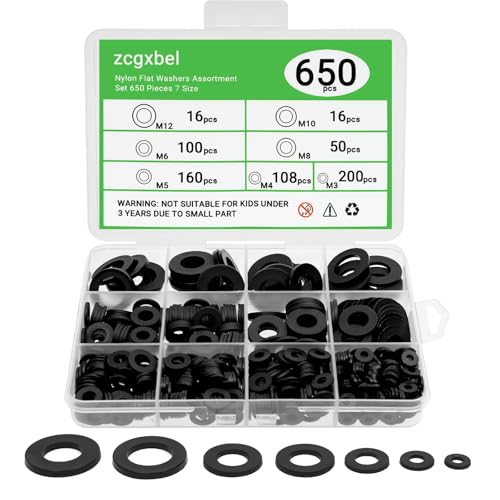
- 650-Pieces Nylon Flat Washer for Screws Bolts, 7 Sizes Black Plastic Washers Assortment Kit (M3-M12), Assorted Screw Washers Washer Set for Household & Commercial
- Pangda 30 Pcs Nylon Flat Washers 1-1/4" Od x 1/16" Thick White Bulk | for Bolts Nuts Screws, Plastic Fender Washers, Non Conductive, Fastener Hardware, Electrical Mechanical Household Industrial
- 1100Pcs Black Nylon Flat Washers Assortment, M2-M12 Plastic Washer Set | Non-marring, rustproof, insulating protection; easy assembly and sorted storage.
- Qjaiune 50 Pack M4 Clear Nylon Washers 17mm OD 1mm Thick for Faucet Hose | Wear-Resistant Insulation Nylon, Leak-Proof Sealing, For Water Pipe Faucet Valve Garden Irrigation
- WEGOUP 900pcs Nylon Flat Washer Assortment Kit for Bolts & Screws (M2-M12) | Black Plastic,Assorted Screw Washers, Washer Set For Household & Industrial Use
A decision sequence for the parts-bin moment
When a real job is open on the bench and a hand hovers over the kit, the reasoning developed throughout this guide compresses into a short sequence. First, name the job in one word: seal, space, insulate, isolate, or protect, because that word selects the material family before size enters the discussion. Second, check the environment the ring will inhabit, its hottest plausible temperature, its fluids, its sunlight, and strike out any compound whose published limits the environment crosses. Third, take the size from the fastener and the legend together, color guiding the hand to a cell and the gauge confirming the choice whenever the joint matters. Fourth, tighten to the material’s feedback rather than to a number borrowed from steel practice, compressing soft rings into their working fraction and seating nylon firmly without forcing it past yield. Fifth, treat the ring as a dated consumable in any sealing role and record anything unusual, a swollen predecessor, a cracked one, a cell that measured off, while the evidence is still on the bench. None of these steps requires expertise beyond attention, which is precisely the appeal of the category: the parts are simple, and the rigor lives in the choosing.
There is a particular satisfaction in a parts system that a glance can read, a rainbow with a legend, each hue a promise about a dimension. Kept honest by a caliper, a printed chart, and respect for what soft materials must never be asked to hold, that little spectrum earns its drawer: not by being colorful, but by being correct at the exact moment a dripping, rattling, shorting job asks a two-cent ring to be exactly the right one.
Inventory habits for households that outgrow one kit
Some benches eventually graduate from a single assortment to a small wall of labeled bins, and the transition rewards the same principles at larger scale. Consumption, not symmetry, should size the bins: the bores that serve weekly get deep cells near the bench, while the once-a-year sizes can live higher and smaller. A simple reorder threshold, a tape line inside a cell below which a refill gets noted on the shopping list, prevents the specific frustration of opening a kit mid-repair and finding the one needed color exhausted. Photographing each bin’s contents beside its legend during the annual workshop cleanup creates a dated record that catches slow drift, cells quietly filled with the wrong size by helpful hands, before drift becomes a failed seal. When a second measurement family joins the bench, its containers should differ in shape or lid color family from the first, a physical distinction that survives tired evenings better than a label alone. And when rings migrate between generations of a family’s tools, as they do, the legend must migrate with them, taped inside the lid or it did not happen. Scale changes nothing fundamental here. Whether the inventory is forty rings or four thousand, its value is the speed with which a known dimension can be trusted, and trust, in a parts system, is simply accuracy that has been maintained on purpose, cell by cell, year after year.
That maintenance, finally, is a form of respect for the future self who will open the box under time pressure, mid-repair, with wet hands or failing light. The colors will speak clearly for that person only if someone, today, kept the legend legible, the cells honest, and the compounds matched to their documented limits. Small parts forgive many things, but they keep every receipt, in set, swell, and fade, for the person who chooses them carelessly and the person who chooses them well alike.
A closing note on proportion
It would be easy to dismiss a colored plastic disc as beneath serious attention, and the history of small leaks, cracked panels, corroded enclosures, and rattling assemblies argues otherwise in a steady drip of evidence. Engineering is mostly the management of interfaces, and a flat polymer ring is an interface made visible, purchasable, and replaceable. Its color code is a modest piece of information design laid over that interface, turning memory into eyesight and eyesight into speed. Use the speed, by all means, but spend a little of the time it saves on the verifications this guide has insisted upon: the legend read once, the gauge applied when the joint matters, the compound matched to its weather and its fluids, the structural line respected without exception. Do that, and the smallest hardware in the building becomes, paradoxically, some of the most trustworthy, holding its quiet posts in the wet, the warm, and the wired corners of the house, asking nothing but to be replaced before it is spent and to be believed only within the limits printed on its maker’s sheet.
One more habit separates tidy benches from frustrating ones: returning every unused ring to its cell the moment a job ends, rather than letting a small rainbow accumulate in a tray where sizes mingle and colors stop meaning anything. The ten seconds that habit costs are repaid the next time a hand reaches into the box with confidence, and confidence, maintained at this miniature scale, has a way of spreading to every larger system the same hands maintain.
Carry a single spare ring of each common size in the toolbox that travels, sealed in a labeled pouch with its dimensions written in permanent marker, and even a repair performed on a ladder or under a sink inherits the same order the bench enjoys. When that pouch empties, its label becomes the shopping note, closing the loop between field and shelf without relying on anyone’s memory of a color glimpsed hours earlier in bad light.
Keep that pouch beside the spare fuses and the hose gaskets, the other small consumables whose absence turns minor repairs into errands, and the whole traveling kit stays ready for the ordinary failures that houses schedule without asking anyone’s permission first.