What's inside
- Key Takeaways
- Quick Picks
- How Did We Choose Sinks Without Inventing Scores?
- How Do the Six Sinks Compare on Verifiable Facts?
- How Should You Read Owner Feedback Without Being Misled?
- Which Specifications Should You Verify, in What Order?
- Why Do Dimensions and Drain Details Outrank Popularity?
- What Mistakes Do Sink Shoppers Make When Chasing Highly Praised Models?
- How Do Vessel and Pedestal Sinks Differ in Daily Judgement?
- How Should You Handle Delivery, Inspection, and the First Week?
- What Does a Fair Price Mean for a Sink, Once Everything Is Counted?
- How Can You Tell Whether a Maker Will Support a Sink for Years?
- What Should Families, Landlords, and Hosts Each Optimise For?
- How Do You Compare Two Sinks When Both Check Out?
- Why Does This Guide Refuse to Crown a Winner by Applause?
- What Is the Ten-Minute Verification Checklist, Stated Once?
- How Should You Think About Resale, Renovation Timing, and the Next Owner?
- What Changes When the Bathroom Is Shared by Several Generations?
- How Do You Keep a Verified Choice Performing for a Decade?
- A Short Word on Photographs in Listings
- Final Recommendation
- Frequently Asked Questions
- Related Guides
As an Amazon Associate I earn from qualifying purchases. This post may contain affiliate links at no extra cost to you.
cottageverdict.com is reader-supported. When you buy through links on our site, we may earn an affiliate commission.
Where to buy: Every sink below is listed on Amazon; use a linked name to reach its page, check price on Amazon, and then do what this guide teaches: verify the dimensions, the drain, and the faucet compatibility yourself on that listing.
Shopping for the best bathroom sinks by verified ratings sounds straightforward until you actually read a few listings and notice how little the applause tells you. Praise is plentiful for almost every basin on the internet, yet the sinks that delight their owners share something quieter than popularity: their specifications were true. The width matched the room, the drain matched the plumbing, the faucet holes matched the faucet, and the material behaved as described for years. This guide is built on that unfashionable insight, that a sink should be chosen by verified facts you can check, with owner enthusiasm treated as a supporting witness rather than the judge.
Let the method be stated plainly, because honesty about method is the whole subject. This page is not a testing laboratory, it employs no laboratory, and it invents no scores. What it does is more useful for a buyer: it selects six sinks whose essential specifications can be verified on their listings, explains exactly which facts to confirm before ordering, and shows how to read owner feedback critically, separating the complaints that reveal a product’s flaw from the complaints that reveal a buyer’s skipped measurement. A reader who finishes this guide should be able to judge any sink, including ones not listed here, with a calmer and sharper eye.
The six picks deliberately mix forms: three pedestal models whose reputations rest on decades of installations, and three vessel sinks whose modern owners judge them on looks, splash behaviour, and daily wipeability. Across both families, the verified facts are the same short list, dimensions, material, drain opening, faucet arrangement, and installation requirements, and those facts, checked in that order, predict satisfaction better than any chorus of approval ever has.
Key Takeaways
- Verify dimensions, drain size, and faucet compatibility on the listing before reading a single owner comment.
- Treat owner feedback as evidence about fit and installation, not as a verdict on a sink’s worth in your room.
- Complaints mentioning measurements usually describe a skipped check, while complaints about finish or cracking deserve real weight.
- Established models from major makers offer the deepest pool of owner experience to learn from.
- Vessel sinks add faucet-height and splash questions that pedestal buyers never face, so verify those too.
- Your own tape measure, applied to your own wall and drain, outranks every opinion on the internet.
Quick Picks
| Pick | Badge | Why it made the list |
|---|---|---|
| KOHLER Cimarron Pedestal Sink | Most proven pedestal | A long-serving Kohler basin whose owner history is deep enough to judge its real-world behaviour. |
| American Standard Pedestal Sink | Plumber-approved staple | A straightforward model from a trade staple brand, with specifications any installer can confirm quickly. |
| Swiss Madison Concorde Ceramic Vessel Sink | Clean-lined vessel choice | A rectangular ceramic vessel whose simple form makes its facts easy to verify and its upkeep easy to predict. |
| DeerValley Vessel Sink 16×12 | Compact vessel with clear specs | A 16 by 12 inch ceramic vessel stating its drain opening and rounded corners in plain language. |
| Kohler Veer Pedestal Sink | Compact pedestal, clear drilling | A 21-inch pedestal whose 8-inch widespread drilling is stated outright, removing the commonest guessing game. |
| VIGO Amber Sunset Glass Vessel Sink | Statement glass vessel | A 17-inch tempered glass bowl whose artistic finish makes verification of faucet and drain pairing essential. |
How Did We Choose Sinks Without Inventing Scores?
The selection rule was verifiability. A sink qualified when its listing, or its maker’s specification, allowed a buyer to confirm the facts that decide fit: overall dimensions, material, drain arrangement, and faucet requirements. Models surrounded by vague descriptions and missing measurements were set aside regardless of their popularity, because a guide about verification cannot recommend what cannot be verified. The six survivors also had to represent the real market’s spread, pedestal and vessel, ceramic and glass, compact and standard, so the verification lessons would transfer.
Owner experience was used the way a careful friend uses it: as a source of recurring themes. When many owners independently mention the same practical point, easy cleaning, a splash tendency, a faucet that proved too short, that theme is worth a buyer’s attention, and the reviews below reflect such themes in general terms. Individual anecdotes, whether glowing or furious, were given no authority, because one bathroom is not a sample and one installation is not a verdict.
No laboratory was invoked, no score was manufactured, and no fixed numerical judgement of any sink appears in this guide. That restraint is deliberate and, in a category drowning in borrowed certainty, it is the most respectful service a buying guide can offer: facts you can check, themes you can weigh, and a decision that remains visibly yours.

KOHLER Cimarron Pedestal Sink — Most proven pedestal
Longevity is the Cimarron’s first verified fact: this Kohler pedestal, model K-2362-8-0 in white, belongs to a family that plumbers have installed for years, which means its owner history runs deep enough for patterns to mean something. The recurring themes in that history are reassuringly dull: a comfortable basin, a glaze that cleans without drama, and installations that proceed normally when the rough plumbing is standard. Dull, in sanitaryware, is the sound of a product doing its job across thousands of ordinary mornings.
Verify three things before ordering yours. First, the exact faucet drilling of the configuration on offer, since long-lived families are produced in variants and the listing, not the family name, is the authority. Second, your wall’s ability to take the basin’s fixings, because a pedestal’s basin is secured to the wall and older plaster deserves a question. Third, the trap’s meeting with your wall outlet, the alignment every pedestal quietly depends on. Owners who confirmed those three facts tend to become the satisfied majority; most unhappy stories begin with one of them assumed.
As a purchase, the Cimarron is the guide’s reference point for proven behaviour: not the smallest, not the most decorative, but the sink whose real-world record a buyer can inspect with the most confidence, provided they add their own measurements to the evidence.
- Model noted: KOHLER K-2362-8-0
- Colourway highlighted: white
- Form: pedestal basin and column
- Verify: drilling variant on listing
- Verify: wall fixing and trap alignment
Strengths
- Deep owner history to learn from
- Comfortable, conventional basin shape
- Strong parts and service ecosystem
Trade-offs
- Variant details demand listing checks
- No storage, as with all pedestals
- Calm looks will not star in a remodel
Best for: buyers who want the most inspectable track record in a standard pedestal.
Not suited for: anyone unwilling to confirm which drilling variant they are ordering.
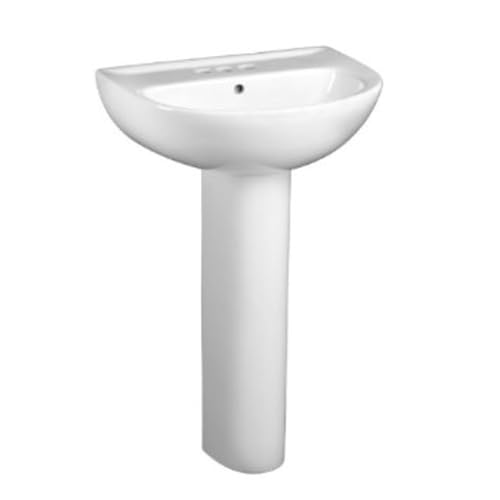
American Standard Pedestal Sink — Plumber-approved staple
Ask a room of plumbers to name a sink they can install blindfolded and a staple American Standard pedestal, this white model 0467.400.020 among them, will be mentioned early and without controversy. That trade familiarity is itself a verified asset: dimensions and connections follow conventions the industry knows, faucets from the same broad family pair predictably, and spare parts remain obtainable long after trendier fixtures have become archaeology. Owner themes echo the trade view, describing a sink that simply works, which is the highest-frequency compliment in the entire category.
The verification homework is light but not optional. Confirm the variant’s drilling and dimensions on the listing, confirm that your faucet choice belongs to the same configuration family, and confirm the drain assembly the installation will need. Because the model is a staple, its specification information is comparatively easy to find and cross-check, and a buyer who spends ten minutes doing so removes nearly all the risk this purchase contains.
Choose it when your renovation values certainty over theatre: rentals, first homes, bathrooms whose budget belongs to tile and light rather than to a hero basin. Its record suggests you will think about it rarely after installation, and for a sink, being forgotten is a form of excellence.
- Model noted: American Standard 0467.400.020
- Colourway highlighted: white
- Form: pedestal basin and column
- Verify: drilling and dimensions of variant
- Verify: drain assembly requirements
Strengths
- Trade familiarity speeds installation
- Specifications are easy to cross-check
- Parts availability over the long term
Trade-offs
- Design presence is intentionally modest
- Variant checking still required
- Ledge space is functional, not ample
Best for: pragmatic buyers who rank a boring, correct installation above all decoration.
Not suited for: statement remodels searching for a sculptural centrepiece.

Swiss Madison Concorde Ceramic Vessel Sink — Clean-lined vessel choice
Vessel sinks live or die by geometry, and the Concorde’s rectangular ceramic form makes its geometry easy to reason about before it ever meets your counter. A rectangle gives predictable splash behaviour, flat sides that wipe without contortions, and a footprint you can template on the vanity top with painter’s tape to test the fit honestly. Swiss Madison’s listing presents the sink plainly as a rectangle ceramic vessel, and that plainness is a virtue in a category where some vessels are photographed like sculpture and specified like rumours.
Verification for a vessel adds two chapters to the pedestal list. First, the counter and faucet plan: a vessel sits above the counter, so the faucet must be tall enough, or wall-mounted, with a spout reach that lands water in the bowl rather than on its rim, and the combined height of counter plus vessel must suit the users’ backs and elbows. Second, the drain: confirm the listing’s drain opening against the pop-up or grid drain you intend, remembering that vessels without an overflow channel pair with grid drains or vessel-specific pop-ups, a detail whose neglect floods vanities with educational speed.
Owner themes for rectangular ceramic vessels are consistent: they look sharp, they clean easily, and they reward the faucet planning described above while punishing its absence. Buy the Concorde with its faucet and drain chosen as a system, and its record suggests a calm and handsome service life.
- Material: ceramic
- Form: rectangular vessel, above counter
- Colourway highlighted: white
- Verify: faucet height and spout reach
- Verify: drain type and overflow arrangement
Strengths
- Predictable, wipe-friendly geometry
- Easy to template before ordering
- Contemporary look with simple upkeep
Trade-offs
- Requires a tall or wall-mounted faucet
- Combined height can challenge shorter users
- Drain pairing must be planned carefully
Best for: vanity owners wanting a modern vessel whose facts are easy to confirm.
Not suited for: counters already paired with a short, standard faucet.

DeerValley Vessel Sink 16×12 — Compact vessel with clear specs
The DeerValley earns its place by stating its business in its name and listing: a white rectangular vessel at 16 by 12 inches, premium ceramic, a standard drain opening, rounded corners, and an easy-clean, modern brief. That clarity is exactly what a verification-minded buyer should reward, because a compact vessel lives in tight rooms where a half-inch of misunderstanding becomes a daily collision. Sixteen inches suits narrow vanities, cloakroom counters, and ensuite shelves where a full-size vessel would crowd the faucet and the mirror’s patience alike.
Rounded corners deserve their mention in the listing, since they change two practical things: cleaning, because grime finds no sharp internal corners to colonise, and safety, because a compact bathroom brings hips and elbows into frequent negotiation with the sink’s edges. The standard drain opening simplifies the drain purchase, though the overflow question should still be confirmed and the drain type chosen accordingly, as with every vessel in this guide.
Compactness imposes the usual physics: hand washing is comfortable, face washing asks for care, and splash discipline matters more than it does in a broad basin. Owners of small vessels who thrive are those who paired them with a sensibly high, well-aimed faucet and moderate water pressure. Verify those companions and this little sink’s clear specifications translate into a tidy, predictable installation.
- Dimensions from listing: 16 by 12 inches
- Material: premium ceramic
- Drain: standard opening, confirm type
- Detail: rounded corners
- Form: above-counter vessel
Strengths
- Specifications stated with unusual clarity
- Fits narrow counters and cloakrooms
- Rounded corners clean and forgive easily
Trade-offs
- Small bowl demands splash care
- Not suited to hair washing or buckets
- Faucet aim matters more at this scale
Best for: compact vanities whose owners appreciate plainly stated dimensions.
Not suited for: family basins expected to absorb vigorous daily washing.
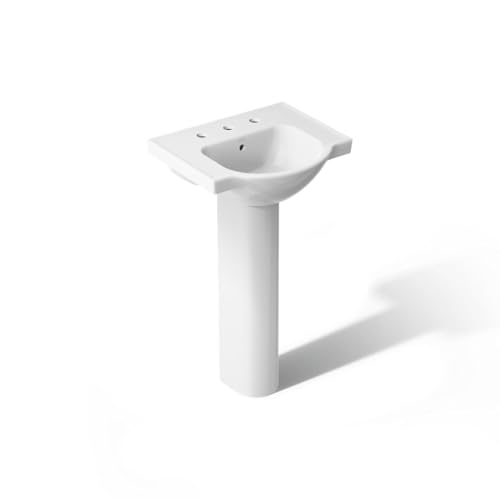
Kohler Veer Pedestal Sink — Compact pedestal, clear drilling
The Veer is this guide’s exhibit for the value of one clearly stated fact. Its listing declares a 21-inch pedestal basin with 8-inch widespread faucet holes, and that single sentence eliminates the commonest sink-buying error in the entire category, the mismatched faucet. A buyer can shop for the faucet with total confidence, price the three-piece installation honestly, and arrive at installation day with no surprises wearing ceramic. More listings should be forced to be this clear, and buyers should reward the ones that are.
Beyond its paperwork, the Veer offers a modern, compact basin from a maker with deep parts support, sized for ensuites and small family bathrooms that want contemporary lines without a vanity’s bulk. Owner themes for compact Kohler pedestals centre on exactly that combination: a room that feels larger, a basin that handles daily washing comfortably, and a faucet arrangement that looks intentional rather than improvised.
Verification still applies, of course: confirm the widespread faucet’s valve dimensions against the drilling, check the wall fixing and trap alignment as with any pedestal, and measure the pass in front of a 21-inch basin with a person standing in it. Do those and the Veer’s clarity at purchase becomes clarity in service, which is the entire thesis of this guide expressed in one product.
- Model noted: Kohler 5265-8-0
- Basin size noted: 21 inches
- Faucet drilling: 8-inch widespread
- Colourway highlighted: white
- Form: pedestal basin and column
Strengths
- Drilling stated plainly in the listing
- Modern compact footprint
- Maker support over the long term
Trade-offs
- Widespread faucet costs more to install
- Compact ledge limits countertop hopes
- Too small for utility-sink ambitions
Best for: verification-minded buyers remodelling a small, modern bathroom.
Not suited for: anyone planning to reuse a centreset faucet they already own.
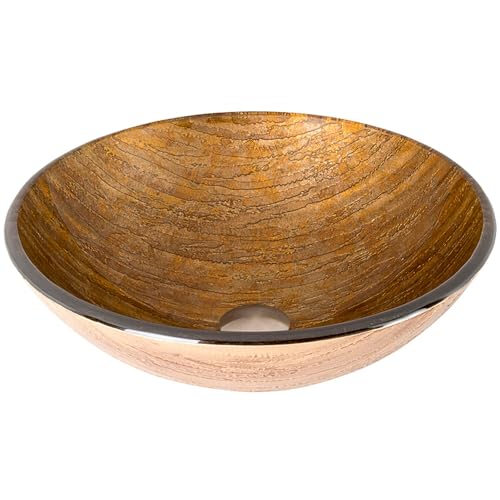
VIGO Amber Sunset Glass Vessel Sink — Statement glass vessel
Every category needs its peacock, and the Amber Sunset, a 17-inch round vessel in tempered glass with an amber, sunset-toned artistic finish, is unapologetically this guide’s. VIGO’s listing adds functional notes to the beauty, referencing its non-stick shield, quick-drain design, and temperature-guard tempering, which is the right way to sell glass: as an engineered material with a maintenance story, not merely as a colour with a hole in it. Owners choose it to be looked at, and in powder rooms and principal ensuites it rewards that choice daily.
Glass demands the strictest verification in this lineup, because its pleasures are specific and its annoyances are too. Confirm the drain pairing and the faucet’s height and reach with extra care, since a round glass bowl shows every badly aimed stream and every water spot with theatrical clarity. Confirm the counter’s strength and the vessel’s seating arrangement, and understand the cleaning rhythm glass asks: a quick wipe after use keeps its glow, while hard water left to dry will frost the artwork with scale that must then be coaxed away gently.
Tempered glass itself is tougher than its reputation, built for thermal and impact resilience within reason, though heavy metal objects dropped from height remain unwelcome in any basin. Buy the Amber Sunset as a deliberate jewel with a care routine attached, verify its companions rigorously, and it will be the room’s conversation for a decade; buy it casually and it will still be a conversation, of a different kind.
- Size noted: 17 inches, round
- Material: tempered glass
- Finish highlighted: amber sunset tones
- Verify: drain pairing and faucet reach
- Verify: counter support and seating
Strengths
- Unmatched visual presence in this guide
- Engineered glass with surface treatments
- Round form suits compact vanities
Trade-offs
- Water spots display themselves proudly
- Needs gentle, frequent wiping
- Faucet pairing errors are very visible
Best for: powder rooms and ensuites where the sink is meant to be the artwork.
Not suited for: hard-water homes that dislike wiping, or chaotic family bathrooms.
How Do the Six Sinks Compare on Verifiable Facts?
| Pick | Form | Material | Key fact to verify |
|---|---|---|---|
| KOHLER Cimarron Pedestal Sink | Pedestal | Glazed ceramic | Drilling variant |
| American Standard Pedestal Sink | Pedestal | Glazed ceramic | Variant dimensions |
| Swiss Madison Concorde Ceramic Vessel Sink | Vessel | Ceramic | Faucet height, drain type |
| DeerValley Vessel Sink 16×12 | Vessel | Ceramic | Drain type, splash pairing |
| Kohler Veer Pedestal Sink | Pedestal | Glazed ceramic | Widespread valve fit |
| VIGO Amber Sunset Glass Vessel Sink | Vessel | Tempered glass | Drain pairing, water care |
The rightmost column is the guide in miniature: every sink has one fact whose neglect causes most of its unhappy owners, and that fact is always checkable before money moves. Verification is not a personality trait; it is a ten-minute habit with a decade of consequences.
How Should You Read Owner Feedback Without Being Misled?
Read for themes, never for verdicts, and sort every comment into one of three baskets as you go. The first basket holds fit stories: too big, too small, faucet too short, drain mismatched. These are the most common unhappy comments about sinks and the least damning, because they describe a measurement that was skipped, and a buyer who performs the checks in this guide has already disarmed them. Let fit stories teach you what to measure, not what to fear.
The second basket holds installation stories: parts missing, instructions confusing, a plumber who struggled. Weight these moderately, because they predict your installation day rather than your decade, and because a professional installer dissolves most of them. A recurring theme of cracked-on-arrival ceramics deserves more attention, since it speaks to packaging and handling, and a buyer can respond rationally by inspecting the delivery immediately and knowing the return route before the box is opened.
The third basket is the one to weight heavily: behaviour over time. Recurring mentions of a finish that stains, a glaze that dulls, a vessel that splashes despite sensible faucets, or a basin that remains pleasant after years of family use describe the product itself rather than its purchaser. When several owners, writing at different times about different bathrooms, independently report the same long-term behaviour, you are looking at the closest thing to evidence that retail feedback can offer, and this guide’s picks were chosen partly because their long-term themes are calm.
Ignore, with a clear conscience, the extremes at both ends: the single furious account with a photograph of an unrelated disaster, and the breathless praise that mentions no fact at all. Neither contains information you can spend. The middle of owner feedback, specific, dated, and a little boring, is where the truth about a sink quietly lives.
Which Specifications Should You Verify, in What Order?
Begin with the room, not the sink. Measure the available width, the projection you can tolerate, the counter depth for a vessel or the wall and floor for a pedestal, and the height at which the basin’s rim should sit for your household’s backs. Write those numbers down, because a specification remembered is a specification already drifting. Then open the listing and compare, dimension against dimension, refusing to be hurried by photography.
Second, verify the water’s path. For a pedestal, that means the faucet drilling and the trap’s alignment with your wall outlet. For a vessel, it means the drain opening’s size and type, the overflow arrangement, and the faucet’s height and reach relative to the bowl’s rim and centre. More sink purchases fail on water’s path than on any other subject, and every element of it is printed somewhere in the listing or the maker’s specification for a buyer willing to look.
Third, verify the material’s promises in plain terms. Glazed ceramic should be described as such, with care expectations you recognise. Tempered glass should say tempered, and its maker should discuss its surface treatments without mysticism. Stone and composite materials, not featured among these six, deserve even closer reading. A listing that will not name its material plainly is telling you something important by omission.
Last, verify the unglamorous logistics: what is included, what must be bought separately, faucets, drains, mounting rings, sealants, and what the installation assumes about your walls, floor, and counter. The total cost and the total errand are the real specification, and a sink that arrives needing three unlisted companions is a different product from the one in the photograph.
Why Do Dimensions and Drain Details Outrank Popularity?
Because a sink is not software; it cannot be patched after installation. A basin two inches too wide will be two inches too wide every morning for a decade, announcing itself to hips and door swings with perfect reliability, while a basin that fits will be forgotten, which is the destiny well-chosen fixtures aspire to. Popularity measures how many people bought a sink; dimensions measure whether it will work in the only bathroom whose opinion matters, yours.
Drain details carry the same permanence with added plumbing. A vessel paired with the wrong drain type can leak, drain slowly, or refuse its pop-up entirely, and the fix after installation ranges from annoying to counter-removing. The standard drain opening stated on the DeerValley, the drilling stated on the Veer, the variant to confirm on the Cimarron: these dry facts are the load-bearing walls of a successful purchase, and this guide returns to them with what may seem like insistence because experience insists first.
None of this makes owner enthusiasm worthless. It makes it secondary, a confirmation to seek after the facts have qualified a candidate, the way a reference is checked after an interview rather than instead of one. Facts first, themes second, applause last: a buyer who keeps that order will rarely need a return label for a fixture of this size.
What Mistakes Do Sink Shoppers Make When Chasing Highly Praised Models?
The first mistake is importing somebody else’s bathroom. A vessel that behaves beautifully on a deep counter with a wall-mounted faucet becomes a splash machine on a shallow vanity with a short deck faucet, and its praise travels without its context. Always ask what installation a happy owner’s sink enjoyed, and whether yours resembles it, before letting their satisfaction raise your expectations.
The second mistake is reading only the recent and the extreme, which overweights delivery drama and underweights decade-long behaviour. The third is treating a brand’s halo as a specification: great makers produce ranges, and the variant in front of you still needs its drilling, dimensions, and drain confirmed as if it were a stranger. The fourth is skipping the counter and wall questions for vessels and pedestals respectively, because the sink is only half of either installation, and the half you already own gets a vote.
The fifth, and the one this guide most hopes to retire, is believing that a sufficiently praised product forgives skipped homework. It does not, it cannot, and the unhappy minority for almost every good sink consists disproportionately of buyers who relied on its reputation to do their measuring for them. Reputation is a reason to shortlist; only verification is a reason to buy.
How Do Vessel and Pedestal Sinks Differ in Daily Judgement?
Owners judge pedestals by disappearance: the best ones are praised, years later, for never being thought about, their basins comfortable, their glaze untroubled, their columns ignored. That is why the pedestal picks here lean on makers with long service histories, because disappearance is a property that only time can verify, and a new pedestal design, however handsome, simply has not yet had the chance to be forgotten by thousands of households.
Vessels are judged by performance in the visible present: splash behaviour at every wash, water spots after every morning, the faucet’s aim judged by the counter’s dryness. Their owners’ themes therefore concentrate on pairing and care, and a vessel’s success is a system’s success, sink plus faucet plus drain plus the household’s wiping habits. When you read vessel feedback, always ask which faucet kept it company, because the same bowl is two different products under two different spouts.
Neither judgement is superior; they suit different rooms and temperaments. A buyer who wants to install and forget should let the pedestal evidence lead. A buyer who enjoys a fixture with presence, and will happily give it a daily wipe and a well-chosen faucet, can trust the vessel themes here with equal confidence, provided the verification chapters were honoured first.
How Should You Handle Delivery, Inspection, and the First Week?
Verification continues after the buy button, because a ceramic sink’s most dangerous journey is the one in the delivery van. Inspect the basin on arrival, before the installer is booked and ideally while the courier’s visit is still recent: run a hand over rims and corners for chips, sight along the glaze for cracks, and confirm that the piece in the box is the variant whose drilling you ordered. A mismatch discovered at the door costs a return; the same mismatch discovered beside a dismantled bathroom costs a renovation’s whole schedule.
Dry-fit before anything is fixed. Set the pedestal in place, or rest the vessel on its counter, and live with the geometry for a day if the project allows: wash hands in a bowl of water at that height, check elbows against walls, confirm the mirror’s relationship to the rim, and let every household member take a turn. Sinks are unusually honest in dry-fit; almost everything that will annoy you for a decade can be felt in that rehearsal, while almost nothing about it is binding yet.
In the first week of service, watch the water. Check joints with a dry hand after the first dozen uses, notice whether the faucet’s stream still lands where it should at your household’s real pressure, and adjust aerators or pressure before declaring a splash problem to be the sink’s character. Many new installations need one small tuning visit, and treating that as normal rather than as failure is the mark of an experienced renovator.
Keep the specification sheet, the order confirmation, and a photograph of the installed plumbing in one folder. Fixtures outlive memories, and the folder turns every future question, a drain replacement, a faucet cartridge, a reseal, from archaeology into administration.
What Does a Fair Price Mean for a Sink, Once Everything Is Counted?
Compare totals, never basin prices alone. A pedestal’s true cost includes its faucet family, and a widespread configuration quietly adds a second handle set and a plumber’s extra half hour to the ceramic’s tag. A vessel’s true cost includes the tall or wall-mounted faucet it demands, the correct drain, possibly a mounting ring, and occasionally a counter modification, items that can together rival the bowl’s own price. A shopper comparing a pedestal and a vessel by their headline figures is comparing two partial invoices and will be surprised by both.
Longevity belongs in the arithmetic too. A well-made ceramic basin from a supported range can serve through several faucets and two redecorations, so its cost per year of service is often lower than a cheaper fixture that tires early or orphans its owner when a part is needed. This is not an argument for the dearest sink; it is an argument for pricing the decade rather than the delivery, and for treating parts availability as a financial feature, which, across ten years of small repairs, it plainly is.
Finally, hold a small contingency for the room itself. Walls that need strengthening for a pedestal, counters that need a new hole for a vessel, valves that deserve renewal while everything is open: these are the renovation’s honest extras, and a budget that anticipates them keeps the project calm. The cheapest sink is the one installed once, correctly, with its companions chosen as a system, and that sentence is as close to a law as this category offers.
How Can You Tell Whether a Maker Will Support a Sink for Years?
Support leaves fingerprints a buyer can check. A maker with a real specification library, model numbers that persist across years, faucets and drains designed around its own drillings, and replacement parts listed by name is a maker planning to be present for your sink’s middle age. Kohler and American Standard built their positions in this guide on exactly that evidence, while smaller brands earn trust case by case, through clear listings, responsive answers about dimensions and drains, and documentation that treats the buyer as an adult.
Test responsiveness before you need it. A seller who answers a precise question about drain size or drilling promptly and accurately has shown you their warranty behaviour in miniature, while a seller who replies to specifications with adjectives has also shown you theirs. In a category where the product may outlive the listing, that miniature matters more than any single feature on the basin itself.
Keep your own side of the covenant: register nothing you do not need to, but file the paperwork, photograph the model label, and note the faucet and drain models chosen to accompany the sink. Supported products reward organised owners, and the pair of you, maker and household, can keep a basin in graceful service long after trendier fixtures have been replaced twice.
What Should Families, Landlords, and Hosts Each Optimise For?
Families should optimise for forgiveness: basins deep enough for enthusiastic washing, materials that shrug off toothpaste and bath toys, and makers whose parts survive a decade of small emergencies. In this guide that points toward the proven pedestals, whose owner themes were written by households rather than by showrooms, and whose ledges and bowls tolerate the choreography of children on step stools. A family verifying a sink should add one homely check to the list: stand the smallest user at the intended rim height and confirm the faucet’s reach works for their arms, not only for yours.
Landlords should optimise for legibility: fixtures any plumber can service, specifications any tenant can be told, and designs whose misuse is visible early rather than hidden until it becomes damage. The American Standard’s staple status is the purest expression of that logic, and its calm owner record across countless rental bathrooms is a form of evidence no showroom can manufacture. Between tenancies, a glazed pedestal can be inspected, cleaned, and returned to service in minutes, which is a verification of a different, commercial kind.
Hosts and guest-room romantics may optimise for impression, provided the facts are honoured first, and the Amber Sunset exists for them. A statement vessel in a powder room will be the fixture guests remember, and its care demands are modest in a room used briefly and admired often. The rule that survives all three households is identical: let the verified facts choose the shortlist, then let your household’s character choose within it, never the reverse.
How Do You Compare Two Sinks When Both Check Out?
Ties happen, and they should be broken by living, not by scrolling. Template both footprints, in tape on the counter or cardboard on the floor, and spend a day walking past each, imagining the morning routine at full speed. One outline will begin to feel like an obstacle and the other like furniture, and that feeling, repeated across a day, is data of a kind no listing can provide. Follow it, because ergonomics experienced beats ergonomics imagined at every scale of renovation.
Next, price the complete systems side by side, faucets, drains, installation quirks, and any wall or counter work, and let the honest totals argue. Then ask the decade question: which maker will still sell you a cartridge, a drain, or a matching part when this sink is middle-aged, and which basin’s style will still please you when the current finish fashion has moved on twice? Ceramic in white is the tortoise of this race, and its slowness is a strategy, not a lack of ambition.
If the tie persists after all that, choose the sink whose listing told you the most. Reward clarity with your purchase, because markets learn from what buyers reward, and a category in which clear specifications win sales is a category that becomes easier for the next buyer to shop honestly. Your order, placed that way, is a small vote for the kind of evidence this whole guide is about.
Why Does This Guide Refuse to Crown a Winner by Applause?
Because applause aggregates other people’s bathrooms. A sink adored by owners with deep counters, soft water, and wall-mounted faucets may be merely ordinary, or even troublesome, in a shallow, hard-water room with a deck faucet, and no average of their delight can tell you which outcome awaits yours. The refusal to crown is therefore not modesty; it is accuracy. What can be offered honestly is a shortlist whose facts check out, a method for testing those facts against your own room, and the recurring themes of people who have lived with each basin, labelled as themes rather than dressed as measurements.
That restraint also protects you from a subtler manipulation, the manufactured certainty of invented scores. A number with a decimal point feels like knowledge even when nobody can say what was measured, by whom, or under what conditions, and fixtures bought on such numbers inherit their emptiness. This guide would rather hand you a tape measure than a decimal, because the tape measure’s answers replicate perfectly in your bathroom, which is where the sink, in the end, will be judged.
Trust, then, is placed where it belongs: in checkable specifications, in makers who publish them, in owner themes that repeat across years, and in your own measurements taken in your own light. A marketplace that worked that way would need fewer guides like this one, and this guide would be delighted to become unnecessary.
What Is the Ten-Minute Verification Checklist, Stated Once?
Minute one and two belong to the room: width, projection, rim height, door swing, and, for vessels, counter depth and strength. Minutes three and four belong to the listing’s dimensions, compared number by number against the room’s, with no rounding in your favour. Minutes five and six belong to water: drilling or faucet plan, drain opening and type, overflow arrangement, trap or counter path. Minutes seven and eight belong to the companions: faucet model chosen, drain model chosen, included parts listed, missing parts priced. Minute nine belongs to the maker: specification documents found, parts named, questions answered. Minute ten belongs to the owners: a skim of long-term themes, fit stories set aside as lessons, behaviour stories weighed.
Ten minutes, once, against a decade of mornings. No item on that list requires expertise, a laboratory, or anybody’s permission, and every item replaces a hope with a fact. Buyers who perform it become, measurably in their own households at least, the satisfied owners whose calm comments future shoppers will one day read, which is a satisfying circle for a guide about evidence to close.
How Should You Think About Resale, Renovation Timing, and the Next Owner?
A sink outlives fashions and sometimes owners, so a thoughtful buyer considers the household that follows. Neutral ceramic pedestals and clean-lined vessels in white are the fixtures least likely to date a bathroom for the next purchaser, because they cooperate with almost any scheme built around them. Statement glass is a more personal wager: glorious for the owner who chose it, narrower in its appeal to strangers, and worth making only when the present household’s pleasure clearly outranks a hypothetical future negotiation.
Timing matters in the other direction as well. If a full renovation is planned within a few years, a sound staple sink installed now, verified and correctly plumbed, can serve as the bridge and may even survive into the new design if its dimensions were chosen with the future room in mind. Buying the bridge and the destination in one fixture is the quiet economy experienced renovators practice, and it begins, as everything in this guide begins, with measurements taken before money moves.
Document the installation for whoever comes next: model numbers, faucet and drain companions, a photograph of concealed plumbing. Such folders are small kindnesses that compound across a house’s life, and they embody the same respect for verifiable fact that this guide has asked of sellers throughout. Be the owner you would want to buy a bathroom from.
What Changes When the Bathroom Is Shared by Several Generations?
A household spanning grandparents and grandchildren asks its sink to be several fixtures at once, and verification gains a human chapter. Rim height that suits a tall adult may defeat a small child even with a stool, while a vessel’s added counter height, charming in a catalogue, can put the bowl’s edge at a grandparent’s awkward angle. Measure the users as faithfully as the room: heights, reaches, and the strength available for turning the intended faucet’s handles all belong in the specification you assemble before shopping.
Lever handles, moderate basin depth, and a faucet whose controls read clearly serve mixed households better than sculptural minimalism, and glazed ceramic forgives the contact lenses, medicines, and small ceremonies that several generations bring to one basin. None of this requires medical claims or specialised products; it requires only the same habit this guide has preached throughout, checking the real facts, now including the real people, before the order is placed.
Where generations disagree on style, let the durable, neutral basin carry the room and let each generation’s presence appear in towels, stools, and accessories that change cheaply. Fixtures are the household’s constitution, amended rarely; textiles are its legislation, and a wise home keeps the constitution calm.
How Do You Keep a Verified Choice Performing for a Decade?
Verification ends at installation; stewardship begins there, and the two are cousins. Keep the glaze or glass clean with gentle, regular attention rather than heroic rescues, wipe hard water before it becomes scale, and inspect the visible joints twice a year with the dry-hand test that catches a weep while it is still a washer’s worth of trouble. Faucet cartridges, drain seals, and trap washers are consumables in every sink’s life, and replacing them calmly, from the folder of model numbers you kept, is what ownership of a good fixture actually looks like.
Resist modifying a working system casually. A taller faucet fitted on impulse can turn a well-behaved vessel into a splash exhibit, and a bargain drain substituted during a repair can undo a pairing that was verified with care. When a companion part must change, re-run the relevant checks from the ten-minute list, because the system’s harmony, not any single component, was the thing you bought. Owners who understand that sentence rarely appear in the unhappy minority of any sink’s story, and their quiet satisfaction, repeated across years, is the truest rating any of these six basins will ever receive.
One last habit separates satisfied owners from the rest more reliably than any brand choice: they photograph the specification page and their own measurements together, before ordering, and keep that single image. Every later question, from a plumber, a seller, or their own memory in year four, answers itself from that photograph, and the purchase remains verified long after the listing has changed or vanished, as listings cheerfully do.
A Short Word on Photographs in Listings
Treat every listing photograph as a witness with an interest in the outcome. Wide angles flatter small basins, lifestyle staging borrows counters and faucets your purchase does not include, and a vessel photographed alone reveals nothing about the height at which it will meet your elbows. Use photographs for silhouette and finish, use dimensions for truth, and when the two disagree, believe the numbers and ask the seller about the picture. That single discipline, applied across this whole category, would retire more disappointment than any other habit a sink shopper can adopt.
Now close the listings, open your own bathroom door, and let the room have the final word it has been waiting to give.
Final Recommendation
Shortlist by facts and buy by verification. The Cimarron and the American Standard serve buyers who want a pedestal with an inspectable past; the Veer serves the same instinct in a compact, modern room with its drilling stated in daylight. The Concorde and the DeerValley bring vessel style within a framework of checkable geometry, while the Amber Sunset asks, fairly, for the most care and rewards it with the most presence. Whichever you choose, measure your room, confirm the drain and the faucet pairing on the listing, and let owner themes confirm rather than decide. A sink chosen that way will earn, over years of unremarkable mornings, the only rating that has ever mattered: yours, given daily, without being asked.
Frequently Asked Questions
How can I judge a sink if this guide prints no scores?
By checking the facts that predict your experience: dimensions against your room, drain and faucet compatibility against your plumbing, material against your care habits, and recurring owner themes about long-term behaviour. Those checks outperform borrowed scores because they are about your bathroom specifically.
What should I verify first on a vessel sink listing?
The drain opening and whether the vessel has an overflow, because those decide the drain type, then the faucet height and reach the bowl requires. Dimensions come next, templated on your actual counter before ordering.
Why do some owners complain a praised sink splashes?
Usually the faucet pairing, not the bowl alone: a spout too high, too short in reach, or too forceful for the basin will splash in any material. Judge splash comments alongside the faucet the owner used.
Is tempered glass a safe material for a bathroom sink?
Tempered glass is engineered for strength and heat resistance and is widely used for vessels, though it still deserves sensible treatment: no heavy impacts, gentle cleaners, and prompt wiping in hard-water homes to protect its finish.
How do I check a pedestal’s faucet compatibility?
Find the drilling stated in the listing, centreset at 4 inches or widespread at 8 inches, and match the faucet family to it exactly. If the listing is ambiguous for a variant, confirm with the seller or maker before ordering either piece.
Should I trust feedback that mentions installation problems?
Weight it as a prediction about installation day rather than about the sink’s decade. Recurring themes about missing parts or unclear instructions are worth noting, especially for self-installers, while a professional installer neutralises most of them.
Related Guides
Round out the renovation with Best Stone Bathroom Sinks for the natural-material branch of the family, revisit Best Lab-Tested Air Purifiers for Allergies for another guide that treats evidence carefully, set the morning schedule with Best Alarm Clocks for Kids in family homes sharing one basin, and read Best Air Purifiers by Verified Lab Ratings for the companion discussion of what verification should and should not claim.



[…] the remodel with Best Bathroom Sinks by Verified Ratings for a shopper’s method of judging basins, size the storage in Best 48-Inch Bathroom Vanities […]