What's inside
- Key Takeaways
- Quick Picks
- How Did We Choose These 60-Inch Vanities?
- How Do the Six Compare Side by Side?
- Why Does One Sink Beat Two at Sixty Inches?
- How Should You Think About Value Without Chasing Prices?
- What Should You Measure Before a 60-Inch Vanity Arrives?
- What Mistakes Do 60-Inch Vanity Buyers Make?
- What Does the Counter Dividend Look Like Day to Day?
- How Do You Choose a Faucet for a Wide Single Vanity?
- What Happens Between Delivery and First Use?
- How Does a Single-Sink Sixty Age in a Family Home?
- How Do Mirrors and Lighting Work With an Offset or Centred Basin?
- What Does This Width Mean for Resale and Renting?
- How Do You Keep a Wide Top Looking Intentional?
- Which of the Six Suits a Narrow but Long Bathroom?
- How Should Couples Divide a Single Vanity Fairly?
- What Should You Know About Tops, Backsplashes and Sealing Schedules?
- How Do You Plan Storage Inside a Wide Vanity?
- What Is the Final Test Before You Commit to One?
- How Does Colour Choice Interact With a Room’s Light?
- What Should the Budget Conversation Sound Like at Home?
- How Do You Live With the Decision While It Ships?
- Final Recommendation
- Frequently Asked Questions
- Related Guides
As an Amazon Associate I earn from qualifying purchases. This post may contain affiliate links at no extra cost to you.
cottageverdict.com is reader-supported. When you buy through links on our site, we may earn an affiliate commission.
Where to buy: the six vanities below are sold through Amazon, and each linked name leads to its listing, where you can check price on Amazon, study the configuration photographs and confirm the sink arrangement before ordering. A vanity is freight, not a parcel, so an hour spent verifying beats a month spent returning.
The best 60-inch bathroom vanities with one sink exist because of a layout insight that double-sink marketing works hard to hide: two people rarely brush their teeth in perfect synchrony, but everyone, every day, wants somewhere to put things down. A single basin centred or offset in sixty inches of counter returns the rest of that counter to life, a landing strip for towels, trays, hair tools and the morning’s small cargo. This guide compares six single-sink candidates at that generous width, and it talks about value in words rather than figures, because the keyword that brought many readers here promises a best price, and the honest version of that promise is a vanity whose construction justifies its tier for decades.
Two cautions frame everything that follows. First, where a listing title does not state the sink count, we flag it, and you should confirm the configuration on the listing itself before ordering, because vanity families often share photographs across single and double variants. Second, sixty inches is a width that rewards measuring: door swings, freight access and the walk from kerb to bathroom all belong in the decision alongside marble and drawer counts.
Key Takeaways
- One sink in sixty inches buys counter space that two sinks would spend on porcelain.
- The Sheffield pair brings real Carrara marble and traditional cabinetmaking to the size.
- ARIEL answers with quartz tops and nine dovetail drawers in both its entries.
- OVE supplies the colour drama: midnight blue or clean white with brass or nickel.
- Confirm sink configuration on listings whose titles do not state the count.
- Budget in words: spend on cabinet construction and top material before hardware sparkle.
Quick Picks
| Pick | Badge | Why it earns its place |
|---|---|---|
| Wyndham Collection Sheffield 60 Inch Single Vanity | Best Classic Marble Top | Espresso cabinetry under white Carrara marble, the traditional statement at this width. |
| Wyndham Collection Sheffield 60 Inch Single Vanity Gray | Best Gray Finish | The same Sheffield architecture in gray, softer with pale floors and chrome fittings. |
| ARIEL Hepburn 60 Inch Vanity | Best Drawer Count | Solid wood, Carrara-toned quartz and nine dovetail drawers behind two soft-close doors. |
| OVE Decors Tahoe 60 Inch Vanity | Best Midnight Blue Drama | Midnight blue with satin brass, tilt-down trays and a double-deep drawer in its layout. |
| OVE Decors Athea 60 Inch Vanity | Best Clean White Profile | White cabinetry with brushed nickel, a calm profile for bright, simple schemes. |
| ARIEL Cambridge 60 Inch Vanity | Best Quartz Alternative | Pure white quartz over solid wood, the Cambridge take on the ARIEL formula. |
How Did We Choose These 60-Inch Vanities?
Width alone did not qualify a vanity; it had to use the width. We looked for storage architectures that treat sixty inches as an opportunity, banks of drawers, double-door cabinets with adjustable shelves, tilt-down trays that rescue the dead space in front of the basin, rather than a single cavern wearing a marble hat. Counter material mattered next: marble and quartz tops both appear here, and the guide explains their different care personalities rather than pretending one is simply better.
Construction signals came third: solid wood framing, dovetail drawer joinery, soft-closing hardware, and backsplashes included rather than sold as regrets. Finally, each vanity had to present a coherent single-sink proposition, or, where its listing title stays silent on sink count, we say so plainly and direct you to confirm the configuration on the listing. A guide that hides ambiguity helps nobody standing in a bathroom with a tape measure.

Wyndham Collection Sheffield 60 Inch Single Vanity — Best Classic Marble Top
The espresso Sheffield is the vanity for people who believe a bathroom should have furniture in it, not merely fittings. Wyndham’s cabinetmaking is traditional in the best sense: framed construction, an undermount square basin set into white Carrara marble, and a deep espresso finish that makes chrome or nickel hardware read like jewellery. At sixty inches with one basin, the marble runs in long, calm stretches on either side, and that expanse is the luxury this whole category exists to deliver.
Carrara marble asks for the owner’s side of the bargain: seal it, wipe acidic spills promptly, and accept that its veining and gentle patina are a living surface rather than a printed one. In exchange it offers the cool, honest top that quartz imitates. The listing states no mirror is included, which we count as freedom rather than lack, since a vanity this characterful deserves a mirror chosen for it, not bundled at it.
Storage follows the classic pattern of doors and drawers suited to towels and bulk, and the whole piece suits a primary bathroom being renovated for the long term. If your scheme leans warm, dark and traditional, this is the anchor around which to build it.
- Width: 60 inches, single basin layout
- Top: white Carrara marble
- Basin: undermount square sink
- Finish: espresso cabinetry
- Mirror: not included, choose your own
Strengths
- Genuine marble with generous counter runs
- Traditional cabinetmaking presence
- Dark finish grounds pale rooms
Trade-offs
- Marble needs sealing and prompt wiping
- Espresso shows dust between cleans
- No mirror bundled with the vanity
Best for: traditional primary bathrooms wanting marble and dark wood
Not suited for: renovators building a room around one furniture-grade piece

Wyndham Collection Sheffield 60 Inch Single Vanity Gray — Best Gray Finish
Take the Sheffield architecture, espresso exchanged for gray, and the room’s temperature changes. Gray is the diplomat of finishes: it cools a south-facing bathroom pleasantly, warms a north-facing one less than white would chill it, and mediates between chrome fittings, pale stone floors and the white Carrara top it also carries. Households that find espresso too formal and white too clinical usually land here, and they rarely regret the landing.
Everything said about the marble applies unchanged, sealing, prompt wiping, the living-surface bargain, because the top is the same Carrara with the same undermount square basin. The cabinetry beneath offers the Sheffield pattern of doors and drawers, and the gray finish hides the daily dust and water spots a fraction more kindly than its darker sibling while showing them more honestly than white. It is, in the best sense, the middle path with nothing middling about it.
Choose between the two Sheffields by light, not by taste alone. Stand in your bathroom at the hour you use it most and ask whether the room wants grounding or lifting. Espresso grounds; gray lifts while keeping one foot on the floor. Both are correct answers to different rooms.
- Width: 60 inches, single basin layout
- Top: white Carrara marble
- Basin: undermount square sink
- Finish: gray cabinetry
- Mirror: not included
Strengths
- Gray mediates between fittings and floors
- Same marble luxury as espresso version
- Kinder to dust than darker finishes
Trade-offs
- Marble care duties unchanged
- Gray can cool an already cold room
- Mirror chosen separately
Best for: bathrooms wanting Sheffield quality in a lighter register
Not suited for: schemes mixing chrome, pale stone and painted wood

ARIEL Hepburn 60 Inch Vanity — Best Drawer Count
The Hepburn competes on engineering rather than patina. Its cabinet is solid wood, its top is a thick slab of Carrara-toned white quartz with a backsplash, and behind two soft-closing doors it organises storage around nine dovetail drawers, a count that changes how a bathroom behaves. Nine drawers means every category, from hair tools to first aid to the household’s tangle of chargers, can hold its own territory, surveyed at a glance when the drawer opens.
Quartz is the pragmatic top: engineered for consistency, indifferent to the sealing calendar, and forgiving of the toothpaste-and-toner spills that marble records. The single rectangular porcelain basin sits in a layout that leaves the long counter stretches this category promises, and the white cabinetry keeps the whole composition bright. Buyers who love the Sheffield look but know their household will not seal marble on schedule should read this entry twice.
The Hepburn’s proposition is that luxury can be systematic. Dovetail joinery, soft-close everything, a top that shrugs off family life: these are unglamorous virtues that compound daily. It lacks marble’s romance and says so by existing, proudly, as the engineered alternative.
- Width: 60 inches, single basin layout
- Top: Carrara white quartz with backsplash
- Basin: single rectangular porcelain sink
- Storage: nine dovetail drawers, two doors
- Cabinet: solid wood construction
Strengths
- Nine drawers organise everything
- Quartz top skips the sealing calendar
- Soft-close doors and drawers throughout
Trade-offs
- Quartz imitates rather than is marble
- White finish needs regular wiping
- Drawer-rich layout costs counter cabinet volume
Best for: organised households wanting maximum drawers
Not suited for: families choosing quartz practicality over marble romance

OVE Decors Tahoe 60 Inch Vanity — Best Midnight Blue Drama
The Tahoe is the colour event of this guide: midnight blue cabinetry with satin brass hardware, a combination that turns a vanity into the room’s deliberate focal point. Its storage plan is unusually thoughtful, two double-door cabinets with adjustable shelves, tilt-down trays that rescue the sliver in front of the basin, regular drawers and one double-deep drawer built for the tall and awkward items other vanities refuse.
A note of diligence: the Tahoe’s listing title does not state its sink count, so confirm the configuration on the listing before ordering, and study which variant the photographs show. That check takes minutes and protects the entire project, because this vanity family spans layouts. What is certain is the design intent: OVE built this as a statement piece with storage engineering to match its looks, rather than a blue box with a top.
Midnight blue rewards commitment. It pairs beautifully with white tops, pale floors and brass fittings echoed elsewhere in the room, and it sulks if asked to share the stage with three other strong colours. Give it a calm room and it will be photographed by every guest who uses your bathroom, which, depending on temperament, is a benefit or a warning.
- Width: 60 inches
- Finish: midnight blue, satin brass hardware
- Storage: cabinets, tilt-down trays, deep drawer
- Shelves: adjustable in door cabinets
- Check: confirm sink count on the listing
Strengths
- Storage layout is genuinely inventive
- Colour and brass create instant character
- Tilt-down trays rescue dead space
Trade-offs
- Title does not state sink count, verify
- Bold blue demands a calm scheme
- Brass fittings want matching elsewhere
Best for: design-led bathrooms wanting one confident colour
Not suited for: households needing deep, varied drawer storage
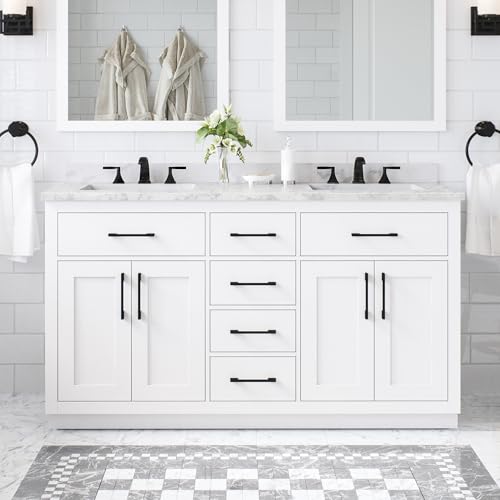
OVE Decors Athea 60 Inch Vanity — Best Clean White Profile
The Athea is the Tahoe’s calmer cousin in spirit: sixty inches of white cabinetry with brushed nickel hardware, a profile that suits bright, simple bathrooms where the vanity should support the room rather than star in it. White at this width reads architectural, especially against coloured walls or patterned floors, and the nickel finish keeps the temperature neutral beside chrome or steel fittings.
As with the Tahoe, the Athea’s listing title does not state a sink count, so confirm the configuration on the listing before you order, checking the photographs and the variant selector carefully. Treat that confirmation as part of the purchase ritual for any vanity whose title is silent on the subject; it is a five-minute habit that prevents the most expensive misunderstanding in bathroom shopping.
Within this guide the Athea is the safe pair of hands: a known maker, a versatile finish, a width that delivers the single-sink counter dividend. It will not be the most talked-about piece here, and for households renovating a bathroom to sell, to rent, or simply to calm down, that restraint is exactly the recommendation.
- Width: 60 inches
- Finish: white cabinetry
- Hardware: brushed nickel
- Profile: clean, versatile, bright
- Check: confirm sink count on the listing
Strengths
- White suits almost any scheme
- Nickel pairs with common fittings
- Calm choice for resale-minded renovators
Trade-offs
- Title does not state sink count, verify
- White shows every splash and scuff
- Less storage theatre than Tahoe
Best for: bright, simple bathrooms and resale renovations
Not suited for: buyers wanting width without visual drama

ARIEL Cambridge 60 Inch Vanity — Best Quartz Alternative
The Cambridge completes the ARIEL pair with a variation buyers should understand: where the Hepburn’s quartz wears Carrara veining, the Cambridge’s top is pure white quartz, cleaner and more contemporary, over the same solid-wood, nine-drawer, two-door architecture with a single rectangular porcelain basin. The difference sounds cosmetic until the vanities are imagined in situ: veined tops converse with traditional rooms, while pure white tops disappear into modern ones and let fittings and mirrors do the talking.
Everything practical said about the Hepburn holds here: quartz’s indifference to sealing, dovetail drawers that organise a household, soft-closing hardware that keeps dawn routines quiet. The Cambridge is for the buyer who nodded through the Hepburn entry and then pictured their bathroom, tiled in large pale formats with black or chrome accents, and realised the veining would be one pattern too many.
Choosing between the ARIEL twins is therefore a decision about pattern, not quality. Bring home samples or study the listing photographs against your tile, because the top is the surface your eye will cross ten thousand times. Both deliver the single-sink counter dividend in full; only the mood differs.
- Width: 60 inches, single basin layout
- Top: pure white quartz with backsplash
- Basin: single rectangular porcelain sink
- Storage: nine dovetail drawers, two doors
- Cabinet: solid wood construction
Strengths
- Pure white top suits modern schemes
- Nine drawers, soft-close throughout
- Quartz shrugs off family spills
Trade-offs
- Plain top shows crumbs and hairs readily
- No marble romance, by design
- White cabinetry needs steady wiping
Best for: modern bathrooms wanting an unpatterned top
Not suited for: organised households sold on the ARIEL drawer plan
How Do the Six Compare Side by Side?
| Pick | Form | Standout trait | Watch out for |
|---|---|---|---|
| Wyndham Collection Sheffield 60 Inch Single Vanity | Single, marble top | Traditional espresso and Carrara | Marble sealing required |
| Wyndham Collection Sheffield 60 Inch Single Vanity Gray | Single, marble top | Gray Sheffield diplomacy | Cool tone for cold rooms |
| ARIEL Hepburn 60 Inch Vanity | Single, quartz top | Nine drawers, quartz ease | Veined quartz, not stone |
| OVE Decors Tahoe 60 Inch Vanity | Confirm on listing | Blue drama, deep drawers | Verify sink configuration |
| OVE Decors Athea 60 Inch Vanity | Confirm on listing | White calm, nickel hardware | Verify sink configuration |
| ARIEL Cambridge 60 Inch Vanity | Single, quartz top | Pure white modern top | Plain surface shows debris |
Why Does One Sink Beat Two at Sixty Inches?
Do the arithmetic of a weekday morning. A double vanity at this width gives each basin a modest apron of counter and spends the middle on a second bowl that sits dry twenty-three hours a day. A single basin returns all of that territory as one continuous worktop, and worktops are what bathrooms actually run out of: space to set down a hair dryer mid-use, to fold a towel, to lay out a child’s plasters or a tray of cosmetics without a balancing act over porcelain.
The honest counterargument is synchrony: two people, one departure time, daily. Households genuinely living that pattern should buy the double and read our companion guide instead. But most couples, interviewed honestly, stagger by ten minutes and would trade the second basin for counter without a heartbeat of regret. The single-sink sixty is the vanity for the household as it is, not as a showroom imagines it.
There is also a plumbing dividend. One basin means one faucet set to buy well rather than two bought thinly, one drain to maintain, and storage beneath uninterrupted by a second trap. That under-counter freedom is part of why the drawer-rich designs here can offer nine drawers: the plumbing occupies one neighbourhood instead of sprawling across the whole cabinet.
How Should You Think About Value Without Chasing Prices?
Value in a vanity hides in the parts photographs flatter least: drawer joinery, hinge and runner quality, the thickness and honesty of the top, and whether the cabinet is solid wood where it matters. A vanity is opened and closed thousands of times a year in a wet room; its price tier should be judged against that duty cycle. Spend first on construction and top material, second on storage architecture, and let hardware finishes, which can be changed later, take what budget remains.
Marble and quartz price their care differently rather than simply differently. Marble charges in attention: sealing, prompt wiping, acceptance of patina. Quartz charges nothing in attention and asks its premium at purchase. Households should choose which currency they are richer in. The Sheffield and ARIEL entries in this guide are, in effect, the same argument conducted in two currencies, and neither side of it is the cheap side; they are differently serious.
What Should You Measure Before a 60-Inch Vanity Arrives?
Measure the wall, then measure the journey. Sixty inches of vanity must travel from a delivery vehicle through your doors, turns and stairs, and the journey defeats more renovations than the wall ever does. Check doorway widths, stair turns and the bathroom door swing, and confirm whether the top ships attached, because a one-piece sixty-inch unit with marble aboard is a four-handed, planned manoeuvre, not an improvisation.
At the wall, confirm the plumbing’s position against the vanity’s interior: drawer banks and traps must agree, and a drawer that meets a waste pipe loses to the pipe every time. Note the floor’s level, since a long vanity exaggerates any slope at its top edge, and plan the mirror and lighting around the single basin’s centre rather than the vanity’s, a small asymmetry that looks deliberate when lighting respects it.
What Mistakes Do 60-Inch Vanity Buyers Make?
Ordering a configuration from a photograph without confirming the variant is the costliest error in this category, which is why this guide repeats the confirmation advice wherever a title stays silent. Second is buying the double out of habit and spending a decade wiping a basin nobody uses while balancing toiletries on its rim. Third is forgetting freight: assuming delivery ends at the kerb and discovering the bathroom is up two flights.
Fourth, buyers choose marble for a household that will not seal it, then blame the stone. Fifth, they centre the mirror on the vanity while the basin sits offset, creating a daily visual itch. Sixth, they ignore the backsplash question until the wall behind the taps is freckled with a year of splashes. Every one of these mistakes is preventable with the checks in this guide, applied before the order rather than after the delivery.
What Does the Counter Dividend Look Like Day to Day?
On the first morning, the extra counter feels like a hotel luxury: room to set down a coffee cup, a phone, a folded towel, all at once, without choreography. By the end of the first week it has stopped feeling like luxury and started feeling like infrastructure, which is the fate of all genuinely useful space. Hair tools acquire a parking zone at one end, a tray organises the daily bottles at the other, and the basin floats between them like a harbour in a well-run port.
The dividend compounds in households with children, where a single wide counter becomes the bathroom’s operating table: plasters applied, teeth supervised, school hair negotiated, all on a surface that a double basin would have spent on a second bowl of standing water. It compounds again for anyone who wears contact lenses, applies makeup at the sink, or shaves with more equipment than a single razor, because those rituals are counter rituals wearing a basin as an accessory.
There is a cleaning dividend too. One basin, one faucet set, one drain: the weekly wipe covers long unbroken stretches of stone or quartz instead of two porcelain interruptions, and the counter’s openness means nothing hides behind a second tap assembly. Households consistently report that the single-sink sixty is the easiest vanity they have owned to keep looking deliberate, because its surfaces are mostly surface.
How Do You Choose a Faucet for a Wide Single Vanity?
A single basin in sixty inches invites one excellent faucet rather than two adequate ones, and the budget logic of this whole category concentrates there. Choose a spout reach that lands water in the basin’s centre without asking users to lean, a handle that can be operated with soapy or occupied hands, and a finish that converses with the vanity’s hardware: brass with the Tahoe, nickel or chrome with the Sheffields and Athea, and a deliberate contrast, matte black, say, only where the ARIEL whites can carry it.
Consider a wall-mounted faucet if the renovation allows the plumbing, because it returns the last strip of counter behind the basin to use and removes the splash trap where deck-mounted taps meet the backsplash. If deck-mounted is the practical answer, leave the backsplash in place and seal its joint; that unglamorous bead of sealant is what stands between a decade of splashes and a swollen wall. The faucet decision, like the sink-count decision, rewards the household that thinks in years.
Height matters more than style at the basin itself. A spout too low makes handwashing a knuckle negotiation; too high, and the falling water drums and splashes across those beautiful long counters. Bring the basin depth and the spout height into the same conversation at ordering time, and where possible test the pairing in a showroom with your own hands, because ergonomics is the one specification no photograph can verify.
What Happens Between Delivery and First Use?
Delivery day for a sixty-inch vanity is a logistics exercise wearing a renovation’s clothes. Clear the route, pad the door frames, decide in advance where the unit will rest while the old vanity comes out, and keep the top’s packaging intact until the cabinet is levelled in its final position. Stone and quartz tops forgive almost nothing dropped on a corner, and corners meet door frames precisely when carriers are tired, so patience at this stage is structural, not temperamental.
Levelling deserves its own paragraph because a long vanity displays a sloping floor mercilessly. Shim from the floor, check along the top’s length and depth, and only then fix the unit back to the wall. A top that pools water toward one end will announce the slope every morning in miniature, long after the renovation’s other details have faded from memory. Ten extra minutes with a spirit level is the cheapest insurance in the entire project.
Connect, seal, and then wait. Silicone at the backsplash and around the basin wants its curing time before the celebration shower, and the first week of use should include a torch inspection under the cabinet for the slow weep that new joints sometimes produce. Catching a weep in week one is a paper towel; catching it in month six is a cabinet floor. The vanity will then settle into the decades of unremarkable service that justify everything spent on it.
How Does a Single-Sink Sixty Age in a Family Home?
Year one is the drawer system’s honeymoon, when every category holds its assigned territory and the counter stays as clear as the brochure. Year two tests it: a child grows into new equipment, a partner takes up a hobby involving bottles, and the drawers must be re-argued. The vanities here survive re-argument because their storage is divisible, drawers and adjustable shelves accepting new constitutions without new furniture. Fixed, sculpted interiors age worst; honest boxes and shelves age best.
The top tells the longer story. Marble will record the household faithfully, a softened sheen where hands pass, a ring where a bottle lived a winter, and owners divide into those who read that record as patina and those who read it as damage. Quartz will look almost exactly as it did at installation, which its owners read as victory. Neither reading is wrong, but the time to choose your reading is before purchase, in the showroom, with your temperament honestly consulted.
By year five the vanity has usually outlasted two colour schemes and one mirror, and the single-sink decision has been validated so many mornings in a row that nobody remembers debating it. That is the destiny this category promises: not excitement, but a wide, calm, workable surface at the centre of the room’s busiest hour, still earning its width long after the delivery day drama is forgotten.
How Do Mirrors and Lighting Work With an Offset or Centred Basin?
A centred basin keeps life simple: one wide mirror or a pair of identical mirrors, lighting balanced on both sides, symmetry doing its ancient calming work. The Sheffields and ARIEL entries, with their centred single basins, reward that classic arrangement. Centre the mirror on the basin rather than on the wall if the two disagree, because the user stands at the basin, and the reflection should be composed for the person, not for the architecture.
Where a household prefers the basin offset to free one long unbroken counter run, the mirror follows the basin and the lighting follows the mirror, leaving the counter stretch lit by a gentler, indirect source. Done deliberately, the asymmetry looks designed; done accidentally, it looks like a measuring error with good PR. Decide the basin position on paper, with the mirror and sconces drawn in, before any plumbing is moved.
Side lighting flatters faces and stone alike, while a single overhead light carves shadows into both. At sixty inches there is finally room to do lighting properly: sconces at face height flanking the mirror, a soft overhead for the room, and nothing that forces a choice between seeing the counter and seeing yourself. Width, used well, is a lighting budget as much as a storage one.
What Does This Width Mean for Resale and Renting?
Estate agents will tell you that primary bathrooms sell houses, and a sixty-inch single vanity photographs as space, which is the quality buyers are actually purchasing. The long counter reads as luxury in a listing photograph in a way two modest basins never do, because the eye measures the unbroken surface and concludes the room is generous. Renovators working for resale should weight the calm finishes here, the Athea’s white, the Sheffield’s gray, which let buyers project their own schemes onto the room.
For landlords, the calculation runs through durability and parts. One basin, one faucet, quartz that ignores tenant habits, drawers that survive being used as filing for everything: the ARIEL pattern was practically designed for rental arithmetic. Marble in a rental is a wager on strangers’ care, and the Tahoe’s bold blue is a wager on strangers’ taste. Both wagers occasionally pay; neither belongs in a cautious portfolio.
Owner-occupiers should ignore both calculations and buy for their own mornings, because a vanity serves its household thousands of times before it serves a valuation once. The resale lens matters only at the extremes: avoid configurations so personal that a future buyer must budget to undo them, and the single-sink sixty, being a mainstream luxury layout, carries no such risk.
How Do You Keep a Wide Top Looking Intentional?
A long counter invites accumulation precisely because it can absorb it, so give the surface a constitution: a tray zone at one end for daily bottles, a clear middle for tasks, and a styled end, a plant, a folded towel stack, a small bowl, that signals the counter is composed rather than merely available. When an object has no zone, it is a visitor, and visitors should be rehomed to drawers before they apply for residency.
Restraint scales with width. On a small vanity, three objects look abundant; on sixty inches, three objects look curated and nine look like a market stall. The households that keep wide tops beautiful are not tidier people; they are people who decided the zones once and let the zones do the daily arguing. The vanity gives you the territory; the constitution keeps it.
Finally, let one beautiful thing live on the counter permanently and defend its solitude. A stone tray, a good plant, a ceramic vessel: a single composed object makes the surrounding emptiness look chosen. Emptiness with one citizen is design; emptiness with none can look like a room still moving in. The single-sink sixty earns its keep by making that small piece of theatre possible in an ordinary family bathroom.
Which of the Six Suits a Narrow but Long Bathroom?
Long, narrow bathrooms are where sixty inches earns its keep most dramatically, because the vanity can run along the long wall and convert the room’s awkwardness into a single confident gesture. In such rooms, depth matters more than width: choose the profile that leaves the clearest walkway, and let the counter’s length do the luxury work. The Athea’s calm white and the Cambridge’s plain top both excel here, widening the room visually instead of crowding it with pattern.
Door swing becomes the governing measurement in a narrow plan. A vanity drawer that opens into the path of the bathroom door creates a daily negotiation, so map the swings on the floor in tape before ordering, drawers extended, door at its widest. If the swings collide, a door-fronted Sheffield may serve better than a drawer bank, or the vanity may need to shift a few inches along the wall, a decision that costs nothing on paper and everything after installation.
Lighting a long room from the vanity wall outward keeps the far end from gloom, and a wide mirror across the single basin bounces that light down the room’s length. Narrow bathrooms renovated this way routinely feel twice their measured size, because every decision, vanity, mirror, light, pulls in the same direction: length treated as an asset rather than an apology.
How Should Couples Divide a Single Vanity Fairly?
Divide by drawers, not by counter inches. Each partner takes a drawer bank or a defined set of drawers, the shared stock, towels, cleaning, first aid, lives below or between, and the counter constitution applies to both equally. This sounds bureaucratic and works beautifully, because most vanity friction is not about the basin at all; it is about one person’s spreading habits colonising shared surface. Territories end colonisation without a single argument about tidiness.
The basin itself is scheduled, not divided, and the schedule usually emerges without negotiation once the counter exists to hold everything else. Ten staggered minutes is the norm this guide keeps returning to, and on the rare colliding morning, one person uses the basin while the other uses the counter and mirror, a parallel arrangement the sixty inches makes physically possible. That, in the end, is the configuration’s deepest argument: it converts a queue into a collaboration.
What Should You Know About Tops, Backsplashes and Sealing Schedules?
A backsplash is the vanity’s quiet bodyguard, intercepting the daily splash harvest before it reaches paint or plaster, and every top in this guide either includes one or deserves one added. Its top edge and its joint with the counter both want sealant, renewed when it yellows or lifts, because water that enters behind a vanity does its damage invisibly and at leisure. Inspect that joint during the twice-yearly bathroom audit and the wall will outlive the renovation.
Marble sealing runs on roughly an annual rhythm for the Sheffield pair, adjusted by the water-bead test: when droplets stop beading and start soaking, the calendar is irrelevant and the sealer comes out. Quartz from the ARIEL entries skips this ritual entirely, which is its whole appeal, though it still wants prompt wiping of strong pigments and no hot implements set down thoughtlessly. Different tops, different religions; both reward the household that knows which one it bought.
Keep the top’s paperwork with the vanity: material, finish, the sealer used, the date it went on. A future owner, or a future you standing in a shop in five years, will bless that small folder. Vanities are decade-scale purchases, and decade-scale purchases deserve decade-scale records.
How Do You Plan Storage Inside a Wide Vanity?
Plan the interior from the stock list outward. Write down everything the vanity must hold, group it by user and frequency, and only then assign drawers and shelves. The exercise takes twenty minutes and prevents the classic outcome in which a nine-drawer vanity somehow still has nowhere for the hair dryer, because nobody measured the hair dryer against the drawers. Tall bottles, in particular, should be measured rather than imagined; they are the interior’s most frequent refugees.
Reserve one drawer as the room’s lost-and-found, the designated home for the objects that otherwise migrate across the counter: hair ties, spare buttons, the nail clippers that belong to everyone and no one. A planned junk drawer is not a failure of the system; it is the system acknowledging human nature and giving it a drawer with a closing front, which is where human nature belongs in a bathroom.
Leave the under-basin zone to plumbing and the cleaning caddy, and resist filling its awkward geometry with stock you value. Items stored around traps are items retrieved with a torch and a sigh, and they are always the items that leak. The wide vanity’s gift is that it offers enough honest storage elsewhere to let the plumbing keep its neighbourhood in peace.
What Is the Final Test Before You Commit to One?
Stand in the bathroom with the footprint taped on the floor and act out a morning at full scale: stand where the basin will be, open imaginary drawers, set down an imaginary hair dryer, reach for an imaginary towel. The pantomime feels foolish for ninety seconds and reveals more than a week of specification reading, because bodies understand rooms faster than eyes understand drawings. Adjust the tape, shift the imagined basin, and repeat until the choreography flows.
Then consult the household’s other actor, if there is one, and let them perform the same mime. Vanities fail socially more often than they fail mechanically, and a configuration that suits one person’s routine while obstructing another’s will be renegotiated at six in the morning, daily, at volume. Ninety seconds of shared theatre now purchases years of unremarkable mornings, which is the best exchange rate in this entire guide.
How Does Colour Choice Interact With a Room’s Light?
The six finishes here span espresso, gray, white twice over, and midnight blue, and each one changes personality with the light it is given. Espresso deepens toward black in a north-facing room and glows almost mahogany under warm evening bulbs. Gray can turn faintly blue at dawn and neutral by noon. White is the honest mirror of whatever light the room owns, which is why it disappoints in rooms whose light is poor and triumphs in rooms whose light is kind.
Before committing, hold finish samples, or the largest images you can obtain, against the bathroom wall at three times of day. A vanity is too large to return on a whim and too visible to forgive, and its colour will be the room’s largest single statement after the walls themselves. The five minutes of sample-holding is the cheapest colour consultancy available, and it routinely reverses decisions made under showroom lighting.
Hardware can mediate a doubtful choice. Brass warms the Tahoe’s blue and would warm the gray Sheffield; chrome sharpens whites; black pulls the ARIEL pair toward the contemporary. Because hardware is replaceable, it is the adjustment dial for a finish that is ninety percent right, and households should use it as such rather than rejecting a vanity whose colour is one dial-turn from perfect.
What Should the Budget Conversation Sound Like at Home?
Talk about the vanity the way you would talk about a boiler or a roof: as infrastructure with a decades-long duty, priced against the mornings it must survive. That framing moves the conversation away from the sticker and toward the joinery, the top and the storage plan, which is where value actually lives in this category. A household that agrees on the duty first rarely argues about the tier afterwards, because the tier becomes an answer rather than an opinion.
Reserve part of the budget, visibly, for the supporting cast: the faucet bought well, the mirror, the lighting, delivery and installation. Vanities fail as projects when the entire fund is spent on the cabinet and the supporting cast is improvised from leftovers. The room will be judged, daily, as a composition, and compositions are only as strong as the piece nobody budgeted for.
One more line belongs in that budget conversation: the cost of being wrong. A vanity returned is freight, restocking and a bathroom out of service; a vanity kept despite being wrong is a decade of small daily taxes. Against those figures, the verification habits in this guide, confirming configurations, measuring journeys, taping footprints, are not caution. They are the highest-return spending in the project, and they cost nothing but an afternoon.
Keep that afternoon sacred in the schedule. Renovations rush toward ordering because ordering feels like progress, while measuring feels like delay. In truth the tape measure is the progress, and the order is merely its paperwork. Every vanity in this guide will still be available next week; the right configuration, once, is worth the wait.
How Do You Live With the Decision While It Ships?
Freight takes its own time, and the interval between ordering and installation is best spent preparing the room rather than refreshing a tracking page. Clear the old vanity’s contents into labelled boxes, decide what will not be returning, and photograph the exposed plumbing once the old unit is out, because that photograph will answer questions at the hardware shop better than any description. Renovations reward households that treat waiting as a work phase.
Prepare the household, too: a bathroom out of service rearranges mornings across the whole home, and a family warned is a family that copes. Set up a temporary washing station, agree the schedule, and keep the new vanity’s paperwork, top material, sealer, configuration confirmation, in one folder ready for installation day. When the unit finally stands level and sealed, that folder becomes the first thing stored in its drawers, which feels exactly right.
And on the first morning, notice the counter. Not the finish, not the hardware, just the long, empty, usable stretch of it, holding a towel and a tray and nothing else. That sight is the entire argument of this guide made visible, and it will repeat, unremarked and indispensable, for as long as the vanity serves.
Keep a photograph of that first morning somewhere in the folder too. Years later, when the room is being repainted and someone questions whether the vanity was worth its tier, the photograph answers in the only currency that matters: all those clear, wide, unhurried mornings, stacked one behind another.
File the delivery photographs with it, the ones taken at the door before the packaging came off, because they close the project’s story neatly: measured, verified, carried carefully, installed level, and used daily, in every season. A vanity chosen with that much attention stops being a purchase and becomes part of the house’s furniture in the oldest sense, the things a home is known by.
That is also why this guide ends where it began, with width used honestly. Sixty inches is not a luxury dimension for its own sake; it is the width at which a bathroom stops negotiating with itself every morning and simply works, basin, counter, drawers and all, for the whole household, every single day of the year, without exception or apology whatsoever.
Final Recommendation
Choose the espresso Sheffield if your bathroom wants furniture and your household will honour marble; choose its gray sibling if the same quality should speak more softly. Choose the Hepburn for quartz ease with veining, the Cambridge for quartz ease without it, and either ARIEL for the nine drawers that reorganise a household. Choose the Tahoe for colour with storage brains, verifying its configuration first, and the Athea for calm white width, with the same verification. Whichever earns your wall, let the single basin be the decision you never revisit: the counter it returns will be used every single day, long after the finish debates are forgotten and the marble has settled into its beautiful, ordinary life.
Frequently Asked Questions
Is one sink enough for a couple at 60 inches?
For most couples, yes, because genuine simultaneous use is rarer than showroom logic suggests, and the returned counter space serves both people all day. Households with truly synchronised departures should choose a double instead. The deciding question is not how many people use the bathroom but how often they need a basin at the same minute, and most honest answers are: seldom enough that counter space wins.
Should I choose a marble or quartz top?
Choose marble for genuine stone character and accept sealing and prompt wiping as its rent. Choose quartz for consistency and near-zero maintenance, accepting that its veining is engineered rather than quarried. Both appear in this guide at the same width because both are legitimate; the wrong choice is the one mismatched to your household habits, not the one a stranger prefers.
Why do some listings not state the sink count?
Vanity families often share a listing across single and double variants, and the title may describe the family rather than the configuration. That is why this guide flags the Tahoe and Athea: confirm the configuration on the listing, in its photographs and variant options, before ordering. The check takes minutes and prevents the most expensive misunderstanding in this category.
Does a 60-inch vanity fit through standard doors?
Usually, but the journey deserves measuring rather than assuming. Check doorway widths, hallway turns and stairs, and whether the top ships attached to the cabinet. Many vanities can be carried on their side or with the top separated, yet a one-piece unit with a stone top is heavy and awkward. Plan the route and the hands before delivery day, not during it.
What storage layout works best under one sink?
A single trap frees the cabinet’s other half, so drawer banks flourish: the ARIEL entries here run nine drawers around one basin. Drawers outperform doors for small bathroom stock because they present contents in one view. Combine drawers for categories with one doored section for tall bottles, and the sixty inches below the counter will work as hard as the sixty above it.
Related Guides
The natural next read is the vanities-with-tops guide, which argues the other side of the top question; the remaining companions look after mornings and room air: Best Bathroom Vanities with Tops Best Alarm Clocks Compatible with iPhone 7 Best Alarm Clocks for Elderly People Best Air Purifiers for a 500 Sq Ft Room.



[…] the remaining companions cover the bedroom surfaces and apartment air that complete the home: Best 60-Inch Bathroom Vanities with One Sink Best Alarm Clocks Compatible with iPhone Best Alarm Clocks for a Desktop Best Air Purifiers for […]