What's inside
- Key Takeaways
- Quick Picks
- How Did We Choose These Corner Whirlpool Bathtubs?
- How Do the Six Corner Whirlpools Compare Side by Side?
- Why Does a Corner Change the Whole Bathroom Layout?
- How Do You Plumb a Tub That Sits in a Wedge?
- What Electrical Protection Does a Corner Whirlpool Need?
- How Much Room Do Two Bathers Really Get in 59 Inches?
- How Do You Clean Jets and Glass in a Corner Installation?
- What Should You Check About the Floor and the Fill?
- How Do Corner Tubs Handle Showers and Daily Use?
- What Filler and Drain Hardware Suits a Corner Shell?
- How Do Headrests, Armrests and Seat Shape Change a Soak?
- What Does the Warranty Story Look Like for Corner Models?
- How Should You Light a Corner Bathing Nook?
- What About Households With Children or Older Bathers?
- How Do You Stage the Rest of the Room Around the Wedge?
- What Delivery and Access Problems Are Unique to Corner Tubs?
- How Do You Decide Between the Three Empava Corner Models?
- How Does Water Volume Affect the Soak Itself?
- What Should Renters and Future Sellers Know?
- How Do You Winterise or Pause a Corner Tub in a Seasonal Home?
- What Companion Fixtures Complete a Corner Installation?
- How Long Does a Corner Installation Usually Take?
- How Do You Compare Jet Placement on a Floor Plan?
- What Is the Sensible Order of Decisions?
- How Does a Corner Tub Age Over a Decade?
- What Should You Photograph and File at Installation?
- How Do Guests Change the Calculation?
- What Does a Realistic Budget Beyond the Tub Include?
- How Should You Run the First Fill?
- What Mistakes Do Corner Whirlpool Buyers Make Most Often?
- Final Recommendation
- Frequently Asked Questions
- Related Guides
As an Amazon Associate I earn from qualifying purchases. This post may contain affiliate links at no extra cost to you.
cottageverdict.com is reader-supported. When you buy through links on our site, we may earn an affiliate commission.
Where to buy: the six best corner whirlpool bathtubs in this guide are sold through Amazon, and the names in the Quick Picks table, the detailed reviews and the comparison table link to the matching listing, where you can check price on Amazon and verify the corner geometry, jet system and heater details before ordering. A corner tub solves a specific architectural puzzle: bathrooms so often strand an awkward triangular wedge of floor where two walls meet at an angle nobody can furnish, and a corner whirlpool turns that dead wedge into the room’s reason for existing. The same trademark note from our wider jetted-tub coverage applies here too — Jacuzzi® is a registered brand of the Jacuzzi company, while these corner picks are whirlpool and air-jetted baths from makers such as Empava, LUTHBAXE, BAYYELL and Atlantis.
Five of the six picks cluster tightly at 59 inches, a size that tucks into a corner while still seating two adults facing the room, and the sixth stretches to a 60 by 60 inch air-jetted square. Within that narrow size band the real differences are jet count and type, whether a heater holds the water at temperature, and how the maker handles controls — pneumatic push-buttons on one, panel controls on others. Corner geometry also changes the plumbing conversation, because the drain and the pump sit deep in the wedge, further from any wall a plumber might open.
Key Takeaways
- Corner whirlpools convert dead corner floor into a two-person bathing position, with five picks here at 59 inches and one at 60 by 60 inches.
- Water-jet models dominate this group; the Atlantis Sublime is the air-jetted exception for bathers who prefer bubbles over pressure.
- Heaters appear on several Empava models, including a stated 104°F inline heater, and they matter because corner tubs hold generous volumes that cool slowly but surely.
- The corner wedge hides the machinery: agree the access route with your installer before tiling, because the pump sits furthest from every wall.
- Jet counts run from 6 to 10 hydro jets in this group — placement around two seats matters more than the arithmetic.
- Glass panels, dual headrests and LED chromatherapy separate the comfort-focused picks from the plainer spa shells.
Quick Picks
| Pick | Badge | Why it earns its place |
|---|---|---|
| Empava 59 Corner Whirlpool | Best All-Round Corner Pick | Ten hydro jets, a 1.0 HP motor and a 104°F inline heater in the classic 59 inch triangle. |
| LUTHBAXE 59 Corner Jetted | Best Comfort Detailing | Dual headrests and a clear glass panel make this six-jet corner tub feel like furniture, not equipment. |
| BAYYELL 59 Corner Whirlpool | Best Simple Controls | Pneumatic control keeps electronics out of the wet zone in a certified six-jet design. |
| Empava 59 Corner Luxury Jetted | Best Constant-Heat System | Ten hydro jets plus a built-in heater and constant heat system for unhurried shared soaks. |
| Empava 59 Corner Jetted with Heater | Best Established Corner Design | Empava’s longer-running corner format with heater support, aimed squarely at couples’ master baths. |
| Atlantis Sublime 60×60 Corner Air Jetted | Best Air-Jetted Corner | A full 60 by 60 inch corner shell with air jets for the gentle, bubbling style of soak. |
How Did We Choose These Corner Whirlpool Bathtubs?
Geometry came first: a pick had to be a genuine corner design, triangular or wedge-shaped to sit into a 90-degree corner with two finished faces to the room, not a rectangular tub photographed diagonally. We then separated the field by jet machinery, keeping the air-jetted Atlantis as the representative of its type among five water-jet designs, because corner buyers face the same sensation choice as every other jetted-bath shopper and deserve it represented honestly.
Heating formed the third sort. Corner tubs hold a lot of water for their footprint, and a long two-person soak punishes any bath that cannot maintain temperature, so we favoured models whose listings document a heater or constant-heat system and we say plainly where the listing instead leans on lighting and jets. Finally we checked the practical furniture of the category — headrests, glass panels, control style, certification marks such as ETL or a UL certified pump — since in a corner installation these details decide whether the tub feels designed or merely wedged.

Empava 59 Corner Whirlpool — Best All-Round Corner Pick
Empava’s 59 inch corner whirlpool is the reference design of this group: a triangular acrylic spa tub for two, ten hydro massage jets driven by a 1.0 HP motor, and an inline heater the listing specifies at 104°F — the classic hot-soak ceiling — so the water arrives at temperature and stays there instead of beginning its long slide the moment the fill stops. Chromatherapy light and ETL certification complete a listing that reads like a checklist written by somebody who has installed one of these before.
The corner format gives two bathers a shared footwell and seats angled toward each other, a more sociable geometry than the side-by-side stretch of a rectangular two-person tub. Ten jets across two seats is a sensible density: enough to give each back and leg zone its own stream without turning the shell into a colander of fittings that complicate cleaning. If your shortlist needs one name to beat, start here and make the others argue against it.
- Format: 59 inch triangular corner tub for two
- Jets: 10 hydro massage water jets
- Motor: 1.0 HP as listed
- Heating: inline heater specified at 104°F
- Extras: chromatherapy light; ETL certified per listing
Strengths
- Heater holds a proper hot soak at a stated temperature.
- Balanced jet count shared sensibly across two seats.
- Certification and specifications are clearly documented.
Trade-offs
- Corner plumbing sits deep in the wedge; access needs planning.
- Two-person volume still taxes modest water heaters.
- Triangular footprint commits the room’s layout around it.
Best for: couples who want the complete corner package — jets, heat and certification — in one decision. Not suited for: solo bathers in small rooms, or renovations that cannot run a new GFCI circuit to the corner.
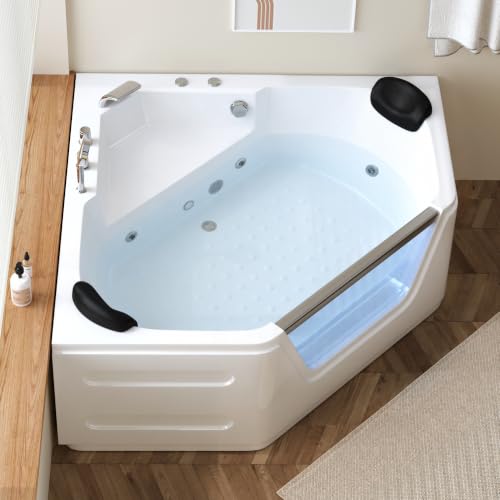
LUTHBAXE 59 Corner Jetted — Best Comfort Detailing
LUTHBAXE’s 59 inch corner tub spends its budget on the parts of a bath you notice with your eyes open: dual headrests moulded for two bathers and a clear glass panel that keeps the room visually open where a solid apron would wall the corner off. Six massage jets is the modest count in this group, and the honest reading is that this tub trades massage density for comfort detailing and a lighter, more furniture-like presence.
Seven-colour LED lighting continues the theme. For couples whose soak is a conversation with a glass of something cold rather than a hydrotherapy session, that trade may be exactly right — headrests you use every minute versus jets you run for ten. Judge it by your own ritual: if you read, talk and linger, comfort detailing compounds; if you arrive with a knotted back and a schedule, the Empava models’ denser jet fields will serve you better.
- Format: 59 inch corner tub for two adults
- Jets: 6 massage water jets
- Comfort: dual headrests, clear glass panel
- Extras: 7-colour LED lights
Strengths
- Headrests for both bathers make long soaks genuinely restful.
- Glass panel keeps small bathrooms feeling open.
- Calmer design suits bathrooms styled as retreats.
Trade-offs
- Fewest jets here; massage intensity is gentle.
- No heater is documented on the listing.
- Glass needs wiping to stay as clear as the photographs.
Best for: couples who soak socially and value comfort and looks over jet force. Not suited for: bathers wanting strong hydro massage or heated long soaks.

BAYYELL 59 Corner Whirlpool — Best Simple Controls
The BAYYELL 59 inch corner whirlpool makes its argument through restraint: six hydro massage jets, chromatherapy LED lighting, and a pneumatic control — the air-switch button that operates the pump with a puff of air rather than an electrical contact in the wet zone. Pneumatic switches are old technology in the best sense: nothing electronic sits where water splashes, the button either works or obviously does not, and replacing one years later is a small job rather than a control-board hunt.
The listing adds a UL certified pump and a UPC drain, the plumbing-side credentials that installers look for first. Six jets will not satisfy a massage maximalist, but for a corner tub bought to make a guest-suite or a modest master bath feel like a small hotel, the BAYYELL’s combination of simple control, certified pump and tidy specification is a defensible, low-drama choice.
- Format: 59 inch corner tub for two
- Jets: 6 hydro massage water jets
- Controls: pneumatic control
- Hardware: UL certified pump, UPC drain per listing
- Extras: chromatherapy LED lights
Strengths
- Pneumatic switch keeps electronics away from splashes.
- Certified pump and drain reassure installers.
- Straightforward specification with few gimmicks.
Trade-offs
- Six jets give the lightest massage coverage here.
- No heater is documented for long soaks.
- Less comfort detailing than the LUTHBAXE.
Best for: buyers who value simple, repairable controls and certified hardware. Not suited for: jet-count shoppers or anyone planning hour-long heated soaks.

Empava 59 Corner Luxury Jetted — Best Constant-Heat System
Empava’s luxury corner variant pairs the same ten hydro massage jets as its sibling with a built-in heater organised as a constant heat system — the maker’s framing for water that is maintained, not merely warmed at fill time. For two-person corner tubs this is the feature with the longest shadow, because a shared soak runs longer than a solo one: conversation, a second glass, nowhere to be. A bath that holds its temperature lets the evening set the schedule instead of the thermometer.
Chromatherapy LED lighting and ETL certification carry over from the family pattern. Choosing between this model and the plainer Empava 59 above is mostly a question of how the listing’s heat language and trim differ at order time, and of which is available in your delivery window; mechanically they are close cousins, and either gives a corner the full jets-plus-heat treatment that defines the top of this category.
- Format: 59 inch corner tub for two
- Jets: 10 hydro massage water jets
- Heating: built-in heater with constant heat system
- Extras: chromatherapy LED lights; ETL certified per listing
Strengths
- Constant heat supports genuinely long shared soaks.
- Full ten-jet field matches the group’s best coverage.
- Luxury trim suits a master-suite brief.
Trade-offs
- Overlaps heavily with its Empava sibling; compare listings carefully.
- Heater and pump together raise the electrical planning stakes.
- Corner access for two systems needs a generous panel.
Best for: couples whose soaks run long and who want heat maintenance as the headline. Not suited for: quick-bath households or rooms where the corner cannot host an access panel.

Empava 59 Corner Jetted with Heater — Best Established Corner Design
This Empava corner tub is the design that has been selling the corner idea the longest in this group: a 59 inch two-person jetted bath with a heater, pitched by its maker at couples turning a master bathroom into a private spa. Longevity in a catalogue is not proof of quality, but it does mean the model’s dimensions, drain position and installation quirks are the most widely understood by installers, and spare-part conversations start from familiarity rather than a search.
The listing leans on the romance of the format rather than a dense specification sheet, so treat the pre-order checks in this guide as mandatory homework for this pick: confirm the jet count, the heater’s behaviour and the control type on the listing itself before ordering. Buyers who do that homework get a proven corner geometry with heat support; buyers who skip it are shopping from a mood, which is how mismatched drains happen.
- Format: 59 inch corner tub for two
- Heating: heater included per listing
- Positioning: two-person home spa design
- Note: confirm jet count and controls on the listing before ordering
Strengths
- Established design with widely understood installation.
- Heater support for longer couples’ soaks.
- Classic corner geometry suits most master layouts.
Trade-offs
- Listing detail is thinner than its newer siblings.
- Specifications must be verified individually before purchase.
- Design is familiar rather than distinctive.
Best for: buyers who prefer a proven corner format and will verify the details themselves. Not suited for: shoppers who want every specification documented up front.

Atlantis Sublime 60×60 Corner Air Jetted — Best Air-Jetted Corner
The Atlantis Sublime breaks the group’s pattern twice over: it is the only air-jetted pick, and at 60 by 60 inches it is the only true square-corner footprint, a generous wedge that fills a corner completely rather than approximating it. Air jets change the soak’s character entirely — a rising field of bubbles instead of directed streams — and they change the maintenance story too, since air lines dry between baths instead of holding water in a loop.
Atlantis Whirlpools builds in the American jetted-bath tradition, and the Sublime’s appeal is its simplicity of concept: a big corner shell, an air system, room for two. What the listing does not promise is a heater, so plan the fill temperature and the water heater’s stamina accordingly, and expect the bubbling action to cool the water a little faster than still soaking does. For air-bath devotees with a corner to fill, it remains the only door in this guide that opens onto their kind of evening.
- Format: 60 x 60 inch corner tub
- Jets: air jetted system
- Maker: Atlantis Whirlpools, Sublime series
- Use: two-person corner soaking
Strengths
- Only air-jetted option for gentle, all-over bubbles.
- Largest corner footprint here fills the wedge completely.
- Air lines dry after use, simplifying hygiene.
Trade-offs
- No water jets for firm, targeted pressure.
- No heater is documented on the listing.
- Biggest footprint demands the most committed corner.
Best for: air-bath loyalists with a generous corner to furnish. Not suited for: water-jet massage seekers or small bathrooms.
How Do the Six Corner Whirlpools Compare Side by Side?
| Pick | Size | Jet system | Defining feature |
|---|---|---|---|
| Empava 59 Corner Whirlpool | 59 inch corner | 10 hydro jets | 104°F inline heater, 1.0 HP motor |
| LUTHBAXE 59 Corner Jetted | 59 inch corner | 6 water jets | Dual headrests, glass panel |
| BAYYELL 59 Corner Whirlpool | 59 inch corner | 6 hydro jets | Pneumatic control, UL pump |
| Empava 59 Corner Luxury Jetted | 59 inch corner | 10 hydro jets | Constant heat system |
| Empava 59 Corner Jetted with Heater | 59 inch corner | Jetted, heated | Established two-person design |
| Atlantis Sublime 60×60 Corner Air Jetted | 60 x 60 inch corner | Air jets | Only air system, largest wedge |
Why Does a Corner Change the Whole Bathroom Layout?
A rectangular tub owns a wall; a corner tub owns a viewpoint. Placed in the wedge, it frees the long walls for vanities, storage and windows, and it turns bathing into an activity that faces the room instead of staring at tiles six inches from your nose. That reorientation is why corner tubs anchor so many master-suite photographs: the bather looks out, the room reads as a space rather than a corridor of fixtures, and the corner that collected laundry baskets becomes the most deliberate square footage in the house.
The layout bill arrives in circulation and storage. A corner tub consumes the junction where a linen tower might have stood, and its angled front needs clearance for stepping in and out safely, so sketch the room with the tub’s true diagonal, not its wall measurements. Rooms with a door swinging into the wedge need particular care. None of this is prohibitive — it is simply the difference between a corner tub that transforms a room and one that obstructs it, and a roll of painter’s tape on the floor settles the question in an evening.
How Do You Plumb a Tub That Sits in a Wedge?
Corner geometry pushes the drain and the machinery toward the middle of the room, away from the walls where pipes naturally live. On a slab, that can mean a longer waste run set before the concrete cures or a channel cut into it afterwards; on a framed floor, it means joists and access planned from below where possible. The filler, too, usually lands on the angled front rim or arrives as a freestanding floor filler at the corner’s point, and both positions must be roughed in with unusual precision because the tub cannot shuffle sideways to forgive an error.
Access deserves its own paragraph in any corner plan. The pump sits at the back of the wedge, the furthest point from every opening, so the access panel often belongs in an adjacent room’s wall, a closet, or a removable section of the tub’s front apron. Agree that route with your installer while the room is still studs, and photograph everything before it closes. The corner that makes the bath so pleasant to use makes its machinery the least reachable in the house, and the only cure is deciding the route in advance.
What Electrical Protection Does a Corner Whirlpool Need?
The rules match every other jetted bath: a GFCI-protected circuit for the pump, and another protected feed where a heater or blower draws its own load, sized from the listing’s specification and installed by a licensed electrician. Corner installs add one wrinkle — the equipment bay’s distance from the panel route and from any junction point — so the electrician should see the actual tub position early, not after the tile has made every route expensive.
Controls divide by philosophy in this group. The BAYYELL’s pneumatic button keeps electricity out of the splash zone entirely, operating the pump by air pressure; electronic panels on the Empava models offer finer control of heat and light from the bather’s seat. Neither is wrong: pneumatic is the repairable classic, electronic the convenient modern. What matters is that the control you choose is reachable from a seated position, because a corner tub’s bather sits deeper in the wedge than any rectangular tub ever asks.
How Much Room Do Two Bathers Really Get in 59 Inches?
Corner seating is not two halves of a rectangle; it is two angled seats sharing a footwell, with bathers’ legs intertwining in the middle whether the brochure admits it or not. For most couples that geometry feels sociable rather than cramped, because the corner points your torsos toward each other and the shared water volume keeps both bathers equally submerged. Very tall bathers should check the seat-to-point diagonal against their leg length, since that diagonal, not the 59 inch wall figure, is the true stretch measurement.
Solo bathers get a different dividend: a corner tub lets one person choose an angle, brace feet against the opposite seat, and use the whole water volume as a personal soaking pool with genuine depth. Many owners report the corner tub is used solo most of the time and socially on occasions, and it serves both modes without the emptiness a long rectangular two-person tub can project at a single occupant.
How Do You Clean Jets and Glass in a Corner Installation?
The water-jet loop wants the same flushing discipline as any whirlpool: fill above the jets, run the maker’s recommended cleaner through the pump, drain, and rinse with a second fill. In a corner tub, remember that you will be leaning across an angled front to reach the far jets for wiping, so keep a long-handled soft brush in the bathroom rather than improvising with a mop twice a year. The air-jetted Atlantis largely opts out of loop flushing, since its lines carry air and dry themselves, though its many small air openings still deserve a wipe-down habit.
Glass panels, like the LUTHBAXE’s, stay clear with a squeegee pass after use and an occasional descale in hard-water homes; left alone, they develop the same mineral bloom as any shower screen, only more visible because the panel is the tub’s design feature. Acrylic shells throughout the group want non-abrasive cleaners and soft cloths, and bath oils should stay modest while water jets run, since oil coats the loop you will later flush.
What Should You Check About the Floor and the Fill?
A filled corner tub concentrates a serious load near the corner’s joists, and two bathers add their shifting weight to the water’s. Upper-floor installations deserve a structural once-over, particularly in houses old enough that the corner was framed for a linen cupboard rather than a small swimming pool. While you are measuring, time your current bath’s fill and drain: corner tubs hold generous volumes, and a slow supply or a lazy drain stretches the whole ritual. High-flow fillers and a waste line in good health keep the corner experience as brisk as it is deep.
Water heating is the companion check. The heated Empava models maintain temperature beautifully, but the initial fill still draws on your heater’s stored hot water, and a two-person corner fill is among the largest single draws a house makes. If your tank already struggles with back-to-back showers, the corner project and the heater conversation belong in the same budget meeting.
How Do Corner Tubs Handle Showers and Daily Use?
Honestly: most corner whirlpools are baths first and everything else second. A shower over a corner tub is possible with a ceiling-mounted curtain track following the angled front, but it is never as tidy as an alcove shower, and the wide wedge makes rinsing the far corner an act of commitment. Households whose bathroom must shower daily and bathe occasionally usually keep the shower elsewhere — a separate stall is the classic master-suite answer — and let the corner tub be the specialist it wants to be.
Daily bathing households, by contrast, find the corner format surprisingly practical: the angled seats give a natural recline for a weekday soak, the shared footwell works as a foot bath, and children treat the wedge as a small pool with a parent seated comfortably rather than perched on a rim. Judge the tub by the week you actually live, not the brochure weekend.
What Filler and Drain Hardware Suits a Corner Shell?
Corner rims are rarely wide enough for the chunky deck-mounted fillers that rectangular tubs carry, so corner installations lean on three alternatives: a slim rim-mounted filler on the angled front, a wall spout reaching over the wedge from the corner itself, or a floor-standing filler planted at the tub’s point like a small sculpture. Each choice is a plumbing commitment made before the tub arrives, and each has a temperament — wall spouts keep the rim clean but demand precise reach calculations, while floor fillers make a design statement and a trip hazard in equal measure if placed carelessly.
Drains deserve equal foresight. A corner tub empties a large volume through one waste, and cable-driven or pop-up drains operated from the rim spare the bather the cold plunge of reaching for a plug chain. Confirm the drain kit’s inclusion on the listing; the BAYYELL documents a UPC drain, which is the kind of line item installers quietly applaud. Whatever the mechanism, agree with your plumber how it will be serviced in year five, because a drain that can only be reached by lifting the tub is a debt the future will collect.
How Do Headrests, Armrests and Seat Shape Change a Soak?
Corner shells live or die by their moulding. A well-shaped corner seat supports the lower back at an angle that lets shoulders sink below the waterline, while a poorly shaped one slides the bather slowly toward the footwell like a boat losing its anchor. Headrests, the LUTHBAXE’s headline, matter because a corner bather’s head rests against a raised rim at an angle a flat edge punishes within minutes; padded or moulded support is the difference between a forty-minute soak and a twelve-minute one followed by a stiff neck.
Armrests sculpted into the wedge’s sides give bathers something to push against when standing — a safety feature wearing a comfort costume — and a textured or simply grippable rim matters when hands are wet. When you compare listings, read the photographs for these mouldings the way you would read a chair’s: you are buying a seat that happens to hold water, and your spine will review it nightly.
What Does the Warranty Story Look Like for Corner Models?
As with other jetted baths, coverage usually splits between the acrylic shell and the machinery, with pumps and heaters on the shorter term. Corner models add a documentation wrinkle: several picks here come from makers whose listings emphasise features over paperwork, so download and keep the warranty terms at purchase time, along with the order record and the electrician’s invoice for the GFCI work. If a claim ever happens, that folder is the whole conversation.
Also note what installation choices can void goodwill: a pump entombed without access, a heater run on an undersized circuit, a drain modified against the maker’s instructions. None of these are traps for a careful buyer; they are simply the written version of the advice repeated throughout this guide — plan the machinery’s life, not just its first evening.
How Should You Light a Corner Bathing Nook?
The corner is naturally the dimmest part of a bathroom, which is either its charm or its flaw depending on the hour. For morning practicality, a wash of light from above and in front keeps faces visible in any nearby mirror; for the evening soak, the tubs’ own LED chromatherapy, fitted to most picks here, supplies the low coloured glow that makes the wedge feel like a grotto rather than a fixture. Put the room’s main lights on a dimmer and the corner will modulate between both lives without a second fitting.
Candles are the traditional corner accessory and deserve a grown-up sentence: keep them on a stable shelf or the wide point of the rim, never on a curved slope, and prefer the enclosed kind in a household with enthusiastic bathers and splashing. The corner concentrates everything placed near it, warmth and water included.
What About Households With Children or Older Bathers?
Children adore corner tubs, which present as a small private sea, and the format genuinely helps a parent who can sit in the wedge during bath time instead of kneeling on tile. The supervision rules are unchanged — water depth discipline, no jets running as a toy, temperatures agreed and checked — and the pneumatic control on the BAYYELL has a quiet advantage here, since it cannot be switched by a wet hand fumbling for an electronic panel it half understands.
Older bathers should weigh entry geometry honestly. A corner tub’s angled front can be easier to swing legs over than a long rectangular side, because the bather approaches at the point and turns into the seat; but the rim height and the absence of wall-mounted grab points on two sides mean a planned grab bar at the entry side belongs in the installation, not on a later wish list. Heated models also help here, holding a safe, even temperature without repeated hot top-ups that require standing mid-soak.
How Do You Stage the Rest of the Room Around the Wedge?
Treat the corner tub as the room’s hearth and arrange accordingly: a stool or narrow bench within arm’s reach for towels and books, a hook rail on the nearest wall, and storage that keeps oils and salts close but never balanced on the rim. Because the wedge consumes the junction of two walls, tall storage usually migrates to the wall opposite, and a vanity with drawers rather than doors repays the move every morning.
Flooring choices complete the staging. The area in front of a corner tub receives the most water in the room, stepped over by every exiting bather, so choose a floor that forgives puddles and a mat that grips rather than skates — the companion guide on bath mats in our Related Guides takes that question seriously. A corner tub installed with this much forethought stops being a fixture and becomes the household’s evening address.
What Delivery and Access Problems Are Unique to Corner Tubs?
A triangular tub is an awkward traveller: wider across its diagonal than a rectangular tub of similar length, rigid, and finished on two faces that scratch if the stairwell turn goes wrong. Measure the route’s tightest turn against the tub’s diagonal, not its wall lengths, and tell the seller about any narrow landing before dispatch. More than one corner tub has spent a weekend in a hallway, admired by all, installed by none.
Once inside the bathroom, the tub usually must be offered into the wedge before surrounding joinery closes the approach, which sequences the renovation: tub positioned and tested first, then vanities and storage built around its confirmed footprint. Contractors who have fitted corner models will insist on that order themselves; if yours does not, this paragraph is your cue to ask why.
How Do You Decide Between the Three Empava Corner Models?
Three picks from one maker is unusual in a guide like this, and the honest way to separate them is by documentation. The newest corner design states its case in numbers — ten hydro jets, a 1.0 HP motor, a heater specified at 104°F — which suits buyers who comparison-shop on specifications. The luxury variant wraps a similar jet field in a constant-heat framing and upgraded presentation, suiting buyers who want the flagship trim of the line. The established model trades paperwork for track record, suiting buyers who value an installer-recognised design and will verify details themselves.
None of the three is a trap; they are three vintages of one idea, and the right choice is the one whose listing, on the day you order, documents the heater behaviour, jet count and drain position that your bathroom plan assumes. Read all three listings side by side with this guide open, and let the paperwork, not the photographs, cast the final vote.
How Does Water Volume Affect the Soak Itself?
Volume is not just a utility bill; it is thermal mass. A large corner fill changes temperature slowly in both directions, which is why unheated corner tubs still hold a respectable soak longer than a small alcove bath, and why heated models sip rather than gulp energy once the water is at temperature — they are maintaining a reservoir, not reheating one. The flip side arrives at fill time: the same mass takes minutes to arrive, so the ritual starts earlier, and households that bathe spontaneously should factor the fill into their expectations or choose the heated models that forgive a slightly cooler, faster fill by bringing it the rest of the way.
Displacement is the other half of volume literacy. Two bathers lower themselves into a corner tub and the waterline climbs dramatically; fill only to the level that leaves headroom below the overflow, or the first enthusiastic jet run will send a warm wave across the floor. Solo bathers can fill deeper and enjoy the buoyancy that makes corner soaking feel like floating in a private cove.
What Should Renters and Future Sellers Know?
A corner whirlpool is a committed installation, closer to a fireplace than to a fridge, so renters should treat it as a landlord conversation with written permission and a clear agreement about the electrical work, full stop. Owners thinking of resale should know the format divides opinion productively: buyers who bathe will pay attention to a well-kept corner spa, while shower-first buyers will simply see a large bath, and neither reaction is a disaster. What does hurt resale is evidence of neglected machinery — stained jets, a dead pump, a missing access panel — so the maintenance rhythm in this guide doubles as an asset-protection plan.
How Do You Winterise or Pause a Corner Tub in a Seasonal Home?
Houses that sit empty through cold months ask one extra routine: drain the tub fully, run the pump briefly to clear its loop where the maker allows, and leave the system dry, because trapped water in a jet loop is exactly where a freeze does its quiet damage. Air systems forgive neglect here as they do elsewhere, drying by design. On reopening the house, flush the loop before the first soak of the season and inspect the access bay for uninvited tenants; corner equipment bays are warm, dark and, to a mouse, extremely well located.
What Companion Fixtures Complete a Corner Installation?
The classic mistake is finishing the tub and forgetting its entourage. A handheld shower on a nearby wall transforms rinsing, hair washing and tub cleaning, and costs little while walls are open. A thermostatic filler valve, set to a household maximum, quietly governs safety for children and guests. Towel warming, whether a rail or simply a hook in the room’s warmest spot, completes the exit experience that the entry planning began. None of these appear in a tub listing, and all of them appear in the reviews owners write a year later.
How Long Does a Corner Installation Usually Take?
Once the room is prepared — floor verified, circuits run, waste roughed to the wedge — setting the tub itself is typically a day of plumbing and levelling, a filled test, and then the finishing work around it. The calendar killers are the preparations nobody scheduled: the electrician’s lead time, the structural opinion for an upper floor, the replacement of a waste line discovered mid-job. Households that front-load those three conversations usually watch the installation weekend feel almost anticlimactic, which is precisely what good planning is for.
How Do You Compare Jet Placement on a Floor Plan?
Jet counts travel well in marketing; jet maps do not, which is a pity because placement is the product. When a listing shows the shell from above, study where the jets sit relative to the two seats: a field clustered behind one seat and absent behind the other tells you the tub was designed for a solo bather with a guest, while mirrored clusters promise an equal soak. Lumbar height matters too — jets placed for the lower back of an average seated adult can land at the shoulder blades of a shorter bather, and no control panel fixes geometry. If a listing hides the top view, that absence is itself information, and the Empava models’ willingness to state counts and motor size sets the standard the others should be held to.
What Is the Sensible Order of Decisions?
Decide in the order the installation will punish you: first the room — tape the wedge, verify the floor, walk the delivery route. Second the sensation — water jets for pressure, air for bubbles, knowing the choice cannot be retrofitted. Third the heat — a heater if your soaks run long or your house runs cold. Fourth the furniture — headrests, glass, controls, lighting — which is where the LUTHBAXE and BAYYELL make their cases. Buyers who follow that order rarely return a tub; buyers who start at step four are the ones writing the regretful reviews the rest of us read.
How Does a Corner Tub Age Over a Decade?
The acrylic shell, kept from abrasives, holds its gloss for many years and can be polished back from minor scuffs. The machinery ages on its own schedule: pumps and blowers are wear items with a service life measured in years of regular use, seals and jet faces are replaceable, and control buttons eventually yellow or stiffen. A corner tub bought with an access plan ages gracefully because every one of those events is an afternoon’s work; the identical tub sealed into its wedge ages as a countdown. Longevity, in this category, is less about the brand on the shell than about the panel in the wall.
What Should You Photograph and File at Installation?
Before the wedge closes, photograph the pump’s label, the heater’s label, every valve position and the full plumbing run, then file those pictures with the warranty documents and the circuit number in your panel that feeds the tub. When a part is needed in year six, the photograph of its label answers questions that a description over the phone cannot, and the circuit note saves an electrician a treasure hunt. This is unglamorous, ten-minute work that separates households who maintain their machinery from households who excavate it.
How Do Guests Change the Calculation?
A corner tub in a guest suite works differently from one in a master bath: guests will not read manuals, so the installation should be operable by intuition — a pneumatic button or a clearly marked panel — and the house rules about temperature limits should be set by the host in advance where the controls allow. Hosts also inherit the flushing schedule for a tub used sporadically, and a line in the house file reminding whoever closes the house for a season will protect the loop better than any good intention.
What Does a Realistic Budget Beyond the Tub Include?
Name the companions of the purchase before the purchase names them for you: the electrician’s circuit work, any waste-line relocation in the wedge, a possible water-heater conversation for the big fills, the access panel’s carpentry and finish, a filler that suits a corner rim, and the grab bar and handheld shower that complete the room. Priced together, those items routinely rival a noticeable share of the tub itself, and households that budget them from the start finish with a room that feels inevitable rather than improvised. The tub is the headline; the budget is the article underneath it, and wise buyers read both.
How Should You Run the First Fill?
Treat the maiden soak as a systems check wearing a dressing gown. Fill to the overflow with nobody in the tub, run each jet setting and the heater through a full cycle while a second person watches the access side with a torch, then drain and inspect the bay again dry-eyed. Only when every fitting has proven itself under pressure does the first real bath get scheduled, candles and all. It sounds ceremonial because it is — the one fill where impatience can still be cheap is this one, and every installer who has mopped a ceiling below knows it.
What Mistakes Do Corner Whirlpool Buyers Make Most Often?
The recurring error is measuring only the two wall lengths and forgetting the diagonal: a 59 inch corner tub projects into the room along its angle, and doors, vanities and knees all meet that projection in practice. Tape the full outline on the floor and walk the room for a day before ordering. The second error is sealing the wedge without an access route, entombing a pump behind tile in the least reachable spot in the house.
Third comes sensation shopping by jet arithmetic alone — choosing ten jets when your household would have loved the Atlantis’s air, or the reverse. And fourth, buyers forget the fill: a huge corner volume on a small water heater produces one glorious bath and a house of cold showers. Every one of these mistakes is a planning miss, not a product flaw, and each is cheaper to catch with tape, questions and a heater specification than with a returns label.
Final Recommendation
Let the corner itself cast the deciding vote: tape the outline, sit in the taped wedge, and only then choose the machinery. For most couples the Empava 59 Corner Whirlpool is the balanced answer, with the Empava 59 Corner Luxury Jetted beside it when constant heat is the priority, while the Atlantis Sublime 60×60 Corner Air Jetted waits for the air-bath loyalist with a truly generous corner. Comfort-first bathers will linger over the LUTHBAXE’s headrests, and the BAYYELL suits anyone who wants certified hardware and a control that cannot short out. Pick the tub whose soak matches your evenings, and the dead corner becomes the room where the house slows down — two seats, warm water, and the day left politely outside the door.
Frequently Asked Questions
How much space does a 59 inch corner tub actually need?
It needs 59 inches along each wall from the corner, plus the diagonal projection into the room and safe clearance in front for stepping in and out. Tape the full outline on the floor using the listing’s dimensions and live with the tape for a day; that test catches door swings and vanity clashes that wall measurements alone never reveal.
Are corner whirlpools comfortable for one person?
Yes — many owners soak solo most of the time. The angled seats let a single bather choose a recline, brace against the opposite seat and enjoy the full depth, and the shared footwell doubles as legroom. Two-person geometry only becomes a compromise for very tall bathers, who should check the seat-to-point diagonal.
Do corner tubs need special plumbing?
They need planned plumbing rather than exotic plumbing. The drain sits further from the wall than in an alcove tub, fillers land on the angled rim or the floor, and the pump’s access route must be designed in advance. A plumber who sees the corner early will treat it as routine; one called after tiling will not.
Is an air-jetted corner tub easier to maintain?
In one specific way, yes: air lines dry between baths, so there is no water loop to flush on schedule. The shell, the air openings and any glass still want regular wiping, and an air system cannot be added to a water-jet tub later — the choice is made at purchase, which is why the sensation question comes first in this guide.
Can I put a corner whirlpool on an upper floor?
Often, yes, but verify the structure first. A filled two-person corner tub plus its bathers is a heavy, concentrated load, and older framing deserves a professional look before the tub travels upstairs. Ground floors and slabs rarely raise the question; timber upper floors should never skip it. Ask the structural question while the answer can still change the plan — a reinforced corner is a modest job during a renovation and a miserable one after the tile has set, the tub has been craned in, and the ceiling below has begun to express its opinion in hairline cracks. The same visit can confirm the route the tub will travel, since a corner shell that fits the room but not the stairwell has solved only half of its geography, and discovering the other half on delivery day, with the old bathroom already demolished, is the sort of afternoon that households describe to friends for years in tones of disbelief.
Related Guides
Still shaping the bathroom around water? These guides continue the same conversation for the neighbouring fixtures and finishes: Best Bathtubs and Surrounds, Best Meat Thermometers With Folding Probe and Best Bathroom Storage Cabinets Over the Sink.


