What's inside
- Key Takeaways
- Quick Picks
- How We Chose These Picks
- How Do the Six Tubs Compare at a Glance?
- How Do You Match a Tub to Your Own Body?
- Why Does Water Depth Beat Water Volume for Comfort?
- How Can You Make Any of These Tubs More Comfortable?
- How Does Posture in the Tub Affect Sleep and Sore Muscles?
- What About Bathers With Limited Mobility?
- How Do You Test a Tub’s Comfort Claims From Photographs?
- How Does Sharing a Bathroom Change the Right Choice?
- How Warm Does the Room Need to Be for the Tub to Feel Right?
- What Role Do Bath Accessories Play in Real Comfort?
- How Should You Plan the First Month With a New Tub?
- How Do You Clean an Acrylic Tub Without Dulling It?
- How Do You Decide Between Depth and Length With a Fixed Budget?
- What Should You Measure in the Bathroom Itself?
- What Mistakes Do Comfort-Tub Buyers Make Most Often?
- Final Recommendation
- How Does a Tub’s Shape Affect Bathing With a Book, a Drink or Music?
- How Long Should a Comfortable Soak Actually Last?
- Frequently Asked Questions
- Related Guides
As an Amazon Associate I earn from qualifying purchases. This post may contain affiliate links at no extra cost to you.
cottageverdict.com is reader-supported. When you buy through links on our site, we may earn an affiliate commission.
Where to buy: all six tubs are sold on Amazon, and their names in the Quick Picks table, the review headings and the comparison table link to the listings, where interior dimensions and installation details can be checked against your own measurements. The best freestanding comfortable bathtubs are judged by a stricter court than looks: the body, twenty minutes in, when the water has done its first work and every design decision announces itself through shoulders, spine and knees. A tub can photograph like a sculpture and still exile its bather to a sliding, upright perch. Comfort lives in specifics — the angle where your back meets the shell, the depth that lets water reach the shoulders, the floor your feet brace against, the rim your neck rests on — and those specifics are what this guide hunts through six acrylic designs, from a fifty-five-inch deep soaker to a double-ended slipper built for two reclining backs.
Every pick here is acrylic, which suits a comfort-first brief. Acrylic arrives at skin temperature quickly, so the first contact does not steal the soak’s opening minute, and its formed surfaces can be shaped into the lumbar curves and slipper slopes that this category is really about. Lengths run from fifty-five to sixty-seven inches, and the reviews will keep repeating an unfashionable truth: the most comfortable tub is rarely the longest one. It is the one whose backrest angle, soaking depth and foot room fit the particular body that will use it most, and bodies differ more than bathrooms do.
Bring your own measurements to this guide. Your height, your leg length, whether you bathe to stretch out or to sit deep and think, whether a sore lower back is the whole point — those facts outrank every badge below. The badges simply tell you which body each tub was designed to please.
Key Takeaways
- Backrest angle decides comfort more than length does; sloped and slipper ends suit recliners, upright ends suit readers.
- Soaking depth is the comfort number that matters — one pick states a fifteen-inch deep soak in its listing.
- Centre drains let a bather recline at either end without a drain under the spine or heels.
- Lumbar shaping and anti-slip floors are real comfort features, not brochure decoration.
- Shorter tubs can bathe deeper and feel more secure for smaller or older bathers.
- Step-over height and ease of rising belong in any honest comfort assessment.
Quick Picks
| Pick | Badge | Why it earns its place |
|---|---|---|
| DeerValley 55 Inch Acrylic Freestanding Bathtub | Best Compact Deep Soak | A deep, centre-drain soaker whose ergonomic shape suits smaller bodies and rooms. |
| Empava 59 Inch Freestanding Bathtub Deep Soaking | Best Measured Soak Depth | Fifteen inches of stated soak depth with ergonomic back support and an anti-slip floor. |
| 67 Inch Acrylic Freestanding Bathtub Lumbar Support | Best Lumbar Support | A deep ergonomic shell shaped around the lower back, with a non-slip base. |
| Mokleba 67 Inch Lucite Acrylic Freestanding Bathtub Slipper | Best Double Slipper Recline | Raised slipper ends at both sides create two proper reclining seats in one tub. |
| IDEALHOUSE 67 Inch Acrylic Freestanding Bathtub | Best Spa-Style Everyday Comfort | A deep sixty-seven-inch soaker tuned for unhurried, spa-pace daily bathing. |
| FerdY Tahiti 55 Inch Acrylic Freestanding Bathtub | Best Small Elegant Oval | A glossy fifty-five-inch oval whose gentle shape suits compact, comfort-led rooms. |
How We Chose These Picks
We judged these tubs the way a body judges them, from the inside out. Backrest geometry came first: the slope of the end wall, whether it supports the shoulder blades or abandons them, and whether the shape invites a recline or enforces a sit. Soaking depth came second, because water that stops at the ribs delivers half a bath; where a listing publishes a depth figure we used it, and where it does not, we said so and judged by the design’s stated intent rather than inventing numbers. Foot room and floor shape followed — a bather braces, turns and rises against that floor, and anti-slip surfacing there is a comfort feature in the most literal sense.
Drain placement was assessed as a comfort decision, not merely a plumbing one. A centre drain frees both ends of the tub for reclining and keeps hardware away from the spine’s resting place; end drains ask the bather to choose the good end. Overflow design mattered for the same reason — slotted and integrated overflows keep the interior free of plates and edges where a back or an elbow might meet them. Rim comfort closed the physical judging: a rim that can rest a head, an arm or a book without a sharp complaint is a rim designed by someone who has actually taken a bath.
Certification and construction were the final screen. Several picks carry cUPC certification in their listings, a plumbing-standard signal worth having in a product that holds this much water above your floor. All six are acrylic, but we favoured builds whose listings describe their ergonomic intent in specific terms — named back support, stated soak depth, slipper geometry — over tubs that merely call themselves comfortable in adjectives.
DeerValley 55 Inch Acrylic Freestanding Bathtub — Best Compact Deep Soak
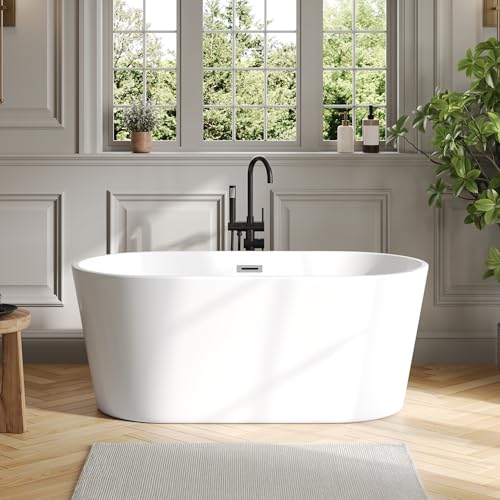
Fifty-five inches sounds like a compromise until you sit in the idea properly. DeerValley’s deep soaking tub puts its centre drain in the middle of the floor and its integrated overflow out of the way, which frees the bather to sit centred, knees drawn up, water high around the torso — the posture of a Japanese-style deep soak translated into a Western oval. For shorter bathers this geometry is not a smaller version of luxury; it is the correct version. In a long tub a small body slides, braces and never quite settles. In a deep compact tub the same body is held, surrounded, and warm to the shoulders without a gallon wasted heating empty length.
The listing describes an ergonomic design, and the centre drain is its most tangible expression. Nothing interrupts the back at either end, nothing catches the heels when you shift, and two bathers’ worth of seating positions exist in a tub that will only ever host one at a time — which end you choose becomes a mood, not a plumbing decision. The white gloss acrylic keeps the first touch kind and the cleaning simple, and the whole object fits bathrooms, including shower-room conversions, where a sixty-seven-inch vessel would dominate cruelly. DeerValley calls it a standalone shower tub in its listing language, a hint at the compact wet-room roles it can play.
Comfort caveats belong to stature. Bathers over about six feet will fold rather than float here, and anyone whose dream bath involves legs fully extended should keep reading this guide rather than romanticising compactness. Rising from a deep, compact soak also asks a little more of the knees than rising from a shallow one, a trade most deep-soak devotees accept gladly. For the right body, though, the DeerValley 55 Inch Acrylic Freestanding Bathtub is the most honestly comfortable object in this entire list, because it was sized for immersion instead of for show.
- Length: fifty-five inches, deep soaking format
- Drain: centre placement with integrated overflow
- Material: white acrylic, glossy ergonomic shell
- Bathing posture: seated deep soak, knees comfortably drawn
- Model reference in listing: DV-1T0582
Strengths
- Centre drain leaves both ends free for reclining.
- Deep compact shape immerses smaller bathers fully.
- Fits bathrooms and wet rooms larger tubs overwhelm.
Trade-offs
- Tall bathers fold their legs rather than stretching.
- Deep seat asks more of knees when rising.
- Single-bather design despite its flexible seating ends.
Best for: shorter bathers and compact bathrooms wanting real immersion. Not suited for: tall soakers who measure comfort in legroom.

Empava 59 Inch Freestanding Bathtub Deep Soaking — Best Measured Soak Depth
Empava does something rare in this category: it publishes a number. Fifteen inches of deep soak, stated plainly in the listing, alongside ergonomic back support, an anti-slip bottom and cUPC certification, with drain and overflow included. That fifteen inches is the distance between a bath that wets you and a bath that holds you — water at the shoulders while seated, the chest’s weight lifted, the particular quiet that only proper immersion produces. In a fifty-nine-inch shell, that depth is the design’s whole argument: trade length you may not need for depth you will feel in the first minute.
The back support is shaped rather than merely sloped, which matters at the twenty-minute mark when an unshaped end wall starts negotiating with your shoulder blades. Empava’s ergonomic back gives the spine a consistent surface to lean its length against, so the bather stops making the small, constant adjustments that fragment a soak’s peace. Underfoot — or rather under-seat — the anti-slip bottom performs the unglamorous heroism of this design: entering, turning and rising in a deep tub all involve wet leverage, and a floor that grips back turns those moments from calculations into non-events. Older bathers and anyone bathing with a healing injury will rank that texture as highly as the depth.
Included drain and overflow simplify the comfort story’s practical chapter — fewer separate fittings to match, fewer surprises at installation. The honest limits are the compact family’s usual ones: length will not stretch a tall frame, and a deep fill in any tub asks the water heater to show up prepared. But judged strictly on the sensation of being in the water, this Empava makes the most measurable comfort promise in the guide and then designs its back and floor to keep it.
- Length: fifty-nine inches, deep soaking design
- Stated soak depth: fifteen inches per the listing
- Back: ergonomic support shaped into the shell
- Floor: anti-slip bottom for safer entry and rising
- Certification and fittings: cUPC certified, drain and overflow included
Strengths
- Published fifteen-inch depth removes the guesswork.
- Shaped back support sustains long, still soaks.
- Anti-slip floor steadies entry, turning and exit.
Trade-offs
- Length limits full stretching for tall bathers.
- Deep fills draw heavily on stored hot water.
- Deep profile means a committed step-over height.
Best for: immersion-first bathers and anyone valuing a stated depth figure. Not suited for: bathers who need to stretch out completely flat.

67 Inch Acrylic Freestanding Bathtub Lumbar Support — Best Lumbar Support
Lower backs have a favourite tub in this guide, and it is this sixty-seven-inch deep ergonomic design with lumbar support built into its shape. Most tub discomfort is not about length or depth at all; it is about the hollow at the base of the spine, where a flat or wrongly curved end wall leaves the lumbar region unsupported while the rest of the back leans. Warm water relaxes the muscles that normally compensate, and twenty minutes later the bather climbs out with the exact ache they climbed in to cure. A shell that meets the lower back with shaped support interrupts that irony entirely, holding the spine’s natural curve so the water can do its work undisturbed.
The rest of the specification supports the same body-first brief: a deep ergonomic interior, an integrated overflow drain that keeps hardware out of the back’s territory, a non-slip base for confident movement, and cUPC certification in the listing. Sixty-seven inches gives the legs their room, so the lumbar support is not purchased at the price of folded knees; tall bathers with bad backs, a constituency larger than any other in bathing, are precisely who this geometry serves. This is also the pick for the end-of-day bath as therapy — not jetted, not theatrical, just warm, deep and correctly shaped, night after night.
An unbranded listing asks buyers to lean on the stated features and certification rather than a famous name, and that is a fair trade when the features are this specific. Check the listing’s dimension drawings against your own seated measurements — torso length matters more than height for lumbar placement — and confirm the rim height suits your household. Get those two numbers right and this tub becomes less a purchase than a prescription the bathroom fills daily.
- Length: sixty-seven inches, deep ergonomic interior
- Signature feature: lumbar support shaped into the backrest
- Overflow: integrated design, hardware kept off the back
- Base: non-slip surface for entry and rising
- Certification: cUPC per the listing
Strengths
- Lumbar shaping targets the commonest source of bath aches.
- Full length pairs back support with real legroom.
- Non-slip base and integrated overflow complete the comfort brief.
Trade-offs
- Unbranded listing leans on stated specs over reputation.
- Support placement must match your torso measurements.
- Large footprint returns the usual delivery planning.
Best for: bathers with lower-back complaints and tall frames. Not suited for: buyers who prefer a famous maker’s badge on the purchase.
Mokleba 67 Inch Lucite Acrylic Freestanding Bathtub Slipper — Best Double Slipper Recline
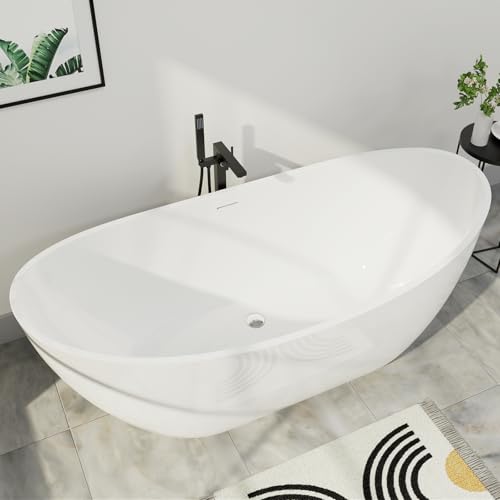
The slipper tub is bathing’s oldest comfort idea: raise the end wall into a high, curved backrest, and the bather reclines as if in a chaise rather than a basin. Mokleba builds that idea in its most generous form, a double slipper in which both ends rise, so the tub offers two proper seats facing each other across sixty-seven inches of Lucite acrylic. For couples this is the romantic configuration, two reclines with legroom negotiated in the middle. For solo bathers it is something subtler — the freedom to choose your end by the light, the window or the mood, with a real backrest waiting at whichever you pick.
Lucite acrylic is the premium member of the acrylic family in most makers’ language, associated with a deep gloss and a hard, colour-stable surface, and here it carries a glossy white finish over the slipper’s dramatic silhouette. The raised ends change the room as much as the bath: this is the most furniture-like profile in the guide, the one that reads as a piece from a grand hotel of another century. Practical details keep their footing — a toe-tap chrome drain you can operate with a foot when your hands are happily occupied, a slotted overflow that keeps the interior line clean, and cUPC certification in the listing.
Slipper geometry has honest costs. The raised ends that cradle a reclining back also make entry a slightly more deliberate climb, and the high ends collect the room’s visual attention whether or not the bathroom’s style wants a period accent. Shared bathing, meanwhile, always involves a diplomacy of knees that no tub fully solves. But as a pure answer to the question “where in this house can two backs be properly supported in warm water,” nothing else in the guide comes close to this double-ended chaise of a bathtub.
- Length: sixty-seven inches, double slipper silhouette
- Material: Lucite acrylic, glossy white finish
- Backrests: raised slipper ends at both sides
- Drain: toe-tap operation, chrome finish
- Overflow and certification: slotted overflow, cUPC certified
Strengths
- Two genuine reclining seats in a single vessel.
- High slipper backs support head and shoulders fully.
- Toe-tap drain keeps hands free during the soak.
Trade-offs
- Raised ends make entry a more deliberate climb.
- Period silhouette will not suit every bathroom style.
- Shared soaks still require knee diplomacy.
Best for: couples and solo recliners who love a chaise-style backrest. Not suited for: bathers needing the lowest possible step-over.

IDEALHOUSE 67 Inch Acrylic Freestanding Bathtub — Best Spa-Style Everyday Comfort
IDEALHOUSE describes its sixty-seven-inch deep soaking tub in the language of retreat — spa-inspired, ergonomically comfortable, aimed at master baths and renovations building a home sanctuary — and the interesting question is whether a tub can be designed for daily ritual rather than occasional drama. The shape argues yes. A deep soak at full length, without jets, without a period silhouette, without a speciality backrest: just a well-proportioned vessel that asks nothing of the bather except arrival. Comfort of this kind is sustainable in a way theatrical comfort is not, because it fits a Tuesday as gracefully as a celebration.
The ergonomic claim in the listing is general rather than anatomical, so this guide judges the tub on its geometry: sixty-seven inches for stretch, depth for immersion, a contemporary oval whose ends slope for reclining rather than sitting to attention. For households where several different bodies will use the same tub — partners of different heights, teenagers, guests — a balanced, unspecialised interior is often the wisest comfort choice, because it refuses to optimise for one spine at the expense of all others. The white acrylic keeps the mood calm and the maintenance mild, suiting a room designed as a retreat from visual noise.
Where it concedes ground is specificity. Backs that need shaped lumbar help should look two reviews up; couples who want the slipper’s embrace should look one review up. This tub’s promise is breadth and calm, and its spa framing will be realised or ruined by the room around it — lighting, warmth, quiet — more than by any curve of its shell. Buy it as the centre of a considered daily ritual, and its refusal to specialise becomes the most comfortable decision in the renovation.
- Length: sixty-seven inches, deep soaking format
- Material: white acrylic, contemporary oval
- Design intent: ergonomic comfort for daily spa-style bathing
- Interior character: balanced recline without specialised shaping
- Room fit: master baths and retreat-style renovations
Strengths
- Balanced geometry suits many different bodies well.
- Deep full-length soak supports a daily ritual.
- Calm styling anchors a retreat-style bathroom.
Trade-offs
- No specialised lumbar or slipper shaping.
- Ergonomic claims are general rather than measured.
- Spa effect depends heavily on the room’s ambience.
Best for: households wanting one versatile, calming everyday soaker. Not suited for: bathers needing targeted back support engineering.

FerdY Tahiti 55 Inch Acrylic Freestanding Bathtub — Best Small Elegant Oval
The FerdY Tahiti closes the list where the DeerValley opened it, at fifty-five inches, but with a different temperament: where the DeerValley is a deep soaking instrument, the Tahiti is an elegant oval in glossy white with brushed nickel drain fittings and an integrated slotted overflow, certified cUPC in its listing. The brushed nickel matters to comfort more than it first appears — it is the warmest of the common metal tones, and in a small bathroom where the tub is always close to the eye, fittings that feel gentle rather than clinical shape the room’s whole emotional temperature. Small rooms cannot hide their details, so this tub sweats them.
Its comfort is the compact oval’s classic kind: a seated soak with the water gathered close, quick to fill, quick to warm the room, and proportioned for bathers who sit rather than sprawl. Guest bathrooms and smaller ensuites often serve their bathers better with exactly this than with a stretched tub that leaves the room cramped and the water shallow for its volume. The slotted overflow keeps the inner wall smooth against the back, and the glossy finish returns light in rooms that frequently lack a window — a small, real mercy in interior ensuites.
The limits mirror its sibling at this size: tall bathers will sit with knees up, and nobody should buy fifty-five inches expecting a floating stretch. Within its brief, though, the Tahiti is the connoisseur’s small tub — certified, carefully fitted, and shaped with an elegance that makes a compact bathroom feel chosen rather than endured. Comfort, it turns out, is sometimes simply a room and a vessel in correct proportion to each other and to the body they serve.
- Length: fifty-five inches, elegant oval form
- Material: acrylic, glossy white finish
- Fittings tone: brushed nickel drain included
- Overflow: integrated slotted assembly per the listing
- Certification: cUPC certified
Strengths
- Brushed nickel fittings warm up small bathrooms.
- Compact oval fills fast and soaks seated bathers well.
- Slotted overflow keeps the back’s surface uninterrupted.
Trade-offs
- No full-length stretch for taller bathers.
- Glossy finish shows limescale in hard-water homes.
- Small size will not host shared bathing.
Best for: compact ensuites and guest bathrooms wanting certified elegance. Not suited for: tall bathers or couples planning shared soaks.
How Do the Six Tubs Compare at a Glance?
| Pick | Badge | Distinguishing detail |
|---|---|---|
| DeerValley 55 Inch Acrylic Freestanding Bathtub | Best Compact Deep Soak | 55 inch, centre drain, integrated overflow |
| Empava 59 Inch Freestanding Bathtub Deep Soaking | Best Measured Soak Depth | 59 inch, 15 inch soak, anti-slip floor |
| 67 Inch Acrylic Freestanding Bathtub Lumbar Support | Best Lumbar Support | 67 inch, lumbar shaping, non-slip base |
| Mokleba 67 Inch Lucite Acrylic Freestanding Bathtub Slipper | Best Double Slipper Recline | 67 inch double slipper, toe-tap drain |
| IDEALHOUSE 67 Inch Acrylic Freestanding Bathtub | Best Spa-Style Everyday Comfort | 67 inch deep soak, balanced interior |
| FerdY Tahiti 55 Inch Acrylic Freestanding Bathtub | Best Small Elegant Oval | 55 inch oval, brushed nickel, slotted overflow |
How Do You Match a Tub to Your Own Body?
Forget the showroom sit-test’s limitations and do the honest version at home. Take your seated measurements: from your back, along the floor, to your heels with legs comfortably extended, and from the floor to your shoulders as you sit. Compare those two numbers against each listing’s interior dimensions — interior, not exterior — and a clear pattern emerges. Bathers whose leg measurement dominates need length first. Bathers whose comfort fails at the shoulders need depth and backrest angle first. Bathers whose lower back complains need shaped support, which in this guide means one pick above all.
Then rehearse the unglamorous movements. Time how easily you rise from a low, seated position on the floor with wet hands imagined; if that motion is already a negotiation, weight your choice toward anti-slip floors, moderate rim heights and interiors you can brace against, and away from the deepest, highest-walled designs. Comfort includes the exit. A bath that ends in a struggle has spent its relaxation at the door, and the right tub is the one whose whole sequence — step in, settle, soak, rise, step out — your body can perform without thinking about any of it.
Why Does Water Depth Beat Water Volume for Comfort?
A bather floats in depth, not in gallons. What the body registers as luxury is water reaching the shoulders while seated, the chest unweighted, the neck the only part of the torso in the air. A long, shallow tub can hold more total water than a compact deep one while delivering less of that sensation, because its water spreads along legs that would happily have settled for less. This is why the Empava’s stated fifteen-inch soak is the most comfort-relevant number in this guide, and why the compact picks can out-bathe their longer rivals for many bodies.
Depth has a thermal dividend too. Water loses heat at its surface, and a deep, compact soak presents less surface for its immersion than a long, shallow one, so the bath stays in its comfort band longer before the hot tap is asked for a top-up. When you compare listings, interrogate depth figures before length figures, and when a listing declines to publish depth, treat its interior height and overflow position as the clues they are. The overflow sets the water’s ceiling; a high overflow is a deep bath’s silent signature.
How Can You Make Any of These Tubs More Comfortable?
Start with water temperature discipline: fill hotter than you think when the room is cold, because a deep soak’s first minutes include warming the shell and the air above it, and a bath that starts perfect often ends merely warm. A bath pillow transforms any end wall into a headrest and is the single cheapest comfort upgrade in bathing; choose one that suctions firmly and dries quickly. A bath caddy or nearby stool keeps books, drinks and phones at a dry arm’s length, removing the drip-and-reach manoeuvres that break a soak’s spell and occasionally its bather’s dignity.
The room itself is half the appliance. Warm the bathroom before the bath, not during it — stepping from hot water into cold air is where even great tubs lose their argument — and keep a large towel within reach of a wet hand rather than across the room. Lighting low and warm, a door that locks against household traffic, and enough unhurried time complete the prescription. None of the six picks can supply those things, and all six are transformed by them. Comfort is a system; the tub is its centre, not its entirety.
How Does Posture in the Tub Affect Sleep and Sore Muscles?
An evening bath is often prescribed, informally, for both sleep and soreness, and posture decides whether the prescription works. Warm water raises the body’s temperature gently; the cooling afterwards is part of what invites sleep, but only if the bather was relaxed enough to warm evenly — shoulders submerged, neck supported, no part of the body holding itself up against a badly angled wall. A bather who spends the soak bracing against a slope spends it exercising isometrically, and climbs out warm but wired. This is the hidden argument for shaped backs and slipper ends: they let the large muscles actually surrender, which is when the water’s warmth reaches them evenly and the evening’s chemistry changes.
For sore muscles the same logic applies with a targeting twist. A lumbar-shaped back delivers warm contact exactly where desk work and lifting leave their damage, while a deep soak’s immersion unweights joints that have carried the day. The Empava 59 Inch Freestanding Bathtub Deep Soaking and the lumbar pick are, in this sense, recovery equipment disguised as furniture. None of this is medicine and this guide makes no medical claims; it is ergonomics. A body held well in warm water rests better than a body held badly, and the difference is noticeable by the second evening.
What About Bathers With Limited Mobility?
Comfort includes the people for whom a bath is both precious and logistically serious. High rims and deep interiors, so luxurious to the able-bodied, can exclude a bather who cannot manage a high step-over or a low rise unaided — and freestanding tubs, lacking the wall a grab bar usually anchors to, demand honest thought here. Floor-mounted bars beside the tub, a stable step with a handhold, and a rim height chosen for the household’s least mobile regular bather are the difference between a tub that serves for decades and one that quietly stops being used by the person who loved it most.
Anti-slip floors move from preference to requirement in this conversation, and two picks here state them plainly in their listings. Water depth should also be chosen conservatively: a moderate fill in a supportive interior beats a heroic depth that makes exit assistance necessary. Households planning to age in place should read this guide’s compact, supportive picks with particular care and involve an occupational therapist’s eye if bathing independence is a stated goal. The most comfortable tub is the one its bather can enter and leave with confidence, alone, at eighty as at forty.
How Do You Test a Tub’s Comfort Claims From Photographs?
Read the silhouette the way a tailor reads a pattern. A long, unbroken slope at the end means a reclined posture with the head low; a short, upright end means a seated, reading posture; raised ends mean slipper support for the shoulders. Look at where the overflow sits, because it caps the waterline, and a tub whose overflow rides low will never immerse your chest no matter how deep its walls look from outside. Examine the floor’s apparent width in overhead photographs — your hips and your turning circle live there — and distrust any listing that shows only beauty angles and no dimension drawing.
Then cross-examine the words. Specific claims — a stated soak depth, named lumbar support, an anti-slip bottom, a centre drain — are checkable commitments a maker can be held to. Adjectives without numbers are weather. The Mokleba 67 Inch Lucite Acrylic Freestanding Bathtub Slipper, for instance, shows its comfort claim in its very silhouette, which is the most honest kind of marketing a tub can do. When shape, specification and language all tell the same story, believe the story. When they diverge, believe the dimension drawing and let the adjectives go.
How Does Sharing a Bathroom Change the Right Choice?
A tub in a solo ensuite answers to one body; a tub in a family bathroom answers to a parliament. Children need containment and a rim a parent can lean across to wash hair, which favours moderate heights and forgiving shapes. Teenagers need speed and will mostly shower, leaving the tub to the adults’ evening ritual. Guests need intuitive fittings. Partners need either a shared design — the double slipper’s whole thesis — or a solo design so good that taking turns feels like a privilege rather than a queue.
The balanced interiors in this guide, above all the IDEALHOUSE, exist for parliament bathrooms, where optimising hard for any single member disenfranchises the rest. Specialist picks earn their place in solo rooms and in households where one bather’s needs genuinely dominate — a bad back outranks a teenager’s indifference every time. Decide whose bath this renovation is really for, say it out loud during planning, and the parliament will usually ratify the honest answer. Trouble begins when everyone pretends the tub is for everyone and it ends up shaped for no one.
How Warm Does the Room Need to Be for the Tub to Feel Right?
A bather’s comfort is set as much by the air as by the water, because the shoulders, neck and face live in the air for the entire soak. A cold bathroom makes even a perfect tub feel like a negotiation — the submerged body warm, the exposed body quietly complaining — and bathers respond by hunching, which ruins the backrest geometry they paid for. Warm the room before the water runs: a heated floor is the dream, a simple heater timed ahead of the bath is the practical version, and even closing the door during filling traps the steam’s generosity where it belongs. Towels staged within reach complete the thermal plan, because the exit minute decides what the memory of the bath will be.
This is also why deep soaks feel disproportionately luxurious in winter. With the room warm and the water at the shoulders, the temperature gradient across the body nearly vanishes, and the bather floats in a single, even warmth that shallower baths in cold rooms cannot reproduce at any price. When a household reports that their new tub is somehow not as comfortable as the hotel’s, the culprit is usually the room, not the vessel. Fix the air, and the tub they already own becomes the tub they thought they were buying.
What Role Do Bath Accessories Play in Real Comfort?
Accessories are where a good tub becomes a personal one. A pillow suited to your chosen end wall supports the head at the angle the shell alone cannot; a caddy wide enough for the tub’s span keeps a book dry and a drink stable; a simple mat where feet land removes the one cold, slippery moment from the ritual. None of these cost much, and together they routinely deliver more felt comfort than the price difference between two rival tubs. Buy them after the first few baths, not before, because your own body in your own tub will tell you exactly which gaps need filling — a lesson generic starter kits never learn.
Restraint is the accessories’ second lesson. A tub rim crowded with bottles, candles, devices and ornaments turns entry into an obstacle course and cleaning into a relocation project. Keep the constellation small, movable and water-tolerant, and store the rest within a step rather than within the splash zone. Comfort is partly the absence of fuss, and a serene rim is a design feature any bather can install in an afternoon, whatever tub they chose.
How Should You Plan the First Month With a New Tub?
Use the first month as calibration. Note the fill depth that actually reaches your shoulders, the temperature that stays pleasant to the end, and the time of day when the household’s hot water is most generous. Learn your end of the tub — most bathers develop a loyalty quickly — and whether a pillow earns its place at that end. If the tub is shared, let each regular bather run the same experiments; the household’s collective settings, once known, end the nightly guesswork that quietly taxes a new fixture.
Small disappointments in month one are data, not verdicts. A bather sliding slightly needs a mat or a different recline, not a different tub; a soak cooling early needs a warmer room or a hotter start, not regret. The designs in this guide are sound; what the first month tunes is the partnership between vessel, room and body. Households that treat it as tuning keep their tubs happily for decades. Households that expect perfection on night one sometimes sell a perfectly good bath short.
How Do You Clean an Acrylic Tub Without Dulling It?
Acrylic’s gloss is its comfort surface — smooth against skin, easy on the eye — and it survives on gentleness. Warm water, a mild cleaner and a soft cloth handle the honest dirt of bathing: soap film, body oils, the faint ring at the waterline. Abrasive powders and scouring pads are the enemy, engraving micro-scratches that hold grime and slowly turn gloss to haze. Limescale in hard-water districts yields to a cloth soaked in a mild acidic solution laid on the deposit, given time, rather than to force. Rinse and dry after cleaning and the surface rewards you by needing less of it.
Fittings deserve their own soft cloth and nothing stronger than mild soap, since brushed and plated finishes can be altered by enthusiastic chemistry. The anti-slip floors on several picks need a brush’s attention to keep their texture honest — a smooth-feeling anti-slip floor is one whose grip has been polished away by residue. Five unhurried minutes after a bath-heavy week keeps every one of these tubs feeling, against the skin, exactly as it did on the first evening.
How Do You Decide Between Depth and Length With a Fixed Budget?
Every household’s money and floor space run out somewhere, and when they do, this is the fork in the road. Spend on depth if your bathers are sitters and thinkers, if the household’s tallest member is of middling height, or if the bath’s purpose is warmth and recovery — depth delivers immersion, heat retention and a sense of enclosure that length cannot imitate. Spend on length if your bathers are tall, if the evening bath is a full-body stretch after sport or labour, or if two people plan to share the water regularly, because no depth compensates a six-foot frame for a fifty-five-inch floor.
The tie-breaker is the household’s second bather. A tub bought for one person’s perfect soak will be borrowed, and a depth-first tub borrows gracefully to shorter guests while failing tall ones outright, whereas a length-first tub borrows adequately to nearly everyone. That asymmetry pushes undecided households toward length with the deepest interior they can find at that length — which is, not coincidentally, the exact centre of this guide’s list, where the sixty-seven-inch deep designs live.
What Should You Measure in the Bathroom Itself?
Beyond the tub’s tape outline, measure the room’s intentions. Note the distance from the tub’s likely position to the door’s swing, to the nearest towel storage, and to the window whose light you are hoping to bathe in. Check the floor’s level with a long spirit level if you can; freestanding tubs reveal a sloping floor honestly, and a small, planned adjustment beats discovering a rocking vessel on installation day. Photograph the space from the doorway at bather height, because that is the view the tub must satisfy daily, and mark where the filler will rise so its silhouette joins the composition rather than interrupting it.
Finally, measure the route one more time, all of it, from the street to the bathroom, including the turn at the top of the stairs that everyone forgets. A sixty-seven-inch rigid shell has no opinion about your hallway’s geometry and will not negotiate. Five minutes with a tape in the cold light of a weekday prevents the single most expensive sentence in bathroom renovation: it does not fit through the door.
What Mistakes Do Comfort-Tub Buyers Make Most Often?
Buying length by ego is the first: the longest tub the room can hold, chosen to prove a point, then used by a bather who slides down its slope hunting for a foothold. The second is ignoring the back entirely and judging by footprint and photograph, when twenty minutes against a wrongly angled end wall will teach the error nightly. Third is forgetting the exit — no thought for rim height, floor grip or where a wet hand can brace — until the first soak ends in an undignified scramble that quietly discourages the second soak.
Fourth is dismissing compact tubs as lesser without ever sitting in the idea of one; for a large share of bodies, deep and short beats long and shallow by a wide, warm margin. Fifth is treating certification and fittings as paperwork rather than comfort infrastructure: a cUPC-listed tub with its drain and overflow resolved is a tub whose installation will not improvise around your floor. And finally, buyers forget the household’s other bathers. A tub optimised fiercely for one unusual spine may serve everyone else in the house poorly, which is why the balanced picks in this guide exist alongside the specialists.
Final Recommendation
Choose by the body that bathes most. If that body is compact, or the room is, the DeerValley’s centre-drain deep soak and the FerdY Tahiti’s elegant little oval prove that fifty-five inches, correctly shaped, is a complete answer. If depth is your definition of comfort, Empava’s fifteen stated inches and shaped back make the most measurable promise here. If your lower back writes the brief, the lumbar-shaped sixty-seven-inch pick is the one your spine would order. For shared reclining, Mokleba’s double slipper stands alone, and for a household of varied bodies wanting one calm, versatile vessel, the IDEALHOUSE carries the everyday ritual best. Measure yourself before you measure the room, honour the exit as much as the entry, and your chosen tub will repay you in the currency that matters — the long, quiet exhale, somewhere around minute fifteen, when the water reaches your shoulders and the whole day finally lets go of you at once.
How Does a Tub’s Shape Affect Bathing With a Book, a Drink or Music?
Leisure has ergonomics too. A reader needs an end wall upright enough to hold the torso at a page-friendly angle and a rim or caddy that keeps paper dry; the slipper’s raised end, designed for shoulders, doubles as the reader’s best friend, while the deep soakers serve the thinker who prefers to float their thoughts without props. A drink wants a stable, reachable surface that is not the rim’s narrowest point, which is why the stool-and-table constellation matters more than any moulded cupholder ever could. Music asks only for a dry shelf and a room whose acoustics forgive a small speaker.
None of these uses appear in a specification table, yet they fill most of the hours these tubs will ever be used for. When you rehearse a tub’s outline in tape on the floor, rehearse the ritual too: sit where you would sit, reach where the book and glass would wait, and check that the shape you are buying supports the evening you are actually planning. Comfort, in the end, is the sum of these small compatibilities between a body, a vessel and its habits.
How Long Should a Comfortable Soak Actually Last?
Long enough for the water’s work, short enough to leave before the warmth turns against you. For most bathers that window opens around the ten-minute mark, when muscles have genuinely released, and closes somewhere past thirty, when fingers prune, water cools and the exit starts to feel like an expedition. Deep soaks extend the comfortable window because they hold temperature and immersion together; shallow or cooling baths shorten it no matter how beautiful the vessel. Let your own signals officiate — drowsiness, overheating, a restless mind — and treat the twenty-minute mark as the honest average around which individual evenings vary. A tub chosen for comfort makes those twenty minutes feel unhurried, which is the entire product being sold.
Frequently Asked Questions
Is a shorter tub really comfortable for an adult?
For many adults, yes — provided it is deep. A compact tub trades leg extension for immersion, and bathers who sit to soak rather than stretch to float often prefer it, sometimes discovering that the sense of being held by the water matters more to them than the inches they surrendered. Tall bathers and committed stretchers are the exceptions, and this guide flags both compact picks accordingly, because a tub bought against your own geometry will be resented nightly no matter how honestly it was reviewed here.
What does a centre drain change in practice?
It removes hardware from both ends of the tub, so a bather can recline either way without a drain beneath the back or heels. It also means the floor’s waste connection is planned for the middle of the footprint, which your installer will want to know early.
How do I judge backrest comfort from a listing?
Look for specific language — lumbar support, ergonomic back, slipper ends — and for interior dimension drawings. Vague comfort adjectives tell you little; named shaping and stated soak depth tell you where the designer’s effort actually went.
Are anti-slip bottoms worth prioritising?
Yes, particularly in deep tubs where entry and rising involve real leverage on wet surfaces. A gripping floor prevents the small slides that make bathers tense, and tension is the opposite of the product being bought.
Can two people bathe comfortably in a sixty-seven-inch tub?
In the double slipper design, that is precisely its purpose, with a raised backrest at each end. In standard ovals of the same length, two bathers fit with more negotiation. Either way, expect intimacy rather than personal space.
What should I verify before ordering any pick here?
Interior dimensions against your seated measurements, rim height against your mobility, drain position against your floor, and the delivery route against the tub’s size. Comfort begins as arithmetic and ends as warm water.
Related Guides
Comfort at the bathing end of the house pairs naturally with order at the working end. The sink decisions that frame a kitchen renovation are covered in Best Undermount Double Kitchen Sinks, draught-free storage for a working garage is handled by Best Garage Ready Refrigerators, and the floors around all of it are the territory of Best Cordless Stick Vacuums for Pet Hair.


