What's inside
- Key Takeaways
- Quick Picks
- How Did We Sort Stainless, Tri-Ply and Enameled Aluminum Pots?
- How Do the Six Pots Compare Side by Side?
- Why Does a Lighter Pot Behave Differently From Cast Iron?
- What Is the Real Difference Between Tri-Ply, an Encapsulated Base and Enameled Aluminum?
- How Should You Choose the Right Capacity?
- How Do You Brown Meat Well in a Stainless Pot?
- How Should You Care for Stainless, Clad and Nonstick Pots?
- How Do You Move a Braise From Stovetop to Oven Without Losing Heat?
- What Should You Cook First in a New Lightweight Dutch Oven?
- How Do Lids Change the Way a Braise Cooks?
- Which Pot Should a Bread Baker Who Is Leaving Iron Choose?
- What Mistakes Do Cooks Make When They Leave Cast Iron Behind?
- Final Recommendation
- Frequently Asked Questions
- Related Guides
As an Amazon Associate I earn from qualifying purchases. This post may contain affiliate links at no extra cost to you.
cottageverdict.com is reader-supported. When you buy through links on our site, we may earn an affiliate commission.
Where to buy: all six pots below are sold through Amazon, and each name in this guide links to its own listing, where you can confirm the stated capacity, the oven temperature ceiling and the lid material before the pot ever reaches your stove.
The search for the best dutch ovens not cast iron usually starts with a sore wrist. A classic enameled cast iron pot is a wonderful braiser, but it is also a heavy lift when it is full of stew, and plenty of home cooks quietly stop using theirs for exactly that reason. The six pots in this guide keep the wide, lidded, stove-to-oven shape that makes a Dutch oven useful, while swapping the iron for stainless steel, tri-ply cladding or enameled aluminum, so a full pot stays something one person can carry to the table without planning the trip.
Honesty about physics comes first, because the swap is not free. Cast iron stores a great deal of heat in its thick walls, so it shrugs off the temperature drop when cold meat lands in it and holds a lazy, steady simmer for hours. A lighter pot responds faster when you turn the burner up or down, which many cooks actually prefer for soups and sauces, but it also cools faster when the lid comes off and gives you a thinner cushion against scorching. None of the six below pretends to be iron. Each one earns its place by being genuinely good at the jobs a lighter pot does well.
The lineup splits into three construction families, and the family matters more than the brand badge. The Granitestone is enameled aluminum with a nonstick interior, the lightest build here. The Cuisinart PureClad and the Tramontina Boston are tri-ply, with an aluminum core bonded between stainless layers from base to rim. The Farberware Brilliance, the Tramontina Pro-Line and the Cooks Standard are stainless pots whose heat spreading depends mainly on an encapsulated base. Read the construction section before choosing, because two pots with the same capacity can behave quite differently over the same burner.
There is a lifestyle argument hiding inside the practical one. A pot that one person can lift, wash and put away without bracing against the counter is a pot that gets used on tired evenings, and tired evenings are when a home braise beats a takeaway both in cost and in comfort. Every pick below was chosen with that weeknight reality in view rather than only the Sunday performance, because the best Dutch oven in any kitchen is ultimately the one that is not avoided when dinner needs making.
Key Takeaways
- Leaving cast iron behind trades stored heat for a pot you can lift full with one steady hand.
- Tri-ply walls spread heat up the sides; an encapsulated base only spreads it across the bottom.
- Enameled aluminum is the lightest route, and its nonstick lining asks for gentler tools.
- Oven ceilings differ sharply here, from a cautious 350 degrees F to far hotter stainless builds.
- Glass lids let you watch a simmer but cap the oven temperature the pot can handle.
- Capacity claims run from 4.5 to 9 quarts, and the biggest pot here is a stockpot in spirit.
Quick Picks
| Pick | Badge | Why it earns a place |
|---|---|---|
| Farberware Brilliance 5Qt | Best Everyday Stainless Starting Point | A five-quart stainless pot with a fully encapsulated base, induction manners and a clearly stated oven ceiling. |
| Cuisinart PureClad 4.5Qt | Best Tri-Ply Pick for Even Walls | A 4.5-quart triple-ply pot whose aluminum core runs through the whole body, not just the base. |
| Tramontina Pro-Line 9Qt | Best Big Pot for Crowd Cooking | Nine stainless quarts with an NSF-certified listing, built for stock, big chilis and canning-day volumes. |
| Granitestone Enameled Aluminum 6.5Qt | Best Lightweight Nonstick Option | Enameled aluminum at 6.5 quarts, the lightest lift in the guide, with a nonstick interior and emerald finish. |
| Cooks Standard 6Qt Glass Lid | Best Glass-Lid Pot for Watching the Simmer | Six stainless quarts under a glass lid, so beans and braises stay visible without lifting the cover. |
| Tramontina Boston Tri-Ply 5Qt | Best Five-Quart Tri-Ply All-Rounder | Tri-ply cladding, a glass lid, induction readiness and an NSF-certified listing in the classic five-quart size. |
How Did We Sort Stainless, Tri-Ply and Enameled Aluminum Pots?
We began by ruling out anything that was simply a stockpot wearing a Dutch oven label. A true candidate needed a wide base relative to its height, two side handles rather than one long handle, and a close-fitting lid, because that geometry is what lets a pot move from browning on the burner to covered braising in the oven. Tall, narrow soup kettles were set aside even when their listings used the right words.
Construction was the second filter, and we treated the three families as separate species. For tri-ply pots we looked for cladding that runs up the walls, not just a disc sealed into the base, because wall cladding is what keeps a stew line from scorching at the edges. For encapsulated-base stainless we checked that the listing actually describes the base rather than leaving the buyer to guess. For the enameled aluminum pot we weighed the nonstick claim, the PFOA-free wording and the induction note, since aluminum alone does not work on an induction hob unless the base is built for it.
Finally we checked the practical ceilings that listings state plainly: oven-safe temperature, dishwasher wording, and whether the lid is steel or glass. Those three lines decide how a pot fits a real kitchen. A glass lid is lovely for watching beans and useless for a recipe that finishes under fierce heat, while a modest oven ceiling matters little to a cook whose Dutch oven work is mostly gentle braises. The six survivors each win a different version of that argument.
We also read each listing for what it did not say. A pot whose description never mentions induction was not assumed to be induction-ready, and a lid described only as glass was not credited with a steel lid’s oven tolerance. Where a listing stayed silent, the reviews below say what is known and leave the rest as a question for the product page, because guessing about cookware specifications is exactly how a reader ends up with a handsome pot that sulks on their particular hob or disappoints in their particular oven.

Farberware Brilliance SS Dutch Oven 5Qt — Best Everyday Stainless Starting Point
The Farberware Brilliance is the pot we would hand to someone replacing a heavy iron braiser for weeknight cooking. Five quarts is the size that disappears into daily use: a pot of lentil soup for four, a chicken stew with room to stir, a batch of rice that does not climb the walls. The body is stainless steel, so there is no coating to baby and no seasoning to maintain, and the listing is refreshingly specific about the base, describing it as fully encapsulated for even heating rather than leaving the construction vague.
That base is the honest centre of this pot’s character. Heat spreading happens across the floor of the pot, which is where soups, chilis and braises actually live, while the single-layer walls respond quickly when you drop the burner under a simmer that is getting ambitious. On induction the pot is listed as safe, and the encapsulated base is what makes that possible on a steel pot of this type. Expect to stir a thick bean pot a little more attentively than you would in iron, because the cushion of stored heat under the food is thinner.
The stated oven ceiling of 350 degrees F is the number to plan around. It covers the great majority of covered braises, which simmer happily well below that line, but it rules out recipes that start covered in a hot oven or finish with a fierce blast. Treat the Farberware as a stovetop-first pot with a useful oven range rather than a bread-baking vessel, and it will not disappoint. Dishwasher wording on the listing will please anyone who has ever faced a crusted stew pot at midnight.
One more practical note belongs to this pot: five quarts of stew is roughly the upper limit of what most people can pour one-handed into a storage container, and the Farberware sits right at that line. Its two side handles give a secure two-handed grip for the oven mitt shuffle from stove to trivet, and the stainless interior shows you the fond clearly as it forms, which makes judging a sear easier than in a dark enamel pot where browning hides until it burns.
- Construction: stainless steel with a fully encapsulated base
- Capacity: 5 quarts as listed
- Compatibility: induction safe per the listing
- Oven ceiling: 350 degrees F per the listing
- Care: dishwasher safe per the listing
Strengths
- Encapsulated base spreads heat where braises actually sit
- Stainless body shrugs off metal tools and tomato acids
- Five quarts suits everyday family cooking without bulk
Trade-offs
- Oven ceiling of 350 degrees F excludes hot bread bakes
- Single-layer walls cool faster than iron when the lid lifts
- Thick stews need an occasional stir to protect the base
Best for: cooks trading iron for a lighter daily pot used mostly on the stovetop
Not suited for: bakers who want a Dutch oven for high-heat crusty loaves

Cuisinart PureClad Dutch Oven 4.5Qt — Best Tri-Ply Pick for Even Walls
Cuisinart’s PureClad is the construction purist’s choice in this group. Triple ply means a core of aluminum, the metal that actually moves heat quickly, bonded between stainless steel faces, and in a clad pot that sandwich runs from the base up through the walls to the rim. The practical result shows up at the stew line: the band of sauce near the wall cooks at close to the temperature of the sauce in the middle, instead of lagging behind while the base races ahead.
At 4.5 quarts this is the smallest pot in the guide, and that is a deliberate kind of usefulness. Smaller households braise two chicken thighs and a handful of vegetables more often than they feed a crowd, and a right-sized pot keeps a shallow braise liquid at the correct depth instead of spreading it into a puddle across a wide floor. The pot also heats its contents with less burner time simply because there is less metal and less food to bring along.
Choose the PureClad when evenness matters more than volume. A risotto-style grain dish, a slow pot of white beans with a ham bone, or a curry that must not catch at the edges all reward clad walls. What it will not do is swallow a whole large chicken with vegetables piled around it, so households that cook in weekend batches should look at the bigger Tramontina further down instead of forcing this pot to be something it is not.
There is also a quiet storage argument for this pot. A 4.5-quart clad Dutch oven nests into the cupboard space a family reserves for its everyday saucepan tier, so it tends to live within reach instead of migrating to the high shelf where heavy pots go to be forgotten. A pot that stays within reach gets used for the Tuesday lentils and the Wednesday soup, which is where a good braiser earns its money back.
- Construction: triple-ply stainless with an aluminum core
- Capacity: 4.5 quarts as listed
- Walls: clad construction carries heat up the sides
- Lid: matching cover included per the listing
- Model reference: PCT3545-24 in the listing title
Strengths
- Clad walls keep the stew line cooking evenly
- Responsive core adjusts quickly to burner changes
- Right-sized depth for small-batch braising
Trade-offs
- Smallest capacity in this guide at 4.5 quarts
- Clad construction usually asks more care at the sink
- Too snug for whole large birds or double batches
Best for: small households that value even heat over sheer volume
Not suited for: batch cooks who routinely double recipes on weekends
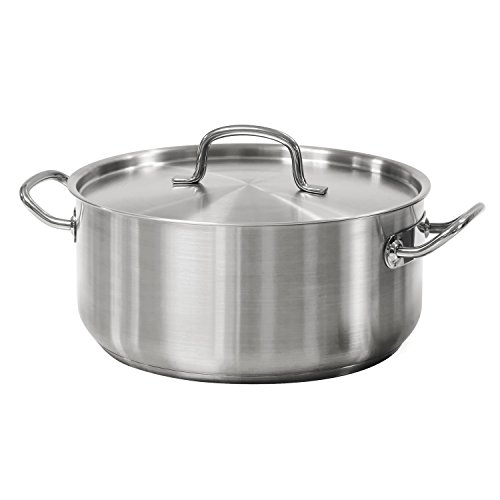
Tramontina Pro-Line SS Dutch Oven 9Qt — Best Big Pot for Crowd Cooking
The Tramontina Pro-Line is the outlier here, and it knows it. Nine quarts moves a pot out of braise territory and into the world of stock making, seafood boils, double chilis and the kind of soup production that fills a freezer for the month. The listing carries NSF certification, a detail borrowed from professional kitchens, where it signals that the pot’s materials and construction meet a public-health standard written for commercial food service. Home cooks do not need that stamp, but its presence says something about how the pot is built.
A stainless body at this size brings a practical gift: you can brown in batches on the stovetop, flood the pot with water or tomatoes, and let acidity work for hours without worrying about a reactive surface or a fragile coating. The wide Dutch oven proportions keep the pot stable and stirrable even when the contents approach the rim, and two side handles matter enormously when nine quarts of soup need to move from burner to counter.
Be clear-eyed about the trade. A pot this large is a storage commitment, it takes a while to bring its full volume to a simmer, and on a small burner the edges of its wide base may sit beyond the hottest zone. It earns its shelf space in homes that genuinely cook big: large families, hunters processing a harvest, church-kitchen volunteers, or anyone whose tomato season produces more sauce than a five-quart pot can forgive.
Think about the burner question before the cupboard question. On a wide gas burner or a large induction zone, the Pro-Line’s broad floor is an asset, letting you brown sausage or render a big batch of onions across the whole surface. On a small apartment range the same floor becomes a cool-ringed liability, and the honest fix is a longer, gentler preheat rather than a fiercer flame under the centre.
- Construction: stainless steel body with lid
- Capacity: 9 quarts as listed
- Certification: NSF-certified per the listing
- Line: Pro-Line, Tramontina’s professional-leaning range
- Shape: wide Dutch oven proportions for stirring room
Strengths
- Nine quarts handle stock and crowd chilis in one batch
- NSF certification signals commercial-grade construction standards
- Stainless surface tolerates long acidic simmers
Trade-offs
- Bulky to store in a small kitchen cabinet
- Full loads take time to reach a simmer
- Wide base can overhang a compact burner
Best for: large families and batch cooks who fill freezers with soup
Not suited for: cooks whose biggest regular job is dinner for two

Granitestone Enameled Aluminum 6.5Qt — Best Lightweight Nonstick Option
The Granitestone takes the opposite route from the clad pots. Its body is aluminum, the lightest serious cookware metal, finished outside in an emerald-green enamel and lined inside with the brand’s ultra nonstick surface. The listing calls the pot lightweight in its own title, and for once the marketing word is the whole point: a 6.5-quart pot you can carry full of potato soup with one hand changes who volunteers to cook, especially for older cooks or anyone managing a weak grip.
Aluminum’s personality differs from steel in ways worth understanding. It heats quickly and evenly across a base because the metal itself conducts well, so there is no need for an encapsulated disc, but it also gives that heat back quickly, which means a simmer needs a steadier eye on the dial. The nonstick lining changes cleanup completely and handles eggs, rice and cheesy gratins gracefully, while asking for wooden or silicone tools and a softer touch when you brown, since a hard sear is not what nonstick surfaces are built for.
The listing describes the pot as dishwasher and oven safe, induction capable and fully PFOA free, a combination that covers most modern kitchens including induction hobs, where bare aluminum would normally be turned away. Buy it as the comfort pick: the pot for weeknight one-pot meals where easy release and easy lifting matter more than a steakhouse crust on your short ribs.
The emerald finish deserves one practical remark: coloured enamel shows the kitchen’s history, from turmeric splashes to the faint scorch halo every well-used pot develops near the base. None of that affects the cooking, and many cooks like a pot that looks worked in. If you prefer cookware that hides its past, the brushed stainless models in this guide will age more discreetly on an open shelf.
- Construction: enameled aluminum with nonstick interior
- Capacity: 6.5 quarts as listed
- Finish: emerald green enamel exterior
- Listing notes: dishwasher and oven safe, induction capable
- Coating note: 100% PFOA free per the listing
Strengths
- Lightest full-size pot here, kind to wrists and grips
- Nonstick interior releases rice and gratins cleanly
- Induction capable despite the aluminum body
Trade-offs
- Nonstick lining dislikes metal tools and hard searing
- Aluminum sheds heat quickly once off the burner
- Enamel exterior can chip if knocked against steel racks
Best for: cooks who want iron-pot capacity without iron-pot weight
Not suited for: anyone whose cooking style leans on aggressive high-heat searing

Cooks Standard SS Dutch Oven 6Qt Glass — Best Glass-Lid Pot for Watching the Simmer
Cooks Standard builds the straightforward stainless entry in this guide: six quarts of steel, a fitted glass lid, and a listing that names the foods this pot is for, namely soup, stew, chili and pasta. The glass lid is the feature to think about, because it changes how you cook. Every time a lid lifts off a braise, the pot sheds the steam and heat it had gathered, and the simmer stumbles. A glass cover lets you check whether the beans are at a murmur or a boil without paying that toll.
Six quarts sits in the generous middle of family cooking. It swallows a whole chicken with vegetables, a serious pot of chili for a game day, or the pasta water for a crowd without boiling over at the first roll. The stainless body is listed as compatible with all stovetops, which makes this the safe recommendation for mixed households, a gas range today and perhaps an induction hob after the next remodel.
Glass does impose a ceiling, literally: a glass lid will never tolerate the oven temperatures a steel lid shrugs off, so cooks who finish braises in a hot oven should confirm the listing’s oven guidance before planning that recipe. Within its lane, though, this is the pot for cooks who like to watch. Dumplings swelling on top of a stew, a sauce reducing to the right gloss, pasta returning to the boil: all visible, all undisturbed.
Consider also who else cooks in your kitchen. A glass lid makes this the most teachable pot in the guide, because a teenager learning to braise can see what a simmer looks like without an adult hovering to lift lids and lecture. The same visibility helps anyone cooking with one eye on a child, a phone call or a football match, since a glance replaces a trip back to the stove.
- Construction: stainless steel casserole body
- Capacity: 6 quarts as listed
- Lid: glass, for watching food without lifting
- Compatibility: all stovetops per the listing
- Named uses on listing: soup, stew, chili and pasta
Strengths
- Glass lid preserves the simmer while you check progress
- Six quarts cover family meals and game-day chili
- All-stovetop compatibility survives a future hob change
Trade-offs
- Glass lid limits high-heat oven finishing
- Steel body alone spreads heat less evenly than clad
- Six quarts is heavy work when brim-full of chili
Best for: attentive cooks who like to watch a braise without disturbing it
Not suited for: recipes that finish covered in a very hot oven

Tramontina Boston Tri-Ply 5Qt — Best Five-Quart Tri-Ply All-Rounder
The Tramontina Boston is where the clad family meets the classic Dutch oven size. Five quarts of tri-ply stainless gives you walls that carry heat upward like the Cuisinart, in a body large enough for a family braise, and the listing adds two credentials worth noticing: it is described as induction-ready and NSF-certified, an unusual pairing of home-kitchen convenience and professional-standard construction in one pot.
The glass lid distinguishes it from its clad sibling. You get the even walls of tri-ply with the watch-the-simmer pleasure of glass, which suits the way most people actually braise: long, covered, and checked by eye more often than by thermometer. Under that lid, clad construction keeps the ring of sauce at the wall from lagging, so a pot of short ribs cooks as one dish rather than a hot centre surrounded by a cooler fringe.
Against the Cuisinart PureClad, the Boston offers a half quart more room and the glass lid; against the Farberware, it offers clad walls instead of a base-only heat spreader. Its compromises are the shared ones of its family: glass caps the fiercest oven work, and clad steel asks for a soak rather than a scour when fond sticks after a hard sear. For a single-pot household that wants one Dutch oven to do nearly everything, this is the balanced answer.
The Boston also handles the stovetop-to-table journey gracefully. Five quarts of clad steel is a civilised weight at the table, the glass lid keeps the braise steaming through the first serving, and the pot looks composed enough to sit on a trivet among guests without an apologetic transfer to a serving bowl that then needs washing too.
- Construction: tri-ply clad stainless steel
- Capacity: 5 quarts as listed
- Lid: glass, fitted
- Listing notes: induction-ready, dishwasher-safe, NSF-certified
- Line: Boston series by Tramontina
Strengths
- Clad walls plus glass lid combine evenness and visibility
- Five quarts is the most versatile size in the guide
- Induction-ready with an NSF-certified listing
Trade-offs
- Glass lid rules out the hottest oven finishes
- Clad body needs soaking after aggressive searing
- Heavier than the aluminum Granitestone at similar jobs
Best for: one-pot households wanting clad evenness in the classic size
Not suited for: cooks who regularly finish braises at very high oven heat
How Do the Six Pots Compare Side by Side?
The table below lines the six up by the things that actually separate them: what the pot is made of, how much it holds, and the trait that would make a particular cook choose it over its neighbours.
| Pick | Format | Capacity note | Standout trait |
|---|---|---|---|
| Farberware Brilliance 5Qt | Stainless, encapsulated base | 5 quarts | Induction safe, oven to 350 degrees F |
| Cuisinart PureClad 4.5Qt | Tri-ply clad stainless | 4.5 quarts | Heat travels up the walls |
| Tramontina Pro-Line 9Qt | Stainless steel | 9 quarts | NSF-certified listing |
| Granitestone Enameled Aluminum 6.5Qt | Enameled aluminum, nonstick | 6.5 quarts | Lightweight, induction capable |
| Cooks Standard 6Qt Glass Lid | Stainless with glass lid | 6 quarts | See-through simmer watching |
| Tramontina Boston Tri-Ply 5Qt | Tri-ply clad, glass lid | 5 quarts | Induction-ready, NSF-certified |
Read the construction column first, because it predicts behaviour better than capacity does. The two tri-ply pots, the Cuisinart PureClad and the Tramontina Boston, are the even-heat specialists. The encapsulated and plain stainless pots, Farberware, Pro-Line and Cooks Standard, concentrate their heat work at the base, which suits soups and stovetop braises perfectly well. The Granitestone stands alone as the light, nonstick path.
Then read capacity honestly against your household rather than your ambitions. Most cooks who think they need nine quarts discover their real life happens between four and a half and six. The Pro-Line earns its keep only when big batches are a weekly fact, while the PureClad’s modest size is a feature for couples who braise small and often.
One pattern worth naming before you decide: cooks consistently overbuy capacity and underbuy construction. The pot that gets reached for is the one whose size matches Tuesday, and the quality that gets noticed every single meal is how evenly the base and walls treat the food. If your budget forces a choice between a bigger plain pot and a smaller clad one, the smaller clad pot will usually make you happier across a year of ordinary dinners.
Why Does a Lighter Pot Behave Differently From Cast Iron?
Heat retention is a question of mass. A thick iron wall is a battery: it soaks up energy from the burner and pays it back slowly, so the temperature inside the pot barely flinches when you add cold ingredients or lift the lid. A stainless or aluminum pot holds a much smaller charge. Add a kilo of cold beef to a light pot and the sizzle fades for a moment while the burner refills the battery, which is why browning in batches matters more in these pots than in iron.
The same lightness cuts the other way in your favour. A responsive pot obeys the dial immediately, so when a milk-based soup threatens to boil over or a sauce needs to drop from a bubble to a bare simmer, the change happens in seconds rather than minutes. Sauces, risottos and custardy dishes often come out better in a responsive vessel, and many cooks who switch from iron are surprised to find they prefer the lighter pot for exactly the cooking they do most.
Simmer stability is the middle ground to manage. Iron holds a lazy simmer almost by itself once it is hot. A lighter pot cycles a little more with the burner, so the practical habit is to find the dial setting that produces occasional lazy bubbles, then leave it alone instead of chasing the temperature up and down. A heavy, well-fitting lid helps every pot in this guide by trapping the steam that does much of a braise’s work.
What Is the Real Difference Between Tri-Ply, an Encapsulated Base and Enameled Aluminum?
Tri-ply cladding bonds an aluminum core between stainless faces across the entire pot. Heat entering the base travels sideways through the core and climbs the walls, so the whole vessel becomes the cooking surface. That is why clad pots scorch less at the edges and why their sauces reduce evenly. The cost of the sandwich is weight and price relative to plain steel, though both stay well below iron.
An encapsulated base takes a cheaper route to a similar goal: a disc of heat-conducting metal is sealed into the bottom of a stainless pot, spreading the burner’s heat across the floor while the walls remain single-layer steel. For soups, stews and chilis, where the food itself carries heat upward by convection, that arrangement is honestly sufficient. Where it shows its limits is in thick, still dishes, a dense bean pot or a polenta, where the walls contribute little and the base must be stirred.
Enameled aluminum skips the sandwich because aluminum already conducts heat eagerly on its own. The enamel gives the exterior its colour and some protection, while the interior here is a nonstick lining rather than bare metal. The result is the lightest pot per quart in this guide and the easiest cleanup, balanced against a lining that should not meet metal utensils or the fiercest dry heat. Three honest technologies, three different kitchens they suit best.
How Should You Choose the Right Capacity?
Work backwards from the meals you actually cook. A braise for two with leftovers lives happily in four and a half quarts. A family stew, a whole chicken or a Sunday sauce wants five to six. Nine quarts is production cooking: stock from carcasses, double batches for the freezer, or the pot that feeds a team lunch. Buying one size up from your routine is sensible; buying two sizes up mostly buys a storage problem and slower heating.
Remember that a Dutch oven should rarely be filled past two-thirds for braising, because the food needs room to bubble and the lid needs a seal of steam rather than a plug of stew. That rule quietly converts a six-quart pot into a four-quart braise, which is why the five and six quart models in this guide are the true family sizes, and why the 4.5-quart PureClad is best understood as a couples’ pot.
Also weigh the pot against your stove and your sink. A wide nine-quart base on a small electric coil leaves a cool ring around the edge, and a pot that does not fit under the tap is a pot that gets washed reluctantly. The best capacity is the one that fits your burner, your oven shelf spacing and your cupboard, in that order.
Do not overlook the oven shelf test while you are measuring. A tall pot with its lid knob needs clearance below the shelf above it, and a wide pot needs a rack position where its handles clear the oven walls. Ten seconds with a tape measure in the oven saves the particular frustration of a braise that fits the stove beautifully and then refuses to go in for its long, slow finish.
How Do You Brown Meat Well in a Stainless Pot?
Dry the meat, then leave it alone. Surface moisture is the enemy of browning in any pot, and in stainless it also encourages sticking, so pat pieces dry, season them, and heat the pot before the oil goes in. When the meat lands, resist the urge to prod it. Stainless releases food on its own schedule: proteins bond to the steel at first, then let go as the crust forms, and a piece that seems welded at minute two often lifts cleanly at minute four.
Work in batches with space between the pieces, because crowding drops the temperature of a light pot faster than it would in iron and the meat steams in its own juices instead of searing. Between batches, a splash of water, wine or stock lifts the browned fond from the base, and those dissolved bits are the flavour foundation of the braise that follows. In the nonstick Granitestone, take a gentler approach: moderate heat, less aggressive crust, and silicone or wooden tools only.
If fond does catch and darken too far during a long stovetop session, do not scrape the scorched layer into your stew. Move the food to a bowl, wash the pot, and restart the base with fresh oil. A lighter pot forgives that reset in a way iron, with its long reheating time, does not, which is one more quiet advantage of giving up the heavy battery.
How Should You Care for Stainless, Clad and Nonstick Pots?
Stainless and clad pots ask for very little: wash them hot, dry them, and do not fear the occasional stuck patch, which a soak and a non-scratch pad will lift. Rainbow heat tints and faint water spots are cosmetic and harmless. A paste of baking soda handles most discolouration, and the dishwasher wording on several listings here means even that small ritual is optional for busy households.
The enameled aluminum pot lives by different rules. Its nonstick interior lasts longest when metal tools stay in the drawer, when the pot is not heated empty on high, and when storage does not involve nesting steel cookware inside it. Enamel exteriors chip from hard knocks rather than from cooking, so the real discipline is in how the pot is handled around the sink and the rack.
Lids deserve a sentence of their own. Glass lids should cool before they meet cold water, since thermal shock is the one reliable way to ruin them, and steel lids benefit from a wipe around the rim where braising liquids dry into a stubborn ring. Store any of these pots with the lid ajar or inverted if your cupboard allows it, and a pot used for a garlicky stew will not perfume the next batch of rice.
How Do You Move a Braise From Stovetop to Oven Without Losing Heat?
Start by preheating the oven before the pot ever leaves the burner, because a light pot gives up its heat to a cold oven faster than iron does. While the oven climbs, bring the braise to a bare simmer on the stovetop, so the contents arrive at temperature rather than spending their first oven minutes merely warming through. A simmering pot placed into a hot oven continues cooking seamlessly, which matters for timing a meal around guests.
Check the listing ceiling for your specific pot before choosing the oven temperature, and remember that the lid is often the limiting part rather than the body. Where a recipe demands more heat than the lid allows, a sheet of foil pressed over the pot before the lid goes on will not raise the safe ceiling, so the honest options are a lower, longer braise or a different pot. Most braises forgive the lower temperature happily, trading a little time for tenderness.
Carry the pot with both hands and dry mitts, and set the destination trivet down before you lift. Lighter pots tempt one-handed carries, and a full five quarts of hot stew is exactly the load that punishes that temptation. The return trip matters too: let the pot rest ten minutes before serving, and the braise will settle, the sauce will gloss, and the meat will slice instead of shredding.
What Should You Cook First in a New Lightweight Dutch Oven?
Choose a forgiving braise for the maiden voyage: chicken thighs in tomato and olive, or a pot of beans with a smoked ham hock. Both dishes bubble along at a gentle simmer, both forgive a dial adjustment or two while you learn the pot’s responsiveness, and both teach you how the base behaves over your particular burner better than any manual could.
Pay attention to three things during that first cook. Notice how quickly the pot answers when you lower the heat under a rising simmer, how the stew line behaves against the walls, and how much fond forms during the initial browning. Those observations calibrate every recipe that follows, because a clad pot and an encapsulated-base pot will give you three different sets of answers.
Save the ambitious dishes for the second week. Bread with a crackling crust asks for the fiercest heat and a lid that tolerates it, while a hard-seared beef stew tests your batching discipline. By the time you attempt them you will know your pot’s hot spots, its simmer setting and its oven ceiling, and the results will reflect the pot’s ability rather than your guesswork.
How Do Lids Change the Way a Braise Cooks?
A lid is not a passive cover. It traps the steam rising off the food and rains it back down, basting the top surface and keeping the braise liquid from reducing faster than the recipe intends. A tight, heavy lid does this best, which is one of cast iron’s quiet advantages, while a lighter steel or glass lid may let a whisper of steam escape at the rim. In practice the difference amounts to a few spoonfuls of water across a long braise, easily corrected when you check the pot halfway through cooking.
Glass lids add information to that system. You can see whether the surface is at a murmur or a rolling boil, whether dumplings have set on top of a stew, or whether a sauce has thickened to the gloss you were waiting for, all without breaking the seal. Experienced cooks learn to read the condensation itself: a fine mist on the glass means a gentle simmer, while big racing droplets mean the heat wants turning down before the bottom catches.
Whichever lid your chosen pot wears, resist the habit of lifting it every ten minutes to admire the progress. Each lift costs the pot its gathered steam and, in a light vessel, a noticeable slice of its temperature, and the braise then spends several minutes climbing back to where it was. Set a timer, trust the process, and let the lid do the quiet work it was designed for, checking once or twice across the whole cook rather than constantly.
Which Pot Should a Bread Baker Who Is Leaving Iron Choose?
Bread is the hardest test to set a lightweight Dutch oven, because a crackling loaf wants a fiercely preheated vessel and a lid that tolerates the same heat. Read the oven ceiling on each listing with that recipe in mind before anything else. A pot capped at 350 degrees F, like the Farberware in this guide, belongs to the braising world and should not be asked to bake artisan loaves, however willing its body might look.
For bakers, the stainless and clad pots with steel construction are the natural starting point, and the lid question decides the details. Where a listing gives the body a generous oven range but the lid is glass, the honest workaround used by many bakers is a foil cover for the bake itself, though you should confirm the listing’s guidance rather than improvising around it. The crust will differ from iron’s in any case, because the lighter walls store less heat to throw at the dough in the first minutes.
None of that makes these pots poor bakers of everything else. Covered casseroles, gratins, fruit cobblers and soda breads all bake happily within the stated ceilings, and they emerge from a pot that was far easier to lift out of the oven. Match the vessel to the loaves you truly bake each month, and most households will find the trade heavily in their favour.
What Mistakes Do Cooks Make When They Leave Cast Iron Behind?
The commonest mistake is expecting a light pot to sear like iron without adjusting the method. Cooks crowd the pan, the temperature dips, the meat greys, and the pot gets blamed. Batch the browning, preheat patiently, and the stainless pots in this guide produce a deep fond that iron would be proud of.
A second mistake is ignoring the oven ceiling printed on the listing. The Farberware states 350 degrees F, and glass lids impose their own limits on other models. A recipe that roasts covered at high heat belongs in a pot whose listing allows it, so check the number before the oven is hot rather than after the lid is stressed.
Third, buyers often choose by capacity alone and end up with a nine-quart pot for a two-person household, then wonder why braises dry out in a shallow puddle at the bottom. Match the pot to the meal you cook weekly, not the feast you cook twice a year, and borrow a big pot for the feast.
One more quiet error: storing the pot with its lid sealed tight after a hasty wash. Trapped moisture perfumes the interior, and the next delicate dish inherits the ghost of the last stew. A minute of air drying with the lid ajar keeps any of these pots neutral and ready.
Finally, nonstick discipline gets forgotten in mixed kitchens. The Granitestone’s lining is a genuine convenience until a metal ladle or a steel-wool pad crosses it. Keep the wooden spoons near the stove, store the pot without steel neighbours nested inside, and the surface will repay the small effort for years.
Final Recommendation
For most households making the switch, the balanced answer is the Tramontina Boston Tri-Ply 5Qt: clad walls, a glass lid, the classic five-quart size and an induction-ready, NSF-certified listing. Cooks who mostly simmer on the stovetop and want the easiest entry should look at the Farberware Brilliance SS Dutch Oven 5Qt, while anyone whose first priority is a pot they can lift without thinking twice belongs with the Granitestone Enameled Aluminum 6.5Qt.
The Pro-Line serves the big-batch minority, the PureClad serves couples who prize even walls, and the Cooks Standard serves cooks who like to watch. What none of these pots will do is behave exactly like the iron one they replace, and that is the point of the exercise: you are trading a heat battery for control, lightness and easy care.
It is also worth saying plainly what did not make this list and why. Any pot whose listing hid its construction, skipped its oven guidance or dressed a tall stockpot in Dutch oven language was set aside, however attractive its photograph looked. The six survivors all publish the facts a buyer needs, and that transparency is itself a quality signal in a category where vague listings are common and returns are a heavy, awkward business.
Pick the construction that matches how you cook, respect the oven ceiling on the listing, and the heavy pot in the back of the cupboard can stay there, unbothered, while dinner gets made in something your wrist actually enjoys lifting.
Frequently Asked Questions
Can a stainless Dutch oven braise as well as cast iron?
Yes, with a small adjustment in technique. The braise itself, hours of gentle covered cooking in liquid, works identically once the pot is at temperature, because the liquid and the trapped steam do the work. The difference shows at the start and the edges: browning needs batches in a lighter pot, and the simmer needs a slightly more attentive dial. Cooks who accept those two habits rarely miss the iron.
Why do some of these pots have glass lids?
A glass lid lets you judge a simmer, watch dumplings or check a reduction without lifting the cover and dumping the steam the braise depends on. The trade is heat tolerance, since glass cannot follow a steel lid into the fiercest oven work. For stovetop cooking and moderate oven braises, the visibility is worth more than the lost degrees.
Is enameled aluminum as durable as stainless steel?
They age differently rather than one simply outlasting the other. Stainless can be scoured, dropped and used with any tool for decades. Enameled aluminum asks for gentler tools and no hard knocks, and in exchange stays far lighter and releases food easily. Treated according to its rules, the aluminum pot gives long service; treated like steel, it will show the abuse sooner.
Which size should a family of four choose?
Five to six quarts is the family-of-four answer for braises and stews, remembering that a pot should sit no more than about two-thirds full while braising. That points to the Farberware or Tramontina Boston at five quarts, or the Cooks Standard at six. Choose nine quarts only if stock making and freezer batches are a regular part of your cooking.
Can these pots go on an induction hob?
Several listings say so directly: the Farberware is listed as induction safe, the Granitestone as induction capable, and the Tramontina Boston as induction-ready. Plain stainless varies by base construction, so for the remaining models, read the current listing carefully before assuming, and test with a magnet on the base of any pot you already own.
Do I need to season a stainless or clad Dutch oven?
No. Seasoning belongs to bare cast iron and carbon steel, where a polymerised oil layer protects a reactive surface. Stainless, clad and enameled surfaces are already non-reactive, so they need only washing and drying. Food may stick briefly during browning, but that is a matter of heat and patience, not a missing layer of seasoning.
Related Guides
A kitchen that cooks lighter still needs the rest of the house in order, so round out your reading with our guides to heavy-duty openers for the pantry, softer landings for tired feet, and a longer soak after a day spent over the stove: Best Commercial Can Openers Best Memory Foam Slippers Best Jacuzzi Bathtubs.



[…] the coffee shelf and the rooms beyond with our guides to Best Dutch Ovens That Are Not Cast Iron Best Cozy Slippers Best 36 Inch […]