What's inside
- Key Takeaways
- Quick Picks
- How Did We Choose Manual Frothers for This Shortlist?
- How Do the Six Manual Frothers Compare Side by Side?
- How Do You Warm Milk for a Manual Frother Without Ruining It?
- What Is the Plunger Technique That Makes Fine Foam?
- How Much Milk Should You Actually Put In?
- Steel or Glass: Which Vessel Suits Your Kitchen?
- How Do You Froth Plant Milks and Skimmed Milk by Hand?
- How Should a Manual Frother Be Cleaned and Stored?
- Can a Manual Frother Travel, and Which of the Six Travels Best?
- How Do You Make a Cappuccino’s Foam Versus a Latte’s?
- What Is the Right Vessel Size for Your Household’s Real Morning?
- How Do You Pour Hand-Frothed Milk Like You Mean It?
- How Should You Froth for Children and for Cocoa Drinkers?
- What Does the Mesh Do Over Years, and When Is It Tired?
- How Do You Froth in a Kitchen With No Hob Space to Spare?
- Can Hand-Frothed Milk Improve Instant and Moka Coffee?
- How Do You Keep the Rhythm When Making Four Drinks in a Row?
- What Should a Buyer Check on the Listing Before Ordering?
- How Does Season Change the Frother’s Work?
- Why Does This Category Survive Every Electric Challenger?
- How Do You Froth for a Crowd at a Holiday Breakfast?
- What Is the Difference Between Foam, Froth and Microfoam at Home?
- How Should the Frother Share a Drawer With the Rest of the Coffee Kit?
- One Last Plunge: Deciding Between the Six
- A Short Word on Lids, Handles and Other Small Mercies
- What Mistakes Do Manual Frother Buyers Make Most Often?
- Final Recommendation
- Frequently Asked Questions
- Related Guides
As an Amazon Associate I earn from qualifying purchases. This post may contain affiliate links at no extra cost to you.
cottageverdict.com is reader-supported. When you buy through links on our site, we may earn an affiliate commission.
Where to buy: all six frothers below are sold through Amazon, and their names in the Quick Picks table, the detailed reviews and the comparison table link to the matching listing, where you can check price on Amazon and confirm capacity and construction before ordering. No batteries, no cords and no pump hum: in this corner of the coffee world, the motor is the person holding the plunger.
The case for the best manual milk frothers begins with a confession the electric models cannot make: a hand-pump frother will never break down in a way a rinse cannot fix, never needs a socket at a campsite, and never hides its method from its owner. Milk goes in, the plunger works the mesh through it, air becomes foam. The six picks here are variations on that honest mechanism, in stainless steel and in glass, from a stovetop exception that heats its own milk to a small glass carafe for a single careful cup.
That exception must be flagged at the door, because it defines the category’s one rule. A manual frother does not heat milk. Five of these six foam milk that the cook has warmed separately, in a pan or a microwave, or foam it cold for iced drinks. The sixth, the MERMOO, is a stovetop vessel that sits on the burner to warm its milk and then froths it with its pump, the only pick here that unites the two jobs. Every review below keeps that distinction bright, because the buyer who expects a cold countertop pitcher to heat milk will be disappointed by physics rather than by the product.
Capacity divides the six as much as construction. The listings state 14 ounces for the MERMOO and the Fino, 400ml for the MOPFOL, and 8 ounces for the Bodum, while the double-mesh pitcher and the glass hand pump describe their vessels without a headline figure in the text supplied. Remember that a frother is filled only part-way, since milk expands as it foams, so the working quantity is always less than the vessel’s size, a piece of arithmetic this guide returns to whenever a number appears.
Key Takeaways
- Manual frothers foam milk; they do not heat it, except the stovetop MERMOO, which warms its milk on the burner before its pump works.
- Fill any of these vessels only part-way, roughly a third, because foaming milk expands and needs the headroom.
- Warm milk foams best in the range a cook would call hand-hot; milk boiled first will foam poorly and taste of the pan.
- Stainless pitchers hide the foam’s progress and keep heat; glass carafes show the foam building and ask for gentler handling.
- The pump’s rhythm matters more than its force: steady strokes through the milk, finishing with the mesh just under the surface, build the finest foam.
- Every pick here rinses clean in seconds, and that, over a year of mornings, is the category’s deepest advantage.
Quick Picks
| Pick | Badge | Why it earns its place |
|---|---|---|
| MERMOO Stovetop Milk Frother | Best Heats and Froths | The stovetop exception: 14 ounces of 304 stainless steel that warms milk on the burner and froths it, at home or over a camp stove. |
| MOPFOL Manual Milk Frother 400ml | Best Steel Hand Pump | A 400ml stainless hand pump with easy-clean claims, the straightforward steel workhorse of the six. |
| Fino Milk Creamer Frother | Best Classic Steel Pitcher | Fino’s classic 14-ounce pitcher in 18/8 stainless, handle and lid, the traditional creamer-frother shape. |
| Bodum Latteo Manual Frother | Best Glass Carafe | Bodum’s 8-ounce glass Latteo, the small carafe that lets a single drinker watch the foam rise. |
| Manual Frother Double Mesh Pitcher | Best Double Mesh Foam | A double-mesh stainless pitcher, two screens doing the aerating work for latte and cappuccino foam. |
| Manual Frother Glass Hand Pump | Best Marked Glass Pump | A glass hand pump with capacity marks on the pitcher, so the fill line is printed rather than guessed. |
How Did We Choose Manual Frothers for This Shortlist?
Mechanism came first: every pick had to foam by a hand-worked plunger and mesh, the defining act of the category, with no battery whisk smuggled into the shortlist under a manual flag. Within that rule the guide sought range rather than repetition, the stovetop heater-frother, plain steel pumps in two sizes, a double-mesh variant, and two glass vessels for the cooks who foam by eye. A shortlist of six identical steel jugs would have been easier to write and useless to read.
Capacities and materials were taken strictly from the listings, quoted where stated and noted as unstated where the listing text supplied gives no figure. Steel grades appear as the makers state them, 304 in the MERMOO’s brief and 18/8 in the Fino’s, two labels for closely related food-grade stainless families. Glass picks are described as their listings describe them, including the heat-resistant wording and capacity marks of the final pick.
The last filter was the life the thing would live: whether it rinses in seconds, whether its mesh comes apart for a real wash, whether it packs for travel or pours gracefully at a table. A manual frother is bought against electric convenience, so it must win on simplicity every single morning, and the reviews judge each pick by that standard rather than by novelty.

MERMOO Stovetop Milk Frother — Best Heats and Froths
The MERMOO breaks the category’s rule so usefully that it leads the guide: a 14-ounce vessel in 304 stainless steel that goes on the stovetop to warm its milk and then froths it with its manual pump, no electricity anywhere in the story. Its listing aims it at camping and travel as much as at home, and the logic is plain, since a gas ring or a camp stove plus this pot equals a latte where no socket exists, a claim none of its five companions can make.
The workflow asks for the cook’s attention in place of the machine’s. Warm the milk in the vessel without letting it boil, take it off the heat, and work the pump until the foam stands. Dairy and non-dairy milks are both named in its brief. The MERMOO Stovetop Milk Frother is the pick for the camper, the narrowboat, the power-cut pragmatist and the household that likes its tools to do two jobs in one body of steel.
Its distinction must not blur the guide’s honesty: the MERMOO heats because it is a pan as much as a frother, and it should be handled with a pan’s respect, hot handle awareness included. Buyers wanting a countertop pitcher to use with milk warmed elsewhere are served by the five below; buyers wanting one vessel from cold milk to foam have exactly one candidate, and it is this one.
- Capacity stated: 14oz
- Material: 304 stainless steel per the listing
- Heating: stovetop, non-electric
- Milks named: dairy and non-dairy
- Settings named: camping, travel, home
- Foam: manual pump after heating
Strengths
- Heats and froths in one vessel
- Works anywhere a burner does
- Steel body travels without fear
Trade-offs
- Handle and body get stovetop-hot
- Needs a burner, not just a kettle
- Watch the milk; it will not watch itself
Best for: campers and single-vessel households. Not suited for: anyone wanting to foam at the table away from heat.

MOPFOL Manual Milk Frother 400ml — Best Steel Hand Pump
The MOPFOL is the category drawn with a straightedge: 400ml of stainless steel, a hand pump, an easy-clean promise, and a brief that names cappuccino as its destination. Four hundred millilitres is the two-drink size in this category’s real arithmetic, enough milk for a pair of cappuccinos once the fill-line discipline is respected, and the steel body keeps warmed milk at its temperature while the coffee is made.
Nothing about it asks to be learned beyond the pump itself, which is the compliment this category trades in. Milk warmed in a pan or jug, poured to the working fill, pumped with the steady rhythm the technique section describes, and rinsed before the foam dries on the mesh. The MOPFOL Manual Milk Frother 400ml is the pick for the household that wants the manual method without a personality to manage.
Steel hides the foam’s progress, so the MOPFOL’s owner foams by time and feel, lifting the lid to check rather than watching through a wall. Cooks who know they judge by eye should look at the glass pair below; cooks content to count strokes will find this the most straightforward instrument in the guide, and the easiest to keep clean across a year of daily use.
- Capacity stated: 400ml
- Material: stainless steel
- Mechanism: hand pump
- Cleaning: easy clean per the listing
- Destination named: cappuccino foam
- Heating: none; warm the milk separately
Strengths
- Two-drink working capacity
- Steel holds the milk’s warmth
- Cleans without ceremony
Trade-offs
- Foam hidden during pumping
- No heating, by design
- Plain design, no table theatre
Best for: couples making cappuccino daily. Not suited for: cooks who foam by watching the milk.

Fino Milk Creamer Frother — Best Classic Steel Pitcher
Fino’s frother is the traditional shape of the thing, a 14-ounce pitcher in 18/8 stainless steel with a handle and a lid, sold as a milk creamer frother for cappuccino foam. The pitcher’s virtues are the old ones: it pours like a jug because it is one, it can carry the frothed milk to the table with dignity, and its steel takes the knocks of a working kitchen that would retire a glass vessel in a season.
Fourteen ounces of vessel means a working fill well under that, enough for two generous lattes or a round of cappuccinos for a small table, and the handle earns its place when the milk inside was warmed thoroughly and the steel has taken the heat. The Fino Milk Creamer Frother suits the household that hosts, where the frother doubles as the serving piece and the foam is made in the kitchen and carried out like a sauce.
As with the MOPFOL, the foam builds unseen, and the lid that makes it a good carrier makes it a blind instrument. Experienced hands judge by the plunger’s changing resistance, a real skill that a week of mornings teaches. New cooks who want to see their foam should start with glass and graduate to this pitcher when the rhythm is in their wrists.
- Capacity stated: 14-ounce
- Material: 18/8 stainless steel per the listing
- Form: pitcher with handle and lid
- Role named: creamer frother, cappuccino foam
- Heating: none; warm the milk separately
- Serving: pours and carries to table
Strengths
- Serves at the table as a pitcher
- 18/8 steel, kitchen-proof build
- Handle suits thoroughly warmed milk
Trade-offs
- Foam progress hidden by steel
- Lid adds a part to wash
- Technique judged by feel alone
Best for: hosts who carry foam to the table. Not suited for: beginners who need to watch the foam rise.

Bodum Latteo Manual Frother — Best Glass Carafe
Bodum’s Latteo is the glass answer, an 8-ounce carafe in black trim from a maker whose name is attached to a generation of coffee glassware. Eight ounces is the single-drink size, and the Latteo makes no pretence otherwise: this is the frother for the person whose latte is a solitary craft, who warms a small quantity of milk, works the plunger, and watches through the glass as the foam doubles the milk’s height in the carafe.
Watching is the point and the pedagogy. The new frother learns in three mornings what the mesh does at different depths and speeds, because the glass reports everything, and that education transfers to every frother the cook will ever own. The Bodum Latteo Manual Frother is therefore this guide’s recommended first frother, the teacher of the set, sized for the student.
Glass asks for its usual respect: no stovetop, no thermal shock from boiling milk poured into a cold carafe, and a sink handled gently. Warm the milk to hand-hot rather than fiercer, both for the foam’s sake and the vessel’s. Households of four coffee drinkers will find the 8-ounce scale a bottleneck and should look up this page to the steel pair; the single drinker will find it exactly fitted.
- Capacity stated: 8 ounce
- Material: glass carafe, black trim
- Maker: Bodum, Latteo line
- Heating: none; warm the milk separately
- Scale: single-drink frothing
- Learning: foam visible through glass
Strengths
- Foam visible as it builds
- Single-drink size wastes no milk
- A maker’s name in coffee glassware
Trade-offs
- 8 ounces serves one, not a table
- Glass fears knocks and thermal shock
- No heat retention to speak of
Best for: solo drinkers learning the craft. Not suited for: families frothing in rounds.
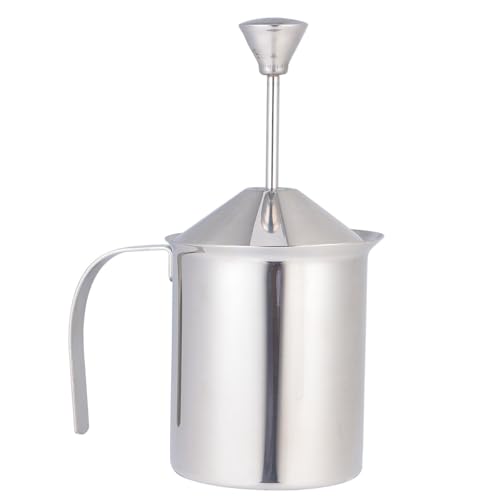
Manual Frother Double Mesh Pitcher — Best Double Mesh Foam
The double-mesh pitcher attacks the foam’s texture directly: two screens on the plunger instead of one, so each stroke works the milk twice, breaking the bubbles finer as they form. Fine bubbles are the whole game in milk foam, the difference between a glossy foam that pours and a froth of large bubbles that sits on the drink like washing-up water, and this pitcher’s listing aims it at latte and cappuccino work with whole or skim milk named.
In stainless steel, it shares the steel family’s temperament, warmth kept, progress hidden, knocks forgiven. The second mesh adds a small cleaning consideration, since foam caught between screens wants a rinse promptly and an occasional separation for a proper wash, and the owner who keeps that habit will never notice the cost. The Manual Frother Double Mesh Pitcher is the texture enthusiast’s pick among the steel three.
Its listing, in the text supplied, gives no headline capacity, so the buyer should confirm the vessel’s size on the listing page and plan the working fill at the usual fraction of it. That small homework aside, the double mesh is the one engineering variation in this guide that a blind tasting of foams might actually detect, and for the drinker who cares about the foam’s fineness above all, it is the argument that matters.
- Mechanism: double mesh hand pump
- Material: stainless steel pitcher
- Milks named: whole and skim
- Drinks named: latte, cappuccino
- Capacity: not stated in listing text
- Heating: none; warm the milk separately
Strengths
- Double mesh builds finer bubbles
- Steel durability and heat keeping
- Works with whole or skim milk
Trade-offs
- Capacity unstated; check the listing
- Two meshes to rinse promptly
- Foam hidden during pumping
Best for: foam-texture perfectionists. Not suited for: buyers who need a stated size before ordering.

Manual Frother Glass Hand Pump — Best Marked Glass Pump
The final pick returns to glass with a practical twist: a hand-pump frothing pitcher in glass and stainless steel with capacity marks built into the pitcher, and a listing that describes the glass as heat-resistant and the pitcher as serving hot and cold milk frothing. The marks are the feature. Every frother in this guide depends on the fill level for its foam, and this one prints the levels on the vessel, ending the guesswork that makes a new owner’s first attempts overflow or underperform.
Glass plus marks makes this the second teacher in the set, and the better one for the methodical cook: fill to the printed line, pump, and watch the foam climb against the scale, learning in numbers what the Bodum teaches by eye. Cold frothing for iced drinks is in its brief alongside the hot, and the stainless pump hardware keeps the working parts in the durable material while the vessel stays transparent.
Its cautions are glass’s cautions, respect for knocks and for sudden temperature changes, softened by the heat-resistant description but not abolished by it. Warm milk, not boiling, remains the rule for foam and vessel alike. The household that wants measurement without electronics, a manual frother that documents itself, has its pick, and it is a fittingly transparent note on which to end the six.
- Vessel: glass with capacity marks
- Hardware: stainless steel hand pump
- Glass described as: heat-resistant
- Use named: hot and cold milk frothing
- Capacity: marks on pitcher; see listing
- Heating: none; warm the milk separately
Strengths
- Printed marks end fill guesswork
- Foam and level both visible
- Hot and cold frothing in its brief
Trade-offs
- Glass care rules apply
- No headline capacity figure
- Marks help only owners who read them
Best for: methodical learners and measurers. Not suited for: rough-and-tumble shared kitchens.
How Do the Six Manual Frothers Compare Side by Side?
The heating column carries the guide’s central honesty in one word per row, and the capacity column prints only what the listings state, because a frother’s size decides how many drinks a morning it can serve.
| Pick | Vessel | Capacity stated | Heats milk? | Standout trait |
|---|---|---|---|---|
| MERMOO Stovetop Milk Frother | 304 stainless, stovetop | 14oz | Yes, on a burner | Camping and travel |
| MOPFOL Manual Milk Frother 400ml | Stainless steel | 400ml | No | Easy-clean workhorse |
| Fino Milk Creamer Frother | 18/8 stainless pitcher | 14-ounce | No | Handle, lid, table service |
| Bodum Latteo Manual Frother | Glass carafe | 8 ounce | No | Single-drink teacher |
| Manual Frother Double Mesh Pitcher | Stainless, double mesh | Not stated | No | Finest bubble aim |
| Manual Frother Glass Hand Pump | Glass, marked pitcher | Marks on vessel | No | Printed fill levels |
How Do You Warm Milk for a Manual Frother Without Ruining It?
Since five of these six vessels cannot heat, the warming is the cook’s first job, and it has one rule with two reasons: warm the milk to hand-hot, roughly the temperature of a good bath, and no further. Foam built from milk in that range is fine, sweet and stable, because the proteins are supple and ready to hold air. Milk taken to the boil foams reluctantly, forms a skin, and tastes cooked in the cup, three punishments for one impatience.
A small pan on a low heat with the milk swirled is the classic method, judged by steam just rising and the pan’s side too hot to hold a palm against comfortably. A microwave works in short bursts with a stir between them, since its hot spots will scorch an unattended jug. Either way, foam promptly while the milk is at its moment, because warmed milk waits badly, cooling toward the temperature at which the foam comes out coarse and brief.
What Is the Plunger Technique That Makes Fine Foam?
Begin with the mesh below the milk’s surface and the vessel filled to its working third. Pump with full, steady strokes for the first phase, drawing the mesh through the whole depth so air is worked through the body of the milk rather than whipped on its surface. The milk’s level will climb as the foam builds, visibly in the glass pair, and by feel, a thickening resistance, in the steel three.
Finish with shorter strokes keeping the mesh just beneath the surface, which polishes the foam and breaks the largest bubbles, then let the vessel stand for half a minute while the foam settles into its layers. A gentle swirl and a tap on the counter collapse the stragglers. The whole performance takes under a minute, and after a week of mornings the wrists know it the way they know a signature, which is the manual category’s quiet promise: skill instead of settings.
How Much Milk Should You Actually Put In?
Less than instinct says. Foaming at least doubles the milk’s volume and a good foam can do more, so the working fill is about a third of the vessel: in the 14-ounce pitchers, enough for the drinks planned and no more; in the Bodum’s 8 ounces, a single drink’s worth; at the printed marks of the glass pump, the line the maker has drawn from exactly this arithmetic. Overfilling does not make more foam; it makes a foam volcano, a sticky counter and a plunger fighting for room to move.
Underfilling fails more quietly, the mesh breaking the surface and whipping large, unstable bubbles instead of working the milk’s body. The marks and the third-rule exist to keep the cook between those two failures. Measure the milk for the first week, in a jug, before pouring it in, and the eye learns the levels faster than any instruction can teach them.
Steel or Glass: Which Vessel Suits Your Kitchen?
Steel keeps the milk’s warmth while the coffee brews, survives the drawer and the campsite, pours at the table without apology and hides the foam completely. Glass shows the foam’s birth and growth, teaches the technique faster than any book, keeps no flavours from yesterday’s drink, and fears the knock, the cold counter under hot milk and the careless sink. The shortlist is built three and three, counting the stovetop MERMOO with the steels, because neither material wins the argument outright.
Choose by the cook’s honest habits. The household that froths daily in a busy kitchen, with children unloading dishwashers and pans in rotation, belongs to steel. The household of one or two careful drinkers, frothing at a calm counter, gets more from glass, including the small daily pleasure of watching the foam rise, which should not be discounted: pleasures repeated daily are what kitchens are for.
How Do You Froth Plant Milks and Skimmed Milk by Hand?
The MERMOO’s listing names non-dairy milks outright, and the double-mesh pitcher names skim, so the category expects the question. Skimmed milk foams eagerly and largely, its foam stiff and dry, excellent for a cappuccino’s dome and quick to collapse in a latte if left standing. Whole milk foams slower and silkier. The hand pump treats both honestly, and the cook adjusts the rhythm, gentler and longer for whole milk’s finer result.
Plant milks divide by formulation. Barista editions, built with the proteins and stabilisers the job needs, foam respectably in any of these vessels; standard plant milks foam thinly and briefly, and are best frothed cold or barely warmed and served immediately. The manual method has one advantage here: the cook feels the foam’s body through the plunger and can stop at its peak rather than at a timer’s guess, a small mercy that matters most with the least cooperative milks.
How Should a Manual Frother Be Cleaned and Stored?
Rinse it now is the whole law and the prophets. Milk foam rinsed in the minute after pouring is warm water’s easy work; the same foam dried for an hour is a scrubbing commitment, and dried between a double mesh it is an archaeological dig. A drop of washing-up liquid and a pump-through of hot soapy water cleans the mechanism in its own language, followed by clear rinses and air drying with the plunger up.
Store the vessel dry and assembled loosely rather than sealed tight, so no stale air moves in. Glass vessels live where they will not be the first thing a falling pan meets; steel lives anywhere. There are no descaling rituals, no filters to buy and no error codes to appease, and across a year that absence is worth more than any single morning’s foam. The manual frother’s maintenance budget is thirty seconds a day, paid in rinsing.
Can a Manual Frother Travel, and Which of the Six Travels Best?
Travel is where the category’s lack of electricity stops being frugality and becomes freedom. The MERMOO was listed for camping and travel by its own maker and earns it, heating on the camp stove that is already there. The steel pumps travel nearly as well, needing only a way to warm milk, a pan over the same stove or a kettle’s mercy in a holiday kitchen, and they pack without the anxiety glass carries.
The glass pair travel as hand luggage decisions rather than as campers: to a self-catering cottage in a padded bag, gladly; in a rucksack over a mountain pass, no. Whichever vessel travels, the coffee it serves at the destination tastes of the household’s own standard rather than the accommodation’s compromise, and travellers who care about the first morning’s cup will find the space. Few objects this small return so much of home, so far from it.
How Do You Make a Cappuccino’s Foam Versus a Latte’s?
The two drinks ask the same vessel for different foams. A cappuccino wants volume, a deep cap of airy foam that domes the cup and takes a dusting of cocoa standing up; pump longer, with the mesh travelling the full depth, and let the foam be generous. A latte wants silk, a thinner layer of dense, pourable foam that merges with the steamed milk beneath it; pump less, finish with the short polishing strokes, and swirl the vessel so the foam and milk marry before the pour.
The manual method’s advantage shows clearly here, because the cook’s hand feels the foam’s body changing through the plunger and can stop at the drink’s requirement rather than at a programme’s assumption. One vessel thereby covers both drinks honestly, which is more than some electric frothers with their fixed cycles manage. Learn the two foams in the glass vessels if you can; the wrists remember what the eyes have seen.
What Is the Right Vessel Size for Your Household’s Real Morning?
Count drinks, not people, and count them at the morning’s peak rather than its average. A household of two latte drinkers needs the 400ml or 14-ounce class working at its comfortable fill; a household of one needs the Bodum’s 8 ounces and will resent washing a pitcher built for four. The guest question cuts the other way: the frother that serves the household perfectly may serve a table of six in relays, which is fine if the host enjoys the ritual and a bottleneck if breakfast is a production line.
Remember the expansion rule when translating: the stated capacity is the vessel, not the serving. A buyer who reads 14 ounces as seven lattes’ worth of milk has misunderstood the physics and will meet the foam volcano described earlier. Read every capacity in this guide as roughly three servings at the very most, two comfortably, and the arithmetic of the shortlist falls into place.
How Do You Pour Hand-Frothed Milk Like You Mean It?
Pour promptly, from a height at first to dive the milk under the espresso’s surface, then lower and faster to lay the foam across the top. The steel pitchers pour best of the six, their lips shaped by the jug tradition, which is one reason the Fino carries its foam to the table like a sauce. Glass vessels pour adequately and honestly, and their owners learn to finish the drink with a spoon’s help for the last of the foam, without shame.
Latte art, in its modest home form, is not forbidden to the hand frother: the fine, glossy foam from a well-worked double mesh or a polished steel pitcher will hold a heart or a rosetta for the drinker who practises. What the manual method will not do is rescue foam that was built coarse; art begins at the plunger, not at the pour. Practise on the morning cup, where the audience is kind, and the skill arrives by accumulation.
How Should You Froth for Children and for Cocoa Drinkers?
The manual frother’s second career is the children’s table: warm milk frothed for cocoa, for a babyccino of foam and a dusting of chocolate, for the small ceremonies that make a kitchen feel generous. Hand power suits this work exactly, no scalding steam wand at child height, no machine cycle to wait for, and the glass vessels let a young helper watch the foam rise as if it were a science lesson, which it quietly is.
Mind the temperatures with more care than for adults, warming the milk to gentle rather than to the coffee drinker’s hand-hot, and let the foam’s theatre carry the drink. The household that froths for cocoa discovers the vessel earns its drawer space twice a day in winter, and the cost per use, already trivial, halves again. Categories of kitchen tool that serve both the dawn espresso and the evening cocoa are rarer than they should be.
What Does the Mesh Do Over Years, and When Is It Tired?
The mesh screen is the wearing heart of every pick here: it flexes through milk thousands of times, meets the occasional careless knock against the vessel’s rim, and slowly loses the crispness that cuts fine bubbles. The signs of tiredness are a foam that comes out coarser than the same technique once produced, a plunger that feels uneven in its travel, and a screen that no longer sits flat or true on its frame.
Care postpones the day considerably. Rinse promptly, never scrub the mesh with anything abrasive, dry it in the air rather than in a towel’s fibres, and store the plunger where it will not be bent by the drawer’s traffic. When the day does come, a frother whose maker sells the plunger assembly as a part is a frother with a second life; check the listing for that detail if longevity matters, since the vessel itself will outlast several screens.
How Do You Froth in a Kitchen With No Hob Space to Spare?
Small kitchens choreograph their mornings tightly, and the manual frother fits the choreography better than its electric rivals because it stores in a drawer and works wherever it is set down. The milk warms in the microwave in the same mug’s cousin, a small jug, while the coffee brews; the frothing happens on the board; the vessel rinses under the tap and vanishes. No appliance has been given a permanent address on the counter, which in a small kitchen is the highest compliment a tool can earn.
The MERMOO is the exception that proves the choreography, since it claims the hob for its few minutes and returns it immediately, still a better tenant than a countertop machine. Households counting sockets rather than burners will find even that trade favourable. The category’s whole design assumes kitchens are busy places, and rewards the ones that are.
Can Hand-Frothed Milk Improve Instant and Moka Coffee?
Emphatically, and this may be the manual frother’s largest real congregation. The moka pot’s strong coffee under a cap of hand-frothed milk is a drink with a century of Mediterranean mornings behind it, and instant coffee, honestly frothed milk’s easiest partner, is transformed from a compromise into a choice by thirty seconds of plunging. Neither drink needs an espresso machine’s permission to wear foam.
This matters for the buyer deciding whether the category is worth a drawer. The frother does not serve the espresso machine; it serves the milk, and the milk serves every coffee the household makes, from the capsule drink of the previous guide to the camping percolator. Judge the purchase against all the cups it will crown in a week, not only against the most elaborate one, and its value settles itself.
How Do You Keep the Rhythm When Making Four Drinks in a Row?
Work like a small cafe: warm the milk in one batch sized for the round, froth once in the largest suitable vessel, and pour the drinks in sequence while the foam is at its peak, rather than frothing four small batches and letting the first three wait. The steel 14-ounce pitchers earn their size here. Between rounds, the mesh wants its rinse even more than between days, since foam from the first round will seed the second with yesterday’s bubbles, in miniature.
Stage the cups, the coffee and the cocoa for dusting before the milk is warm, because hand-frothed foam waits for nobody and the pour is the performance. Hosts discover that guests enjoy watching the plunger work, a small theatre no machine matches, and that the manual method’s supposed slowness is mostly a story told by people who have not watched a practised hand make four cappuccinos in the time a machine takes to think.
What Should a Buyer Check on the Listing Before Ordering?
Confirm the capacity in the maker’s own figures rather than in a marketplace headline, the vessel’s material and grade where stated, whether the plunger and mesh come apart for washing, and the care instructions for glass. For the double-mesh pitcher in this guide, whose listing text supplied no headline capacity, that confirmation is the purchase’s first task rather than an optional refinement.
Check also what the vessel is not: not a heater, except where the stovetop design says so; not dishwasher-mandated, whatever the steel suggests, since meshes prefer the rinse described here; and not sized by its brim. A buyer who spends four minutes on those confirmations will receive exactly the instrument the reviews describe, and in this category of simple, honest tools, that is the whole of the law.
How Does Season Change the Frother’s Work?
Winter is the frother’s high season, hot drinks in rotation and cocoa for the children, and the vessel earns its keep daily. Summer moves it to the cold work, foaming cold milk for iced coffees and lending its pump to cold foam toppings, a second career the glass pump’s listing names outright. The steel vessels, straight from a cool cupboard, keep cold milk cold through the frothing better than glass that has sat in a warm kitchen.
The seasonal rhythm also governs care: a frother used twice daily all winter wants its mesh inspected monthly, while the summer’s lighter use is the time for the deep clean and the honest assessment of the screen’s crispness. Tools with seasons are tools that belong to a household’s year rather than to a fad, and the manual frother, older than every electric rival, has the longest year of all.
Why Does This Category Survive Every Electric Challenger?
Because its proposition is not nostalgia but arithmetic. It costs little, stores in a drawer, consumes nothing, breaks in no way that matters, cleans in seconds, travels anywhere and teaches its owner a skill that transfers to every kitchen on earth. Electric frothers win on effort, genuinely, and for many households that win is decisive; but the manual frother’s constituency renews itself with every camper, student, sailor, minimalist and careful cook who does the sum.
The six picks here are that constituency’s current honour roll, from the stovetop traveller to the marked glass teacher. None of them will ever need a firmware update, a descaling tablet or a service centre, and the foam they make this morning is made by the same motion that made it a century ago. Some technologies are not waiting to be replaced; they are waiting to be noticed, usually at the moment the kettle boils and the milk is already warm.
How Do You Froth for a Crowd at a Holiday Breakfast?
Holiday breakfasts concentrate every demand: more drinks, more variety, an audience in pyjamas, and a cook who is also hosting. The manual method scales by rhythm rather than by machinery. Warm a generous pan of milk once, work in the largest steel vessel in relays, and set a willing guest to plunging, since the task is the rare kitchen job a novice performs perfectly after one demonstration and visibly enjoys. Cocoa for the children comes from the same pan, frothed in the glass vessel where they can watch it.
The host’s real enemy is sequence, not scale: coffee brewed too early cools while milk waits, and milk frothed too early settles while coffee brews. Alternate in small waves, two drinks at a time, and let the table’s conversation carry the intervals as it does in a cafe. The morning will feel unhurried even at twelve cups, which is the manual frother’s party trick, turning its supposed limitation into the pace of the occasion itself.
What Is the Difference Between Foam, Froth and Microfoam at Home?
The words describe a spectrum the hand learns before the vocabulary arrives. Froth is the coarse end, large bubbles, dry and light, quick to make and quick to vanish, at home on a cocoa. Foam is the middle, finer and wetter, the cappuccino’s cap and the latte’s blanket in these vessels. Microfoam, the glossy, paint-like extreme of the steam-wand world, is approached by the best hand work, the double mesh’s polished finish, without being fully claimed, and this guide does not claim it.
Knowing the spectrum lets the cook aim. Most home drinks live happily in the middle band, and the plunger’s finishing strokes are the steering wheel that moves a given batch along it. The drinker who once wanted only volume usually migrates toward the finer end within a month of mornings, which is why the teachers in this shortlist, the glass pair, matter: they make the spectrum visible while the hands are still learning.
How Should the Frother Share a Drawer With the Rest of the Coffee Kit?
Give it the front of the drawer, because a tool used daily and stored behind the melon baller will be used weekly. The plunger stores assembled in its vessel for most of these designs, compact and self-contained, and the whole instrument asks for less room than the mug it serves. Households that keep the frother beside the coffee, rather than beside the pans, find the morning’s choreography shortens by the small distances that actually compose it.
Protect the mesh in storage as the one delicate part: no heavy pan resting on the plunger, no cutlery poured into the vessel. A frother stored kindly is ready at the reach of a hand, and readiness is the quality that decides whether the manual method survives its first month in a real kitchen. Survive that month and it becomes the way things are done, which is the only victory any kitchen tool is really after.
One Last Plunge: Deciding Between the Six
Run the six past your own kitchen in imagination, at its busiest honest moment. The camper and the single-vessel cook stop at the MERMOO without needing the rest of the page. The daily couple land on the MOPFOL or the Fino by whether the foam travels to a table. The texture devotee takes the double mesh and accepts its homework. The learner, and the cook who simply loves watching milk become foam, take glass, by size or by printed marks.
What none of the six will do is disappoint by complication, because there is nothing in any of them to go wrong beyond a tired mesh years from now. Choose the one whose morning you can picture, warm the milk gently, and begin. The first foam is allowed to be imperfect; the tenth, made by hands that have learned the rhythm, will be the reason the electric frother stays in its box.
A Short Word on Lids, Handles and Other Small Mercies
The details that listings mention last are the ones hands notice first: a lid that keeps the foam’s warmth in during the pour’s preparation, a handle that stays grippable when the vessel is full of hot milk, a rim that pours without a dribble down the steel. Judge the six with those mercies in mind when the listings are side by side, because a frother is handled twice a day at close quarters, and small kindnesses in its design compound across a year exactly as small annoyances do.
What Mistakes Do Manual Frother Buyers Make Most Often?
The founding mistake is expecting the frother to heat the milk, then blaming the vessel for cold foam; only the stovetop MERMOO heats, and it does so as a pan. The second is filling to the brim in defiance of the expansion arithmetic, redecorating the counter in foam. The third is boiling the milk first, which ruins the foam and the flavour in one act of impatience, and the fourth is pumping like the vessel owes money, whipping large bubbles that collapse in the cup.
Care mistakes are the usual pair: the unrinsed mesh left to dry into concrete, and the glass carafe shocked with boiling milk or set on a cold stone counter. Every one of these errors is answered in the technique sections above, and every one is made exactly once by most owners, which is the honest tuition this category charges. Pay it in the first week and the frother is free for years.
Final Recommendation
Choose by heat, then by hand. If one vessel must warm and foam, the MERMOO stands alone, on the stovetop at home and the camp stove away. If the milk is warmed elsewhere, as most kitchens warm it, the steel MOPFOL and Fino serve daily and hosting duties, the double-mesh pitcher chases the finest foam, and the glass Bodum and marked pump teach the craft while they perform it, one careful drink at a time.
Whichever vessel joins the kitchen, fill it a third, warm the milk gently and rinse the mesh before the foam dries. Keep those three small faiths and the plunger will repay them every morning, in foam made by hand, in silence, at exactly the pace of the person drinking it.
Frequently Asked Questions
Does a manual frother heat the milk?
No, with one named exception. Five of the six picks foam milk that you warm separately or serve cold. The MERMOO is a stovetop vessel that warms its milk on a burner first and then froths it, which is why this guide flags it in every relevant section rather than letting the exception blur the rule.
How long does hand frothing take?
Under a minute of pumping for most quantities in this guide, after a few mornings of practice. The milk’s warming takes longer than the frothing on most days. The rhythm described in the technique section, full strokes then short finishing strokes, matters more to the result than any extra time spent pumping.
Why did my foam collapse in the cup?
The usual causes are milk taken too hot, which foams coarsely and briefly, a vessel overfilled so the mesh whipped the surface instead of working the body, or a pause between frothing and pouring while the foam drained. Warm gently, fill a third, pour promptly, and the foam will hold its side of the bargain.
Can I froth cold milk for iced drinks?
Yes. Cold frothing is in the brief of the glass hand pump and suits the steel vessels too, producing a lighter foam that sits happily on iced coffee. Work the plunger a little longer than for warm milk, since cold milk builds its foam more slowly, and serve at once over the ice.
Which pick is best for a complete beginner?
One of the glass pair, because the teacher you can watch beats the teacher you cannot. The Bodum Latteo suits the single drinker; the marked glass pump suits the measurer. Learn the rhythm where the foam is visible, and every steel pitcher afterwards becomes an instrument you already understand.
How is a manual frother different from a battery whisk?
The whisk spins in the milk and makes a quick, coarse foam with a motor’s help and a battery’s lifespan. The plunger frothers here work a mesh through the milk by hand, building a finer, more durable foam with no power at all. They are different tools sharing a goal, and this guide’s category is the hand-worked one.
Related Guides
Finish the coffee shelf and the rooms beyond with our guides to Best Dutch Ovens That Are Not Cast Iron Best Cozy Slippers Best 36 Inch Refrigerators



[…] same measure-first thinking to cleaner air and better mornings: Best Air Purifiers for 1500 Sq Ft, Best Manual Milk Frothers and Best Luxury Oversized Bath […]