What's inside
- Key Takeaways
- Quick Picks
- How Did We Choose the Best Shop Towels for This List?
- Which Shop Towels Handle Each Garage Job Best?
- Comparison Table
- What Should You Look for When Buying the Best Shop Towels?
- How Do You Wash and Organize Shop Towels So They Last?
- Which Towel Belongs on Which Surface of the Car?
- How Does a Towel Rotation Work Across a Real Week in the Garage?
- What Mistakes Do People Make With Shop Towels?
- How Should You Store Shop Towels Between Jobs?
- What Does a Sensible Shop Towel Budget Look Like Over a Year?
- Can Shop Towels Pull Double Duty Around the Rest of the House?
- How Do Folding and Technique Change What a Towel Can Do?
- Which Seasonal Jobs Test a Towel Drawer the Hardest?
- What About the Jobs Nobody Puts on the Box?
- Final Recommendation
- Frequently Asked Questions
- Related Guides
As an Amazon Associate I earn from qualifying purchases. This post may contain affiliate links at no extra cost to you.
cottageverdict.com is reader-supported. When you buy through links on our site, we may earn an affiliate commission.
Where to buy: Every linked pick below is sold through Amazon, where you can check price on Amazon and confirm the current pack count before ordering. Shop towels are a consumable as much as a tool, so buying the right format in the right quantity matters more than chasing a fancy brand name.
A Saturday spent changing brake pads teaches you something no product photo can: the best shop towels are the ones you stop thinking about. They soak up the puddle of oil creeping toward your shoe, they survive being dragged across a gritty caliper bracket, and they do not leave a trail of lint across a freshly cleaned throttle body. The wrong towel, by contrast, pushes dirty fluid around in circles, shreds on the first bolt head it meets, and turns a twenty-minute job into an hour of picking fibers out of a gasket surface.
This guide sorts the garage towel drawer into three honest families. First come the microfiber workhorses, sold in triple-digit packs, that handle glass, paint, and general grime without scratching. Then there are the plain cotton rags that mechanics have trusted for generations, the ones you can bleach, boil, and abuse. Finally there is the heavy paper-style roll that lives on the wall dispenser and gets torn off when a spill is simply too filthy to wash back into your laundry. Six picks cover all three families, and each one earned its place for a different corner of the shop.
It also helps to abandon the idea that one miracle towel will cover the whole building. Professionals never worked that way: body shops separate polishing cloths from prep rags, machine shops separate the wipers near the lathes from the ones near the wash tank, and dealerships keep interior towels in a different room from the underbody crew’s supplies. A home garage is smaller, but the physics of grit and grease do not scale down with the square footage. Six picks, three families, clear ranks — that structure is the entire secret, and the rest of this guide simply walks through it in work clothes.
One boundary before we start: towels that live in the garage should stay in the garage. A rag that has wiped up transmission fluid does not belong near a cutting board, no matter how many wash cycles it has survived. Several picks below are marketed for home use too, and they are fine for that — as long as you dedicate them to one world or the other from day one and never let the two laundry piles mix.
Key Takeaways
- Microfiber packs in the hundreds suit paint, glass, and interior work where a scratch-free wipe matters most.
- Plain cotton rags remain the toughest choice for grease, because they tolerate hot washes and bleach without melting or shedding their structure.
- Red cotton towels exist for a reason: the color hides staining and makes the garage pile instantly recognizable in a mixed laundry room.
- Disposable paper shop towels earn their keep on the worst spills — solvents, gear oil, paint — where washing the mess back in makes no sense.
- Small squares around eleven to fourteen inches cover most bench jobs; oversized towels mostly bunch up and waste material.
- Sorting towels by task, not by cleanliness, extends their useful life more than any washing trick.
Quick Picks
| Pick | Badge | Why it made the cut |
|---|---|---|
| FIXSMITH Shop Towels Microfiber 200 Pack | Best Bulk Microfiber | Two hundred small squares mean a fresh, clean face for every panel and window without rationing. |
| HOMERHYME Microfiber Cleaning Cloth 100 Pack | Best for Mixed Garage and Home Duty | A hundred lint-free cloths that move from dashboard dust to countertop spills without leaving streaks behind. |
| Simpli-Magic Cotton Shop Towels White 145 Pack | Best White Cotton Value | Plain white cotton in serious quantity, ready to be bleached back to presentable after ugly jobs. |
| Nabob Wipers Mechanic Shop Towels White 25 Pack | Best Heavy Cotton Rag | A smaller count of sturdier fourteen-inch squares built for mechanics who wash and reuse for months. |
| Utopia Cotton Shop Towels Red 100 Pack | Best Color-Coded Rag | The classic red shop rag in a hundred-count box, easy to spot and forgiving of permanent stains. |
| Scott Shop Towels Original Roll | Best Disposable Option | Tear-off paper towels tough enough for oil and solvent, made to be thrown away without regret. |
How Did We Choose the Best Shop Towels for This List?
We started with the jobs, not the marketing. A working garage asks a towel to do four distinct things: absorb liquid quickly, trap grit without grinding it into paint, survive abrasive hardware, and come out of the wash ready to repeat the cycle. Any candidate that only solved one of those four had to justify itself as a specialist, the way the disposable roll does. Everything else needed range.
Fiber came next. Microfiber splits into fine strands that grip dust and polish cleanly, which is why detailers love it, but it melts near exhaust heat and holds onto metal shavings stubbornly. Cotton terry and flat-weave cotton shrug off heat, tolerate bleach, and release debris in the wash more willingly, at the cost of some lint and slower drying. Neither fiber wins outright; the honest answer is that a well-run shop keeps both within arm’s reach.
Pack economics mattered too, in a qualitative sense. A towel you are afraid to use because the pack felt expensive is a towel that fails at its only job. We favored counts that let you grab freely — hundreds for microfiber, dozens to over a hundred for cotton — and sizes that fold into a palm-sized pad, because that folded pad, not the flat sheet, is how a shop towel actually gets used on a bench.
Finally, we weighed washability as a real-world trait rather than a label claim. Towels that demand precious handling lose in a garage. The picks below go through ordinary machine washing, and the cotton ones accept the hot water and bleach that greasy work eventually requires. Where a maker warns against fabric softener or high dryer heat, we say so in the pick itself, because that single habit quietly ruins more microfiber than any spill ever will.
Which Shop Towels Handle Each Garage Job Best?
Before the individual reviews, it helps to picture the rotation. Keep microfiber near the detailing shelf and the toolbox top, where the work is about clean surfaces: glass, chrome, painted panels, phone screens on the workbench. Keep cotton rags in a bin beside the lift or the jack stands, where fluids and grit rule. Keep the disposable roll mounted where spills happen fastest, usually near the oil drain pan and the parts washer. When each towel type lives where its strength applies, you stop ruining good microfiber on axle grease and stop wasting cotton on a windshield that needed a lint-free finish.

FIXSMITH Shop Towels Microfiber 200 Pack — Best Bulk Microfiber
Two hundred towels changes your behavior, and behavior is the whole point. When the stack feels endless, you flip to a clean face the moment one side loads up with grime instead of grinding that grime across the next surface. These squares measure about eleven and a half inches per side, which folds neatly into quarters for a padded grip, and the microfiber face lifts dust, fingerprints, and dried wax residue without dragging scratches across clear coat.
In a garage context, this pack shines on the finishing half of every job: wiping down a dashboard after a cabin filter swap, clearing the film off the inside of a windshield, polishing chrome trim, drying a motorcycle tank. The edges hold up through repeated laundering better than the bargain-bin microfiber most of us have melted in a hot dryer. Keep them away from underbody work, though. Once microfiber picks up a curl of metal swarf, that curl is nearly impossible to wash out, and the towel becomes a scratch waiting to happen. Dedicate this pack to clean-side tasks and it will serve for a long time.
- Material: microfiber
- Size: about 11.5 x 11.5 inches per towel
- Count: 200 towels
- Care: machine washable; skip fabric softener to protect absorbency
Strengths
- Huge count encourages using a fresh face instead of spreading dirt around.
- Fine fibers leave glass and glossy paint genuinely streak-free.
- Compact squares store flat in a drawer, bin, or glove box.
Trade-offs
- Not the tool for heavy grease; oily loads wash out of microfiber reluctantly.
- Heat is an enemy — a hot dryer cycle shortens the life of the fibers.
- Small size feels skimpy for mopping a large spill on the floor.
Best for: detailers and tidy garages that go through many light-duty towels every week. Not suited for: mechanics who need one rag to survive a transmission teardown.

HOMERHYME Microfiber Cleaning Cloth 100 Pack — Best for Mixed Garage and Home Duty
Some households run one towel economy for the whole property, and this hundred-pack is built for that reality. The cloths are the same handy eleven-and-a-half-inch square format, absorbent enough to take on a spilled mug of coffee or a coolant dribble with equal calm, and the maker positions them for cars, garages, kitchens, and general house cleaning. The lint-free claim matters most on screens and glass, where these leave a cleaner finish than a cotton rag pulled from the same drawer.
The honest way to use a crossover pack like this is to split it on arrival. Put half in the garage and half in the house, and never let the halves trade places. The garage half will meet oil eventually, and oil-stained microfiber that migrates back to the kitchen is exactly how good cloths get thrown out in disgust. Split early, and each half ages gracefully in its own world: the house half stays bright and soft, the garage half becomes the trusty stack for wheels, door jambs, and engine-bay dust that has not yet turned to sludge.
- Material: microfiber
- Size: about 11.5 x 11.5 inches per cloth
- Count: 100 cloths
- Care: machine washable; avoid softener and high heat
Strengths
- Versatile enough to justify one bulk purchase for house and garage together.
- Absorbs spills quickly instead of pushing liquid across the surface.
- Leaves mirrors, windows, and screens free of lint trails.
Trade-offs
- Half the count of the biggest microfiber pack, so heavy users reorder sooner.
- Like all microfiber, it grabs onto burrs and shavings permanently.
- Needs its own wash routine if you want the absorbency to last.
Best for: households that want one dependable cloth for the car, the bench, and the counter. Not suited for: dedicated heavy-grease work where cotton rags take the punishment better.
Simpli-Magic Cotton Shop Towels White 145 Pack — Best White Cotton Value
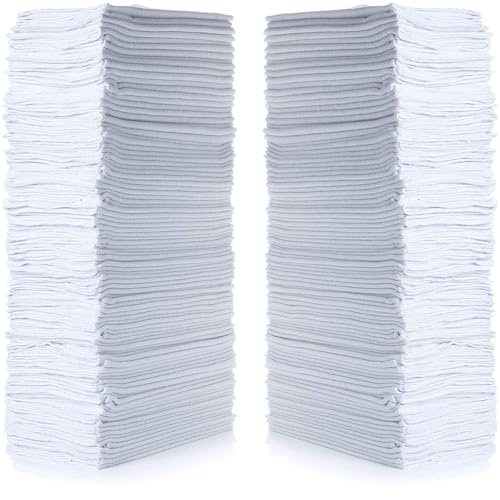
White cotton is the oldest language a shop speaks. These flat cotton towels, roughly fourteen by twelve inches, come in a stack of well over a hundred, and their virtue is transparency: you can see exactly how dirty one is, you can bleach it back toward white, and you never wonder whether it is clean enough for the next task. Painters like this style for wiping stain and checking color; mechanics like it because cotton tolerates the hot, aggressive washing that greasy work demands.
Flat-weave cotton behaves differently from terry. It slides under parts, wraps around a dipstick cleanly, and does not leave loops snagged on bolt threads. It also works as a clean surface itself — lay one under a carburetor you are rebuilding and small parts stay visible and off the gritty bench. Over months of service these will gradually thin and develop the odd hole, at which point they retire gracefully to one last duty as disposable rags for paint or adhesive. That full lifecycle, from precision work to final filthy job, is what makes a big white cotton pack such good value in practice.
- Material: cotton
- Size: about 14 x 12 inches per towel
- Count: 145 towels
- Care: machine washable; bleach-safe white cotton
Strengths
- White fabric shows soil honestly and bleaches back for a fresh start.
- Flat cotton slips into tight spaces and wraps small parts neatly.
- Generous count supports a long rotation between laundry days.
Trade-offs
- Flat weave absorbs less per towel than a thick terry rag.
- White shows every stain that bleach cannot fully lift, even when clean.
- Edges and weave thin gradually under constant heavy use.
Best for: painters, woodworkers, and mechanics who bleach their rags as a routine. Not suited for: anyone wanting a plush, high-pile towel for drying a car body.

Nabob Wipers Mechanic Shop Towels White 25 Pack — Best Heavy Cotton Rag
Where the big packs trade on quantity, this one trades on substance. Twenty-five fourteen-inch squares of commercial-grade cotton does not sound like much until you pick one up: the weave feels denser, the towel holds its shape when soaked, and it wrings out with a satisfying resistance that flimsier rags never offer. This is the rag you reach for when you are packing grease into a bearing by hand or wiping down a freshly honed surface.
A smaller, sturdier fleet changes how you care for towels, too. With twenty-five in rotation you actually learn each one’s condition; the frayed veteran becomes the designated underbody rag, while the sound ones stay on the bench. Commercial users — the small repair shops and fleet garages this pack is aimed at — wash these hard and often, and the cotton rewards that treatment by softening without collapsing. If your garage work leans mechanical rather than cosmetic, a modest stack of serious rags beats a mountain of thin ones.
- Material: 100% cotton
- Size: about 14 x 14 inches per towel
- Count: 25 towels
- Care: machine washable; stands up to hot washes
Strengths
- Dense cotton survives the twisting and wringing that shreds lighter rags.
- Generous square size covers a palm and a part at the same time.
- Built for repeated commercial-style laundering without falling apart.
Trade-offs
- Only twenty-five towels, so a busy weekend can exhaust the clean stack.
- Heavier cotton dries more slowly on the line than microfiber.
- White fabric carries permanent shadows from the dirtiest jobs.
Best for: hands-on mechanics who wash and reuse a small fleet of tough rags. Not suited for: high-volume shops that burn through dozens of towels a day.

Utopia Cotton Shop Towels Red 100 Pack — Best Color-Coded Rag
There is a reason the red rag became the universal symbol of the working garage. The dye forgives what no wash can remove, so a red towel can be perfectly clean and still look ready for duty, while a white towel in the same condition looks retired. These twelve-by-fourteen cotton towels come a hundred to the pack, absorb water, oil, and grease willingly, and wash back into service without ceremony.
The color does a second, quieter job: it codes your laundry. Red means garage, full stop. Nobody folds a red shop rag into the bathroom stack by mistake, and nobody grabs one to dry dishes at a family cookout. In a shared household that simple signal prevents the one unforgivable towel error — a petroleum-tainted rag wandering into the kitchen. Tuck a few into the trunk kit and the mower shed as well; the color makes them easy to spot in a cluttered bin, and their cotton build handles the roadside jobs — checking oil at a rest stop, wiping a dipstick, kneeling on one beside a flat tire — without complaint.
- Material: cotton
- Size: about 12 x 14 inches per towel
- Count: 100 towels
- Care: machine washable and reusable; wash reds separately at first
Strengths
- Red dye hides staining, so clean towels still look serviceable.
- Color-coding keeps garage laundry unmistakably separate from household linen.
- Hundred-count pack keeps every corner of the shop stocked at once.
Trade-offs
- New red cotton can bleed dye in early washes if mixed with lights.
- Cotton leaves some lint on glass, so it is not your finishing towel.
- Absorbency is honest but not equal to thick terry on a huge spill.
Best for: busy home garages that want an unmistakable, forgiving everyday rag. Not suited for: paint finishing or glass work where lint shows immediately.

Scott Shop Towels Original Roll — Best Disposable Option
Every shop eventually faces a spill that should not enter the laundry at all: a quart of used gear oil, a splash of solvent, a paint can tipped across the floor. That is the moment this roll justifies its wall space. These paper-based shop towels tear off one at a time, feel noticeably tougher than kitchen paper, hold together when wet with oil, and then go straight into the bin carrying the mess with them.
The format shapes the habit. A roll on a holder above the bench means a towel is always one pull away, even with one hand occupied holding a drain plug. Used for wiping hands between stages, catching drips under a filter change, or lining a tray under a bleeding brake line, the sheets keep the reusable rags cleaner for longer, which stretches the whole towel budget. The trade is obvious and worth stating plainly: a disposable habit generates waste, and for routine dusting or drying it is the wrong tool. Treat the roll as the hazmat tier of your towel system — reserved for contamination, not convenience — and it earns its place without taking over.
- Material: paper-based disposable towel
- Format: perforated roll, 55 towels per roll
- Count: sold by the roll and in multi-roll cases
- Care: none — use once and discard
Strengths
- Strong when wet, so it survives wiping up oil without disintegrating.
- Disposal removes solvents and filthy fluids from your laundry entirely.
- Roll format keeps a fresh towel within reach mid-job.
Trade-offs
- Single use creates ongoing waste and an ongoing restocking chore.
- Not soft or fine enough for paint polishing or delicate surfaces.
- Per-towel value collapses if you reach for it for trivial dust.
Best for: fluid changes, solvent work, and spills too dirty to wash. Not suited for: anyone building a low-waste, reusable-only towel system.
Comparison Table
| Pick | Material | Count | Reusable? | Strongest use |
|---|---|---|---|---|
| FIXSMITH Microfiber 200 Pack | Microfiber | 200 | Yes | Glass, paint, detailing |
| HOMERHYME Microfiber 100 Pack | Microfiber | 100 | Yes | Mixed car and home cleaning |
| Simpli-Magic Cotton White | Cotton, flat weave | 145 | Yes | Bleachable general rags |
| Nabob Wipers Mechanic | Cotton, heavy grade | 25 | Yes | Grease and bench work |
| Utopia Cotton Red | Cotton | 100 | Yes | Everyday garage duty |
| Scott Original Roll | Paper-based | 55 per roll | No | Filthy spills and solvents |
What Should You Look for When Buying the Best Shop Towels?
Start with the fluid you spill most. Water-based messes — coolant top-offs, wash buckets, condensation — yield to almost anything absorbent. Petroleum messes are pickier: oil clings to cotton happily but loads microfiber in a way that ordinary washing only partly reverses, and solvents attack some synthetic fibers outright. If your weekends revolve around fluid changes, weight your drawer toward cotton and keep a disposable tier for the worst of it. If your work is mostly cleaning, detailing, and maintenance of things already in good shape, microfiber carries the day.
Then think about grit. A towel’s second job is trapping particles, and the trap works differently by fiber. Microfiber’s split strands grab dust and hold it inside the cloth, which is wonderful until the particle is a metal shaving; then the trap becomes permanent and the towel turns abrasive. Cotton releases its grit in the wash far more willingly. The practical rule: anything that has touched a grinding wheel, a drill press, or a brake lathe should be cotton, and it should be inspected before it ever meets paint.
Size deserves a moment of honesty. Catalog photos make big towels look generous, but on a bench the working shape is a folded pad roughly the size of your hand. Squares between eleven and fourteen inches fold into exactly that pad with four layers of thickness, which is why nearly every pick in this guide clusters in that range. Larger cloths have their place — draped over a fender, laid under a transmission — but as your default wipe they mostly bunch, drag, and waste two-thirds of their area.
Finally, count the wash loads, not just the towels. A rotation only works if the clean stack outlasts your longest stretch between laundry days. For a weekend hobbyist, fifty cotton rags might be plenty. For a two-bay home shop with a project car, a daily driver, and a mower all in rotation, a hundred-plus count is not excess; it is the difference between reaching for a clean rag and reaching for a dirty one, and the dirty one is how scratches and cross-contamination happen.
How Do You Wash and Organize Shop Towels So They Last?
Sorting begins at the bin, not the machine. Keep a lidded bucket for towels soaked in oil or solvent and let them wait there until wash day; tossing a saturated rag straight into a hamper invites odor and, in the case of some oils, a genuine safety concern as rags pile up. Shake every towel outdoors before washing — you would be surprised how much grit, and how many small fasteners, come out — and check microfiber for embedded metal before it joins a load with anything you care about.
Wash the garage load separately, always, in hot water with a strong detergent, and consider a second rinse when the load was heavily oiled. Cotton rewards this treatment. Microfiber wants a gentler version of the same routine: warm water, no fabric softener, because softener coats the fine strands and quietly kills the absorbency you bought them for, and moderate dryer heat or line drying to protect the fibers. Whites can take bleach when they need rescuing; reds should travel alone for their first few washes until the dye settles.
Organization after washing is where the system pays off. Fold microfiber into its own stack near the clean work, roll or fold cotton into a bin at the dirty end of the shop, and keep the disposable roll mounted between the two worlds. Retire towels by demotion rather than disposal: a microfiber that has lost its finish becomes a wheel rag, a thinning cotton rag becomes the one you use under a jack stand, and only the truly contaminated leave the building. A towel that passes through three ranks before it exits has repaid its purchase many times over.
Which Towel Belongs on Which Surface of the Car?
Walk around a car slowly and you pass through four different towel territories. The paint and clear coat form the first: they show every scratch under good light, so they belong to clean microfiber and nothing else, worked with light pressure and frequent refolding so a captured grain of grit never gets dragged twice. Glass is the second territory, and it is fussier than paint in one way — it forgives scratches more readily but broadcasts lint and streaks mercilessly, which is why a dedicated, well-kept microfiber or a clean flat cotton towel lives in the door pocket of many careful owners.
Chrome and polished metal make the third territory. They want a soft touch and a dry finish; a damp towel leaves water spots that bake on near exhaust tips. The fourth territory is everything below the beltline and inside the engine bay: wheels, tires, suspension, and the greasy underside of nearly every component. This is cotton country, and specifically cotton you have already demoted from cleaner work. A wheel rag will pick up brake dust that stains permanently and grit that scratches permanently, so the demotion is one-way. Mark the veterans if you must — a snipped corner is the traditional signal — but never let a below-the-beltline towel travel upward again.
Interiors sit somewhere between the territories. Leather and vinyl tolerate microfiber beautifully and dislike the lint cotton can leave in stitching. Fabric seats and carpets, on the other hand, benefit from cotton’s willingness to scrub. The dashboard screen, now the most delicate surface in many cars, deserves the newest microfiber you own and a touch so light it feels like dusting furniture. Sorting towels by territory takes ten minutes once, and it prevents the two classic heartbreaks: the swirl-marked hood and the brake-dust-streaked windshield.
How Does a Towel Rotation Work Across a Real Week in the Garage?
Monday might be maintenance day: an oil change on the daily driver. The disposable roll handles the drain-pan drips and the filter that comes off dripping, a red cotton rag minds the dipstick and the funnel, and one microfiber finishes the job by clearing your handprints off the fender. Nothing in that sequence is interchangeable. Swap the order — microfiber under the drain pan, disposable on the fender — and you have ruined a good towel and scratched a panel in a single afternoon.
Wednesday could be a cleaning evening, the kind where the car gets washed in the driveway and the garage gets swept. Microfiber does nearly all of this work: drying panels, clearing glass, wiping the door jambs where cotton would leave lint in the seals. The cotton stack contributes one towel for the wheels and one for the muddy floor mats, and both go straight into the garage wash bin afterward, already demoted in spirit if not yet in rank.
The weekend project — brakes, say, or a suspension refresh — is where counts get tested. Brake work generates a steady stream of dirty hands, dusty parts, and small fluid spills, and it punishes anyone who tries to stretch three towels across two days. This is the scenario the hundred-count packs are built for. You pull a fresh cotton rag whenever the current one loads up, you keep one microfiber sealed in a bag for the final clean of the caliper paint and the wheel faces, and the disposable roll stands by for the brake-fluid moments, because brake fluid eats paint and should never ride a reusable towel back into a shared wash.
Laundry closes the loop on Sunday. One hot load for the cotton, one gentler load for the microfiber that stayed clean-side, and a quick sort as you fold: promote nothing, demote the tired, retire the hopeless. Ten minutes of sorting keeps the territories honest for another week. People who skip the sort do not notice the cost immediately; they notice it the day a gritty towel meets a clean hood, which is to say they notice it exactly once, and then they sort forever.
What Mistakes Do People Make With Shop Towels?
The classic error is the single all-purpose pile. One bin, every fiber, every level of filth mixed together, guarantees that the towel you grab for a windshield was last week’s oil rag. Separate by fiber and by duty from the start. The second error is washing microfiber with softener or drying it on high heat, then concluding that microfiber simply stops working after a month; the fibers were coated or melted by the routine, not by the work.
A third mistake is hoarding saturated rags in an open heap. Oily towels bunched together in a warm garage are a hazard as well as a stink, and they should wait in a covered metal container until laundry day. Fourth: using a brand-new white cotton towel on a greasy job and a stained veteran on a clean one, simply because they came to hand in that order. Look at the towel, assign the job, and keep the ranks clear. And finally, people underbuy. A towel drawer that runs dry by Sunday afternoon trains you to stretch dirty rags across clean surfaces, which costs more in scratched paint and smeared glass than a bigger pack ever would.
How Should You Store Shop Towels Between Jobs?
Storage sounds like housekeeping, but in a garage it is really about keeping clean towels clean. An open shelf above the bench collects the dust that every grinding, sanding, and sweeping job launches into the air, so a towel stored uncovered is pre-loaded with grit before it ever touches a car. Closed bins, drawers, or even a lidded plastic tote keep the clean stack genuinely clean. The microfiber for glass and paint deserves the most protection of all — some detailers keep it in a sealed bag — because its whole value lies in arriving at the surface with empty fibers.
Dirty storage matters just as much. A covered metal container with a lid is the traditional home for oil-soaked rags awaiting the wash, and tradition is right here: it contains odor, keeps the pile away from ignition sources and curious pets, and signals to everyone in the household that the contents are not laundry in the ordinary sense. Keep the container near the wash area rather than beside the furnace or water heater, and empty it on a schedule instead of waiting until it overflows. Towels waiting for demotion decisions can live in a second, open bin; towels waiting for the bin of no return — the solvent-soaked and the shredded — should leave promptly rather than joining any pile at all.
One last storage habit separates tidy shops from chaotic ones: keep a small working stash at each station instead of one central hoard. A half-dozen red cotton rags at the lift, a few microfiber squares in the detailing cabinet, the roll mounted by the fluids, a pair of veterans in the trunk kit. When the right towel is within arm’s reach, you use it. When it is across the room, you use whatever is in your hand, and that compromise, repeated weekly, is how good towels die young and good paint gets its first swirl.
What Does a Sensible Shop Towel Budget Look Like Over a Year?
Think in tiers rather than totals. The clean tier — microfiber reserved for paint, glass, and interiors — wears out slowly because its work is gentle, so a large pack bought once can carry a home garage for a very long stretch, with losses mostly coming from accidental demotions when a towel meets something gritty. The middle tier of cotton does the heavy weekly lifting and thins gradually; expect to refresh it in waves, retiring the worst third and folding the newcomers in alongside the survivors. The disposable tier is the only true consumable, and its pace is set entirely by how much fluid work you do: a household that changes its own oil on two cars will move through rolls steadily, while a cleaning-focused garage may take a year to finish one.
Positioned by tier rather than by price tags, the picks in this guide sort themselves naturally. The FIXSMITH and HOMERHYME packs sit at the accessible end of the microfiber world, where value comes from sheer count. The Simpli-Magic and Utopia cotton packs are the budget-friendly backbone — unglamorous, bleachable, replaceable. The Nabob rags sit a step up in substance per towel, the choice when you would rather wash twenty-five good ones than babysit a hundred thin ones. The Scott roll is priced by the job rather than the year: its value shows up the first time a quart of used oil stays out of your washing machine.
The mistake to avoid is false economy at the wrong tier. Skimping on count in the cotton tier does not save money; it costs paint, because a mechanic short of clean rags reuses dirty ones. Skimping on the disposable tier costs laundry, because filthy work migrates onto reusables that then need aggressive washing and early replacement. Spend where the count protects surfaces, keep the disposable tier stocked for contamination, and the whole system runs cheaper than any single heroic purchase.
Can Shop Towels Pull Double Duty Around the Rest of the House?
Within limits, yes — as long as the traffic flows one way, downhill, from clean rooms toward dirty ones. A microfiber cloth that starts life in the garage’s clean tier can retire to dusting shelves and wiping patio furniture. A cotton rag demoted from bench duty makes an excellent mop-up towel for basement spills, paint projects, and the annual gutter-cleaning ordeal. What must never happen is the return trip: no towel that has served in the garage comes back to the kitchen or bathroom, however clean it looks, because petroleum residues and metal grit survive washing in traces you cannot see.
Plenty of households formalize this with color. Red stays in the garage, as the Utopia pack encourages. White cotton belongs to whichever world bleaches it — often the paint-and-projects world. Microfiber in a bright color might be the house set, while dark microfiber belongs to the car. The scheme does not need to be elaborate; it needs to be obvious at a glance, at laundry-folding speed, to every person in the house. When a teenager helping with chores can sort the towel drawer correctly without asking, the system is finished. Until then, keep simplifying it.
Outdoor work rounds out the picture. Gardeners borrow shop towels for tool cleaning and hand wiping between rows. Anyone who maintains a mower, a snow blower, or a string trimmer already knows the small-petrol-engine ritual of spilled fuel and oily plugs, and that ritual belongs to the disposable tier or the most demoted cotton you own. Pool equipment, bicycles, and camping stoves all generate the same category of mess: light oil, gritty water, and grime you would rather not carry indoors. A garage towel system with clear tiers absorbs all of it without a single special purchase, which is the quiet argument for building the system properly in the first place.
How Do Folding and Technique Change What a Towel Can Do?
The same towel performs like three different tools depending on how you fold it. Laid flat, it covers ground: drying a hood, catching a spill across a bench, padding a fender while you lean in with a wrench. Folded in quarters, it becomes a pad with four clean faces, and disciplined refolding — dirty face in, fresh face out — stretches one towel across an entire detailing session. Bunched loosely in the fist, it becomes a scrubber for textured surfaces, valve covers, tire sidewalls, and the tread of a work boot. Most towel disappointment is really folding disappointment: a flat towel dragged across a small spill just spreads it, while the same towel as a pad presses, absorbs, and lifts.
Pressure is the second variable. Microfiber wants a light hand; its fibers do the gripping, and pressing harder mostly grinds whatever the fibers captured. Cotton on a greasy fitting wants the opposite — firm pressure and a slow twist, letting the weave work into threads and knurling. Paper shop towels want to be laid down and left for a moment on a fresh spill, because their absorbency needs contact time; wiping immediately just moves the puddle to a thinner, wider puddle. None of this is complicated, but all of it is learnable in a weekend, and it doubles the useful work you get from every pack in this guide.
Direction matters on finished surfaces. Wipe glass and paint in straight lines rather than circles, and any faint mark left behind points in one direction and buffs out easily. Work from the cleanest panel toward the dirtiest so the towel’s load builds gradually instead of peaking on the first surface. And when a towel face feels gritty between your fingers, believe your fingers: refold or retire it on the spot. The five seconds that takes is the cheapest paint protection in the entire garage.
Which Seasonal Jobs Test a Towel Drawer the Hardest?
Spring brings the mower, the trimmer, and the winter tires rotating off. Small engines wake up thirsty and messy: stale fuel to drain, plugs to pull, blades to scrape. Cotton veterans and the disposable roll carry this season almost entirely, because everything emerging from winter storage wears a film of oil and dust that has had months to bond. Summer is detailing season, when the microfiber tier earns its keep — wash days, wax days, the convertible or motorcycle that gets wiped down after every ride. It is also spill season for anyone with kids, coolers, and a garage fridge, and a towel within reach of that fridge will save the floor weekly.
Autumn belongs to preparation: the snow blower’s first start, the generator test, the leaf blower’s fouled plug, the last oil change before cold weather makes the garage floor a hostile place to lie. Towels vanish quickly in autumn because every machine gets attention in the same few weekends. Winter, finally, is the season of slush and salt, when the garage floor becomes a shallow lake of gray meltwater and the cotton stack works as mops, door mats, and boot wipes. A drawer stocked generously in October glides through winter; a drawer that was already thin becomes a January argument for the hundred-count packs.
None of these seasons demands a specialty product. They demand depth — enough towels, of the right fibers, in the right places, that the correct choice is always the easy choice. That, more than any single pick, is the real subject of this guide, and it is why the packs above are sized the way they are.
What About the Jobs Nobody Puts on the Box?
Every garage towel eventually meets the odd jobs. Kneeling on concrete during a tire change, where a folded cotton rag saves a knee and then gets promoted to hero of the day. Padding a jack stand so it does not scar a freshly painted subframe. Wrapping a hot exhaust tip while you work beside it. Lining the trunk before a run to the recycling center with a leaking battery riding along. Catching the drip tray overflow that the tray was supposed to prevent. A towel drawer with depth handles all of these without a thought, because there is always a veteran available for sacrifice duty.
Then there is the social side of the shop towel. Lend a neighbor a wrench and it comes back; lend the good microfiber and it comes back smelling of deck stain. Keep a lending tier — sound but unremarkable cotton — for the driveway favors, the borrowed-pressure-washer afternoons, the friend changing oil in your bay because his driveway is gravel. Your best towels stay home, your lending towels build goodwill, and nobody’s paint suffers for anyone’s generosity.
Finally, towels are the garage’s memory. The rag with the paint overspray from the fence project, the microfiber retired the day it met the angle grinder, the red cotton that has outlasted two project cars — they mark the work like rings in a tree. That is sentiment, not buying advice, but it explains why mechanics defend their towel systems so stubbornly. Build yours with the tiers above and it will quietly accumulate the same history.
Final Recommendation
Build the drawer in tiers and most garages will never think about towels again. Stock the FIXSMITH microfiber pack for the clean half of your work, add the Utopia red cotton for daily garage duty, and mount the Scott roll where the fluids live. If your work is heavier and more mechanical, swap the bulk cotton for the denser Nabob rags and wash them like you mean it. Households running one towel economy for house and car will find the HOMERHYME pack the simplest single purchase, while anyone who bleaches rags as a matter of routine should start with the Simpli-Magic whites. In a well-sorted garage, the right towel is always the one already in your hand, waiting patiently for whatever the next project decides to spill, drip, or splatter.
Frequently Asked Questions
Can shop towels go in the same wash as regular laundry?
They should not. Garage towels carry oil, grit, and sometimes solvent that transfer to clothing and household linen in a shared load, and the hot, strong wash garage rags need is rougher than most clothes want. Run a dedicated load, and keep the piles separate from hamper to shelf.
Why does microfiber stop absorbing after a while?
Usually the routine, not the towel, is at fault. Fabric softener coats the split fibers, and very hot drying can damage them, so the cloth starts skating across liquid instead of drinking it. Washing without softener and drying gently restores much of the performance if the fibers themselves are intact.
Are red shop towels actually different from white ones?
The cotton itself is comparable; the dye is the difference. Red hides the staining that greasy work leaves behind, so a clean red towel still looks ready for service, and the color codes the garage pile so it never migrates into the kitchen or bathroom stacks.
When should a shop towel be thrown away instead of washed?
When it is saturated with solvent or heavy oil, contaminated with something you do not want in your machine, or worn to the point of leaving fibers on everything it touches. Demote aging towels to dirtier jobs first; reserve outright disposal for contamination and collapse.
How many shop towels does a home garage really need?
Enough that the clean stack survives your longest gap between laundry days with a few to spare. For most home mechanics that lands somewhere between fifty and a hundred fifty towels across fibers, weighted toward the type matching your most common work.
Should new shop towels be washed before their first use?
Yes, and the first wash tells you a lot. Cotton towels arrive with sizing and loose fibers from manufacturing, so an initial wash improves absorbency and shakes out the lint that would otherwise land on your first clean surface. Microfiber benefits from the same rinse, and its first wash should travel separately from cotton, since cotton lint loves to move into microfiber and stay there. Wash reds alone at the start as well; early dye release is normal, and it is far better spent on rinse water than on a load of white rags.
Is it worth keeping different towels for motorcycles and bicycles?
The machines are smaller, but the logic is identical. Chains and sprockets produce the same gritty, oil-black mess as any drivetrain, so they belong to demoted cotton and the disposable tier. Painted tanks, chrome, and windscreens deserve clean microfiber, and a bicycle’s disc rotors deserve a towel that has never carried lubricant, because a contaminated rotor squeals and loses bite. A small labeled bin for two-wheeled work keeps those boundaries intact without buying anything new.
Related Guides
If your towel system is getting an overhaul, the neighboring guides round out the picture: start with Best Alternatives to Paper Towels for the kitchen side of the reusable habit, then look at Best Backpacking Towels when the same quick-dry logic needs to travel, and Best 3-Fold Hand Towels for the folded format that suits guest baths and salons. For the messiest member of the household fleet, see Best Canister Vacuums for Pet Hair and Messes.



[…] in both directions from this guide. The hardest-working towels in the house are the subject of Best Shop Towels, for garage and workshop duty where these bathroom sets should never be sent. For the youngest […]