What's inside
- Key Takeaways
- Quick Picks
- How Did We Choose These Baby Towels?
- How Do the Six Baby Towel Picks Compare Side by Side?
- What Size Baby Towel Does a Newborn Actually Need?
- Which Fabric Is Kindest Against Newborn Skin?
- How Should Baby Towels Be Washed and Stored?
- How Many Baby Towels Should a Household Own?
- How Does Bath Time Change From Newborn to Toddler?
- What Should Gift Buyers Know Before Choosing a Baby Towel Set?
- How Can Parents Tell When a Baby Towel Needs Replacing?
- Why Do Midwife-Led Bath Demonstrations Emphasise the Towel So Much?
- How Should Baby Towels Be Chosen for Babies Who Hate Bath Time?
- What Mistakes Do Parents Make With Baby Towels?
- Final Recommendation
- Frequently Asked Questions
- Related Guides
As an Amazon Associate I earn from qualifying purchases. This post may contain affiliate links at no extra cost to you.
cottageverdict.com is reader-supported. When you buy through links on our site, we may earn an affiliate commission.
Where to buy: Every set below is sold on Amazon. A linked name opens its listing, where you can check price on Amazon, confirm the exact piece count, and look closely at fabric and dimensions before the towel ever touches your baby.
Safety comes before softness in this guide, so read this framing first. Baby towels belong to bath time only: an adult stays within arm’s reach for the whole bath, the towel is used while the baby is supervised on a changing surface or in caring arms, and afterwards it goes to a hook or hamper, never into the crib. Babies under twelve months should sleep with nothing loose in the crib at all, no towel, blanket, or cloth, however soft it feels. With that settled, here is how we chose the best baby towels for everyday family bathing.
A baby towel does a different job from the adult towel hanging beside it. Newborn skin loses heat quickly once lifted from warm water, so the first seconds matter: the cloth must wrap fully, absorb without hard rubbing, and feel smooth against skin that has never met detergent residue or rough terry loops before. Parents also wash these towels constantly, far more often than any other linen in the house, which means thin fabric that pills or sheds after a month of laundry is a genuine failure, not a minor flaw.
This shortlist mixes full bath towels, hooded wraps, and the small washcloths that handle faces, necks, and the folds where milk and bath water collect. Some families want one generous hooded towel that lasts from the first newborn bath into toddlerhood. Others prefer a stack of muslin squares they can rotate without thinking. Both instincts are sound, and the six picks below are organised around real routines rather than nursery decoration, because a towel that photographs beautifully but dries a baby slowly helps nobody at seven in the evening.
Key Takeaways
- Buy coverage before cuteness: a square near thirty-two inches wraps a newborn fully, while forty-inch muslin suits toddlers who kick and twist.
- Muslin in multiple layers is the forgiving middle ground for daily use, growing softer across washes instead of rougher.
- Washcloths do half the real work at bath time, so a set that includes plenty of small cloths saves laundry stress all week.
- Rayon made from bamboo feels silkier than cotton muslin at first touch, yet it asks for gentler washing to keep that surface intact.
- Keep every baby towel out of the crib afterwards; bath linens live on hooks and shelves, never beside a sleeping infant.
- Wash new baby towels before the first bath to lift loose fibres and factory finishing away from newborn skin.
Quick Picks
| Pick | Badge | Why it earns its place |
|---|---|---|
| CandyHome Baby Bath Towels Set 12 PCS | Best Complete Starter Set | Twelve pieces pairing four hooded bath towels with eight washcloths, so a new household starts with rotation built in from day one. |
| Yoofoss Muslin Hooded Baby Towels 2 Pack | Best Muslin Pair for Daily Baths | Two thirty-two-inch hooded towels in organic muslin cotton, in calm beige and coffee tones that suit almost any bathroom. |
| Momcozy Muslin Baby Towels with Hood | Best Layered Muslin Construction | A six-layer muslin build at thirty-two inches square, giving the open weave more body and absorbency than single-layer cloths. |
| HIPHOP PANDA Baby Washcloths 6 Pack | Best Washcloths for Delicate Skin | Six two-layer washcloths in rayon made from bamboo, sized for faces, necks, and the gentle cleaning between full baths. |
| Comfy Cubs Muslin Baby Washcloths 6 Pack | Best Cotton Muslin Washcloths | Six ten-inch washcloths in six-layer muslin cotton, multicoloured so families can assign colours to jobs or children. |
| Muslin Baby Bath Towel 3 Pack 40×40 | Best Oversize Muslin for Toddlers | Three forty-inch muslin towels in six-layer cotton, the generous square that keeps working long after newborn wraps are outgrown. |
Badges here describe the role each set plays in a family bathroom, not a ranking carved in stone. A household bathing twins daily will read this table differently from grandparents equipping a spare-room changing corner, and both readings are legitimate.
How Did We Choose These Baby Towels?
We started from the listings parents actually buy in quantity, then filtered hard on fabric honesty. A set had to state its material plainly, whether cotton muslin, organic cotton, or rayon made from bamboo, because vague blends give parents no way to predict how a towel behaves after twenty washes. Piece counts were read carefully too, since headline numbers sometimes fold tiny washcloths into what sounds like a pile of full towels.
Size was the second filter. Bath towels for babies cluster around thirty to forty inches square, and that range is not arbitrary: smaller squares suit the newborn weeks, when the baby is lifted in one forearm, while larger squares earn their keep once a toddler sits up, splashes, and objects to being wrapped at all. Washcloths were judged near ten inches, big enough to cover a parent’s hand without bunching into a wad.
Finally, we weighed laundry temperament. Baby towels meet warm water, frequent cycles, and the occasional forgotten damp hour in a hamper. Fabrics that stay supple through that treatment, and constructions with finished edges rather than raw hems, ranked above delicate showpieces. Every pick below survived that practical screening; the differences that remain are about routine, texture preference, and how much wrapping your household actually does.
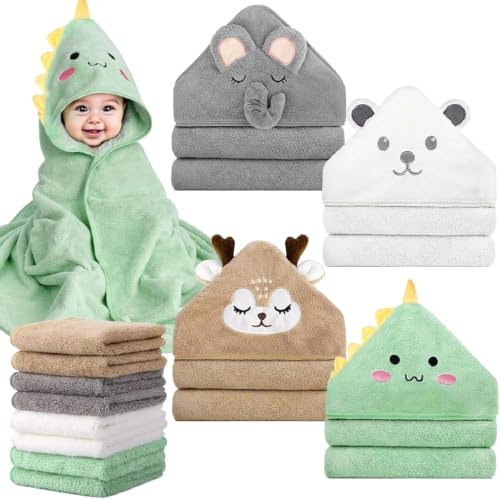
CandyHome Baby Bath Towels Set 12 PCS — Best Complete Starter Set
The CandyHome set answers the question most first-time parents ask in the shop aisle: how many towels does a baby actually need before laundry becomes a daily emergency? Four hooded bath towels plus eight washcloths is a sensible census for a home that bathes a newborn every other day and wipes faces, hands, and necks several times between baths. One towel can hang drying while another works, and the washcloth stack absorbs the constant small jobs that would otherwise consume the big towels.
The hooded pieces carry cute animal styling, which sounds decorative until you watch a parent use one: the hood anchors the wrap at the head, the part of a wet baby that chills fastest, and gives the adult a visual cue for orientation when lifting a slippery newborn from the water. Under the styling, the job is ordinary and important, namely full coverage without a second towel. Families who receive this set as a shower gift often report it becomes the default rotation while fancier single towels wait for guests.
Treat the animal designs as a bonus rather than the reason to buy. The durable argument is arithmetic: twelve coordinated pieces, one purchase, no midweek scramble. If your household prefers natural fibres exclusively, read the listing fabric details carefully and compare with the muslin options below, because this set competes on convenience and completeness first. For a nursery being equipped from zero, though, completeness is exactly the point, and few single purchases cover bath time this thoroughly.
- Format: 4 hooded bath towels plus 8 washcloths
- Intended users: infants and toddlers
- Styling: cute animal hooded designs
- Role in the home: full starter rotation in one box
- Care note: wash before first use, like every pick here
Strengths
- Rotation is built in, so a clean dry towel is almost always waiting
- Hoods help parents orient the wrap quickly with wet hands
- Washcloth count matches how babies actually generate small messes
Trade-offs
- Families wanting only natural fibres should verify the blend on the listing
- Animal styling will not suit every nursery aesthetic
- Twelve pieces need drawer or shelf space from the start
Best for: New parents building a bath kit from nothing, and gift buyers who want one box that genuinely covers the first months.
Not suited for: Minimalists who would rather own two excellent towels than a coordinated dozen pieces.

Yoofoss Muslin Hooded Baby Towels 2 Pack — Best Muslin Pair for Daily Baths
Yoofoss builds its pair from muslin cotton, the open, breathable weave that grandmothers trusted long before it became fashionable again. Muslin behaves kindly across a baby’s first year: it arrives slightly crisp, then relaxes wash by wash into a cloth that drapes rather than stands, folding itself around small shoulders without the bulk of plush terry. At thirty-two inches square, each towel wraps a newborn completely and still covers a sitting infant who has started kicking against the whole procedure.
The two-pack rhythm suits real laundry habits. One towel handles tonight’s bath while yesterday’s dries fully on the rail, and that complete drying between uses matters more for freshness than any fragrance a detergent promises. The beige and coffee pairing is quietly practical too: pale enough to show when a cloth needs washing, warm-toned enough not to display every faint mark a family bathroom produces. Parents who dislike cartoon styling in photographs tend to land here.
Because muslin is thinner than terry, expectations should be set honestly. This pair will not feel like a hotel robe, and it is not meant to. It dries a baby by coverage and absorbency rather than by plush weight, then dries itself quickly on the hook, ready for tomorrow. Households in warm climates, or small bathrooms where thick towels stay damp for hours, will understand the appeal immediately.
- Format: 2 hooded bath towels
- Size: 32 x 32 inches each
- Material: muslin organic cotton, per listing title
- Colours in this listing: beige and coffee
- Role in the home: dependable two-towel rotation
Strengths
- Muslin softens progressively instead of wearing thin and rough
- Hooded shape keeps the wrap anchored during the lift from the tub
- Neutral colours coordinate with almost any nursery or bathroom
Trade-offs
- Thinner hand feel than plush terry alternatives
- Only two towels, so laundry cannot slip beyond a day or two
- Muslin can snag on rough hooks or Velcro in a mixed wash
Best for: Parents who want natural-fibre hooded towels in calm colours and wash laundry frequently anyway.
Not suited for: Anyone expecting a thick, spa-weight wrap for a newborn.

Momcozy Muslin Baby Towels with Hood — Best Layered Muslin Construction
Momcozy’s towel takes the muslin idea and gives it architecture. Six layers of cotton muslin are stacked and stitched so the cloth gains substance without surrendering the breathability that makes muslin comfortable against warm, damp skin. Held in the hand, it feels closer to a light blanket than to a gauze square, and that body helps when a parent is wrapping a wriggling infant one-handed while the other hand guards the baby on the changing mat.
Layering changes the absorbency conversation. A single muslin layer wicks and spreads water; six layers hold it, so the outer surface stays drier against the parent’s clothes during the post-bath cuddle. The blue colourway in this listing reads fresh in photographs without the starkness of pure white, which many parents find unforgiving once real life begins. The hood is proportioned for newborns through toddlers, following the same thirty-two-inch square format as the Yoofoss pair.
Choose between this and a two-pack by thinking about your rotation. A single, more substantial towel suits households that wash small loads often and prefer fewer, better pieces. If your laundry runs twice a week, one towel of any quality becomes a scheduling problem, and the pairs and sets elsewhere in this guide will serve you better. Judged purely as an object, though, the layered construction is the most considered muslin design on this page.
- Format: hooded baby towel
- Size: 32 x 32 inches
- Material: 6-layer cotton muslin, per listing title
- Colour in this listing: blue
- Role in the home: one substantial towel, washed often
Strengths
- Six layers give muslin real holding capacity for bath water
- Drapes with enough body to wrap securely one-handed
- Breathable weave stays comfortable against flushed post-bath skin
Trade-offs
- A single towel demands a prompt laundry rhythm
- Layered muslin takes longer to dry than a single-layer cloth
- Blue colourway will not match every nursery palette
Best for: Parents who prefer one well-made muslin towel and run laundry frequently.
Not suited for: Households that need several days of towels between wash days.

HIPHOP PANDA Baby Washcloths 6 Pack — Best Washcloths for Delicate Skin
Washcloths are the unsung labour of baby care. They wipe milk from neck folds, clean small hands after a meal, dampen a feverish forehead, and handle the top-and-tail wash on mornings when a full bath is not happening. The HIPHOP PANDA six pack is built for that tempo: two-layer cloths in rayon made from bamboo, a fibre prized in nurseries for a surface that glides rather than drags across delicate skin.
Honesty about fibre naming matters here. Rayon made from bamboo begins as bamboo pulp that is dissolved and re-formed into rayon yarn, so the finished cloth behaves like a fine rayon: exceptionally soft, absorbent, and somewhat more delicate than cotton. Parents who choose it are choosing that first-touch gentleness, and in return they should wash the cloths kindly, avoiding harsh cycles that would roughen the very surface they paid for. The white colourway shows every stain plainly, which many caregivers count as a feature, since a cloth that hides grime is a cloth that stays in service too long.
As a companion purchase, this pack completes almost any towel set in this guide. The full towels handle the bath itself; these cloths handle everything else, and six is a workable count when they are rinsed and rotated daily. Keep a small basket of them near the changing area and another near the feeding chair, and the geography of baby messes becomes noticeably easier to govern.
- Format: 6 washcloths
- Construction: 2-layer, per listing title
- Material: rayon made from bamboo
- Colour in this listing: white
- Role in the home: face, body, and between-bath cleaning
Strengths
- Exceptionally smooth surface for newborn faces and neck folds
- Two-layer build gives a small cloth genuine absorbency
- Six pieces allow stationing cloths where messes actually happen
Trade-offs
- Rayon rewards gentle washing and resents rough treatment
- White shows stains immediately, for better and worse
- Washcloths only; a full bath towel must come from elsewhere
Best for: Parents prioritising the gentlest possible cloth for faces and delicate skin.
Not suited for: Anyone wanting one purchase that covers full baths as well.

Comfy Cubs Muslin Baby Washcloths 6 Pack — Best Cotton Muslin Washcloths
Comfy Cubs applies the layered muslin formula at washcloth scale, and the result is a small cloth with surprising usefulness. Ten inches square covers an adult hand properly, so the cloth stays between your fingers and the baby’s skin instead of collapsing into a ball. Six layers of muslin cotton give it enough body to wipe effectively while staying flexible enough to reach into the creases at the neck, behind ears, and between tiny toes.
The multicolour assortment invites a household system. Many parents quietly assign one colour to faces, another to bodies, and a third to the changing area, and the colour coding survives even when grandparents or babysitters take over bath duty. Muslin’s temperament helps too: it tolerates hot washes better than delicate rayon, dries quickly on a rail, and becomes more pliable across its first dozen cycles. For families standardising on cotton throughout the nursery, this is the natural washcloth choice.
Set beside the HIPHOP PANDA cloths, the difference is philosophy. Rayon from bamboo wins the first-touch softness contest; layered cotton muslin wins on ruggedness, colour coding, and indifference to laundry temperature. Neither answer is wrong, and many households end up owning both, using the silkiest cloths for newborn faces and the muslin workhorses for everything the toddler years invent.
- Format: 6 washcloths
- Size: 10 x 10 inches each
- Material: 6-layer muslin cotton, per listing title
- Colours: multicolour assortment
- Role in the home: colour-coded everyday cleaning
Strengths
- Ten-inch size stays spread across the hand during use
- Layered muslin tolerates regular warm washing well
- Colour variety supports simple hygiene routines by zone
Trade-offs
- Surface is pleasant rather than silky at first touch
- Multicolour set will not suit strict single-colour nurseries
- Small format only; not a substitute for a bath towel
Best for: Cotton-first households that like colour-coded cloths for different jobs.
Not suited for: Parents seeking the silkiest possible newborn face cloth.

Muslin Baby Bath Towel 3 Pack 40×40 — Best Oversize Muslin for Toddlers
Every other towel in this guide is sized for the baby you have now. This three pack is sized for the child that baby becomes. At forty inches square, a six-layer muslin towel still wraps a tall two-year-old completely, hood or no hood, and that longevity changes the value calculation entirely. Parents tired of equipment expiring every four months will feel the appeal in their shoulders: buy the bigger square once, and bath time stops being a recurring shopping problem.
The grey colourway is a deliberate kind of wisdom. It hides the faint shadows of a thousand washes, coordinates with nearly every bathroom, and photographs calmly. Six-layer construction keeps the large square from feeling like a bedsheet; there is enough substance to absorb a toddler’s worth of bath water, yet the muslin still dries faster than a comparably sized terry towel would on an ordinary rail. Three towels give a rotation that survives a weekend away from the washing machine.
For a newborn, forty inches is undeniably generous, and some parents will find the extra fabric awkward during the first weeks when the baby is small and the parent is nervous. That is the honest trade: this pack is the second purchase for some families and the only purchase for confident ones who would rather fold down extra cloth now than buy again in spring. Either way, by toddlerhood it becomes the towel children ask for by name.
- Format: 3 bath towels
- Size: 40 x 40 inches each
- Material: 6-layer cotton muslin, per listing title
- Colour in this listing: grey
- Role in the home: long-service towels from infancy into toddlerhood
Strengths
- Forty-inch coverage outlasts the newborn stage by years
- Three-pack rotation survives gaps between laundry days
- Grey tone conceals the gradual marks of heavy family use
Trade-offs
- Generous fabric can feel unwieldy around a tiny newborn
- No hood to anchor the wrap at the head
- Larger squares claim more drawer and rail space
Best for: Parents who want to buy once and keep using the same towels into the toddler years.
Not suited for: First-time parents who want a snug, hooded newborn wrap above all.
How Do the Six Baby Towel Picks Compare Side by Side?
Read the table by job rather than by brand. Full towels differ mainly in size and fibre temperament, washcloths differ in surface feel and laundry tolerance, and the right household often pairs one row from each family instead of crowning a single winner.
| Pick | Format | Material | Standout trait |
|---|---|---|---|
| CandyHome Baby Bath Towels Set 12 PCS | 4 hooded towels + 8 washcloths | See listing for fibre details | Most complete starter census |
| Yoofoss Muslin Hooded Baby Towels 2 Pack | 2 hooded towels, 32 x 32 in | Muslin organic cotton | Softens with every wash |
| Momcozy Muslin Baby Towels with Hood | 1 hooded towel, 32 x 32 in | 6-layer cotton muslin | Most substantial muslin build |
| HIPHOP PANDA Baby Washcloths 6 Pack | 6 washcloths | Rayon made from bamboo | Smoothest face cloth here |
| Comfy Cubs Muslin Baby Washcloths 6 Pack | 6 washcloths, 10 x 10 in | 6-layer muslin cotton | Colour-coded cotton workhorse |
| Muslin Baby Bath Towel 3 Pack 40×40 | 3 towels, 40 x 40 in | 6-layer cotton muslin | Longest service life here |
What Size Baby Towel Does a Newborn Actually Need?
A newborn is smaller than new parents expect and colder than they fear. The practical minimum is a square that can wrap the baby’s torso fully with fabric to spare for tucking, which is why towels near thirty inches dominate this category. Below that, parents end up holding edges together with their fingers while a wet baby wriggles, and the whole exercise becomes a race against the chill that follows a bath.
Growth rewrites the answer quickly. By the sitting-up stage, babies splash deliberately, straighten their legs against being wrapped, and treat the towel as part of the game. A thirty-two-inch square still works; a forty-inch square works without negotiation. Families who bathe toddlers in a full tub, rather than an infant insert, tend to migrate toward the larger format within the first year.
Washcloth sizing deserves its own sentence, because it is routinely ignored. A cloth near ten inches covers the caregiver’s hand and stays flat against the baby’s back during washing. Much smaller, and it balls up; much larger, and it drags excess water everywhere. The two washcloth picks in this guide both respect that hand-sized logic, differing in fibre rather than in dimensions.
Which Fabric Is Kindest Against Newborn Skin?
Kindness in a fabric is mostly about surface behaviour. Cotton muslin presents a soft, slightly textured weave that grips gently and improves with washing, which is why it anchors four of the six picks here. Its openness also means it rinses clean easily, an underrated virtue when the cloth has been used with baby wash and needs to release every trace of it before the next bath.
Rayon made from bamboo presents a smoother, cooler glide. On skin that flushes easily, that smoothness can feel noticeably calmer, and many parents reserve their silkiest cloths for faces for exactly that reason. The compromise is durability: rayon surfaces prefer gentler cycles and can lose their finish if they are regularly boiled alongside the family’s tea towels.
Plush terry, the adult default, appears less in this guide deliberately. Deep loops hold water generously but can feel coarse against newborn skin once they stiffen in hard water, and thick towels dry slowly in the humid room where babies are bathed. For the first year, most families are better served by muslin’s balance or rayon’s glide, graduating to family terry when the child is older and hardier.
How Should Baby Towels Be Washed and Stored?
Wash every baby towel before its first use. New textiles carry loose fibres and finishing treatments from manufacture, and a preliminary wash removes both while letting the fabric settle into its true texture. Use a mild detergent, rinse thoroughly, and skip fabric softener, which coats fibres and quietly reduces the absorbency you bought the towel for in the first place.
Drying deserves the same attention as washing. A baby towel left bunched on a hook in a steamy bathroom can stay damp for a day, and damp cloth develops the stale smell parents then try to wash out with stronger detergent. Spread towels fully on a rail or line, give them air, and rotate so no single towel works two baths in a row without a complete dry between.
Storage closes the safety loop that opened this guide. Clean baby towels belong on a shelf, in a drawer, or on hooks near the bath, within adult reach and outside the crib entirely. An infant’s sleep space stays empty of loose cloth, full stop; the towel’s job begins when the bath runs and ends when it is hung up afterwards.
How Many Baby Towels Should a Household Own?
Count backwards from your laundry rhythm. A home washing every day can thrive on two bath towels and a handful of washcloths. A home washing twice a week needs at least three bath towels, because baths do not consult the laundry schedule, and a stomach bug or a nappy disaster can consume the clean stock in a single evening.
Washcloths multiply faster than any estimate. Between baths, feeds, and the general weather system of a baby’s face, six cloths is a floor rather than a target, and twelve is comfortable. This is why sets that bundle washcloths generously, like the CandyHome box, solve a problem that elegant single towels leave untouched.
Finally, budget a spare for the changing bag. Bath time happens at grandparents’ houses, swimming lessons, and holiday cottages, and a dedicated travel towel prevents the home rotation from collapsing whenever the family leaves the house. The towel in the bag should be the one you would miss least, because travel towels lead adventurous lives.
How Does Bath Time Change From Newborn to Toddler?
The first baths are brief, warm, and heavily choreographed. A newborn is bathed in a small tub or supported insert, lifted out within minutes, and wrapped before the room air has a chance to chill damp skin. At this stage the towel is essentially a receiving blanket with absorbency, and parents value speed of wrapping above every other trait. Hoods shine here, because the head is both the coldest point and the hardest to cover with a flat corner.
By six months the production has changed character. Babies sit, splash with intent, and grab at anything within reach, including the towel meant to dry them. Baths lengthen, water travels further, and the towel must now absorb a genuinely wet child rather than a damp one. This is where layered muslin and larger squares start repaying their cost, and where washcloths graduate from gentle wipers to tools for scrubbing porridge out of hair.
Toddlerhood turns the towel into costume and comfort object as much as equipment. Children emerge from the bath wanting to be wrapped completely, often dramatically, and a towel that no longer reaches around them becomes a nightly negotiation. Families who bought the forty-inch format early simply skip this argument. Those who started small can promote the old towels to hair duty and poolside spares, so nothing is truly wasted, but the second purchase still arrives on schedule.
What Should Gift Buyers Know Before Choosing a Baby Towel Set?
A towel set is one of the safest gifts in the baby category, provided the buyer respects the parents’ likely system. Registries reveal fibre preferences plainly: a household that registered organic cotton throughout is sending a message, and a rayon or blended set, however soft, may sit unused. When no registry guidance exists, cotton muslin in neutral colours is the diplomat’s choice, welcomed by nearly every nursery and useful from the first week.
Piece count communicates thoughtfulness better than extravagance. New parents are drowning in single beautiful objects and starved of multiples, so a set that includes several washcloths alongside the towels reads as genuinely helpful rather than decorative. The CandyHome box succeeds as a gift for exactly this reason: it equips a rotation, not a photo opportunity.
Finally, consider the household’s laundry reality before choosing delicacy. A gift that demands gentle cycles and special handling becomes a chore dressed as generosity in a home running on two hours of sleep. Durable, warm-wash-friendly towels in forgiving colours will be used daily and remembered kindly, which is the most any bath gift can reasonably hope to achieve.
How Can Parents Tell When a Baby Towel Needs Replacing?
Replacement announces itself through texture before appearance. A towel that stays scratchy after washing, or that leaves the baby’s skin looking flushed where it was rubbed, has finished its useful life regardless of how intact the stitching appears. Muslin usually softens indefinitely, so roughness in a muslin towel signals mineral build-up first; try the vinegar rinse before condemning it, and replace only if the harshness survives that rescue.
Thinning is the second signal. Hold the cloth against the light: a washcloth worn to translucency in the centre will no longer absorb meaningfully, and continuing to use it just spreads water around a small body. Edges matter too, because frayed hems shed threads, and loose threads have no place near infant fingers and toes. A towel shedding visible lint onto wet skin at every bath is asking to be retired to the cleaning cupboard.
Smell is the final arbiter. A towel that emerges from a proper wash already carrying a stale odour has colonies of residue deep in its fibres that ordinary cycles cannot shift. One rescue attempt with a hot wash is fair; after that, replacement is cheaper than the repeated washing, and a baby’s bath kit is the last place to practise false economy with tired textiles.
Why Do Midwife-Led Bath Demonstrations Emphasise the Towel So Much?
Watch a professional bathe a newborn and the striking thing is how little of the performance involves water. Most of the choreography is preparation: towel laid open, clothes arranged, room warmed, everything within reach before the baby is undressed at all. The lesson embedded in that ritual is that bath time succeeds or fails on the towelling stage, because a naked, wet newborn experiences every second of delay as cold.
Home baths go better when parents borrow that staging wholesale. The towel waits open on the changing surface, the washcloth sits folded beside the tub, and a second towel hangs ready for the parent whose sleeves lose the argument with the splash zone. None of this requires special equipment; it requires only that the cloths in this guide be treated as the main event rather than as an afterthought grabbed one-handed from a drawer.
That professional emphasis also explains the sizing consensus across this category. Towels cluster near a generous square because the wrap must be achievable in one motion, without refolding, while the other hand supports the baby. Every pick here respects that choreography, differing in fibre and count rather than in the fundamental geometry that midwives settled long ago.
How Should Baby Towels Be Chosen for Babies Who Hate Bath Time?
Some babies object to baths from the first week, and the towel is rarely the cause, yet it can absolutely be part of the remedy. A reluctant bather usually protests the transitions: the undressing chill, the water, then the cold air afterwards. Shortening that final transition with a pre-warmed, generously sized towel removes one protest from the sequence, and many families find the remaining objections easier to soothe once the exit from the bath is swift and warm.
Texture familiarity helps the reluctant ones disproportionately. Introducing a new towel texture mid-routine gives a sensitive baby one more novelty to process, so households with a bath-hater should standardise on a single towel type early and buy multiples of it. The muslin picks here suit that strategy well, since their feel changes only gradually, softening across washes rather than transforming.
Finally, keep the post-bath sequence identical every evening: same towel, same order of drying, same song or patter if your household has one. Predictability is a genuine comfort to infants, and the humble towel, appearing at the same moment in the same way each night, quietly becomes one of the anchors of the whole bedtime ritual.
What Mistakes Do Parents Make With Baby Towels?
The gravest mistake is treating the towel as nursery bedding. A soft towel left in a crib, draped over a sleep space, or tucked around a sleeping baby introduces loose fabric into the one place guidance is unambiguous: an infant under twelve months sleeps with nothing loose around them. Towels live at the bath, on hooks, and in drawers, and the habit of returning them there every single time is a safety habit, not tidiness.
The second mistake is judging by first touch in the shop. Several fabrics feel magnificent once, under shop lighting, and then stiffen, shed, or pill across a month of washing. Muslin famously does the opposite, improving steadily, which is why experienced parents often choose the cloth that feels merely pleasant on day one. Ask how a towel behaves at wash thirty, not how it charms at minute one.
A third error is buying only the photogenic hooded towel and no washcloths. Bath time then improvises with adult flannels or paper products, neither of which suits newborn skin or a family budget. The small cloths are not accessories; they are half the system, and the households that enjoy bath time most are usually the ones that stocked them properly.
Finally, many parents wash baby towels with the household’s scented, softened load and wonder why absorbency fades. Softener residue coats fibres, and heavy fragrance lingers against skin that has just been washed clean. A separate, simple wash for baby linens, dried fully in moving air, keeps every pick in this guide performing as intended for far longer.
One quiet detail separates pleasant bath times from chaotic ones: temperature staging. Lay the towel open on the changing surface before the bath begins, hood positioned where the head will land, so the transfer from water to wrap takes seconds. Parents who stage the towel in advance rarely juggle, and babies who are wrapped quickly cry less, which everyone in the household experiences as a better evening.
Grandparents and other caregivers deserve a mention in any honest guide. A towel that confuses occasional helpers, with unclear orientation or fiddly folds, slows the whole routine. The hooded designs here communicate their own instructions visually, and the colour-coded washcloths explain the household system without a briefing. Equipment that teaches its own use is equipment that gets used correctly at midnight.
Hard water quietly rewrites the life story of every towel in this guide. Mineral deposits stiffen fibres across months of washing, and baby towels, washed more often than any other cloth in the house, feel the effect first. An occasional rinse with a cup of white vinegar in the wash helps dissolve that build-up without adding fragrance or coating, restoring much of the original drape to muslin and cotton alike. Parents in hard-water regions who build this habit in early keep their towels pleasant far longer than the packaging ever promised.
Twins and close siblings deserve a planning note of their own, because every quantity in this guide effectively halves. Two babies bathed back to back consume towels at a pace that turns a two-pack into a same-day laundry obligation. Doubling the rotation at purchase time, or choosing the larger bundled sets, is not extravagance in a multiples household; it is the difference between bath time as a calm ritual and bath time as a logistics exercise conducted in wet sleeves.
If budget forces a single decision, prioritise in this order: one towel large enough to wrap completely, washcloths enough for three days, then a second towel for rotation. That sequence mirrors how bath time actually consumes cloth, and it prevents the common outcome where a household owns one exquisite towel, no spares, and a permanent sense of laundry urgency hanging over what should be the gentlest, calmest, most unhurried hour of the entire parenting day for everyone involved in it.
A word about hand-me-downs, because baby towels circulate through families like library books. A towel from an older sibling or a cousin is perfectly serviceable provided it passes the texture test: soft after washing, free of fraying threads, and fresh-smelling from a hot cycle. Muslin and cotton both survive this inheritance well, which is one more argument for buying durable cloth in the first place. The original owner may never know their purchase served three children, but the household budget certainly notices.
Daycare and nursery bags create one last demand that home-only planning misses. Many childcare settings ask families to supply a small towel or cloths labelled with the child’s name, and they return them in states that would alarm the fabric. Send the sturdy, replaceable pieces on this duty and keep the beloved hooded towel at home, because institutional laundry runs hot, fast, and entirely without sentiment.
Photographs deserve one honest paragraph in a guide like this, because many baby towels are bought partly for the newborn photo session and the announcement picture. There is nothing wrong with that motive; those images become family history. The mistake is letting photographic charm dictate the whole purchase. Buy the towel you love for the pictures if the budget allows, then equip the daily rotation with the workhorses in this guide, so beauty and utility each get their own budget line instead of sabotaging one another in a single compromised purchase.
Storage near the bath sounds trivial until a parent is holding a wet baby with one arm and reaching with the other. Towels stored in a distant linen cupboard fail that moment completely. A small shelf, basket, or set of hooks within arm’s reach of the tub transforms bath time more than any upgrade in fabric quality, and it costs almost nothing. Equip the reach zone with two towels and a stack of washcloths, replenish it during the morning tidy, and the evening bath becomes a calm procedure rather than a treasure hunt conducted at the worst possible moment.
Older siblings introduce one final variable: imitation. A four-year-old who watches the baby emerge into a hooded animal towel will demand equivalent ceremony, and households that anticipate this keep one generously sized towel in reserve for the understudy performance. The forty-inch muslin squares absorb this duty gracefully, being large enough to wrap a preschooler for the length of a song. Planning for the sibling encore prevents both jealousy and the mysterious disappearance of the baby’s towel into an older child’s bedroom.
Season changes the bath equation more than most buying guides admit. In winter, a baby leaves warm water for a room that may be several degrees cooler, and the towel becomes a thermal bridge: thicker layered muslin or a promptly applied hood measurably shortens the shivering interval that makes babies protest. In summer, the same child may bathe twice in a day after sunscreen and garden adventures, and the household suddenly cares about drying speed on the rail rather than warmth in the wrap. Owning one substantial towel and one quick, light towel covers both seasons without a special purchase in either direction, which is why mixed rotations outperform uniform ones across a full year of family life.
Travel exposes the weaknesses of every towel choice within a single weekend. Hotel bathrooms offer hooks in the wrong places, grandparents keep their houses at unfamiliar temperatures, and the towel that performed flawlessly at home must suddenly dry draped over a suitcase in a spare room. Muslin forgives this treatment, releasing moisture from its open weave in still air where plush terry would sulk. Parents planning frequent family travel often promote one muslin towel to permanent luggage duty, a small decision that removes a surprising amount of packing friction from every trip thereafter.
There is also a developmental footnote worth knowing: babies begin recognising their own objects surprisingly early, and the towel is among the first. A consistent bath towel, with its familiar texture and faint household smell, becomes part of the evening ritual that signals sleep is coming. Rotating identical towels preserves that familiarity while allowing proper washing, which is another practical argument for buying multiples of one design rather than a parade of unrelated singles, however charming each individual towel may look in the shop.
Swimming lessons introduce a second career for these towels around the six-month mark. A familiar towel from home comforts a baby in a strange, echoing pool hall far better than a rented or borrowed cloth, and muslin’s quick drying suits the trip home in a changing bag. Many families dedicate one towel from the rotation to lessons permanently, accepting its faster wear as the cost of a calmer class, and replace it without ceremony when the edges eventually tire.
Final Recommendation
Start with the household you actually run. If the nursery is empty and the shower gifts are still arriving, the CandyHome twelve-piece set builds a working rotation in a single decision. If you already own basics and want the daily towel to be better, the Yoofoss pair or the layered Momcozy towel upgrades bath time immediately, while the forty-inch muslin three pack is the purchase your future toddler will silently thank you for.
Add washcloths according to temperament: HIPHOP PANDA for the silkiest face cloths, Comfy Cubs for colour-coded cotton durability. Whichever combination you choose, wash everything before the first bath, dry it fully between uses, and keep the crib clear of every cloth in this guide. For this family, the towel draped over the nursery chair rail, still faintly warm from the dryer, is the one that gets reached for on the coldest evenings.
Frequently Asked Questions
Are hooded baby towels genuinely better than plain squares?
A hood earns its place in the first months, when a baby loses heat quickly through the head and a parent is managing a wet, slippery lift with limited hands. It anchors the wrap and speeds up those first seconds out of the water. As children grow into confident toddlers, plain large squares catch up, because coverage matters more than anchoring. Many families use hooded towels first and graduate naturally.
Can baby towels go in the crib as a comforter afterwards?
No. A towel is a bath tool, not a sleep item, and babies under twelve months should sleep in a clear space without loose fabric of any kind. After the bath, the towel goes on a hook, a rail, or into the laundry, and the crib stays empty. This is one of the few absolute rules in this guide, and it applies to every soft, beautiful towel listed here.
How often should baby towels be washed?
A bath towel used once and dried fully on a rail can reasonably serve two or three baths before washing, provided it dried completely between uses. Washcloths that touched faces, food, or nappy changes belong in the laundry after a single day. In practice, frequent small washes suit baby linens better than a weekly mountain, and rotation sets exist precisely to make that rhythm painless.
Is rayon made from bamboo a natural fabric?
It is a regenerated fibre: bamboo is processed into pulp, then dissolved and re-formed as rayon yarn. The finished cloth feels exceptionally smooth and absorbent, which is why nurseries love it, but it behaves like a fine rayon rather than like raw bamboo. Naming it honestly, as the HIPHOP PANDA listing does, helps parents wash it appropriately and enjoy that softness for longer.
When does a baby outgrow a thirty-two-inch towel?
Most children outgrow the wrap of a thirty-two-inch square somewhere in the second year, though the towel remains useful for hair, shoulders, and travel long afterwards. The forty-inch muslin pack in this guide exists for families who would rather skip that transition. Height matters more than age here: a tall toddler reaches the limit months before a petite one does.
Should baby towels be washed separately from family laundry?
Separating them for the first months is sensible, mainly to keep detergents mild and softeners away from fibres that touch newborn skin. A simple load of baby linens, washed warm and dried completely, avoids both residue and the absorbency loss that softener causes. As the baby grows, many families merge the loads gradually while keeping softener out of the towel wash entirely.
Related Guides
Keep building a calmer, better-equipped family bathroom with these companion shortlists: Best Backpacking Towels Best 3-Fold Hand Towels Best Absorbent Thin Towels Best Muslin Swaddle Blankets


