What's inside
- Key Takeaways
- Quick Picks
- How Did We Choose These Bar Towels?
- How Do the Six Bar Towel Packs Compare?
- What Is the Difference Between a Bar Mop and a Bar Towel?
- Why Are Bar Towels Almost Always White and Striped?
- How Many Bar Towels Does a Home Bar Really Need?
- How Should Bar Towels Be Washed to Last for Years?
- How Do You Set Up a Home Bar Towel Station That Actually Works?
- What Should a Host Do About Glassware That Never Looks Clean?
- How Do Bar Towels Behave at Outdoor and Garden Bars?
- How Does a Professional Bartender Actually Use Towels During Service?
- What Is the Right Towel for a Coffee and Tea Station?
- What Mistakes Do Home Bartenders Make With Bar Towels?
- Final Recommendation
- Frequently Asked Questions
- Related Guides
As an Amazon Associate I earn from qualifying purchases. This post may contain affiliate links at no extra cost to you.
cottageverdict.com is reader-supported. When you buy through links on our site, we may earn an affiliate commission.
Where to buy: Every pack below is sold on Amazon in bar-ready quantities. A linked name opens the listing to check price on Amazon, verify the towel dimensions, and confirm whether you are ordering cotton terry or microfiber.
Behind every competent bar, professional or domestic, hangs a small army of unglamorous cloths doing the evening’s real work. The best bar towels wipe condensation from counters, catch the drip beneath a freshly poured drink, polish glassware to a spotless shine, and absorb the spills that any gathering eventually produces. They are bought by the dozen, washed without ceremony, and replaced without grief, and that working character, not softness or decoration, is what this guide judges them on.
Two families share the bar rail. The classic bar mop is a thick cotton terry towel, usually white and often striped, built to drink up liquid in volume and survive bleach. Its thinner cousin, the polishing towel, exists for glassware and presentation, trading absorbency for a lint-free finish. Most of the picks below are mops, because most home bars need absorbency first, but the distinction runs through every review, since buying mops to polish glasses, or polishers to mop a flooded counter, disappoints in both directions.
Home bars have multiplied the audience for these packs. A garden cocktail corner, a basement tap setup, or a kitchen island that hosts Friday drinks all consume towels at a professional pace on a domestic laundry schedule. The twelve-packs gathered here suit that scale exactly: enough cloths for a full evening’s service, a wash, and a second evening, without the host ever wiping a counter with the good kitchen linen again.
Key Takeaways
- Bar mops are the thick cotton terry workhorses for spills and counters; thin towels are for polishing glass, and the jobs should not be swapped.
- White cotton earns its dominance honestly: it can be bleached back to brightness after red wine, citrus, and coffee have had their say.
- Sixteen by nineteen inches is the classic mop footprint, large enough to fold into a pad and small enough to wring one-handed.
- A coloured stripe is not decoration; it is an identification system that keeps bar cloths from migrating into the bathroom stock.
- Microfiber bar towels dry faster and polish better, but they resent heat and bleach in ways cotton simply shrugs off.
- Buy the full dozen even for a small home bar, because an evening with guests consumes clean towels faster than any host predicts.
Quick Picks
| Pick | Badge | Why it earns its place |
|---|---|---|
| Utopia Towels Kitchen Bar Mops White 12 Pack | Best Classic Bar Mop | Twelve white cotton mops at sixteen by nineteen inches, the reference pack against which every other bar towel in this guide is measured. |
| Softolle Kitchen Bar Mops 12 Pack | Best Soft-Handed Alternative | A dozen cotton mops at sixteen by nineteen inches in white, positioned as a soft, highly absorbent all-purpose bar and kitchen towel. |
| ZUPERIA Bar Mop Towels 12 Pack | Best Striped Identification System | Twelve cotton mops at sixteen by nineteen inches with a blue stripe, aimed at restaurants, bartenders, cooks, and homes that like their cloths coded. |
| Utopia Towels Ribbed Bar Mops White 12 Pack | Best Grip for Wet Glassware | Twelve ribbed cotton mops at sixteen by nineteen inches, whose channelled texture grips wet glasses and channels liquid instead of skating over it. |
| POLYTE Microfiber Ribbed Bar Mop Towels 12 Pack | Best Quick-Dry Microfiber Option | Twelve ribbed microfiber towels at fourteen by seventeen inches, lint-free and quick-drying, for hosts who reuse towels within the same service. |
| Nabob Wipers Bar Mop Terry Towels Blue Stripe | Best Compact Stripe Mop | Twelve cotton terry mops at fourteen by seventeen inches with a blue stripe, a slightly handier size for small bars and tight kitchens. |
Badges below mark each pack’s station: mop duty at the counter, ribbed grip for wet glassware, or microfiber speed for hosts who wash and reuse within the same evening. Read your own bar’s busiest hour into the table and the ranking will rearrange itself sensibly.
How Did We Choose These Bar Towels?
We screened for the professional fundamentals first: honest dimensions, a stated fibre, and pack counts that match how bars actually consume cloth. Sixteen by nineteen inches emerged as the standard mop size across the strongest listings, big enough to matter and small enough to handle, and every pick here either meets that standard or explains its deviation. Towels sold in vague handfuls without measurements were passed over, because a bar cannot plan around adjectives.
Fibre was read literally. Cotton terry dominates the category for good reasons, bleach tolerance, heat tolerance, and sheer thirst, and five of the six picks honour that tradition. The one microfiber entry was kept deliberately, because its quick drying and polishing manners serve a real subset of hosts, and because a guide that pretends microfiber does not exist in bars would be describing 1995. Its care limitations are stated as plainly as its virtues.
Finally, we valued boring reliability over novelty. Stripes, ribbing, and weave variations were assessed for what they do, identification, grip, and channelled absorption, not for how they photograph. A bar towel succeeds anonymously, dozens of times an evening, and the packs below were chosen for exactly that anonymous competence across hundreds of washes.

Utopia Towels Kitchen Bar Mops White 12 Pack — Best Classic Bar Mop
Utopia’s bar mops are the category’s default setting, and defaults become defaults by surviving contact with reality. Sixteen by nineteen inches of cotton terry is the size bartenders’ hands expect: folded once, it makes a pad that drinks a spilled drink in two passes; opened flat, it covers the drip zone under a row of glasses; wrung one-handed, it resets for the next job. Twelve in the pack matches a home bar’s evening arithmetic with a little to spare.
White is a working decision here, not an aesthetic one. A white mop can be bleached, and behind a bar everything eventually meets red wine, coffee liqueur, citrus oils, or the mysterious purple of a berry garnish. Cotton tolerates that chemical reset indefinitely, emerging bright enough for front-of-house duty again, while coloured towels accumulate a biography of stains that eventually exiles them to the garage. The listing also promises a lint-free character, which matters when the same towel dries a glass a guest is about to drink from.
The terry pile is thick enough to be genuinely thirsty without becoming a sodden blanket by the second hour. Hosts who run a cocktail evening on these report the familiar professional rhythm: two mops in service, one drying glasses, the rest in reserve, and the whole dozen through a hot wash the next morning. Nothing about the experience is luxurious, and that is precisely the compliment this category trades in.
If your home bar is new and you want the question of towels simply closed, close it here. Fancier options below add ribbing, stripes, or microfiber speed, each with real arguments, but the classic white mop remains the purchase nobody regrets, the one reordered by the dozen when the first pack eventually thins after years of Fridays.
- Size: 16 x 19 inches
- Material: 100% cotton
- Pack: 12 towels, white
- Character per listing: absorbent, soft, durable, lint-free
- Role in the home: default mop for counters and spills
Strengths
- Classic dimensions suit every bar task without thought
- White cotton bleaches back to service after staining
- Dozen count matches a full evening plus laundry lag
Trade-offs
- Plain white offers no identification stripe
- Thick terry dries slower than microfiber rivals
- Front-of-house elegance is functional, not decorative
Best for: Home bartenders who want the professional standard without deliberation.
Not suited for: Hosts who want coloured towels matched to their bar decor.
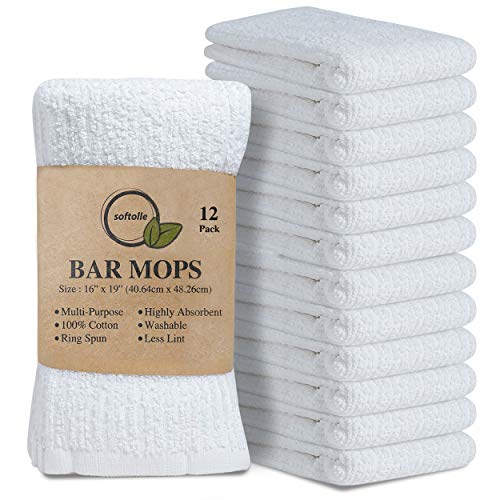
Softolle Kitchen Bar Mops 12 Pack — Best Soft-Handed Alternative
Softolle’s mops match the Utopia blueprint dimension for dimension, sixteen by nineteen inches of white cotton in a pack of twelve, and compete on hand feel. Where the classic mop can arrive slightly stern, Softolle emphasises softness alongside absorbency, a combination that matters in homes where the bar towel doubles as the kitchen’s general-purpose cloth and is handled by cooks as often as by drink-makers. A towel that feels pleasant gets used; a towel that feels like equipment gets avoided, and usage is the whole game.
The multipurpose billing is credible because the size genuinely straddles both stations. At the bar it mops and dries; in the kitchen it catches the overflow from a pasta pot, lines a tray of washed glasses, and handles the hundred small wipes that cooking generates. Households without a dedicated bar, whose cocktail hour happens at the kitchen island, may rationally prefer one towel that serves the whole room, and this pack makes that case better than any other here.
White cotton keeps the bleach option open, essential for a cloth that will meet tomato sauce and turmeric as well as gin. The dozen count supports the same rotation logic as the category standard: several in service, several in the wash, and no evening ever begins with the host shaking a damp towel hopefully and calling it ready. Consistency across the pack, every towel the same size and weight, sounds dull and is in fact the trait professionals value most.
Choose Softolle if your bar and kitchen are one room wearing two hats, or if the people using the towels care about softness enough that a harsher mop would migrate to the back of the drawer. Purists running a dedicated bar with bleach-heavy laundry may still default to the Utopia name, but the functional difference is temperament, not competence, and temperament is a legitimate reason to buy.
- Size: 16 x 19 inches
- Material: 100% cotton
- Pack: 12 towels, white
- Stated character: super absorbent, soft
- Role in the home: bar and kitchen shared duty
Strengths
- Soft hand encourages use across bar and kitchen
- Standard size keeps one towel for the whole room
- White cotton retains the bleach reset option
Trade-offs
- No stripe for separating bar stock from kitchen stock
- Softness-first positioning may wear faster under abuse
- Indistinguishable from rivals without handling them
Best for: Island bars and dual-duty households wanting one pleasant towel everywhere.
Not suited for: Dedicated bars that want striped, station-coded cloths.

ZUPERIA Bar Mop Towels 12 Pack — Best Striped Identification System
The blue stripe running through ZUPERIA’s mops is the oldest information system in professional kitchens: this cloth belongs to this station. In a home, the same stripe solves the quiet chaos of the shared linen drawer, where bar towels, kitchen towels, and bathroom hand towels otherwise interbreed until nobody knows which cloth wiped what. A striped towel announces itself across a crowded laundry basket, and that instant recognition keeps bar cloths on bar duty for their entire working lives.
Under the stripe, the specification is orthodox and proud of it: sixteen by nineteen inches, cotton, high absorbency per the listing, sold as reusable dish and bar cloths for restaurants and homes alike. The quick-dry claim in the title should be read relative to other cotton mops rather than against microfiber, since cotton terry of this weight dries respectably when hung spread and slowly when left in a heap, like every towel ever made. Hung properly, the ZUPERIA keeps a workable rhythm through an evening.
Bars that serve food will appreciate the dual citizenship. The same mop that catches cocktail spills at nine is wiping down the pass at eleven, and its stripe keeps it out of the glass-polishing rotation where terry lint is unwelcome. Hosts who entertain in courses, drinks, then dinner, then drinks again, will find one coded towel simpler than two specialised stocks competing for drawer space and laundry priority.
The stripe itself is the only real caveat: households devoted to an all-white linen aesthetic will find it visually noisy, and it cannot be bleached quite as aggressively without eventually fading, though the cotton beneath remains fully serviceable. For everyone else, the coding is pure profit, and ZUPERIA is the pack to buy when organisation, not novelty, is the upgrade being purchased.
- Size: 16 x 19 inches
- Material: 100% cotton
- Pack: 12 towels, white with blue stripe
- Stated users: restaurants, cooks, bartenders, homes
- Role in the home: station-coded mop for bar and kitchen
Strengths
- Blue stripe identifies bar cloths instantly in mixed laundry
- Classic mop dimensions and cotton bleach tolerance
- Dual bar-and-kitchen citizenship suits course-by-course hosting
Trade-offs
- Stripe may clash with an all-white aesthetic
- Stripe can fade under relentless bleaching
- Cotton drying speed trails the microfiber pick
Best for: Organised hosts who code their cloths by station and room.
Not suited for: Minimalists who want invisible, uniform white linen only.

Utopia Towels Ribbed Bar Mops White 12 Pack — Best Grip for Wet Glassware
Ribbing is the one structural idea in the classic mop family, and it earns its place the first time a wet pint glass tries to escape a smooth towel. The channels woven into Utopia’s ribbed mops give fingers purchase through the cloth, so glasses can be held, twisted, and dried with control, while the same channels give spilled liquid somewhere to go, wicking it along the ribs instead of pushing a puddle across the counter ahead of a flat weave. Small engineering, immediately felt.
The rest of the specification is the trusted standard: sixteen by nineteen inches, cotton, white, a dozen to the pack, with the listing repeating the family promises of absorbency, durability, and a lint-free finish. Ribbed cloths also fold with a natural hinge along their channels, making a neat pad for setting under a cocktail shaker or a dripping tap, and they stack flatter in a drawer than an equally thirsty plain terry, a minor mercy in small kitchens that adds up across a dozen towels.
Bartenders who dry glassware by hand, rather than leaving everything to air and luck, will feel the difference most. The ribbed surface works water out of the grooves and bases of glasses where smooth cloth skates, and the grip reduces the evening’s most expensive sound, the slip. Home bars with good glassware, the kind bought deliberately and mourned when chipped, are exactly where that control justifies choosing ribs over plain pile.
The trade-off is subtle: channels can hold onto fine debris a little more than a flat surface, so ribbed mops reward a proper shake and a thorough wash. Hosts who mostly mop counters and rarely hand-dry glass will notice less advantage and might as well buy the classic. For glass-heavy bars, though, this is the connoisseur’s mop, different in the hand from the first evening onward.
- Size: 16 x 19 inches
- Material: 100% cotton, ribbed weave
- Pack: 12 towels, white
- Stated character: absorbent, durable, lint-free
- Role in the home: glass-handling and counter mop in one
Strengths
- Ribbed channels grip wet glassware securely
- Channels wick spills instead of pushing them
- Folds and stacks neatly along the rib lines
Trade-offs
- Ribs can retain fine debris without a good shake
- Advantage is wasted on counter-only duty
- Same bleach-and-wash care as any white cotton
Best for: Home bars with good glassware that gets dried by hand.
Not suited for: Hosts who only ever mop and never polish or dry glass.

POLYTE Microfiber Ribbed Bar Mop Towels 12 Pack — Best Quick-Dry Microfiber Option
POLYTE is the dissenting voice in this guide, and bars need dissenters. Its ribbed terry microfiber works on different physics from cotton: split fibres that grab water and grease eagerly, release them under the tap, and dry in a fraction of cotton’s time. For a host running a small bar with a small stock, that drying speed is transformative, because a towel washed at seven can be working again by nine, and the evening never stalls for want of a dry cloth.
The dimensions run slightly smaller, fourteen by seventeen inches, which suits the polishing and wiping work microfiber does best. On glassware, the lint-free finish is the headline: a POLYTE towel leaves a wine glass genuinely clear, without the terry motes that cotton can deposit, and on mirrors, taps, and the glossy front of a drinks fridge it wipes to a shine that makes it the natural closer of the evening’s cleaning routine. Ribbing adds the same grip and channelling praised in the cotton ribbed pick.
Now the honest ledger of microfiber care. It should not be bleached, it dislikes high heat, and it must be washed without fabric softener and away from cotton, whose lint it collects like a magnet. A bar that runs one hot, bleached, mixed laundry will shorten these towels’ lives considerably. Hosts willing to give them a separate, cooler wash, which takes one extra habit and no extra money, will be repaid in speed and shine for years.
Buy POLYTE as a complement rather than a conversion: a half-dozen for polishing and quick-turnaround wiping alongside cotton mops for the floods. Bars that try to make microfiber do everything usually end up bleaching it into mediocrity, while bars that assign it its proper station wonder how they ever polished glass without it. Specialisation, here as everywhere in this guide, is the whole secret.
- Size: 14 x 17 inches
- Material: microfiber, ribbed terry
- Pack: 12 towels
- Stated character: lint free, quick dry
- Role in the home: polishing and fast-turnaround wiping
Strengths
- Dries fast enough to rejoin service the same evening
- Lint-free finish polishes glassware to a true shine
- Ribbed surface grips and channels like its cotton cousin
Trade-offs
- No bleach, no high heat, no fabric softener, ever
- Must be washed apart from lint-shedding cotton
- Slightly smaller than the classic mop footprint
Best for: Hosts who polish glass by hand and reuse towels mid-evening.
Not suited for: One-load laundry households that bleach everything together.

Nabob Wipers Bar Mop Terry Towels Blue Stripe — Best Compact Stripe Mop
Nabob Wipers comes from the commercial wiping world, and its bar mops carry that unpretentious DNA: cotton terry, a blue stripe for identification, and a fourteen by seventeen inch footprint that runs a touch smaller than the classic mop. That smaller size is a considered choice for home bars, where counters are narrower, sinks are closer, and a full-size mop can feel like a bath towel assigned to a shot glass. In a compact kitchen bar, the Nabob handles like a tool sized to the room.
The listing spreads its bets across home, kitchen, bathroom, bars, restaurants, and even auto use, and for once the sprawl is believable, because a striped cotton mop is a universal solvent of a cloth. The stripe keeps the bar set identifiable, the terry drinks respectably, and the size suits one-handed work: grab, wipe, wring, hang, all without the two-handed management a bigger cloth sometimes demands of a host whose other hand holds a shaker.
Against the full-size ZUPERIA stripe, the Nabob trades coverage for agility. A major spill, a knocked bottle, a flooded drip tray, will take an extra pass with the smaller cloth, and hosts with generous counters and clumsy guests should weigh that honestly. For the drip-and-glass tempo of an ordinary evening, though, the compact mop is never the bottleneck, and its drawer footprint across a dozen towels is meaningfully kinder.
Nabob is the connoisseur’s second pack: the one bought after the classic dozen, when a household knows its bar’s actual dimensions and wants cloths fitted to them. New hosts should start standard-size and standardise later; experienced hosts with tight quarters may skip directly here and never miss the two inches they traded for control.
- Size: 14 x 17 inches
- Material: 100% cotton terry
- Pack: 12 towels, blue stripe
- Stated venues: home, kitchen, bars, restaurants, auto
- Role in the home: compact coded mop for smaller bars
Strengths
- Compact size handles beautifully in tight kitchens
- Blue stripe preserves station identification
- Commercial-wiper heritage favours durability over frills
Trade-offs
- Smaller footprint needs extra passes on big spills
- Less coverage under rows of glasses
- Second-pack logic suits experienced hosts best
Best for: Small home bars and kitchen-island setups with limited counter depth.
Not suited for: Hosts with wide counters and a history of large spills.
How Do the Six Bar Towel Packs Compare?
Five cotton mops and one microfiber dissenter: the table sorts them by the trait that actually divides them, size, surface, and identification. If two rows look similar, they are, and the deciding factor will be your laundry habits and your counter depth rather than any specification.
| Pick | Format | Material | Standout trait |
|---|---|---|---|
| Utopia Towels Kitchen Bar Mops White 12 Pack | 12 pack, 16 x 19 in | 100% cotton terry | The reference bar mop |
| Softolle Kitchen Bar Mops 12 Pack | 12 pack, 16 x 19 in | 100% cotton | Softest classic mop feel |
| ZUPERIA Bar Mop Towels 12 Pack | 12 pack, 16 x 19 in | 100% cotton, blue stripe | Instant station identification |
| Utopia Towels Ribbed Bar Mops White 12 Pack | 12 pack, 16 x 19 in | 100% cotton, ribbed | Grip for wet glassware |
| POLYTE Microfiber Ribbed Bar Mop Towels 12 Pack | 12 pack, 14 x 17 in | Microfiber, ribbed terry | Same-evening turnaround speed |
| Nabob Wipers Bar Mop Terry Towels Blue Stripe | 12 pack, 14 x 17 in | 100% cotton terry, blue stripe | Compact coded agility |
What Is the Difference Between a Bar Mop and a Bar Towel?
The terms blur in listings, but behind real bars they describe different tools. A bar mop is the thick terry cloth, usually near sixteen by nineteen inches, built for volume: floods, drips, and the constant condensation that a working counter generates. A bar towel in the narrower sense is thinner, sometimes barely more than a flour-sack weight, and exists for polishing, presentation, and the final wipe that makes a glass sparkle before it is filled.
Home bars need mops first, which is why this guide is mop-heavy. A household’s spills are larger than its polishing ambitions, and a thin towel assigned to a knocked-over bottle fails publicly. Once the mop stock is secure, a polishing specialist like the microfiber POLYTE earns its drawer space, and the two together reproduce the professional arrangement at domestic scale.
Knowing the distinction protects the glassware, too. Drying a good wine glass with a working mop invites lint and the occasional chip from a heavy, wet cloth handled carelessly. Assigning each cloth its station, mops below the counter, polishers above it, is the kind of invisible order that guests experience simply as a bar that feels well run.
Why Are Bar Towels Almost Always White and Striped?
White survives because bleach exists. A bar towel meets the most staining substances in the house, berry garnishes, coffee, red wine, citrus, bitters, and a white cotton cloth can be chemically reset to brightness after any of them. Colour would be prettier for a month and sadder for a year, which is why professional bars standardised on white long before home bars existed to imitate them.
The stripe is information, not branding. In a professional laundry, stripes route cloths back to their stations without a single word being read; in a home, they perform the same routing between bar, kitchen, and bathroom stocks. Blue is the commonest bar colour, which is why two picks in this guide wear it, and adopting the convention means any household member can sort the wash correctly without a briefing.
There is also a hygiene argument woven into the colour code. A cloth that can be seen to be clean, white, bright, unstained, earns trust when it touches glassware in front of guests. A dingy towel may be perfectly sanitary after a hot wash, but it does not look it, and bars, domestic ones included, run partly on appearances honestly earned.
How Many Bar Towels Does a Home Bar Really Need?
Count an evening honestly. A cocktail night for eight will soil towels through spills, drips, hand-drying, glass-drying, and the final wipe-down, and a working host rotates cloths rather than reusing a sodden one, because a wet towel spreads more than it absorbs. Six towels in service is a calm minimum; the dozen in every pack here provides that six, plus a drying set, plus the margin that keeps the host relaxed when a bottle goes over at the worst moment.
Laundry lag argues for the full dozen as well. Towels washed the morning after need a day to dry fully, and a household that entertains on consecutive evenings, a Friday dinner and a Saturday barbecue, will exhaust a six-pack before the second event begins. The dozen is not professional excess scaled down; it is the smallest count that survives a social weekend without a midnight wash.
Beyond twelve, returns diminish for most homes, though keen hosts often add a specialised half-set, microfiber polishers or compact mops, rather than more of the same. That layered stock, a dozen classics plus a specialist, is the mature configuration, and it is cheaper than it sounds because bar towels, properly rotated, last for years rather than seasons.
How Should Bar Towels Be Washed to Last for Years?
Hot water and confidence. Cotton bar mops should be washed hot with ordinary detergent, bleached when stains demand it, and dried completely before they return to the drawer, because a towel stored faintly damp will smell faintly damp forever. Shake each towel out before washing to release the evening’s debris, and wash bar cloths as their own load when the night involved anything oily or brightly coloured, sparing the household’s other linen the consequences.
Microfiber plays by different rules and must be allowed to. The POLYTE towels need a cooler wash, no bleach, no softener, and separation from cotton lint, and they repay that small administrative effort with years of fast, shiny service. Mixing the two families in one aggressive load is the commonest way home bars shorten both sets’ lives while believing they are saving time.
Retirement, when it comes, is a demotion rather than a funeral. A thinning mop moves to garage and garden duty, where its remaining absorbency still outperforms paper, and only the truly exhausted cloth leaves the house. A dozen bar towels bought well can thus serve a household, in one role or another, for the better part of a decade.
How Do You Set Up a Home Bar Towel Station That Actually Works?
Place towels where the mess is predicted, not where storage is convenient. One mop lives draped over the host’s shoulder or the oven handle nearest the mixing zone, one lies flat under the glassware as a draining and drip-catching mat, and the reserve stack sits within one step, folded, on a shelf the host can reach without turning away from guests. That triangle, shoulder, counter, reserve, reproduces the professional station at domestic scale and prevents the wet-handed wanderings that spread drips through a kitchen.
Add a small bucket or basin under the counter for spent towels, because a sodden cloth needs a destination that is not the counter it just cleaned. Empty it into the wash the same night, rinse the bucket, and the system resets itself. Hosts who build this micro-infrastructure find that guests begin imitating it unprompted, wiping their own small spills with the nearest mop, which is the moment a home bar starts to feel professionally run.
What Should a Host Do About Glassware That Never Looks Clean?
Cloudy glasses are usually a towel problem wearing a detergent costume. Terry lint, a cloth carrying softener residue, or a mop that was itself half-dry will all leave a glass looking tired no matter how it was washed. The professional fix is a dedicated polishing cloth, kept apart from the mops, used on glasses while they are still warm from washing, with a twist that dries the bowl without fingers ever touching it. The microfiber pick in this guide exists for exactly this ritual.
Technique matters as much as cloth. Hold the glass by its base through the towel, work the second corner of the cloth inside the bowl, and never let bare fingers touch a polished surface afterwards. Glasses dried this way and stored upright in a closed cupboard stay bright for weeks, while glasses handled casually need re-polishing at the moment guests arrive, which is precisely when a host has no hands to spare.
How Do Bar Towels Behave at Outdoor and Garden Bars?
Outside, towels work harder and dry faster, a fair trade. Wind and sun reset a cotton mop between uses in a way indoor air never matches, but the same outdoors deposits grass, dust, and the occasional insect into any cloth left draped over a chair. Hang bar towels on a rail or line at a garden setup rather than over furniture, shake them before each use, and the outdoor station will run as cleanly as the indoor one it imitates.
Garden bars also multiply the spill surfaces: grass swallows drips invisibly, but patios, decks, and outdoor counters show every ring, and a mop stationed outside prevents the procession of hosts carrying drips through the house to find a cloth. Dedicate a set to the garden for the season, striped so it can be sorted back afterwards, and both bars, indoor and out, stay properly equipped without competing for the same dozen towels.
How Does a Professional Bartender Actually Use Towels During Service?
Watch a professional through a busy hour and the towels reveal a choreography. One lives on the shoulder, the host’s constant companion for hands and bottles. One lies flat as a landing pad where wet tools and shakers are set down, keeping the bar top itself dry. A third, kept scrupulously clean, touches only glassware. The system looks like habit and functions like infrastructure, because each cloth has a hygiene grade and the grades never blur mid-service.
Home hosts can adopt the grades without the theatre. The shoulder towel and the landing pad translate directly to a kitchen island, and the clean-glass cloth is the single upgrade that most improves how drinks look when they reach a guest. Three towels in defined roles, from a dozen in stock, will carry an evening that a single heroic rag cannot, and the reserve stays folded for the spill that every gathering eventually schedules.
The wash afterwards respects the same grades in reverse. Glass cloths wash with the lightest load, working mops take the hot bleach cycle they were built for, and nothing returns to the drawer until it is completely dry. A household that runs this small discipline owns a bar that feels professional to guests for reasons they cannot articulate, which is the highest state domestic hospitality can reach.
What Is the Right Towel for a Coffee and Tea Station?
Many homes run a morning drinks station that is a bar in everything but name, and it consumes towels on the same terms: drips, steam, grounds, and the milk jug’s eternal ring. A bar mop stationed there outperforms the decorative tea towel hung for show, absorbing the espresso machine’s overflow and the kettle’s splashes without complaint, and its white cotton tolerates the coffee stains that would retire a prettier cloth within a month.
Hosts who serve both morning coffee and evening cocktails often run two coded sets, stripes for one station, plain for the other, preventing the espresso cloth from ever meeting the cocktail shaker. The arrangement costs one extra dozen towels and a moment’s thought, and it keeps flavours, smells, and laundry loads in their proper lanes from breakfast to midnight.
What Mistakes Do Home Bartenders Make With Bar Towels?
The commonest mistake is raiding the wrong drawer: pressing good kitchen towels or, worse, bathroom hand towels into bar service for a party, then returning stained, bleach-needing cloths to stations where they no longer belong. A dedicated dozen bar mops costs less than replacing one set of respectable kitchen linen, and it ends the cross-contamination of stocks that makes every drawer in the house slightly wrong for its purpose.
The second mistake is working a single towel into a sodden rag and continuing to wipe with it. A saturated mop redistributes liquid and leaves counters smeared, glasses streaked, and the host mysteriously wetter than the spill. Rotation is the entire discipline: when a towel feels heavy, it is done, and the reserve stack exists so that done never means desperate. Hosts who rotate look calm because, towel-wise, they are.
A third error is laundering microfiber polishers with the cotton mops on a hot bleach cycle, then concluding microfiber is overrated when it emerges dulled and linted. The two families have different care contracts, stated plainly in this guide, and honouring them takes one extra load a week at most. Ignore the contracts and both sets underperform, which is how good products acquire bad reputations in otherwise sensible households.
Finally, many hosts store the clean stock far from the bar, guaranteeing that the first spill of the evening is wiped with a paper napkin, a sleeve, or the nearest inappropriate cloth. Towels obey the geography of convenience like everything else in a home. Keep the dozen within arm’s reach of the mixing zone and the system will run itself; store them beautifully elsewhere and it will not run at all.
In the end, the bar towel is the host’s signature written in cloth rather than in drinks. Anyone can buy a beautiful bottle; keeping a clean, dry, gleaming station through a five-hour evening is a skill, and like most skills it rests on unglamorous equipment used with complete consistency. Stock the dozen, learn the rotation, and the rest of hosting becomes the pleasure it was always supposed to be for the person behind the bar as well as in front of it, on every ordinary Friday and every celebration that the house will ever hold in the years ahead of it, with friends gathered close and the counter wiped clean between every single round of drinks all night long, until the last glass is polished and racked away safely at the very end of the evening together.
New hosts often ask whether bar towels make a sensible gift, and the answer, unfashionable as it sounds, is enthusiastically yes for anyone who has just built a home bar or moved into a first house with a real kitchen. A dozen white mops with a striped set beside them will be used within the week and remembered at every party for years, which is more than can be said for most novelty bar accessories gathering dust by February. Practical gifts compound; decorative ones merely accumulate.
Keep one more habit from the professionals and your towels will outlast your glassware: hang every cloth to dry fully before it joins the laundry basket, even after the longest evening. A mop thrown wet into a hamper on Saturday and washed on Tuesday arrives at the machine pre-soured, and no detergent fully forgives that delay. Thirty seconds on a rail saves the whole load, and tired hosts who build the habit anyway are the ones whose linen still smells like nothing at all, which is the correct smell for anything that touches a guest’s glass.
Renting a house for a celebration weekend teaches the same lesson from the other side: the linen provided will be inadequate, decorative, or both. Hosts who travel with their own dozen mops, a habit formed by the cottage and festival veterans, never spend a holiday evening protecting a landlord’s embroidered hand towels from the drinks they were actually bought to serve. The pack weighs little, washes wherever the party ends, and returns home with stories rather than stains that matter.
Consider also the humble towel’s role in safety, rarely mentioned and genuinely real. A folded mop under a cutting board stops it skating while citrus is sliced for garnishes; a dry towel is the only safe grip for a wet bottle; a cloth on the floor at the ice station catches the meltwater that sends hosts sliding at midnight. Bars are wet workplaces, and the towel is their primary safety equipment, a role it performs so routinely that nobody notices until the evening it is absent.
A last word on colour temptation, because home bars are increasingly designed rooms and coloured towels beckon from every catalogue. Resist for the working stock and indulge in the display layer instead: let the napkins, the glassware, and the bottles carry the colour story, while the mops stay white, striped, and bleachable beneath them. A bar can be beautiful and professional at once, but only when each layer is allowed to do the job it is actually shaped for.
Weddings and big family celebrations are the stress test that justifies every towel in this guide. A home hosting forty guests for an afternoon will burn through cloths at a genuinely professional rate, and the hosts who bought two dozen mops in advance sail through, while those relying on a drawer of mixed linen spend the party laundering. If a large event is on the calendar, treat bar towels as part of the event supplies, bought with the glasses and the ice, and the day itself becomes dramatically easier to enjoy from behind the drinks table.
There is a quiet pleasure in a well-kept towel drawer that hosts rarely admit to: opening it before an evening and seeing the white stacks folded, the stripes aligned, the polishers apart in their own pile. That order is not fussiness. It is the visible form of readiness, and it settles the host’s nerves more effectively than any last-minute cleaning, because it proves the invisible infrastructure of the evening is already in place and waiting.
Cocktail napkins and bar towels are often confused by new hosts, and the division is simple: napkins are for guests, towels are for work. A guest should never be handed the mop, and a spill should never be chased with a stack of paper napkins that disintegrate on contact. Stocking both, in their separate places, is one of the small arrangements that makes a home bar feel considered rather than improvised, and guests register the difference without ever naming it.
A travelling note for hosts who take their show on the road: a half-dozen bar mops transform holiday cottages and rented houses, whose kitchens are reliably stocked with two tea towels and optimism. They weigh little, pack flat around bottles, and give the travelling bartender a professional station anywhere. Many hosts keep a permanent travel set in the drinks case for exactly this reason, washed and folded back into it after every trip like part of the equipment.
Ice deserves a sentence in any bar towel guide, because a towel is the ice station’s silent partner. A mop under the ice bucket catches the condensation that would otherwise ring the counter all evening, and a second towel handles the wet hands that ice service guarantees. Assigning these two posts before guests arrive prevents the mid-party improvisation that ends with the good hand towel sacrificed to the bucket, a small domestic tragedy repeated in houses everywhere.
Finally, consider the towel as the bar’s closing ritual. The last wipe of the counter, the glasses polished and racked, the mops gathered for their wash: hosts who perform this ten-minute ceremony wake to a kitchen that feels like a gift from their previous evening’s selves. The towels are the instruments of that kindness, which is a surprisingly dignified role for a dozen squares of cotton, and one they perform without ever asking to be thanked.
Final Recommendation
For most home bars, the classic Utopia dozen closes the question: buy it, bleach it, and spend your deliberation on the drinks instead. Choose ZUPERIA or Nabob when your household runs on colour-coded order, the ribbed Utopia when good glassware is dried by hand nightly, Softolle when bar and kitchen share one towel stock, and POLYTE as the polishing specialist that every serious setup eventually adds.
The evening your bar runs itself, spills vanishing, glasses gleaming, the host unhurried, count the towels working quietly in the background, because that invisible dozen is doing more for the party than anything in a bottle.
Frequently Asked Questions
Can bar towels be used as kitchen towels, and vice versa?
They can, and the dual-duty Softolle pack is built for exactly that, but dedicated stocks work better once a household entertains regularly. Bar towels meet alcohol, citrus, and garnish stains and are bleached accordingly, while kitchen towels meet food and heat. Many homes start with one shared dozen and separate the stocks later, ideally using a stripe to mark which dozen belongs where.
How do I get red wine stains out of white bar mops?
Rinse the cloth promptly in cold water, then wash it hot with ordinary detergent, adding bleach for cotton when the stain persists, which the white cotton picks in this guide are built to tolerate. Heat sets wine stains, so avoid hot water until the cold rinse has done its work. A mop that survives a wine incident bright again is demonstrating exactly why bars standardised on white cotton.
Are microfiber bar towels better than cotton?
Better at some jobs, worse at others. Microfiber dries faster, polishes glass without lint, and suits quick-turnaround wiping, but it cannot be bleached, hates high heat, and must be washed apart from cotton. Cotton mops absorb floods, shrug off bleach and boiling washes, and ask nothing. Most well-run home bars end up owning both, assigned to the stations each fibre serves best.
What size bar towel should a beginner buy?
Start with the classic sixteen by nineteen inch mop, the size in the Utopia, Softolle, and ZUPERIA packs. It folds into a pad for spills, covers a drip zone under glasses, and wrings comfortably in one hand. Smaller fourteen by seventeen towels, like the Nabob and POLYTE, suit compact bars and polishing work, and make excellent second packs once a host knows their counter’s real dimensions.
How often should bar towels be replaced?
A cotton mop in home service lasts years; replace it when the pile thins enough that absorbency visibly fades, when edges fray, or when a stale smell survives a proper hot wash. Demote tired mops to garage and garden duty rather than discarding them, and the household extracts a second career from the purchase. Microfiber should be replaced when its grab and shine fade despite correct washing.
Why do my bar towels smell even after washing?
Usually because they were stored damp, washed cool, or dried incompletely, allowing residue to settle deep in the pile. A hot wash, thorough drying in moving air, and storage only when bone dry will cure most cases. Towels that were left sodden after a party need the rescue promptly, since every day of damp storage deepens the problem, and a striped bar set kept in rotation rarely develops it at all.
Related Guides
Keep the entertaining kit coherent with these neighbouring guides: Best Bath Sheet Towels Best Absorbent Bathroom Hand Towels Best Affordable Luxury Towels Best Bath Mats for Cleanliness



[…] the kitchen linen audit with these related shortlists: Best Bar Towels Best Absorbent and Quick-Drying Bath Towels Best Affordable Decorative Hand Towels Best Bamboo and […]